Monday, October 13, 2014

Get Ready for the Fireballs of October

Get Ready for the Fireballs of October:

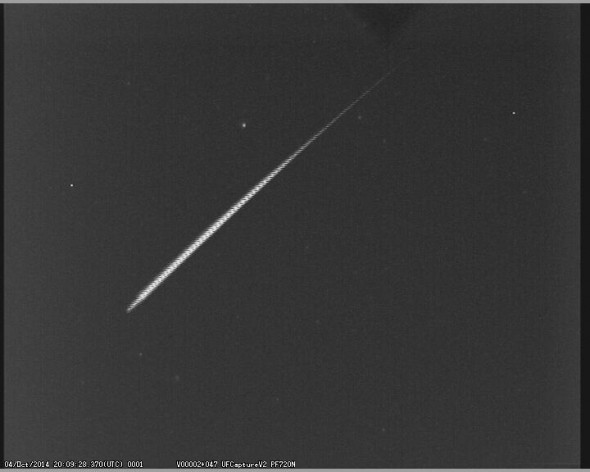
A recent fireball captured over the UK on October


A recent fireball captured over the UK on October 4th, 2014. Credit: the UK Meteor Observation Network.
On October 31st 2005, trick-or-treaters across the central U.S. eastern seaboard were treated to a brilliant fireball, a celestial spectacle that frequently graces October skies.

Mid- to late October is fireball season, a time when several key meteor showers experience a broad peak. We’re already seeing an uptick in fireball activity as monitored by numerous all-sky cameras this month, including NASA’s system positioned across the United States. Three lesser known but fascinating showers are the chief culprits.

Credit: NASA


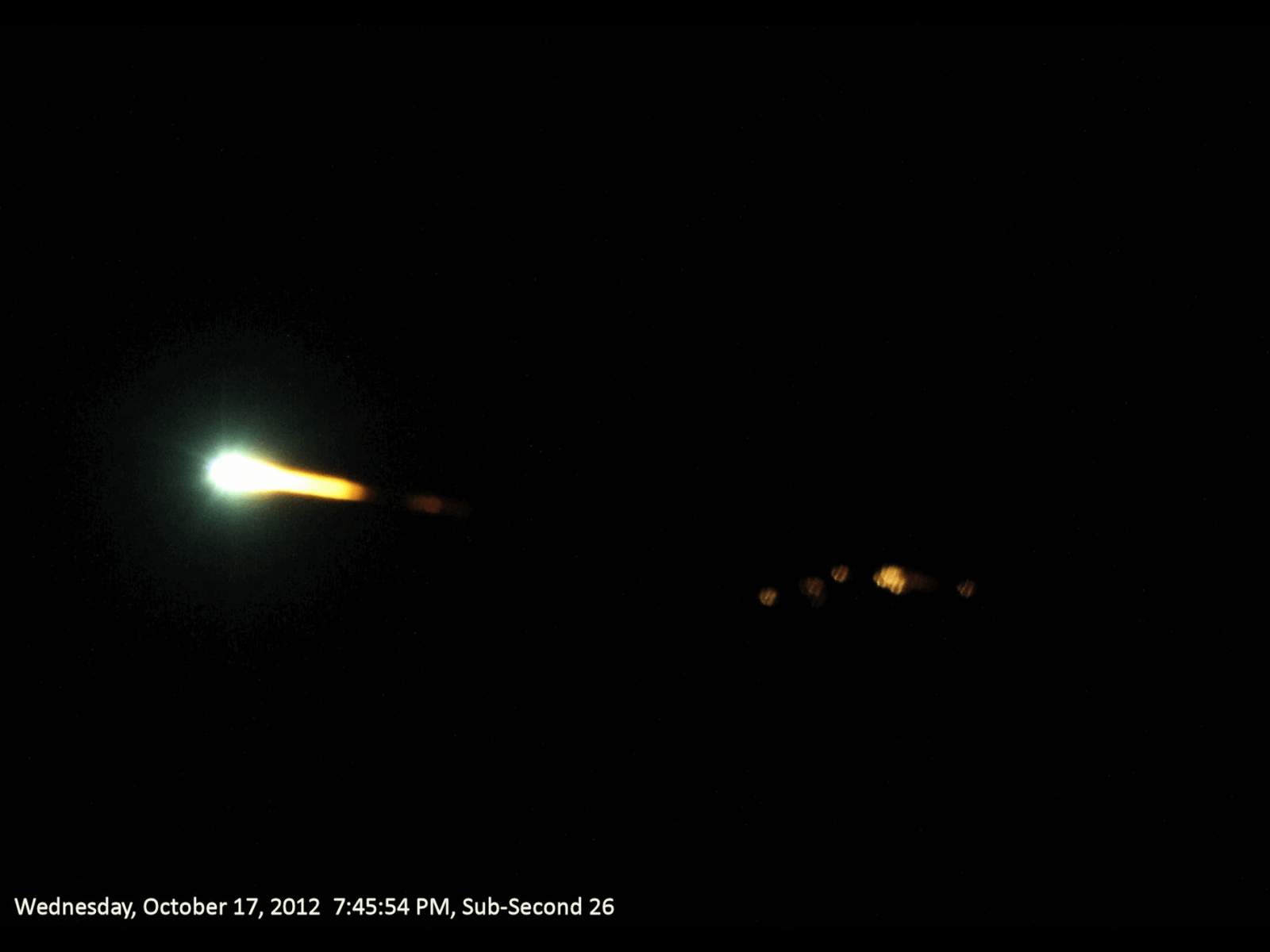
A Bay area fireball captured in 2012. Credit: NASA/Robert P. Moreno Jr.
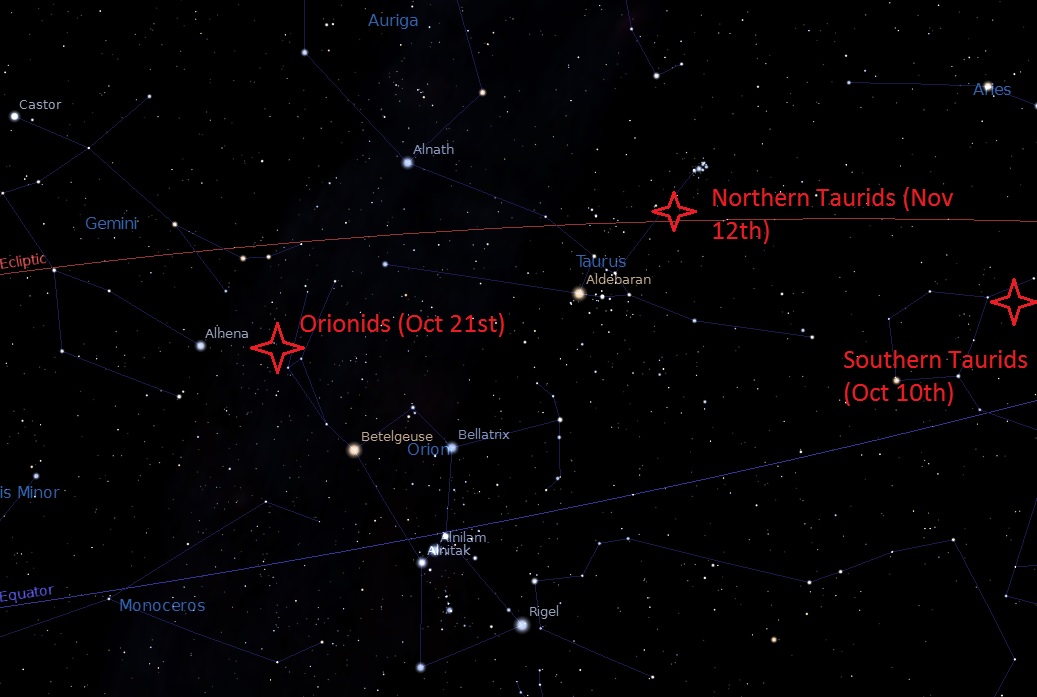
The main meteor shower on tap for the month of October is the Orionids. This shower radiates from the Club of the constellation Orion, and is the product of that most famous comet of them all, 1P Halley. Halley’s Comet is actually the source of two annual meteor showers, the October Orionids and the May Eta Aquarids. We’re seeing the inward stream of Halley debris in October, and Orionid velocities average a swift 66 kilometres a second. The radiant rides highest for northern hemisphere observers at 4 AM local, and 2014 sees an estimated zenithal hourly rate (ZHR) of 20 predicted to arrive on the mornings of October 21st through the 22nd. The Orionids experience a broad peak spanning October 21st through November 7th, and 2014 sees the peak arrive just two days prior to the Moon reaching New phase. The Orionids have exhibited an uptick in activity as high as 50-75 per hour from 2005-2007, and it’s been suggested that a 12 year peak cycle may govern the Orionids, as the path of meteoroid debris stream is modified by the gravitational influence of the giant planet Jupiter.
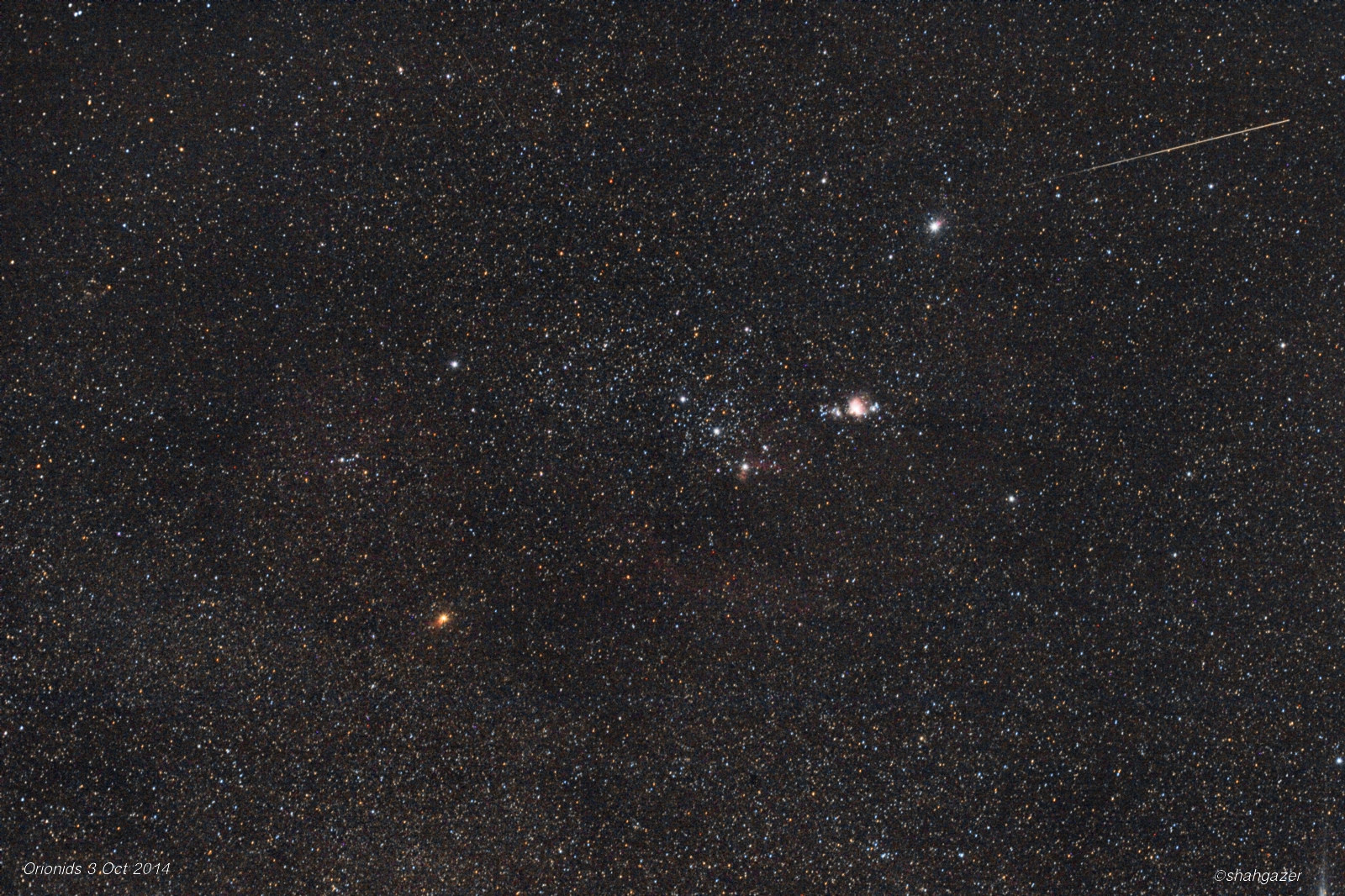
Orionid


A recent early Orionid meteor. Credit: Sharin Ahmad @Shahgazer.
Two other nearby radiants in the sky also produce an exceptionally large number of fireballs in late October: the Southern Taurids and Northern Taurids. These are complex streams laid down by the periodic comet 2P Encke, which possesses the shortest orbital period of any comet known at 3.3 years. Though the ZHR for both is only slightly above the background sporadic rate for northern hemisphere Fall at about five per hour, the Taurids also produce a high ratio of fireballs. The southern Taurids peak in early October and are already active, and the Northern Taurids peak in late October through early November, earning them the nickname the “Fireballs of Halloween”. Unlike many meteor showers, the Northern Taurids are approaching the Earth from behind in our orbit and have a slow relative atmospheric entry velocity of 28 kilometres per second. This makes for long, stately meteor trains often visible in the evening hours before local midnight.
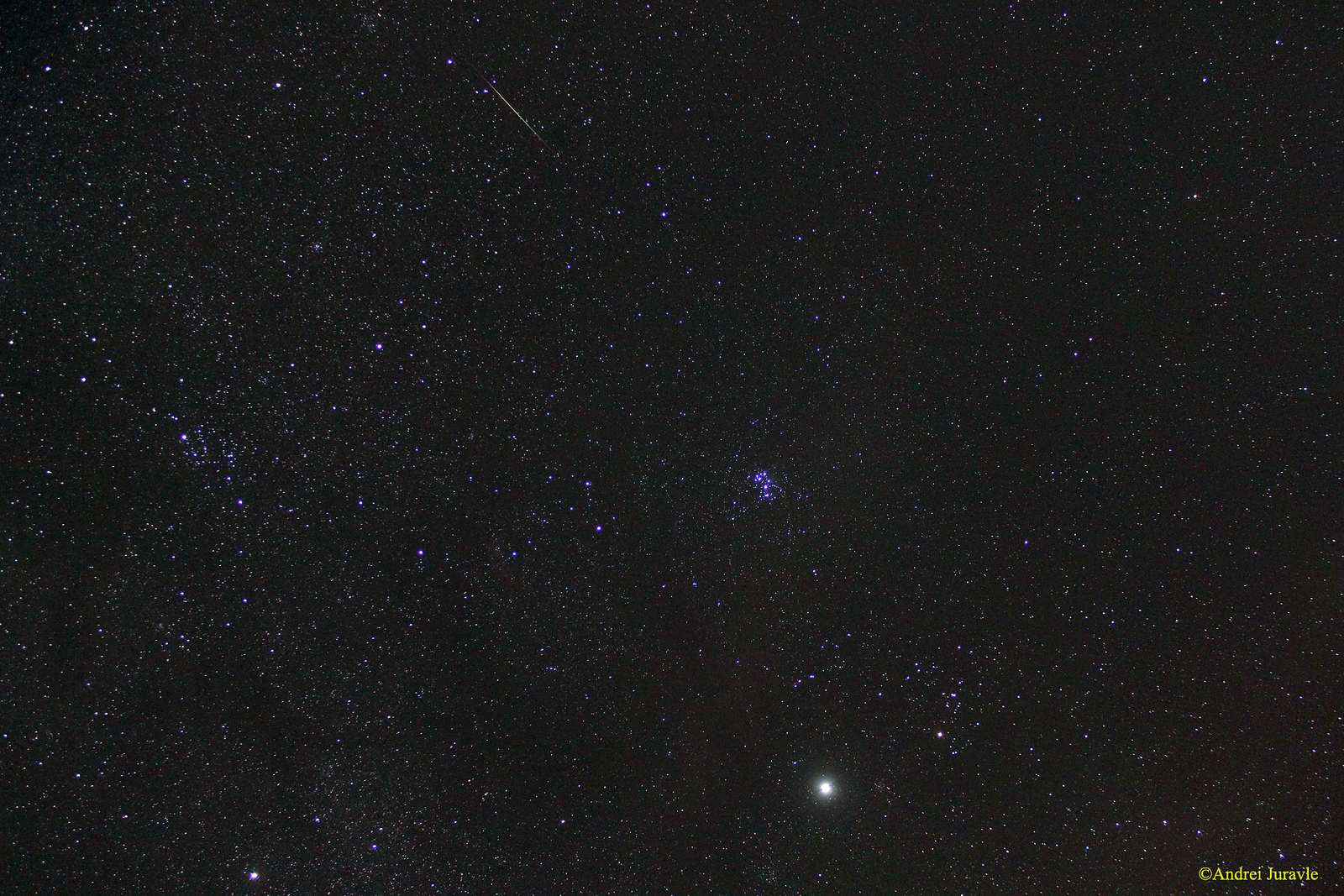
Taurid


A 2012 Taurid meteor. Credit: Andrei Juralve.
The Taurids also seem to exhibit a seven year periodicity that begs for further study. 2008 was a fine year for Taurid fireballs… could 2015 be next?
Of course, the exact definition of a “fireball” meteor varies by source, though we prefer the definition of a fireball as a meteor brighter than magnitude -3. A fireball reaching -14 (a Full Moon equals magnitude -13, about 2.5 times fainter) is often termed a bolide.
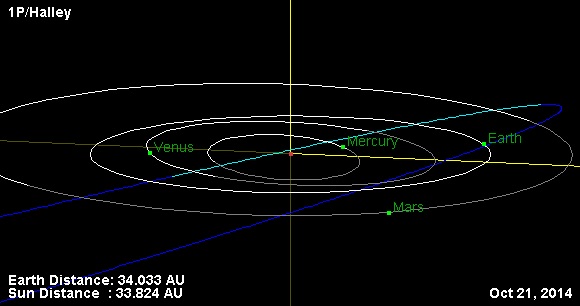
Halley's orbit


Comet 1P/Halley’s orbital path through the inner solar system. (Credit: NASA/JPL).
Observing meteor showers such as the Orionids is as simple as sitting back and patiently watching the skies. Our own personal rule while starting a meteor vigil is to scan the skies for 10 minutes; one or more meteor sightings is a good sign to keep on watching, while no meteors means it’s time to pack it in and instead maybe write about astronomy. Dark, moonless skies are key, and you can report how many meteors you see to the International Meteor Organization. Be sure to keep a pair of binoculars handy to examine any lingering smoke trails post-fireball passage.

Credit: Stellarium


The positions of the radiants of the Orionids and the Taurids, with peak dates. Credit: Stellarium.
Of course, seeing a Taurid fireball is largely a matter of luck and looking at the right place in the sky at the right time. All-sky cameras work great in this regard, and many amateurs now use tripod mounted DLSRs set to take wide-field exposures of the sky automatically throughout the night. Just watch out for dew! Nearly every meteor we’ve caught on camera turned up only in post review, a testament to how much of the sky a lone pair of eyes still misses.

Spot a fireball? The American Meteor Society maintains a great online database of recent sightings and reports. Keep in mind, lots of “meteor-wrongs” inevitably crop up on Facebook and Twitter during any event, posted by folks eager for likes and retweets. Faves of such spoofers are: the Peekskill meteor train, the reentry of Hyabusa, Mir, and scenes (!) from the movie Armageddon. We’ve seen ‘em all passed off as legit, though you’re more than welcome to try and be original… a majority of initial meteor images almost always come from dash cams (remember Chelyabinsk?) and security cameras.


Finally, in addition to fireballs, there’s another astronomical tie-in for Halloween, as it’s one of four cross-quarter tie-in days approximately mid-way between a solstice and an equinox. The other three are: Lammas Day (August 1st), Groundhog’s Day (February 2nd) and May Day (May 1st). We just think that it’s great — if a bit paradoxical — to see modern day suburbanites dress up as ghouls and goblins as they reenact archaic rites and holidays…

Don’t forget to keep an eye out for the fireballs of October this Halloween!


About 

David Dickinson is an Earth science teacher, freelance science writer, retired USAF veteran & backyard astronomer. He currently writes and ponders the universe from Tampa Bay, Florida.
Tagged as: fireball season, october fireballs, orionids, sporadic meteors, taurid fireball, taurids

Sunday, October 12, 2014

Earth Shines In Space Pictures In Glory You’ve Rarely Seen Before

Earth Shines In Space Pictures In Glory You’ve Rarely Seen Before:

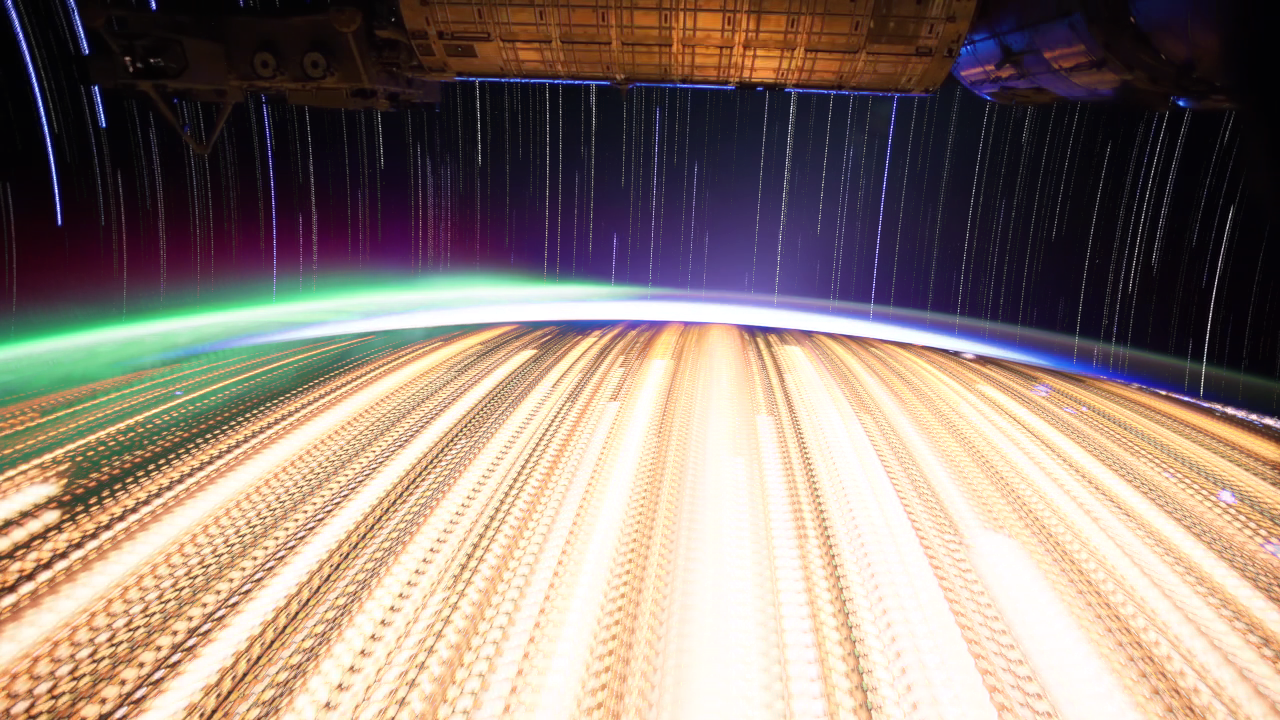
A timelapse photo of Earth created from a video made by the Expedition 28 and 29 crews on the International Space Station. Credit: zqyogl


A timelapse photo of Earth created from a video made by the Expedition 28 and 29 crews on the International Space Station. Credit: zqyogl
We truly live on a beautiful planet, and sometimes it just takes a bit of an unusual picture to remind us of that fact. An intrepid amateur took time lapse pictures from the Expedition 28 and 29 crews (filmed in 2011) and combined the shots to create some incredible composite pictures of our planet.

The pictures below are the result of blending 9 different timelapse sequences in two different ways,” wrote a user dubbed zqyogl on Imgur. “The first in each set of two was made by finding the brightest colour for each pixel, and the second by averaging every frame of the timelapse.”

Anyone else out there reminded of Don Pettit’s stunning pictures from space a few years ago? To check out the entire gallery, visit this website to download everything in high-resolution glory. The source video is below the jump.

Earth from Michael König on Vimeo.

h/t Reddit


About 

Elizabeth Howell is the senior writer at Universe Today. She also works for Space.com, Space Exploration Network, the NASA Lunar Science Institute, NASA Astrobiology Magazine and LiveScience, among others. Career highlights include watching three shuttle launches, and going on a two-week simulated Mars expedition in rural Utah. You can follow her on Twitter @howellspace or contact her at her website.
Tagged as: Expedition 28, Expedition 29, timelapse video

Check Out This Huge Rock On The Surface Of Rosetta’s Comet!

Check Out This Huge Rock On The Surface Of Rosetta’s Comet!:

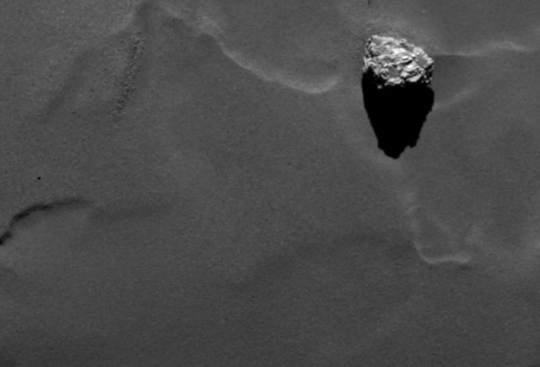
A close-up of a boulder nicknamed "Cheops" on the surface of 67P/Churyumov-Gerasimenko. Image taken by the Rosetta spacecraft. Credit: ESA/Rosetta/MPS for OSIRIS Team MPS/UPD/LAM/IAA/SSO/INTA/UPM/DASP/IDA


A close-up of a boulder nicknamed “Cheops” on the surface of 67P/Churyumov-Gerasimenko. Image taken by the Rosetta spacecraft. Credit: ESA/Rosetta/MPS for OSIRIS Team MPS/UPD/LAM/IAA/SSO/INTA/UPM/DASP/IDA
As the Rosetta spacecraft drops a bit closer to its target comet, some really cool features are popping into view. For example, look at this picture of a 150-foot (45-meter) rock on Comet 67P/Churyumov-Gerasimenko, which was taken in September and released today (Oct. 9). And it’s led to the decision to have an Egyptian theme to naming features on the comet.

“It stands out among a group of boulders in the smooth region located on the lower side of 67P/C-G’s larger lobe,” ESA stated in a release. “This cluster of boulders reminded scientists of the famous pyramids at Giza near Cairo in Egypt, and thus it has been named Cheops for the largest of those pyramids, the Great Pyramid, which was built as a tomb for the pharaoh Cheops (also known as Kheops or Khufu) around 2550 BC.”

Scientists are still trying to figure out what the boulders are made of, and how they are formed, as the spacecraft moves into a “close observation phase” tomorrow (Oct. 10) where it is only 10 kilometers (6.2 miles) from the surface.

A wider field of view of 67P/Churyumov-Gerasimenko on the larger lobe, where the boulder Cheops is located. This picture was taken by the Rosetta spacecraft shortly after its arrival in August. Credit: ESA/Rosetta/MPS for OSIRIS Team MPS/UPD/LAM/IAA/SSO/INTA/UPM/DASP/IDA


A wider field of view of 67P/Churyumov-Gerasimenko on the larger lobe, where the boulder Cheops is located. This picture was taken by the Rosetta spacecraft shortly after its arrival in August. Credit: ESA/Rosetta/MPS for OSIRIS Team MPS/UPD/LAM/IAA/SSO/INTA/UPM/DASP/IDA
Meanwhile, some new results are coming from an asteroid that the spacecraft whizzed by a couple of years ago. In the picture below, you can see evidence of a crater that Rosetta didn’t even see!

The grooves you see there on Lutetia (which Rosetta imaged in 2010) hint at shock waves from various craters, including one that was likely on the hidden side of the asteroid relative to Rosetta as it flew by. The suspected crater is called “Suspicio.” While craters have been found in other asteroids visited by spacecraft, grooves are rarer.

“The way in which grooves are formed on these bodies is still widely debated, but it likely involves impacts,” ESA stated. “Shock waves from the impact travel through the interior of a small, porous body and fracture the surface to form the grooves.”

A paper on the research will be published in Planetary and Space Science this month, led by Sebastien Besse, a research fellow at ESA’s Technical Centre. For more information, check out this release from ESA.


A part of asteroid Lutetia imaged by the Rosetta spacecraft in 2010. The grooves you see are colored according to the crater scientists believe it’s associated with. The blue lines are from a suspected, unseen crater called “Suspicio”. Red is associated with the known crater Massilia and purple for the North Pole Crater Cluster. Yellow is unassociated with craters considered in this study. Credit: Data: Besse et al (2014); image: ESA/Rosetta/MPS for OSIRIS Team MPS/UPD/LAM/IAA/SSO/INTA/UPM/DASP/IDA


About 

Elizabeth Howell is the senior writer at Universe Today. She also works for Space.com, Space Exploration Network, the NASA Lunar Science Institute, NASA Astrobiology Magazine and LiveScience, among others. Career highlights include watching three shuttle launches, and going on a two-week simulated Mars expedition in rural Utah. You can follow her on Twitter @howellspace or contact her at her website.
Tagged as: Asteroid Lutetia, Comet 67P/Churymov-Gerasimenko

Video: Test Flight For NASA’s Orion Will be a ‘Trial By Fire’

Video: Test Flight For NASA’s Orion Will be a ‘Trial By Fire’:


NASA is getting ready for the first test flight of the Orion crew vehicle, currently scheduled for December 4, 2014. “Before we can send astronauts into space on Orion, we have to test all of its systems,” says NASA engineer Kelly Smith in this new video released by NASA. “And there’s only one way to know if we got it right: fly it in space.”


Of course for Orion’s first test fight, no astronauts will be aboard. The spacecraft will be loaded with sensors to record and measure all aspects of the flight in detail. Orion is now in the final stages of preparation for the uncrewed flight that will take it 5,800 km (3,600 miles) above Earth on a 4.5-hour mission to test many of the systems necessary for future human missions into deep space.

Already the Delta IV Heavy rocket that will launch the test flight has been rolled to the launch pad, and the Orion capsule will be transported to the pad around November 10 or 11.

After launch, the spacecraft will make two orbits and then reenter Earth’s atmosphere at almost 32,000 km/hr (20,000 miles per hour), and reach temperatures near 2,200 degrees Celsius (4,000 degrees Fahrenheit), before its parachute system deploys to slow the spacecraft for a splashdown in the Pacific Ocean.

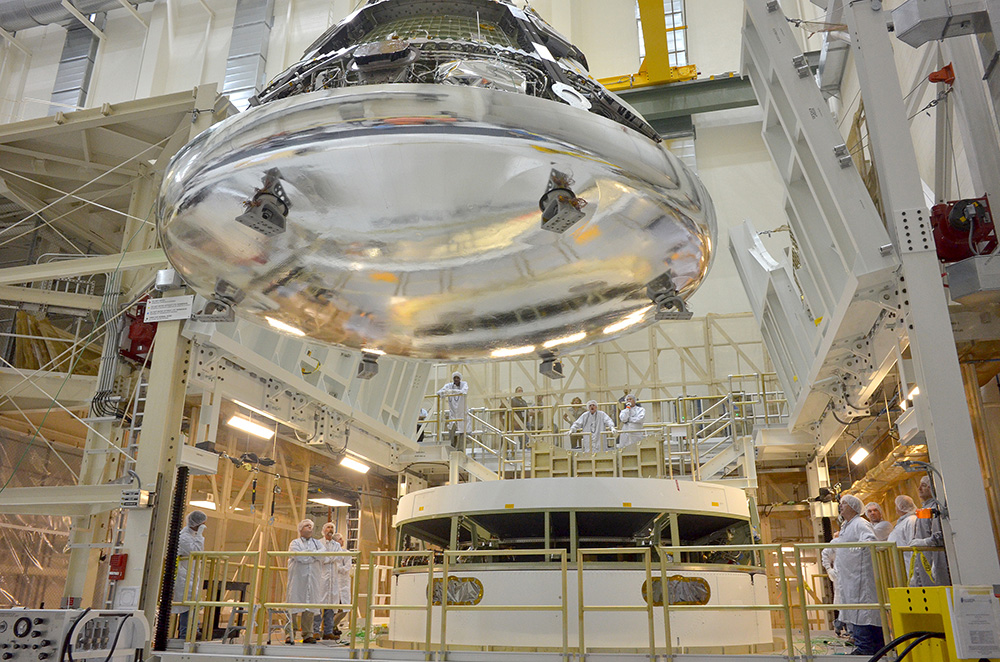
The Orion crew module for Exploration Flight Test-1 is shown in the Final Assembly and System Testing (FAST) Cell, positioned over the service module just prior to mating the two sections together. Credit: NASA/Rad Sinyak


The Orion crew module for Exploration Flight Test-1 is shown in the Final Assembly and System Testing (FAST) Cell, positioned over the service module just prior to mating the two sections together. Credit: NASA/Rad Sinyak
Tagged as: NASA, Orion, test flight

Radio Telescopes Help Astronomers Tune In To Nova Generated Gamma Rays

Radio Telescopes Help Astronomers Tune In To Nova Generated Gamma Rays:

When the nova stops blowing a wind, and the material drifts off into space, the fireworks are finished. Credit: Bill Saxton, NRAO/AUI/NSF


When the nova stops blowing a wind, and the material drifts off into space, the fireworks are finished. Credit: Bill Saxton, NRAO/AUI/NSF
Over two years ago, the Fermi-LAT Collaboration observed an “ear and eye opening” event – the exact location where a stellar explosion called a nova emitted one of the most energentic forms of electromagnetic waves… gamma rays. When it was first detected in 2012, it was something of a mystery, but the findings could very well point to what may cause gamma ray emissions.

“We not only found where the gamma rays came from, but also got a look at a previously-unseen scenario that may be common in other nova explosions,” said Laura Chomiuk, of Michigan State University.

A nova? According to the Fermi researchers, a classical nova results from runaway thermonuclear explosions on the surface of a white dwarf that accretes matter from a low-mass main-sequence stellar companion. As it gathers in material, the thermonuclear event expels debris into surrounding space. However, astronomers didn’t expect this “normal” event to produce high energy gamma rays!

Explains the Fermi-LAT team: “The gamma-ray detections point to unexpected high-energy particle acceleration processes linked to the mass ejection from thermonuclear explosions in an unanticipated class of Galactic gamma-ray sources.”

While NASA’s Fermi spacecraft was busy watching a nova called V959 Mon, some 6500 light-years from Earth, other radio telescopes were also busy picking up on the gamma ray incidences. The Karl G. Jansky Very Large Array (VLA) was documenting radio waves coming from the nova. The source of these emissions could be subatomic particles moving at nearly the speed of light interacting with magnetic fields – a condition needed to help produce gamma rays. These findings were backed up by the extremely-sharp radio “vision” of the Very Long Baseline Array (VLBA) and the European VLBI network. They revealed two knots in the radio observations – knots which were moving away from each other. Additional studies were done with e-MERLIN in the UK, and another round of VLA observations in 2014. Now astronomers could begin to piece together the puzzle of how radio knots and gamma rays are produced.

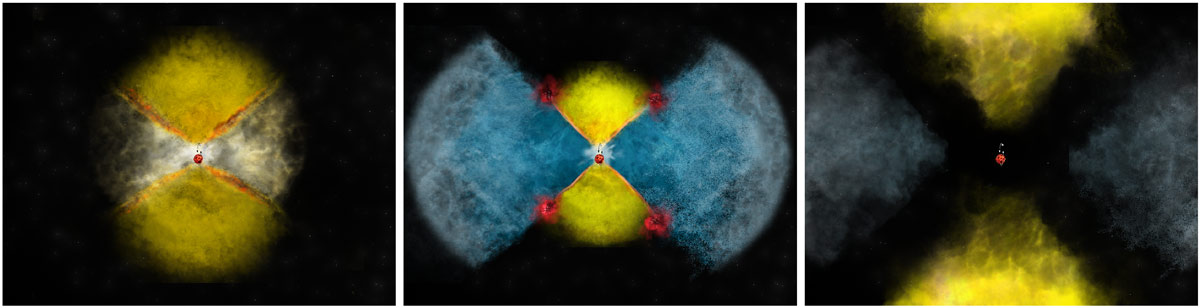
According to the NRAO news release, the white dwarf and its companion give up some of their orbital energy to boost some of the explosion material, making the ejected material move outward faster in the plane of their orbit. Later, the white dwarf blows off a faster wind of particles moving mostly outward along the poles of the orbital plane. When the faster-moving polar flow hits the slower-moving material, the shock accelerates particles to the speeds needed to produce the gamma rays, and the knots of radio emission.

“By watching this system over time and seeing how the pattern of radio emission changed, then tracing the movements of the knots, we saw the exact behavior expected from this scenario,” Chomiuk said.

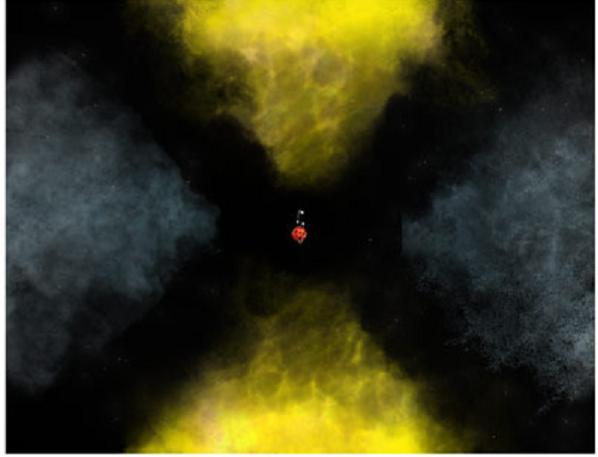
A nova does not explode like an expanding ball, but instead throws out gas in different directions at different times and different speeds. When this gas inevitably crashes together, it produces shocks and high-energy gamma-ray photons. The complex explosion and gas collisions in nova V959 Mon is illustrated here. In the first days of the nova explosion, dense, relatively slow-moving material is expelled along the binary star system's equator (yellow material in left panel). Over the next several weeks, fast winds pick up and are blown off the binary, but they are funneled along the binary star system's poles (blue material in central panel). The equatorial and polar material crashes together at their intersection, producing shocks and gamma-ray emission (red regions in central panel). Finally, at later times, the nova stops blowing a wind, and the material drifts off into space, the fireworks finished (right panel). CREDIT: Bill Saxton, NRAO/AUI/NSF


A nova does not explode like an expanding ball, but instead throws out gas in different directions at different times and different speeds. When this gas inevitably crashes together, it produces shocks and high-energy gamma-ray photons. The complex explosion and gas collisions in nova V959 Mon is illustrated here. In the first days of the nova explosion, dense, relatively slow-moving material is expelled along the binary star system’s equator (yellow material in left panel). Over the next several weeks, fast winds pick up and are blown off the binary, but they are funneled along the binary star system’s poles (blue material in central panel). The equatorial and polar material crashes together at their intersection, producing shocks and gamma-ray emission (red regions in central panel). Finally, at later times, the nova stops blowing a wind, and the material drifts off into space, the fireworks finished (right panel). CREDIT: Bill Saxton, NRAO/AUI/NSF
But the V959 Mon observations weren’t the end of the story. According to Fermi-LAT records, in 2012 and 2013, three novae were detected in gamma rays and stood in contrast to the first gamma-ray detected nova V407 Cygni 2010, which belongs to a rare class of symbiotic binary systems. Despite likely differences in the compositions and masses of their white dwarf progenitors, the three classical novae are similarly characterized as soft spectrum transient gamma-ray sources detected over 2-3 week durations.

“This mechanism may be common to such systems. The reason the gamma rays were first seen in V959 Mon is because it’s close,” Chomiuk said. Because the type of ejection seen in V959 Mon also is seen in other binary-star systems, the new insights may help astronomers understand how those systems develop. This “common envelope” phase occurs in all close binary stars, and is poorly understood. “We may be able to use novae as a ‘testbed’ for improving our understanding of this critical stage of binary evolution,” explains Chomiuk.

Original Story Source: Radio Telescopes Unravel Mystery of Nova Gamma Rays from National Radio Astronomy Observatory. Chomiuk worked with an international team of astronomers. The researchers reported their findings in the scientific journal “Nature”.


About 

Tammy is a professional astronomy author, President Emeritus of Warren Rupp Observatory and retired Astronomical League Executive Secretary. She’s received a vast number of astronomy achievement and observing awards, including the Great Lakes Astronomy Achievement Award, RG Wright Service Award and the first woman astronomer to achieve Comet Hunter's Gold Status.
Tagged as: binary star systems, Fermi-LAT, Gamma rays, nova, Radio Knots

How to See Comet Siding Spring as it Encounters Mars

How to See Comet Siding Spring as it Encounters Mars:

Comet C/2013 A1 Siding Spring passes just north of the sparking Butterfly Cluster on October 9. Credit: Rolando Ligustri


Comet C/2013 A1 Siding Spring passes just north of the sparkling Butterfly Cluster in Scorpius on October 9. Credit: Rolando Ligustri
With excitement building as Comet Siding Spring rapidly approaches the Red Planet, we’ll soon have the opportunity to spot it through our own telescopes. Dark skies return this week with the moon now past full and rising later each night. Until recently, the comet could only be seen by skywatchers living in southern latitudes. Now it’s popped high enough above the southern horizon to see from mid-northern latitudes, albeit low in the sky. Observers with 8-inch (20 cm) or larger telescopes can follow the comet as it travels from Scorpius north to Ophiuchus and its encounter with Mars on October 19.

adsfdf


JPL Horizons light curve for Comet C/2013 A1 Siding Spring shows it brightening as it approaches Earth and then fading after late September. For our purposes we’re interested in the purple squares which are visual magnitude estimates of the whole comet submitted to the Comet Observation Database. Recently, the comet has faded faster than predictions. Click for more details. Credit: CIOC
Until late September, the comet had been brightening as forecast based on the simple principle that the closer an object is to Earth the brighter it appears in the sky. Siding Spring came just shy of 1 A.U. of Earth in early September and has since been slip-sliding away. All through the first weeks of September it glowed at magnitude +9-10 and could be spotted in small telescopes trekking across the south polar constellations. Now on the cusp of its big moment with Mars, Siding Spring has been fading faster than expected.

It could be running low on exposed ice or concluding a long, slow outburst. Maybe it’s as simple as our changing perspective on the comet’s tail – we see it from the side now instead of looking down the tail where reflective dust piles up along our line of sight. No one knows exactly why, but given that comets are famous for their unpredictability due to their fragile nature and the varying rates at which they sputter away ice and dust, we shouldn’t be too surprised.

The paths of Mars and Comet Siding Spring are clearly on a (near) collision course! Watch over the coming nights as they draw ever closer. Source: Chris Marriott's SkyMap


The paths of Mars and Comet Siding Spring are clearly on a (near) collision course! Watch over the coming nights as they draw ever closer. This map shows the sky facing southwest at nightfall from Kansas City, Missouri. From the central U.S. the comet will be about 13-15º high but only ~5-8º altitude in the northern border states. Source: Chris Marriott’s SkyMap
So what does that mean for observers? The most recent observations put the comet at about magnitude +11 with a loosely condensed coma and diameter of about one arc minute or a little larger than Jupiter appears in a telescope. It’s a small, relatively faint object now but should be visible in 8-inch and larger telescopes from a dark sky assuming it doesn’t “drop off the deep end” and fade even faster.  With Mars nearby, finding the general location of Siding Spring is easy. The maps will help you pinpoint it.

Daily positions of Comet Siding Spring October 10-20 from the central U.S. at nightfall. Stars shown to magnitude +11.5. Closest approach to Mars is October 19. Brighter stars like 3 Sagittarii, 44 and 51 Ophiuchi and Theta Ophiuchi are labeled. Source: Chris Marriott's SkyMap


Daily positions of Comet Siding Spring October 10-20 from the central U.S. at nightfall. Stars shown to magnitude +11.5. Closest approach to Mars is October 19. The brighter stars 3 Sagittarii, 44 and 51 Ophiuchi and Theta Ophiuchi are labeled. Click for large version to print and use at the telescope. Source: Chris Marriott’s SkyMap
The good news is that the comet is heading straight north and getting higher in the sky every night. The bad news is that it’s also dropping westward each evening mostly negating its northerly altitude gains. Those in the southern U.S. will have the best viewing window with Siding Spring 20º high at nightfall (14º in the central states and 6º in the north). To ensure success, find a spot with a wide open view as far down to the southwestern horizon as possible. You’ll make best use of your time and see the comet highest if you set up during evening twilight and begin searching as soon as the sky is dark. Given that Mars is 1st magnitude and the comet has faded more than expected, it may be difficult to see against the planet’s glare on the 19th. Not that I want to dissuade you from trying, but the nights leading up to and after the encounter will prove better for comet spotting.

Need to get in closer yet? This map shows Mars and Comet Siding Spring on five nights closer to its flyby with stars to magnitude +12. Time and location are the same as the map above. Click for larger version. Source: Chris Marriott's SkyMap


Need to get in closer? This more detailed map shows Mars and Comet Siding Spring nightly October 15-20 with stars to magnitude +12. Time and location are the same as the map above. Click for larger version. Source: Chris Marriott’s SkyMap
The fluffball passed the glittery Butterfly Cluster (M6) in Scorpius on October 9 displaying an attractive curved tail pointing southeast. Tim Reyes of Universe Today calculated the current tail length at ~621,000 miles (1 million km) with a coma ~19,900 miles across (32,000 km).  Closest approach occurs around 1:28 p.m. Central Daylight Time (18:28 UT) October 19 when the comet will miss Mars by only 88,000 miles (141,600 km). Dust particles leaving the coma will rip by the planet at ~125,000 mph (56 km/sec). Will they pass close enough to set the Martian sky a-sparkle with meteors?

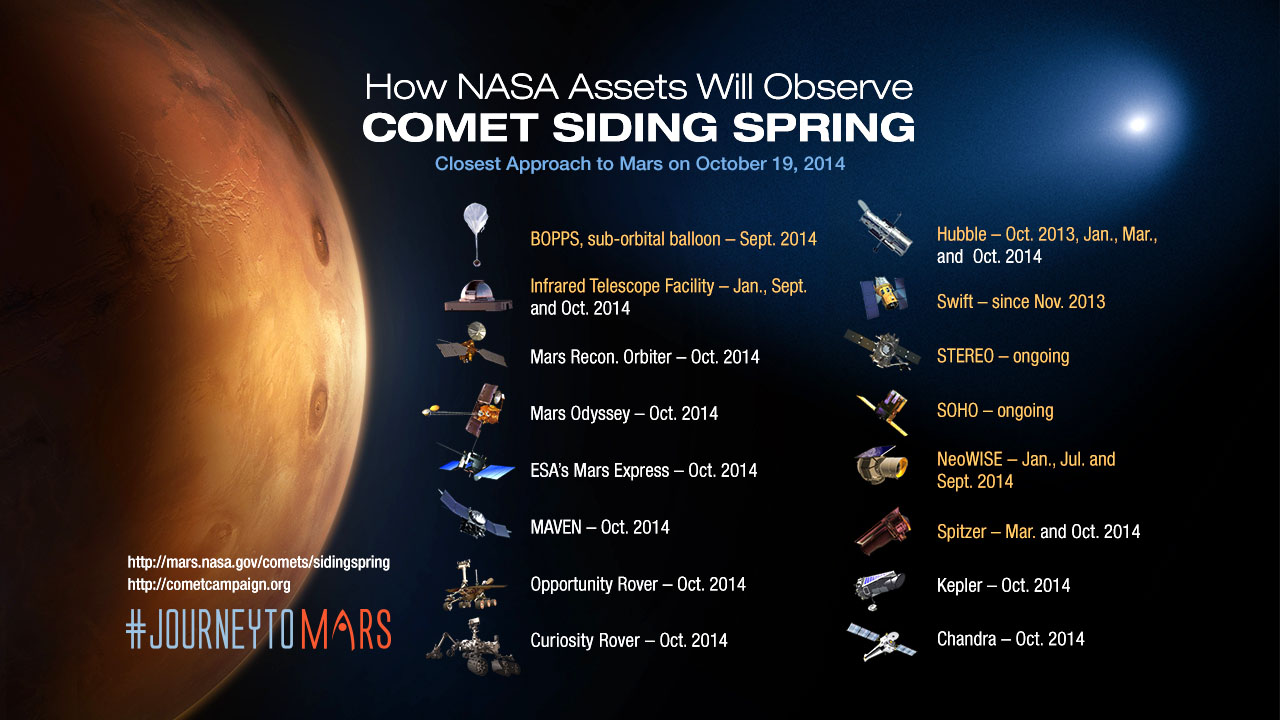
Not only will the Mars orbiters gather information about the comet and its dust before, during and after the encounter, a fleet of additional telescopes will be making the most of the rare opportunity. Credit: NASA


Not only will the Mars orbiters gather information about the comet and its dust before, during and after the encounter, a fleet of additional telescopes will make the most of the rare opportunity. Credit: NASA
According to a recent NASA press release, the period of greatest risk to orbiting spacecraft will start about 90 minutes after the closest approach of the comet’s nucleus and will last about 20 minutes, when Mars will come closest to the center of the widening trail of dust flying from the comet’s nucleus. Since the comet will barely graze the planet, dust impacts on orbiting spacecraft may or may not happen.

Back on Earth we can watch the daredevil pass by telescope or catch it live on the Web here:

* SLOOH:  broadcast begins Sunday Oct. 19 at 9:51 a.m. CDT (14:51 UT)

* Gianluca Masi’s Virtual Telescope:  streaming begins Sunday, Oct. 19 at 11:45 a.m. CDT (16:45 UT)


About 

I'm a long-time amateur astronomer and member of the American Association of Variable Star Observers (AAVSO). My observing passions include everything from auroras to Z Cam stars. Every day the universe offers up something both beautiful and thought-provoking. I also write a daily astronomy blog called Astro Bob.
Tagged as: Butterfly Cluster, C/2013 A1, Comet Siding Spring, Mars

‘Frankenstein’ Moon: Tidal Forces From Uranus May Have Contributed to Miranda’s Bizarre Appearance

‘Frankenstein’ Moon: Tidal Forces From Uranus May Have Contributed to Miranda’s Bizarre Appearance:

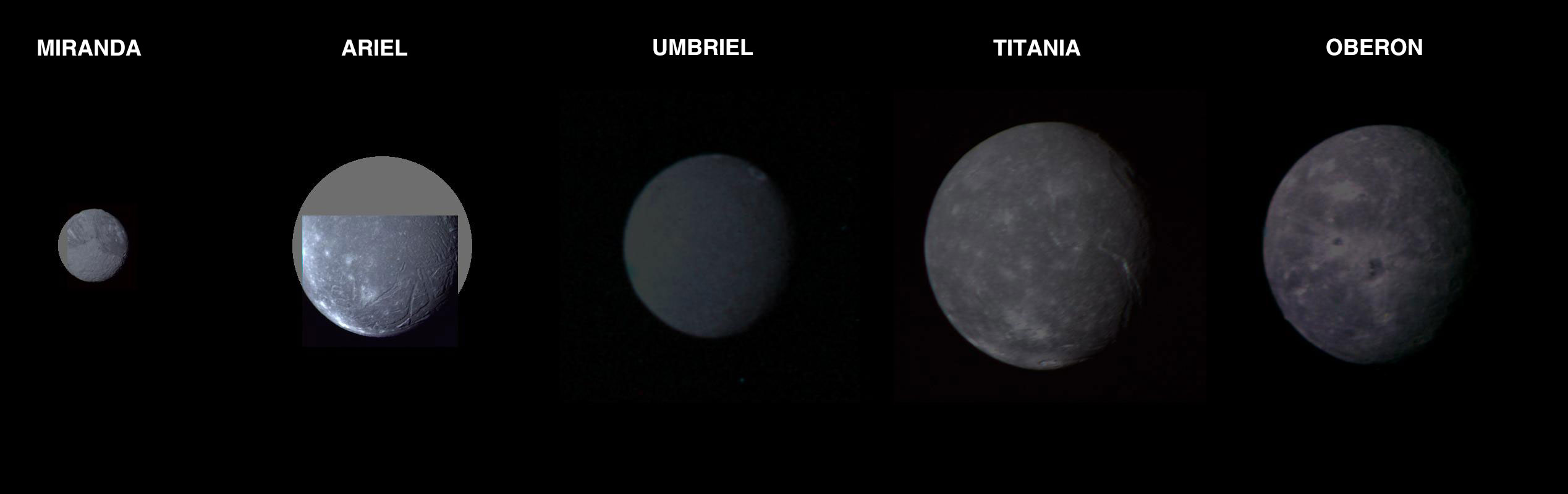
Uranus' Five Largest Moons


Uranus’ five largest moons shown left-to-right in increasing distance from the planet. Note there is incomplete coverage of Miranda and Ariel. Image credit: NASA/JPL
Miranda, the innermost of Uranus’ five moons, has a “Frankenstein”-like appearance: it looks as though it was pieced together from parts that didn’t quite fit together properly. Plus, it has incredibly diverse surface features including canyons up to 12 times deeper than Earth’s Grand Canyon, impact craters, cliffs, and parallel grooves called sulci.

Over the years, various hypotheses have been presented in an attempt to account for Miranda’s enigmatic appearance. First thought to be the result of a catastrophic impact, disintegration, and subsequent reassembly, scientists now believe that some of Miranda’s features might have been influenced by Uranus itself, and are the result of convection: thermally-induced resurfacing from tidal forces from the planet.

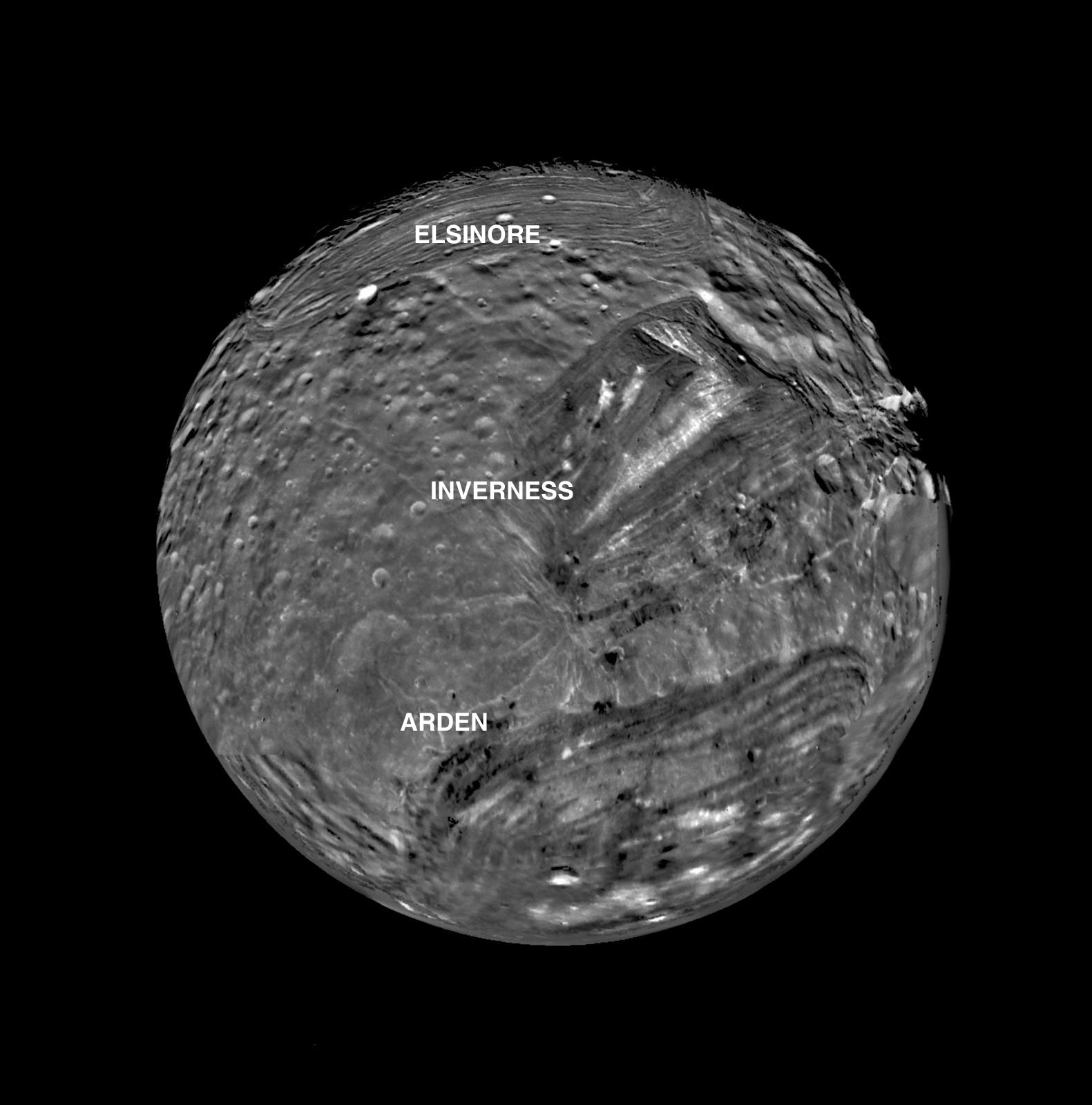
Miranda's Three Coronae


Three large, geometric-shaped features called coronae are visible on Miranda. To date, Venus and Miranda are the only bodies in our solar system on which coronae have been observed. Image Credit: NASA/JPL-Caltech
Miranda was discovered in 1948 by Gerard Kuiper. Although it is only 293 miles (471 kilometers) in diameter (approximately one-seventh that of Earth’s moon,) it has one of the strangest and most varied landscapes in our Solar System.

Central to the new research was analysis of three very large, geometric shaped features known as coronae, which are only found on one other planetary body. Coronae were first identified on Venus in 1983 by Venera 15/16 radar imaging equipment.

A leading theory about their formation has been that they form when warm, sub-surface fluids rise to the surface and form a dome. As the edges of the dome cool, the center collapses and warm fluid leak out its sides, forming a crown-like structure, or corona. Based on this premise, the question is then raised as to what mechanism/processes in Miranda’s past warmed its interior sufficiently to produce warm, sub-surface fluids that resulted in coronae formation. Scientists believe that tidal warming played an important role in the formation of the coronae, but the process by which this internal heating led to these features has remained unclear.

Extensive 3D computer simulations conducted by Brown University’s Noah P. Hammond and Amy C. Barr have produced results that are consistent with the three coronae seen on Miranda. In their paper titled, “Global Resurfacing of Uranus’s Moon Miranda by Convection,” Hammond and Barr summarize their results as follows:

“We find that convection in Miranda’s ice shell powered by tidal heating can generate the global distribution of coronae, the concentric orientation of sub-parallel ridges and troughs, and the thermal gradient implied by flexure. Models that account for the possible distribution of tidal heat ing can even match the precise locations of the coronae, after a reorientation of 60°.”

Using Saturn’s moon Enceladus as a baseline due to its similarity in size, composition, and orbital frequency to Miranda, original calculations estimate that as much as 5 GW of tidal dissipation power could be generated. Hammond and Barr’s simulation results indicate almost twice that amount of power would have been created:

“Simulations that match the thermal gradient from flexure have total power outputs of close to 10 GW , somewhat larger than the total power we predict could be generated during orbital resonance.”

Results from Hammond and Barr’s simulations provide a preliminary set of answers that strive to unlock the mysteries of Miranda’s bizarre appearance. Future simulations and studies into the complex nature of tidal heating will build upon these results to provide further insight into the enigmatic moon we call Miranda.

“Global Resurfacing of Uranus’s Moon Miranda by Convection,” was published online on 15 September 2014 in GEOLOGY, a journal of The Geological Society of America. You can read the abstract here.


About 

Nancy Graziano is a technical writer with 25 years writing experience. She earned a Bachelor of Science degree in Electrical Engineering from Rochester Institute of Technology, Rochester, NY, and currently resides in New Jersey. You can contact her through her website Galaxy Media Services.
Tagged as: Miranda, Uranus

Nearby Galaxy Holds First Ultraluminous X-Ray Source that is a Pulsar

Nearby Galaxy Holds First Ultraluminous X-Ray Source that is a Pulsar:

An illustration [click for video] of a rotation neutron star, the remnants of a super nova explosion has been found to be an ultraluminous X-ray source, the first of its kind. (Credit: NASA, Caltech-JPL)


An illustration [click for video] of a rotating neutron star, the remnants of a super nova explosion has been found to be an ultraluminous X-ray source, the first of its kind. (Credit: NASA, Caltech-JPL)
A research team led by Caltech astronomers of Pasadena California have discovered an ultraluminous X-ray (ULX) source that is pulsating. Their analysis concluded that the source in a nearby galaxy – M82 – is from a rotating neutron star, a pulsar. This is the first ULX source attributed to a pulsar.


Matteo Bachetti of the Université de Toulouse in France first identified the pulsating source and is the lead author of the paper, “An ultraluminous X-ray source powered by an accreting neutron star” in the journal Nature. Caltech astronomer Dr. Fiona Harrison, the team leader, stated “This compact little stellar remnant is a real powerhouse. We’ve never seen anything quite like it. We all thought an object with that much energy had to be a black hole.”

What is most extraordinary is that this discovery places even more strain on theories already hard pressed to explain the existence of ultraluminous X-Ray sources. The burden falls on the shoulder of the theorists.

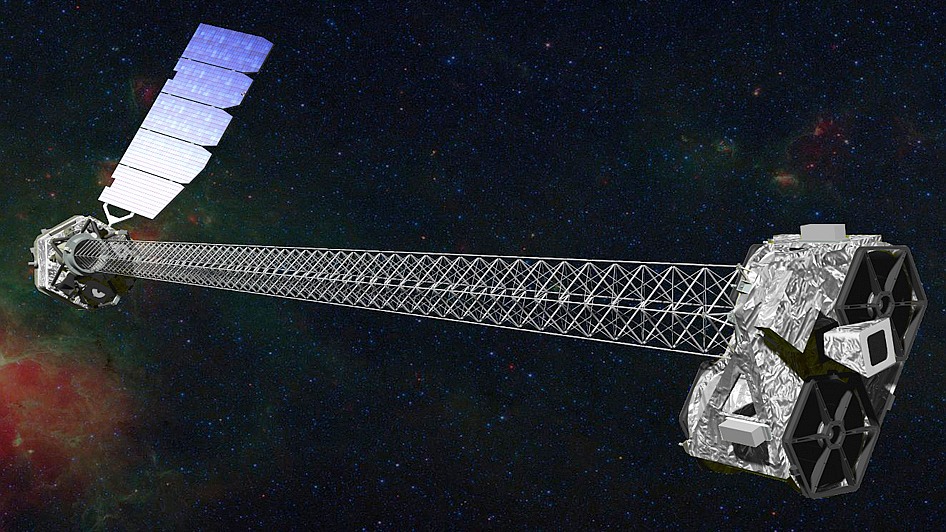
The NuStar Space Telescope launched into Earth orbit by a Orbital Science Corp. Pegasus rocket, 2012. The Wolter telescope design images throughout a spectral range from 5 to 80 KeV. (Credit: NASA/Caltech-JPL)


The NuStar Space Telescope launched into Earth orbit by a Orbital Science Corp. Pegasus rocket, 2012. The Wolter telescope design images throughout a spectral range from 5 to 80 KeV. (Credit: NASA/Caltech-JPL)
The source of the observations is the NuSTAR space telescope, a SMEX class NASA mission. It is a Wolter telescope that uses grazing incidence optics, not glass (refraction) or mirrors (reflection) as in visible light telescopes. The incidence angle of the X-rays must be very shallow and consequently the optics are extended out on a 10 meter (33 feet) truss. NuSTAR records its observations with a time stamp such as taking a video of the sky. The video recording in high speed is not in visible everyday light but what is called hard x-rays. Only gamma rays are more energetic. X-rays emanate from the most powerful sources and events in the Universe. NuStar observes in the energy range of X-Rays from 5 to 80 KeV (electron volt)while the famous Chandra space telescope observes in the .1 to 10 KeV range. Chandra is one NASA’s great space telescope, was launched by the Space Shuttle Columbia (STS-93) in 1999. Chandra has altered our view of the Universe as dramatically as the first telescope constructed by Galileo. NuSTAR carries on the study of X-rays to higher energies and with greater acuity.

ULX sources are rare in the Universe but this is the first pulsating ULX. After analysis, they concluded that this is not a black hole but rather its little brother, a spinning neutron star as the source. More specifically, this is an accreting binary pulsar; matter from a companion star is being  gravitationally attracted by and accreting onto the pulsar.

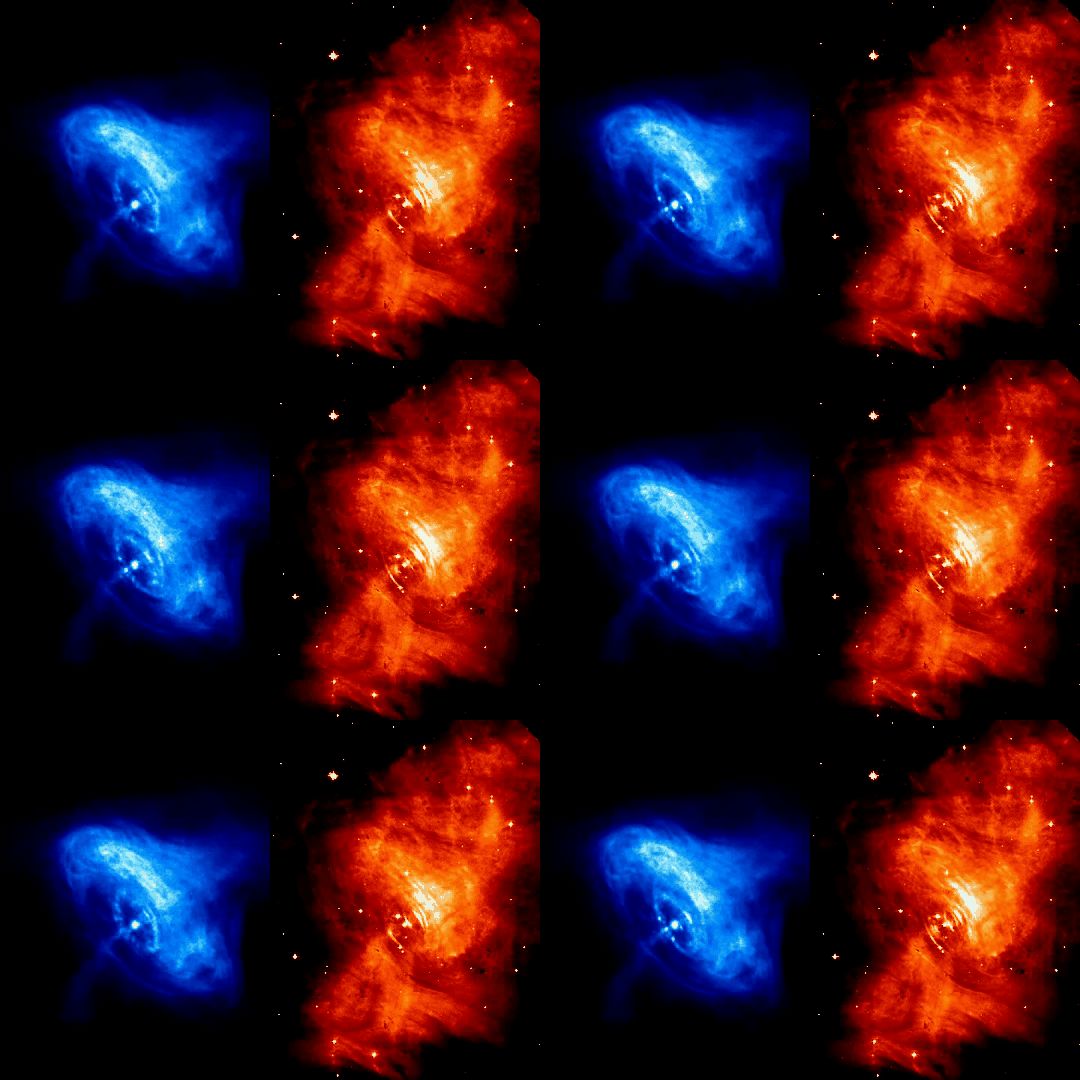
The Crab Nebula Pulsar, M1. Both are sequences of observations that show the expansion of shock waves emanating from the Pulsar interacting with the surrounding nebula. The Crab Pulsar actually pulsates 30 times per second a result of its rotation rate and the relative offset of the magnetic pole. Charndra X-Rays (left), Hubble Visible light (right). (Credit: NASA, JPL-Caltech)


The prime example of a pulsar – the Crab Nebula Pulsar, M1. These actual observations show the expansion of shock waves emanating from the Pulsar interacting with the surrounding nebula. The Crab Pulsar actually pulsates 30 times per second, not seen here, a result of its rotation rate and the relative offset of the magnetic pole. Charndra X-Rays (left), Hubble Visible light (right). (Credit: NASA, JPL-Caltech)
Take a neutron star and spin it up to anywhere from 700 rotations per second to a mere one  rotation every 10 seconds. Now you have a neutron star called a pulsar. Spinning or not, these are the remnants of supernovae, stellar explosions that can outshine a galaxy of 300 billion stars. Just one teaspoon of neutron star material weighs 1,100 tons (5.5 x 10^12 kg). That is the same weight as 900 Great Pyramids of Giza all condensed to one teaspoon. As incredible a material and star that a neutron star is, they were not thought to be the source of any ultraluminous X-Ray sources. This view has changed with the analysis of observations by this research team utilizing NuSTAR. The telescope name – NuSTAR – stands for Nuclear Spectroscopic Telescope Array.

There is nothing run of the mill about black holes. Dr. Stephen Hawking only conceded after 25 years, in 2004 (the Thorne-Hawking Bet)  that Black Holes exist. And still today it is not absolutely certain. Recall the Universe Today weekly – Space Hangout on September 26 – “Do Black Holes exist?” and the article by Jason Major, “There are no such things as Black Holes.

Pulsars stars are nearly as exotic as black holes, and all astronomers accept the existence of these spinning neutron stars. There are three final states of a dying star. Stars like our Sun at the end of their life become very dense White Dwarf stars, about the size of the Earth. Neutron stars are the next “degenerate” state of a dying exhausted star. All the electrons have merged with the protons in the material of the star to become neutrons. A neutron star is a degenerate form of matter effectively made up of all neutron particles. Very dense, these stars are really small, the size of cities, about 16 miles in diameter. The third type of star in its final state is the Black Hole.

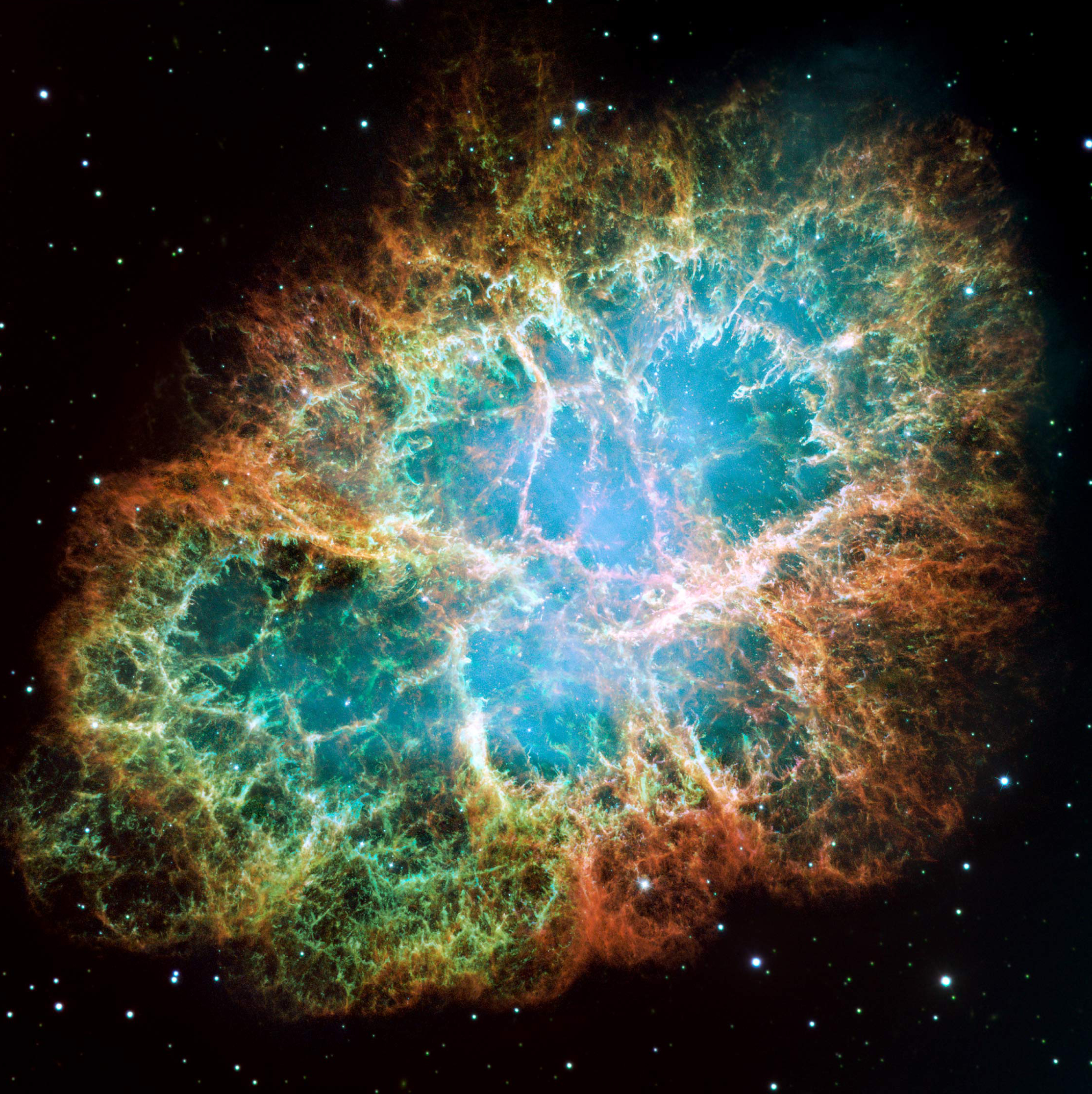
The Crab Nebula was first observed in the 1700s and is catalogued Messier object, M1. The remant explosion of a SuperNova, Chinese astronomers observed in 1054 A.D and holds the second Pular discovered (1968).


The Crab Nebula was first observed in the 1700s and is catalogued Messier object, M1. The remant explosion of a SuperNova that Chinese astronomers observed in 1054 A.D, it holds the second Pulsar discovered (1968).
A spinning neutron star creates a magnetic field, the most powerful of such fields in the Universe. They are like a dipole of a bar magnet and because of how magnetic fields confine the hot gases – plasma – of the neutron star, constant streams of material flow down and light streams out from the magnetic poles.

Recently, the Earth has had incredible northern lights, aurora. These lights are also from hot gases — a plasma — at the top of our atmosphere. Likewise, hot energetic particles from the Sun are funneled down into the magnetic poles of the Earth’s field that creates the northern lights. For spinning neutron stars – pulsars – the extreme light from the magnetic poles are like beacons. Just like our Earth, the magnetic poles and the spin axis poles do not coincide. So the intense beacon of light will rotate around and periodically point at the Earth. The video of the first illustration describes this action.

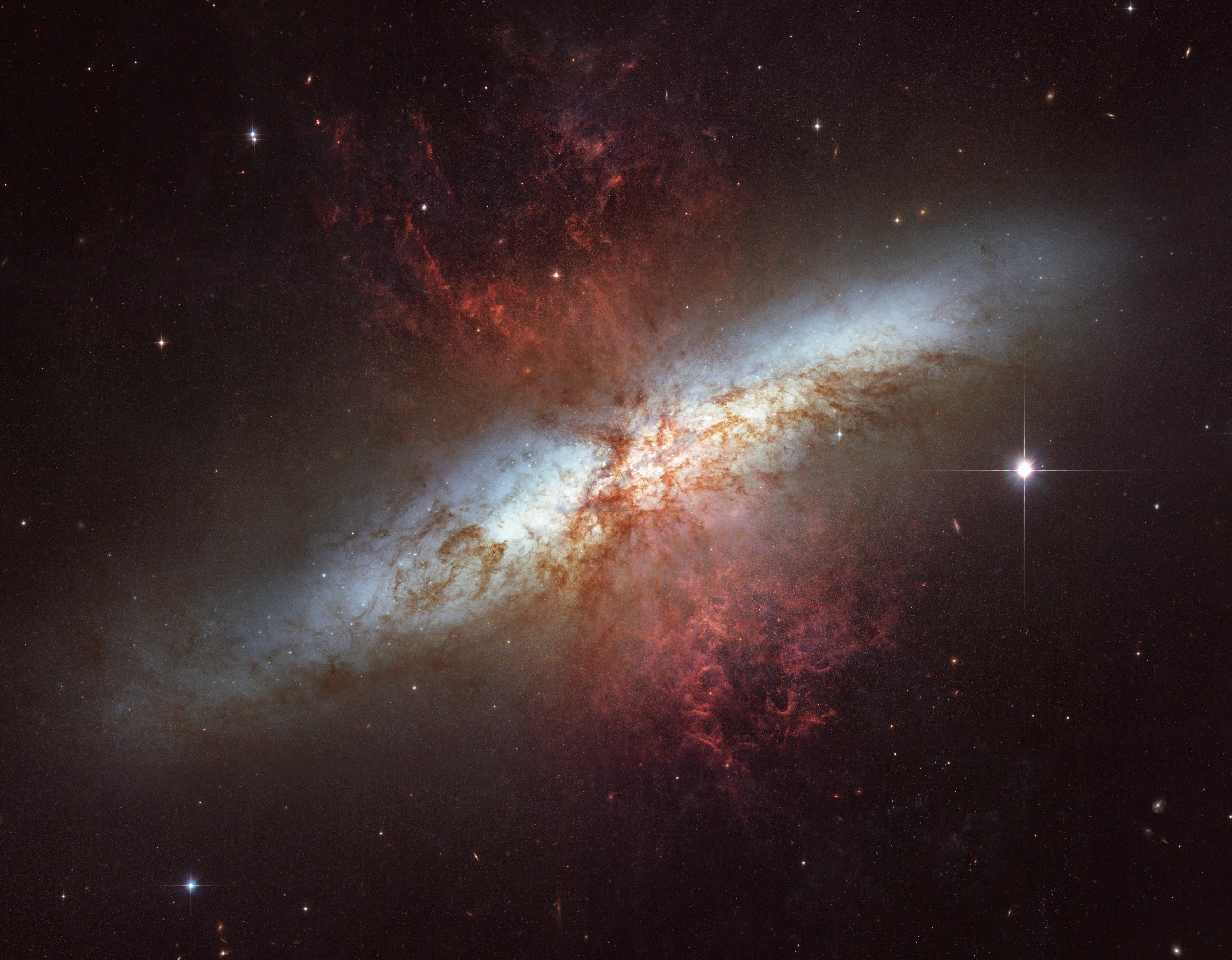
Messier object - M82, the Cigar Nebula, nicknamed for the shape seen through telescopes of the 1800s. This is the location of the newly discovered Pulsar.


Messier object – M82, the Cigar Nebula, nicknamed for the shape seen through telescopes of the 1800s. This is the location of the newly discovered Pulsar.
The light beacons from pulsars are very bright but theory, until now, has been supported by observations. No ultraluminous X-ray sources should be pulsars. The newly discovered pulsar is outputting 100 times more energy than any other. Discoveries like the one by these astronomers utilizing NuSTAR is proof that there remains more to discover and understand and new telescopes will be conceived to help resolve questions raised by NuSTAR or Chandra.

Further reading: JPL


About 

Contributing writer Tim Reyes is a former NASA software engineer and analyst who has supported development of orbital and lander missions to the planet Mars since 1992. He has an M.S. in Space Plasma Physics from University of Alabama, Huntsville.
Tagged as: caltech, Chandra, JPL, NASA, NuSTAR, Orbital Sciences, pulsar, telescope, Ultraluminous, Université de Toulouse, X-ray astronomy, X-Ray Source

Watch the “Blood Moon” Eclipse from Mercury

Watch the “Blood Moon” Eclipse from Mercury:


Yes, it’s another time-lapse of the October 8 lunar eclipse that was observed by skywatchers across half the Earth… except that these images weren’t captured from Earth at all; this was the view from Mercury!

Earth and the Moon imaged by the MESSENGER spacecraft on Oct. 8, 2014

Earth and the Moon imaged by the MESSENGER spacecraft on Oct. 8, 2014
The animation above was constructed from 31 images taken two minutes apart by the MESSENGER spacecraft between 5:18 a.m. and 6:18 a.m. EDT on Oct. 8, 2014.

“From Mercury, the Earth and Moon normally appear as if they were two very bright stars,” said Hari Nair, a planetary scientist at the Johns Hopkins University Applied Physics Laboratory, which developed and operates the MESSENGER mission for NASA. “During a lunar eclipse, the Moon seems to disappear during its passage through the Earth’s shadow, as shown in the movie.”

According to Nair the images have been zoomed by a factor of two and the Moon’s brightness has been increased by a factor of about 25 to enhance visibility. Captured by MESSENGER’s narrow-angle camera, Earth and the Moon were 0.713 AU (106.6 million km / 66.2 million miles) away from Mercury when the images were acquired.

Want to see some great photos of the eclipse shared by talented photographers around the world? Click here.

The Oct. 8 “Hunter’s Moon” eclipse was the second and last total lunar eclipse of 2014. The next will occur on April 4 of next year… but by that time MESSENGER won’t be around to witness it.

Launched August 3, 2004, MESSENGER entered orbit at Mercury on March 18, 2011. It is currently nearing the end of its missions as well as its its operational life, but we still have several more months of observations to look forward to from around the Solar System’s innermost planet before MESSENGER makes its final pass and ultimately impacts Mercury’s surface in March 2015.

Video credit: NASA/Johns Hopkins University Applied Physics Laboratory/Carnegie Institution of Washington

Source: MESSENGER news release


About 

A graphic designer in Rhode Island, Jason writes about space exploration on his blog Lights In The Dark, Discovery News, and, of course, here on Universe Today. Ad astra!
Tagged as: blood moon, eclipse, Mercury, MESSENGER, NASA, Solar System, space

NASA Inaugurates New Space Station Era as Earth Science Observation Platform with RapidScat Instrument

NASA Inaugurates New Space Station Era as Earth Science Observation Platform with RapidScat Instrument:

ISS-RapidScat instrument, shown in this artist's rendering, was launched to the International Space Station aboard the SpaceX CRS-4 mission On Sept. 21, 2014. It will measure ocean surface wind speed and direction and help improve weather forecasts, including hurricane monitoring. Credit: NASA/JPL-Caltech/Johnson Space Center.


ISS-RapidScat instrument, shown in this artist’s rendering, was launched to the International Space Station aboard the SpaceX CRS-4 mission on Sept. 21, 2014. It will measure ocean surface wind speed and direction and help improve weather forecasts, including hurricane monitoring. Credit: NASA/JPL-Caltech/Johnson Space Center.
NASA inaugurated a new era of research for the International Space Station (ISS) as an Earth observation platform following the successful installation and activation of the ISS-RapidScat science instrument on the outposts exterior.

The ISS Rapid Scatterometer, or ISS-RapidScat, is NASA’s first research payload aimed at conducting near global Earth science from the stations exterior and will be augmented with others in coming years.

RapidScat is designed to monitor ocean winds for climate research, weather predictions and hurricane monitoring.

The 1280 pound (580kilogram) experimental instrument is already collecting its first science data following its recent power-on and activation at the station.

“Its antenna began spinning and it started transmitting and receiving its first winds data on Oct.1,” according to a NASA statement.

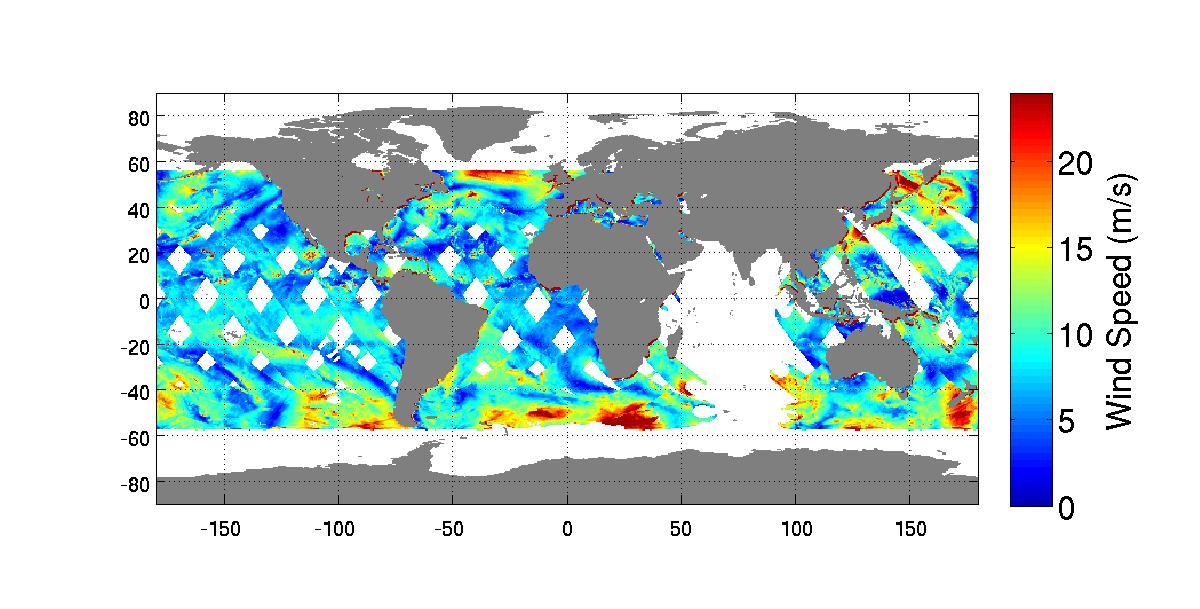
The first image from RapidScat was released by NASA on Oct. 6, shown below, and depicts preliminary measurements of global ocean near-surface wind speeds and directions.

Launched Sept. 21, 2014, to the International Space Station, NASA's newest Earth-observing mission, the International Space Station-RapidScat scatterometer to measure global ocean near-surface wind speeds and directions, has returned its first preliminary images. Credit: NASA-JPL/Caltech


Launched Sept. 21, 2014, to the International Space Station, NASA’s newest Earth-observing mission, the International Space Station-RapidScat scatterometer to measure global ocean near-surface wind speeds and directions, has returned its first preliminary images. Credit: NASA-JPL/Caltech
The remote sensing instrument uses radar pulses to observe the speed and direction of winds over the ocean for the improvement of weather forecasting.

“Most satellite missions require weeks or even months to produce data of the quality that we seem to be getting from the first few days of RapidScat,” said RapidScat Project Scientist Ernesto Rodriguez of NASA’s Jet Propulsion Laboratory, Pasadena, California, which built and manages the mission.

“We have been very lucky that within the first days of operations we have already been able to observe a developing tropical cyclone.

“The quality of these data reflect the level of testing and preparation that the team has put in prior to launch,” Rodriguez said in a NASA statement. “It also reflects the quality of the spare QuikScat hardware from which RapidScat was partially assembled.”

RapidScat, payload was hauled up to the station as part of the science cargo launched aboard the commercial SpaceX Dragon CRS-4 cargo resupply mission that thundered to space on the company’s Falcon 9 rocket from Space Launch Complex-40 at Cape Canaveral Air Force Station in Florida on Sept. 21.

Dragon was successfully berthed at the Earth-facing port on the stations Harmony module on Sept 23, as detailed – here.

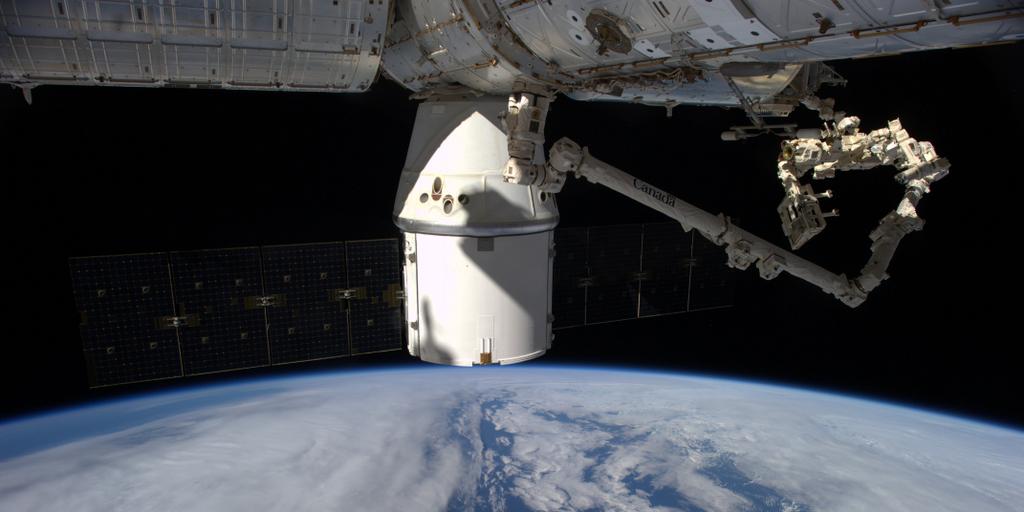
It was robotically assembled and attached to the exterior of the station’s Columbus module using the station’s robotic arm and DEXTRE manipulator over a two day period on Sept 29 and 30.

Ground controllers at Johnson Space Center intricately maneuvered DEXTRE to pluck RapidScat and its nadir adapter from the unpressurized truck section of the Dragon cargo ship and attached it to a vacant external mounting platform on the Columbus module holding mechanical and electrical connections.

Fascinating: #Canadarm & Dextre installed the #RapidScat Experiment on Columbus! @ISS_Research @NASAJPL @csa_asc. Credit: ESA/NASA/Alexander Gerst


Fascinating: #Canadarm & Dextre installed the #RapidScat Experiment on Columbus! @ISS_Research @NASAJPL @csa_asc. Credit: ESA/NASA/Alexander Gerst
The nadir adapter orients the instrument to point at Earth.

The couch sized instrument and adapter together measure about 49 x 46 x 83 inches (124 x 117 x 211 centimeters).

Engineers are in the midst of a two week check out process that is proceeding normally so far. Another two weeks of calibration work will follow.

Thereafter RapidScat will begin a mission expected to last at least two years, said Steve Volz, associate director for flight programs in the Earth Science Division, NASA Headquarters, Washington, at a prelaunch media briefing at the Kennedy Space Center.

RapidScat is the forerunner of at least five more Earth science observing instruments that will be added to the station by the end of the decade.

The second Earth science instrument, dubbed CATS, could be added by year’s end.

The Cloud-Aerosol Transport System (CATS) is a laser instrument that will measure clouds and the location and distribution of pollution, dust, smoke, and other particulates in the atmosphere.

CATS is slated to launch on the next SpaceX resupply mission, CRS-5, currently targeted to launch from Cape Canaveral, Fl on Dec. 9.

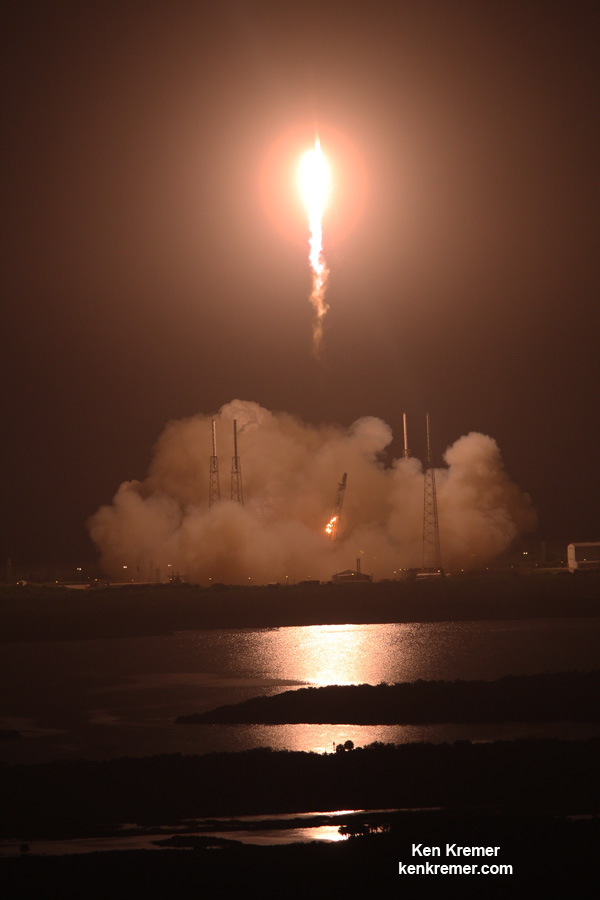
A SpaceX Falcon 9 rocket carrying a Dragon cargo capsule packed with science experiments and station supplies blasts off from Space Launch Complex 40 at Cape Canaveral Air Force Station, Florida, at 1:52 a.m. EDT on Sept. 21, 2014 bound for the ISS. Credit: Ken Kremer/kenkremer.com


A SpaceX Falcon 9 rocket carrying a Dragon cargo capsule packed with science experiments and station supplies blasts off from Space Launch Complex 40 at Cape Canaveral Air Force Station, Florida, at 1:52 a.m. EDT on Sept. 21, 2014 bound for the ISS. Credit: Ken Kremer/kenkremer.com
This has been a banner year for NASA’s Earth science missions. At least five missions will be launched to space within a 12 month period, the most new Earth-observing mission launches in one year in more than a decade.

ISS-RapidScat is the third of five NASA Earth science missions scheduled to launch over a year.

NASA has already launched the Global Precipitation Measurement (GPM) Core Observatory, a joint mission with the Japan Aerospace Exploration Agency in February and the Orbiting Carbon Observatory-2 (OCO-2) carbon observatory in July 2014.

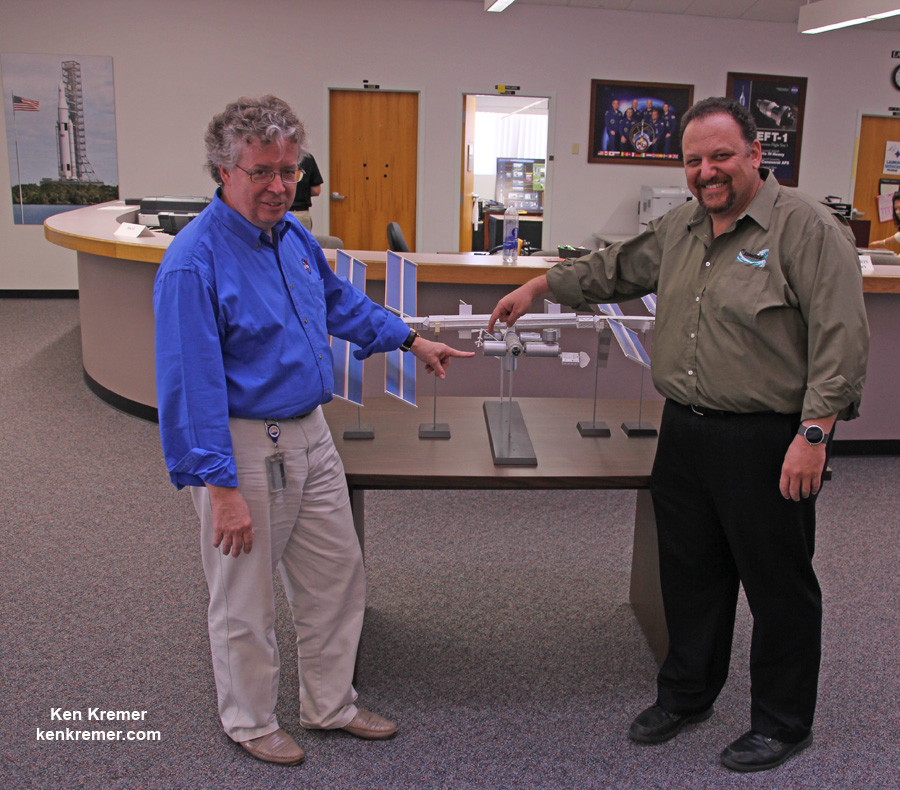
NASA managers show installed location of ISS-RapidScat instrument on the Columbus module on an ISS scale model at the Kennedy Space Center press site during launch period for the SpaceX CRS-4 Dragon cargo mission. Posing are Steve Volz, associate director for flight programs in the Earth Science Division, NASA Headquarters, Washington and RapidScat Project Scientist Ernesto Rodriguez of NASA's Jet Propulsion Laboratory, Pasadena, California. Credit: Ken Kremer - kenkremer.com


NASA managers show installed location of ISS-RapidScat instrument on the Columbus module on an ISS scale model at the Kennedy Space Center press site during launch period for the SpaceX CRS-4 Dragon cargo mission. Posing are Steve Volz, associate director for flight programs in the Earth Science Division, NASA Headquarters, Washington and RapidScat Project Scientist Ernesto Rodriguez of NASA’s Jet Propulsion Laboratory, Pasadena, California. Credit: Ken Kremer – kenkremer.com
Stay tuned here for Ken’s continuing Earth and Planetary science and human spaceflight news.

Ken Kremer

…………….

Learn more about Commercial Space Taxis, Orion and NASA Human and Robotic Spaceflight at Ken’s upcoming presentations:

Oct 14: “What’s the Future of America’s Human Spaceflight Program with Orion and Commercial Astronaut Taxis” & “Antares/Cygnus ISS Rocket Launches from Virginia”; Princeton University, Amateur Astronomers Assoc of Princeton (AAAP), Princeton, NJ, 7:30 PM

Oct 23/24: “Antares/Cygnus ISS Rocket Launch from Virginia”; Rodeway Inn, Chincoteague, VA


About 

Dr. Ken Kremer is a speaker, scientist, freelance science journalist (Princeton, NJ) and photographer whose articles, space exploration images and Mars mosaics have appeared in magazines, books, websites and calanders including Astronomy Picture of the Day, NBC, BBC, SPACE.com, Spaceflight Now and the covers of Aviation Week & Space Technology, Spaceflight and the Explorers Club magazines. Ken has presented at numerous educational institutions, civic & religious organizations, museums and astronomy clubs. Ken has reported first hand from the Kennedy Space Center, Cape Canaveral and NASA Wallops on over 40 launches including 8 shuttle launches. He lectures on both Human and Robotic spaceflight - www.kenkremer.com. Follow Ken on Facebook and Twitter
Tagged as: commercial resupply services (CRS), Commercial Space, CRS, CRS-4, CRS-5, Dragon, Dragon capsule, Earth, Earth Observation, Earth science, Falcon 9, hurricane monitoring, International Space Station (ISS), ISS, ISS-Rapidscat, NASA, NASA Earth science, ocean winds, RapidScat, SpaceX, weather forecasting

Chandra Awaits Comet Siding Spring's Approach to Mars

Chandra Awaits Comet Siding Spring's Approach to Mars:

On October 19th, Chandra will join with telescopes across the world, in orbit around Earth, and even on and around Mars, as Comet Siding Spring makes an extremely close approach to the Red Planet.

Chandra Awaits Comet Siding Spring's Approach to Mars
This is an extremely exciting event because scientists have determined this comet has been traveling for maybe a million years from the distant Oort Cloud. This will be the first time that humans have ever captured images of a comet from the Oort Cloud, which is an enormous reservoir of left over debris from the formation of the Solar System. (Previous observations and spacecraft visits of comets came from those that originated in the much closer Kuiper Belt.)

As Comet Siding Spring advances toward Mars, it will be moving extremely fast since it is going in the opposite direction from the Red Planet in its orbit. It will also come incredibly close to Mars. At its nearest point, the comet’s distance will be equivalent to only a third of the way between Earth and Moon.

The passage will be so close that Mars will be in the outer atmosphere, or coma, of the comet. Gas molecules and dust particles in this coma could interact with the Martian atmosphere and orbiting spacecraft, and, if large enough, could even make it down to the surface of the planet.

Expansion of the upper Martian atmosphere should increase its cross section to the solar wind, and thus its ability to emit X-rays as Martian atmosphere gas molecules charge exchange with highly-charged solar wind ions. Scientists will be monitoring Mars with Chandra, looking for just such an increase, from 4 hours before closest approach to 11 hours after. Scientists will also be using Chandra to watch the comet from 4 hours before to 6 hours after closest approach to search for its own interaction with the solar wind and any changes caused by its traversing the near-Mars solar wind structure and having Mars travel through its outer coma.

Scientists know that both objects emit X-rays, so they expect to observe a small Chandra signal from each in the 11 hours (54,000 seconds) of observation time. Any increase in these signals due to the comets close flyby should tell us something about their interaction. In a cross-platform coordinated program, the researchers will also be using the Hubble Space Telescope to monitor the Martian aurora, a measure of the planet’s exospheric excitation, as well as the comet's gas production rate, which drives both its X-ray production and its mass/energy input into the Martian atmosphere.

Researchers expect it will take a few days at least to process and analyze the Chandra data after it is obtained on October 19th. Keep checking our website and blog and we’ll post any information as soon as it’s available.

Megan Watzke, CXC

FULL STORY: http://science.nasa.gov/science-news/science-at-nasa/2014/09oct_cometprep/