Sunday, October 12, 2014

JPL Selects Europa CubeSat Proposals for Study

JPL Selects Europa CubeSat Proposals for Study:

Artist's concept of CubeSats near Jupiter's moon Europa Artist's concept of CubeSats near Jupiter's moon Europa. Image Credit: NASA/JPL
NASA's Jet Propulsion Laboratory in Pasadena, California, has chosen proposals from 10 universities to study CubeSat concepts that could enhance a Europa mission concept currently under study by NASA. The CubeSat concepts will be incorporated into a JPL study describing how small probes could be carried as auxiliary payloads. The CubeSats would then be released in the Jovian system to make measurements and enhance our understanding of Jupiter's moon Europa.

CubeSats are small, lightweight and low-cost satellites, often only inches on a side. With support from NASA, JPL is working to include small spacecraft on deep space exploration missions to complement primary spacecraft.

The conceptual Europa mission, called Europa Clipper, would conduct detailed reconnaissance of the icy moon and investigate whether it could harbor conditions suitable for life.

Awardees will receive up to $25,000 each to develop their CubeSat concepts for inclusion in the study, which will be completed next summer.

CubeSat concepts from the following universities were chosen by JPL's Planetary CubeSat office for inclusion in the study:

-- Arizona State University, Tempe

-- Georgia Tech Research Corporation, Atlanta

-- Stanford University, Stanford, California

-- The Regents of New Mexico State University, Las Cruces, New Mexico

-- The Regents of the University of Colorado, Boulder

-- The Regents of the University of Michigan, Ann Arbor

-- University of Alaska, Fairbanks

-- University of Southern California, Los Angeles

-- University of Illinois, Urbana

-- University of Washington, Seattle

The universities' Europa science objectives for their CubeSats would include reconnaissance for future landing sites, gravity fields, magnetic fields, atmospheric and plume science, and radiation measurements.

"We've seen some innovative and quite creative surprises among the CubeSat ideas submitted by these universities," said Barry Goldstein, pre-project manager for the Europa Clipper mission concept. "Using CubeSats for planetary exploration is just now becoming possible, so we want to explore how a future mission to Europa might take advantage of them."

The California Institute of Technology in Pasadena manages JPL for NASA.

For more information about Europa, visit:

http://solarsystem.nasa.gov/europa

For more information about Europa Clipper, visit:

http://www.jpl.nasa.gov/missions/europa-clipper

Media Contact

Preston Dyches
NASA's Jet Propulsion Laboratory, Pasadena, Calif.
818-354-7013
preston.dyches@jpl.nasa.gov

2014-347

Tiny U.S. Region Is Methane 'Hot Spot,' NASA Finds

Tiny U.S. Region Is Methane 'Hot Spot,' NASA Finds:

This map shows anomalous U.S. methane emissions This map shows anomalous U.S. methane emissions (or how much the emissions differ from average background concentrations) for 2003 to 2009, as measured by the European Space Agency's SCIAMACHY instrument. Purple and dark blue areas are below average. Pale blue and green areas are close to normal or slightly elevated. Yellows and red indicate higher-than-normal anomalies, with more intense colors showing higher concentrations. The Four Corners area - the area where Arizona, Colorado, New Mexico and Utah meet -- is the only red spot on the map.Image credit: NASA/JPL-Caltech/University of Michigan
One small "hot spot" in the U.S. Southwest is responsible for producing the largest concentration of the greenhouse gas methane seen over the United States -- more than triple a standard ground-based estimate -- according to a new study of satellite data by scientists at NASA and the University of Michigan.

Methane is very efficient at trapping heat in the atmosphere and, like carbon dioxide, it contributes to global warming. The hot spot, near the Four Corners intersection of Arizona, Colorado, New Mexico and Utah, covers only about 2,500 square miles (6,500 square kilometers), or half the size of Connecticut.

In each of the seven years studied from 2003 to 2009, the area released about 0.59 million metric tons of methane into the atmosphere. This is almost 3.5 times the estimate for the same area in the European Union's widely used Emissions Database for Global Atmospheric Research.

In the study, which is published online in the journal Geophysical Research Letters, researchers used observations made by the European Space Agency's Scanning Imaging Absorption Spectrometer for Atmospheric Chartography (SCIAMACHY) instrument. SCIAMACHY measured greenhouse gases from 2002 to 2012. The atmospheric hot spot persisted throughout the study period. A ground station in the Total Carbon Column Observing Network, operated by the Department of Energy's Los Alamos National Laboratory in New Mexico, provided independent validation of the measurement.

To calculate the emissions rate that would be required to produce the observed concentration of methane in the air, the authors performed high-resolution regional simulations using a chemical transport model, which simulates how weather moves and changes airborne chemical compounds.

Research scientist Christian Frankenberg of NASA's Jet Propulsion Laboratory in Pasadena, California, first noticed the Four Corners signal years ago in SCIAMACHY data.

"We didn't focus on it because we weren't sure if it was a true signal or an instrument error," Frankenberg said.

The study's lead author, Eric Kort of the University of Michigan, Ann Arbor, noted the study period predates the widespread use of hydraulic fracturing, known as fracking, near the hot spot. This indicates the methane emissions are not attributed to fracking but instead to leaks in natural gas production and processing equipment in New Mexico's San Juan Basin, which is the most active coal-bed methane production area in the country.

Natural gas is 95 to 98 percent methane. Methane is colorless and odorless, making leaks hard to detect without scientific instruments.

"The results are indicative that emissions from established fossil fuel harvesting techniques are greater than inventoried," Kort said. "There's been so much attention on high-volume hydraulic fracturing, but we need to consider the industry as a whole."

Coal-bed methane is gas that lines pores and cracks within coal. In underground coal mines, it is a deadly hazard that causes fatal explosions almost every year as it seeps out of the rock. After the U.S. energy crisis of the 1970s, techniques were invented to extract the methane from the coal and use it for fuel. By 2012, coal-bed methane supplied about 8 percent of all natural gas in the United States.

Frankenberg noted that the study demonstrates the unique role space-based measurements can play in monitoring greenhouse gases.

"Satellite data cannot be as accurate as ground-based estimates, but from space, there are no hiding places," Frankenberg said.

In March 2014, the Obama Administration announced a strategy to reduce methane emissions under its Climate Action Plan. The strategy includes improving the measurement and monitoring of methane emissions and assessing current methane emissions data.

NASA monitors Earth's vital signs from land, air and space with a fleet of satellites and airborne and ground-based observation campaigns. NASA develops new ways to observe and study Earth's interconnected natural systems with long-term data records and computer analysis tools to better see how our planet is changing. The agency shares this unique knowledge with the global community and works with institutions in the United States and around the world that contribute to understanding and protecting our home planet.

For more about NASA's Earth science activities this year, visit:

http://www.nasa.gov/earthrightnow

Media Contact

Alan Buis

Jet Propulsion Laboratory, Pasadena, Calif.

818-354-0474

alan.buis@jpl.nasa.gov

Steve Cole

NASA Headquarters, Washington

202-358-0918

stephen.e.cole@nasa.gov

Nicole Casals Moore

University of Michigan
734-647-7087

ncmoore@umich.edu

Written by Carol Rasmussen

NASA Earth Science News Team

Wednesday, October 8, 2014

Foom! ‘Superflares’ Erupt From Tiny Red Dwarf Star, Surprising Scientists

Foom! ‘Superflares’ Erupt From Tiny Red Dwarf Star, Surprising Scientists:

Artist's impression of a flare erupting from binary star sytem DG CVn. Credit: NASA's Goddard Space Flight Center/S. Wiessinger


Artist’s impression of a flare erupting from binary star sytem DG CVn. Credit: NASA’s Goddard Space Flight Center/S. Wiessinger
Don’t get too close to this little star! In April, a red dwarf star sent out a series of explosions that peaked at 10,000 times as powerful as the largest solar flare ever recorded.

The tiny star packs a powerful punch because its spin is so quick: it rotates in less than a day, or 30 times faster than the Sun does. Astronomers believe that in the distant past, when the Sun was young, it also was a fast turner — and could have produced “superflares”, as NASA terms the explosions, of its own.

“We used to think major flaring episodes from red dwarfs lasted no more than a day, but Swift detected at least seven powerful eruptions over a period of about two weeks,” stated Stephen Drake, an astrophysicist at NASA’s Goddard Space Flight Center in Maryland. “This was a very complex event.”

The surprising activity came from a red dwarf star in a binary system that together is known as DG Canum Venaticorum (DG CVn). Located just 60 light-years away, the two red dwarfs are each about one-third the size and mass of the Sun. Astronomers can’t say for sure which one sent out the eruption because the stars were so close to each other, at about three times the distance of Earth’s average distance to the sun.


The first flare (which sent out a burst of X-rays) caused an alert in NASA’s Swift Space Telescope’s burst alert telescope on April 23. It’s believed to be caused by the same process that creates flares on our Sun — magnetic field lines twisting and then releasing a burst of energy that sends out radiation.

Three hours later came another flare — scientists have seen similar events on the Sun after one active region sets off flares in another — and then came “successively weaker blasts” in the next 11 days, NASA said. Normal X-ray emissions stabilized about 20 days after the first flare. Swift is now monitoring this star for further activity.

Drake presented his results at the August meeting of the American Astronomical Society’s high energy astrophysics division, which was highlighted in a recent release from NASA.

Source: NASA


About 

Elizabeth Howell is the senior writer at Universe Today. She also works for Space.com, Space Exploration Network, the NASA Lunar Science Institute, NASA Astrobiology Magazine and LiveScience, among others. Career highlights include watching three shuttle launches, and going on a two-week simulated Mars expedition in rural Utah. You can follow her on Twitter @howellspace or contact her at her website.
Tagged as: NASA Swift, red dwarf

Protest Delays NASA Commercial Crew Spacecraft Work: Report

Protest Delays NASA Commercial Crew Spacecraft Work: Report:

The Dream Chaser space plane atop a United Launch Alliance Atlas V rocket. Image Credit: SNC

The Dream Chaser space plane atop a United Launch Alliance Atlas V rocket. Image Credit: SNC
NASA told two companies to halt work on the next phase of its commercial crew program — the spacecraft expected to replace Russian ones ferrying astronauts to the International Space Station — because of a protest related to the contract award, according to media reports.

Sierra Nevada Corp. (SNC) filed a complaint on Sept. 26, shortly after its Dream Chaser shuttle-like design was not selected for further funding under the Commercial Crew Transportation Capability (CCtCap) phase of the program. Competitors SpaceX and Boeing each received billions of dollars for further development for their Dragon and CST-100 spacecraft, which are expected to start flying around 2017.

A Spaceflight Now report, quoting NASA spokesperson Stephanie Schierholz, said the agency told both selectees that they must “stop performance of the CCtCap contract” pending the result of the challenge, which is before the Government Accountability Office. The office’s deadline for a response is Jan. 5, the report said.

In a statement, SNC said this is the first fight it undertook in relation to a government contract in more than five decades of operations. “Inconsistencies” in the process, SNC added, prompted it to go forward with the protest:

Importantly, the official NASA solicitation for the CCtCap contract prioritized price as the primary evaluation criteria for the proposals, setting it equal to the combined value of the other two primary evaluation criteria: mission suitability and past performance. SNC’s Dream Chaser proposal was the second lowest priced proposal in the CCtCap competition. SNC’s proposal also achieved mission suitability scores comparable to the other two proposals. In fact, out of a possible 1,000 total points, the highest ranked and lowest ranked offerors were separated by a minor amount of total points and other factors were equally comparable.
NASA administrator Charles Bolden declined to comment on the situation last week in response to questions from reporters at the International Astronautical Congress in Toronto, Canada, citing the legal situation.


About 

Elizabeth Howell is the senior writer at Universe Today. She also works for Space.com, Space Exploration Network, the NASA Lunar Science Institute, NASA Astrobiology Magazine and LiveScience, among others. Career highlights include watching three shuttle launches, and going on a two-week simulated Mars expedition in rural Utah. You can follow her on Twitter @howellspace or contact her at her website.
Tagged as: Boeing, CCtCAP, Commercial Crew, CST-100, dream chaser, Sierra Nevada

How to Take Great Photos of the Lunar Eclipse

How to Take Great Photos of the Lunar Eclipse:

On Wednesday morning October 8, Earth's shadow will nibble away at the moon for this year's second total lunar eclipse. Credit: Bob King


On Wednesday morning October 8, Earth’s shadow will nibble away at the moon during the wee hours eclipsing it for the second time this year. Credit: Bob King
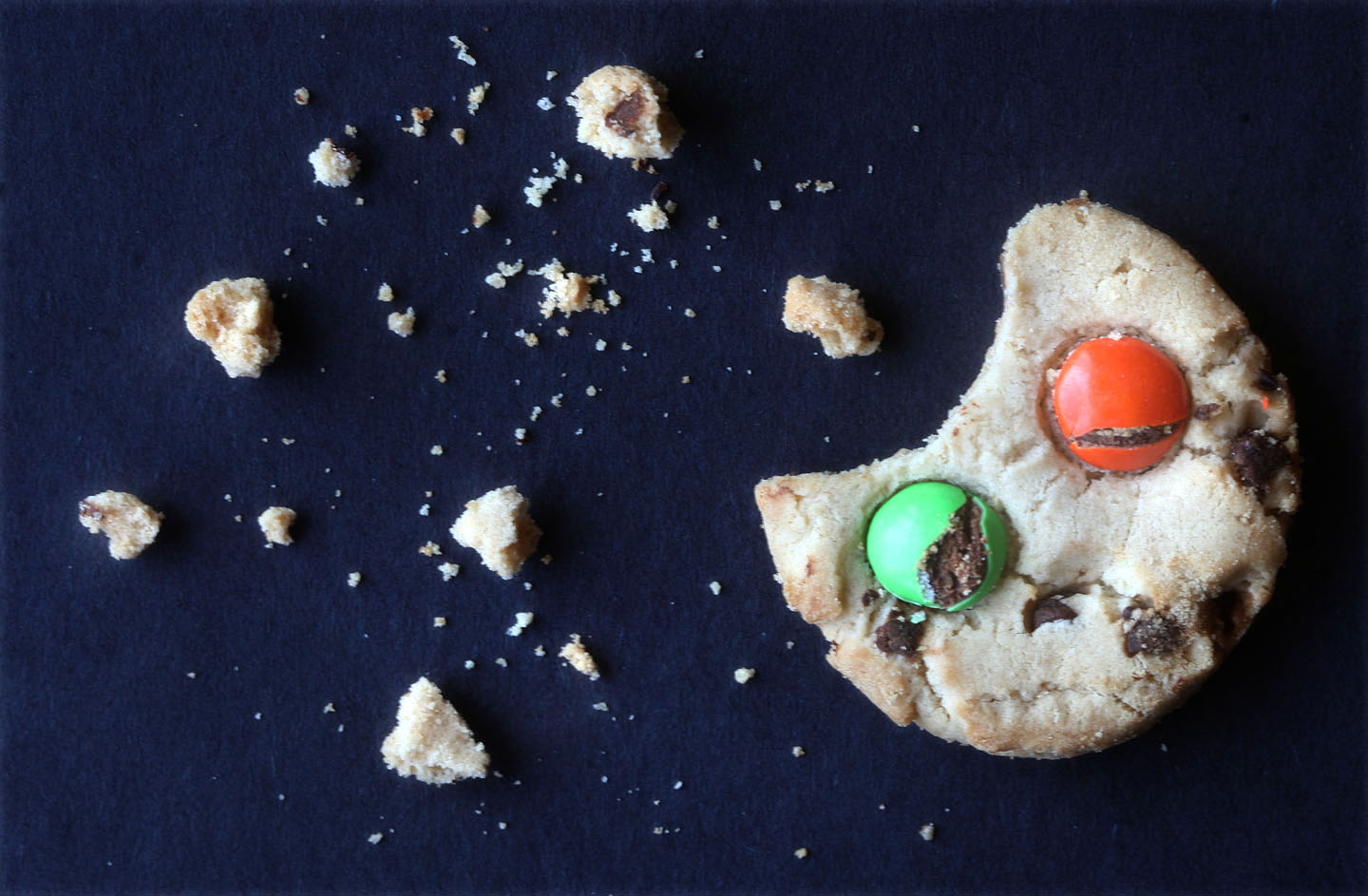
Ready for Wednesday’s morning lunar eclipse Some people – and I envy them at times – treat an eclipse more casually. They enjoy the show with no desire to set up a telescope or take a photo. For those of us can’t part with our cameras, here’s a little guide to help you get better pictures.

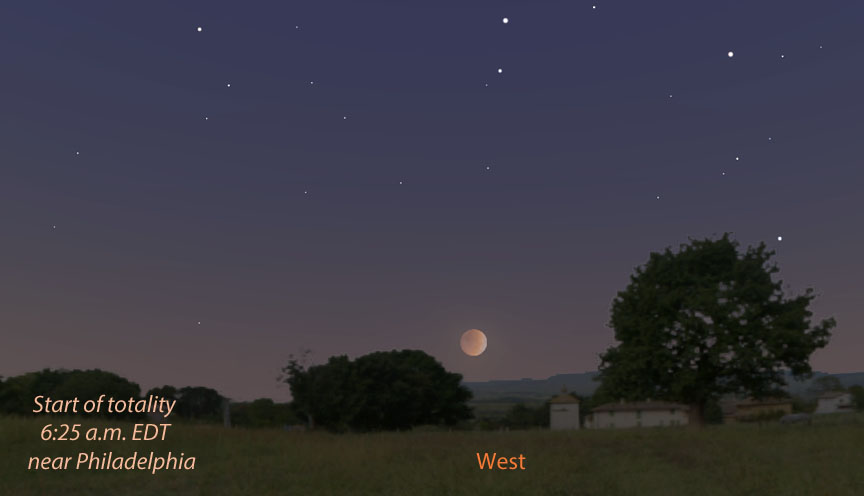
From Philadelphia and other eastern U.S. cities the partial phases of the eclipse will take place with the moon well up in the western sky. By the start of totality, the moon will have dropped to within about 6º of the horizon as shown here. Source: Stellarium


From Philadelphia and other eastern U.S. cities the partial phases of the eclipse will take place with the moon well up in the western sky. By the start of totality, the moon will have dropped to within about 6º of the horizon as shown here. Source: Stellarium
If you’re also into photography and would like to grab a few shots, here are a few tips on what equipment you’ll need and camera settings. This eclipse offers unique opportunities especially for the eastern half of the country because the eclipsed moon will be low in the western sky near the start of and during morning twilight.

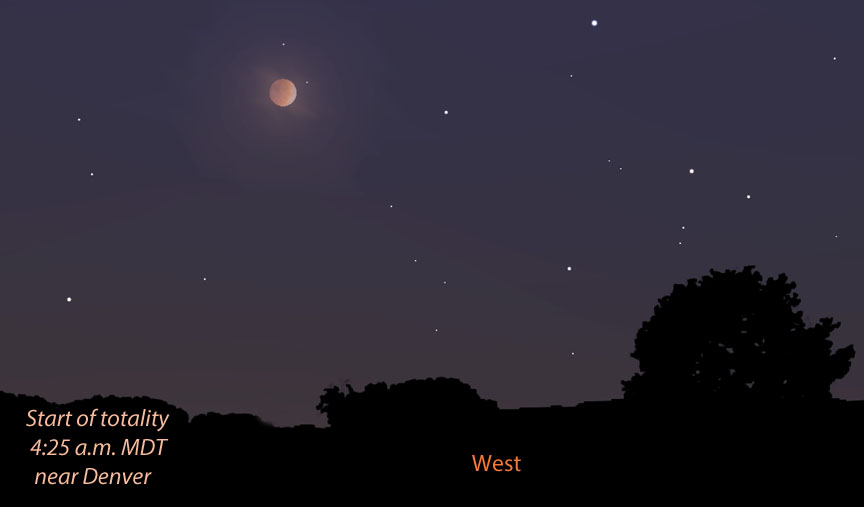
In the Midwest at the start of the hour-long totality, the red moon will be about 20º (two fists) above the western horizon. From the East Coast the moon slips into total eclipse only a half hour before sunrise 6-7º high. So if you live in the eastern half of the country, find a site with a good view to the west.

Seen from Denver, total eclipse begins with the moon 30º high (three fists). All of totality and all partial phases of the eclipse will be visible from western Midwest west to Hawaii and Alaska. Source: Stellarium


Seen from Denver, total eclipse begins with the moon 30º high (three fists). All of totality and all partial phases of the eclipse will be visible from western Midwest west to Hawaii and Alaska. Source: Stellarium
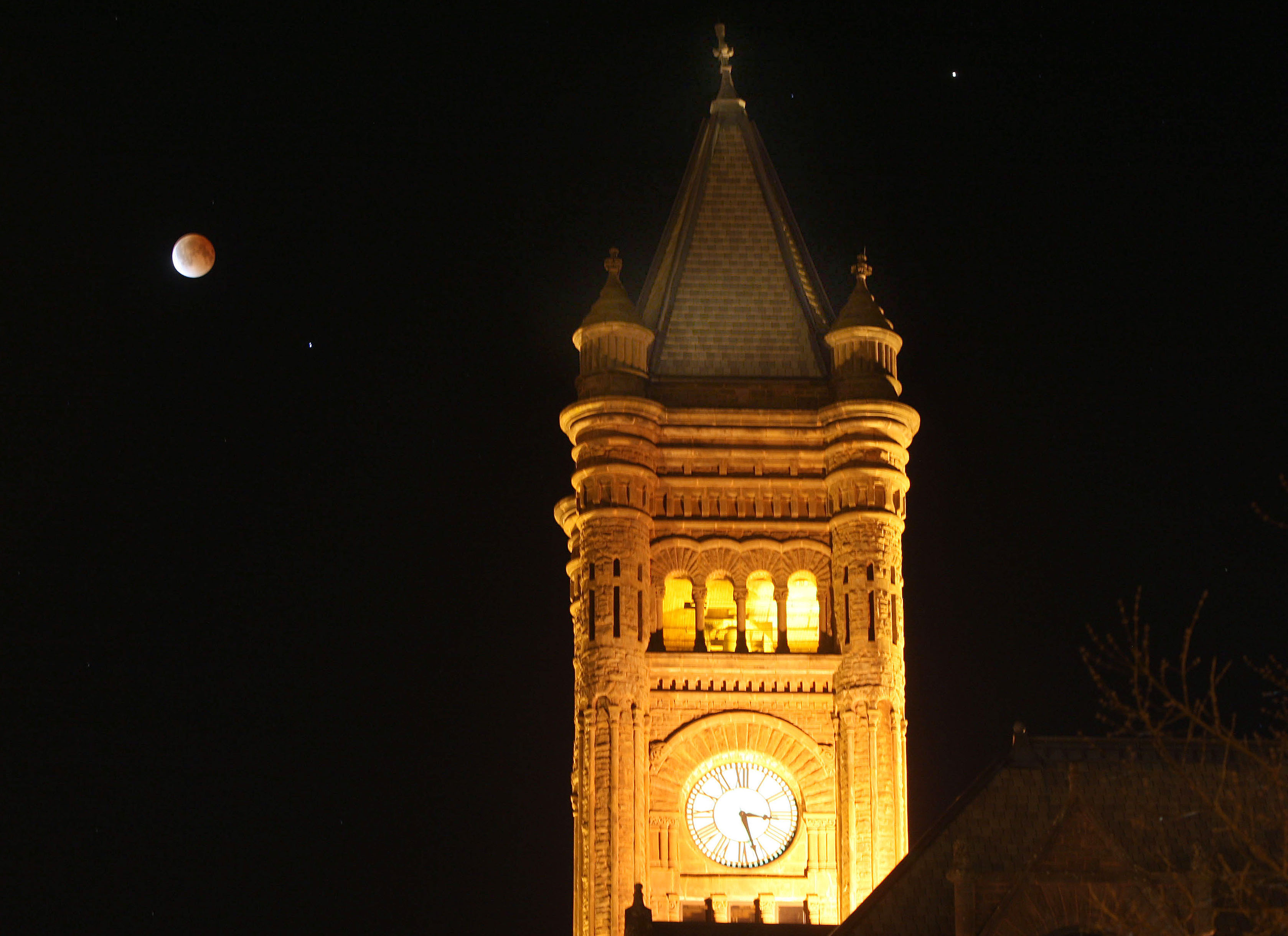
A low moon means easier framing with a pleasing foreground like a grove of fall trees, a church or distant line of mountain peaks. And the lower it drops, the longer the telephoto lens you can use to enlarge the moon relative to the foreground. When the moon is high in the sky it’s more difficult to find a suitable foreground.

Sometimes it's nice to have a foreground object to add character to your eclipse photos. Last April's totally eclipsed moon joins the old Central High School clock tower in downtown Duluth, Minn. Mars at upper right. Details: 80mm lens, f/5, 1.6-second exposure at ISO 400 on a tripod. Credit: Bob King


Sometimes it’s nice to have a foreground object to add character to your eclipse photos. Last April’s totally eclipsed moon joins the old Central High School clock tower in downtown Duluth, Minn. Mars at upper right. Details: 80mm lens, f/5, 1.6-second exposure at ISO 400 on a tripod. Credit: Bob King
As the scene brightens during twilight, balancing the light of the dim moon, your photos will get even more interesting. Textures and details in foreground objects will stand out instead of appearing as silhouettes.

Use the table below to plan when to watch depending on your time zone. The blanks mean the moon will have set by the time of the event.

Eclipse Events                                                EDT                 CDT                MDT                 PDT

Penumbra first visible 4:45 a.m. 3:45 a.m. 2:45 a.m. 1:45 a.m.
Partial eclipse begins 5:15 a.m. 4:15 a.m. 3:15 a.m. 2:15 a.m.
Total eclipse begins 6:25 a.m. 5:25 a.m. 4:25 a.m. 3:25 a.m.
Mid-eclipse 6:55 a.m. 5:55 a.m. 4:55 a.m. 3:55 a.m.
Total eclipse ends 7:24 a.m. 6:24 a.m. 5:24 a.m. 4:24 a.m.
Partial eclipse ends ——— 7:34 a.m. 6:34 a.m. 5:34 a.m.
Penumbra last visible ——— ——— 7:05 a.m. 6:05 a.m.


Exposures and lens settings

Partial phase during the April 14-15 eclipse this year. Details: Telescope (=1300mm telephoto lens) at f/11, 1/250 second at ISO 400. Credit: Bob King


Partial phase during the April 14-15 eclipse this year. Details: Telescope (=1300mm telephoto lens) at f/11, 1/250 second at ISO 400. Credit: Bob King
The full moon and even the partially eclipsed moon (up to about half) are so bright you can shoot a handheld photo without resorting to a tripod. Exposures at ISO 400 are in the neighborhood of f/8 at 1/250-1/500 second. Only thing is, all you’ll get is the moon surrounded by blackness. These exposures are so brief almost nothing will show in your foreground except for possibly moonlit clouds. That’s usually fine for the early partial phases.

Once the moon is more than half smothered by shadow, open up your lens to a wider setting – f/2.8 to f/4 – or increase the exposure. Let the back of the camera be your guide. If the images look too bright, dial back. If too dim, increase exposure or open the lens to a wider aperture.

To capture the encroaching shadow during partial phases you'll need to overexpose the sunlit part of the moon. Details: f/11, 2-second exposure at ISO 400. Credit: Bob King


To capture the encroaching shadow during partial phases you’ll need to overexpose the sunlit part of the moon. Details: f/11, 2-second exposure at ISO 400. Credit: Bob King
While you can continue to shoot the partially eclipsed moon at f/8 from 1/30-1/125 second, you’ll miss the best part – the portion filling up with Earth’s red shadow. To capture that, break out the tripod, open the lens all the way up – f/2.8-f/4 – and expose at ISO 400 between 1/4 and 1 second.

You can also shoot at ISO 800 and cut those times in half, important if you’re using a longish telephoto lens. Remember, Earth’s rotation means the moon’s on the move and will show trailing if you expose longer than a few seconds. On the other hand, this won’t be a problem if you’re shooting with a wide angle lens though they have their limits, too.

The moon completely immersed in Earth's umbra during totality. Details: f/11, 6-second exposure, ISO 400. Credit : Bob King


The moon completely immersed in Earth’s umbra during totality. Details: f/11, 6-second exposure, ISO 400. To prevent trailing I used a motorized mount to track the moon. Credit : Bob King
During totality, expose anywhere from 1/2 to 5 seconds at f/2.8-4.5 at ISO 400. Let’s say you want to include both scenic foreground and stars in the picture using a wide angle or standard lens. Dial up the ISO to 800, open your lens wide and expose between 6-10 seconds. On the 6-second end you’ll catch only the brightest stars, but the moon won’t show trailing; on the longer end you’ll get lots more stars with some overexposure of the eclipsed moon.

Of course, you can go to even higher ISOs and shorten exposure times considerably. But in all but the newest, high-end cameras that comes at the price of increased graininess and less color saturation.

Wide scene from April's total eclipse with Spica below the moon and Mars to the right. Details: 24mm lens at f/2.8, 8-second exposure at ISO 800. The moon was deliberately overexposed to show it in a field of stars. You can vary the exposure to your taste but the shorter it is, the fewer stars. Longer exposures will show trailing. Credit: Bob King


Wide scene from April’s total eclipse with Spica below the moon and Mars to the right. Details: 24mm lens at f/2.8, 8-second exposure at ISO 800. The moon was deliberately overexposed to show it in a field of stars. You can vary the exposure to your taste but the shorter it is, the fewer stars. Longer exposures will show trailing. Credit: Bob King
Where parts of the eclipse happen in twilight, even mobile phones may suffice. There should be enough light to capture a pretty scene with the moon just emerging from total eclipse and during the ensuing partial phases.

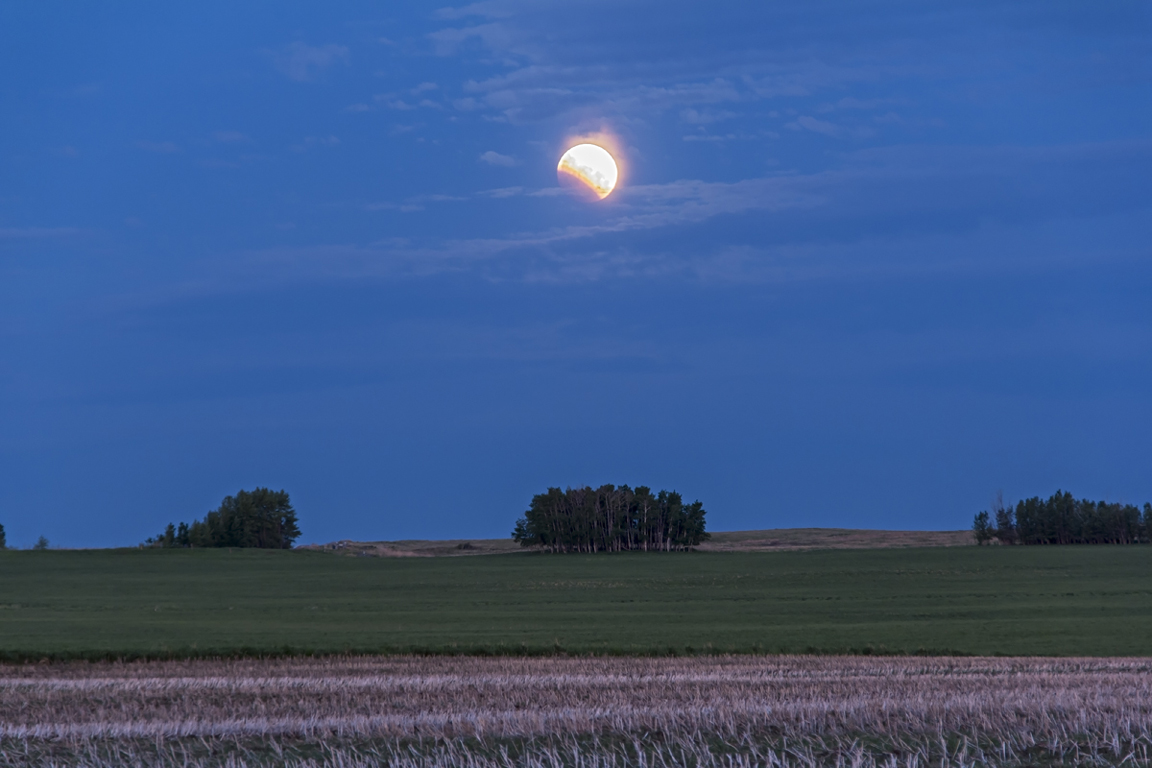
The partial lunar eclipse of June 4, 2012, pre-dawn at moonset, from home in southern Alberta. This is a single exposure with the Canon 60Da and 18-200mm Sigma lens at 115mm and at f/5.6 for 0.4 sec at ISO 160. Copyright: Alan Dyer


The partial lunar eclipse of June 4, 2012, pre-dawn at moonset, from home in southern Alberta. This is a single exposure with the Canon 60Da and 18-200mm Sigma lens at 115mm and at f/5.6 for 0.4 sec at ISO 160. Copyright: Alan Dyer
If you’re clouded out or on the wrong side of the planet for the eclipse, you can catch live webcasts from the following sites:

* Gianluca Masi’s Virtual Telescope
* Griffith Observatory in Los Angeles
* SLOOH 

Clear skies!


About 

I'm a long-time amateur astronomer and member of the American Association of Variable Star Observers (AAVSO). My observing passions include everything from auroras to Z Cam stars. Every day the universe offers up something both beautiful and thought-provoking. I also write a daily astronomy blog called Astro Bob.
Tagged as: camera, eclipse, f-stop, lunar, Moon, shadow

Astrophoto: Old Faithful Geyser Erupts Under a Starry Sky

Astrophoto: Old Faithful Geyser Erupts Under a Starry Sky:

'Old Faithful' geyser in Yellowstone National Park in Wyoming under a beautiful night sky on September 28, 2014. Credit and copyright: astroval1 on Flickr.


‘Old Faithful’ geyser in Yellowstone National Park in Wyoming under a beautiful night sky on September 28, 2014. Credit and copyright: astroval1 on Flickr.
The Old Faithful geyser in Yellowstone National Park in the western US is one of the most predictable geographical features on Earth, as it erupts “faithfully” every 60 – 110 minutes. But you can never predict what the night sky will look like overhead. Astroval1 on Flickr captured this gorgeous shot of the stars over Old Faithful on September 28, 2014, with 30 seconds of exposure time.

Gorgeous!

Just another #MilkyWayMonday shot from Universe Today’s Flickr page! Enjoy browsing through all the great images from our readers and join our group to add your own astronomical imagery.

Want to get your astrophoto featured on Universe Today? Join our Flickr group or send us your images by email (this means you’re giving us permission to post them). Please explain what’s in the picture, when you took it, the equipment you used, etc.

Tagged as: #milkywaymonday, Astrophotos, old faithful, Yellowstone national park

How to Turn Your Phone Into A Cosmic Ray Detector

How to Turn Your Phone Into A Cosmic Ray Detector:

Artist's impression of cosmic rays striking Earth (Simon Swordy/University of Chicago, NASA)

Artist’s impression of cosmic rays striking Earth (Simon Swordy/University of Chicago, NASA)
Quick, do you have an Android phone in your pocket? A few small changes and you could help physicists probe more of the curious nature of cosmic rays, high-energy particles that emanate from outside our solar system.

Just download an app, cover up your phone’s camera with duct tape, then place it somewhere (running idle) with the screen facing up. If a particle “event” happens, the information will be logged in a central database.

The project (called Distributed Electronic Cosmic-ray Observatory or DECO) aims to record secondary particles called muons that occur when cosmic rays hit the Earth’s atmosphere. Scientists believe cosmic rays are created in black holes and supernovas, but more studies are needed.

Screenshot of an Android app developed at the University of Wisconsin-Madison that aims to capture cosmic rays. Credit: Justin Vandenbroucke


Screenshot of an Android app developed at the University of Wisconsin-Madison that aims to capture cosmic rays. Credit: Justin Vandenbroucke
Researchers at the Wisconsin IceCube Particle Astrophysics Center (WIPAC), led by Justin Vandenbroucke, note that there are things about cosmic rays that confuse physicists. Their paths in space change as they go across magnetic fields, and it makes searching for other astronomy events difficult. That’s where they hope the phone study will be useful.

“Smartphone cameras use silicon chips that work through what is called the photoelectric effect, in which particles of light, or photons, hit a silicon surface and release an electric charge,” the University of Wisconsin-Madison wrote in a press release.

“The same is true for muons. When a muon strikes the semiconductor that underpins a smartphone camera, it liberates an electric charge and creates a signature in pixels that can be logged, stored and analyzed.”

For more details on how to run and use the app, consult this page (it’s the second item).

Source: University of Wisconsin-Madison


About 

Elizabeth Howell is the senior writer at Universe Today. She also works for Space.com, Space Exploration Network, the NASA Lunar Science Institute, NASA Astrobiology Magazine and LiveScience, among others. Career highlights include watching three shuttle launches, and going on a two-week simulated Mars expedition in rural Utah. You can follow her on Twitter @howellspace or contact her at her website.
Tagged as: cosmic rays

REAL Images of Eclipses Seen From Space

REAL Images of Eclipses Seen From Space:

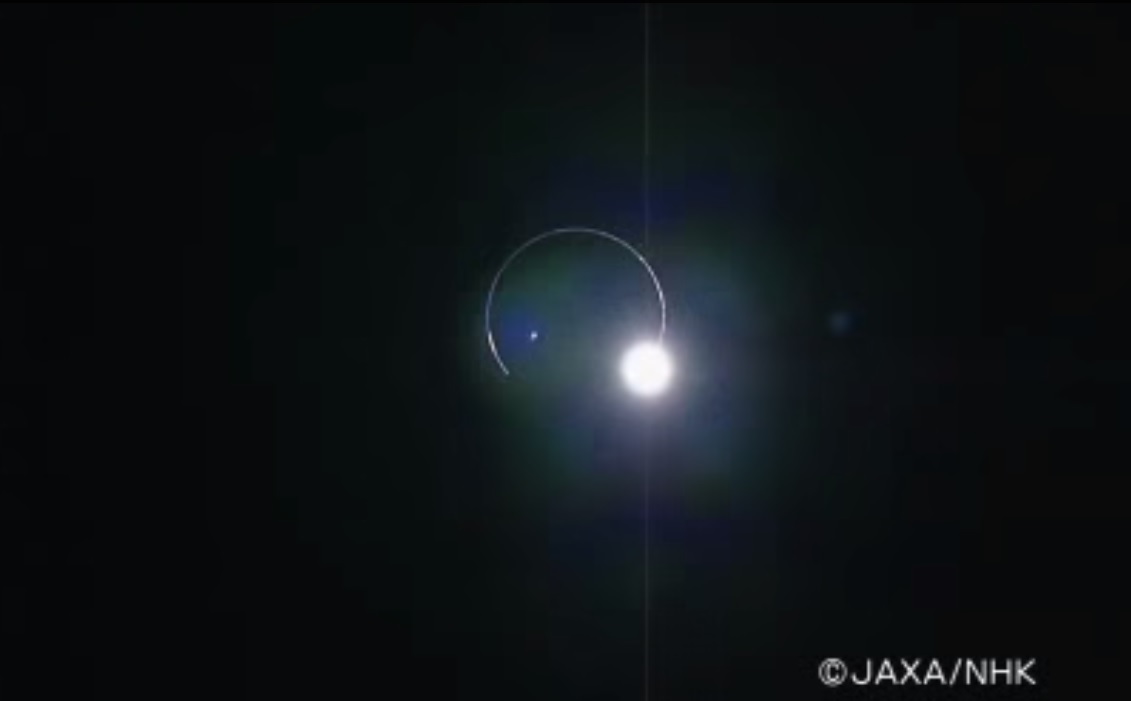
JAXA


A screenshot of the ‘diamond ring effect’ as seen during a total solar eclipse captured by Kaguya from lunar orbit. Credit: JAXA/NHK.
That ‘amazing astro-shot that isn’t’ is making the rounds of ‘ye ole web again.

You know the one. “See an Amazing Image of an Eclipse… From SPACE!!!” screams the breathless headline, with the all-too-perfect image of totality over the limb of the Earth, with the Milky Way thrown in behind it for good measure.

As the old saying goes, if it looks too good to be true, it probably is. Sure, the pic is a fake, and it’s been debunked many, many times since it was first released into the wild a few years back. But never let reality get in the way of a good viral meme. As eclipse season 2 of 2 gets underway tonight with a total lunar eclipse followed by a partial solar eclipse on October 23rd both visible from North America, the image is once again making its rounds. But there’s a long history of authentic captures of eclipses from space that are just as compelling. We’ve compiled just such a roll call of real images of eclipses seen from space:

SDO


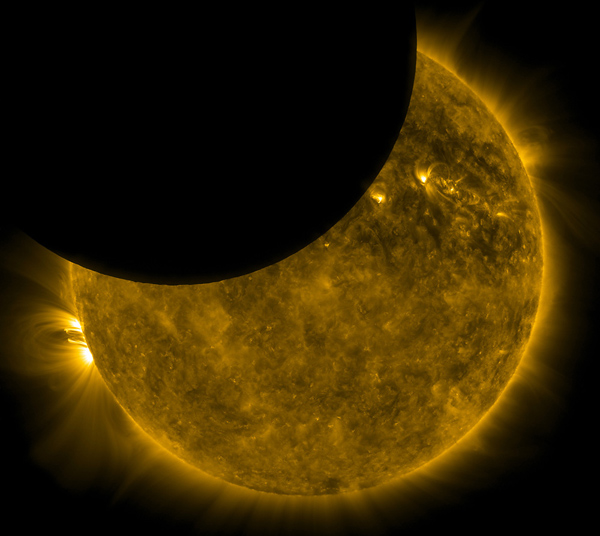
A partial solar eclipse as captured by SDO. Credit: NASA/SDO.
The Solar Dynamics Observatory:

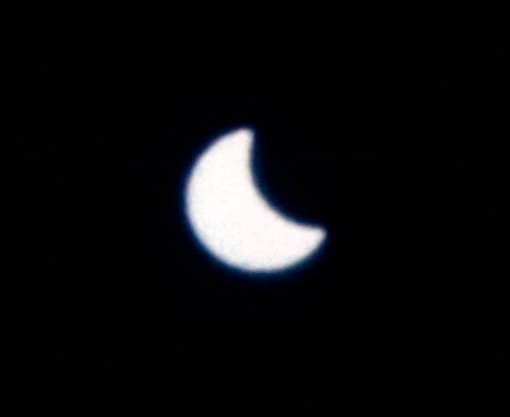
Launched in 2010, The Solar Dynamics Observatory or SDO is NASA’s premier orbiting solar observatory. But unlike Sun-staring satellites based in low Earth orbit, SDO’s geosynchronous orbit assures that it tends to see a cycle of partial solar eclipses twice a year, roughly around the equinoxes. And like many satellites, SDO also passes into the Earth’s shadow as well, offering unique views of a solar eclipse by the limb of the Earth from its vantage point.

JAXA


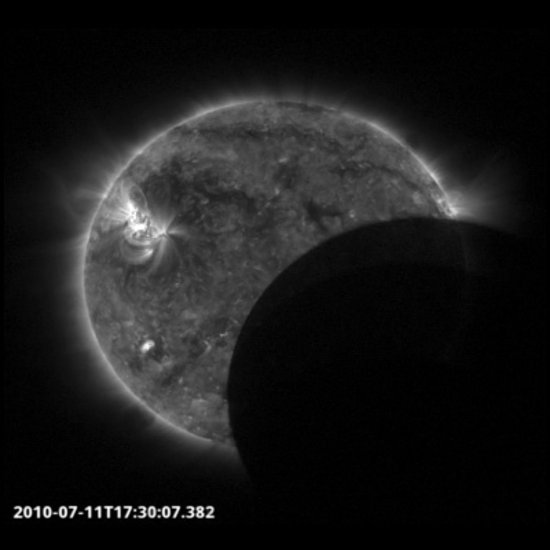
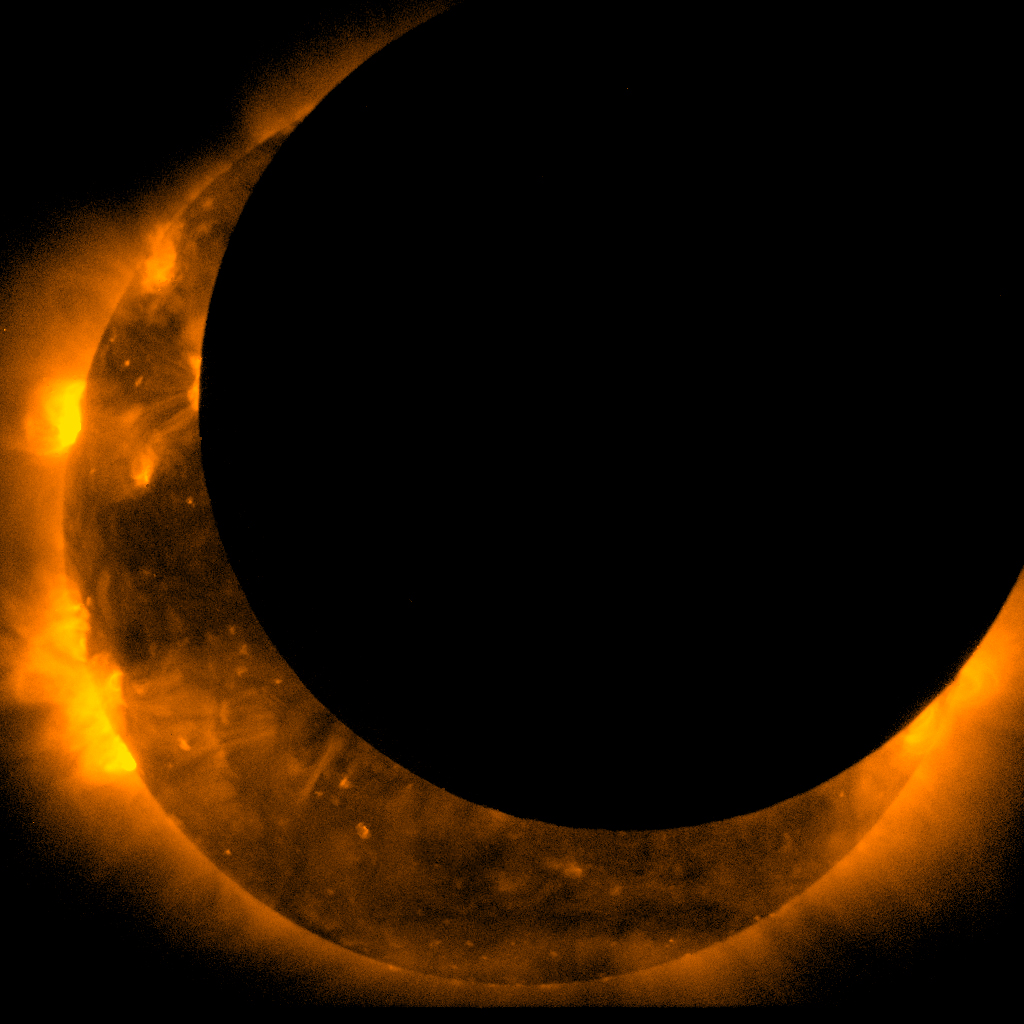
The Moon ‘photobombs’ the view of Hinode. Credit: NASA/JAXA.
Hinode:

A joint mission between NASA and JAXA (the Japanese Aerospace Exploration Agency) launched in 2006, Hinode observes the Sun from low Earth orbit. As a consequence, it nearly has a similar vantage point as terrestrial viewers and frequently nabs passages of the Moon as solar eclipses occur. Such events, however, are fleeting; moving at about eight kilometres per second, such eclipses last only seconds in duration!

ESA


Catching the passage of the Moon during a brief partial eclipse. Credit: ESA.
Proba-2:

Like Hinode, Proba-2 is the European Space Agency’s flagship solar observing spacecraft based in low Earth orbit. It also catches sight of the occasional solar eclipse, and these fleeting passages of the Moon in front of the Earth happen in quick multiple cycles. Recent images from Proba-2 are available online.


Eclipses from the ISS:

The International Space Station isn’t equipped to observe the Sun per se, but astronauts and cosmonauts aboard have managed to catch views of solar eclipses in an unusual way, as the umbra of the Moon crosses the surface of the Earth. Such a view also takes the motion of the ISS in low Earth orbit into account. Cosmonauts aboard the late Mir space station also caught sight of the August 11th, 1999, total solar eclipse over Europe.

NASA GOES


NASA’ s GOES-WEST spies the umbra of the Moon. Credit: NASA-GOES.
NASA-GOES:

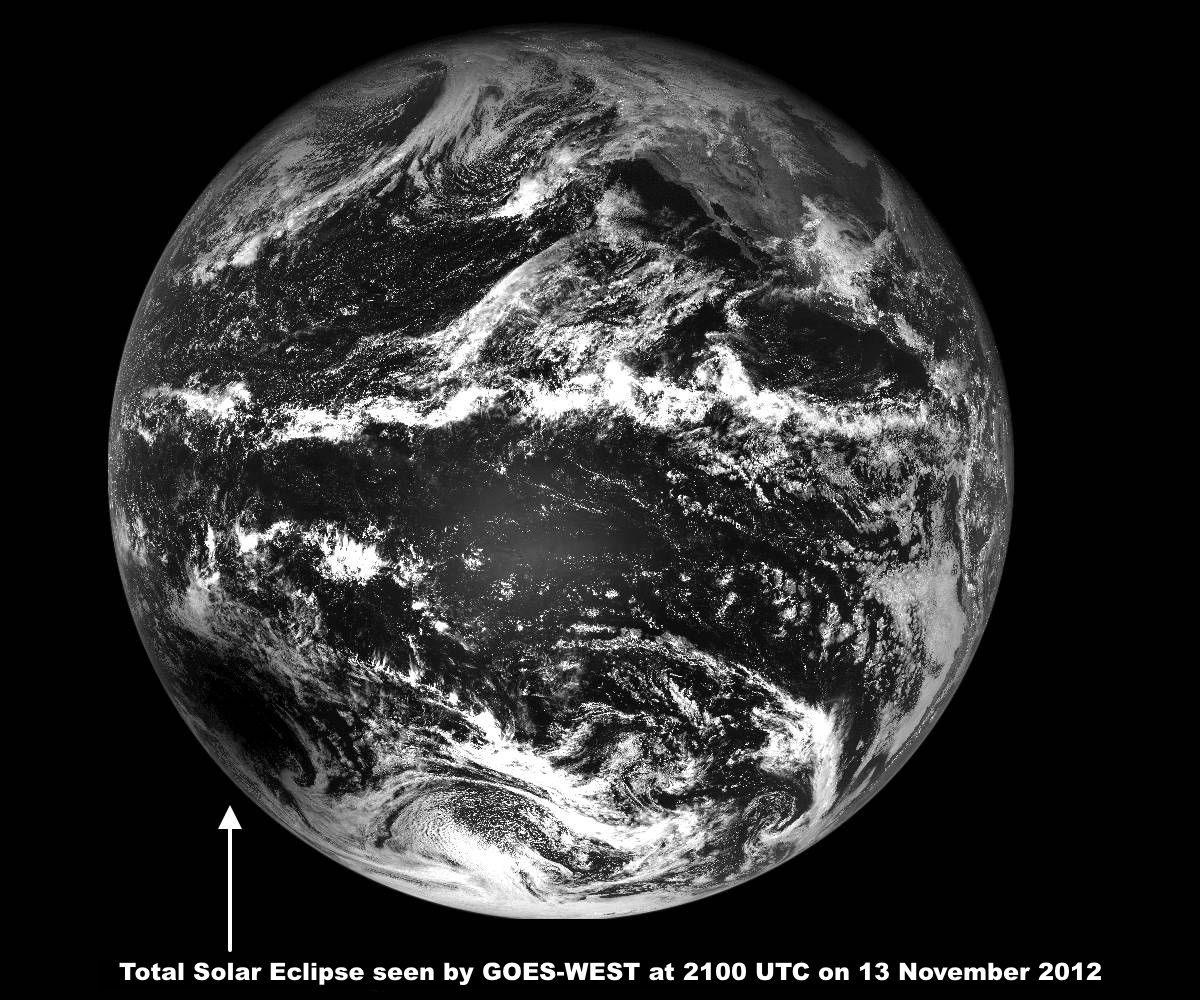
Weather satellites can, and do, occasionally catch sight of the inky black dot of the Moon’s penumbra crossing the disk of the Earth.  GOES-West snapped the above image of the November 13th, 2012, solar eclipse. The umbra of the Moon’s shadow races about 1700 kilometres per hour from west to east during an eclipse, and we can expect some interesting images in 2017 when the next total solar eclipse crosses the United States on August 21st, 2017.

NASA


An ‘Apollo eclipse!’ Credit: NASA.
Apollo-Soyuz Test Project:

The final mission of Apollo program, the 1975 Apollo-Soyuz Test Project, also yielded an unusual and little known effort to observe the Sun. The idea was to use the Apollo command module as a “coronagraph” and have cosmonauts image the Sun from the Soyuz as the Apollo spacecraft blocked it out after undocking. Unfortunately, the Apollo thrusters smeared the exposure, and it became a less than iconic— though unusual — view from the space age.

Gemini XII


A partial solar eclipse snapped by the crew of Gemini XII. Credit: NASA.
Gemini XII and the first eclipse seen from space:

On November 12th, 1966, a total solar eclipse graced South America. Astronauts James Lovell Jr. and Edwin “Buzz” Aldrin Jr. were also in orbit at the time, and managed to snap the first image of a solar eclipse from space. Gemini XII was the last flight of the program, and the astronauts initially thought they’d missed the eclipse after a short trajectory burn.

ISS


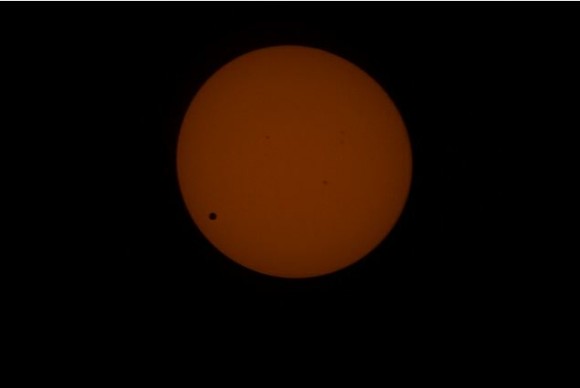
The 2012 transit of Venus as seen from the ISS. Credit: NASA/Don Pettit.
ISS Astronauts catch a transit of Venus:

We were fortunate that the International Space Station had its very own amateur astronomer in residence in 2012 to witness the historic transit of Venus from space. NASA astronaut Don Pettit knew that the transit would occur during his rotation, and packed a full-aperture white light solar filter for the occasion. Of course, a planetary transit meets the very loosest definition of a partial eclipse, but it’s a unique capture nonetheless.


Kaguya:

Japan’s SELENE-Kaguya spacecraft entered orbit around the Moon in 2007 and provided some outstanding imagery of our solitary natural neighbor. On February 10th, 2009, it also managed to catch a high definition view of the Earth eclipsing the Sun as seen from lunar orbit. A rare catch, such an event occurs during every lunar eclipse as seen from the Earth.

Mars eclipse


Curiosity captures a misshapen eclipse from the surface of Mars. Credit: NASA/JPL.
An unusual eclipse… seen from Mars:

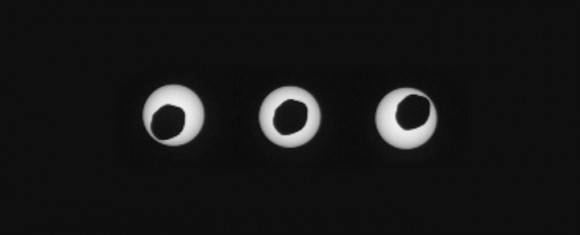
We’re fortunate to live in an epoch in time and space where total solar eclipses can occur as seen from the Earth. But bizarre eclipses and transits can also be seen from Mars. The Spirit and Opportunity rovers have witnessed brief transits of the Martian moons Phobos and Deimos across the face of the Sun, and in 2010, the Curiosity rover recorded the passage of Phobos in front of the Sun in a bizarre-potato shaped “annular eclipse”. But beyond just the “coolness” factor, the event also helped researchers refine our understanding of orbital path of the Martian moon.

The future: It’s also interesting to think of what sort of astronomical wonders await travelers as we venture out across the solar system. For example, no human has yet to stand on the Moon and witness a solar eclipse. Or how about a ring plane passage through Saturn’s rings, thus far only witnessed via the robotic eyes of Cassini? Of course, for the best views of Saturn’s rings, we recommend a vacation stay on Iapetus, the only major Saturnian moon whose orbit is inclined to the ring plane. And stick around ‘til November 10th, 2084, and you can witness a transit of Earth, the Moon and Phobos as seen from the slopes of Elysium Mons on Mars:


Hopefully, they’ll have perfected that whole Futurama “head-in-a-jar” thing by then…

-Looking for eclipses in science fiction? Check out the author’s tales Exeligmos and Shadowfall.


About 

David Dickinson is an Earth science teacher, freelance science writer, retired USAF veteran & backyard astronomer. He currently writes and ponders the universe from Tampa Bay, Florida.
Tagged as: eclipse from space, eclipse from space fake, eclipses from other planets, real eclipse from space, total eclipse from space, Total Lunar Eclipse, total solar eclipse

Astrophoto: Nighttime at Horseshoe Bend

Astrophoto: Nighttime at Horseshoe Bend:

The night sky over Horseshoe Bend, near Page Arizona. Credit and copyright: Jack Fusco.


The night sky over Horseshoe Bend, near Page Arizona. Credit and copyright: Jack Fusco.
As the Milky Way now begins to set earlier in the evening here in the northern hemisphere, that doesn’t mean the photos of our night sky are any less stunning. This lovely shot for #TerrestrialTuesday by photographer Jack Fusco was taken this week at Horseshoe Bend in Arizona, a horseshoe-shaped meander of the Colorado River.

“During the day, the walk to Horseshoe Bend was full of tourists from all over the world,” Jack explained on Flickr. “At night, we sat alone and stared up at a brilliant star filled sky and only heard coyotes in the distance. It was an absolutely incredible location during the day and at night. This was shot with no Moon at the sky, so the area was at it’s absolute darkest. I was a little nervous setting up my gear for this shot as my tripod was just a few inches from a 1000ft drop down to the river. It was certainly an experience I’ll never forget.”

See more of Jack’s work on Flickr, Google+ and his website, www.jackfusco.com

Want to get your astrophoto featured on Universe Today? Join our Flickr group or send us your images by email (this means you’re giving us permission to post them). Please explain what’s in the picture, when you took it, the equipment you used, etc.

Tagged as: #TerrestrialTuesday, arizona, Astrophotos, Horseshoe Bend, Jack Fusco, milky way

Stunning Photos of the Hunter’s Moon Lunar Eclipse

Stunning Photos of the Hunter’s Moon Lunar Eclipse:

Lunar eclipse timelapse into totality. Taken from Palmyra, New Jersey on the Delaware River near Philadelphia, Pennsylvania. Night began with stormy clouds and transitioned to clearer skies as the eclipse progressed. Sequence from approx 4AM EDT to 7AM sunrise. Credit and copyright: Frank Miller.

Lunar eclipse timelapse into totality. Taken from Palmyra, New Jersey on the Delaware River near Philadelphia, Pennsylvania. Night began with stormy clouds and transitioned to clearer skies as the eclipse progressed. Sequence from approx 4AM EDT to 7AM sunrise. Credit and copyright: Frank Miller.
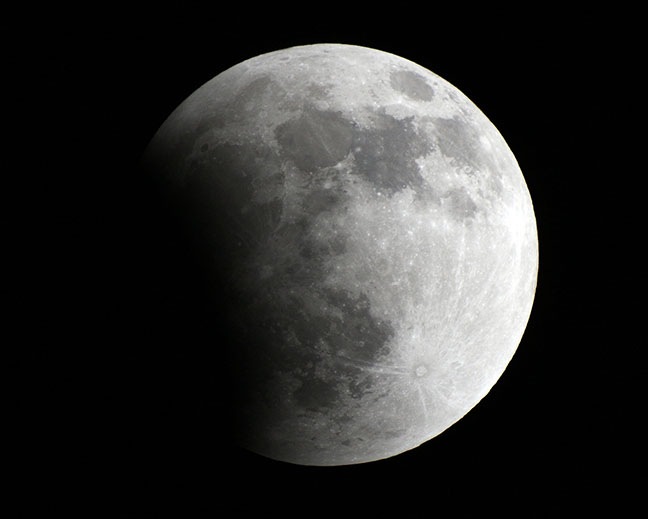
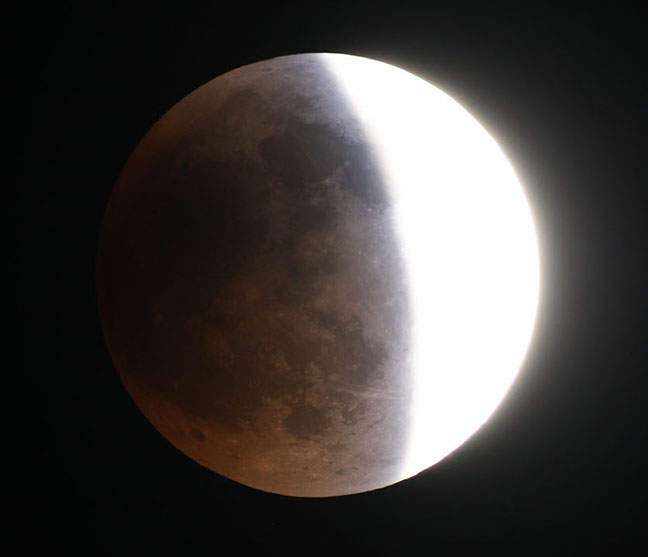
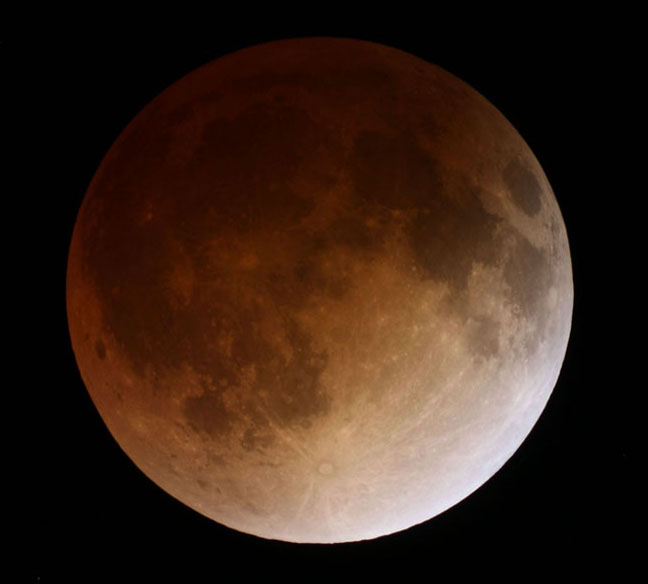
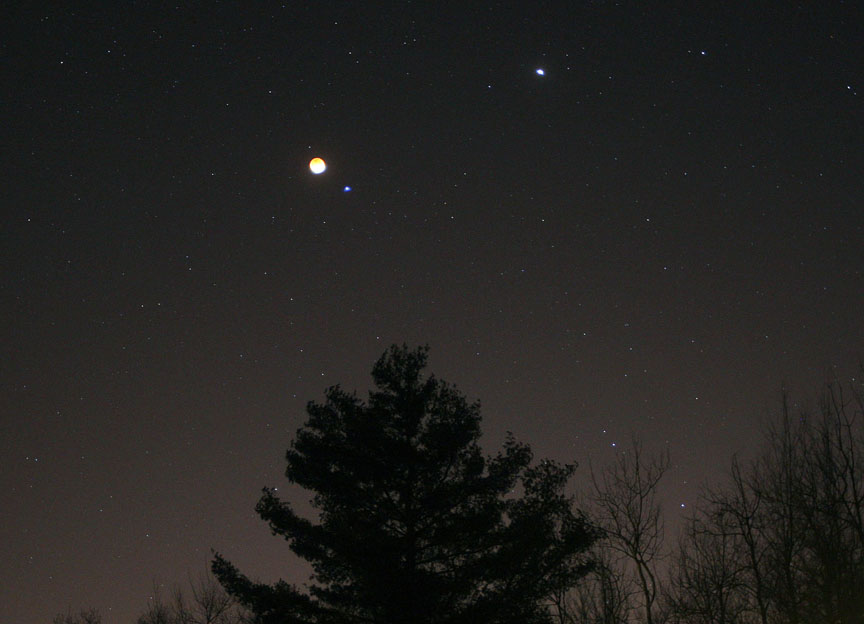
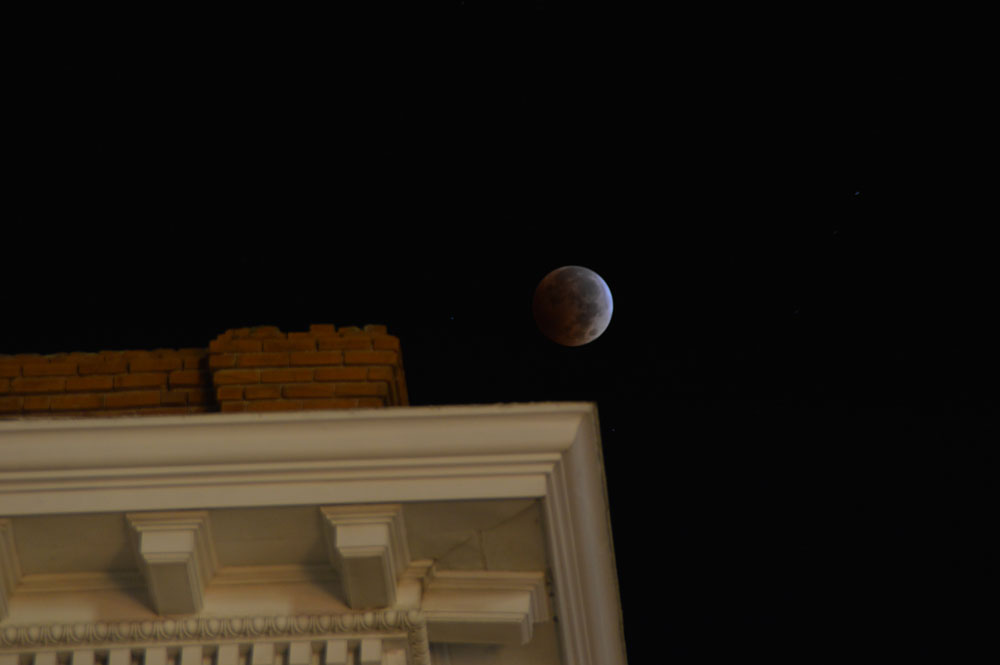
Did you see it? On October 8, 2014, early risers in North and South America, east Asia, Australia and the Pacific saw unique and rare views of the Hunter’s Moon as was eclipsed by Earth’s shadow. We’ve got so many great pictures to share from our Flickr group and from social media! In some shots, the fully eclipsed Moon glows with a coppery red hue, and in others the partially eclipsed Moon appears to have a bite taken out of its bright surface. Some images pair the Moon with a faint planet Uranus.
This is the second and final total lunar eclipse of 2014, and the second of four in a quartet series of lunar eclipses known as a tetrad — a series of 4 consecutive total eclipses occurring at approximately six month intervals. The next total eclipse will be on April 4, 2015, with another occurring on Sept. 28, 2015.

Enjoy the images below!


Montage of the various views of the Moon during the lunar eclipse on October 8, 2014. Credit and copyright: Chuck Manges.


Montage of the various views of the Moon during the lunar eclipse on October 8, 2014. Credit and copyright: Chuck Manges.
Near-totality eclipsed Moon, in Pisces, with Uranus at left. Delta Psc is that brightest star at upper-right of Moon. Imaged near Calabash, North Carolina. Credit and copyright: Tavi Greiner.


Near-totality eclipsed Moon, in Pisces, with Uranus at left. Delta Psc is that brightest star at upper-right of Moon. Imaged near Calabash, North Carolina. Credit and copyright: Tavi Greiner.
The red 'blood Moon' of the October 8, 2014 lunar eclipse, as seen from the Mare Island Observatory. Credit and copyright: Clifton Reed.


The red ‘blood Moon’ of the October 8, 2014, lunar eclipse, as seen from the Mare Island Observatory. Credit and copyright: Clifton Reed.
The eclipsed Moon sets over the Andes (Mts. Lopez and Capilla, Bariloche). Credit and copyright: Guillermo Abramson.


The eclipsed Moon sets over the Andes (Mts. Lopez and Capilla, Bariloche). Credit and copyright: Guillermo Abramson.
Total Lunar Eclipse through the clouds as seen from Weatherly, PA on October 8, 2014. Credit and copyright: Tom Wildoner.


Total Lunar Eclipse through the clouds as seen from Weatherly, PA on October 8, 2014. Credit and copyright: Tom Wildoner.
'Eclipse on the edge,' shot from the front of the Mizpah Hotel in Tonopah, Nevada. Credit and copyright: David Dickinson.


‘Eclipse on the edge,’ shot from the front of the Mizpah Hotel in Tonopah, Nevada. Credit and copyright: David Dickinson.
Last moments of the eclipse as seen from Calama, Chile. Credit and copyright: srta Andrea on Flickr.


Last moments of the eclipse as seen from Calama, Chile. Credit and copyright: srta Andrea on Flickr.
The October 8th 2014 lunar eclipse from Houston, Texas, taken with a 500m lens featuring a statue of Sam Houston. Credit and copyright: Sergio Garcia Rill.


The October 8th, 2014, lunar eclipse from Houston, Texas, taken with a 500m lens featuring a statue of Sam Houston. Credit and copyright: Sergio Garcia Rill.
Image of the lunar eclipse taken just before the midpoint of totality. Taken with a modified Canon 450D + Celestron C6-N telescope. f/4 ISO400 4s exposure. Credit and copyright: Fred Locklear.


Image of the lunar eclipse taken just before the midpoint of totality. Taken with a modified Canon 450D + Celestron C6-N telescope. f/4 ISO400 4s exposure. Credit and copyright: Fred Locklear.
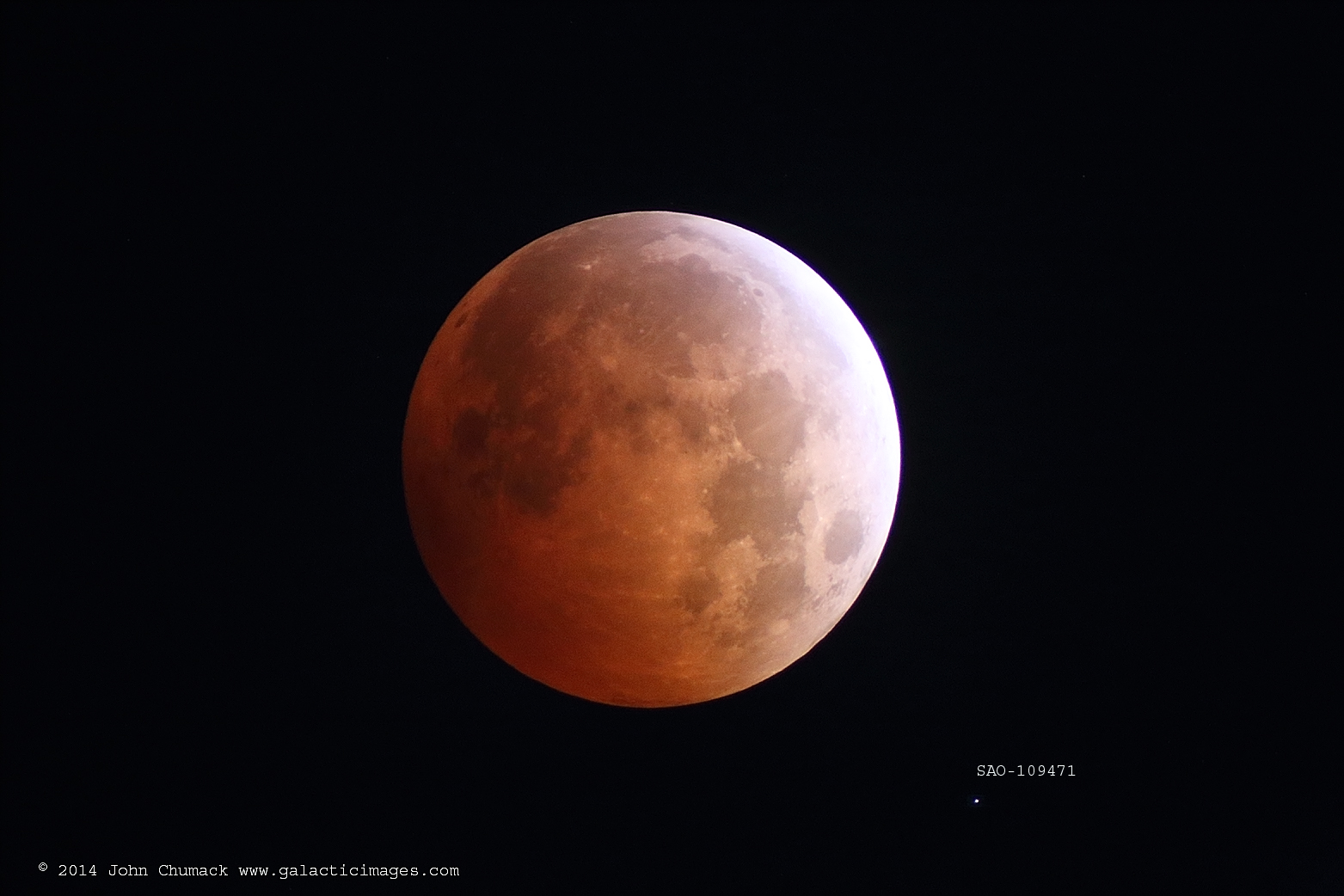
Lunar Eclipse on 10-08-2014 Huffman Dam, Dayton, Ohio Canon 6D, 80mm refractor,2x Barlow (1200mm) ISO 6400, 2 sec exposure. Credit and copyright: John Chumack/Galactic Images.


Lunar Eclipse on 10-08-2014
Huffman Dam, Dayton, Ohio
Canon 6D, 80mm refractor,2x Barlow (1200mm) ISO 6400,
2 sec exposure. Credit and copyright: John Chumack/Galactic Images.
@Nancy_A I managed to see it and got a pic after clouds and snow got out of the way in Jellicoe Ont. pic.twitter.com/TiHDLGxwCM

— Bill Magee (@88skywatcher88) October 8, 2014
@fcain @starstryder these photos were taken on my phone with a 11 inch dobsonian telescope at the Perth Observatory pic.twitter.com/xhqnNalpqM

— Matt Woods (@matty_woods) October 8, 2014
#BloodMoon at treetops 08OCT2014, 06:25:25 EST! @universetoday @CanonUSA @triadlivingmag @WFMY @WXII @weatherchannel pic.twitter.com/9Kz1yVCVGn

— J Farley Photography (@jfarleyphoto) October 8, 2014
Want to get your astrophoto featured on Universe Today? Join our Flickr group or send us your images by email (this means you’re giving us permission to post them). Please explain what’s in the picture, when you took it, the equipment you used, etc.

Tagged as: Astrophotos, blood moon, eclipse, hunter's moon, lunar eclipse

Magical Images From Two Prolific Astronaut Tweeters Doing Their First Spacewalk

Magical Images From Two Prolific Astronaut Tweeters Doing Their First Spacewalk:

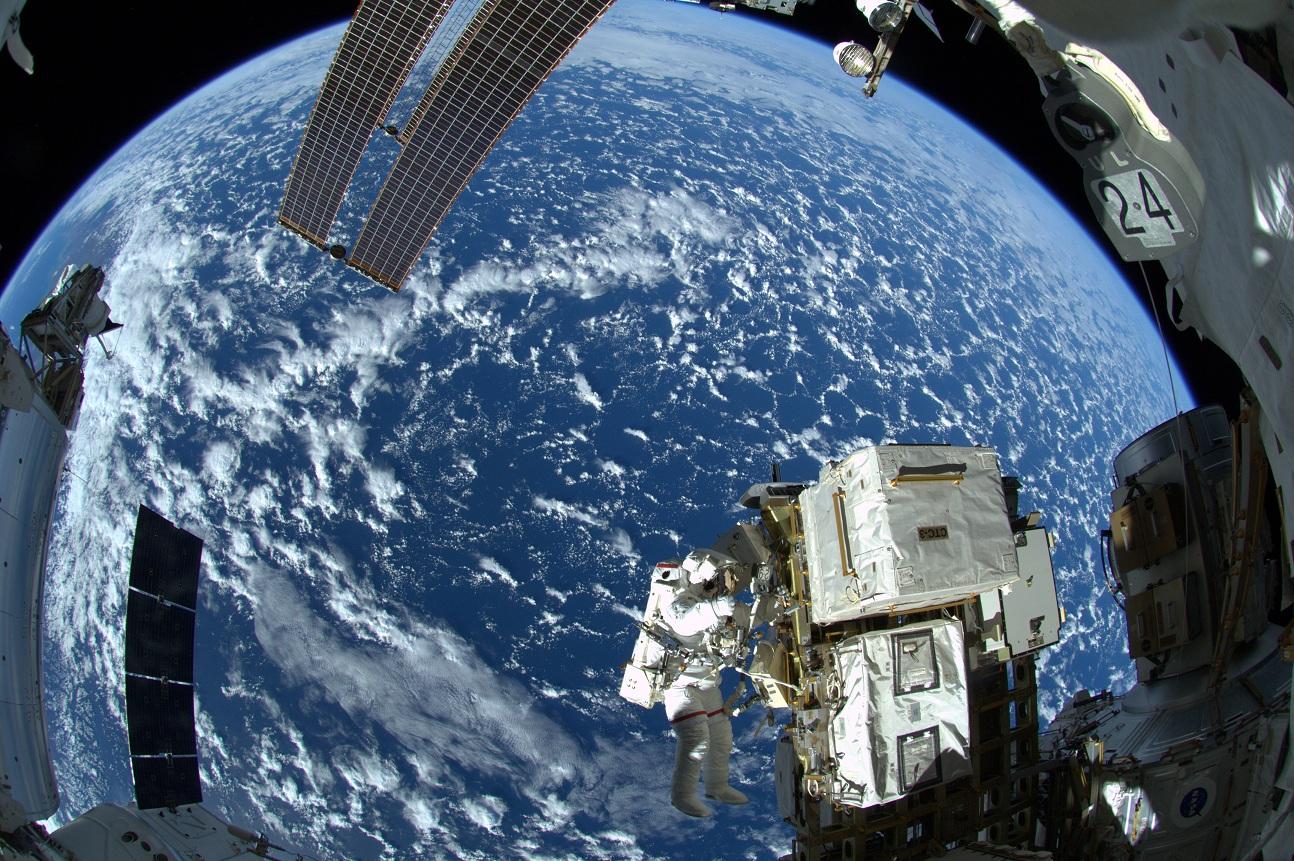
Photo of a spacewalker at work on the International Space Station on Oct. 7, 2014. "I don't have words to describe what we did today, but this photo gives a pretty good impression!" wrote European Space Agency astronaut (and spacewalk participant) Alexander Gerst on Twitter as a caption to this photo. Credit: Alexander Gerst / Twitter


Photo of a spacewalker at work on the International Space Station on Oct. 7, 2014. “I don’t have words to describe what we did today, but this photo gives a pretty good impression!” wrote European Space Agency astronaut (and spacewalk participant) Alexander Gerst on Twitter as a caption to this photo. Credit: Alexander Gerst / Twitter
What happens when you send two prolific social media astronauts out on a spacewalk? The best photos ever. Reid Wiseman (NASA) and Alexander Gerst (European Space Agency) both participated in their first extra-vehicular activity yesterday, and sent back amazing pictures of what the view looked like outside their visors.

Their comments are also fun: “reasonably INSANE” and “learning to fly” are among the phrases they put on Twitter, which you can see in the photo gallery below. The spacewalkers accomplished the major task of yesterday’s spacewalk, placing a failed International Space Station pump module in a permanent location, and doing a couple of minor maintenance tasks.

The view was reasonably INSANE during the #spacewalk pic.twitter.com/V8PbaPo2Rg

— Reid Wiseman (@astro_reid) October 7, 2014
Learning to fly. #EVA27 #selfie pic.twitter.com/LmoYKLaIJt — Alexander Gerst (@Astro_Alex) October 8, 2014
What an experience and an honor to share it with @Astro_Alex pic.twitter.com/3WACwhCPOQ

— Reid Wiseman (@astro_reid) October 7, 2014
Safe to say, this was the most amazing thing I have done in my life. #spacewalk #EVA27 pic.twitter.com/HiX6ZrN0U7 — Alexander Gerst (@Astro_Alex) October 8, 2014

Guilty pleasure to turn the camera upon thyself during a #spacealk pic.twitter.com/ivCZ4rxNyF

— Reid Wiseman (@astro_reid) October 7, 2014
My friend @astro_reid doing what he’s good at. #EVA27 #spacewalk https://t.co/iYXV91FvXi pic.twitter.com/8SzrIJUwRm — Alexander Gerst (@Astro_Alex) October 8, 2014
And here’s a bonus for those who scrolled to the end of this post — the first Vine video posted real-time during a spacewalk! This comes courtesy of NASA’s account. Click on the video to access the audio, which is Reid Wiseman exclaiming on the view over southern South America.


Tagged as: alexander gerst, Expedition 42, reid wiseman

Comet Siding Spring: Close Call for Mars, Wake Up Call for Earth?

Comet Siding Spring: Close Call for Mars, Wake Up Call for Earth?:

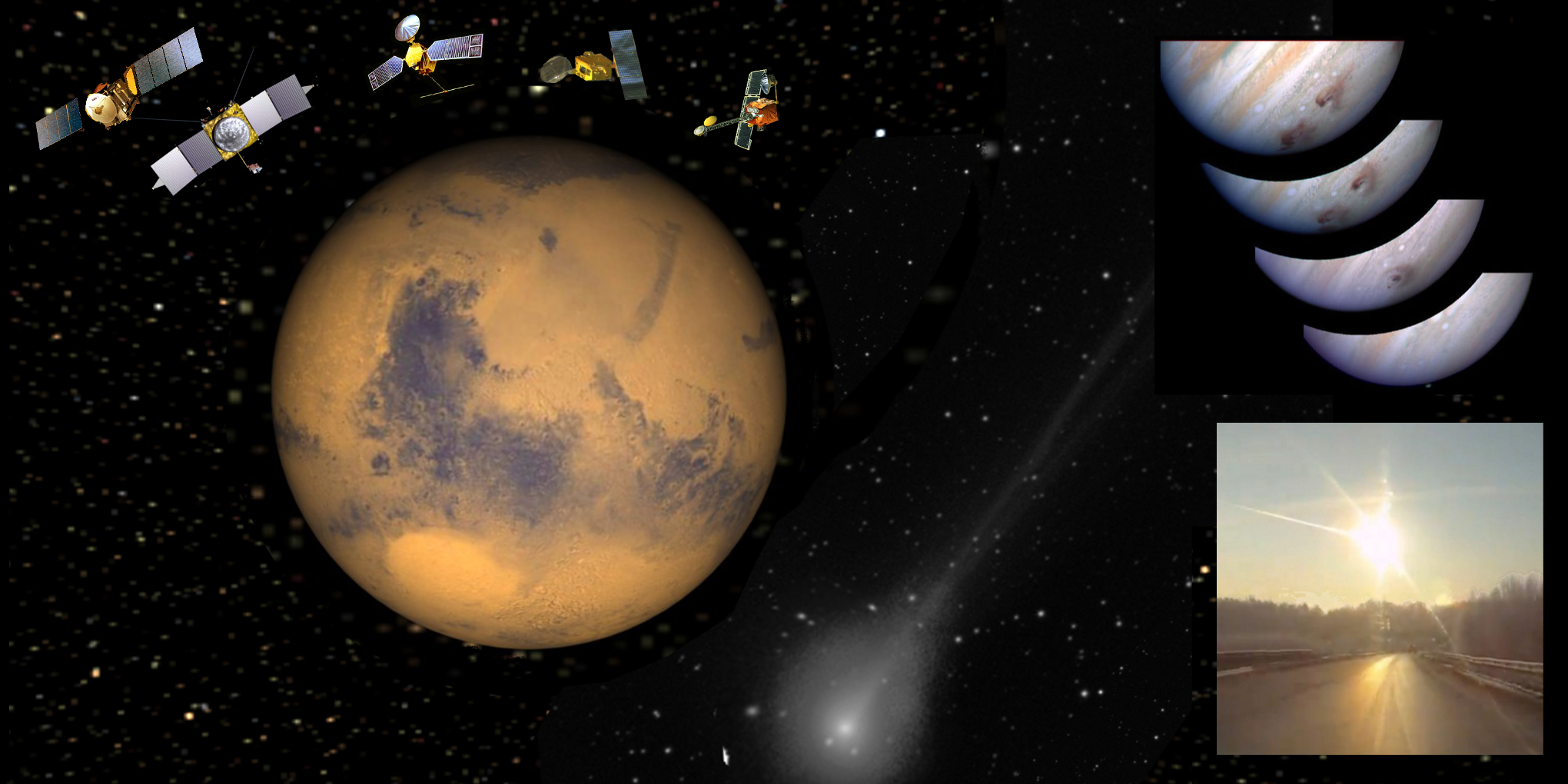
Five orbiters from India, the European Union and the United States will nestle behind the Mars as comet Siding Springs passes at a speed of 200,000 km/hr (125,000 mph). At right, Comet Shoemaker-Levy 9 impacts on Jupiter, the Chelyabinsk Asteroid over Russia. (Credits: NASA,ESA, ISRO)


Five orbiters from India, the European Union and the United States will nestle behind Mars as comet Siding Springs passes at a speed of 200,000 km/hr (125,000 mph). At right, Shoemaker-Levy 9 impacts on Jupiter, the Chelyabinsk Asteroid over Russia. (Credits: NASA,ESA, ISRO)
It was 20 years ago this past July when images of Jupiter being pummeled by a comet caught the world’s attention. Comet Shoemaker-Levy 9 had flown too close to Jupiter. It was captured by the giant planet’s gravity and torn into a string of beads. One by one the comet fragments impacted Jupiter — leaving blemishes on its atmosphere, each several times larger than Earth in size.

Until that event, no one had seen a comet impact a planet. Now, Mars will see a very close passage of the comet Siding Spring on October 19th. When the comet was first discovered, astronomers quickly realized that it was heading straight at Mars. In fact, it appeared it was going to be a bulls-eye hit — except for the margin of error in calculating a comet’s trajectory from 1 billion kilometers (620 million miles, 7 AU) away.

It took several months of analysis for a cataclysmic impact on Mars to be ruled out. So now today, Mars faces a just a cosmic close shave. But this comet packs enough energy that an impact would have globally altered Mars surface and atmosphere.

So what should us Earthlings gather from this and other events like it? Are we next? Why or why not should we be prepared for impacts from these mile wide objects?

For one, ask any dinosaur and you will have your answer.

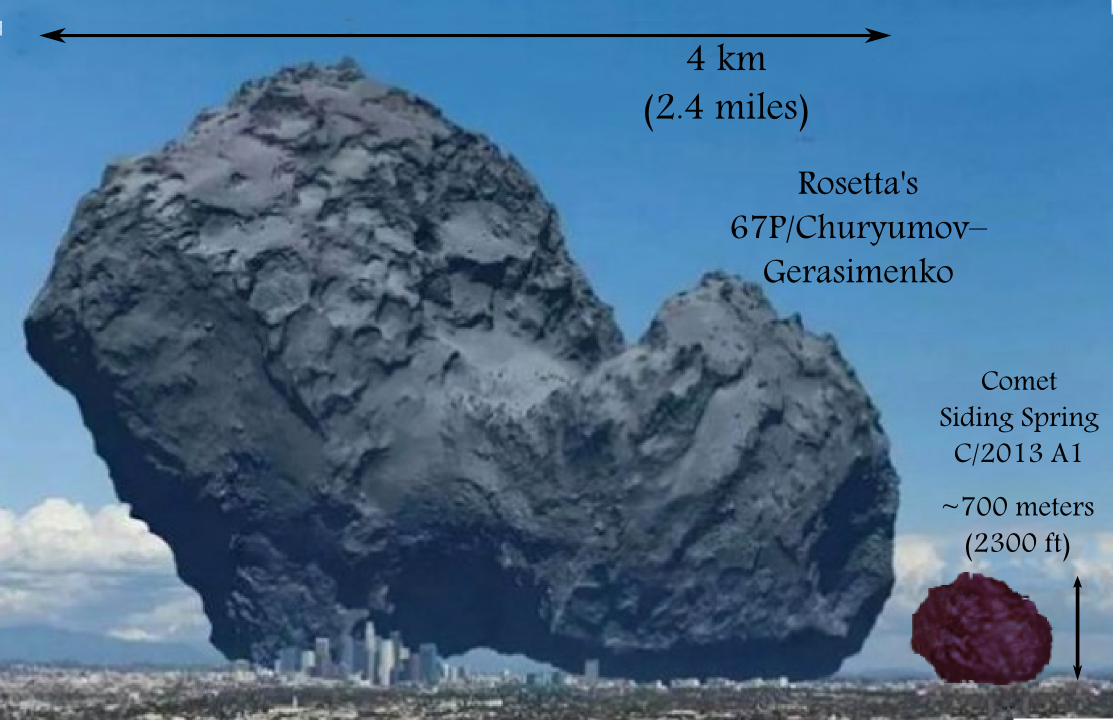
Adding Siding Spring to the Comet 67P atop Los Angeles provides a rough comparison of sizes. This images was expanded upon U.T.'s Bob King - "What Comets, Parking Lots and Charcoal Have in Common". (Credit: ESA, anosmicovni)


An illustration of the Siding Spring comet in comparison to the Comet 67P atop Los Angeles. The original image was the focus of Bob King’s article – “What Comets, Parking Lots and Charcoal Have in Common“. (Credit: ESA, anosmicovni)
One can say that Mars was spared and also the five orbiting spacecraft from India (Mars Orbiter Mission), the European Union (Mars Express) and the United States (MOD,MRO,MAVEN). We have Scottish-Australian astronomer Robert McNaught to thank for discovering the comet on January 3, 2013 using the half meter (20 inch) Uppsala Southern Schmidt Telescope at Siding Spring, Australia.

Initially the margin of error in the trajectory was large, but a series of observations gradually reduced the error. By late summer 2014, Mars was in the clear and astronomers could confidently say the comet would pass close but not impact. Furthermore, as observations accumulated — including estimates of the outpouring of gases and dust — comet Siding Spring shrunk in size, i.e. the estimates of potentially tens of kilometers were down to now 700 meters (4/10th of a mile) in diameter. Estimates of the gas and dust production are low and the size of the tail and coma — the spherical gas cloud surrounding the solid body — are small and only the outer edge of both will interact with Mars’ atmosphere.

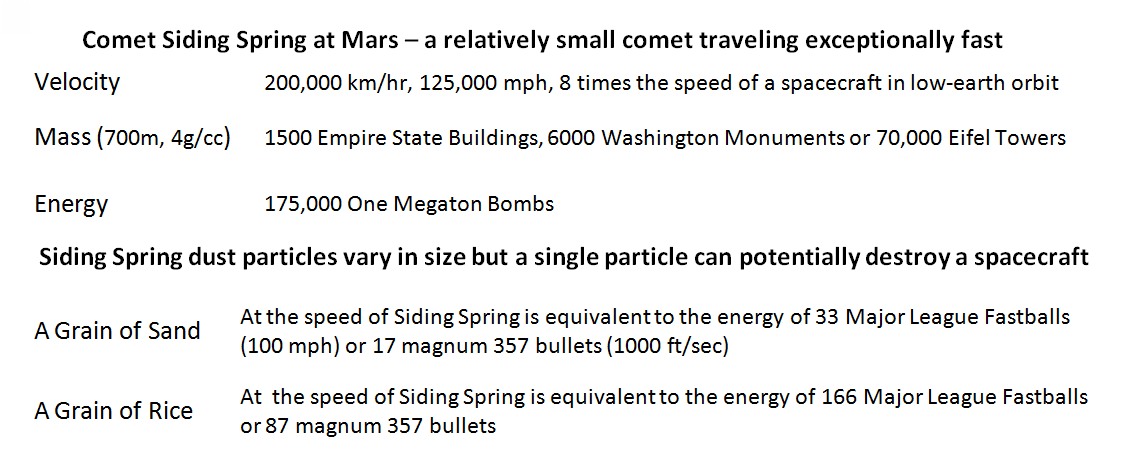
The mass, velocity and kinetic energy of celestial bodies can be deceiving. It is useful to compare the Siding Spring comet to common or man-made objects.


The mass, velocity and kinetic energy of celestial bodies can be deceiving. It is useful to compare the Siding Spring comet to common or man-made objects.
Yet, this is a close call for Mars. We could not rule out a collision for over six months. While this comet is small, it is moving relative to Mars at a speed of 200,000 kilometers/hour (125,000 mph, 56 km/sec). This small body packs a wallop. From high school science or intro college Physics, many of us know that the kinetic energy of an object increases by the square of the velocity. Double the velocity and the energy of the object goes up by 4, increase by 3 – energy increases by 9.

So the close shave for Mars is yet another wake up call for the “intelligent” space faring beings of the planet Earth. A wake up call because the close passage of a comet could have just as easily involved Earth. Astronomers would have warned the world of a comet heading straight for us, one that could wipe out 70% of all life as happened 65 million years ago to the dinosaurs. Replace dinosaur with humans and you have the full picture.

Time would have been of the essence. The space faring nations of the world — those of the ESA, and Russia, the USA, Japan and others — would have gathered and attempted to conceive some spacecrafts with likely nuclear weapons that could be built and launched within a few months. Probably several vehicles with weapons would be launched at once, leaving Earth as soon as possible. Intercepting a comet or asteroid further out would give the impulse from the explosions more time to push the incoming body away from the Earth.

There is no way that humanity could sit on their collective hands and wait for astronomers to observe and measure for months until they could claim that it would just be a close call for Earth. We could imagine the panic it would cause. Recall the scenes from Carl Sagan’s movie Contact with people of every persuasion expressing at 120 decibels their hopes and fears. Even a small comet or asteroid, only a half kilometer – a third of a mile in diameter would be a cataclysmic event for Mars or Earth.

But yet, in the time that has since transpired from discovery of the comet Siding Spring (1/3/2013), the Chelyabinsk asteroid (~20 m/65 ft) exploded in an air burst that injured 1500 people in Russia. The telescope that discovered Comet Siding Spring was decommissioned in late 2013 and the Southern Near-Earth Object Survey was shutdown. This has left the southern skies without a dedicated telescope for finding near-Earth asteroids. And proposals such as the Sentinel project by the B612 Foundation remain underfunded.

We know of the dangers from small celestial bodies such as comets or asteroids. Government organizations in the United States and groups at the United Nations are discussing plans. There is plenty of time to find and protect the Earth but not necessarily time to waste.

Previous U.T. Siding Spring stories:
What Comets, Parking Lots and Charcoal Have in Common“, Bob King, Sept 5, 2014
MAVEN Mars Orbiter Ideally Poised to Uniquely Map Comet Siding Spring Composition
– Exclusive Interview with Principal Investigator Bruce Jakosky”, Ken Kremer“, Sept 5, 2014
NASA Preps for Nail-biting Comet Flyby of Mars“, BoB King, July 26,2014


Tagged as: asteroid, comet, esa, Impacts, ISRO, Mars, Mars Express, MAVEN, MOM, MRO, NASA, Siding Spring