Wednesday, October 8, 2014

Suspected Black Hole Unmasked as Ultraluminous Pulsar

Suspected Black Hole Unmasked as Ultraluminous Pulsar:

M82

An Ultraluminous X-ray Source (ULX) that astronomers had thought was a black hole is really the brightest pulsar ever recorded. ULXs are objects that produce more X-rays than most "normal" X-ray binary systems, in which a star is orbiting a neutron star or a stellar-mass black hole. Black holes in these X-ray binary systems generally weigh about five to thirty times the mass of the sun.

Astronomers used NASA's NuSTAR (Nuclear Spectroscopic Telescope Array) and Chandra X-ray Observatory to study two ULXs in the center of M82, a galaxy located just over 11 million light years from Earth. This composite image shows X-rays from NuSTAR (purple) and Chandra (blue) that have been combined with optical data from the NRAO 2.1 meter telescope (gold). The extended X-ray emission is unrelated to the two ULXs.

Until now, astronomers have thought that matter falling onto black holes powered the bright X-ray emission in all ULXs. Most of the black holes in ULXs are thought to weigh at least 10 to 50 times the mass of the Sun, but some of the brightest ULXs are thought to weigh 100 times the Sun's mass, or more.

The new X-ray data provide a critical clue to the nature of one of the ULXs in M82. Using NuSTAR, scientists have discovered regular variations, or "pulsations," in the object known as M82X-2. This object pulses once on average every 1.37 seconds, and pulsations change in a regular pattern with a period of 2.5 days.

These types of pulsations are not seen with black holes. Rather, they are the signatures of so-called pulsars, rapidly rotating neutron stars. The apparent shifts in the pulsation period are due to the motion of the star in its orbit. Assuming that the pulsar weighs 1.4 times the mass of the Sun (the common size of a pulsar or neutron star), the data imply that the companion star's mass is at least 5.2 times the mass of the Sun.

More information at http://chandra.harvard.edu/photo/2014/m82nu/index.html

-Megan Watzke, CXC

A 'Comet' Lands in Pasadena

A 'Comet' Lands in Pasadena:

The interactive comet sculpture
Add caption
The interactive comet sculpture "Metamorphosis" is on display during the AxS Festival, an arts and sciences celebration in Pasadena, California. Image credit: NASA/JPL-Caltech

› Larger image
AxS (pronounced axis) is a citywide festival produced by the Pasadena Arts Council that celebrates the California town as the "City of Art and Science." It runs through Oct. 5.

JPL space science-related highlights of the festival include:

"Metamorphosis"
Nine-feet-high and lit from within, this steel sculpture emits a fine water mist and was inspired by the comet which the Rosetta spacecraft is currently orbiting. The sculpture will also be on display at the JPL Open House, Oct. 11 and 12.

"REALSPACE"
Data and imagery from NASA's Curiosity Mars rover, the Dawn mission's exploration of giant asteroid Vesta, and the optical science of light and space are the subjects of various works in this exhibition.

For specific dates, times, locations and other information on all AxS events, visit:
http://axsfestival.org/2014/

For details regarding the free 2014 JPL Open House, see:
http://www.jpl.nasa.gov/news/news.php?release=2014-330

Media Contact

Stephanie L. Smith

Jet Propulsion Laboratory, Pasadena, Calif.

slsmith@jpl.nasa.gov

818-393-5464

2014-337

NASA Holds Teleconference on NuSTAR Discovery

NASA Holds Teleconference on NuSTAR Discovery:

Artist's concept of NuSTAR on orbit. Artist's concept of NuSTAR on orbit. NuSTAR has a 10-m (30') mast that deploys after launch to separate the optics modules (right) from the detectors in the focal plane (left). Image credit: NASA/JPL-Caltech

› Full image and caption
NASA will host a news teleconference at 10 a.m. PDT (1 p.m. EDT) Wednesday, Oct. 8, to announce new findings from its Nuclear Spectroscopic Telescope Array (NuSTAR) mission. The results describe an unusual source of X-rays that will leave theorists scratching their heads, but also will help astronomers learn more about how black holes and galaxies are formed.

Details of the findings are under embargo by the journal Nature until 10 a.m. PDT (1 p.m. EDT), Oct. 8.

Participants in the teleconference are:

-- Paul Hertz, director of astrophysics division, NASA Headquarters, Washington

-- Fiona Harrison, NuSTAR principal investigator, California Institute of Technology, Pasadena

-- Matteo Bachetti, astronomer, University of Toulouse, France

-- Jeanette Gladstone, astronomer, University of Alberta, Canada

Audio of the teleconference will be streamed live at:

http://www.nasa.gov/newsaudio

Visuals will be posted at the start of the event at:

http://www.nasa.gov/jpl/nustar/telecon

Audio and supporting visuals will be streamed live at:

http://www.ustream.tv/NASAJPL2

For more information on NuSTAR, visit:

http://www.nasa.gov/nustar

Media Contact

Whitney Clavin Jet Propulsion Laboratory, Pasadena, Calif.

818-354-4673

whitney.clavin@jpl.nasa.gov

Felicia Chou
NASA Headquarters,
Washington
202-358-0257
felicia.chou@nasa.gov

2014-339

NASA Holds Briefing to Discuss Comet Flyby of Mars Observations

NASA Holds Briefing to Discuss Comet Flyby of Mars Observations:

Artist's concept of comet Siding Spring (C/2013 A1) heading toward Mars. Artist's concept of comet Siding Spring (C/2013 A1) heading toward Mars. Image Credit: NASA

› Larger image
NASA will host a briefing at 11 a.m. PDT (2 p.m. EDT) Thursday, Oct. 9, to outline the space and Earth-based assets that will have extraordinary opportunities to image and study a comet from relatively close range to Mars on Sunday, Oct. 19.

The briefing will be held at NASA Headquarters' and broadcast live on NASA Television and the agency's website.

Comet C/2013 A1 Siding Spring will miss Mars by only about 88,000 miles (139,500 kilometers). That is less than half the distance between Earth and its moon and less than one-tenth the distance of any known comet flyby of Earth. The comet's nucleus will come closest to Mars at about 11:27 a.m. PDT (2:27 p.m. EDT), hurtling at about 126,000 mph (56 kilometers per second), relative to Mars.

The concerted campaign of observations by multiple spacecraft at Mars and by numerous NASA assets is directed at the comet and its effect on the Martian atmosphere. The observations of the comet may yield fresh clues to our solar system's earliest days more than four billion years ago.

Panelists include:

- Jim Green, director, Planetary Science Division (PSD), NASA Headquarters, Washington

- Kelly Fast, program scientist, PSD

- Carey Lisse, senior astrophysicist, Johns Hopkins University Applied Physics Laboratory, Laurel, Maryland

- Padma Yanamandra-Fisher, senior research scientist, Space Science Institute, Rancho Cucamonga Branch, California

The public may ask questions on social media using the hashtag #askNASA.

The news conference will be available live and archived on:

http://www.ustream.tv/nasajpl

For more about the comet, visit:

http://mars.nasa.gov/comets/sidingspring

For NASA Television downlink information, scheduling information and streaming video, visit: http://www.nasa.gov/nasatv

Media Contact

D.C. Agle/Guy Webster

Jet Propulsion Laboratory, Pasadena, Calif.

818-393-9011/818-354-6278

agle@jpl.nasa.gov/guy.webster@jpl.nasa.gov

Dwayne Brown

NASA Headquarters, Washington

202-358-1726

dwayne.c.brown@nasa.gov

2014-340

Sunday, October 5, 2014

Glorious Global 3-D Mars from ISRO’s MOM and ESA’s Rosetta

Glorious Global 3-D Mars from ISRO’s MOM and ESA’s Rosetta:

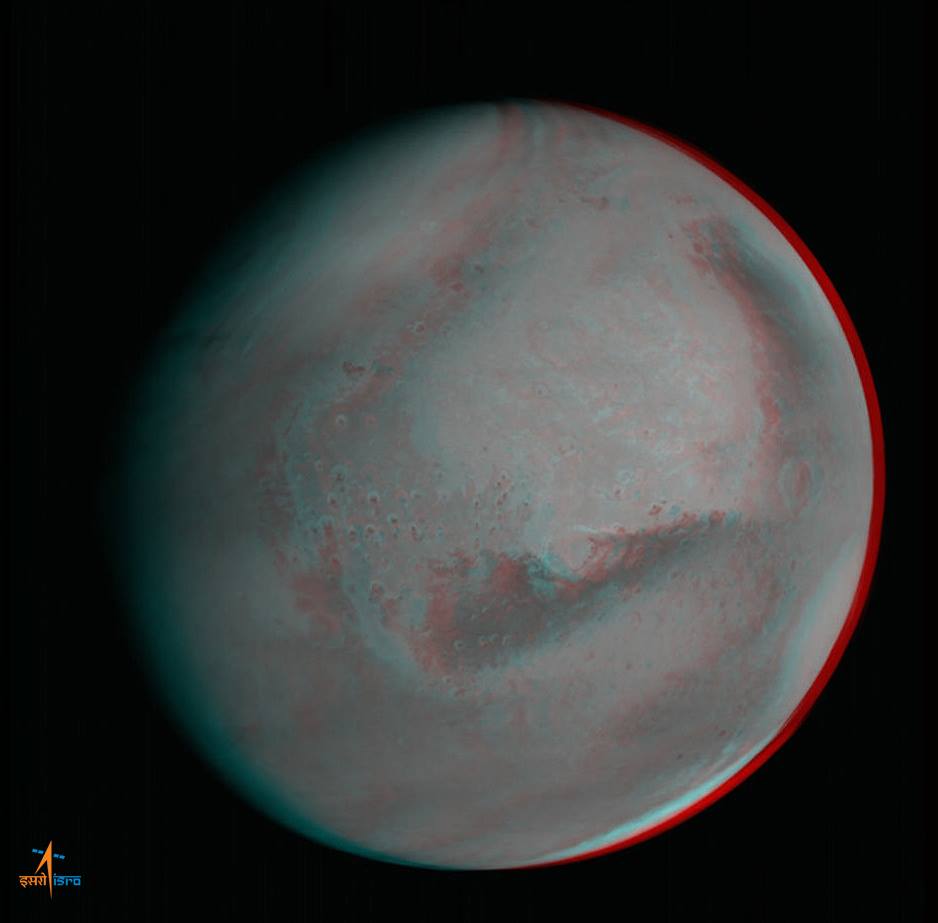
3-D image of Mars generated from multiple pictures acquired by Mars Color Camera on-board Mars Orbiter Spacecraft on Sept 28, 2014. Credit: ISRO


3-D image of Mars generated from multiple pictures acquired by Mars Color Camera on-board Mars Orbiter Spacecraft on Sept 28, 2014. 3-D red/blue glasses required. Credit: ISRO
Here’s another breathtakingly glorious view from India’s Mars Orbiter Mission (MOM) – her first global 3-D portrait of her new home careening around the Red Planet.

MOM is India’s first deep space voyager to explore beyond the confines of her home planet’s influence and just successfully arrived at the Red Planet after the “history creating” orbital insertion maneuver on Sept. 23/24 following a ten month journey.

This newly released 3-D view from MOM expands upon the initial 2-D global color view of Mars released by the Indian Space Research Organization (ISRO), India’s space agency. See below and detailed in my earlier story – here.

The 3-D image was generated from multiple pictures acquired by MOM’s on-board Mars Color Camera on Sept 28, 2014, from the very high altitude of approximately 74,500 kilometers as the spacecraft orbits Mars.

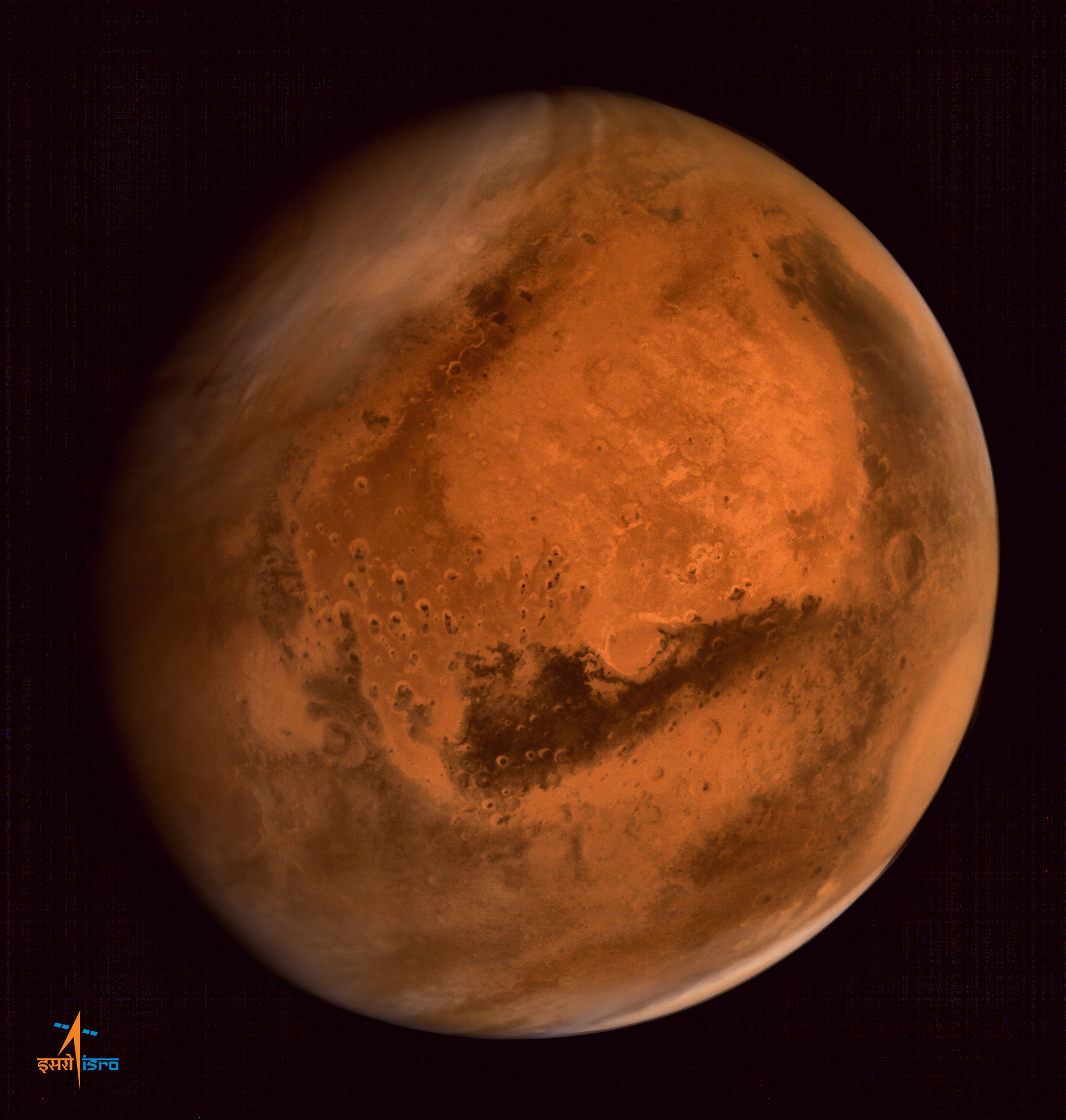
ISRO's Mars Orbiter Mission captures spectacular portrait of the Red Planet and swirling dust storms with the on-board Mars Color Camera from an altitude of 74500 km on Sept. 28, 2014. Credit: ISRO


ISRO’s Mars Orbiter Mission captures spectacular portrait of the Red Planet and swirling dust storms with the on-board Mars Color Camera from an altitude of 74,500 km on Sept. 28, 2014. Credit: ISRO
The images were taken by the tri-color camera as MOM swooped around the Red Planet in a highly elliptical orbit whose nearest point to Mars (periapsis) is at 421.7 km and farthest point (apoapsis) at 76,993.6 km, according to ISRO.

Therefore, the 3-D Red Planet portrait was captured nearly at apoapsis. And being three dimensional, it gives a stereo sense of the huge dust storm swirling over a large swath of the planet’s Northern Hemisphere set against the blackness of space.

Below right is the southern polar ice cap. To see the 3-D effect, whip out your handy pair of left-eye red, right-eye blue color anaglyph glasses.

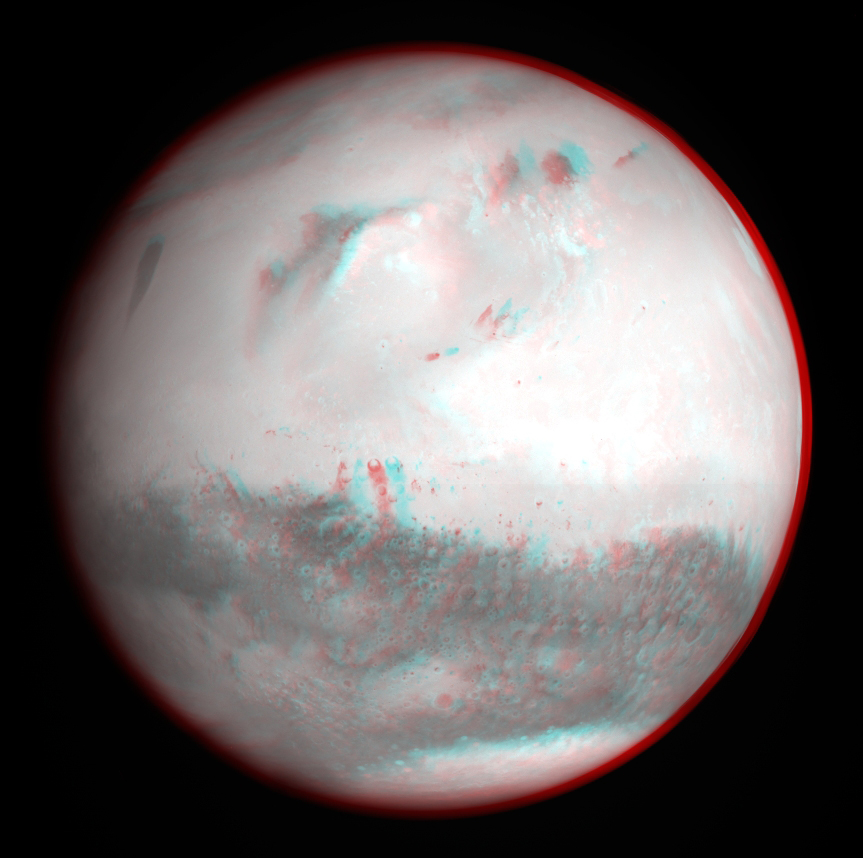
And while we’re on the subject of spacely 3-D, it’s worth noting that another of humanity’s ground breaking probes currently making news – ESA’s comet hunting Rosetta probe – likewise snapped a glorious 3-D view of Mars way back in 2007, during the brief, but critical, gravity assist slingshot maneuver that flung Rosetta along her vast 10 year path through interplanetary space.

So by way of comparison let’s take a trip down memory lane and be sure to look back at Rosetta’s global 3-D Martian views (below) taken by the high resolution OSIRIS camera on 24 February 2007 at 19:28 CET from a distance of about 240,000 kilometers.

Mars 3-D anaglyph (black & white) taken by ESA’s Rosetta spacecraft during Mars flyby on 24 February 2007 from a distance of about 240 000 km. Image resolution is about 5 km. Credit: MPS for OSIRIS Team MPS/UPD/LAM/ IAA/ RSSD/ INTA/ UPM/ DASP/ IDA


Mars 3-D anaglyph (black & white) taken by ESA’s Rosetta spacecraft during Mars flyby on 24 February 2007 from a distance of about 240,000 km. Image resolution is about 5 km. Credit: MPS for OSIRIS Team MPS/UPD/LAM/ IAA/ RSSD/ INTA/ UPM/ DASP/ IDA
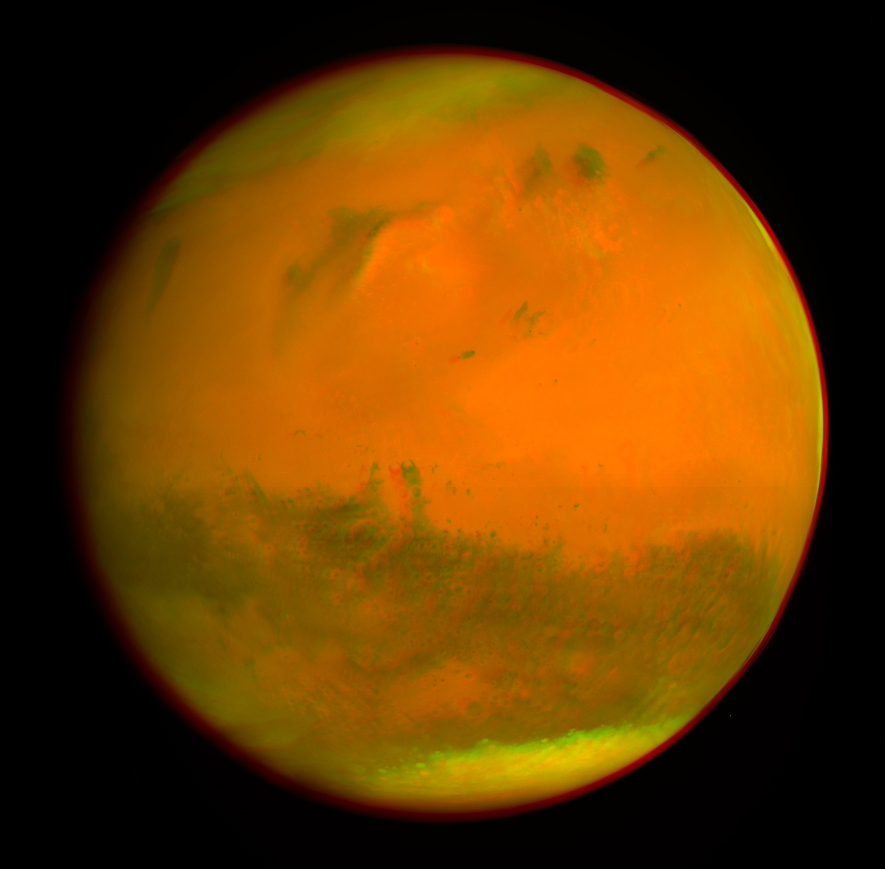
The Rosetta team created both color and black & white 3-D views of Mars.

Mars 3-D anaglyph (color) taken by ESA’s Rosetta spacecraft during Mars flyby on 24 February 2007 from a distance of about 240 000 km. Image resolution is about 5 km. Credit: MPS for OSIRIS Team MPS/UPD/LAM/ IAA/ RSSD/ INTA/ UPM/ DASP/ IDA


Mars 3-D anaglyph (color) taken by ESA’s Rosetta spacecraft during Mars flyby on 24 February 2007 from a distance of about 240,000 km. Image resolution is about 5 km. Credit: MPS for OSIRIS Team MPS/UPD/LAM/ IAA/ RSSD/ INTA/ UPM/ DASP/ IDA
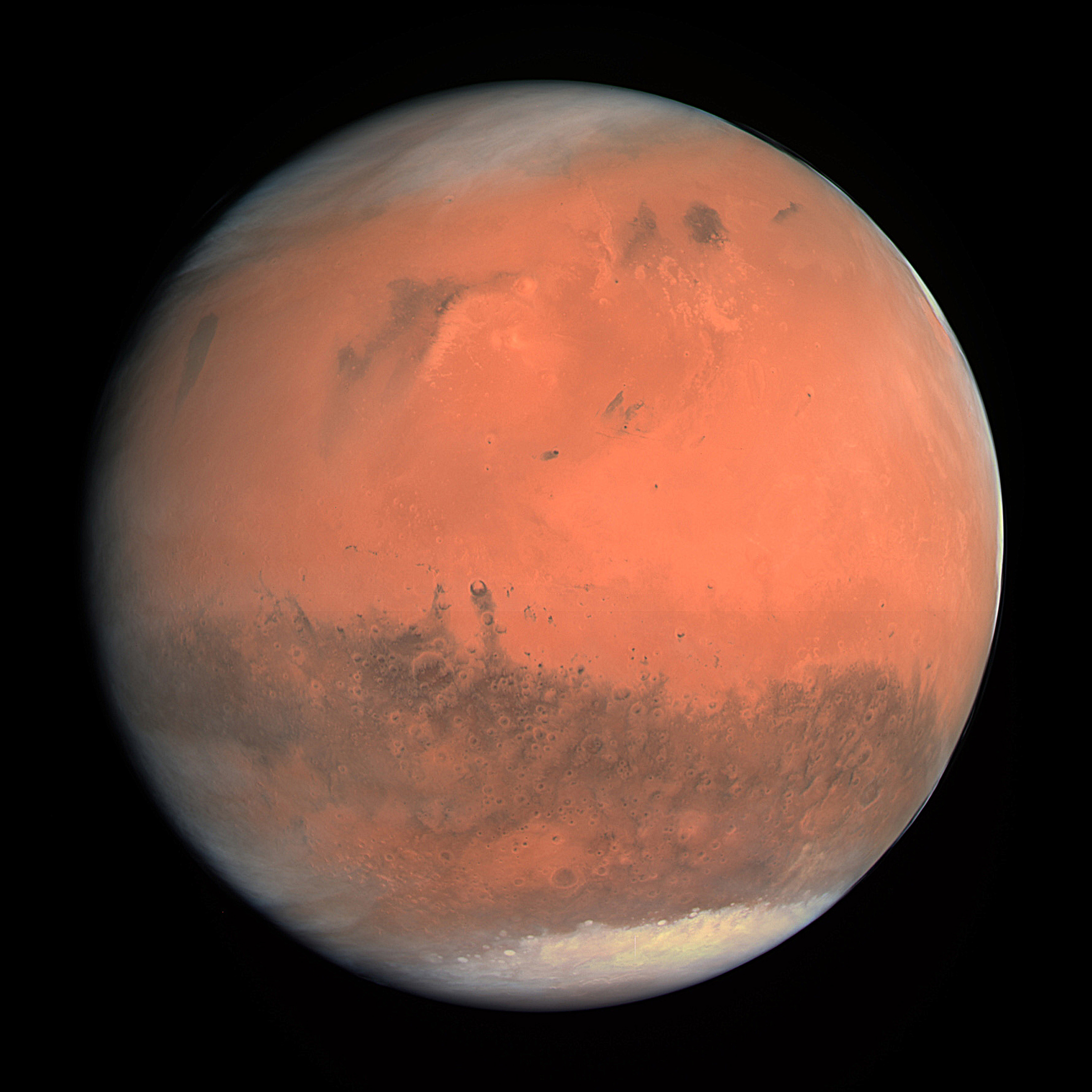
And be sure to check out Rosetta’s 2-D true color view showing a different swatch of the Red Planet compared to MOM, along with a more expansive view of the southern polar ice cap.

The first true-colour image of Mars from ESA’s Rosetta generated using the OSIRIS orange (red), green and blue colour filters. The image was acquired on 24 February 2007 at 19:28 CET from a distance of about 240 000 km; image resolution is about 5 km/pixel. Credit: MPS for OSIRIS Team MPS/UPD/LAM/ IAA/ RSSD/ INTA/ UPM/ DASP/ IDA


The first true-color image of Mars from ESA’s Rosetta generated using the OSIRIS orange (red), green and blue color filters. The image was acquired on 24 February 2007 at 19:28 CET from a distance of about 240,000 km; image resolution is about 5 km/pixel. Credit: MPS for OSIRIS Team MPS/UPD/LAM/ IAA/ RSSD/ INTA/ UPM/ DASP/ IDA
The $73 million MOM mission is expected to last at least six months.

MOM’s success follows closely on the heels of NASA’s MAVEN orbiter which also successfully achieved orbit barely two days earlier on Sept. 21 and could last 10 years or more.


Tagged as: Comet 67P, Comet 67P/Churyumov–Gerasimenko, esa, european space agency, indian space program, Indian Space Research Organization, ISRO, Mars, Mars 3 D, Mars Orbiter Mission, MOM, OSIRIS Camera, red planet, rosetta

Friday, October 3, 2014

ISRO and NASA Ink Deal to Collaborate on Red Planet and Home Planet Science Missions

ISRO and NASA Ink Deal to Collaborate on Red Planet and Home Planet Science Missions:

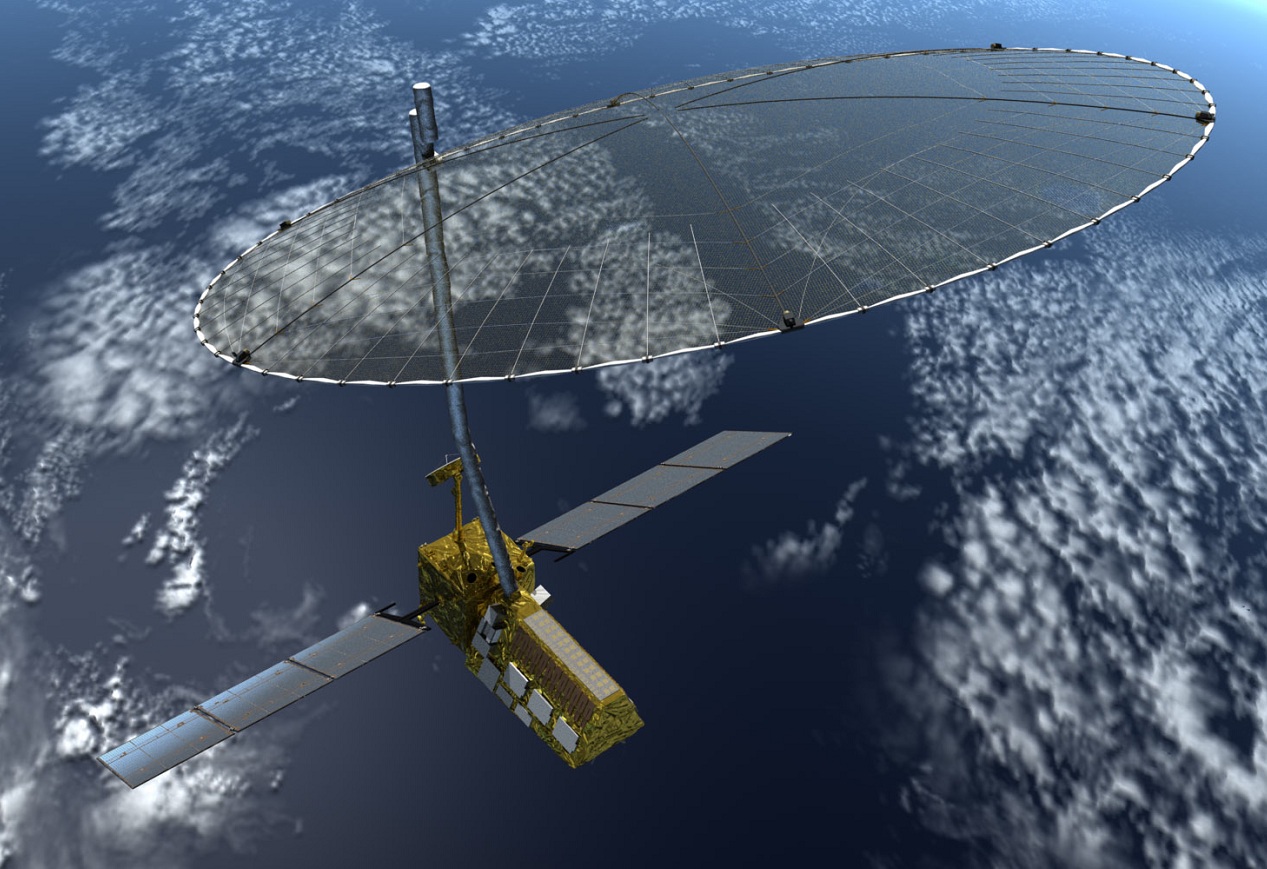
The NASA-ISRO Synthetic Aperture Radar (NISAR) mission, targeted to launch in 2020, will make global measurements of the causes and consequences of a variety of land surface changes on Earth. Image Credit: NASA


The NASA-ISRO Synthetic Aperture Radar (NISAR) mission, targeted to launch in 2020, will make global measurements of the causes and consequences of a variety of land surface changes on Earth. Image Credit: NASA
ISRO and NASA have inked a deal to collaborate on future missions to jointly explore the Red Planet and our Home Planet hot on the heels of ISRO’s wildly successful Mars Orbiter Mission (MOM), India’s first ever interplanetary voyager to explore Mars.

NASA Administrator Charles Bolden and K. Radhakrishnan, chairman of the Indian Space Research Organisation (ISRO), signed an agreement to collaborate on future science missions to explore Mars as well as to build and launch a joint NASA-ISRO mission to observe Earth.

The leaders of NASA and ISRO met in Toronto, Canada on Tuesday, Sept. 30 and “signed two documents to launch a NASA-ISRO satellite mission to observe Earth and establish a pathway for future joint missions to explore Mars,” according to a NASA statement.

Bolden and Rao met at the International Astronautical Congress underway in Toronto.

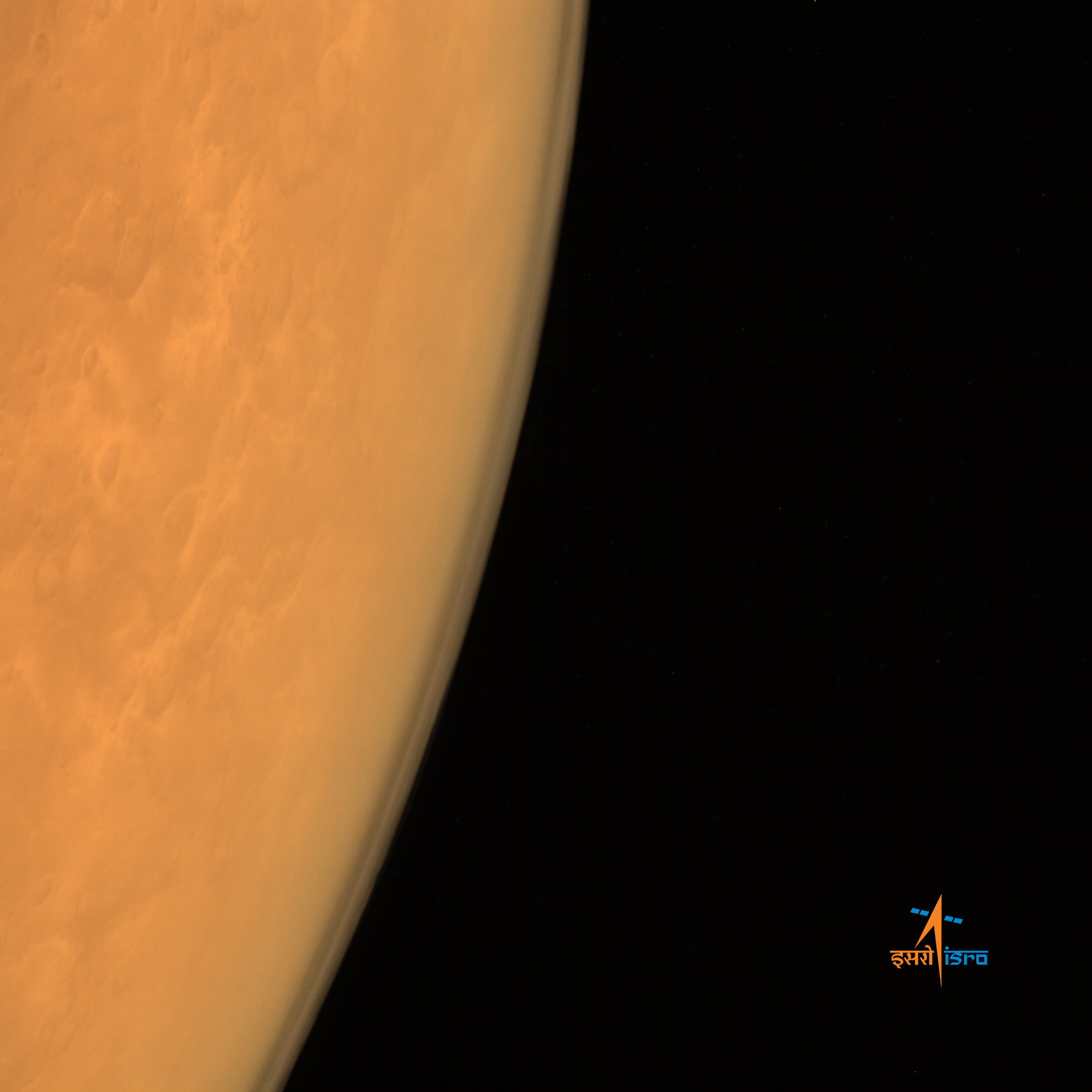
ISRO's Mars Orbiter Mission captures the limb of Mars with the Mars Color Camera from an altitude of 8449 km soon after achieving orbit on Sept. 23/24, 2014. . Credit: ISRO


ISRO’s Mars Orbiter Mission captures the limb of Mars with the Mars Color Camera from an altitude of 8449 km soon after achieving orbit on Sept. 23/24, 2014. . Credit: ISRO
They signed one agreement defining each agency’s responsibilities for the joint NASA-ISRO Synthetic Aperture Radar (NISAR) mission, targeted to launch in 2020. NISAR will make global measurements of the causes and consequences of land surface changes.

The second agreement “establishes a NASA-ISRO Mars Working Group to investigate enhanced cooperation between the two countries in Mars exploration.”

“The signing of these two documents reflects the strong commitment NASA and ISRO have to advancing science and improving life on Earth,” said NASA Administrator Charles Bolden, in a NASA statement.

“This partnership will yield tangible benefits to both our countries and the world.”

NISAR will be the first Earth observing mission to be equipped two different synthetic aperture radar (SAR) frequencies (L-band and S-band) – one each from NASA and ISRO.

NASA will also provide “the high-rate communication subsystem for science data, GPS receivers, a solid state recorder, and a payload data subsystem.”

ISRO will provide the spacecraft bus and launch vehicle.

The radars will be able to measure subtle changes in Earth’s surface of less than a centimeter across stemming from the flow of glaciers and ice sheets as well as earthquakes and volcanoes.

Regarding Mars, the first subject the joint working group will tackle will be to coordinate observations from each nation’s recently arrived Mars orbiters – ISRO’s MOM and NASA’s MAVEN. They will also examine areas of future collaboration on surface rovers and orbiters.

“NASA and Indian scientists have a long history of collaboration in space science,” said John Grunsfeld, NASA Associate Administrator for Science.

“These new agreements between NASA and ISRO in Earth science and Mars exploration will significantly strengthen our ties and the science that we will be able to produce as a result.”

Stay tuned here for Ken’s continuing Earth and planetary science and human spaceflight news.

Ken Kremer

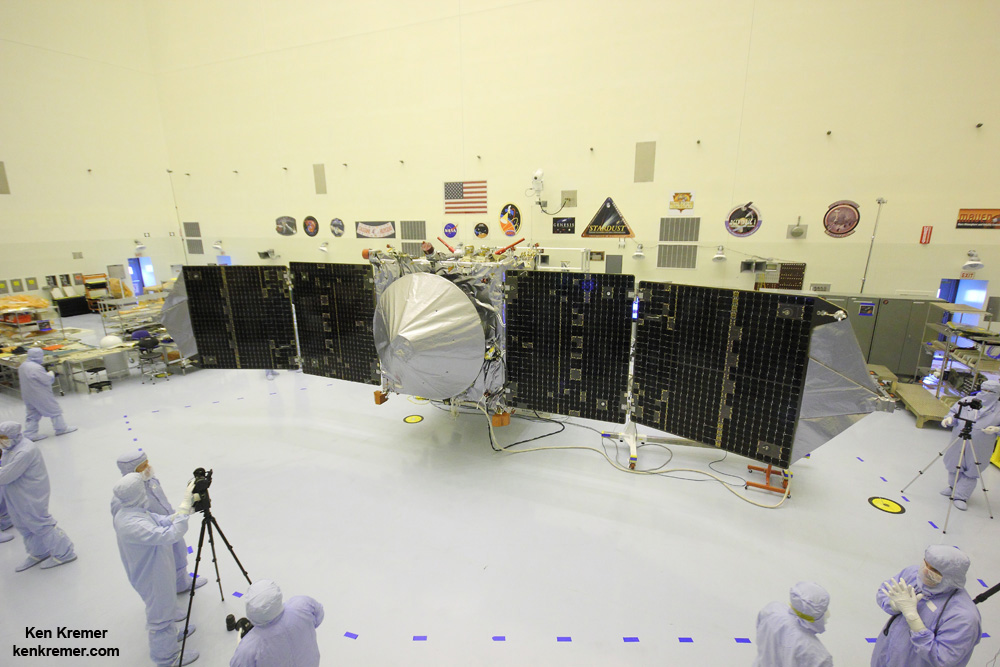
MAVEN is NASA’s next Mars orbiter and launched on Nov. 18, 2014 from Cape Canaveral, Florida. It will study the evolution of the Red Planet’s atmosphere and climate. Universe Today visited MAVEN inside the clean room at the Kennedy Space Center. With solar panels unfurled, this is exactly how MAVEN looks when flying through space and circling Mars and observing Comet Siding Spring. Credit: Ken Kremer/kenkremer.com


MAVEN is NASA’s next Mars orbiter and launched on Nov. 18, 2014, from Cape Canaveral, Florida. It will study the evolution of the Red Planet’s atmosphere and climate. Universe Today visited MAVEN inside the clean room at the Kennedy Space Center. With solar panels unfurled, this is exactly how MAVEN looks when flying through space and circling Mars and observing Comet Siding Spring. Credit: Ken Kremer/kenkremer.com


About 

Dr. Ken Kremer is a speaker, scientist, freelance science journalist (Princeton, NJ) and photographer whose articles, space exploration images and Mars mosaics have appeared in magazines, books, websites and calanders including Astronomy Picture of the Day, NBC, BBC, SPACE.com, Spaceflight Now and the covers of Aviation Week & Space Technology, Spaceflight and the Explorers Club magazines. Ken has presented at numerous educational institutions, civic & religious organizations, museums and astronomy clubs. Ken has reported first hand from the Kennedy Space Center, Cape Canaveral and NASA Wallops on over 40 launches including 8 shuttle launches. He lectures on both Human and Robotic spaceflight - www.kenkremer.com. Follow Ken on Facebook and Twitter
Tagged as: Climate Change, Earth science, indian space program, Indian Space Research Organization, ISRO, Mars, Mars MAVEN, Mars Orbiter Mission, MAVEN, MOM, NASA, NISAR, red planet

ow Do Aliens Think? We Need To Learn About Their Biology First, Analyst Argues

How Do Aliens Think? We Need To Learn About Their Biology First, Analyst Argues:

Credit: José Antonio Peñas/Sinc

Credit: José Antonio Peñas/Sinc
TORONTO, CANADA – Should E.T. finally give Earth a ring, it’s not only important to understand what the message says but why it is being sent, a speaker at a talk about extraterrestrials urged this week. This requires understanding about alien social behavior, also known as sociology.

“We keep complaining about the fact that we know so little about extraterrestrials in general, and even though sociology is mentioned in the Drake Equation, it is generally agreed that is the most difficult aspect to address,” said Morris Jones, an Australian who describes himself as an independent space analyst.

The Drake Equation is a set of variables proposed by astronomer Frank Drake that estimates how many intelligent, communicating civilizations there are in the universe. While speaking at the International Astronautical Congress Wednesday (Oct. 1), Jones pointed out that most talk about alien communications focuses on the basics – how they transmit, and where to search, and whether we can hear them. But to fully understand the message, we have to understand how their society works.

Extraterrestrials in the 1979 movie "Close Encounters of the Third King." Credit: Columbia Pictures / Alien Wiki


Extraterrestrials in the 1979 movie “Close Encounters of the Third Kind.” Credit: Columbia Pictures / Alien Wiki
How a society functions is partly a function of biology, Jones argued. So if humans decided to incorporate machine intelligence in their bodies, it would be reasonable to assume that society would change because of that. “Machine society is an entirely different sociology, and that we cannot predict,” Jones said. An extraterrestrial civilization could use machines, drugs, genetic engineering or surgery to alter their basic nature (something that is used also with humans.)

Class systems could also be in place that are similar to the animal kingdom. Herd and hive sociology covers how animals behave. Pigeons, for example, flock together for mutual protection. In the insect world, beings such as ants tend to be born in specific physiological roles that prepare them for different functions — such as the queen ant that is the mother of other ants in the colony.

These are societies that we could predict, perhaps, but more intriguing are those that are difficult to extrapolate from human experience or observation. Jones is particularly interested in cryptosociology. That’s the concept that because we can’t predict yet how alien civilizations will behave, we can speculate what they are capable of.

SETI's Allen Telescope Array monitor the stars for signs of intelligent life (SETI.org)

SETI’s Allen Telescope Array monitors the stars for signs of intelligent life (SETI.org)
Here’s where the danger lies, Jones said: it’s possible to make unfounded assumptions that cannot be tested through science. “If our thinking is too wild it could degenerate into dragons and unicorns, and become a pseduo science. At some point it has to be a framework of … reason and evidence,” he said.

Here, Jones urges using systems theories that would make each system consistent with itself. On Earth, if a system contradicts itself it disappears — such as with ancient civilizations that failed.

While he didn’t detail what these systems could be — predicting them would be difficult, he said — Jones argued it would be tough to really know the true sociology of extraterrestrial civilizations when we not only are ignorant about their biology, but aspects of our own sociology.


About 

Elizabeth Howell is the senior writer at Universe Today. She also works for Space.com, Space Exploration Network, the NASA Lunar Science Institute, NASA Astrobiology Magazine and LiveScience, among others. Career highlights include watching three shuttle launches, and going on a two-week simulated Mars expedition in rural Utah. You can follow her on Twitter @howellspace or contact her at her website.
Tagged as: aliens, extraterrestrials, sociology

Thursday, October 2, 2014

Astro-Panarama: Aurora on the Farm

Astro-Panarama: Aurora on the Farm:

A 180° panorama of an aurora display behind grain bins on a country road in Alberta, Canada. Credit and copyright: Alan Dyer/Amazing Sky Photography.


A 180° panorama of an aurora display behind grain bins on a country road in Alberta, Canada. Credit and copyright: Alan Dyer/Amazing Sky Photography.
Since I grew up on a farm, I know how lovely the night sky can be when you’re out in the country. But this new image from Alan Dyer is just astounding!

This 180-degree panorama shows an aurora display behind grain bins on a country road in Alberta, Canada. “The aurora adds more color to a sky also filled with green airglow,” Alan wrote on Flickr, “while at the ends of the roads are yellow glows of light pollution, from Strathmore and Calgary at left, and Bassano at right. For a few minutes there was also the sharp edge at left to the aurora rays, present in 3 frames of the panorama, so it is not an artifact of the stitching. The Big Dipper is left of centre, low in the north.”

Just gorgeous. Plus, it reminds me of home…

You can click on the image above to see larger versions.
#TerrestrialTuesday

Want to get your astrophoto featured on Universe Today? Join our Flickr group or send us your images by email (this means you’re giving us permission to post them). Please explain what’s in the picture, when you took it, the equipment you used, etc.

Tagged as: Astrophotos, aurora

India’s MOM Snaps Spectacular Portrait of New Home – the Red Planet

India’s MOM Snaps Spectacular Portrait of New Home – the Red Planet:

ISRO's Mars Orbiter Mission captures spectacular portrait of the Red Planet and swirling dust storms with the on-board Mars Color Camera from an altitude of 74500 km on Sept. 28, 2014. Credit: ISRO


ISRO’s Mars Orbiter Mission captures spectacular portrait of the Red Planet and swirling dust storms with the on-board Mars Color Camera from an altitude of 74500 km on Sept. 28, 2014. Credit: ISRO
MOM is truly something special.

For her latest eye popping feat, India’s Mars Orbiter Mission (MOM) has snapped the first global portrait of her new Home – the Red Planet.

MOM is India’s first interplanetary voyager and took the stupendous new image on Sept. 28, barely four days after her historic arrival on Sept. 23/24 following the successful Mars Orbital Insertion (MOI) braking maneuver.

The MOM orbiter was designed and developed by the Indian Space Research Organization (ISRO), India’s space agency, which released the image on Sept. 29.

Even more impressive is that MOM’s Martian portrait shows a dramatic view of a huge dust storm swirling over a large patch of the planet’s Northern Hemisphere against the blackness of space. Luckily, NASA’s Opportunity and Curiosity surface rovers are nowhere nearby.

“Something’s brewing here!” ISRO tweeted.

The southern polar ice cap is also clearly visible.

It was taken by the probe’s on-board Mars Color Camera from a very high altitude of 74,500 kilometers.

ISRO's Mars Orbiter Mission captures the limb of Mars with the Mars Color Camera from an altitude of 8449 km soon after achieving orbit on Sept. 23/24, 2014. . Credit: ISRO


ISRO’s Mars Orbiter Mission captures the limb of Mars with the Mars Color Camera from an altitude of 8449 km soon after achieving orbit on Sept. 23/24, 2014. Credit: ISRO
When MOM met Mars, the thrusters placed the probe into a highly elliptical orbit whose nearest point to Mars (periapsis) is at 421.7 km and farthest point (apoapsis) at 76,993.6 km. The inclination of the orbit with respect to the equatorial plane of Mars is 150 degrees, as intended, ISRO reported.

So the Red Planet portrait was captured nearly at apoapsis.

This is the third MOM image released by ISRO thus far, and my personal favorite. And its very reminiscent of whole globe Mars shots taken by Hubble.

MOM’s goal is to study Mars’ atmosphere, surface environments, morphology, and mineralogy with a 15 kg (33 lb) suite of five indigenously built science instruments. It will also sniff for methane, a potential marker for biological activity.

The $73 million mission is expected to last at least six months.

MOM’s success follows closely on the heels of NASA’s MAVEN orbiter which also successfully achieved orbit barely two days earlier on Sept. 21 and could last 10 years or more.

With MOM’s arrival, India became the newest member of an elite club of only four entities who have launched probes that successfully investigated Mars – following the Soviet Union, the United States and the European Space Agency (ESA).

Stay tuned here for Ken’s continuing Earth and planetary science and human spaceflight news.

Ken Kremer


About 

Dr. Ken Kremer is a speaker, scientist, freelance science journalist (Princeton, NJ) and photographer whose articles, space exploration images and Mars mosaics have appeared in magazines, books, websites and calanders including Astronomy Picture of the Day, NBC, BBC, SPACE.com, Spaceflight Now and the covers of Aviation Week & Space Technology, Spaceflight and the Explorers Club magazines. Ken has presented at numerous educational institutions, civic & religious organizations, museums and astronomy clubs. Ken has reported first hand from the Kennedy Space Center, Cape Canaveral and NASA Wallops on over 40 launches including 8 shuttle launches. He lectures on both Human and Robotic spaceflight - www.kenkremer.com. Follow Ken on Facebook and Twitter
Tagged as: Curiosity Rover, indian space program, Indian Space Research Organization, ISRO, Mars, Mars Dust Storms, mars ice caps, Mars MAVEN, MAVEN, MOM, NASA, Opportunity Rover, red planet

Gallery: 5 Exotic Places NASA’s Next-Generation Rocket Could Help Explore

Gallery: 5 Exotic Places NASA’s Next-Generation Rocket Could Help Explore:

Artist concept of NASA’s Space Launch System (SLS) 70-metric-ton configuration launching to space. SLS will be the most powerful rocket ever built for deep space missions, including to an asteroid and ultimately to Mars. Credit: NASA/MSFC

Artist concept of NASA’s Space Launch System (SLS) 70-metric-ton configuration launching to space. SLS will be the most powerful rocket ever built for deep space missions, including to an asteroid and ultimately to Mars. Credit: NASA/MSFC
TORONTO, CANADA – Could NASA’s new rocket bring a probe to sample the geysers of Saturn’s moon Enceladus, or ferry human explorers to the surface of Mars? Representatives of contractor Boeing think so.

They’ve put together some ideas for sending their Space Launch System to these far-flung destinations, which they presented at the International Astronautical Congress today (Oct. 1).

Bear in mind that the SLS hasn’t yet flown — it’s slated for 2018 if funding lasts and the schedule holds — and the destinations below are just in the conceptual stage. The gallery below summarizes some of the destinations SLS could visit. For more information, check out this brochure by Boeing.

Enceladus

Artist's conception of the Cassini spacecraft flying amid geysers on Enceladus, a moon of Saturn. Credit: Karl Kofoed / NASA


Artist’s conception of the Cassini spacecraft flying amid geysers on Enceladus, a moon of Saturn. Credit: Karl Kofoed / NASA
The icy moon of Saturn is known as a hotspot for geysers; earlier this year, scientists found 101 gushers using data from the prolific Cassini probe. Using the SLS could bring a satellite there in four years, as opposed to about seven with rockets on the market today, according to Boeing. It also could carry a heavier spacecraft.

Europa

Artist's conception of Europa's surface, backdropped by planet Jupiter. Credit: NASA/JPL-Caltech


Artist’s conception of Europa’s surface, backdropped by planet Jupiter. Credit: NASA/JPL-Caltech
Europa is known to have a subterranean ocean, and it also is capable of spewing water plumes — as researchers using the Hubble Space Telescope discovered earlier this year. The SLS could get to Europa a lot faster than a launch with an Atlas, according to Boeing — it would only take two years to fly there directly as opposed to more than six years with the Atlas, which would need to fly by Venus first to pick up some speed.

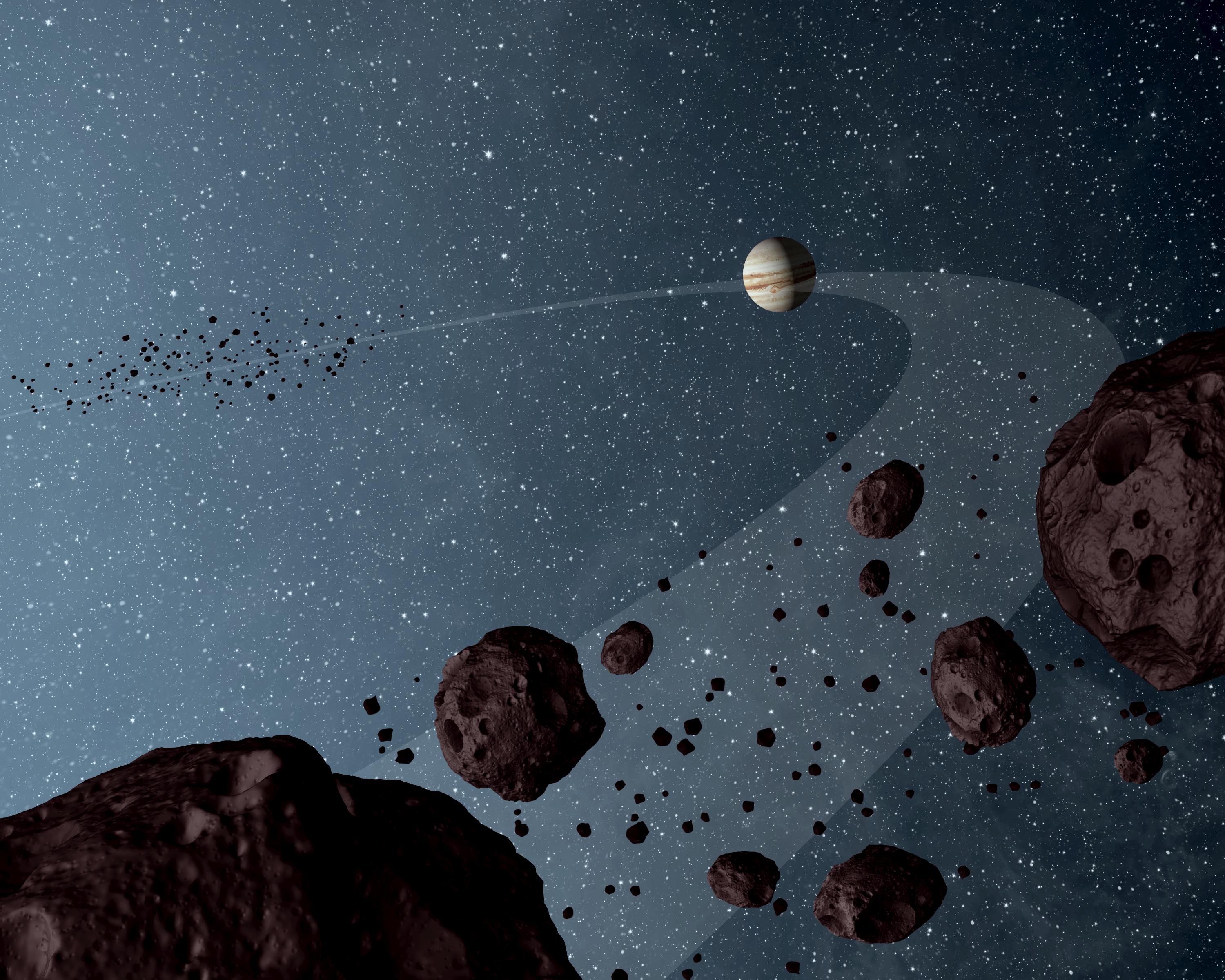
Trojan asteroids

Artist's diagram of Jupiter and some Trojan asteroids nearby the gas giant. Credit: NASA/JPL-Caltech


Artist’s diagram of Jupiter and some Trojan asteroids nearby the gas giant. Credit: NASA/JPL-Caltech
Trailing before and after Jupiter are more than a million asteroids that are called Trojans. This means any probe in the area would have no lack of targets to study, providing it had enough fuel on board. A mission profile from Boeing suggests the SLS could bring a spacecraft out there that could swing by a target at least half a dozen times.

Mars

Artist's impression of astronauts exploring Mars. Credit: NASA/Pat Rawlings, SAIC


Artist’s impression of astronauts exploring Mars. Credit: NASA/Pat Rawlings, SAIC
One of the largest challenges of getting to Mars is figuring out how to send all the life-support equipment and food that humans require — on top of the humans themselves! Since SLS is a heavy-lift rocket, Boeing is trying to position its rocket as the ideal one to get humans to Mars. But it remains to be seen what concept works best to get people out there.

The Moon

Artist's impression of astronauts on the moon. This image was used to illustrate a landing concept of NASA's now defunct Constellation program. Credit: John Frassanito and Associates / NASA


Artist’s impression of astronauts on the moon. This image was used to illustrate a landing concept of NASA’s now defunct Constellation program. Credit: John Frassanito and Associates / NASA
Boeing has an idea to bring a lander down to the Moon that could then lift off multiple times in search of other destinations. Such a concept would require a hefty amount of fuel and equipment. If it works, Boeing says the SLS could assist with plans for lunar mining and other exploration ideas.


About 

Elizabeth Howell is the senior writer at Universe Today. She also works for Space.com, Space Exploration Network, the NASA Lunar Science Institute, NASA Astrobiology Magazine and LiveScience, among others. Career highlights include watching three shuttle launches, and going on a two-week simulated Mars expedition in rural Utah. You can follow her on Twitter @howellspace or contact her at her website.
Tagged as: Boeing

How Private Space Companies Make Money Exploring The Final Frontier

How Private Space Companies Make Money Exploring The Final Frontier:

Virgin Galactic's SpaceShipTwo soars in a powered flight test on Sept. 5, 2013. Credit: MarsScientific.com and Clay Center Observatory

Virgin Galactic’s SpaceShipTwo soars in a powered flight test on Sept. 5, 2013. Credit: MarsScientific.com and Clay Center Observatory
TORONTO, CANADA – There’s a big difference in thinking between governments and the private companies that participate in space. While entities such as NASA can work on understanding basic human health or exploring the universe for the sake of a greater understanding, companies have a limitation: they need to eventually make a profit.

This was brought up in a human spaceflight discussion at the International Astronautical Congress today (Oct. 1), which included participants from agencies and companies alike. Below are some concepts for how private companies in the space world today are making their money.

“We have in space a movement towards more privatization … and also for more use of space activities in general and human space activity in the future by individual private persons,” said Johann Dietrich Worner, chairman of the executive board of DLR (Germany’s space agency), in the panel.

“You can imagine that even for the upcoming 10 to 20 to 30 years, the public funding is the basic funding for [space] activities while in other areas, we are already seeing that private money is doing its work if you look to communication and if you look to other activities, like for instance, research in space.”

But commercial spaceflight is already taking place, as some of these examples show.

Commercial crew

Would you ‘Enter the Dragon’? First look inside SpaceX Dragon V2 next generation astronaut spacecraft unveiled by CEO Elon Musk on May 29, 2014. Credit: Robert Fisher/AmericaSpace


Would you ‘Enter the Dragon’?
First look inside SpaceX Dragon V2 next generation astronaut spacecraft unveiled by CEO Elon Musk on May 29, 2014. Credit: Robert Fisher/AmericaSpace
The two successful companies in NASA’s latest round of commercial contracts — SpaceX (Dragon) and Boeing (CST-100) — are each receiving government money to develop their private space taxis. The companies are responsible for meeting certain milestones to receive funds. There is quite the element of risk involved because the commercial contracts are only given out in stages; you could be partway through developing the spacecraft and then discover you will not be awarded one for the next round. This is what happened to Sierra Nevada Corp., whose Dream Chaser concept did not receive more money in the announcement last month. The company has filed a legal challenge in response.

Private space travel

Sir Richard Branson hugs designer Burt Rutan as they are surrounded by employee's of Virgin Galactic, The SpaceShip Company and Scaled Composites watch as Virgin Galactic's SpaceShip2 streaks across the sky under rocket power, its first ever since the program began in 2005. Burt's wife Tonya Rutan is at right taking their photo. The spacecraft was dropped from its "mothership", WhiteKnight2 over the Mojave, CA area, April 29, 2013 at high altitude before firing its hybrid power motor. Virgin Galactic hopes to become the first commercial space venture to bring multiple passengers into space on a regular basis.


Sir Richard Branson hugs designer Burt Rutan, surrounded by employees of Virgin Galactic, The SpaceShip Company, and Scaled Composites, and watch as Virgin Galactic’s SpaceShip2 streaks across the sky under rocket power, its first ever since the program began in 2005. Burt’s wife Tonya Rutan is at right taking their photo. The spacecraft was dropped from its “mothership,” WhiteKnight2, over the Mojave CA area on April 29, 2013, at high altitude before firing its hybrid power motor. Virgin Galactic hopes to become the first commercial space venture to bring multiple passengers into space on a regular basis.
Virgin Galactic and its founder, Richard Branson, are perhaps the most visible of the companies that are looking to bring private citizens into space — as long as they can pay $250,000 for a ride. The first flight of Virgin into space is expected in the next year. Customers must pay a deposit upfront upon registering and then the balance before they head into suborbit. In the case of Virgin, Branson has a portfolio of companies that can take on the financial risk during the startup phase, but eventually the company will look to turn a profit through the customer payments.

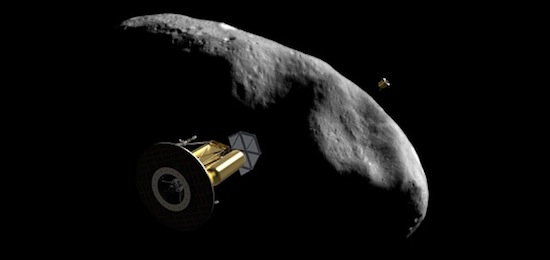
Asteroid mining

Artist concept of the ARKYD spacecraft by an asteroid. Credit: Planetary Resources.


Artist concept of the ARKYD spacecraft by an asteroid. Credit: Planetary Resources.
The business case for Planetary Resources and Deep Space Industries, the two self-proclaimed asteroid mining companies, hasn’t fully been released yet. We assume that the companies would look to make a profit through selling whatever resources they manage to dig up on asteroids, but bear in mind it would cost quite a bit of money to get a spacecraft there and back. Meanwhile, Planetary Resources is diversifying its income somewhat by initiatives such as the Arkyd-100 telescope, which will look for asteroids from Earth orbit. They raised money for the project through crowdsourcing.

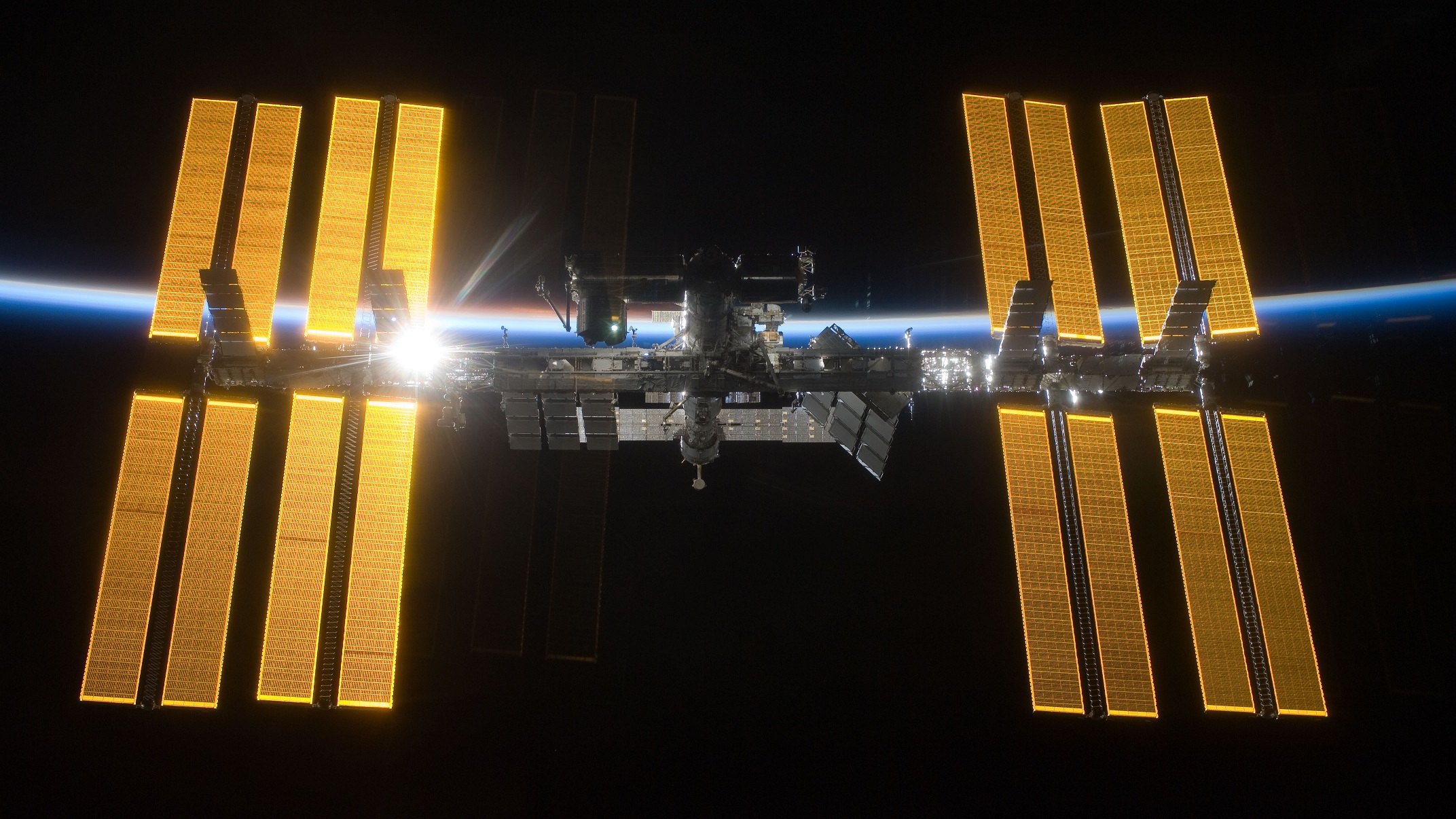
Space station research

The International Space Station in March 2009 as seen from the departing STS-119 space shuttle Discovery crew. Credit: NASA/ESA


The International Space Station in March 2009 as seen from the departing STS-119 space shuttle Discovery crew. Credit: NASA/ESA
NanoRacks is a company that has research slots available on the International Space Station that it sells to entities looking to do research in microgravity. The company has places inside the station and can also deploy small satellites through a Japanese system. While the company’s website makes it clear that they are focused on ISS utilization, officials also express an interest in doing research in geocentric orbit, the moon or even Mars.

About 

Elizabeth Howell is the senior writer at Universe Today. She also works for Space.com, Space Exploration Network, the NASA Lunar Science Institute, NASA Astrobiology Magazine and LiveScience, among others. Career highlights include watching three shuttle launches, and going on a two-week simulated Mars expedition in rural Utah. You can follow her on Twitter @howellspace or contact her at her website.
Tagged as: asteroid mining, boeing CST 100, commercial crew program, deep space industries, Dragon, NanoRacks, Planetary Resources, Sierra Nevada

Making the Case for a Mission to the Martian Moon Phobos

Making the Case for a Mission to the Martian Moon Phobos:

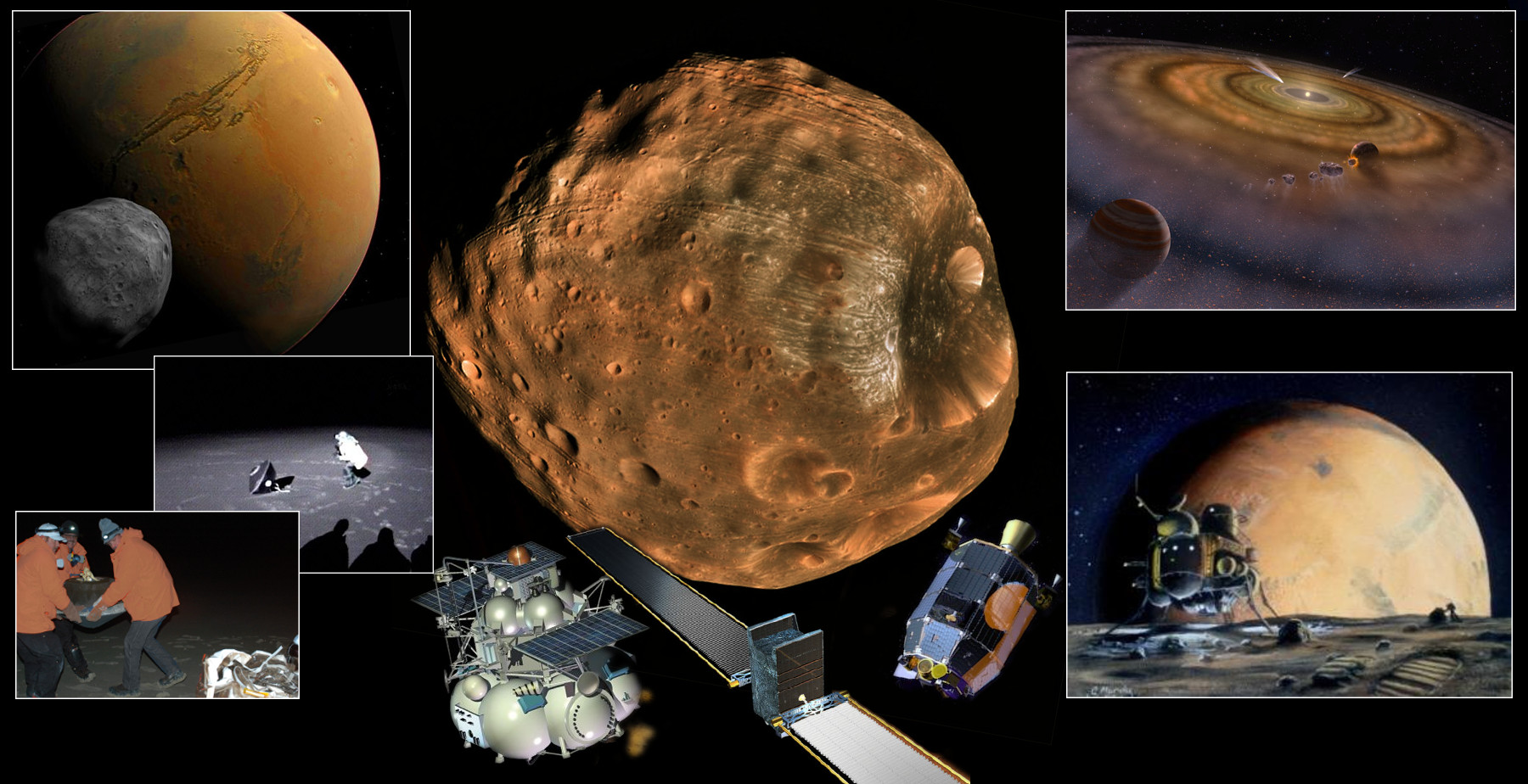
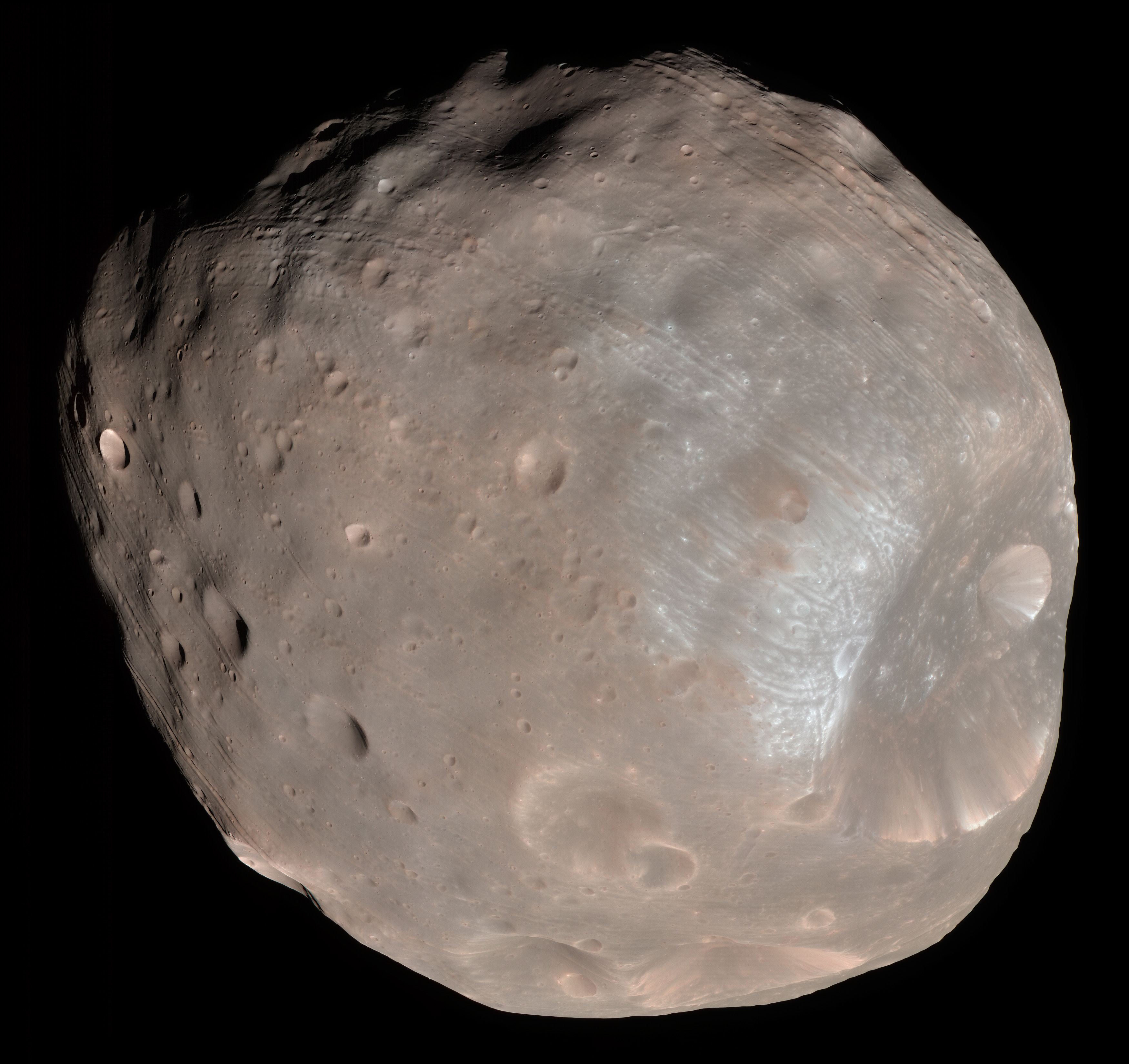
Phobos. From where did it arise or arrive? Is it dry or wet? Should we flyby or sample and return? Should it be Boots or Bots? (Photos: NASA, Illus.:T.Reyes)


From where did Phobos arise or arrive? The Inner or Outer Solar System? Is it dry or wet? Should we flyby or sample & return? Or should it be Boots or Bots? In the illustration, space probes (L-R) Phobos-Grunt 2, JPL/SAR, ARC PADME. Also, Stardust’s return capsule, Phobos above Mars, the Solar Nebula and the MRO HiRISE photo of Phobos. (Photos: NASA, Illustration:T.Reyes)
Ask any space enthusiast, and almost anyone will say humankind’s ultimate destination is Mars. But NASA is currently gearing up to go to an asteroid. While the space agency says its Asteroid Initiative will help in the eventual goal of putting people on Mars, what if instead of going to an asteroid, we went to Mars’ moon Phobos?

Three prominent planetary scientists have joined forces in a new paper in the journal Planetary and Space Science to explain the case for a mission to the moons of Mars, particularly Phobos.

“Phobos occupies a unique position physically, scientifically, and programmatically on the road to exploration of the solar system,” say the scientists. In addition, the moons may possibly be a source of in situ resources that could support future human exploration in circum-Mars space or on the Martian surface. But a sample return mission first could provide details on the moons’ origins and makeup.

The Martian moons are riddles, wrapped in a mystery, inside an enigma. Phobos and its sibling Deimos seem like just two asteroids which were captured by the planet Mars, and they remain the last objects of the inner solar system not yet studied with a dedicated mission. But should the moons be explored with flybys or sample-return? Should we consider “boots or bots”?

The publications and mission concepts for Phobos and Deimos are numerous and go back decades. The authors of “The Value of a Phobos Sample Return,” Murchie, Britt, and Pieters, explore the full breadth of questions of why and how to explore Phobos and Deimos.

Dr. Murchie is the principal investigator of the Mars Reconnaissance Orbiter’s CRISM instrument, a visible/infrared imaging spectrometer. He is a planetary scientist from John Hopkins’ Applied Physics Lab (APL) which has been at the forefront of efforts to develop a Phobos mission. Likewise, authors Dr. Britt, from the University of Central Florida, and Dr. Pieters, from Brown University, have partnered with APL and JPL in Phobos/Deimos mission proposals.

A MRO HiRise image of the Martian moon Phobos. Taken on March 23, 2008. Phobos has dimensions of 27 × 22 × 18 km, while Deimos is 15 × 12.2 × 11 km. Both were discovered in 1877 at the US Naval Observatory in Washington, D.C. (Photo: NASA/MRO/HiRISE)


An MRO HiRise image of the Martian moon Phobos. Taken on March 23, 2008. Phobos has dimensions of 27 × 22 × 18 km, while Deimos is 15 × 12.2 × 11 km. Both were discovered in 1877 at the US Naval Observatory in Washington, D.C. (Photo: NASA/MRO/HiRISE)
APL scientists are not the only ones interested in Phobos or Deimos. The Jet Propulsion Laboratory, Ames Research Center and the SETI Institute have also proposed several missions to the small moons. Every NASA center has been involved at some level.

But the only mission to actually get off the ground is the Russian Space Agency’s Phobos-GRUNT[ref]. The Russian mission was launched November 9, 2011, and two months later took a bath in the Pacific Ocean. The propulsion system failed to execute the burns necessary to escape the Earth’s gravity and instead, its orbit decayed despite weeks of attempts to activate the spacecraft. But that’s a whole other story.

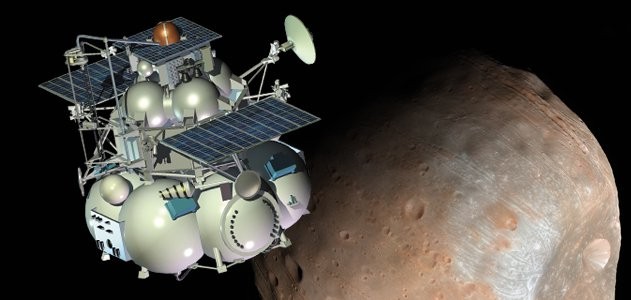
The Russian-led mission Phobos-Grunt did not end well; under Pacific swells to be exact. Undaunted Russian scientists are pressing for Phobos-Grunt 2. (Credit: CNES)


The Russian-led mission Phobos-Grunt did not end well; under Pacific swells to be exact. Undaunted Russian scientists are pressing for Phobos-Grunt 2 (illus.), an improved lander with sample-return. Proposed for 2020s (Credit: CNES)
“The Value of a Phobos Sample Return” first discusses the origins of the moons of Mars. There is no certainty. There is a strong consensus that Earth’s Moon was born from the collision of a Mars-sized object with Earth not long after Earth’s formation. This is just one possibility for the Martian moons. Murchie explains that the impacts that created the large basins and craters on Mars could have spawned Phobos and Deimos: ejecta that achieved orbit, formed a ring and then coalesced into the small bodies. Alternative theories claim that the moons were captured by Mars from either the inner or outer solar system. Or they could have co-accreted with Mars from the Solar Nebula. Murchie and the co-authors describe the difficulties and implications of each scenario. For example, if captured by Mars, then it is difficult to explain how their orbits came to be “near-circular and near-equatorial with synchronous rotational periods.”

To answer the question of origins, the paper turns to the questions of their nature. Murchie explains that the limited compositional knowledge leaves several possibilities for their origins. They seem like D-type asteroids of the outer asteroid belt. However, the moons of Mars are very dry, void of water, at least on their surfaces as the paper discusses in detail. The flybys of Phobos and Deimos by NASA and ESA spacecraft are simply insufficient for drawing any clear picture of their composition or structure, let alone their origins, Murchie and co-authors explain.

If the moons were captured then they have compositions different from Mars; however if they accreted with or from Mars, then they share similar compositions with the early Mars when forming, or from Martian crustal material, respectively.

The paper describes in some detail the problem that billions of years of Martian dust accumulation presents. Every time Mars has been hit by a large asteroid, a cloud of debris is launched into space. Some falls back to the planet but much ends up in orbit. Each time, some of the debris collided with Phobos and Deimos; Murchie uses the term “Witness plate” to describe what the two moons are to Mars. There is an accumulation of Martian material and also material from the impactors covering the surfaces of the moons.  Flyby images of Phobos show a reddish surface similar to Mars, and numerous tracks along the surface as if passing objects struck, plowed or rolled along. However, the reddish hue could be weathering from Solar flux over billions of years.

The paper continues with questions of the composition and how rendezvous missions could go further to understanding the moons makeup and origins, however, it is sample return that would deliver, the pay dirt. Despite how well NASA and ESA engineers have worked to shrink and lighten the instruments that fly, orbit, and land on Mars, returning a sample of Phobos to labs on Earth would permit far more detailed analysis.

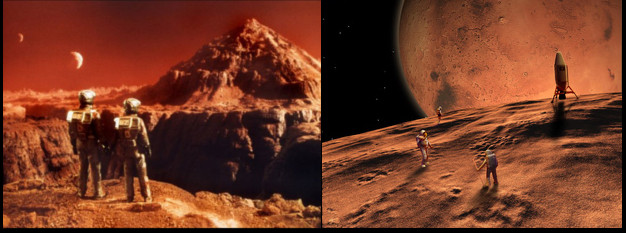
SpaceX and Elon Musk claim that they will mount human flight to Mars before 2030. Many others remain less optimistic with hopes to human flights before 2040. (Illustrations: Total Recall, 1990, early artist illustration c.1950s )


SpaceX and Elon Musk claim that they will mount human flight to Mars before 2030. Many others remain less optimistic with hopes of human flights before 2040. (Illustrations: Total Recall, 1990, early artist illustration c.1950s )
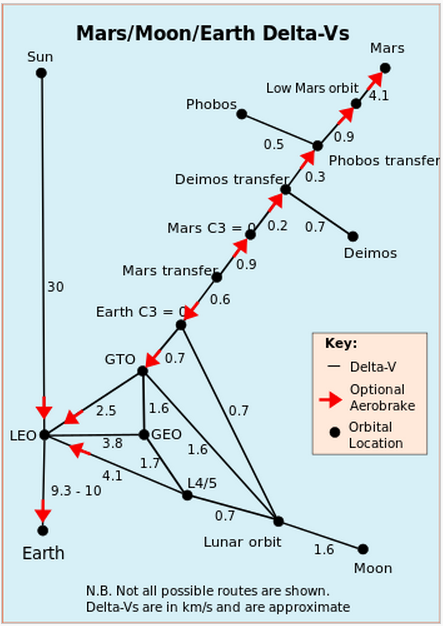
Science Fiction writers and mission designers have imagined Phobos, in particular, as a starting point for the human exploration and colonization of Mars. A notable contemporary work is “Red Mars” by Kim Stanley Robinson; however, the story line is dated due to the retirement of the Space Shuttle and the external tanks Robinson clustered to form the colonization vessel. While this paper by Murchie et al. is purely scientific, fiction writers have used the understanding that Phobos is far easier to reach from Earth than is the surface of Mars (see Delta-V chart below).

A diagram showing the stair-step energy needed to travel to places beyond the Earth. Delta-V is the velocity in km/sec to reach a destination. The Delta-Vs a accumulative. (Credit: Wikipedia, Delta-V)


A diagram showing the stair-step energy needed to travel to places beyond the Earth. Delta-V is the speed in km/sec required to reach a destination. As shown, the Delta-Vs are cumulative. Note that it takes an extra 5 km/sec  beyond Phobos to reach the Martian surface; a prime reason for making the journey to the moons of Mars. (Credit: Wikipedia, Delta-V)
Phobos, orbiting at 9,400 kilometers (5,840 miles), and Deimos, at 23,500 km (14,600 miles), above Mars avoids the need for the 7-odd minutes of EDL terror – Entry, Descent, and Landing — and pulling oneself out of the Martian gravity well to return to Earth. Furthermore, there is the interest in using Phobos as a material resource – water, material for rocket fuel or building materials. “The Value of a Phobos Sample Return” discusses the potential of Phobos as a resource for space travelers – “In Situ Resource Utilization” (ISRU), in the context of its composition, how the solar flux may have purged the moons of water or how Martian impact debris covers materials of greater interest and value to explorers.

With so many questions and interests, what missions have been proposed and explored? The Murchie paper describes a half dozen missions but there are several others that have been conceived and proposed to some level over several decades.

At present, there is at least one mission actively pursuing funds. The SETI and Ames proposed “Phobos and Deimos & Mars Environment” (PADME) mission led by Dr. Pascal Lee is competing for Discovery program funding. Such projects must limit cost to $425 million or less and be capable of launching in less than 3 years. They are proposing a launch date of 2018 on a SpaceX Falcon 9. The PADME mission design would reuse Ames LADEE hardware and expertise, however, it does not go so far as what Murchie and co-authors argue – returning a sample from Phobos. PADME would maintain in a synchronized orbit with Phobos and then Deimos foe repeated flybys. The mission is likely to cost in the range of $300 million. Stardust, a relevant mission due to its sample return capsule, launched in 1999 and had costs which likely reached a similar level by end of mission in 2012.

The Russian Space Agency is attempting to gain funding for Phobos-Grunt 2 but possible launch dates continue to be moved back – 2020, 2022, and now possibly 2024.

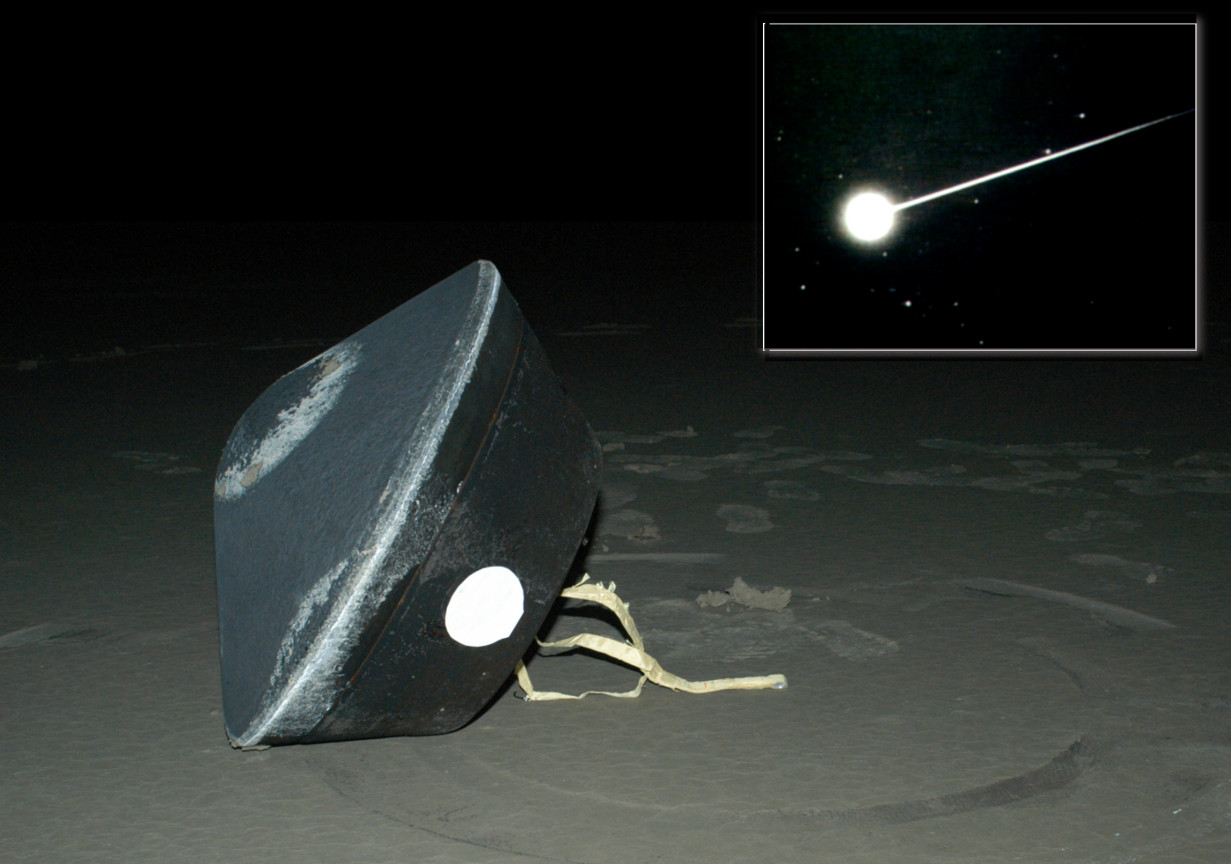
Return of the Stardust sample inside the Lockheed-Martin developed sample-return capsule. See here upon successful landing in the Utah desert. (Credit: NASA/Stardust)


Return of the Stardust sample inside the Lockheed-Martin developed sample-return capsule. Seen here upon successful landing in the Utah desert. (Credit: NASA/Stardust)
Additionally, each of this papers’ authors has mission proposals described. Dr. Pieters, JPL, and Lockheed-Martin proposed the Aladdin mission; Dr. Britt at APL, also with Lockheed-Martin, proposed the mission Gulliver; both would re-use the Stardust sample-return capsule (photo, above). Dr. Murchie also describes his APL/JPL mission concept called MERLIN (Mars–Moon Exploration, Reconnaissance and Landed Investigation).

Phobos and Deimos are the last two of what one would call major objects of the inner Solar System that have not had dedicated missions of exploration. Several bodies of the Asteroid Belt have been targeted with flybys and Dawn is nearing its second target, the largest of the Asteroids, Ceres.

So sooner rather than later, a spacecraft from some nation (not necessarily the United States) will target the moons of Mars. Targeted Phobos/Deimos missions are also likely to include both flyby missions and one or more sample-return missions. A US-led mission with sample-return in the Discovery program will be strained to meet both criteria – $425 million cost cap and 3 year development period.

Those utilizing the Lockheed-Martin (LM) Stardust design have a proven return capsule and spacecraft buses (structure, mechanisms and avionics) for re-use for cost and time savings. This includes five generations of the LM flight software that holds an incredible legacy of mission successes starting with Mars Odyssey/Genesis/Spitzer to now Maven.

All three proposals by this paper’s authors could be re-vamped and proposed again and compete against each other. All three could use Lockheed-Martin past designs. Cooperation in writing this paper may be an indicator that they will join forces, combine concepts, and share investigator positions on a single NASA-led project. The struggle for federal dollars remains a tough, tight battle and with the human spaceflight program struggling to gain a new footing after Space Shuttle, dollars for inter-planetary missions are likely to remain very competitive. However, it appears a Phobos-Deimos mission is likely within the next ten years.

Further reading:

“The Value of a Phobos Sample Return”, Scott L. Murchie, Daniel T. Britt, Carle M. Pieters, Planetary and Space Science, 1 November 2014

The US Naval Observatory, Great 26″ Refractor Telescope

Past Universe Today story, “Finding Phobos: Discovery of a Martian Moon”

About 

Contributing writer Tim Reyes is a former NASA software engineer and analyst who has supported development of orbital and lander missions to the planet Mars since 1992. He has an M.S. in Space Plasma Physics from University of Alabama, Huntsville.
Tagged as: Ames, APL, Deimos, Discovery Program, Hopkins, JPL, Lockheed Martin, Mars, NASA, PADME, Phobos, SETI

Astrophotos: A Wide Angle “Trilogy” of the North America Nebula

Astrophotos: A Wide Angle “Trilogy” of the North America Nebula:

A colorful, wide view of the North America Nebula (NGC 7000 or Caldwell 20) in Cygnus. This three-panel mosaic spanning an area approximately 2.5 x 5.5 degrees, captured using QHY11/TAK E180 presented here in H-Alpha, Hubble Palette and RGB with H-Alpha. Credit and copyright: Terry Hancock.


A colorful, wide view of the North America Nebula (NGC 7000 or Caldwell 20) in Cygnus. This three-panel mosaic spanning an area approximately 2.5 x 5.5 degrees, captured using QHY11/TAK E180 presented here in H-Alpha, Hubble Palette and RGB with H-Alpha. Credit and copyright: Terry Hancock.
A perfect set of astrophotos for #WideAngleWednesday! Here are not one but three views of the North America Nebula taken by Terry Hancock. Terry said this is his widest view yet of this region. Also known as NGC 7000 or Caldwell 20, this is an emission nebula in the constellation Cygnus that resembles the shape of North America and The Gulf Of Mexico. It lies at a distance of approximately 1800 light years away from Earth.

Terry presents a “trilogy” of three different color processes (see below). He took imagery in both July and September 2014 with a total exposure time of 13.9 hours from his Down Under Observatory in Fremont, Michigan.


For more details about the processing for each image, click on the images. To see more of Terry’s great work, see his website, Facebook, Flickr, or G+.

A wide, three-panel mosaic spanning an area approximately 2.5 x 5.5 degrees of the North America Nebula (NGC 7000 or Caldwell 20), in H-Alpha, Hubble Palette and RGB with H-Alpha. Credit and copyright: Terry Hancock.


A wide, three-panel mosaic spanning an area approximately 2.5 x 5.5 degrees of the North America Nebula (NGC 7000 or Caldwell 20), in H-Alpha, Hubble Palette and RGB with H-Alpha. Credit and copyright: Terry Hancock.
Another version of the 3-panel, wide angle view of the North America Nebula. Credit and copyright: Terry Hancock.


Another version of the 3-panel, wide angle view of the North America Nebula. Credit and copyright: Terry Hancock.
Want to get your astrophoto featured on Universe Today? Join our Flickr group or send us your images by email (this means you’re giving us permission to post them). Please explain what’s in the picture, when you took it, the equipment you used, etc.

Tagged as: Nebulae, North American Nebula, Terry Hancock