Thursday, October 2, 2014

Making the Case for a Mission to the Martian Moon Phobos

Making the Case for a Mission to the Martian Moon Phobos:

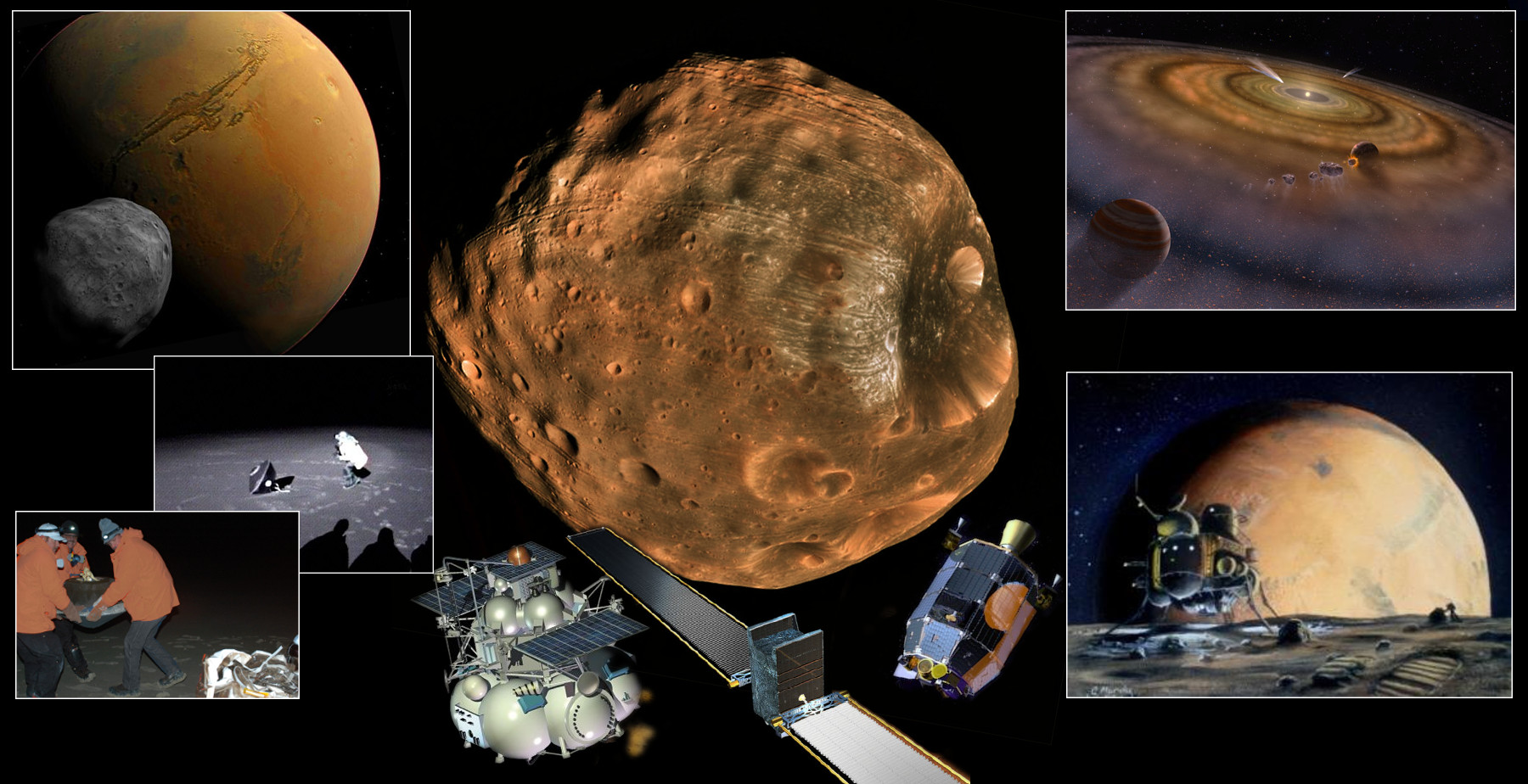
Phobos. From where did it arise or arrive? Is it dry or wet? Should we flyby or sample and return? Should it be Boots or Bots? (Photos: NASA, Illus.:T.Reyes)


From where did Phobos arise or arrive? The Inner or Outer Solar System? Is it dry or wet? Should we flyby or sample & return? Or should it be Boots or Bots? In the illustration, space probes (L-R) Phobos-Grunt 2, JPL/SAR, ARC PADME. Also, Stardust’s return capsule, Phobos above Mars, the Solar Nebula and the MRO HiRISE photo of Phobos. (Photos: NASA, Illustration:T.Reyes)
Ask any space enthusiast, and almost anyone will say humankind’s ultimate destination is Mars. But NASA is currently gearing up to go to an asteroid. While the space agency says its Asteroid Initiative will help in the eventual goal of putting people on Mars, what if instead of going to an asteroid, we went to Mars’ moon Phobos?

Three prominent planetary scientists have joined forces in a new paper in the journal Planetary and Space Science to explain the case for a mission to the moons of Mars, particularly Phobos.

“Phobos occupies a unique position physically, scientifically, and programmatically on the road to exploration of the solar system,” say the scientists. In addition, the moons may possibly be a source of in situ resources that could support future human exploration in circum-Mars space or on the Martian surface. But a sample return mission first could provide details on the moons’ origins and makeup.

The Martian moons are riddles, wrapped in a mystery, inside an enigma. Phobos and its sibling Deimos seem like just two asteroids which were captured by the planet Mars, and they remain the last objects of the inner solar system not yet studied with a dedicated mission. But should the moons be explored with flybys or sample-return? Should we consider “boots or bots”?

The publications and mission concepts for Phobos and Deimos are numerous and go back decades. The authors of “The Value of a Phobos Sample Return,” Murchie, Britt, and Pieters, explore the full breadth of questions of why and how to explore Phobos and Deimos.

Dr. Murchie is the principal investigator of the Mars Reconnaissance Orbiter’s CRISM instrument, a visible/infrared imaging spectrometer. He is a planetary scientist from John Hopkins’ Applied Physics Lab (APL) which has been at the forefront of efforts to develop a Phobos mission. Likewise, authors Dr. Britt, from the University of Central Florida, and Dr. Pieters, from Brown University, have partnered with APL and JPL in Phobos/Deimos mission proposals.
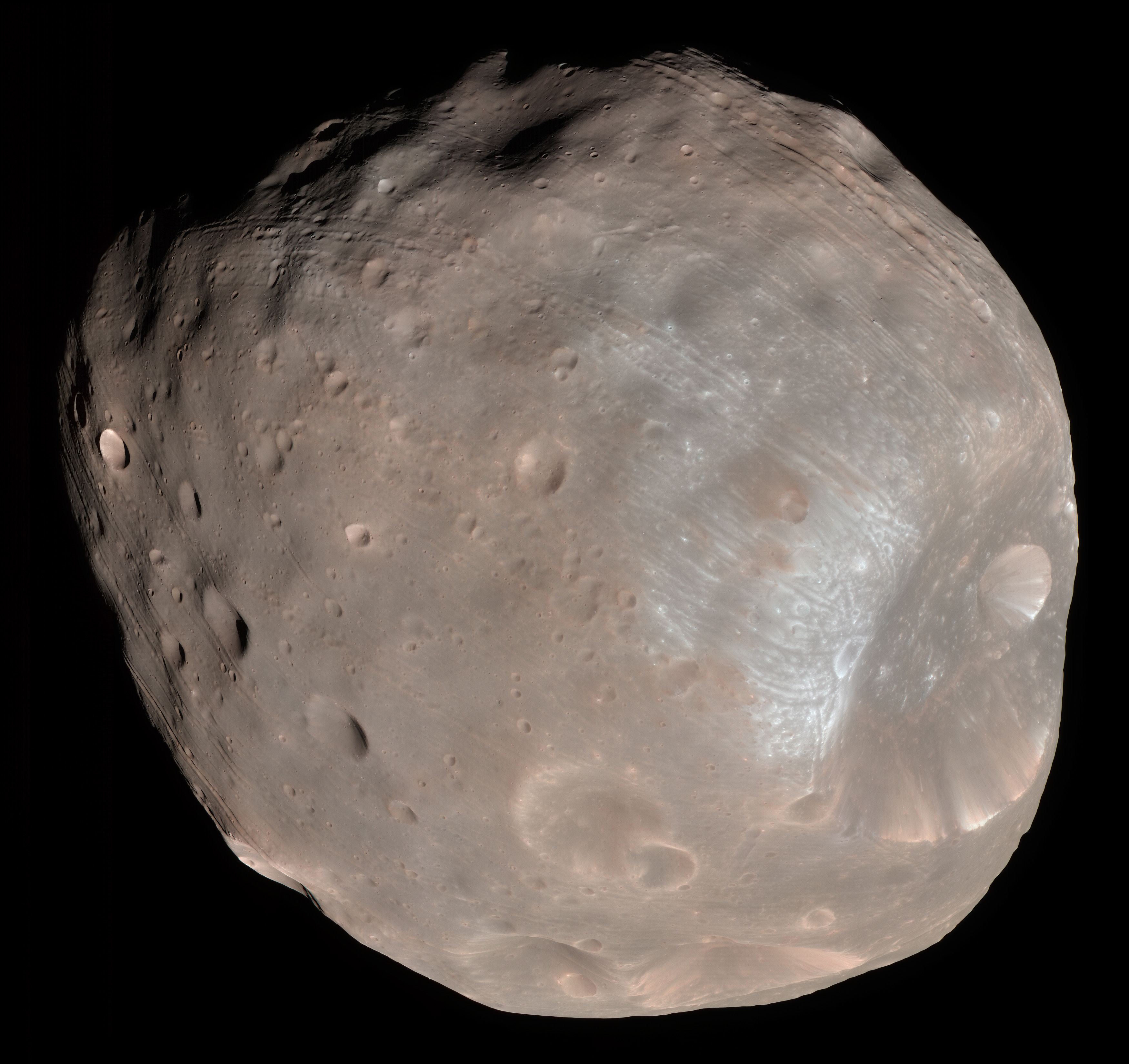
A MRO HiRise image of the Martian moon Phobos. Taken on March 23, 2008. Phobos has dimensions of 27 × 22 × 18 km, while Deimos is 15 × 12.2 × 11 km. Both were discovered in 1877 at the US Naval Observatory in Washington, D.C. (Photo: NASA/MRO/HiRISE)


An MRO HiRise image of the Martian moon Phobos. Taken on March 23, 2008. Phobos has dimensions of 27 × 22 × 18 km, while Deimos is 15 × 12.2 × 11 km. Both were discovered in 1877 at the US Naval Observatory in Washington, D.C. (Photo: NASA/MRO/HiRISE)
APL scientists are not the only ones interested in Phobos or Deimos. The Jet Propulsion Laboratory, Ames Research Center and the SETI Institute have also proposed several missions to the small moons. Every NASA center has been involved at some level.

But the only mission to actually get off the ground is the Russian Space Agency’s Phobos-GRUNT[ref]. The Russian mission was launched November 9, 2011, and two months later took a bath in the Pacific Ocean. The propulsion system failed to execute the burns necessary to escape the Earth’s gravity and instead, its orbit decayed despite weeks of attempts to activate the spacecraft. But that’s a whole other story.
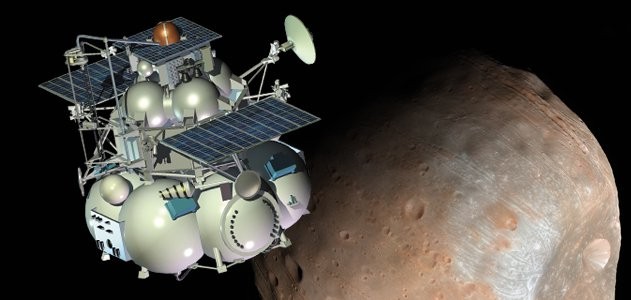
The Russian-led mission Phobos-Grunt did not end well; under Pacific swells to be exact. Undaunted Russian scientists are pressing for Phobos-Grunt 2. (Credit: CNES)


The Russian-led mission Phobos-Grunt did not end well; under Pacific swells to be exact. Undaunted Russian scientists are pressing for Phobos-Grunt 2 (illus.), an improved lander with sample-return. Proposed for 2020s (Credit: CNES)
“The Value of a Phobos Sample Return” first discusses the origins of the moons of Mars. There is no certainty. There is a strong consensus that Earth’s Moon was born from the collision of a Mars-sized object with Earth not long after Earth’s formation. This is just one possibility for the Martian moons. Murchie explains that the impacts that created the large basins and craters on Mars could have spawned Phobos and Deimos: ejecta that achieved orbit, formed a ring and then coalesced into the small bodies. Alternative theories claim that the moons were captured by Mars from either the inner or outer solar system. Or they could have co-accreted with Mars from the Solar Nebula. Murchie and the co-authors describe the difficulties and implications of each scenario. For example, if captured by Mars, then it is difficult to explain how their orbits came to be “near-circular and near-equatorial with synchronous rotational periods.”

To answer the question of origins, the paper turns to the questions of their nature. Murchie explains that the limited compositional knowledge leaves several possibilities for their origins. They seem like D-type asteroids of the outer asteroid belt. However, the moons of Mars are very dry, void of water, at least on their surfaces as the paper discusses in detail. The flybys of Phobos and Deimos by NASA and ESA spacecraft are simply insufficient for drawing any clear picture of their composition or structure, let alone their origins, Murchie and co-authors explain.

If the moons were captured then they have compositions different from Mars; however if they accreted with or from Mars, then they share similar compositions with the early Mars when forming, or from Martian crustal material, respectively.

The paper describes in some detail the problem that billions of years of Martian dust accumulation presents. Every time Mars has been hit by a large asteroid, a cloud of debris is launched into space. Some falls back to the planet but much ends up in orbit. Each time, some of the debris collided with Phobos and Deimos; Murchie uses the term “Witness plate” to describe what the two moons are to Mars. There is an accumulation of Martian material and also material from the impactors covering the surfaces of the moons.  Flyby images of Phobos show a reddish surface similar to Mars, and numerous tracks along the surface as if passing objects struck, plowed or rolled along. However, the reddish hue could be weathering from Solar flux over billions of years.

The paper continues with questions of the composition and how rendezvous missions could go further to understanding the moons makeup and origins, however, it is sample return that would deliver, the pay dirt. Despite how well NASA and ESA engineers have worked to shrink and lighten the instruments that fly, orbit, and land on Mars, returning a sample of Phobos to labs on Earth would permit far more detailed analysis.
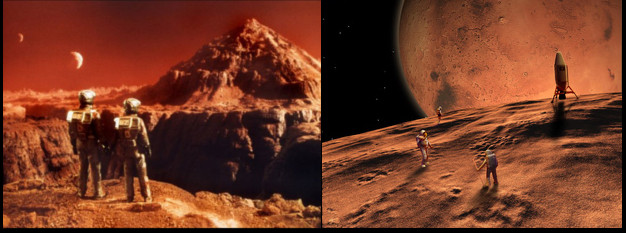
SpaceX and Elon Musk claim that they will mount human flight to Mars before 2030. Many others remain less optimistic with hopes to human flights before 2040. (Illustrations: Total Recall, 1990, early artist illustration c.1950s )

SpaceX and Elon Musk claim that they will mount human flight to Mars before 2030. Many others remain less optimistic with hopes of human flights before 2040. (Illustrations: Total Recall, 1990, early artist illustration c.1950s )
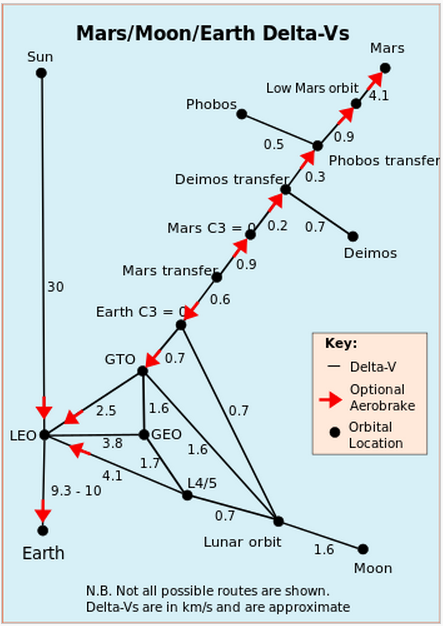
Science Fiction writers and mission designers have imagined Phobos, in particular, as a starting point for the human exploration and colonization of Mars. A notable contemporary work is “Red Mars” by Kim Stanley Robinson; however, the story line is dated due to the retirement of the Space Shuttle and the external tanks Robinson clustered to form the colonization vessel. While this paper by Murchie et al. is purely scientific, fiction writers have used the understanding that Phobos is far easier to reach from Earth than is the surface of Mars (see Delta-V chart below).

A diagram showing the stair-step energy needed to travel to places beyond the Earth. Delta-V is the velocity in km/sec to reach a destination. The Delta-Vs a accumulative. (Credit: Wikipedia, Delta-V)


A diagram showing the stair-step energy needed to travel to places beyond the Earth. Delta-V is the speed in km/sec required to reach a destination. As shown, the Delta-Vs are cumulative. Note that it takes an extra 5 km/sec  beyond Phobos to reach the Martian surface; a prime reason for making the journey to the moons of Mars. (Credit: Wikipedia, Delta-V)
Phobos, orbiting at 9,400 kilometers (5,840 miles), and Deimos, at 23,500 km (14,600 miles), above Mars avoids the need for the 7-odd minutes of EDL terror – Entry, Descent, and Landing — and pulling oneself out of the Martian gravity well to return to Earth. Furthermore, there is the interest in using Phobos as a material resource – water, material for rocket fuel or building materials. “The Value of a Phobos Sample Return” discusses the potential of Phobos as a resource for space travelers – “In Situ Resource Utilization” (ISRU), in the context of its composition, how the solar flux may have purged the moons of water or how Martian impact debris covers materials of greater interest and value to explorers.

With so many questions and interests, what missions have been proposed and explored? The Murchie paper describes a half dozen missions but there are several others that have been conceived and proposed to some level over several decades.

At present, there is at least one mission actively pursuing funds. The SETI and Ames proposed “Phobos and Deimos & Mars Environment” (PADME) mission led by Dr. Pascal Lee is competing for Discovery program funding. Such projects must limit cost to $425 million or less and be capable of launching in less than 3 years. They are proposing a launch date of 2018 on a SpaceX Falcon 9. The PADME mission design would reuse Ames LADEE hardware and expertise, however, it does not go so far as what Murchie and co-authors argue – returning a sample from Phobos. PADME would maintain in a synchronized orbit with Phobos and then Deimos foe repeated flybys. The mission is likely to cost in the range of $300 million. Stardust, a relevant mission due to its sample return capsule, launched in 1999 and had costs which likely reached a similar level by end of mission in 2012.

The Russian Space Agency is attempting to gain funding for Phobos-Grunt 2 but possible launch dates continue to be moved back – 2020, 2022, and now possibly 2024.
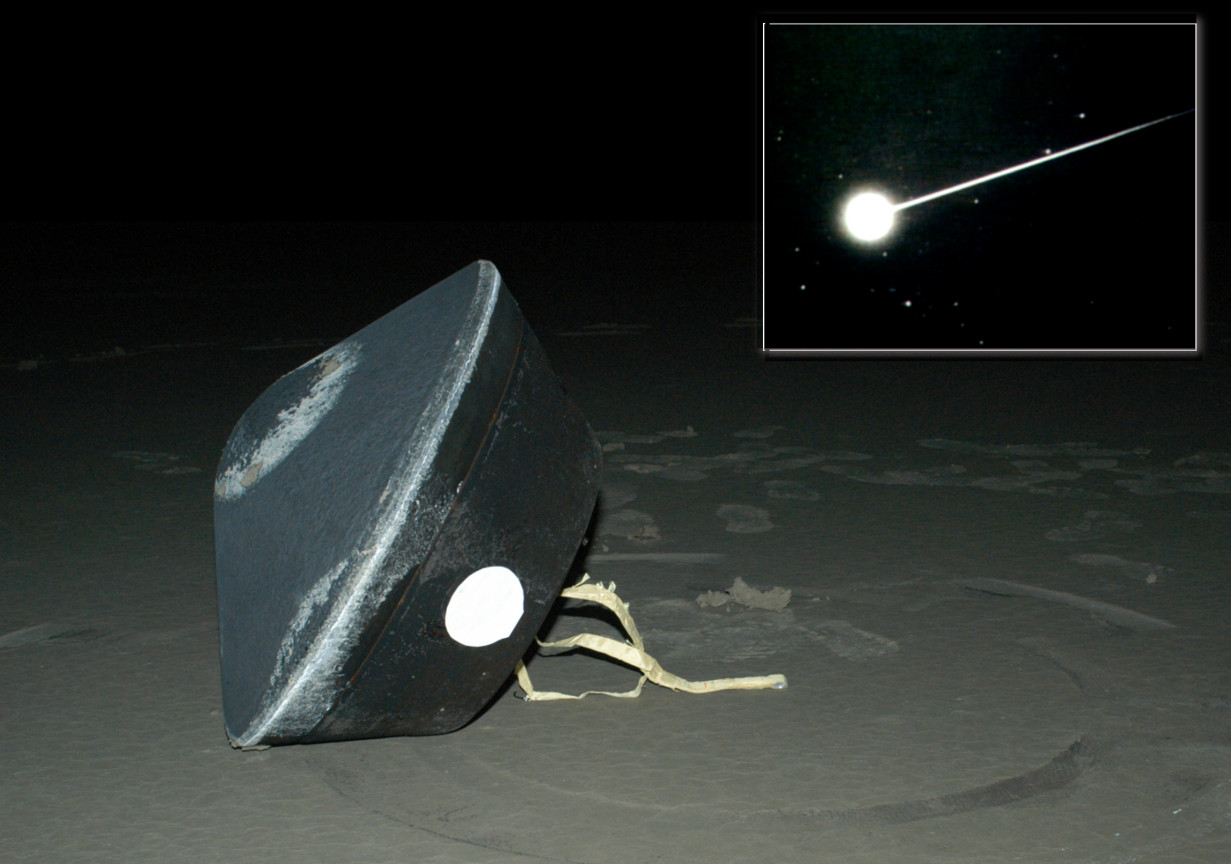
Return of the Stardust sample inside the Lockheed-Martin developed sample-return capsule. See here upon successful landing in the Utah desert. (Credit: NASA/Stardust)


Return of the Stardust sample inside the Lockheed-Martin developed sample-return capsule. Seen here upon successful landing in the Utah desert. (Credit: NASA/Stardust)
Additionally, each of this papers’ authors has mission proposals described. Dr. Pieters, JPL, and Lockheed-Martin proposed the Aladdin mission; Dr. Britt at APL, also with Lockheed-Martin, proposed the mission Gulliver; both would re-use the Stardust sample-return capsule (photo, above). Dr. Murchie also describes his APL/JPL mission concept called MERLIN (Mars–Moon Exploration, Reconnaissance and Landed Investigation).

Phobos and Deimos are the last two of what one would call major objects of the inner Solar System that have not had dedicated missions of exploration. Several bodies of the Asteroid Belt have been targeted with flybys and Dawn is nearing its second target, the largest of the Asteroids, Ceres.

So sooner rather than later, a spacecraft from some nation (not necessarily the United States) will target the moons of Mars. Targeted Phobos/Deimos missions are also likely to include both flyby missions and one or more sample-return missions. A US-led mission with sample-return in the Discovery program will be strained to meet both criteria – $425 million cost cap and 3 year development period.

Those utilizing the Lockheed-Martin (LM) Stardust design have a proven return capsule and spacecraft buses (structure, mechanisms and avionics) for re-use for cost and time savings. This includes five generations of the LM flight software that holds an incredible legacy of mission successes starting with Mars Odyssey/Genesis/Spitzer to now Maven.

All three proposals by this paper’s authors could be re-vamped and proposed again and compete against each other. All three could use Lockheed-Martin past designs. Cooperation in writing this paper may be an indicator that they will join forces, combine concepts, and share investigator positions on a single NASA-led project. The struggle for federal dollars remains a tough, tight battle and with the human spaceflight program struggling to gain a new footing after Space Shuttle, dollars for inter-planetary missions are likely to remain very competitive. However, it appears a Phobos-Deimos mission is likely within the next ten years.

Further reading:

“The Value of a Phobos Sample Return”, Scott L. Murchie, Daniel T. Britt, Carle M. Pieters, Planetary and Space Science, 1 November 2014

The US Naval Observatory, Great 26″ Refractor Telescope

Past Universe Today story, “Finding Phobos: Discovery of a Martian Moon”

About 

Contributing writer Tim Reyes is a former NASA software engineer and analyst who has supported development of orbital and lander missions to the planet Mars since 1992. He has an M.S. in Space Plasma Physics from University of Alabama, Huntsville.
Tagged as: Ames, APL, Deimos, Discovery Program, Hopkins, JPL, Lockheed Martin, Mars, NASA, PADME, Phobos, SETI

Astrophotos: A Wide Angle “Trilogy” of the North America Nebula

Astrophotos: A Wide Angle “Trilogy” of the North America Nebula:

A colorful, wide view of the North America Nebula (NGC 7000 or Caldwell 20) in Cygnus. This three-panel mosaic spanning an area approximately 2.5 x 5.5 degrees, captured using QHY11/TAK E180 presented here in H-Alpha, Hubble Palette and RGB with H-Alpha. Credit and copyright: Terry Hancock.


A colorful, wide view of the North America Nebula (NGC 7000 or Caldwell 20) in Cygnus. This three-panel mosaic spanning an area approximately 2.5 x 5.5 degrees, captured using QHY11/TAK E180 presented here in H-Alpha, Hubble Palette and RGB with H-Alpha. Credit and copyright: Terry Hancock.
A perfect set of astrophotos for #WideAngleWednesday! Here are not one but three views of the North America Nebula taken by Terry Hancock. Terry said this is his widest view yet of this region. Also known as NGC 7000 or Caldwell 20, this is an emission nebula in the constellation Cygnus that resembles the shape of North America and The Gulf Of Mexico. It lies at a distance of approximately 1800 light years away from Earth.

Terry presents a “trilogy” of three different color processes (see below). He took imagery in both July and September 2014 with a total exposure time of 13.9 hours from his Down Under Observatory in Fremont, Michigan.


For more details about the processing for each image, click on the images. To see more of Terry’s great work, see his website, Facebook, Flickr, or G+.

A wide, three-panel mosaic spanning an area approximately 2.5 x 5.5 degrees of the North America Nebula (NGC 7000 or Caldwell 20), in H-Alpha, Hubble Palette and RGB with H-Alpha. Credit and copyright: Terry Hancock.


A wide, three-panel mosaic spanning an area approximately 2.5 x 5.5 degrees of the North America Nebula (NGC 7000 or Caldwell 20), in H-Alpha, Hubble Palette and RGB with H-Alpha. Credit and copyright: Terry Hancock.
Another version of the 3-panel, wide angle view of the North America Nebula. Credit and copyright: Terry Hancock.


Another version of the 3-panel, wide angle view of the North America Nebula. Credit and copyright: Terry Hancock.
Want to get your astrophoto featured on Universe Today? Join our Flickr group or send us your images by email (this means you’re giving us permission to post them). Please explain what’s in the picture, when you took it, the equipment you used, etc.

Tagged as: Nebulae, North American Nebula, Terry Hancock

Our Complete Guide to the October 8th “Hunter’s Moon” Total Lunar Eclipse

Our Complete Guide to the October 8th “Hunter’s Moon” Total Lunar Eclipse:

Photo by author


The April 15th, 2014, total lunar eclipse and Spica. Photo by author.
October 2014 means eclipse season 2 of 2 for the year is upon us.

Don’t fear the ‘Blood Moon’ that’s currently infecting the web, but if you find yourself on the correct moonward facing hemisphere of the planet, do get out and observe the total lunar eclipse coming right up on the morning of Wednesday, October 8th. This is the second and final total lunar eclipse of 2014, and the second of four in a quartet series of lunar eclipses known as a tetrad.

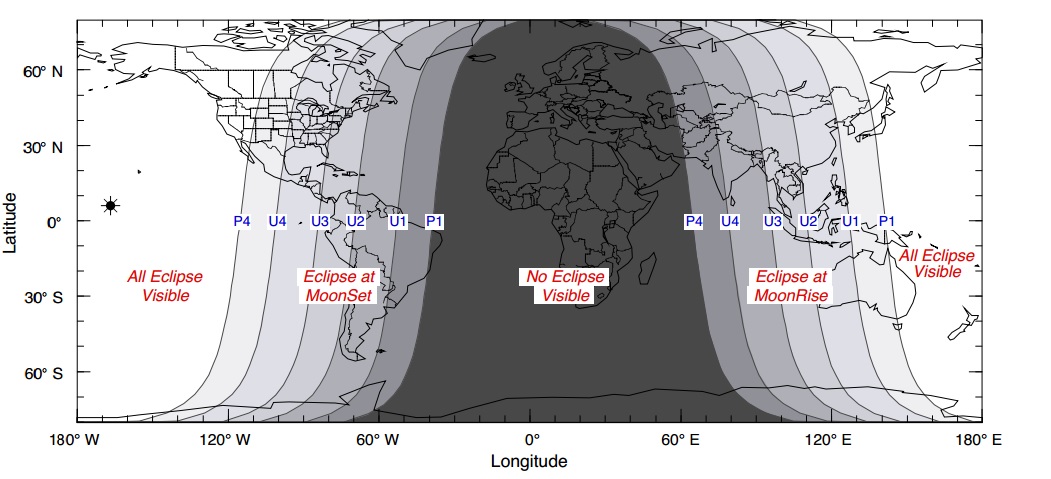
And the good news is, the eclipse once again favors nearly all of North America. From the western U.S. and Canada, the Moon will be high in the western skies when partial phases begin early in the morning on October 8th. The western U.S., Canada and Alaska will see the entire 61 minute span of totality, just 18 minutes shorter than last April’s lunar eclipse. The Moon will be high in the sky during totality for the Hawaiian Islands, and viewers in Australia and the Pacific Far East will witness the eclipse in the evening hours.

Visibility


The visibility regions for the total lunar eclipse. Credit: NASA/GSFC/Espenak.
This lunar eclipse is part of saros 127, and marks number 42 of a series of 72 for that particular saros. If you witnessed the total lunar eclipse visible from North America and Europe on September 27th, 1996, you caught the last of the series, and if you catch the next eclipse in the saros on October 18th, 2032, you’ve earned a veteran lunar eclipse-watchers badge of seeing an exeligmos, or “triple saros” of eclipses.


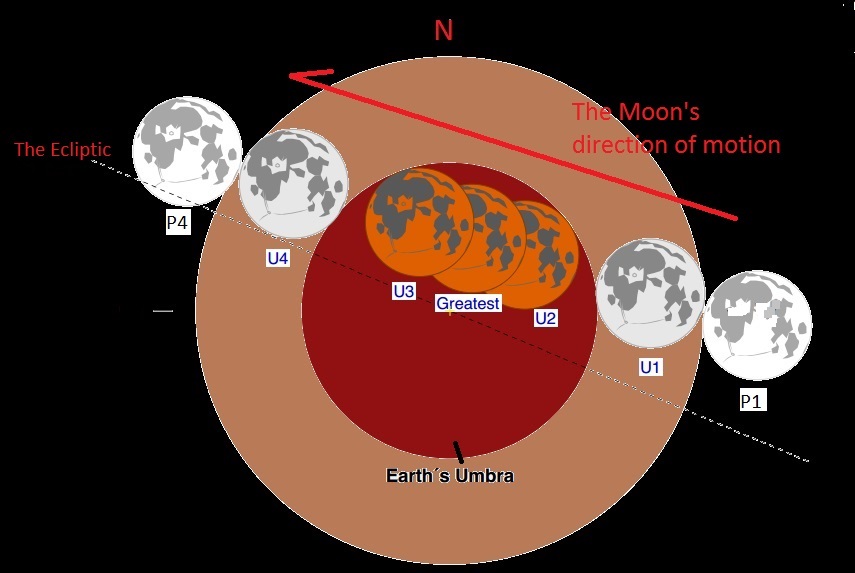
The path of the Moon through the Earth’s umbra on October 8th. Adapted from NASA/GFSC.
Timings for key phases of the eclipse are as follows:

P1- Penumbral phase begins: 8:14 UT/4:14 EDT/1:14 PDT

U1- Umbral (partial) phase begins: 9:15 UT/5:14 EDT/2:14 PDT

U2- Totality begins: 10:24 UT/6:24 EDT/3:24 PDT

Mid-totality- 10:55 UT/6:55 EDT/3:55 PDT

U3- Totality ends: 11:25 UT/7:25 EDT/4:25 PDT

U4- Umbral phase ends: 12:35 UT/5:35 PDT

P4- Penumbral phase ends: 13:35/6:35 PDT


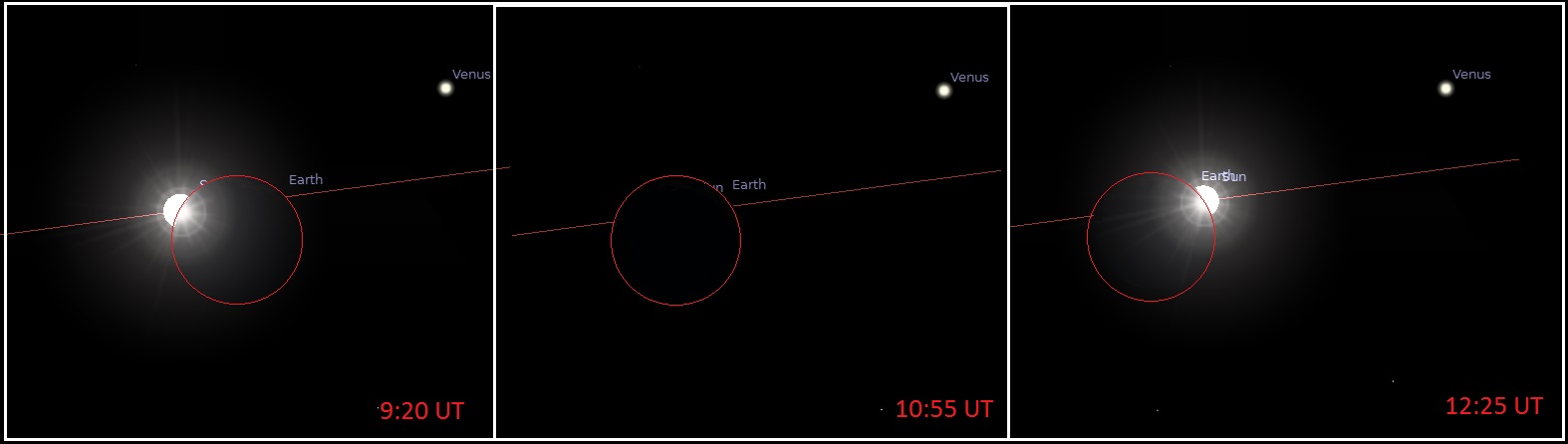
Not all total lunar eclipses are the same when it comes to color. Totality can appear anywhere from a dark brick color, as happened during the December 9th, 1992, eclipse following the eruption of Mount Pinatubo, when the Moon nearly disappeared during totality, to a bright coppery red, as seen during the April eclipse earlier this year. The Moon passes to the north of the dark central core of the Earth’ shadow next Wednesday, so expect a brighter than normal eclipse, especially along the Moon’s northeast limb. Grab a painter’s wheel and compare the eclipsed Moon to swatches of orange through red: what colors do you see? What you’re seeing is the combinations of all the world’s sunsets refracted into the cone of the Earth’s shadow, which is about three times the size of the Moon at its average distance as seen from Earth. Remember, the Moon is experiencing a total solar eclipse as we watch the lunar eclipse unfold!

Stellarium


The October 8th total solar eclipse as seen from the Apollo 11 landing site on the nearside of the Moon. Created using Stellarium.
This color can be quantified and described on what is known as the Danjon Scale, with 0 being a very dark eclipse with the Moon barely visible, to a 4, meaning a very bright eclipse.

And yes, each total lunar eclipse is now receiving the “Blood Moon” meme thanks to ye ole Internet. Expect the conspiracy-minded to note that this eclipse occurs on the Jewish holiday of Sukkot starting at sundown on the 8th, which isn’t really all that wondrous as the Jewish calendar is a luni-solar one, and total lunar eclipses have to occur during a Full Moon by definition. Wait long enough, and an occasional “Sukkot total lunar eclipse” does indeed occur.

Uranus occultation


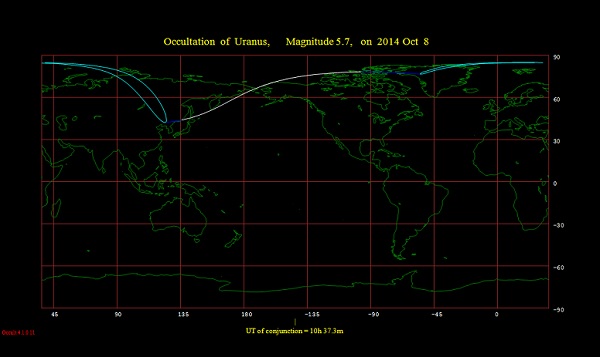
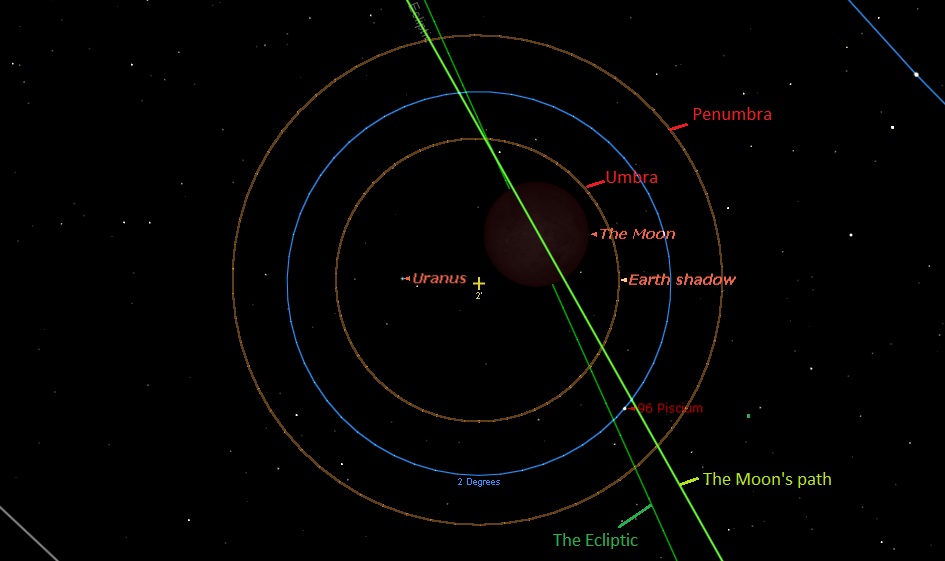
The footprint of the October 8th occultation of Uranus by the Moon during totality. (Credit: Occult 4.1.0).
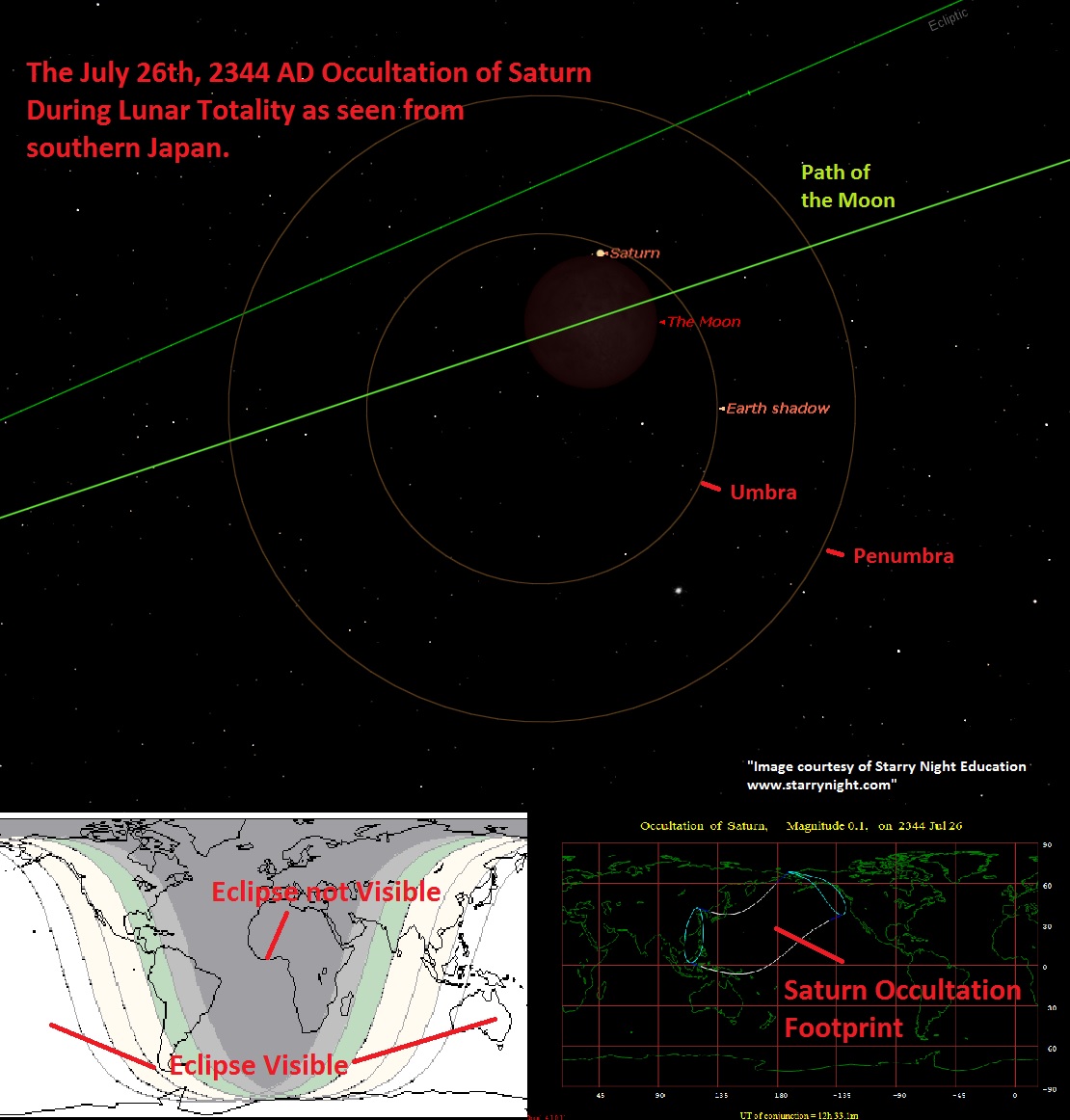
But a truly rare event does occur during this eclipse, as the Moon actually occults (passes in front of) the planet Uranus during totality for observers in northern Alaska and northeast Asia. The rest of us in the observing zone will see a near miss. Can you spy Uranus with binoculars near the lunar limb during totality? Another such rarity occurred during Shakespeare’s time on December 30th, 1591, involving Saturn and the eclipsed Moon, and another such odd occurrence transpires in 2344 A.D.

2344 eclipse


The circumstances of the 2344 eclipse/occultation. Credit: Starry Night, NASA/GSFC & Occult 4.0.1.
The brightest star to be occulted by the total eclipsed Moon as it crosses the constellation Pisces is +7.9th magnitude HIP 4231 for the northern U.S. and Canada.

And speaking of historical eclipses, there’s a Columbus Day tie-in with the phenomenon as well. Like many mariners of his day, Columbus was well-versed in celestial navigation, and used a total lunar eclipse to get a good one-time fix on his longitude at sea, an experiment that you can easily replicate. Columbus also wasn’t above using prior knowledge of an impending lunar eclipse to get himself and his crew out of a bind with the locals when the need arose.

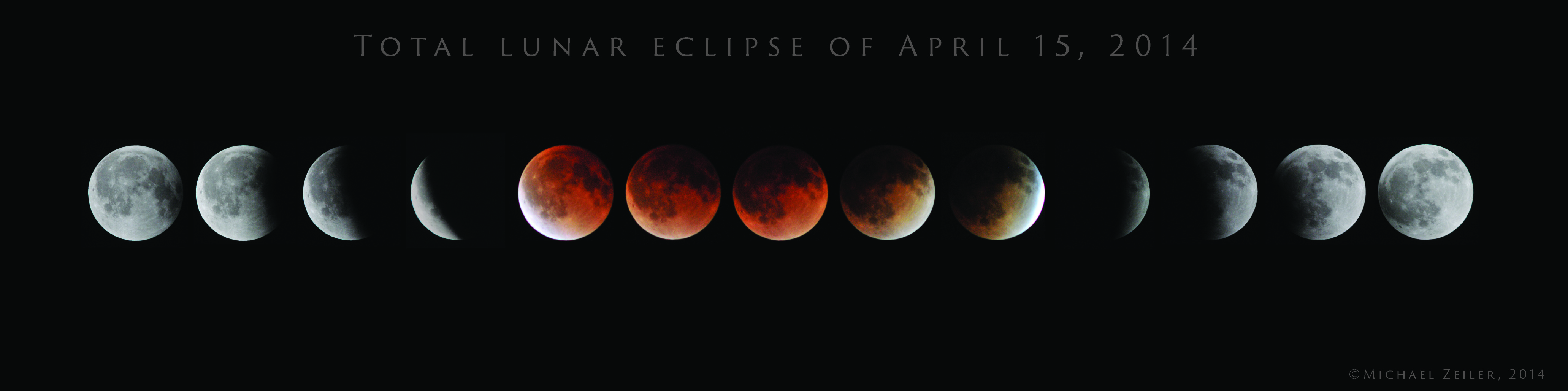
An outstanding sequence of images taken during the April 15th, 2014 total lunar eclipse. Credit: Michael Zeiler (Eclipse-Maps) Used with permission.


An outstanding sequence of images taken during the April 15th, 2014, total lunar eclipse. Credit: Michael Zeiler (Eclipse-Maps) Used with permission.
Photographing an eclipse with a DSLR is as easy as shooting an image of the Moon. Try this a few evenings before the big event. A minimum focal length of 200mm is needed to render the Moon larger than a white dot in the image, and remember that the Moon is much darker during total eclipse, and you’ll need to step the exposure times rapidly down from 1/100th of a second to 2 to 4 seconds during totality.

A long-running effort by Sky & Telescope has been looking for amateur observations of precise crater contacts along the rim of the umbra in an effort to measure variations in the diameter of the Earth’s shadow.

starry night


The Moon versus Uranus as seen from Napa, California just past mid-eclipse on the morning of October 8th. Credit: Starry Night Education Software.
As always, weather prospects are the big question mark when it comes to eclipses. Typically, the southwestern U.S. experiences 13-20 clear days in the month of October; prospects worsen to the northwest, with an average of 3-12 days. We’ll be looking at resources such as NOAA, Skippy Sky and ClearSkyChart on the evenings leading up to the 8th. The great thing about a lunar eclipse is, you don’t need a 100% clear sky to see it: just a clear view of the Moon!

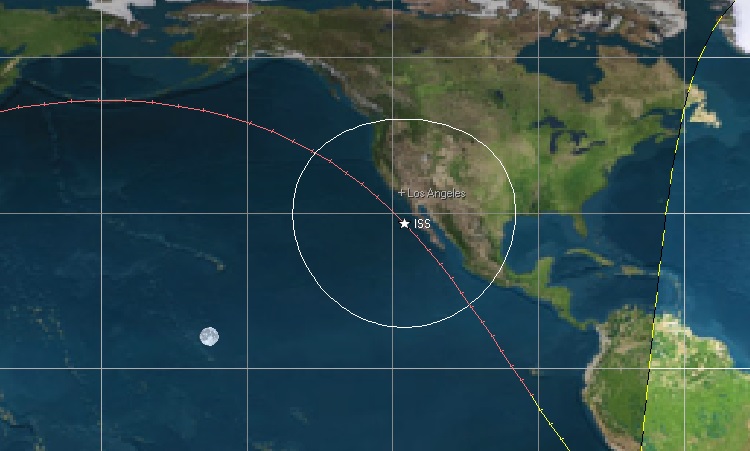
Up for a challenge? We’ve yet to see a capture of a shadow transit of the International Space Station in front of the eclipsed Moon. This time around, such a capture should be possible across southern coastal California and the Baja peninsula just minutes prior to the onset of totality.

Orbitron


A shadow pass of the International Space Station just prior to the onset of totality. Note the position of the Moon. Created using Orbitron.
Another bizarre catch, known as a selenelion — witnessing the end of lunar totality after sunrise — may just be possible across the northern Rockies from the U.S. into southern Canada. The more elevation you can get the better! This works because the Moon lingers a bit in the large shadow of the Earth, plus atmospheric refraction gives the low altitude Sun and Moon a slight boost.

Clouded out? On the wrong side of the planet? You can watch the eclipse online at the following links:

– Live views courtesy of Gialuca Masi and the Virtual Telescope starting at 10:00 UT on October 8th.

– A live webcast starting at 9:00 UT courtesy of Slooh:


– A Columbia State University broadcast, (time to be determined).

Planning an ad-hoc broadcast? Let us know!

And as the eclipse wraps up, the biggest question is always: When’s the next one? Well, lunar eclipse number three of the four eclipse tetrad occurs next year on April 4th, 2015… but in just two weeks time, the western United States and Canada will also witness a fine partial solar eclipse on Oct 23rd

Stay tuned!

Got images of the total lunar eclipse? Send ‘em in to Universe Today’s Flickr forum!

Interested in eclipse sci-fi? Check out our latest short stories Exeligmos and Shadowfall.


Tagged as: 2014 eclipse, blood moon, eclipse observing, eclipse photography, eclipse projects, eclipse science, north america eclipse, oct 8 lunar eclipse, october eclipse, Total Lunar Eclipse, viewing a lunar eclipse

One More Absolutely Amazing Timelapse from the International Space Station

One More Absolutely Amazing Timelapse from the International Space Station:


We’ve featured several timelapse compilations of footage and imagery taken from the International Space Station (like here, here and here) but this one put together by Phil Selmes is great in that it also includes footage *of* the ISS, as shot by the astronauts on the space shuttle as well as actual space to ground audio communications. Phil said he included the audio clips “to remind the audience of the humanity that inhabits the space station.”

There is just something about these videos from the ISS that speaks to your soul. Phil told Universe Today that while putting this together, he saw “how different our world looks just 370kms above our heads. I didn’t see politics, races, borders, countries, religions or differences,” he said via email. “I saw one planet, one world, one incredibly beautiful miracle in the absolute vastness of the universe. It gave me some perspective, ironically it brought me ‘back to earth.’”


The video and imagery is from the Johnson Space Center’s Gateway to Astronaut Photography of the Earth.

Look for more #TimelapseThursday videos in the weeks to come.

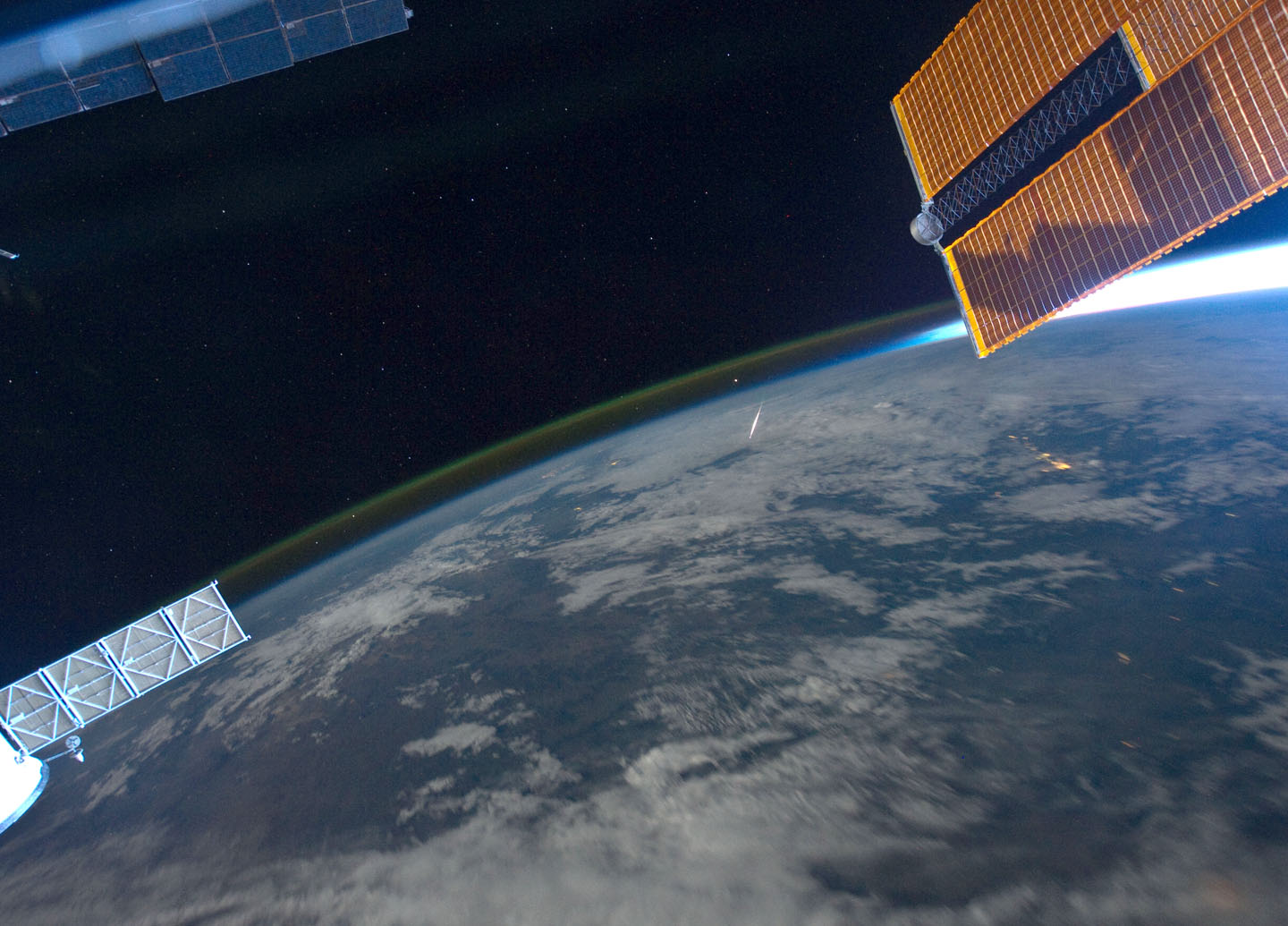
Perseid meteor as seen from the ISS by astronaut Ron Garan on August 13, 2011. Credit: NASA/Ron Garan.


Perseid meteor as seen from the ISS by astronaut Ron Garan on August 13, 2011. Credit: NASA/Ron Garan.
Tagged as: Earth, Earth Observation, International Space Station (ISS), Timelapse videos

Swirling Cloud at Titan's Pole is Cold and Toxic

Swirling Cloud at Titan's Pole is Cold and Toxic: Spectral map of Titan with Polar Vortex These two views of Saturn's moon Titan show the southern polar vortex, a huge, swirling cloud that was first observed by NASA's Cassini spacecraft in 2012. Credit: NASA/JPL-Caltech/ASI/University of Arizona/SSI/Leiden Observatory and SRON
› Full image and caption


October 01, 2014

Scientists analyzing data from NASA's Cassini mission have discovered that a giant, toxic cloud is hovering over the south pole of Saturn's largest moon, Titan, after the atmosphere there cooled dramatically.

The scientists found that this giant polar vortex contains frozen particles of the toxic compound hydrogen cyanide, or HCN.

"The discovery suggests that the atmosphere of Titan's southern hemisphere is cooling much faster than we expected," said Remco de Kok of Leiden Observatory and SRON Netherlands Institute for Space Research, lead author of the study published today in the journal Nature.

Titan is the only moon in the solar system that is cloaked in a dense atmosphere. Like our home planet, Earth, Titan experiences seasons. As it makes its 29-year orbit around the sun along with Saturn, each season lasts about seven Earth years. The most recent seasonal switch occurred in 2009, when winter gave way to spring in the northern hemisphere, and summer transitioned to autumn in the southern hemisphere.

In May 2012, while Titan's southern hemisphere was experiencing autumn, images from Cassini revealed a huge swirling cloud, several hundred miles across, taking shape above Titan's south pole. This polar vortex appears to be an effect of the change of season.

A puzzling detail about the swirling cloud is its altitude, some 200 miles (about 300 kilometers) above Titan's surface, where scientists thought the temperature was too warm for clouds to form. "We really didn't expect to see such a massive cloud so high in the atmosphere," said de Kok.

Keen to understand what could give rise to this mysterious cloud, the scientists dove into Cassini's observations and found an important clue in the spectrum of sunlight reflected by Titan's atmosphere.

A spectrum splits the light from a celestial body into its constituent colors, revealing signatures of the elements and molecules present. Cassini's visual and infrared mapping spectrometer (VIMS) maps the distribution of chemical compounds in Titan's atmosphere and on its surface.

"The light coming from the polar vortex showed a remarkable difference with respect to other portions of Titan's atmosphere," says de Kok. "We could clearly see a signature of frozen HCN molecules."

As a gas, HCN is present in small amounts in the nitrogen-rich atmosphere of Titan. Finding these molecules in the form of ice was surprising, as HCN can condense to form frozen particles only if the atmospheric temperature is as cold as minus 234 degrees Farenheit (minus 148 degrees Celsius). This is about 200 degrees Fahrenheit (about 100 degrees Celsius) colder than predictions from current theoretical models of Titan's upper atmosphere.

To check whether such low temperatures were actually possible, the team looked at observations from Cassini's composite infrared spectrometer (CIRS), which measures atmospheric temperature at different altitudes. Those data showed that the southern hemisphere of Titan has been cooling rapidly, making it possible to reach the cold temperature needed to form the giant toxic cloud seen on the south pole.

Atmospheric circulation has been drawing large masses of gas towards the south since the change of season in 2009. As HCN gas becomes more concentrated there, its molecules shine brightly at infrared wavelengths, cooling the surrounding air in the process. Another factor contributing to this cooling is the reduced exposure to sunlight in Titan's southern hemisphere as winter approaches there.

"These fascinating results from a body whose seasons are measured in years rather than months provide yet another example of the longevity of the remarkable Cassini spacecraft and its instruments," said Earl Maize, Cassini project manager at NASA's Jet Propulsion Laboratory in Pasadena, California. "We look forward to further revelations as we approach summer solstice for the Saturn system in 2017."

The Cassini-Huygens mission is a cooperative project of NASA, the European Space Agency and the Italian Space Agency. JPL, a division of the California Institute of Technology, Pasadena, manages the mission for NASA's Science Mission Directorate in Washington. The VIMS team is based at the University of Arizona in Tucson. The CIRS team is based at NASA's Goddard Space Flight Center in Greenbelt, Maryland.

More information about Cassini is available at the following sites:

http://www.nasa.gov/cassini

http://saturn.jpl.nasa.gov

Preston Dyches
Jet Propulsion Laboratory, Pasadena, Calif.
818-354-7013
preston.dyches@jpl.nasa.gov

2014-331

NASA Mission Points to Origin of 'Ocean of Storms' on Earth's Moon

NASA Mission Points to Origin of 'Ocean of Storms' on Earth's Moon: A view of Earth's moon looking south across Oceanus Procellarum A view of Earth's moon looking south across Oceanus Procellarum, representing how the western border structures may have looked while active. Image credit: NASA/Colorado School of Mines/MIT/JPL/GSFC.
› Full image and caption


October 01, 2014

Using data from NASA's Gravity Recovery and Interior Laboratory (GRAIL), mission scientists have solved a lunar mystery almost as old as the moon itself.

Early theories suggested the craggy outline of a region of the moon's surface known as Oceanus Procellarum, or the Ocean of Storms, was caused by an asteroid impact. If this theory had been correct, the basin it formed would be the largest asteroid impact basin on the moon. However, mission scientists studying GRAIL data believe they have found evidence the craggy outline of this rectangular region -- roughly 1,600 miles (2,600 kilometers) across -- is actually the result of the formation of ancient rift valleys.

"The near side of the moon has been studied for centuries, and yet continues to offer up surprises for scientists with the right tools," said Maria Zuber, principal investigator of NASA's GRAIL mission, from the Massachusetts Institute of Technology, Cambridge. "We interpret the gravity anomalies discovered by GRAIL as part of the lunar magma plumbing system -- the conduits that fed lava to the surface during ancient volcanic eruptions."

The surface of the moon's near side is dominated by a unique area called the Procellarum region, characterized by low elevations, unique composition and numerous ancient volcanic plains.

The rifts are buried beneath dark volcanic plains on the near side of the moon and have been detected only in the gravity data provided by GRAIL. The lava-flooded rift valleys are unlike anything found anywhere else on the moon and may at one time have resembled rift zones on Earth, Mars and Venus. The findings are published online in the journal Nature.

Another theory arising from recent data analysis suggests this region formed as a result of churning deep in the interior of the moon that led to a high concentration of heat-producing radioactive elements in the crust and mantle of this region. Scientists studied the gradients in gravity data from GRAIL, which revealed a rectangular shape in resulting gravitational anomalies.

"The rectangular pattern of gravity anomalies was completely unexpected," said Jeff Andrews-Hanna, a GRAIL co-investigator at the Colorado School of Mines in Golden, and lead author of the paper. "Using the gradients in the gravity data to reveal the rectangular pattern of anomalies, we can now clearly and completely see structures that were only hinted at by surface observations."

The rectangular pattern, with its angular corners and straight sides, contradicts the theory that Procellarum is an ancient impact basin, since such an impact would create a circular basin. Instead, the new research suggests processes beneath the moon's surface dominated the evolution of this region.

Over time, the region would cool and contract, pulling away from its surroundings and creating fractures similar to the cracks that form in mud as it dries out, but on a much larger scale.

The study also noted a surprising similarity between the rectangular pattern of structures on the moon, and those surrounding the south polar region of Saturn's icy moon Enceladus. Both patterns appear to be related to volcanic and tectonic processes operating on their respective worlds.

"Our gravity data are opening up a new chapter of lunar history, during which the moon was a more dynamic place than suggested by the cratered landscape that is visible to the naked eye," said Andrews-Hanna. "More work is needed to understand the cause of this newfound pattern of gravity anomalies, and the implications for the history of the moon."

Launched as GRAIL A and GRAIL B in September 2011, the probes, renamed Ebb and Flow, operated in a nearly circular orbit near the poles of the moon at an altitude of about 34 miles (55 kilometers) until their mission ended in December 2012. The distance between the twin probes changed slightly as they flew over areas of greater and lesser gravity caused by visible features, such as mountains and craters, and by masses hidden beneath the lunar surface.

The twin spacecraft flew in a nearly circular orbit until the end of the mission on Dec. 17, 2012, when the probes intentionally were sent into the moon's surface. NASA later named the impact site in honor of late astronaut Sally K. Ride, who was America's first woman in space and a member of the GRAIL mission team.

GRAIL's prime and extended science missions generated the highest-resolution gravity field map of any celestial body. The map will provide a better understanding of how Earth and other rocky planets in the solar system formed and evolved.

The GRAIL mission was managed by NASA's Jet Propulsion Laboratory (JPL) in Pasadena, California, for NASA's Science Mission Directorate in Washington. The mission was part of the Discovery Program managed at NASA's Marshall Space Flight Center in Huntsville, Alabama. GRAIL was built by Lockheed Martin Space Systems in Denver.

For more information about GRAIL, visit:

http://www.nasa.gov/grail

DC Agle

Jet Propulsion Laboratory, Pasadena, Calif.

818-393-9011

agle@jpl.nasa.gov

Dwayne Brown

NASA Headquarters, Washington

202-358-1726

dwayne.c.brown@nasa.gov

Kathleen Morton

Colorado School of Mines, Golden

303-273-3088

kmorton@mines.edu

2014-333

Monday, September 29, 2014

MESSENGER Completes Second Burn to Maintain Mercury Orbit

MESSENGER Completes Second Burn to Maintain Mercury Orbit:

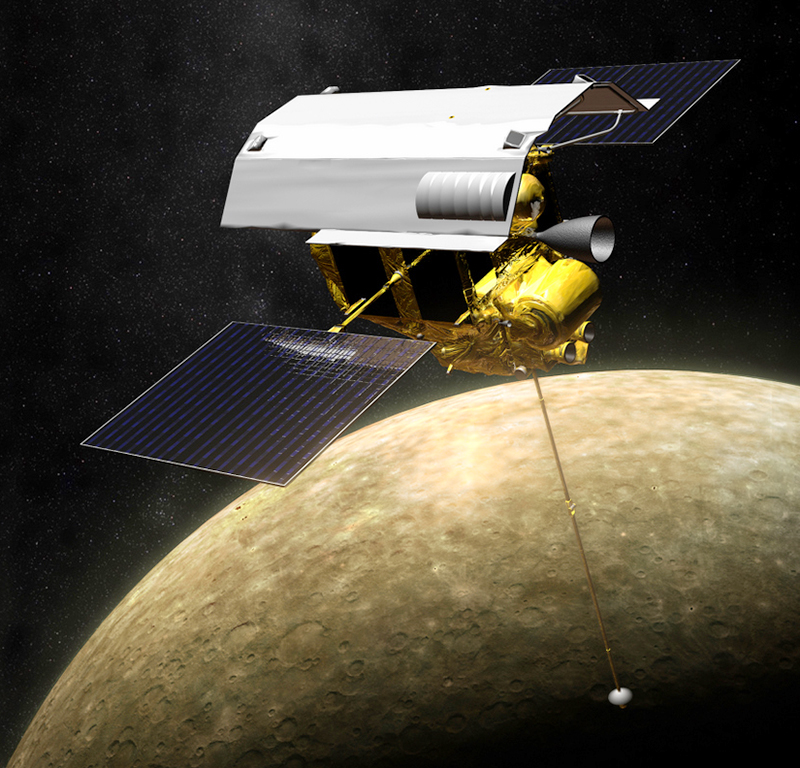
Illustration of MESSENGER in orbit around Mercury (NASA/JPL/APL)

A little over a week before NASA’s MAVEN spacecraft fired its rockets to successfully enter orbit around Mars, MESSENGER performed a little burn of its own – the second of four orbit correction maneuvers (OCMs) that will allow it to remain in orbit around Mercury until next March. Although it is closing in on the end of its operational life it’s nice to know we still have a few more months of images and discoveries from MESSENGER to look forward to!

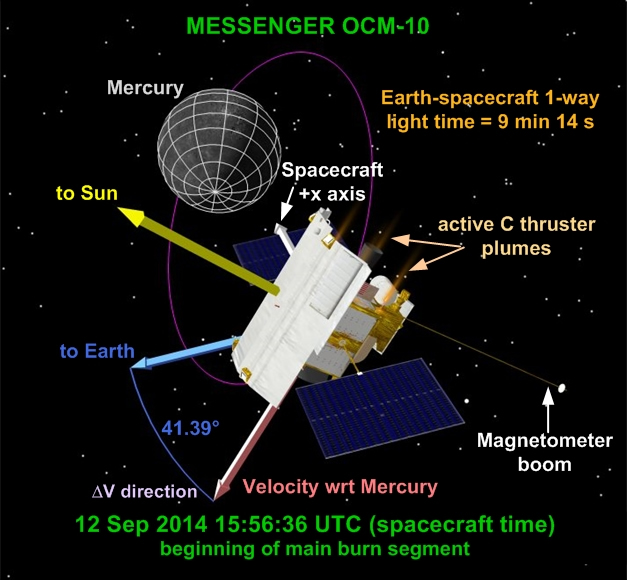
MESSENGER's orientation after the start of orbit correction maneuver 10 (OCM-10). Credit: NASA/Johns Hopkins University Applied Physics Laboratory/Carnegie Institution of Washington


MESSENGER’s orientation after the start of orbit correction maneuver 10 (OCM-10). Credit: NASA/Johns Hopkins University Applied Physics Laboratory/Carnegie Institution of Washington
The first OCM burn was performed on June 17, raising MESSENGER’s orbit from 115 kilometers (71.4 miles) to 156.4 kilometers (97.2 miles) above the surface of Mercury. That was the ninth OCM of the MESSENGER mission, and at 11:54 a.m. EDT on Sept. 12, 2014, the tenth was performed.

Read more: Mercury’s Ready for Its Close-up, Mr. MESSENGER

According to the mission news article:

At the time of this most recent maneuver, MESSENGER was in an orbit with a closest approach of 24.3 kilometers (15.1 miles) above the surface of Mercury. With a velocity change of 8.57 meters per second (19.17 miles per hour), the spacecraft’s four largest monopropellant thrusters (with a small contribution from four of the 12 smallest monopropellant thrusters) nudged the spacecraft to an orbit with a closest approach altitude of 94 kilometers (58.4 miles). This maneuver also increased the spacecraft’s speed relative to Mercury at the maximum distance from Mercury, adding about 3.2 minutes to the spacecraft’s eight-hour, two-minute orbit period.
OCM-10 lasted for 2 1/4 minutes and added 3.2 minutes to the spacecraft’s 8-hour, 2-minute-long orbit. (Source)

The next two burns will occur on October 24 and January 21.

After its two final successful burns MESSENGER will be out of propellant, making any further OCMs impossible. At the planned end of its mission MESSENGER will impact Mercury’s surface in March of 2015.

WATCH: A Tribute to MESSENGER

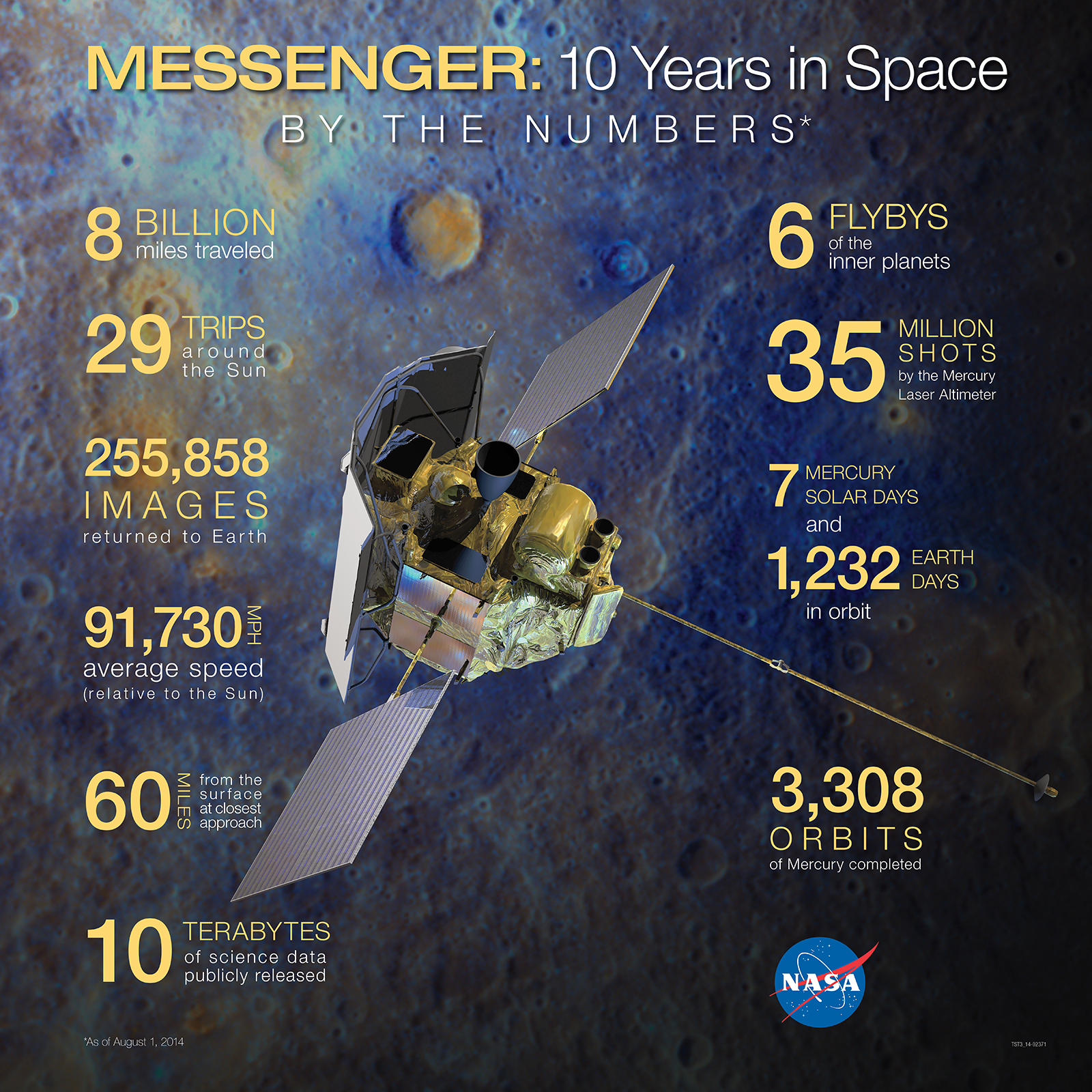
Built and operated by The Johns Hopkins University Applied Physics Laboratory (JHUAPL), MESSENGER launched from Cape Canaveral Air Force Station on August 3, 2004. It entered orbit around Mercury on March 18, 2011, the first spacecraft ever to do so. Since then it has performed countless observations of our Solar System’s innermost planet and has successfully mapped 100% of its surface. Check out the infographic below showing some of the amazing numbers racked up by MESSENGER since its launch ten years ago, and read more about the MESSENGER mission here.

"MESSENGER by the Numbers" - and infographic by NASA


“MESSENGER by the Numbers” – an infographic by NASA

Tagged as: JHUAPL, Mercury, MESSENGER, orbit, planet, Solar System

NASA Explains: The Difference Between CMEs and Solar Flares

NASA Explains: The Difference Between CMEs and Solar Flares:


This is a question we are often asked: what is the difference between a coronal mass ejection (CME) and a solar flare? We discussed it in a recent astrophoto post, but today NASA put out a video with amazing graphics that explains it — and visualizes it — extremely well.

“CMEs and solar flares are both explosions that occur on the Sun,” the folks at NASA’s Goddard Spaceflight Center’s Scientific Visualization Studio explain. “Sometimes they occur together, but they are not the same thing.”


CMEs are giant clouds of particles from the Sun hurled out into space, while flares are flashes of light — occurring in various wavelengths — on the Sun.

You can find even more details from NASA here.

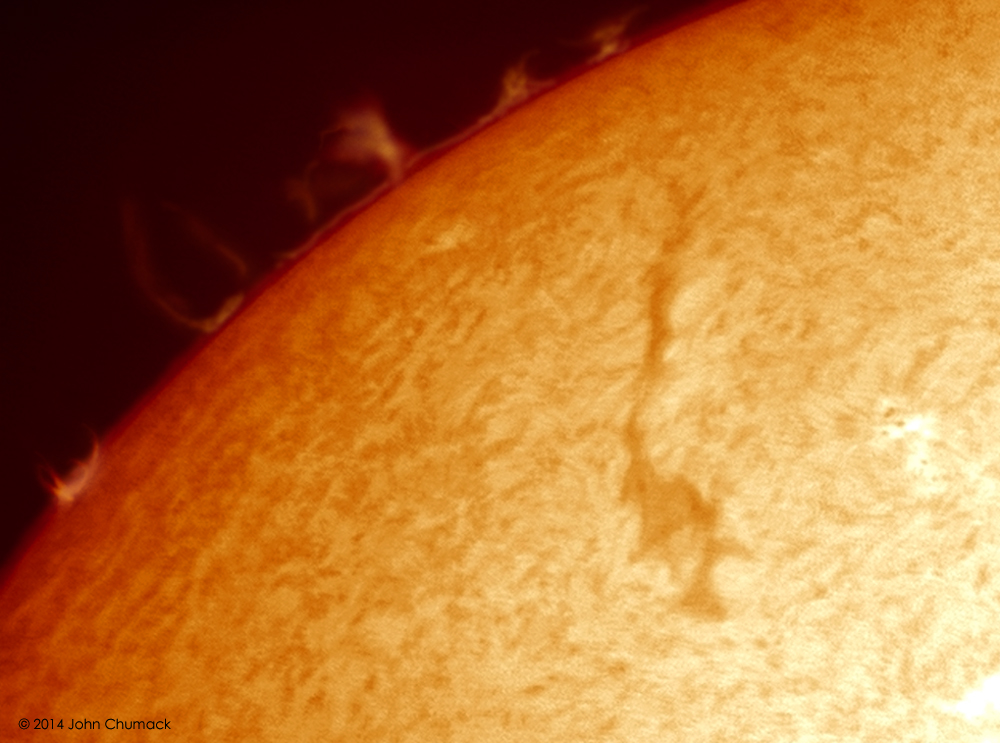
Solar prominences and filaments on the Sun on September 18, 2014, as seen with a hydrogen alpha filter. Credit and copyright: John Chumack/Galactic Images.


Solar prominences and filaments on the Sun on September 18, 2014, as seen with a hydrogen alpha filter. Credit and copyright: John Chumack/Galactic Images.
Tagged as: CME, coronal mass ejection, NASA, solar flare, sun

Beautiful Astrophoto: Jupiter at Dawn

Beautiful Astrophoto: Jupiter at Dawn:

Jupiter at Dawn from the Savannah Skies Observatory in Australia, taken on September 20, 2014. Credit and copyright: Joseph Brimacombe.


Jupiter at Dawn from the Savannah Skies Observatory in Australia, taken on September 20, 2014. Credit and copyright: Joseph Brimacombe.
Prolific astrophotographer Joseph Brimacombe from Australia shot this beauty from his Savannah Skies Observatory near Cairns. He notes on Flickr that “Jupiter has been enhanced for effect,” but what a lovely effect! Plus what a great view of the landscape in Queensland.


Taken with a Canon 5D Mk II and 28-300 mm lens, six frames; three exposures each.

Want to get your astrophoto featured on Universe Today? Join our Flickr group or send us your images by email (this means you’re giving us permission to post them). Please explain what’s in the picture, when you took it, the equipment you used, etc.

Tagged as: Astrophoto, Joseph Brimacombe, Jupiter

2 Days Out from the Red Planet, India’s MOM Probe Test Fires Main Engine for Mars Orbit Insertion

2 Days Out from the Red Planet, India’s MOM Probe Test Fires Main Engine for Mars Orbit Insertion:

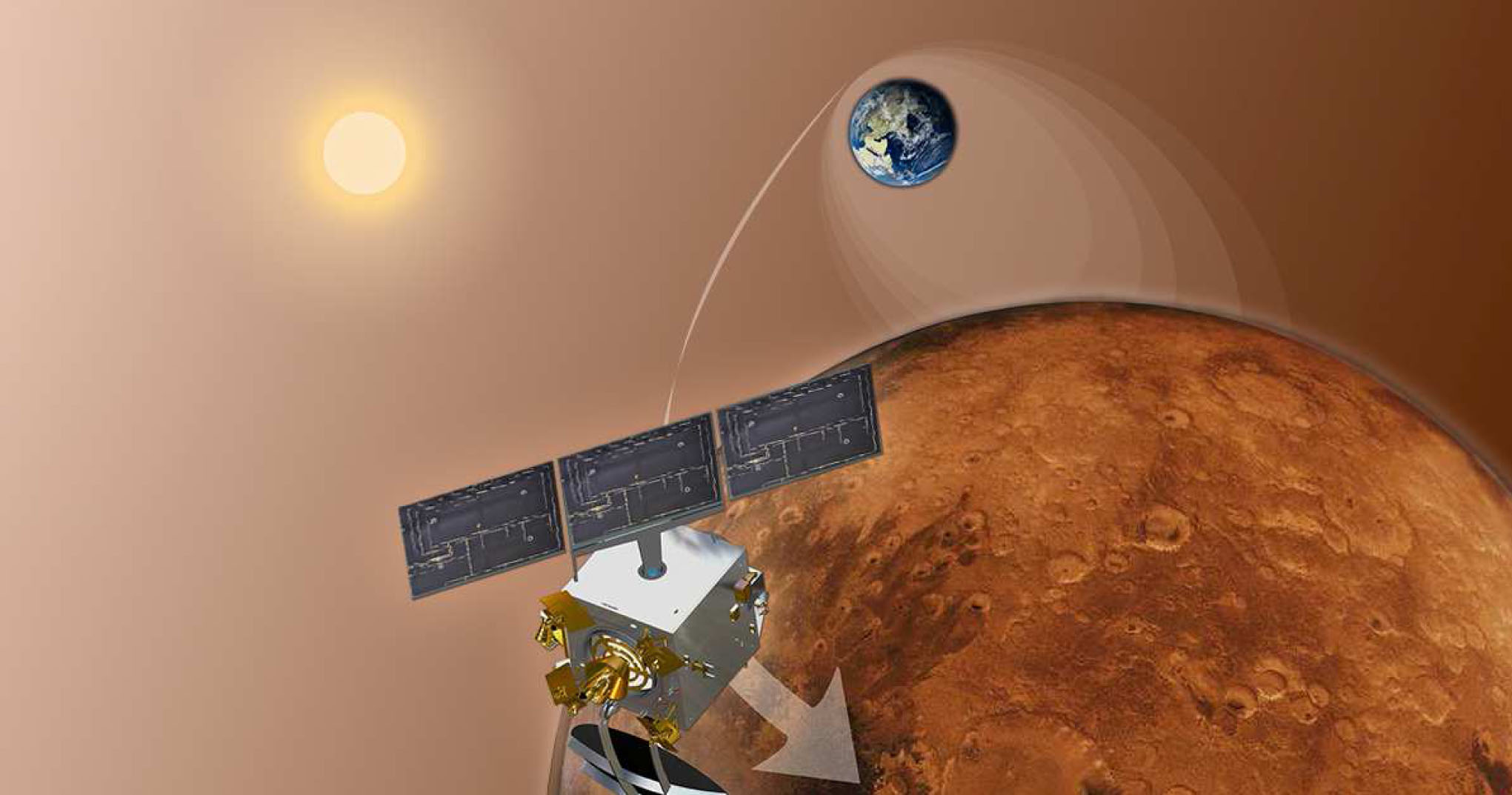
India’s Mars Orbiter Mission (MOM) is closing in on the Red Planet and the Mars Orbit Insertion engine firing when it arrives on September 24, 2014 after its 10 month interplanetary journey. Credit ISRO


India’s Mars Orbiter Mission (MOM) is closing in on the Red Planet and the Mars Orbit Insertion engine firing when it arrives on September 24, 2014 after its 10 month interplanetary journey. Credit ISRO
See cool trajectory animation below
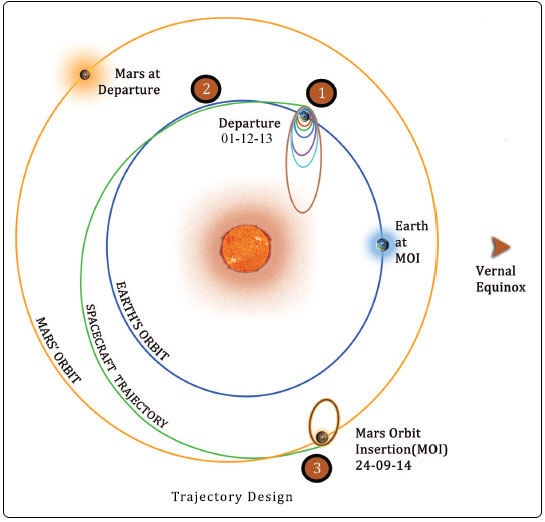
Two days out from her history making date with destiny, India’s Mars Orbiter Mission (MOM) successfully completed a crucial test firing of the spacecraft’s main liquid engine to confirm its operational readiness for the critical Mars Orbital Insertion (MOI) engine firing on Wednesday morning Sept. 24 IST (Tuesday evening Sept. 23 EDT).

Engineers at the Indian Space Research Organization (ISRO) which designed and developed MOM successfully fired the probes 440 Newton Liquid Apogee Motor (LAM) earlier today, Sept. 22, 2014, for a duration of 3.968 seconds at 1430 hrs IST (Indian Standard Time), according to today’s announcement from ISRO.

“We had a perfect burn for four seconds as programmed. MOM will now go-ahead with the nominal plan for Mars Orbital Insertion,” said ISRO.

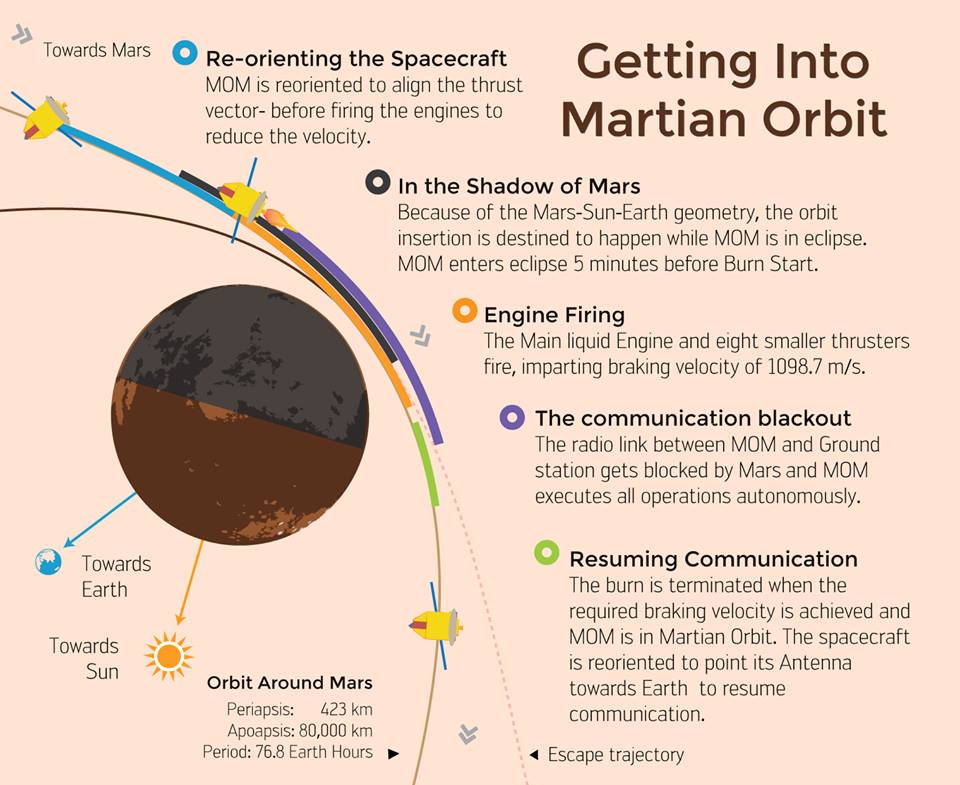
ISRO's Mars Orbiter Mission - The plan of action for Mars Orbit Insertion on September 24. Credit ISRO


ISRO’s Mars Orbiter Mission – The plan of action for Mars Orbit Insertion on September 24. Credit ISRO
MOM counts as India’s first interplanetary voyager and the nation’s first manmade object to orbit the 4th rock from our Sun – if all goes well.

The LAM was last fired over nine months ago on December 01, 2013 to inject MOM into a ten month long interplanetary Trans Mars Trajectory.

Today’s operation verified that LAM is fully operational to perform the do-or-die MOI braking burn on Sept. 24 targeted for 07:17:32 hrs IST (Sept. 23, 9:47:32 p.m. EDT) that will place the probe into a highly elliptical 377 km x 80,000 km orbit around the Red Planet.

You can watch all the action live on ISRO’s website during the streaming webcast starting at 6:45 IST (9:15 p.m. EDT): http://www.isro.org/

The burn was also marks the spacecraft’s final Trajectory Correction Maneuver known as TCM-4 and changed its velocity by 2.18 meters/second.

“The trajectory has been corrected,” said ISRO.

The $69 Million probe is being continuously monitored by the Indian Deep Space Network (IDSN) and NASA JPL’s Deep Space Network (DSN) to maintain its course.

Trans Mars Injection (TMI), carried out on Dec 01, 2013 at 00:49 hrs (IST) has moved the spacecraft in the Mars Transfer Trajectory (MTT). With TMI the Earth orbiting phase of the spacecraft ended and the spacecraft is now on a course to encounter Mars after a journey of about 10 months around the Sun. Credit: ISRO


Trans Mars Injection (TMI), carried out on Dec 01, 2013 at 00:49 hrs (IST) has moved the spacecraft in the Mars Transfer Trajectory (MTT). With TMI the Earth orbiting phase of the spacecraft ended and the spacecraft is now on a course to encounter Mars after a journey of about 10 months around the Sun. Credit: ISRO
ISRO space engineers are taking care to precisely navigate MOM to keep it on course during its long heliocentric trajectory from Earth to Mars through a series of in flight Trajectory Correction Maneuvers (TCMs).

The last TCM was successfully performed on June 11 by firing the spacecraft’s 22 Newton thrusters for a duration of 16 seconds. TCM-1 was conducted on December 11, 2013 by firing the 22 Newton Thrusters for 40.5 seconds.

Engineers determined that a TCM planned for August was not needed.

On “D-Day” as ISRO calls it, the LAM and the eight smaller 22 Newton liquid fueled engines are scheduled to fire for a duration of about 24 minutes.

The MOI braking burn will be carried out fully autonomously since MOM will be eclipsed by Mars due to the Sun-Earth-Mars geometry about five minutes prior to initiation of the engine firing.

Round trip radio signals communicating with MOM now take some 21 minutes.

The 1,350 kilogram (2,980 pound) probe has been streaking through space for over ten months.

MOM follows hot on the heels of NASA’s MAVEN spacecraft which successfully achieved Red Planet orbit less than a day ago on Sunday, Sept. 22, 2014.

“We wish a successful MOI for MOM,” said Bruce Jakosky, MAVEN principal investigator with the Laboratory for Atmospheric and Space Physics at the University of Colorado, Boulder (CU/LASP) at MAVEN’s post MOI briefing earlier today.

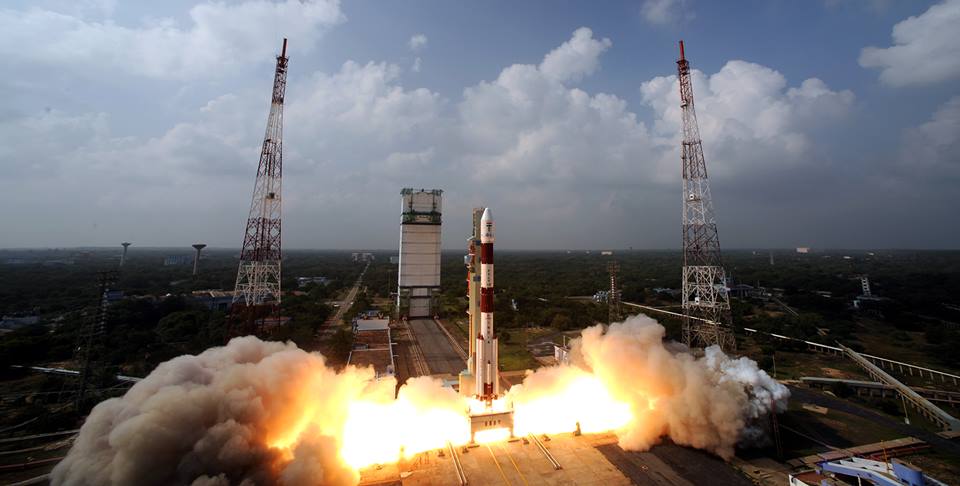
MOM was launched on Nov. 5, 2013 from India’s spaceport at the Satish Dhawan Space Centre, Sriharikota, atop the nation’s indigenous four stage Polar Satellite Launch Vehicle (PSLV) which placed the probe into its initial Earth parking orbit.

Watch this cool animation showing the interplanetary path of MOM and MAVEN from Earth to Mars sent to me be an appreciative reader – Sankaranarayanan K V:


Although MOM’s main objective is a demonstration of technological capabilities, she will also study the planet’s atmosphere and surface.

The probe is equipped with five indigenous instruments to conduct meaningful science – including a tri-color imager (MCC) and a methane gas sniffer (MSM) to study the Red Planet’s atmosphere, morphology, mineralogy and surface features. Methane on Earth originates from both geological and biological sources – and could be a potential marker for the existence of Martian microbes.

Both MAVEN’s and MOM’s goal is to study the Martian atmosphere , unlock the mysteries of its current atmosphere and determine how, why and when the atmosphere and liquid water was lost – and how this transformed Mars’ climate into its cold, desiccated state of today.

If all goes well, India will join an elite club of only four who have launched probes that successfully investigated the Red Planet from orbit or the surface – following the Soviet Union, the United States and the European Space Agency (ESA).

Stay tuned here for Ken’s continuing MOM, MAVEN, Rosetta, Opportunity, Curiosity, Mars rover and more Earth and planetary science and human spaceflight news.

Ken Kremer

Blastoff of the Indian developed Mars Orbiter Mission (MOM) on Nov. 5, 2013 from the Indian Space Research Organization’s (ISRO) Satish Dhawan Space Centre SHAR, Sriharikota. Credit: ISRO


Blastoff of the Indian developed Mars Orbiter Mission (MOM) on Nov. 5, 2013 from the Indian Space Research Organization’s (ISRO) Satish Dhawan Space Centre SHAR, Sriharikota. Credit: ISRO

Tagged as: DSN, indian space program, Indian Space Research Organization, ISRO, Mars, Mars Orbiter Mission, mars upper atmosphere, MAVEN, MAVEN mission, MOM, NASA, red planet

A 3-D Printed Telescope Took This Picture Of The Moon — And The Plans Are Coming

A 3-D Printed Telescope Took This Picture Of The Moon — And The Plans Are Coming:

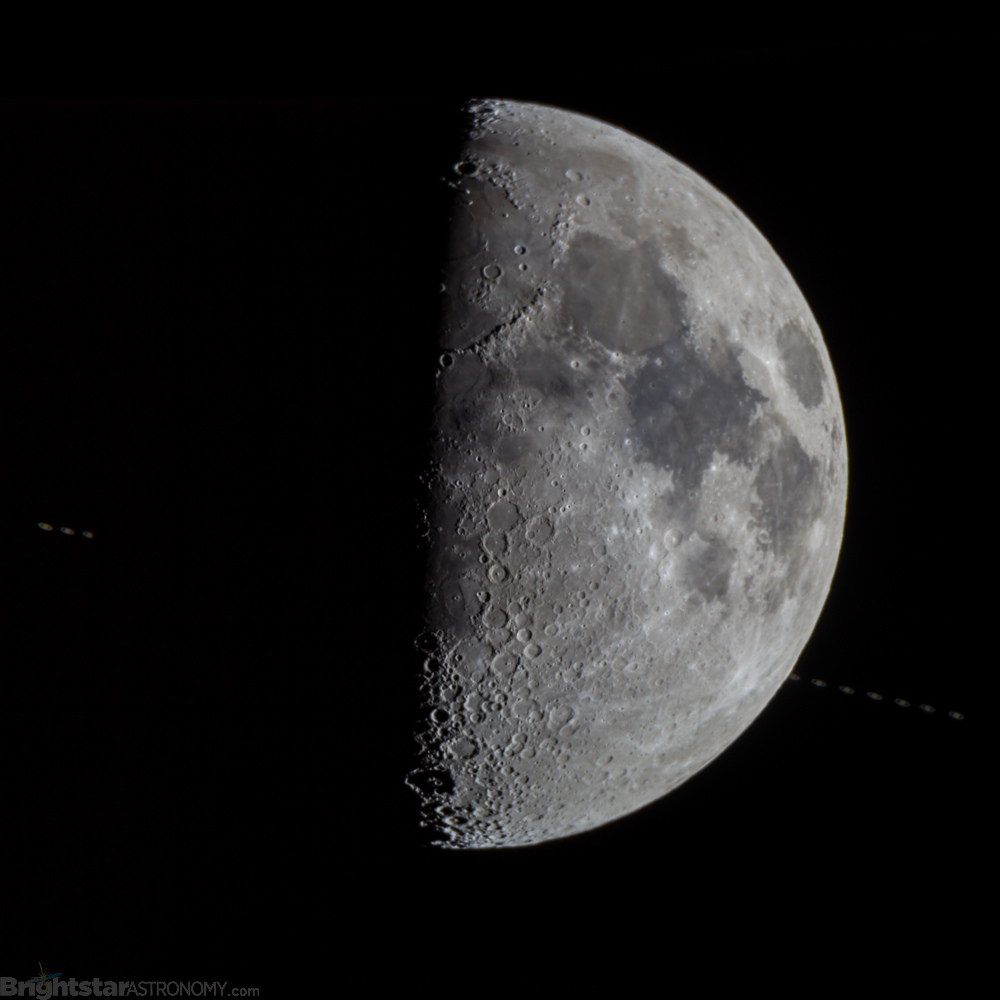
A shot of the moon taken by a telescope created by 3-D printing. Credit: University of Sheffield


A shot of the moon taken by a telescope created by 3-D printing. Credit: University of Sheffield
What would Galileo think of this? Here’s a shot of our closest large celestial neighbor, the Moon, taken through a 3-D printed telescope. Better yet — before long, the creators of this telescope promise, the plans will be made available on the Internet for all to use.

The concept (called PiKon) is based on a Newtonian reflecting telescope, with the rays of light focused onto a Raspberry Pi camera’s photo sensor.

“This is all about democratizing technology, making it cheap and readily available to the general public,” stated Mark Wrigley, who-co led the design. He runs a one-person company (Alternative Photonics) and built the telescope with support from the University of Sheffield in the United Kingdom.

“And the PiKon is just the start. It is our aim to not only use the public’s feedback and participation to improve it, but also to launch new products which will be of value to people.”

The mirror size of the telescope was not disclosed in a press release, but its magnification is 160. This makes it able to look at planets, moons, galaxies and star clusters. Stacking images is also possible to look for moving objects such as comets, the university stated.

The creators say it only costs £100 ($165) to make, so we can hardly wait to see what the plans contain. More information on the telescope is available on the PiKon website.

Source: University of Sheffield


Tagged as: 3-d printing

A Triple Occultation Bonanza: A Challenging Series of Occultations This Weekend and More

A Triple Occultation Bonanza: A Challenging Series of Occultations This Weekend and More:

The 1st Quarter Moon occults Saturn during the last event in the series on August 5th, 2015. Sequence courtesy of Teale Britstra.


The 1st Quarter Moon occults Saturn during the last event in the current series on August 5th, 2015. Sequence courtesy of Teale Britstra.
Got clear skies? This week’s equinox means the return of astronomical Fall for northern hemisphere observers and a slow but steady return of longer nights afterwards. And as the Moon returns to the evening skies, all eyes turn to the astronomical action transpiring low to the southwest at dusk.

Three planets and two “occasional” planets lie along the Moon’s apparent path this coming weekend: Mars, Saturn, Mercury and the tiny worldlets of 4 Vesta and 1 Ceres. Discovered in the early 19th century, Ceres and Vesta enjoyed planetary status initially before being relegated to the realm of the asteroids, only to make a brief comeback in 2006 before once again being purged along with Pluto to dwarf planet status.

Credit: Stellarium.


The Moon approaches Saturn on the evening of September 28th as seen from latitude 30 degrees north. Credit: Stellarium.
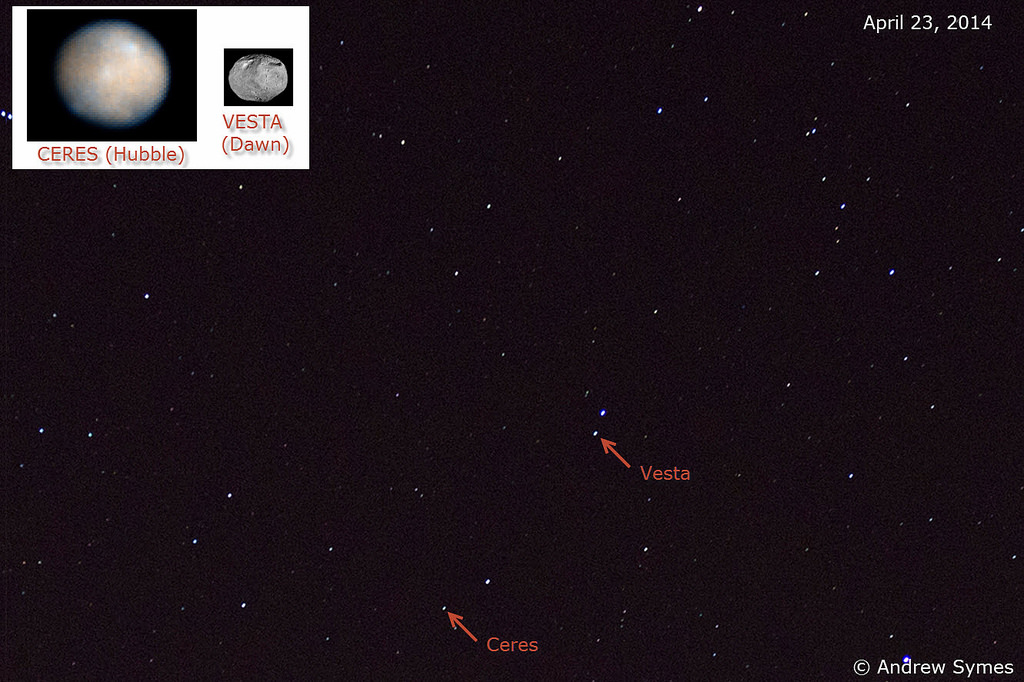
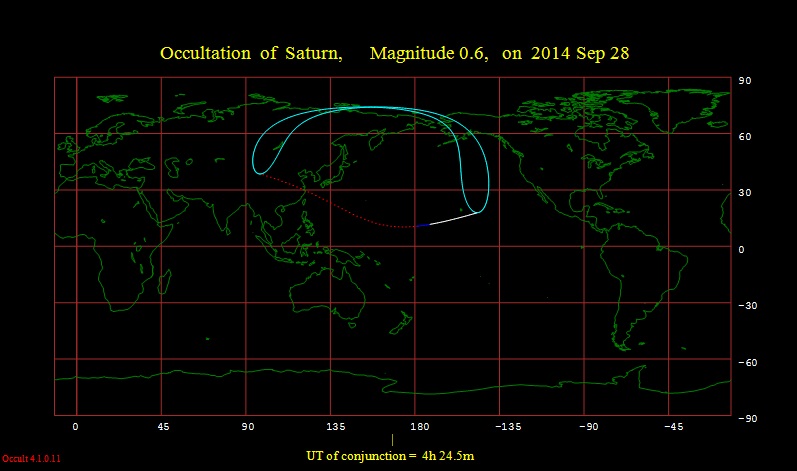
On Sunday September 28th, the four day old Moon will actually occult (pass in front of) Saturn, Ceres, and Vesta in quick succession. The Saturn occultation is part of a series of 12 in an ongoing cycle. This particular occultation is best for Hawaiian-based observers on the evening of September 28th. Astute observers will recall that Ceres and Vesta fit in the same 15’ field of view earlier this summer. Both are now over six degrees apart and slowly widening. Unfortunately, there is no location worldwide where it’s possible to see all (or two) of these objects occulted simultaneously. The best spots for catching the occultations of +7.8 magnitude Vesta and +9.0 magnitude Ceres are from the Horn of Africa and just off of the Chilean coast of South America, respectively. The rest of us will see a close but photogenic conjunction of the trio and the Moon. To our knowledge, an occultation of Ceres or Vesta by the dark limb of the Moon has yet to be recorded. Vesta also reaches perihelion this week on September 23rd at 4:00 UT, about 2.2 astronomical units from the Sun and 2.6 A.U.s from Earth.

Credit: Andrew Symes


4 Vesta and 1 Ceres share the same field of view this past summer. Credit: Andrew Symes @FailedProtostar.
The reappearance of the Moon in the evening skies is also a great time to try your hand (or eyes) at the fine visual athletic sport of waxing crescent moon-spotting. The Moon passes New phase marking the start of lunation 1135 on Wednesday, September 24th at 6:12 UT/2:12 AM EDT. First sighting opportunities will occur over the South Pacific on the same evening, with worldwide opportunities to spy the razor-thin Moon low to the west the following night. Aim your binoculars at the Moon and sweep about three degrees to the south, and you’ll spy Mercury and the bright star Spica just over a degree apart.

This week’s New Moon is also notable for marking the celebration of Rosh Hashanah, and the beginning of the Jewish year 5775 A.M. at sundown on Wednesday. The Jewish calendar is a hybrid luni-solar one, and inserted an embolismic or intercalculary month earlier this spring to stay in sync with the solar year.

Occult 4.0


The occultation footprint of Saturn. The dashed line denotes where the event occurs in the daytime, while the solid line marks where it can be seen after sunset. Created using Occult 4.1.0.
The Moon also visits Mars and Antares on September 29th. The ruddy pair sits just three degrees apart on the 28th, making an interesting study in contrast. Which one looks “redder” to you? Antares was actually named by the Greeks to refer to it as the “equal to,” “pseudo,” or “anti-Mars…” Mars can take on anything from a yellowish to pumpkin orange appearance, depending on the current amount of dust suspended in its atmosphere. The action around Mars is also heating up, as NASA’s MAVEN spacecraft just arrived in orbit around the Red Planet and India’s Mars Orbiter is set to join it this week… and all as Comet A1 Siding Spring makes a close pass on October 19th!

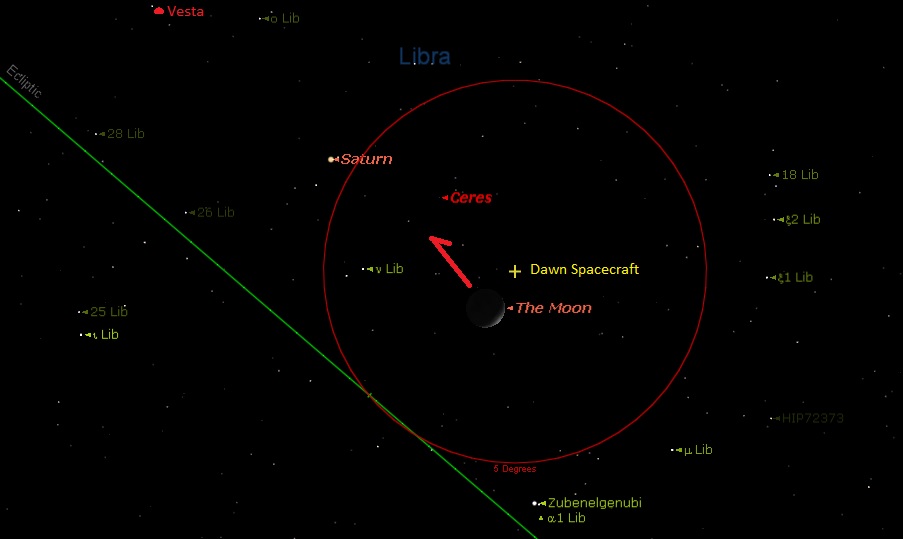
And speaking of spacecraft, another news maker is photo-bombing the dusk scene, although of course it’s much too faint to see. NASA’s Dawn mission is en route to enter orbit around Ceres in early 2015, and currently lies near R.A. 15h 02’ and declination -14 37’, just over a degree from Ceres as seen from Earth. The Moon will briefly “occult” the Dawn spacecraft as well on September 28th.

Credit: Starry Night


Crowded skies: the Moon approaching Saturn, 4 Vesta, 1 Ceres and the Dawn spacecraft on the 28th. The red arrow shows the direction of the Moon. Created using Starry Night Education Software.
Be sure to keep an eye out for Earthshine on the dark limb of the Moon as our natural neighbor in space waxes from crescent to First Quarter. What you’re seeing is the reflection of sunlight from the gibbous Earth illuminating the lunar plains on the nighttime side of the Moon. This effect gives the Moon a dramatic 3D appearance and can vary depending on the amount of cloud and snow cover currently facing the Moon.

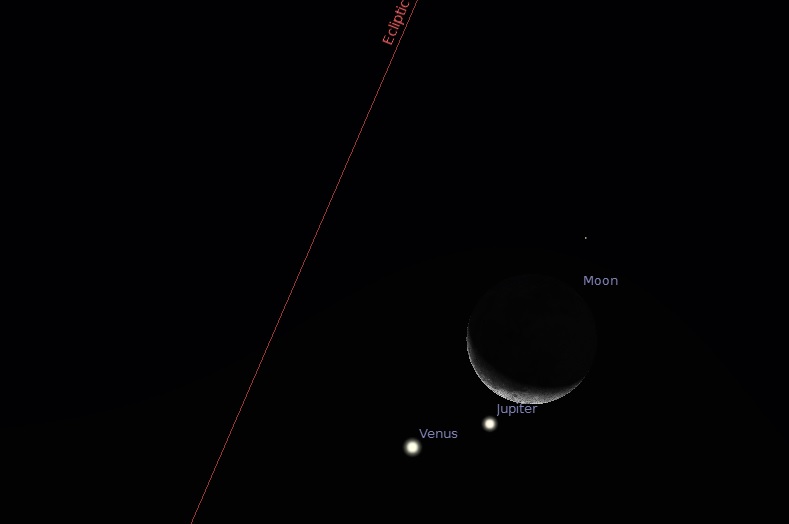
Such a close trio of conjunctions raises the question: when was the last time the Moon covered two or more planets at once? Well, on April 23rd 1998, the Moon actually occulted Venus and Jupiter at the same time, although you had to journey to Ascension Island to witness it!

Credit: Stellarium


The waning crescent Moon approaches Jupiter and Venus on April 23rd, 1998. Credit: Stellarium.
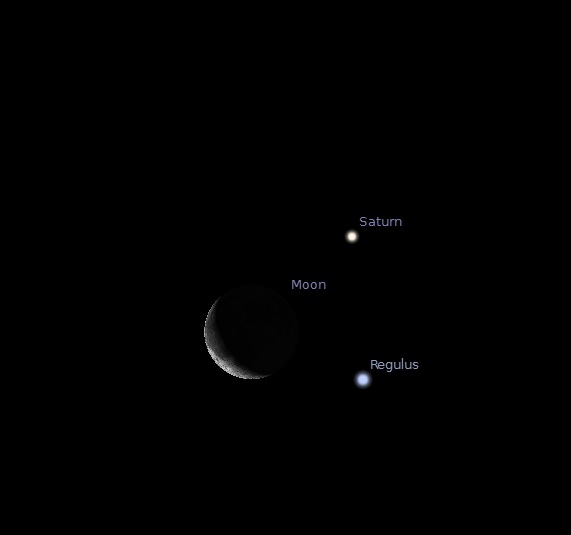
Such bizarre conjunctions are extremely rare. You need a close pairing of less than half a degree for two bright objects to be covered by the Moon at the same time. And often, such conjunctions occur too close to the Sun for observation. A great consequence of such passages, however, is that it can result in a “smiley-face” conjunction, such as the one that occurs on October 15th, 2036:

Credit: Starry Night.


Smile: A close pass of the Moon, Saturn, and Regulus in 2036. Credit: Stellarium.
Such an occurrence lends credence to a certain sense of cosmic irony in the universe.

And be sure to keep an eye on the Moon, as eclipse season 2 of 2 for 2014 kicks off next week, with the second total lunar eclipse of the year visible from North America.

More to come!


Tagged as: ceres occultation, dawn ceres, Earthshine, equinox september 2014, saturn occultation, Total Lunar Eclipse, vesta occultation