Monday, September 29, 2014

Did Wild Weather — Or A Companion — Cause Eerie Infrared Glow From This Baby Star?

Did Wild Weather — Or A Companion — Cause Eerie Infrared Glow From This Baby Star?:

Artist's impression AS 205 N, which is a T Tauri star, and a smaller partner. Credit: P. Marenfeld (NOAO/AURA/NSF)


Artist’s impression AS 205 N, which is a T Tauri star, and a smaller partner. Credit: P. Marenfeld (NOAO/AURA/NSF)
Watch out! Carbon monoxide gas is likely fleeing the disk of a young star like our Sun, producing an unusual signature in infrared. This could be the first time winds have been confirmed in association with a T Tauri star, or something else might be going on.

Because the observed signature of the star (called AS 205 N) didn’t meet what models of similar stars predicted, astronomers say it’s possible it’s not winds after all, but a companion tugging away at the gas.

“The material in the disk of a T Tauri star usually, but not always, emits infrared radiation with a predictable energy distribution,” stated Colette Salyk, an astronomer with the National Optical Astronomical Observatory who led the research. “Some T Tauri stars, however, like to act up by emitting infrared radiation in unexpected ways.”

View of the Atacama Large Millimeter/submillimeter Array (ALMA) site, which is 5,000 meters (16,400 feet) on the Chajnantor Plateau in the Atacama Desert of northern Chile. Credit: A. Marinkovic/X-Cam/ALMA (ESO/NAOJ/NRAO)


View of the Atacama Large Millimeter/submillimeter Array (ALMA) site, which is 5,000 meters (16,400 feet) on the Chajnantor Plateau in the Atacama Desert of northern Chile. Credit: A. Marinkovic/X-Cam/ALMA (ESO/NAOJ/NRAO)
T Tauri stars are still young enough to be surrounded by dust and gas that could eventually form planets. Winds in the vicinity, however, could make it difficult for enough gas to stick around to form Jupiter-sized gas giants — or could change where planets are formed altogether.

While it’s still unclear what’s going on in AS 205 N, the astronomers plan to follow up their work with observing other T Tauri stars. Maybe with more observations, they reason, they can better understand what these signatures are telling us.

The weird environment was spotted by astronomers using the Atacama Large Millimeter/submillimeter Array (ALMA), a set of 66 radio telescopes in Chile. A paper based on the research was published in the Astrophysical Journal and is also available in preprint version on Arxiv.

Source: National Radio Astronomy Observatory


Tagged as: ALMA, as 205 n, T Tauri

Russia Plans To Spend $8B On Space Station Through 2025: Report

Russia Plans To Spend $8B On Space Station Through 2025: Report:

A view of the International Space Station as seen by the last departing space shuttle crew, STS-135. Credit: NASA

A view of the International Space Station as seen by the last departing space shuttle crew, STS-135. Credit: NASA
Amid tensions surrounding international space collaboration, Russia is planning to spend $8 billion (321 billion rubles) on the International Space Station between 2016 and 2025, according to a Russian state agency report.

Deputy prime minister Dmitry Rogozin made the announcement at the Yuri Gagarin Cosmonaut Training Center in Star City, Russia. Part of the money will go to new “automatic spacecraft” and modules, said a translated version of the Russian-language ITAR-TASS report.

There was no mention in the report about Rogozin’s anger this spring concerning sanctions against Russia levied earlier this year after his nation placed soldiers inside Ukranian Crimea, which subsequently was annexed to Russia.

As part of policy with the Obama administration, this April NASA said it would cut most space ties with Russia except for those that are deemed essential to operation of the space station. In response, Rogozin wrote a tweet pointing out the Americans’ dependence on Russian Soyuz vehicles to bring astronauts to and from the station, an arrangement that has been in place since the space shuttle retired in 2011.

Screenshot from NASA TV of the Soyuz TMA-09M spacecraft arriving at the International Space Station.

Screenshot from NASA TV of the Soyuz TMA-09M spacecraft arriving at the International Space Station.
“After analyzing the sanctions against our space industry, I suggest to the USA to bring their astronauts to the International Space Station using a trampoline,” Rogozin wrote in Russian at the time.

The United States wants to extend operations of the station at least four years to 2024, but has not received commitments from its international partners yet. Rogozin’s reported announcement implies Russia would use the station through at least 2024, but it’s not clear if that is the case or what form any international collaboration would take.

There Are No Such Things As Black Holes

There Are No Such Things As Black Holes:

UNC-Chapel Hill physics professor Laura Mersini-Houghton has proven mathematically that black holes don't exist. (Source: unc.edu)

UNC-Chapel Hill physics professor Laura Mersini-Houghton has proven mathematically that black holes don’t exist. (Source: unc.edu)
That’s the conclusion reached by one researcher from the University of North Carolina: black holes can’t exist in our Universe — not mathematically, anyway.

“I’m still not over the shock,” said Laura Mersini-Houghton, associate physics professor at UNC-Chapel Hill. “We’ve been studying this problem for a more than 50 years and this solution gives us a lot to think about.”

In a news article spotlighted by UNC the scenario suggested by Mersini-Houghton is briefly explained. Basically, when a massive star reaches the end of its life and collapses under its own gravity after blasting its outer layers into space — which is commonly thought to result in an ultra-dense point called a singularity surrounded by a light- and energy-trapping event horizon — it undergoes a period of intense outgoing radiation (the sort of which was famously deduced by Stephen Hawking.) This release of radiation is enough, Mersini-Houghton has calculated, to cause the collapsing star to lose too much mass to allow a singularity to form. No singularity means no event horizon… and no black hole.

Artist's conception of the event horizon of a black hole. Credit: Victor de Schwanberg/Science Photo Library

Artist’s conception of the event horizon of a black hole. Credit: Victor de Schwanberg/Science Photo Library
At least, not by her numbers.

Read more: How Do Black Holes Form?

So what does happen to massive stars when they die? Rather than falling ever inwards to create an infinitely dense point hidden behind a space-time “firewall” — something that, while fascinating to ponder and a staple of science fiction, has admittedly been notoriously tricky for scientists to reconcile with known physics — Mersini-Houghton suggests that they just “probably blow up.” (Source)

According to the UNC article Mersini-Houghton’s research “not only forces scientists to reimagine the fabric of space-time, but also rethink the origins of the universe.”

Hm.

The submitted papers on this research are publicly available on arXiv.org and can be found here and here.

Read more: What Would It Be Like To Fall Into a Black Hole?

Don’t believe it? I’m not surprised. I’m certainly no physicist but I do expect that there will be many scientists (and layfolk) who’ll have their own take on Mersini-Houghton’s findings (*ahem* Brian Koberlein*) especially considering 1. the popularity of black holes in astronomical culture, and 2. the many — scratch that; the countlessobservations that have been made on quite black hole-ish objects found throughout the Universe.

So what do you think? Have black holes just been voted off the cosmic island? Or are the holes more likely in the research? Share your thoughts in the comments!

Want to hear more from Mersini-Houghton herself? Here’s a link to a video explaining her view of why event horizons and singularities might simply be a myth.

Source: UNC-Chapel Hill. HT to Marco Iozzi on the Google+ Space Community (join us!)

Of course this leads me to ask: if there really are “no black holes” then what’s causing the stars in the center of our galaxy to move like this?

*Added Sept. 25: I knew Brian wouldn’t disappoint! Read his post on why “Yes, Virginia, There Are Black Holes.”


Tagged as: astrophysics, Black Holes, Chapel Hill, Hawking, Laura Mersini-Houghton, Physics, singularity, space, UNC

A Splash of Color Across the Supermoon

A Splash of Color Across the Supermoon:

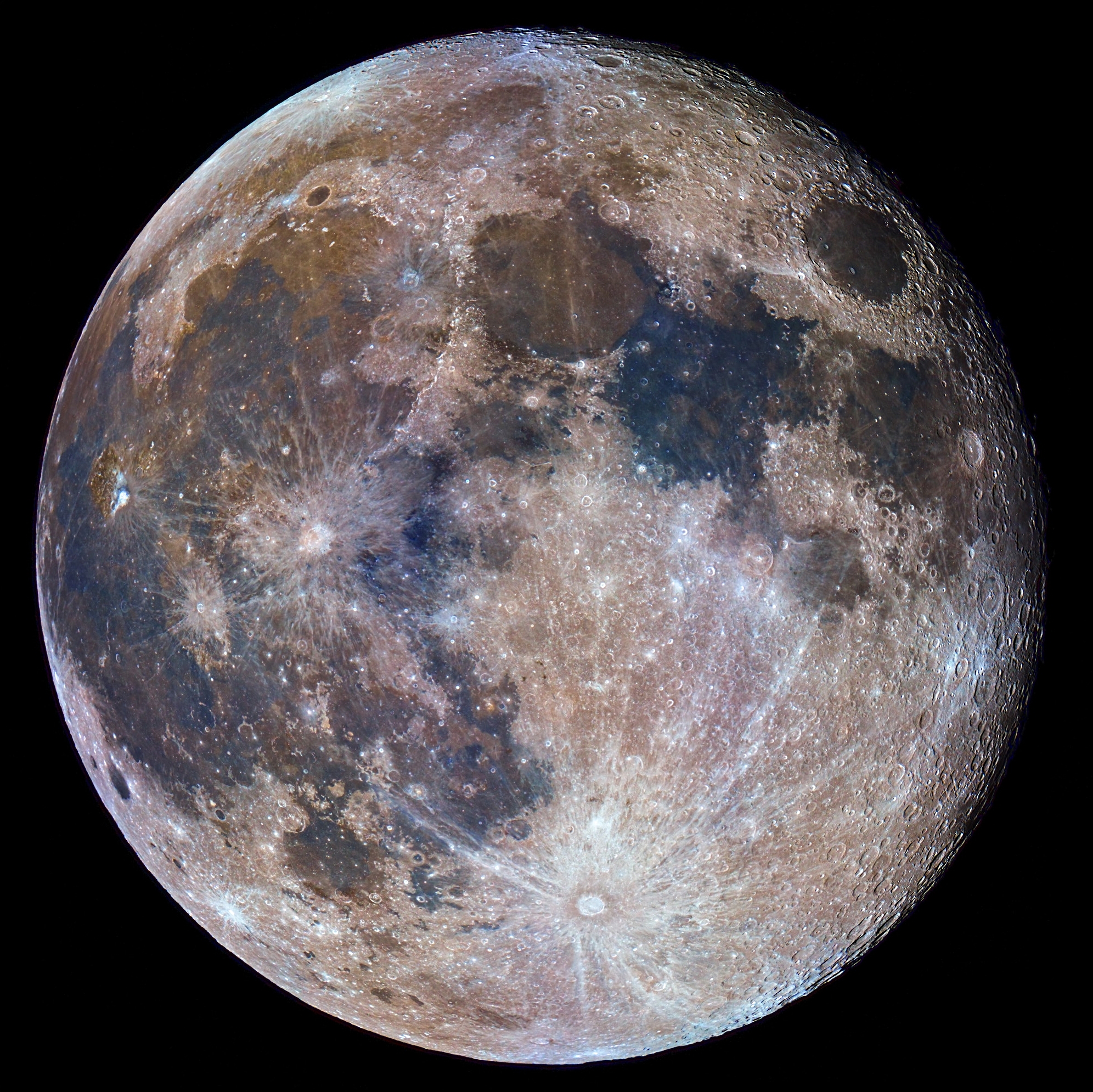
Color variations observed a day after the supermoon are indicative of compositional differences over the Lunar surface (image credit: Noel Carboni).


Color variations observed a day after the supermoon are indicative of compositional differences over the Lunar surface (image credit: Noel Carboni).
A software engineer from Florida recently captured an image of the day-old supermoon in September that clearly conveys color variations across its surface.  Such variations are often imperceptible, but the brightness and color differences were digitally enhanced to make them easier to discern.    The color variations are indicative of compositional differences across the Lunar surface (e.g., iron content and impact ejecta).

A supermoon is a full Moon that is observed during the satellite’s closest approach to Earth.  The Moon’s orbit is described by a marginally elongated ellipse rather than a circle, and hence the Moon’s distance from Earth is not constant. The Moon will achieve its largest apparent diameter in the Sky during that closest approach, which in part gives rise to the supermoon designation.

Noel Carboni, who imaged the supermoon a day after the full phase, told Universe Today that he, “created the image using 17 frames shot with a Canon EOS-40D, which was mounted to a 10-inch Meade telescope.”  He added that, “each exposure was 1/40th of a second, and a workstation was used to stitch the image which is more than 17,000 pixels square.”

Carboni noted that, “Ever since the 1980s, I have harbored a growing interest in digital imaging. It is exciting that nowadays affordable and high quality image capture equipment are available to consumers, and that formidable digital image processing tools are available to just plain folks!”

His astrophotography may be well known to readers of Universe Today, as his work has been featured on NASA’s Astronomy Picture of the Day (APOD) and elsewhere.  A gallery of Carboni’s astrophotography can be viewed at his webpage.

Readers desiring to learn more about the Moon and its surface can join the Moon Zoo Citizen Science Project, and glance at images from NASA’s Lunar Reconnaissance Orbiter.   The Moon Zoo project aims to inspect millions of images captured by that instrument, which will invariably help scientists advance our understanding of the Moon.


Tagged as: Moon, Supermoon

Amazing Timelapse: Watch the Milky Way Spin Above the Space Station

Amazing Timelapse: Watch the Milky Way Spin Above the Space Station:


Have you ever sat outside on a starry night and just watched the stars move slowly above you? Here’s a video that shows what it is like to sit back on a spaceship and gaze at the ever-changing sky above.

This timelapse was compiled from recent images taken from the International Space Station. Hugh Carrick-Allan, a 3D Animator/VFX artist living in Sydney Australia used a sequence of 52 images posted on the NASA Crew Earth Observation website. The video also features the Aurora Australis and and some random satellites.


He also created the beautiful image below by combining all 52 the images.

“I used DeepSkyStacker to stack the images, I used PixInsight for some heavy noise reduction on the foreground, and then I combined and tweaked everything in Photoshop,” Carrick-Allan wrote on his website.

The Milky Way above the International Space Station's solar panels. Credit: NASA/NASA Crew Earth Observations/Hugh Carrick-Allan


The Milky Way above the International Space Station’s solar panels. Credits: NASA/NASA Crew Earth Observations/Hugh Carrick-Allan.
Tagged as: International Space Station (ISS), milky way, Timelapse videos

New Results from Planck: It Doesn’t Look Good For BICEP2

New Results from Planck: It Doesn’t Look Good For BICEP2:

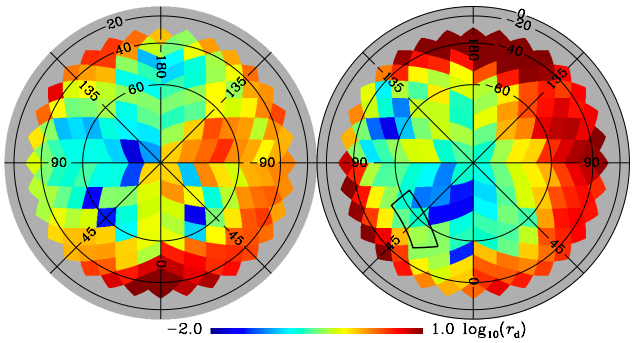
Dust map of the Universe. The region studied by BICEP2 is indicated by the rectangle in the right circle. Credit: Planck Collaboration


Dust map of the Universe. The region studied by BICEP2 is indicated by the rectangle in the right circle. Credit: Planck Collaboration
One of the recent sagas in cosmology began with the BICEP2 press conference announcing evidence of early cosmic inflation. There was some controversy since the press release was held before the paper was peer reviewed. The results were eventually published in Physical Review Letters, though with a more cautious conclusion than the original press release. Now the Planck team has released more of their data. This new work hasn’t yet been peer reviewed, but it doesn’t look good for BICEP2.

As you might recall, BICEP2 analyzed light from the cosmic microwave background (CMB) looking for a type of pattern known as B-mode polarization. This is a pattern of polarized light that (theoretically) is caused by gravitational waves produced by early cosmic inflation. There’s absolutely no doubt that BICEP2 detected B-mode polarization, but that’s only half the challenge. The other half is proving that the B-mode polarization they saw was due to cosmic inflation, and not due to some other process, mainly dust. And therein lies the problem. Dust is fairly common in the Milky Way, and it can also create B-mode polarization. Because the dust is between us and the CMB, it can contaminate its B-mode signal. This is sometimes referred to as the foreground problem. To really prove you have evidence of B-mode polarization in the CMB, you must ensure that you’ve eliminated any foreground effects from your data.

When the BICEP2 results were first announced, the question of dust was immediately raised. Some researchers noted that dust particles caught in magnetic fields could produce stronger B-mode effects than originally thought. Others pointed out that part of the data BICEP2 used to distinguish foreground dust wasn’t very accurate. This is part of the reason the final results went from “We found inflation!” to “We think we’ve found inflation! (But we can’t be certain.)”

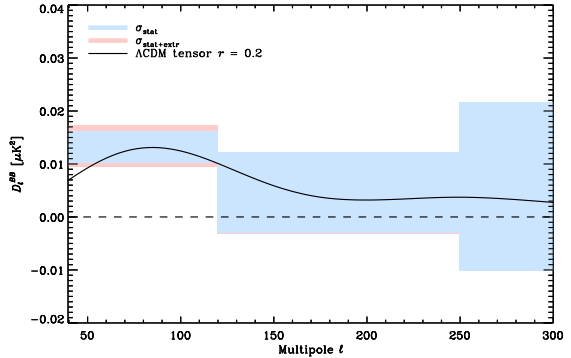
Dust effects seen by Planck (shaded region) compared with inflation results of BICEP2 (solid line). Credit: Planck Collaboration


Dust effects seen by Planck (shaded region) compared with inflation results of BICEP2 (solid line).
Credit: Planck Collaboration
The new results from Planck chip at that claim even further. Whereas BICEP2 looked at a specific region of the sky, Planck has been gathering data across the entire sky. This means lots more data that can be used to distinguish foreground dust from a CMB signal. This new paper presented a map of the foreground dust, and a good summary can be seen in the figure. The shaded areas represents the B-mode levels due to dust at different scales. The solid line represents the B-mode distribution due to inflation as seen by BICEP2. As you can see, it matches the dust signal really well.

The simple conclusion is that the results of BICEP2 have been shown to be dust, but that isn’t quite accurate. It is possible that BICEP2 has found a mixture of dust and inflation signals, and with a better removal of foreground effects there may still be a real result. It is also possible that it’s all dust.

While this seems like bad news, it actually answers a mystery in the BICEP2 results. The level of inflation claimed by BICEP2 was actually quite large. Much larger than expected than many popular models. The fact that a good chuck of the B-mode polarization is due to dust means that inflation can’t be that large. So small inflation models are back in favor. It should also be emphasized that even if the BICEP2 results are shown to be entirely due to dust, that doesn’t mean inflation doesn’t exist. It would simply mean we have no evidence either way.

It’s tempting to look at all this with a bit of schadenfreude. Har, har, the scientists got it wrong again. But a more accurate view would be of two rival sports teams playing an excellent game. BICEP2 almost scored, but Planck rallied an excellent defense. Both teams want to be the first to score, but the other team won’t let them cheat to win. And we get to watch it happen.

Anyone who says science is boring hasn’t been paying attention.

Here’s the paper from the Planck team.

Tagged as: BICEP2, CMB, Cosmology, Planck Satellite

A Fun Way of Understanding E=mc2

A Fun Way of Understanding E=mc2:

Einstein's famous equation. Image via Pixabay.


Einstein’s famous equation. Image via Pixabay.
Many people fail to realize just how much energy there is locked up in matter. The nucleus of any atom is an oven of intense radiation, and when you open the oven door, that energy spills out; oftentimes violently. However, there is something even more intrinsic to this aspect of matter that escaped scientists for years.

It wasn’t until the brilliance of Albert Einstein that we were able to fully grasp this correlation between mass and energy. Enter E=mc2. This seemingly simple algebraic formula represents the correlation of energy to matter (energy equivalence of any given amount of mass). Many have heard of it, but not very many understand what it implies. Many people are unaware of just how much energy is contained within matter. So, for the next few minutes, I will attempt to convey to you the magnitude of your own personal potential energy equivalence.


First, we must break down this equation. What do each of the letters mean? What are their values? Let’s break it down from left to right:

Albert Einstein's Inventions


Albert Einstein. Image credit: Library of Congress
E represents the energy, which we measure in Joules. Joules is an SI measurement for energy and is measured as kilograms x meters squared per seconds squared [kg x m2/s2]. All this essentially means is that a Joule of energy is equal to the force used to move a specific object 1 meter in the same direction as the force.

m represents the mass of the specified object. For this equation, we measure mass in Kilograms (or 1000 grams).

c represents the speed of light. In a vacuum, light moves at 186,282 miles per second. However in science we utilize the SI (International System of Units), therefore we use measurements of meters and kilometers as opposed to feet and miles. So whenever we do our calculations for light, we use 3.00 × 10⁸m/s, or rather 300,000,000 meters per second.

So essentially what the equation is saying is that for a specific amount of mass (in kilograms), if you multiply it by the speed of light squared (3.00×10⁸)2, you get its energy equivalence (Joules). So, what does this mean? How can I relate to this, and how much energy is in matter? Well, here comes the fun part. We are about to conduct an experiment.

This isn’t one that we need fancy equipment for, nor is it one that we need a large laboratory for. All we need is simple math and our imagination. Now before I go on, I would like to point out that I am utilizing this equation in its most basic form. There are many more complex derivatives of this equation that are used for many different applications. It is also worth mentioning that when two atoms fuse (such as Hydrogen fusing into Helium in the core of our star) only about 0.7% of the mass is converted into total energy. For our purposes we needn’t worry about this, as I am simply illustrating the incredible amounts of energy that constitutes your equivalence in mass, not illustrating the fusion of all of your mass turning into energy.

Let’s begin by collecting the data so that we can input it into our equation. I weigh roughly 190 pounds. Again, as we use SI units in science, we need to convert this over from pounds to grams. Here is how we do this:

1 Josh = 190lbs
1 lbs = 453.6g
So 190lbs × 453.6g/1 lbs = 86,184g
So 1 Josh = 86,184g

Since our measurement for E is in Joules, and Joule units of measurement are kilograms x meters squared per seconds squared, I need to convert my mass in grams to my mass in kilograms. We do that this way:

86,184g × 1kg/1000g = 86.18kg.

So 1 Josh = 86.18kg.
Now that I’m in the right unit of measure for mass, we can plug the values into the equation and see just what we get:
E=mc2
E= (86.18kg)(3.00 × 10⁸m/s)2
E= 7.76 × 10¹⁸ J

That looks like this: 7,760,000,000,000,000,000 or roughly 7.8 septillion Joules of energy.

Artistic rendition of energy released in an explosion. Via Pixabay.


Artistic rendition of energy released in an explosion. Via Pixabay.
This is an incredibly large amount of energy. However, it still seems very vague. What does that number mean? How much energy is that really? Well, let’s continue this experiment and find something that we can measure this against, to help put this amount of energy into perspective for us.

First, let’s convert our energy into an equivalent measurement. Something we can relate to. How does TNT sound? First, we must identify a common unit of measurement for TNT. The kiloton. Now we find out just how many kilotons of TNT are in 1 Joule. After doing a little searching I found a conversion ratio that will let us do just this:

1 Joule = 2.39 × 10⁻¹³ kilotons of explosives. Meaning that 1 Joule of energy is equal to .000000000000239 kilotons of TNT. That is a very small number. At better way to understand this relationship is to flip that ratio around to see how many Joules of energy is in 1 kiloton of TNT. 1 kiloton of TNT = 4.18×10¹² Joules or rather 4,184,000,000,000 Joules.

Now that we have our conversion ratio, let’s do the math.

1 Josh (E) = 7.76 x 10¹⁸ J
7.76 x 1018 J x 1 kT TNT/ 4.18 x 10¹² J = 1,856,459 kilotons of TNT.

Thus, concluding our little mind experiment we find that just one human being is roughly the equivalence of 1.86 MILLION kilotons of TNT worth of energy. Let’s now put that into perspective, just to illuminate the massive amount of power that this equivalence really is.

The bomb that destroyed Nagasaki in Japan during World War II was devastating. It leveled a city in seconds and brought the War in the Pacific to a close. That bomb was approximately 21 kilotons of explosives. So that means that I, 1 human being, have 88,403 times more explosive energy in me than a bomb that destroyed an entire city… and that goes for every human being.

So when you hear someone tell you that you’ve got real potential, just reply that they have no idea….

Hydrogen Bomb Blast. Image via Pixabay.


Hydrogen Bomb Blast. Image via Pixabay.

Tagged as: energy, Physics

Alien Planet’s Clear Weather Could Show Way To ‘Super-Earth’ Atmospheres

Alien Planet’s Clear Weather Could Show Way To ‘Super-Earth’ Atmospheres:

Artist's concdption of a Neptune-sized planet with a clear atmosphere, passing across the face of its star. Credit: NASA/JPL-Caltech


Artist’s conception of a Neptune-sized planet with a clear atmosphere, passing across the face of its star. Credit: NASA/JPL-Caltech
In an encouraging find for habitability researchers, astronomers have detected molecules on the smallest planet ever — a Neptune-sized planet about 120 light-years from Earth. The team behind the discovery says this means the dream of understanding the atmospheres on planets even closer to size of Earth is getting closer.

“The work we are doing now is important for future studies of super-Earths and even smaller planets, because we want to be able to pick out in advance the planets with clear atmospheres that will let us detect molecules,” stated co-author Heather Knutson, of the California Institute of Technology.

This particular world is not life-friendly as we understand it, however. Called HAT-P-11b, it’s not only a gas giant but also a planet that orbits extremely close to its star — making one circle every five days. And unusually among planets of its size that were previously probed by astronomers, it appears to have clear skies.

The team examined the world using the Hubble Space Telescope’s Wide Field Camera 3, looking at the planet as it passed across the face of its star. The team compared the signature of elements observed when the planet was in front of the star and when it was not, and discovered telltale signs of water vapor in its atmosphere.

Artist's conception of what the weather may look like on HAT-P-11b, a Neptune-sized exoplanet. The upper atmosphere (right) appears clear while the lower atmosphere may host clouds. Credit: NASA/JPL-Caltech


Artist’s conception of what the weather may look like on HAT-P-11b, a Neptune-sized exoplanet. The upper atmosphere (right) appears clear while the lower atmosphere may host clouds. Credit: NASA/JPL-Caltech
While other planets outside our solar system are known to have water vapor, the ones previously examined are much larger. Jupiter-sized planets are much easier to examine not only because they are larger, but their atmospheres puff up more (making them more visible from Earth.)

To confirm the water vapor was not a false signal from sunspots on the parent star (which also can contain it), the team used the Kepler and Spitzer space telescopes to confirm the information. (Kepler’s single field of view around the constellation Cygnus, which it had been peering at for about four years, happily included the zone where HAT-P-11b was orbiting.) The infrared information from Spitzer and the visible-light data from Kepler both showed the sunspots were too hot for water vapor.

Further, the discovery shows there were no clouds in the way of the observations — a first for planets of that size. The team also hopes that super-Earths could have clear skies, allowing astronomers to analyze their atmospheres.

“When astronomers go observing at night with telescopes, they say ‘clear skies’ to mean good luck,” stated lead author Jonathan Fraine, of the University of Maryland, College Park. “In this case, we found clear skies on a distant planet. That’s lucky for us because it means clouds didn’t block our view of water molecules.”

The research was published in the journal Nature.

Source: NASA


Tagged as: HAT-P-11b exo-neptune, super earth, water vapor

Multicolor Mars! Speedy NASA Spacecraft Takes Pictures Just Hours After Arrival

Multicolor Mars! Speedy NASA Spacecraft Takes Pictures Just Hours After Arrival:

The first Mars observations from NASA’s Mars Atmosphere and Volatile Evolution (MAVEN) spacecraft in three ultraviolet wavelength bands. From left to right, you can see wavelengths that focus on hydrogen, oxygen and reflected sunlight. A composite image is at far right. Credit: Laboratory for Atmospheric and Space Physics /University of Colorado and NASA


The first Mars observations from NASA’s Mars Atmosphere and Volatile Evolution (MAVEN) spacecraft in three ultraviolet wavelength bands. From left to right, you can see wavelengths that focus on hydrogen, oxygen and reflected sunlight. A composite image is at far right. Credit: Laboratory for Atmospheric and Space Physics /University of Colorado and NASA

Sure is fun to see the Red Planet in different colors! This is what the gases around the Red Planet’s atmosphere look like from NASA’s Mars Atmosphere and Volatile Evolution (MAVEN) spacecraft, which did its first observations on Monday (Sept. 22) — just eight hours after arriving in orbit.

The goal of the spacecraft is to better understand how quickly gases are fleeing the Martian atmosphere, and here you can definitely see a difference between hydrogen (at left) and oxygen (second-to-left). Figuring out how fast the atmosphere escapes could help scientists learn why water appeared to flow freely on the Red Planet’s surface in the distant past.

The hydrogen gas is much lighter and surrounds the planet in a bigger cloud that is so huge it extends beyond the boundaries of the picture at left. The oxygen, which is heavier, is less prone to drifting away and stays closer to the planet. (All images were obtained from an altitude of 22,680 miles or 36,500 kilometers.)

An artist concept of MAVEN in orbit around Mars. (Credit: NASA's Goddard Spaceflight Center).

An artist concept of MAVEN in orbit around Mars. (Credit: NASA’s Goddard Spaceflight Center).
It is believed that the Sun’s radiation pushed hydrogen out of the Martian atmosphere in the planet’s past, thinning it over time. A thicker atmosphere would have allowed water to exist in gullies and perhaps even seas or oceans, but today the atmosphere is too thin for liquid water to survive in large quantities on the surface.

MAVEN is in a commissioning phase that will last until early November, although the spacecraft will take a time-out to do observations of Comet Siding Spring upon the object’s closest approach to the planet Oct. 19. So far, NASA does not believe the comet will pose a huge dust threat to the spacecraft, but MAVEN will be maneuvered to minimize exposure just in case.

Source: University of Colorado Boulder


Tagged as: MAVEN

Some Of Earth’s Water Could Be A Million Years Older Than The Solar System

Some Of Earth’s Water Could Be A Million Years Older Than The Solar System:

A view of rivers in Montana, USA, from the ISS. Credit: ESA/Luca Parmitano.

A view of rivers in Montana, USA, from the ISS. Credit: ESA/Luca Parmitano.
A new model suggests that up to half of the water on Earth may be older than the Sun and the rest of the Solar System. The model indicates that much of our planet’s water originated in the molecular cloud that created our Solar System, rather than the disc of material that was orbiting the Sun 4.6 billion years ago.

“Chemistry tells us that Earth received a contribution of water from some source that was very cold – only tens of degrees above absolute zero, while the Sun being substantially hotter has erased this deuterium, or heavy water, fingerprint,” stated Ted Bergin, an astronomy professor at the University of Michigan who participated in the research.

“We let the chemistry evolve for a million years – the typical lifetime of a planet-forming disk – and we found that chemical processes in the disk were inefficient at making heavy water throughout the solar system. What this implies is if the planetary disk didn’t make the water, it inherited it. Consequently, some fraction of the water in our solar system predates the Sun.”

What this could mean is that water would be quite abundant in young solar systems since it doesn’t depend on the chemistry of the planetary disc, but what is in molecular clouds — making it easier, perhaps, for water to arise in planets.

The researchers’ work was published in Science.

Source: University of Michigan


Tagged as: water

Hubble Vision: Galaxy DDO 68 – Young Or Old?

Hubble Vision: Galaxy DDO 68 – Young Or Old?:

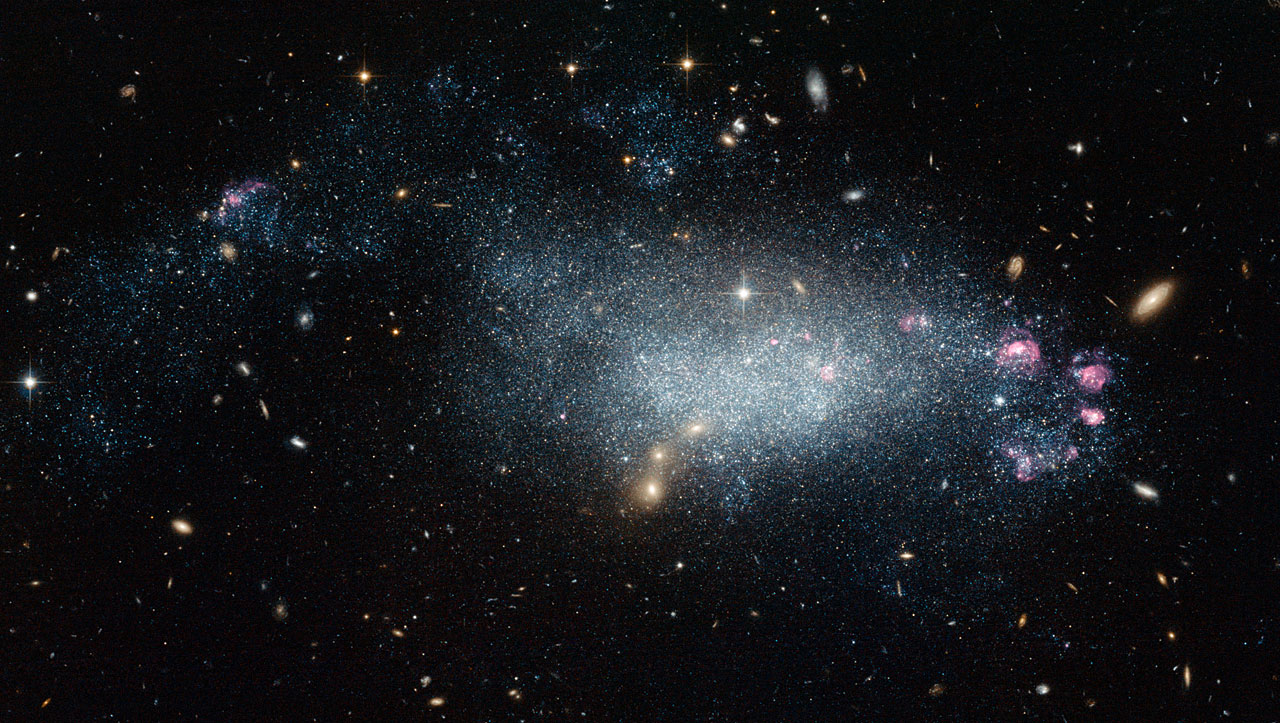
Image credit: NASA & ESA


Image credit: NASA & ESA
Only astronomers know for sure… Or do they? In this assembly of images taken with Hubble’s Advanced Camera for Surveys, scientists have utilized both visible and infrared light to survey a most unusual galaxy. When looking for a newly formed galaxy in our “cosmic neighborhood”, they spied DDO 68 (a.k.a. UGC 5340). Normally to witness galactic evolution, we have to look over great distances to see back in time… but this particular collection of gas and stars seems to break the rules!

Researching galactic evolution isn’t a new concept. Over the last few decades astronomers have increased our understanding of how galaxies change with time. One of the most crucial players in this game has been the NASA/ESA Hubble Space Telescope. Through its eyes, scientists can see over almost incomprehensible distances – studying light that has taken billions of years to reach us. We are essentially looking back in time.

While this is great news on its own, studying progressively younger galaxies can sometimes pose more questions than it answers. For example, all the newly created galaxies reside a huge distance from us and thereby appear small and faint when imaged. On the other side of the coin, galaxies which are close to us appear to be far more mature.

Loading player…
This video begins with a ground based view of the night sky, before zooming in on dwarf galaxy DDO 68 as the NASA/ESA Hubble Space Telescope sees it. This ragged collection of stars and gas clouds looks at first glance like a recently-formed galaxy in our own cosmic neighbourhood. But, is it really as young as it looks? Credit: NASA/ESA
DDO 68, imaged here by the NASA/ESA Hubble Space Telescope, would seem to be the best example of a nearby newly-formed galaxy. Just how nearby? Estimates place it at about 39 million light years distant. While this might seem like a very long way, it is still roughly 50 times closer than other galactic examples. Studying galaxies of different ages is important to our understanding of how the Universe works. Astronomers have discovered that young galaxies are quite different than those which have aged. In this case, DDO 68 gives off the appearance of being young. These findings come from examining its structure, appearance and composition. However, researchers question their findings. It is possible this galaxy may be considerably older than initial findings indicate.

“All of the available data are consistent with the fact that DDO 68 is a very rare candidate for young galaxies.” says S. A. Pustilnik (et al). “The bulk of its stars were formed during the recent (with the first encounter about 1 Gyr ago) merger of two very gas-rich disks.”

These common events – mergers and collisions – are part of galactic life and are generally responsible for older galaxies being more bulky. These “senior citizens” are normally laced with a wide variety of stellar types – young, old, large and small. The chemistry is also different, too. Very young galaxies are rich in hydrogen and helium, making them tantalizingly similar in composition to the primordial matter created by the Big Bang. Older galaxies have more experiences. Numerous stellar events have happened within them over their lifetimes, making them rich in heavy elements. This is what makes DDO 68 very exciting! It is the best local candidate found so far to be low in heavier elements.

“DDO 68 (UGC 5340) is the second most metal-poor star-forming galaxy,” explains Pustilnik. “Its peculiar optical morphology and its HI distribution and kinematics are indicative of a merger origin. We use the u, g, r, and i photometry based on the SDSS images of DDO 68 to estimate its stellar population ages.”

Step into the light? You bet. The Hubble observations were meant to examine the properties of this mysterious galaxy’s light – determine whether or not it contains any older stars. If they are discovered, which seems to be the case, this would disprove the theory that DDO 68 is singularly comprised of younger stars. If not, it will validate the unique nature of this nearby neighbor. While more computer modeling and studies are needed, we can still enjoy this incredible look at another cosmic enigma!

Original Story Source: A Galaxy Of Deception – Hubble/ESA


Tagged as: DDO 68, galactic evolution, Hubble Telescope Images

India’s Bargain Mars Spacecraft Cost Less Than Many Space Movies

India’s Bargain Mars Spacecraft Cost Less Than Many Space Movies:

Artist's conception of India’s Mars Orbiter Mission (MOM). Credit ISRO


Artist’s conception of India’s Mars Orbiter Mission (MOM). Credit ISRO
India achieved a remarkable feat earlier this week — the nation became only one of a handful of countries to successfully send a probe to Mars. The $75 million mission has been hailed as an achievement by NASA and other space experts from around the world.

Just how remarkable is this bargain mission? As a tweet from travel writer Jon Tindale pointed out, MOM cost less than the 2000 Gary Sinise movie Mission To Mars. (Note that we came up with a different dollar figure below.)

Just for fun, we’ve compared MOM to several space movies below. All dollar figures are adjusted for inflation from budgets listed in the Internet Movie Database.

Avatar: $263 million ($237 million in 2009 dollars)

Wall-E: $199 million ($180 million in 2008 dollars)

The Fifth Element: $138 million ($93 million in 1997 dollars)

Mission to Mars: $124 million ($90 million in 2000 dollars)

Elysium: $117 million ($115 million in 2013 dollars)

Star Trek: The Motion Picture: $115 million ($35 million in 1979 dollars)

Gravity: $102 million ($100 million in 2013 dollars)

Apollo 13: $101.5 million ($62 million in 1995 dollars)

Dune (1984): $92 million ($40 million in 1984 dollars)

Close Encounters of the Third Kind: $76 million ($19.4 million in 1977 dollars)

2001: A Space Odyssey: $72 million ($10.5 million in 1968 dollars)

Mars Orbiter Mission: $70 million (2014 dollars)

The Right Stuff: $65 million ($27 million in 1983 dollars)

Serenity: $49 million ($40 million in 2005 dollars)

Star Wars (1977): $43 million ($11 million in 1977 dollars)

Outland: $42 million ($16 million in 1981 dollars)

Alien: $36 million ($11 million in 1979 dollars)

War of the Worlds (1953): $18 million ($2 million in 1953 dollars)

Silent Running: $6.2 million ($1.1 million in 1972 dollars)

Moon: $5.5 million ($5 million in 2009 dollars)

Apollo 18: $5.3 million ($5 million in 2011 dollars)


Tagged as: Mars Orbiter Mission, space movies

Have Astronomers Seen a Forming Planet in Action?

Have Astronomers Seen a Forming Planet in Action?:

Image at 7 mm wavelength of the dusty disk around the star HD 169142 obtained with the Very Large Array (VLA) at 7 mm wavelength. The positions of the protoplanet candidates are marked with plus signs (+) (Osorio et al. 2014, ApJ, 791, L36). The insert in the upper right corner shows, at the same scale, the bright infrared source in the inner disk cavity, as observed with the Very Large Telescope (VLT) at 3.8 micron wavelength (Reggiani et al. 2014, ApJ, 792, L23).


Image of the dusty disk around the star HD 169142 obtained with the Very Large Array. The positions of the protoplanet candidates are marked with plus signs (Osorio et al. 2014, ApJ, 791, L36). The insert in the upper right corner shows the bright infrared source in the inner gap, as observed with the Very Large Telescope. (Reggiani et al. 2014, ApJ, 792, L23).
Huge disks of dust and gas encircle many young stars. Some contain circular gaps — likely the result of forming planets carving out cavities along their orbital paths — that make the disks look more like ripples in a pond than flat pancakes.

But astronomers know only a few examples, including the archetypal disk surrounding Beta Pictoris, of this transitional stage between the original disk and the young planetary system. And they have never spotted a forming planet.

Two independent research teams think they’ve observed precisely this around the star HD 169142, a young star with a disk that extends up to 250 astronomical units (AU), roughly six times greater than the average distance from the Sun to Pluto.

Mayra Osorio from the Institute of Astrophysics of Andalusia in Spain and colleagues first explored HD 169142’s disk with the Very Large Array (VLA) in New Mexico. The 27 radio dishes configured in a Y-shape allowed the team to detect centimeter-sized dust grains. Then combining their results with infrared data, which traces the presence of microscopic dust, the group was able to see two gaps in the disk.

One gap is located between 0.7 and 20 AU, and the second larger gap is located between 30 and 70 AU. In our Solar System the first would begin at the orbit of Venus and end at the orbit of Uranus, while the second would begin at the orbit of Neptune, pass Pluto’s orbit, and extend beyond.

“This structure already suggested that the disk was being modified by two planets or sub-stellar objects, but, additionally, the radio data reveal the existence of a clump of material within the external gap, located approximately at the distance of Neptune’s orbit, which points to the existence of a forming planet,” said Mayra Osorio in a news release.

Maddalena Reggiani from the Institute for Astronomy in Zurich and colleagues then tried to search for infrared sources in the gaps using the Very Large Telescope. They found a bright signal in the inner gap, which likely corresponds to a forming planet or a young brown dwarf, an object that isn’t massive enough to kick start nuclear fusion.

The team was unable to confirm an object in the second gap, likely due to technical limitations. Any object with a mass less than 18 times Jupiter’s mass will remain hidden in the data.

Future observations will shed more light on the exotic system, hopefully allowing astronomers to better understand how planets first form around young stars.

Both papers have been published in the Astrophysical Journal Letters.


Tagged as: exoplanets, Planetary Disks, protoplanets, Very Large Array, Very Large Telescope

Busy Spaceport: There are Now Five Spaceships Parked at the Space Station

Busy Spaceport: There are Now Five Spaceships Parked at the Space Station:

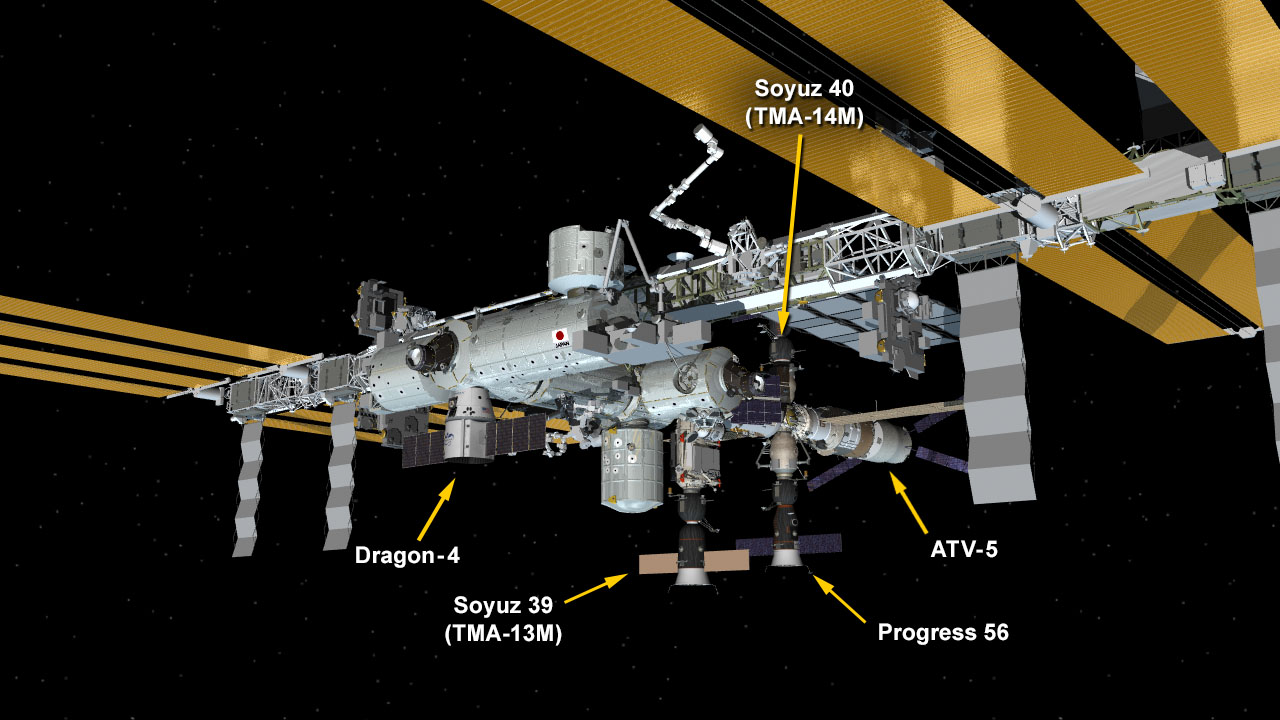
Five spacecraft are parked at the International Space Station including the Soyuz TMA-14M and Dragon which docked this week. Credit: NASA


Five spacecraft are parked at the International Space Station including the Soyuz TMA-14M and Dragon which docked this week. Credit: NASA
Mars isn’t the only place in the Solar System that was busy this week with arriving spacecraft. While NASA’s MAVEN and ISRO’s MOM arrived in orbit around the Red Planet, the International Space Station also welcomed two arriving spacecraft, bringing the total of docked ships at the ISS to five.


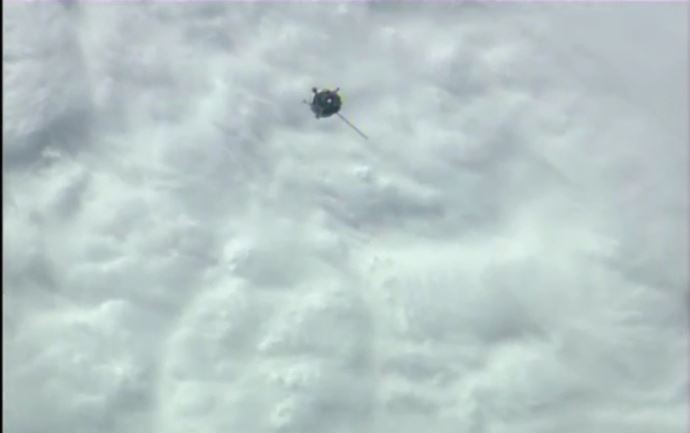
Screenshot from NASA TV of the Soyuz-TMA14M arriving with just one solar panel deployed.


Screenshot from NASA TV of the Soyuz-TMA14M arriving with just one solar panel deployed.
Last night, the Expedition 41/42 crew arrived — peeling in on one solar panel on their Soyuz TMA-14M — with the first female cosmonaut to be part of an ISS crew, Elena Serova along with her crewmates cosmonaut Alexander Samokutyaev, and NASA astronaut Barry Wilmore. They took the Soyuz “fast track,” arriving at the station in just under six hours after launch. One of the craft’s solar panels jammed and couldn’t deploy, but the crew docked to Poisk docking compartment without indecent.

The arrival of Wilmore, Samokutyaev and Serova returns the station’s crew complement to six. Already on board are Commander Max Suraev of Roscosmos, Reid Wiseman of NASA and Alexander Gerst of the European Space Agency. They have been aboard the complex since May.

Suraev, Wiseman and Gerst will return home in November. At that time, Wilmore will become commander of the station for Expedition 42, and the remainder of the Expedition 42 crew will arrive in a new Soyuz.

Earlier this week, on September 23, the SpaceX Dragon capsule arrived with over 2.5 tons of science experiments and supplies for the crew.

Also docked to the space station is the Soyuz ship that will take Suraev, Wiseman and Gerst home, a Progress resupply ship and the European ATV-5 supply ship.

There are two more cargo missions targeted to launch to the space station before the end of the year. Orbital Sciences just announced October 20 as the next launch date for their Cygnus commercial space freighter. It will occupy the same Harmony node port as Dragon when it leaves in a few weeks. When Cygnus vacates the Harmony node port, SpaceX CRS-5 will replace it in December.

Tagged as: ATV-5, Dragon capsule, international space station, Soyuz, SpaceX

ESA’s Rosetta Mission sets November 12th as the Landing Date for Philae

ESA’s Rosetta Mission sets November 12th as the Landing Date for Philae:

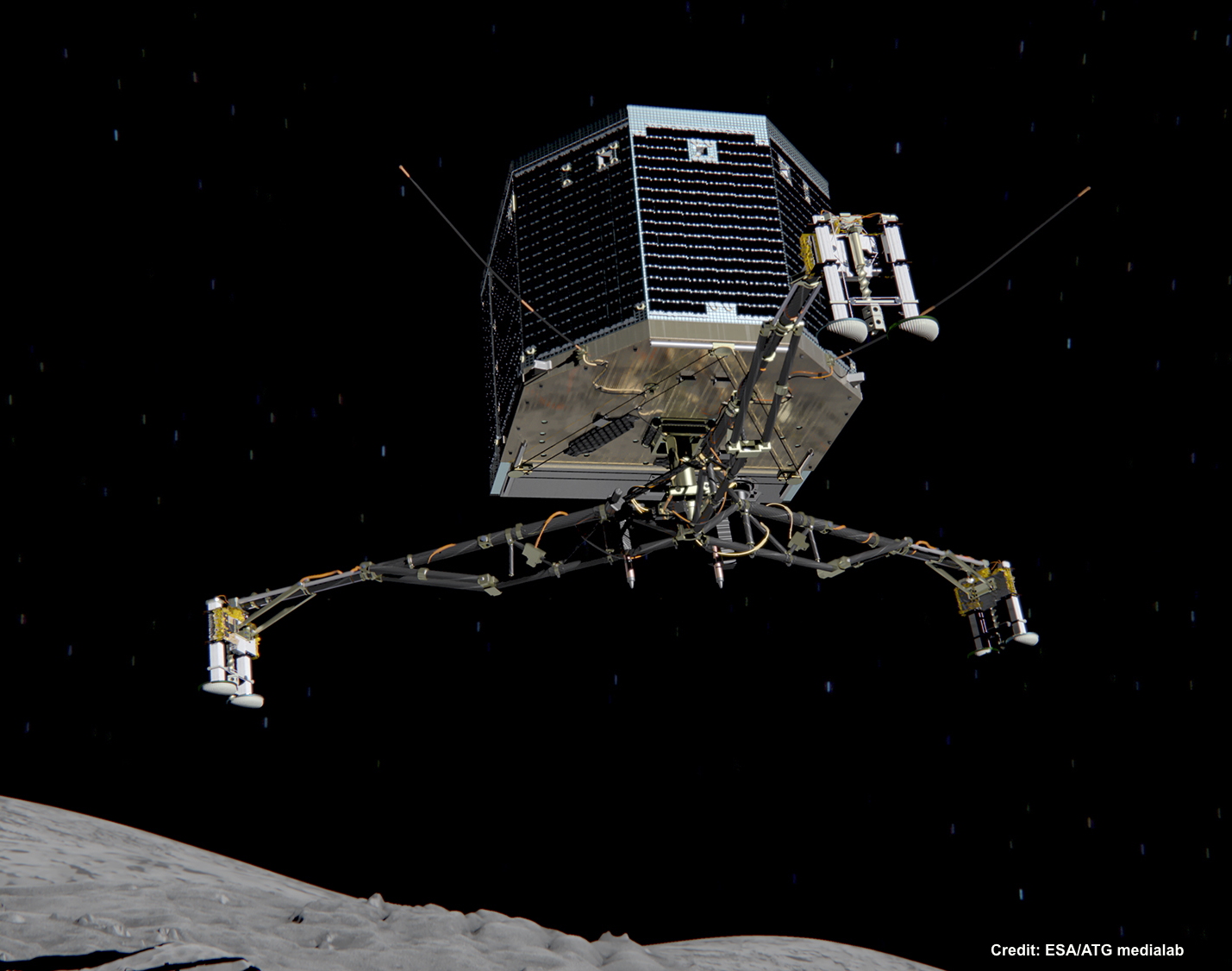
Illustration of the Rosetta Missions Philae lander on final approach to a comet surface. The date is now set for landing, November 12. (Photo: ESA)


Illustration of the Rosetta Missions Philae lander on final approach to a comet surface. The date is now set for landing, November 12. (Photo: ESA)
ESA Rosetta mission planners have selected November 12th, one day later than initially planned, for the historic landing of Philae on a comet’s surface. The landing on 67P/Churyumov-Gerasimenko will be especially challenging for the washing machine-sized lander. While mission scientists consider their choice of comet for the mission to be an incredibly good one for scientific investigation and discovery, the irregular shape and rugged terrain also make for a risky landing. The whole landing is not unlike the challenge one faces in shooting a moving target in a carnival arcade game; however, this moving target is 20 kilometers below and it is also rotating.


At  8:35 GMT (3:35 AM EST), the landing sequence will begin with release of Philae by Rosetta at an altitude of 20 kilometers above the comet. The expected time of touchdown is seven hours later – 15:35 GMT (10:35 AM EST). During the descent, Philae’s ROLIS camera will take a continuous series of photos. The comet will complete more than half a rotation during the descent; comet P67’s rotation rate is 12.4 hours. The landing site will actually be on the opposite side of the comet when Philae is released and will rotate around, and if all goes as planned, meet Philae at landing site J.

Before November 12th, mission planners will maintain the option of landing at Site C. If the alternate site is chosen, the descent will begin at 13:04 GMT also on November 12 but from an altitude of 12.5 kilometers, a 4 hour descent time.

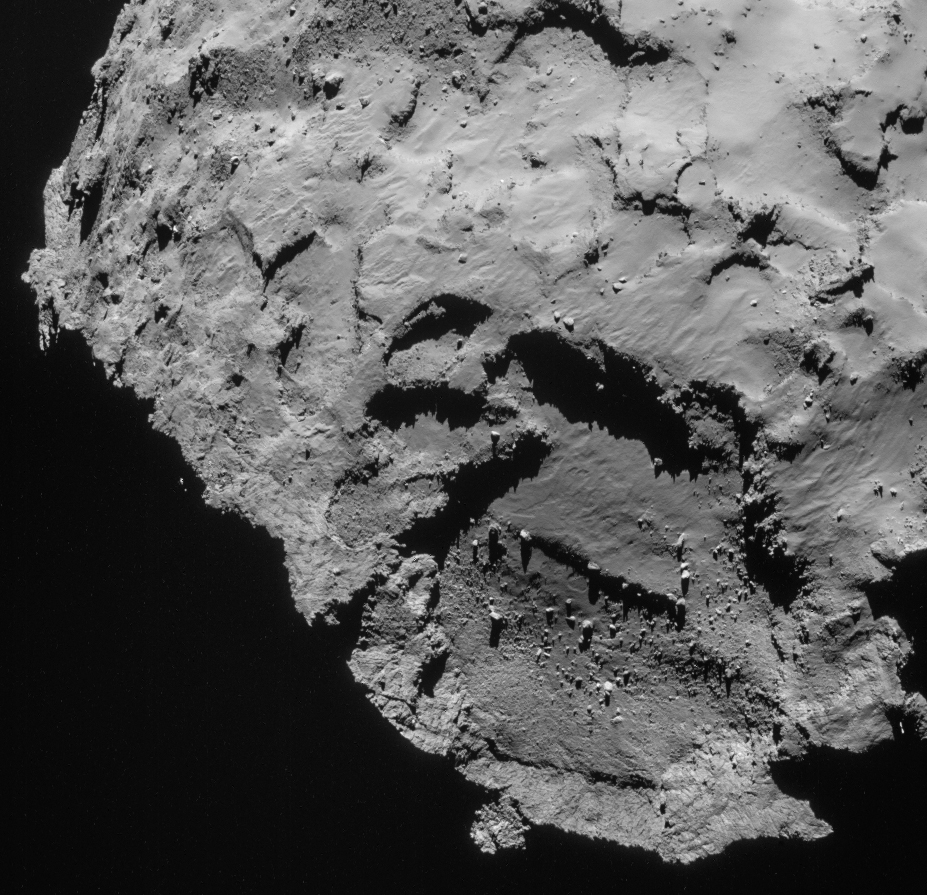
NAVCAM image of the comet on 21 September, which includes a view of primary landing site J. Click for more details and link to context image. (Credits: ESA/Rosetta/NAVCAM)


NAVCAM image of the comet on 21 September, which includes a view of primary landing site J. Click for more details and link to context image. (Credits: ESA/Rosetta/NAVCAM)
Rosetta will eject Philae with an initial velocity of approximately 2 1/2  kilometers per hour. Because the comet is so small, its gravity will add little additional speed to Philae as it falls to the surface. Philae is essentially on a ballistic trajectory and does not have any means to adjust its path.

The actions taken by Philae’s onboard computer begin only seconds from touchdown. It has a landing propulsion system but unlike conventional systems that slow down the vehicle for soft landing, Philae’s is designed to push the lander snugly onto the comet surface. There is no guarantee that Philae will land on a flat horizontal surface. A slope is probably more likely and the rocket will force the small lander’s three legs onto the slope.

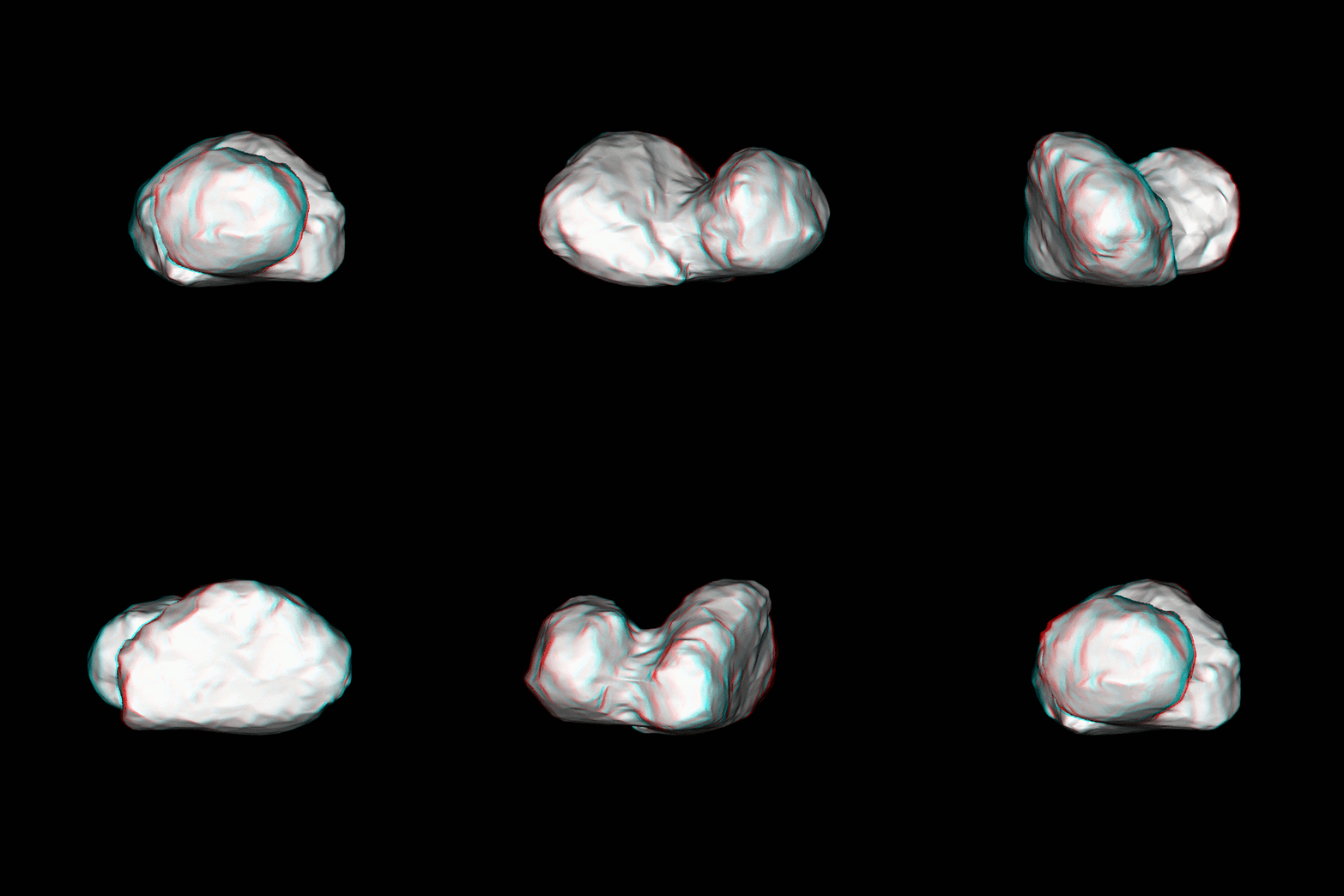
A model of the comet P67/Churyumov-Gerasimenko created using images from the Rosetta OSIRIS narrow field camera. (Credit: ESA)


A model of the comet P67/Churyumov-Gerasimenko created using images from the Rosetta OSIRIS narrow field camera. Mouse click on the image to start the animated GIF. (Credit: ESA)
Landing harpoons will be fired that are attached to cables that will be pulled in to also help Philae return upright and attach to the surface. Philae could actually bounce up or topple over if the rocket system and harpoons fail to do their job.

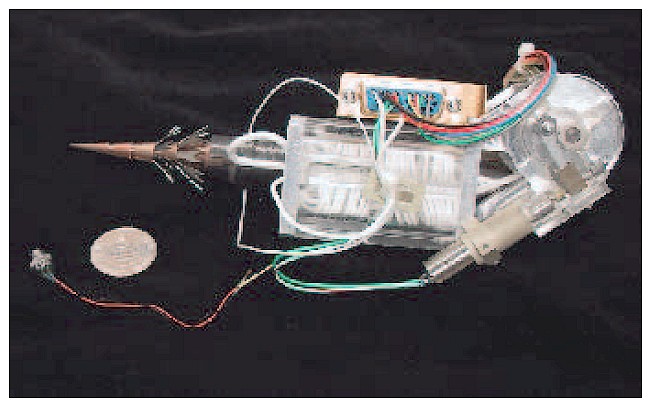
The Philae Lander anchoring harpoon with the integrated MUPUS-accelerometer and temperature sensor. (Credit: "Philae Lander Fact Sheet", ESA)


The Philae Lander anchoring harpoon with the integrated MUPUS-accelerometer and temperature sensor. (Credit: “Philae Lander Fact Sheet”, ESA)
However, under each of the three foot pads, there are ice screws that will attempt to drill and secure Philae to the surface. This will depend on the harpoons and/or rockets functioning as planned, otherwise the action of the drills could experience resistance from hard ground and simply push the lander up rather than secure it down. Philae also has a on-board gyro to maintain its attitude during descent, and an impact dampener on the neck of the vehicle which attaches the main body to the landing struts.

Ten landing sites were picked, then down-selected to five, and then finally on September 15th, they selected Site J on the head of the smaller lobe – the head of the rubber duck, with site C as a backup. Uncertainty in the release and the trajectory of the descent to the comet’s surface means that the planners needed to find a square kilometer area for landing. But comet 67P/Churyumov-Gerasimenko simply offered no site with that much flat area clear of cliffs and boulders. Philae will be released to land at Site J which offers some smooth terrain but only about a quarter of the area needed to assure a safe landing. Philae could end up landing on the edge of a cliff or atop a large boulder and topple over.

A 'color' view of Comet 67P, from a September 24, 2014 NavCam image. Credits: ESA/Rosetta/NavCam - Processing by Elisabetta Bonora & Marco Faccin.


A ‘color’ view of Comet 67P, from a September 24, 2014 NavCam image. Credits: ESA/Rosetta/NavCam – Processing by Elisabetta Bonora & Marco Faccin.
The Rosetta ground control team will have no means of controlling and adjusting Philae during the descent. This is how it had to be because the light travel time for telecommunications from the spacecraft to Earth does not permit real-time control. The execution time and the command sequence will be delivered to Rosetta days before the November 12th landing. And ground control must maneuver Rosetta with Philae still attached to an exact point in space where the release of Philae must take place. Any inaccuracy in the initial release point will be translated all the way down to the surface and Philae would land some undesired distance away from Site J. However, ground controllers have a month and a half to practice simulations of the landing many times over with a model of the comet’s nucleus. With practice and more observational data between now and the landing, the initial conditions and model of the comet in the computer simulation will improve and raise the likelihood of a close landing to Site J.

Previous Universe Today articles on Rosetta’s Philae:

How do you land on a comet? Very carefully.

Rosetta’s Philae Lander: A Swiss Army Knife of Scientific Instruments

Comet’s Head Selected as Landing Site for Rosetta’s Historic Philae Lander


Tagged as: esa, historic, lander, landing, P67/Churyumov-Gerasimenko, philae, rosetta

MOM Eyes the Limb of Mars after History Creating Arrival

MOM Eyes the Limb of Mars after History Creating Arrival:

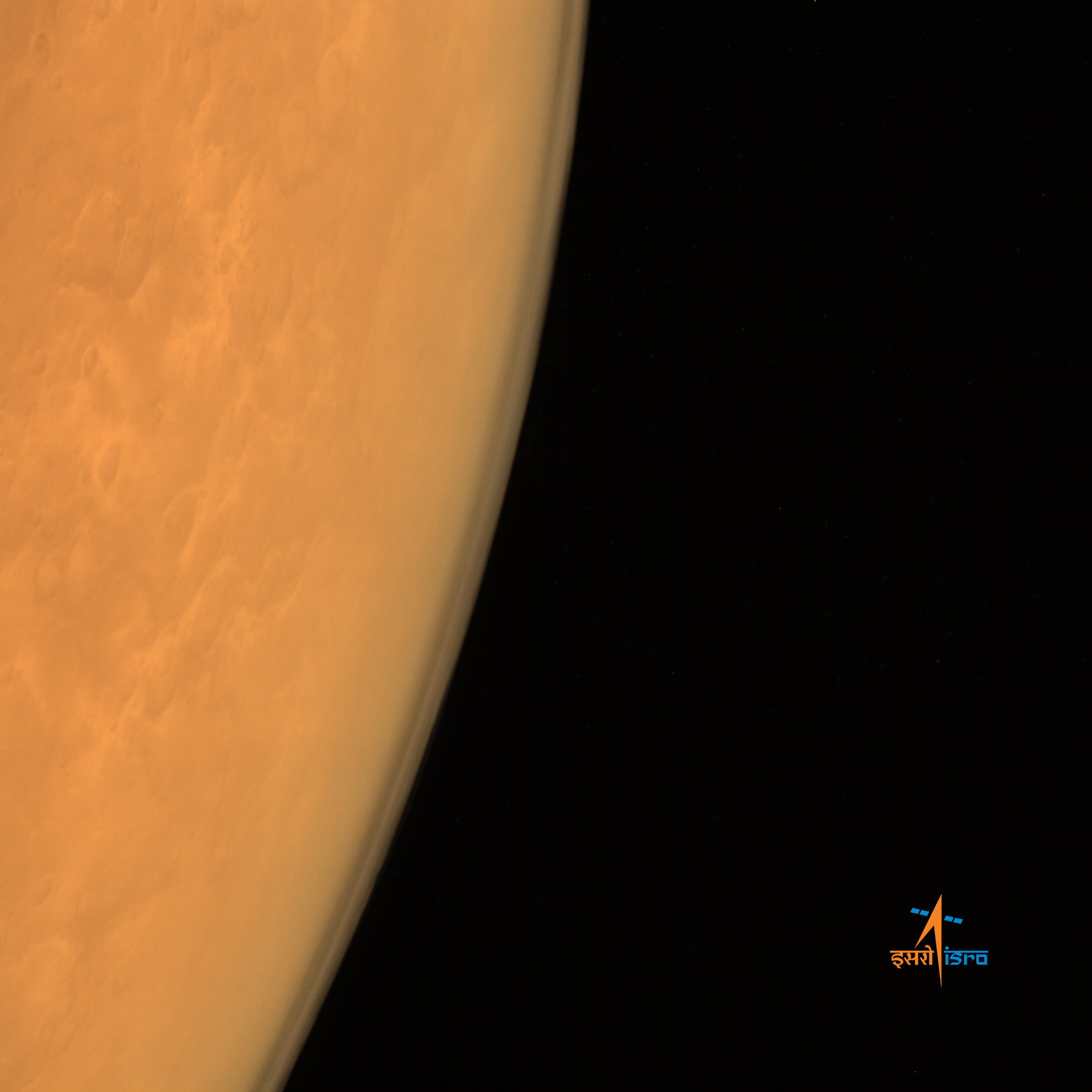
ISRO's Mars Orbiter Mission captures the limb of Mars with the Mars Color Camera from an altitude of 8449 km soon after achieving orbit on Sept. 23/24, 2014. . Credit: ISRO


ISRO’s Mars Orbiter Mission captures the limb of Mars with the Mars Color Camera from an altitude of 8449 km soon after achieving orbit on Sept. 23/24, 2014 . Credit: ISRO
India’s maiden interplanetary voyager, the Mars Orbiter Mission (MOM) has transmitted a breathtaking new image eyeing the limb of Mars and its atmosphere against the blackness of space.

The beautiful Martian image is only MOM’s second since successfully braking into orbit during the ‘history creating’ insertion maneuver days ago on Sept. 23/24.

The MOM orbiter was designed and developed by the Indian Space Research Organization (ISRO), India’s space agency, which released the image on Sept 25, about a day after MOM arrived.

The limb image was taken using MOM’s Mars Color Camera (MCC) from an altitude of 8449 kilometers and shows more of an ‘Orange Planet’ rather than a ‘Red Planet.’

“A shot of Martian atmosphere. I’m getting better at it. No pressure,” tweeted ISRO at MOM’s newly established twitter account after entering orbit.

The image has a spatial resolution of 439 meters and is centered around Lat: 20.01N and Lon:31.54E.

MOM’s goal is to study Mars atmosphere , surface environments, morphology, and mineralogy with a 15 kg (33 lb) suite of five indigenously built science instruments. It will also sniff for methane, a potential marker for biological activity.

“The view is nice up here,” ISRO tweeted.

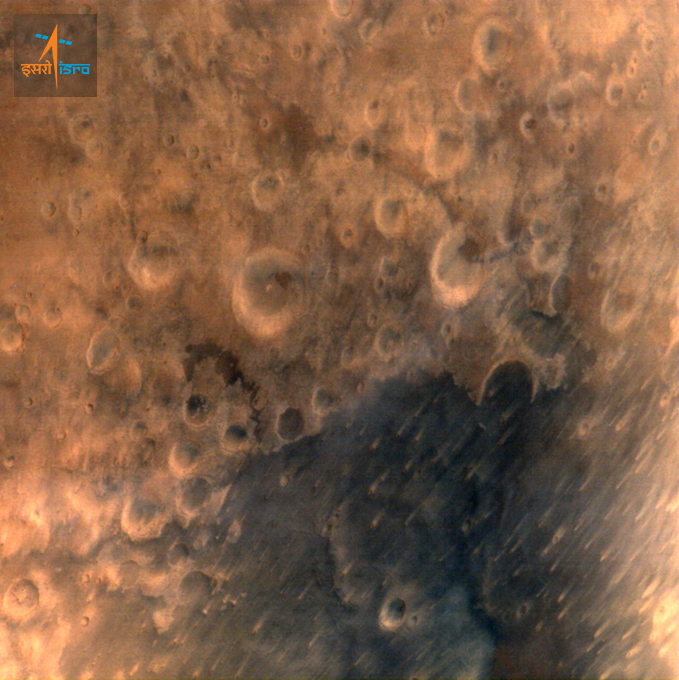
MOM’s first image taken shortly after orbital arrival showed a heavily cratered region of the Red Planet taken by the MCC tri-color camera from a slightly lower altitude of 7300 kilometers with a spatial resolution of 376 meters.

ISRO's Mars Orbiter Mission captures its first image of Mars from a height of 7300 km. Credit: ISRO


ISRO’s Mars Orbiter Mission captures its first image of Mars from a height of 7300 km. Credit: ISRO
Following MOM’s successful Mars Orbital Insertion (MOI) maneuver, India became the newest member of an elite club of only four entities who have launched probes that successfully investigated Mars – following the Soviet Union, the United States and the European Space Agency (ESA).

Read my complete MOM meets Mars arrival story – here.

MOM is now circling Mars in a highly elliptical orbit whose nearest point to Mars (periapsis) is at 421.7 km and farthest point (apoapsis) at 76,993.6 km. The inclination of orbit with respect to the equatorial plane of Mars is 150 degree, as intended, ISRO reports.

The $73 million mission is expected to last at least six months.

MOM’s success follows closely on the heels of NASA’s MAVEN orbiter which also successfully achieved orbit barely two days earlier on Sept. 21 and could last 10 years or more.

Stay tuned here for Ken’s continuing Earth and planetary science and human spaceflight news.

Ken Kremer


Tagged as: indian space program, Indian Space Research Organization, ISRO, Mars, Mars MAVEN, Mars Orbiter Mission, MAVEN, MOM, red planet