Wednesday, August 13, 2014

Cassini Prepares For Its Biggest Remaining Burn

Cassini Prepares For Its Biggest Remaining Burn:

Artists's Conception of Cassini Saturn Orbit Insertion
This is an artists concept of Cassini during the Saturn Orbit Insertion (SOI) maneuver, just after the main engine has begun firing. Image credit: NASA/JPL
› Full image and caption


August 07, 2014

NASA's Cassini spacecraft will execute the largest planned maneuver of the spacecraft's remaining mission on Saturday, Aug. 9. The maneuver will target Cassini toward an Aug. 21 encounter with Saturn's largest moon, Titan.

The main engine firing will last about a minute and will provide a change in velocity of 41 feet per second (12.5 meters per second). This is the largest maneuver by Cassini in five years. No other remaining maneuver comes close, in the amount of propellant it will consume and the amount by which it will change the spacecraft's velocity. By contrast, the smallest maneuvers Cassini routinely executes are about 0.4 inches (10 millimeters) per second.

The large size of the Aug. 9 burn is needed to begin the process of "cranking down" Cassini's orbit, so that the spacecraft circles Saturn nearer to the plane of the rings and moons. Previously, with each Titan flyby, mission controllers adjusted the spacecraft's orbit to be increasingly inclined, carrying Cassini high above Saturn's polar regions. The upcoming maneuver starts reversing that trend, making the orbit increasingly close to the equator.

Although Cassini has occasionally performed similar large propulsive maneuvers during its decade in the Saturn system, Titan itself has proven to be the workhorse for steering Cassini around Saturn. It is not uncommon for the spacecraft to receive a gravitational assist, or boost, from Titan that rivals or exceeds the 96-minute engine burn Cassini performed in 2004 to insert itself into Saturn orbit.

The Cassini mission recently celebrated a decade studying Saturn, its rings, moons and magnetosphere.

The Cassini-Huygens mission is a cooperative project of NASA, the European Space Agency and the Italian Space Agency. NASA's Jet Propulsion Laboratory, Pasadena, California, manages the mission for NASA's Science Mission Directorate in Washington. JPL is a division of the California Institute of Technology.

For more information about Cassini, visit:

http://www.nasa.gov/cassini

http://saturn.jpl.nasa.gov

Preston Dyches

Jet Propulsion Laboratory, Pasadena, Calif.

818-354-7013

preston.dyches@jpl.nasa.gov


2014-269

Spitzer Telescope Honored by Aerospace Society

Spitzer Telescope Honored by Aerospace Society:

SST and the Milky Way, an Artist's Concept
The Spitzer Space Telescope whizzes in front of a brilliant, infrared view of the Milky Way galaxy's plane in this artistic depiction. Image credit:
NASA/JPL
› Full image and caption


August 07, 2014

NASA's Spitzer Space Telescope has received the 2014 AIAA Space Science Award for its ongoing infrared studies of the hidden cosmos. The American Institute of Aeronautics and Astronautics, or AIAA, a society for the field of aerospace engineering, established the award in 1961 for "individuals demonstrating leadership of innovative scientific investigation associated with space science missions."

Michael Werner, the project scientist for Spitzer at NASA's Jet Propulsion Laboratory in Pasadena, California, accepted the award on behalf of the Spitzer team today, Aug. 7, at the AIAA Space and Astronautics Forum in San Diego.

The citation for the award reads: "For outstanding science producing over 5,000 papers, 75,000+ hours of observation, and significant findings such as the first telescope to directly detect light from extrasolar planets."

Spitzer, which launched into space in 2003, continues to be one of the best telescopes for studying the atmospheres of exoplanets, or extrasolar planets -- planets outside our solar system. In 2005, it made the first-ever measurements of direct light from such a far-off world.

Now, in Spitzer's "warm" phase -- its coolant ran out in 2009 as planned -- Spitzer continues to collect and analyze light from exoplanets, setting the stage for future telescopes to use similar techniques on even smaller worlds more akin to Earth. In addition, the observatory's heat-sensitive infrared vision is used for other types of objects, both in our solar system and billions of light-years away.

"In the coming years, as the mission continues, we will be studying the most distant galaxies, exoplanets orbiting nearby stars, and small bodies in our own solar system," said Werner. "We are continuing to lay the foundation for NASA's James Webb Space Telescope."

JPL manages the Spitzer Space Telescope mission for NASA's Science Mission Directorate, Washington. Science operations are conducted at the Spitzer Science Center at the California Institute of Technology in Pasadena. Spacecraft operations are based at Lockheed Martin Space Systems Company, Littleton, Colorado. Data are archived at the Infrared Science Archive housed at the Infrared Processing and Analysis Center at Caltech. Caltech manages JPL for NASA.

For more information about Spitzer, visit:

http://spitzer.caltech.edu

http://www.nasa.gov/spitzer

Whitney Clavin

Jet Propulsion Laboratory, Pasadena, Calif.

818-354-4673

whitney.clavin@jpl.nasa.gov


2014-268

Friday, August 8, 2014

Where Exactly Is Pluto? Pinpoint Precision Needed For New Horizons Mission

Where Exactly Is Pluto? Pinpoint Precision Needed For New Horizons Mission:


Artist's conception of the Pluto system from the surface of one of its moons. Credit: NASA, ESA and G. Bacon (STScI)

Artist’s conception of the Pluto system from the surface of one of its moons. Credit: NASA, ESA and G. Bacon (STScI)
When you have a spacecraft that takes the better part of a decade to get to its destination, it’s really, really important to make sure you have an accurate fix on where it’s supposed to be. That’s true of the Rosetta spacecraft (which reached its comet today) and also for New Horizons, which will make a flyby past Pluto in 2015.

To make sure New Horizons doesn’t miss its big date, astronomers are using the Atacama Large Millimeter/submillimeter Array (ALMA) to figure out its location and orbit around the Sun. You’d think that we’d know where Pluto is after decades of observations, but because it’s so far away we’ve only tracked it through one-third of its 248-year orbit.

“With these limited observational data, our knowledge of Pluto’s position could be wrong by several thousand kilometers, which compromises our ability to calculate efficient targeting maneuvers for the New Horizons spacecraft,” stated Hal Weaver, a New Horizons project scientist at Johns Hopkins University Applied Physics Laboratory in Maryland.


Pluto’s moon Charon moves around the dwarf planet in this animated image based on the data from the Atacama Large Millimeter/submillimeter Array (ALMA). Credit: B. Saxton (NRAO/AUI/NSF)
As ALMA is a radio/submillimeter telescope, the array picked up Pluto and its largest moon, Charon, by looking at the radio emission from their surfaces. They examined the objects in November 2013, in April 2014 and twice in July. More observations are expected in October.

“By taking multiple observations at different dates, we allow Earth to move along its orbit, offering different vantage points in relation to the Sun,” stated Ed Fomalont, an astronomer with the National Radio Astronomy Observatory who is assigned to ALMA’s operations support facility in Chile. “Astronomers can then better determine Pluto’s distance and orbit.”

New Horizons will reach Pluto in July 2015, and Universe Today is planning a series of articles about the dwarf planet. We’ll need your support to get it done, though. Check out the details here.

Source: National Radio Astronomy Observatory

Tagged as:
ALMA,
Atacama Large Millimeter Array,
Charon,
New Horizons

These Mercury Crater Pictures Look Like Amazing Abstract Art

These Mercury Crater Pictures Look Like Amazing Abstract Art:


Images of the surface of Mercury taken by the MESSENGER (MErcury Surface, Space ENvironment, GEochemistry, and Ranging) spacecraft. Some are in visual wavelengths and some are in other wavelengths. Yellow areas are considered to be younger spots. Credit: NASA/Johns Hopkins University Applied Physics Laboratory/Carnegie Institution of Washington

Images of the surface of Mercury taken by the MESSENGER (MErcury Surface, Space ENvironment, GEochemistry, and Ranging) spacecraft. Some are in visual wavelengths and some are in other wavelengths. Yellow areas are considered to be younger spots. Credit: NASA/Johns Hopkins University Applied Physics Laboratory/Carnegie Institution of Washington
We’re lucky to have a spacecraft looking at Mercury and sending back information like this. NASA’s MESSENGER satellite just beamed back these images of three craters on the hplanet — Kertesz (top), Dominici (middle) and an unnamed crater (bottom).


Why the interesting appearance? That’s because some of these are color composites representing spectral information gathered by the spacecraft. By examining elements that are a part of the surface, scientists can get a sense of how the planet was formed and what parts of it were made when. For example, the yellow parts of those images are believed to be the youngest parts.

MESSENGER made its first flyby of Mercury in 2008 and entered orbit into the planet, which is the closest to the Sun, in 2011. Its discoveries including finding ice and hot flows amid the pictures of its cratered surface.

Source: Johns Hopkins University Applied Physics Laboratory

Hubble Archive Reveals Possible Culprit for Enigmatic Supernova

Hubble Archive Reveals Possible Culprit for Enigmatic Supernova:


The white X at the top of the image marks the location of the supernova. The inset panel is a pair of Hubble Space Telescope images of the spiral galaxy NGC 1309 that were taken before and after the appearance of Supernova 2012Z. Credit: NASA, ESA, C. McCully and S. Jha (Rutgers University), R. Foley (University of Illinois), and Z. Levay (STScI)

The white X at the top of the image marks the location of the supernova. The inset panel is a pair of Hubble Space Telescope images of the spiral galaxy NGC 1309 that were taken before and after the appearance of Supernova 2012Z. Credit: NASA, ESA, C. McCully and S. Jha (Rutgers University), R. Foley (University of Illinois), and Z. Levay (STScI)
More than two decades of Hubble observations have produced more than 25 terabytes of data. Thanks to the wealth of information stored in the Hubble data archive, astronomers can easily revisit old images in an effort to better understand new discoveries.

Now, astronomers have used the archive to find the progenitor of a mysterious type of supernova, dubbed Type 1ax, which is less energetic and much fainter than its Type Ia cousin.

A Type 1a supernova occurs when a white dwarf siphons material off a companion star, building an additional layer of hydrogen on its surface that will eventually trigger a runaway reaction that detonates the accumulated gas.

The most popular explanation for Type 1ax supernovae is that they’re created in the same way, except the explosion doesn’t completely tear the white dwarf into pieces. Instead, the white dwarf ejects roughly half of its mass. It becomes battered and bruised, leaving behind a hot core composed of carbon and oxygen.

So far, astronomers have identified more than 30 of these mini-explosions, which occur at one-fifth the rate of Type 1a supernovae.

“Astronomers have been searching for decades for the progenitors of Type Ia’s,” said Saurabh Jha from Rutgers University in a NASA press release. “Type Ia’s are important because they’re used to measure vast cosmic distances and the expansion of the universe. But we have very few constraints on how any white dwarf explodes. The similarities between Type Iax’s and normal Type Ia’s make understanding Type Iax progenitors important, especially because no Type Ia progenitor has been conclusively identified.”

So after the team observed the weak supernova, dubbed SN 2012Z, in the Lick Observatory Supernova Search, they dug through Hubble’s archive. Fortuitously, Hubble had observed the supernova’s host galaxy, NGC 1309, in 2005, 2006, and 2010, before the supernova outburst.

Curtis McCully, a graduate student at Rutgers and lead author on the team’s paper, reprocessed the pre-explosion images to find an object at the supernova’s position.

“I was very surprised to see anything at the supernova’s location,” said McCully. “We expected that the progenitor system would be too faint to see, like in previous searches for normal Type Ia supernova progenitors. It is exciting when nature surprises us.”

The pre-supernova observations reveal a bright, blue source the team calls S1. McCully and colleagues concluded that they were most likely seeing a star that had lost its outer hydrogen envelope, revealing its helium core. But they don’t think it’s a type of star that was about to explode, rather it’s the companion that fed the white dwarf’s outburst.

The most likely explanation involves a binary star system where each star detonates mass to the other over time.

The team acknowledges that they can’t totally rule out other possibilities for the object’s identity, including that it was simply a single, massive star that exploded as a supernova. To settle any uncertainties the team plans to use Hubble again in 2015. Hopefully by then the supernova should fade enough to get a better look at what remains.

The team’s results will appear in the journal Nature tomorrow.

Tagged as:
Hubble Archive,
Supernova Progenitor,
Type 1ax Supernova

Power Up! Distant Uranus Sees A Storm Surge Of ‘Monstrous’ Proportions

Power Up! Distant Uranus Sees A Storm Surge Of ‘Monstrous’ Proportions:


Huge storms on Uranus were spotted by the Keck Observatory on Aug. 5 and Aug. 6, 2014. Credit: Imke de Pater (UC Berkeley), Pat Fry (University of Wisconsin), Keck Observatory

Huge storms on Uranus were spotted by the Keck Observatory on Aug. 5 and Aug. 6, 2014. Credit: Imke de Pater (UC Berkeley), Pat Fry (University of Wisconsin), Keck Observatory
Who can imagine Uranus as a quiet planet now? The Keck Observatory caught some spectacular pictures of the gas giant undergoing a large storm surge a few days ago, which took astronomers by surprise because the planet is well past the equinox in 2007, when the sun was highest above the equator.

“We are always anxious to see that first image of the night of any planet or satellite, as we never know what it might have in store for us,” stated Imke de Pater, an astronomer at the University of California, Berkeley that led the research.

“This extremely bright feature we saw on UT 6 August 2014 reminds me of a similarly bright storm we saw on Uranus’s southern hemisphere during the years leading up to and at equinox.”

Astronomers say the brightest of the storms is “monstrous” and reminds them of a dissipated feature nicknamed the “Berg”, since it looked a bit like an iceberg.

These two pictures of Uranus -- one in true color (left) and the other in false color -- were compiled from images returned Jan. 17, 1986, by the narrow-angle camera of Voyager 2. Image credit: NASA/JPL

These two pictures of Uranus — one in true color (left) and the other in false color — were compiled from images returned Jan. 17, 1986, by the narrow-angle camera of Voyager 2. Image credit: NASA/JPL
The Berg, which might have been there when one of the Voyager spacecraft flew by in 1986, moved between the southern latitudes of 32 and 36 degrees between 2000 and 2005. After getting brighter in 2004, it moved towards the equator and got even stronger, where it remained until falling apart in 2009. (You can see pictures of it here.)

“The present storm is even brighter than the Berg. Its morphology is rather similar, and the team expects it may also be tied to a vortex in the deeper atmosphere,” Keck stated. Based on how bright the storm appears, researchers believe it must be reaching high into the atmosphere, perhaps approaching the tropopause (just below the stratosphere)

Source: Keck Observatory

Tagged as:
Keck Observatory

Robot Spacecraft Swarm Among Group Tapped For More NASA Funding

Robot Spacecraft Swarm Among Group Tapped For More NASA Funding:


Artist's conception of "spacecraft/rover hybrids for the exploration of small solar system bodies", a concept funded under Phase II of NASA' Innovative Advanced Concepts program in 2014. Credit: NASA

Artist’s conception of “spacecraft/rover hybrids for the exploration of small solar system bodies”, a concept funded under Phase II of NASA’ Innovative Advanced Concepts program in 2014. Credit: NASA
How do crazy but neat ideas such as the Mars crane make it to space? It’s through years, sometimes decades, of development to try to solve a problem in space exploration. NASA has an entire program devoted to far-out concepts that are at least a decade from making it into space, and has just selected five projects for a second round of funding.

One of them is a robotic swarm of spacecraft that we’ve written about before on Universe Today. Flying out from a mothership, these tiny spacecraft would be able to tumble across the surface of a low-gravity moon or asteroid.

“The systematic exploration of small bodies would help unravel the origin of the solar system and its early evolution, as well as assess their astrobiological relevance,” stated its principal investigator, Stanford University’s Marco Pavone, in a 2012 story. “In addition, we can evaluate the resource potential of small bodies in view of future human missions beyond Earth.”

The concept, called “Spacecraft/Rover Hybrids for the Exploration of Small Solar System Bodies“, is among the selectees in the second phase of the NASA Innovative Advanced Concepts program. Each will receive up to $500,000 to further develop their concept during the next two years. While Phase I studies are considered to show if a project is feasible, Phase II begins to narrow down the design.

Artist's conception of a 10-meter sub-orbital large balloon reflector funded under NASA's Innovative Advanced Concepts program. Credit: NASA

Artist’s conception of a 10-meter sub-orbital large balloon reflector funded under NASA’s Innovative Advanced Concepts program. Credit: NASA
“This was an extremely competitive year for NIAC Phase II candidates,” stated Jay Falker, the program’s executive at NASA Headquarters. “But the independent peer review process helped identify those that could be the most transformative, with outstanding potential for future science and exploration.”

This is the rest of the selected concepts:

10 meter Sub-Orbital Large Balloon Reflector (Christopher Walker, University of Arizona): A telescope that uses part of a balloon as a reflector. The telescope would fly high in the atmosphere, perhaps doing examinations of Earth’s atmosphere or performing telecommunications or surveillance.

Deep mapping of small solar system bodies with galactic cosmic ray secondary particle showers (Thomas Prettyman, Planetary Science Institute): Using subatomic particles to map asteroids, comets and other smaller objects in the solar system.

Low-Mass Planar Photonic Imaging Sensor (Ben S.J. Yoo, University of California, Davis): A new way of thinking about telescopes that would use a low-mass planar photonic imaging sensor. This could be useful for missions to the outer solar system.

Orbiting Rainbows (Marco Quadrelli, NASA Jet Propulsion Laboratory): Using “an orbiting cloud of dust-like matter” for astronomical imaging by taking advantage of the spots where light passes through.

Source: NASA

Tagged as:
nasa innovative advanced concepts,
NIAC

Wow! Gas Bridge In The Milky Way Stretches 2.6 Million Light-Years Across

Wow! Gas Bridge In The Milky Way Stretches 2.6 Million Light-Years Across:

Want to stay on top of all the space news? Follow @universetoday on Twitter

A stream of gas 2.6 million light-years long stretches in green across this picture. The insets are of galaxies in the neighborhood, while the green circle represents the Arecibo telescope beam. Credit: Rhys Taylor/Arecibo Galaxy Environment Survey/The Sloan Digital Sky Survey Collaboration

A stream of gas 2.6 million light-years long stretches in green across this picture. The insets are of galaxies in the neighborhood, while the green circle represents the Arecibo telescope beam. Credit: Rhys Taylor/Arecibo Galaxy Environment Survey/The Sloan Digital Sky Survey Collaboration
How the heck did all that gas get there? Researchers have discovered an astonishing amount of it bridging galaxies, stretching across a stream that is 2.6 million light-years across. This is more than a million light-years longer than a similar stream that was previously found in the Virgo Cluster.

“This was totally unexpected,” stated Rhys Taylor, a researcher at the Czech Academy of Sciences who led the research. “We frequently see gas streams in galaxy clusters, where there are lots of galaxies close together, but to find something this long and not in a cluster is unprecedented.”

The atomic hydrogen gas is about 500 million light-years away and was spotted with the William E. Gordon Telescope at the Arecibo Observatory in Puerto Rico.

Its origins are unknown, but one hypothesis postulateas that a larger galaxy passed close to smaller galaxies in the distant past, drawing out the gas as the larger galaxy moved apart again. Alternately, the large galaxy could have pushed through the group and disturbed the gas within it.

The research will be published shortly in the Monthly Notices of the Royal Astronomical Society.

Source: Royal Astronomical Society

Tagged as:
arecibo,
gas,
gas bridge

A Hellacious Two Weeks on Jupiter's Moon Io

A Hellacious Two Weeks on Jupiter's Moon Io:

Bright Outburst on Io
Jupiter's moon Io saw three massive volcanic eruptions within a two-week period last August. Credit: Katherine de Kleer/UC Berkeley/Gemini Observatory
› Full image and caption


August 04, 2014

Three massive volcanic eruptions occurred on Jupiter's moon Io within a two-week period in August of last year. This led astronomers to speculate that such "outbursts," which can send material hundreds of miles above the surface, might be much more common than they thought.

"We typically expect one huge outburst every one or two years, and they're usually not this bright," said Imke de Pater, professor and chair of astronomy at the University of California, Berkeley, and lead author of one of two papers describing the eruptions. "Here we had three extremely bright outbursts, which suggest that if we looked more frequently we might see many more of them on Io."

Io, the innermost of Jupiter's four large "Galilean" moons, is about 2,300 miles across (3,630 kilometers). Aside from Earth, it is the only known place in the solar system with volcanoes erupting extremely hot lava like that on Earth. Because of Io's low gravity, large eruptions produce an umbrella of debris that rises high into space.

De Pater's long-time colleague and coauthor Ashley Davies, a volcanologist with NASA's Jet Propulsion Laboratory in Pasadena, California, said that the recent eruptions match past events that spewed tens of cubic miles of lava over hundreds of square miles in a short period of time.

"These new events are in a relatively rare class of eruptions on Io because of their size and astonishingly high thermal emission," Davies said. "The amount of energy being emitted by these eruptions implies lava fountains gushing out of fissures at a very large volume per second, forming lava flows that quickly spread over the surface of Io."

All three events, including the largest, most powerful eruption of the trio on Aug. 29, 2013, were likely characterized by "curtains of fire" as lava blasted out of fissures perhaps several miles long.

The papers, one with lead author Katherine de Kleer, a UC Berkeley graduate student, and coauthored by UC Berkeley research astronomer Máté Ádámkovics, and the other coauthored by Ádámkovics and David R. Ciardi of the NASA Exoplanet Science Institute/California Institute of Technology, Pasadena, have been accepted for publication in the journal Icarus.

Ciardi is an astronomer who studies exoplanets, but while imaging at the W. M. Keck Observatory in Hawaii, he took infrared imaging for de Pater that was involved in this research.

"I saw this as a nice opportunity to more closely connect one end of solar system formation/evolution to another," he said. "Understanding our solar system will help understand all the other systems we are finding and vice versa."

De Pater discovered the first two massive eruptions on Aug. 15, 2013, in Io's southern hemisphere, using the near-infrared camera (NIRC2) coupled to the adaptive optics system on the Keck II telescope, one of two 10-meter telescopes operated by the Keck Observatory. The brightest, at a caldera named Rarog Patera, was calculated to have produced a 50-square-mile (130-square-kilometer), 30-foot-thick (10-meter) lava flow. The other eruption, close to another caldera called Heno Patera, produced flows covering 120 square miles (310 square kilometers).

De Pater discovered a third and even brighter eruption - one of the brightest ever seen on Io - on Aug. 29, using both the Near-Infrared Imager with adaptive optics on the Gemini North telescope on Mauna Kea, and the SpeX near-infrared spectrometer on NASA's nearby Infrared Telescope Facility (IRTF). De Kleer used the fortuitous detection of this outburst simultaneously at Gemini and the IRTF to show that the eruption temperature is likely much higher than typical eruption temperatures on Earth today, "indicative of a composition of the magma that on Earth only occurred in our planet's formative years," she said.

Davies has developed models to predict the volume of magma erupted based on spectroscopic observations. "This will help us understand the processes that helped shape the surfaces of all the terrestrial planets, including Earth, and the moon."

Volcanoes were first discovered on Io in 1979, and subsequent studies by NASA's Galileo spacecraft, which first flew by Io in 1996, and ground-based telescopes show that eruptions and lava fountains occur constantly, creating rivers and lakes of lava. Only 13 large eruptions were observed between 1978 and 2006, in part because only a handful of astronomers, de Pater among them, regularly scan the moon.

The eruptions on Io are likely similar to those that shaped the surfaces of inner solar system planets such as Earth and Venus in their youth.

"We are using Io as a volcanic laboratory, where we can look back into the past of the terrestrial planets to get a better understanding of how these large eruptions took place, and how fast and how long they lasted," Davies said.

In a third paper accepted by Icarus, de Pater, Davies and their colleagues summarize a decade of Io observations with the Keck II and Gemini telescopes. Their map of the surface of Io pinpointed more than two dozen hot spots whose spatial distribution changed significantly between 2001 and 2010.

The team hopes that monitoring Io's surface annually will reveal the style of volcanic eruptions there, constrain the magma composition, and accurately map the spatial distribution of the heat flow and potential variations over time. This information is essential to better understand the physical processes involved in the heating and cooling processes on Io, de Pater said.

The work is funded by the National Science Foundation and NASA's Outer Planets Research and Planetary Geology and Geophysics Programs. JPL is managed for NASA by the California Institute of Technology. JPL managed the Galileo mission for NASA.

Elizabeth Landau

818-354-6425

Jet Propulsion Laboratory, Pasadena, Calif.

elizabeth.landau@jpl.nasa.gov


Robert Sanders

510-643-6998

University of California, Berkeley

rlsanders@berkeley.edu


Peter Michaud

1 (808) 974-2510

Gemini Observatory, Hilo, Hawaii

pmichaud@gemini.edu


Steve Jefferson

808-881-3827

W. M. Keck Observatory, Kamuela, Hawaii

sjefferson@keck.hawaii.edu


2014-260

Study of Aerosols Stands to Improve Climate Models

Study of Aerosols Stands to Improve Climate Models:

Low-level clouds along the California coast are visible in this July 26, 2014 image
Low-level clouds along the California coast are visible in this July 26, 2014 image from the NOAA/NASA Geostationary Operational Environmental Satellite (GOES)-15 satellite. A new NASA/Caltech study examines how changes in aerosol levels affect this key type of cloud that helps cool our planet.
Credit: NASA-Goddard Space Flight Center, data from NOAA GOES


› Larger image


August 05, 2014

Of all the factors that influence Earth's changing climate, the effect that tiny particles in Earth's atmosphere called aerosols have on clouds is the least well understood. Aerosols scatter and absorb incoming sunlight and affect the formation and properties of clouds. Among all cloud types, low-level clouds over the ocean, which cover about one-third of the ocean's surface, have the biggest impact on the albedo, or reflectivity, of Earth's surface, reflecting solar energy back to space and cooling our planet.

Now a new, comprehensive global analysis of satellite data led by Yi-Chun Chen, a postdoctoral fellow at NASA's Jet Propulsion Laboratory, Pasadena, California, and a joint team of researchers from JPL and the California Institute of Technology in Pasadena, has quantified how changes in aerosol levels affect these warm clouds over the ocean. The findings appeared Aug. 3 in the advance online version of the journal Nature Geoscience.

Changes in aerosol levels have two main effects -- they alter the amount of clouds in the atmosphere and change their properties. Water vapor condenses on aerosol particles into cloud droplets or cloud ice particles, so higher levels of aerosols mean more clouds. With regard to cloud properties, increased aerosol levels can either increase or decrease the amount of liquid water in clouds, depending on whether the clouds are raining or not, the stability of the atmosphere and humidity levels in the upper troposphere. The team analyzed 7.3 million individual data points from multiple satellites in the international constellation of Earth observing satellites known as the Afternoon Constellation, or A-Train, from August 2006 to April 2011 to provide the first real estimate of both effects.

The researchers found each effect to be of similar magnitude - that is, changing the amount of the clouds and changing their internal properties are both equally important in their contribution to cooling our planet. Moreover, they found that the total impact from the influence of aerosols on this type of cloud is almost double that estimated in the latest report of the United Nations' Intergovernmental Panel on Climate Change.

"These results offer unique guidance on how warm cloud processes should be incorporated in climate models with changing aerosol levels," said John Seinfeld, the Louis E. Nohl professor and professor of chemical engineering at Caltech.

The study is funded by NASA and the Office of Naval Research.

NASA monitors Earth's vital signs from land, air and space with a fleet of satellites and ambitious airborne and ground-based observation campaigns. NASA develops new ways to observe and study Earth's interconnected natural systems with long-term data records and computer analysis tools to better see how our planet is changing. The agency shares this unique knowledge with the global community and works with institutions in the United States and around the world that contribute to understanding and protecting our home planet.

For more information, visit:

http://www.caltech.edu/content/study-aerosols-stands-improve-climate-models

For more information about NASA's Earth science activities in 2014, visit:

http://www.nasa.gov/earthrightnow

Alan Buis

818-354-0474

Jet Propulsion Laboratory, Pasadena, Calif.

Alan.Buis@jpl.nasa.gov


Kimm Fesenmaier

626-395-6240

Caltech, Pasadena, Calif.

kfesenma@caltech.edu


2014-264

Wednesday, August 6, 2014

Join the Live Discussion: The Hunt for Other Worlds Heats Up

Join the Live Discussion: The Hunt for Other Worlds Heats Up:


Artist’s impression of a massive asteroid belt in orbit around a star. Credit: NASA-JPL / Caltech / T. Pyle (SSC)

Artist’s impression of a massive asteroid belt in orbit around a star. Credit: NASA-JPL / Caltech / T. Pyle (SSC)


As readers of Universe Today know, exoplanets are one of the hottest topics in astronomy today. In just the past six months, astronomers have announced the discovery of more than 700 planets orbiting other stars, bringing the total to more than 1700. These discoveries include the first Earth-size planet found in what’s called the habitable zone of a star, where liquid water could exist; the oldest known planet that could support life; and the first rocky “mega-Earth,” a planet that’s much like Earth except that it’s 17 times more massive.


On July 9, at 19:00 UTC (3 pm EDT, 12:00 pm PDT), three exoplanet hunters will come together discuss the discovery boom, consider the next steps in the hunt for habitable worlds, and debate whether we’re likely to find alien life in the next decade.

You can watch live below:


The panel includes MIT’s Zachory Berta-Thompson, Stanford’s Bruce Macintosh and Université de Montréal’s Marie-Eve Naud) will come together discuss the recent discovery boom, consider the next steps in the hunt for habitable worlds, and ponder the odds of finding life on another planet. The discussion will be moderated by journalist Kellen Tuttle.

To submit questions ahead of time or during the webcast, send an email to info@kavlifoundation.org or post on Twitter with hashtag #KavliLive. You can find additional information about the webcast and the Kavli Foundation here.

Between the great combination of scientists and the exciting topic, this should be an especially good one.

About the Participants (left to right)

ZACHORY BERTA-THOMPSON – Dr. Berta-Thompson is the Torres Fellow for Exoplanetary Research at the MIT Kavli Institute for Astrophysics and Space Research. He hunts for exoplanets as a member of the MEarth Project, a survey to find small planets orbiting the closest, smallest stars.

BRUCE MACINTOSH – Dr. Macintosh is the principal investigator for the Gemini Planet Imager, which searches for planets from the Gemini South telescope. GPI recently snapped its first image, thereby producing the best-ever direct photo of a planet outside our solar system. Dr. Macintosh is also a Professor of Physics at Stanford University and a member of the Kavli Institute for Particle Astrophysics and Cosmology.

MARIE-EVE NAUD – Ms. Naud is the University of Montreal PhD student who led analysis that recently uncovered a previously unknown giant planet using infrared light. The planet, known as GU Pisces b, is one of the most unusual exoplanets found to-date, with a mass 10 times greater than Jupiter’s and orbiting its star at 2,000 times the distance between Earth and our sun.

KELEN TUTTLE (moderator) – Ms. Tuttle is a freelance journalist with more than a decade of experience in science communications. Most recently, she served as Editor-in-Chief of Symmetry, a magazine dedicated to the science and culture of particle physics. Her fields of expertise also include astrophysics, biology and chemistry.

Tagged as:
exoplanets,
Extrasolar Planets,
Kavli foundation

Supermassive Black Hole Blasting Molecular Hydrogen Solves Outstanding Mystery

Supermassive Black Hole Blasting Molecular Hydrogen Solves Outstanding Mystery:


An artist's conception of a supermassive black hole's jets. Image Credit: NASA / Dana Berry / SkyWorks Digital

An artist’s conception of a supermassive black hole’s jets. Image Credit: NASA / Dana Berry / SkyWorks Digital
The supermassive black holes in the cores of most massive galaxies wreak havoc on their immediate surroundings. During their most active phases — when they ignite as luminous quasars — they launch extremely powerful and high-velocity outflows of gas.

These outflows can sweep up and heat material, playing a pivotal role in the formation and evolution of massive galaxies. Not only have astronomers observed them across the visible Universe, they also play a key ingredient in theoretical models.

But the physical nature of the outflows themselves has been a longstanding mystery. What physical mechanism causes gas to reach such high speeds, and in some cases be expelled from the galaxy?

A new study provides the first direct evidence that these outflows are accelerated by energetic jets produced by the supermassive black hole.

Using the Very Large Telescope in Chile, a team of astronomers led by Clive Tadhunter from Sheffield University, observed the nearby active galaxy IC 5063. At locations in the galaxy where its jets are impacting regions of dense gas, the gas is moving at extraordinary speeds of over 600,000 miles per hour.

“Much of the gas in the outflows is in the form of molecular hydrogen, which is fragile in the sense that it is destroyed at relatively low energies,” said Tadhunter in a press release. “I find it extraordinary that the molecular gas can survive being accelerated by jets of highly energetic particles moving at close to the speed of light.

As the jets travel through the galactic matter, they disrupt the surrounding gas and generate shock waves. These shock waves not only accelerate the gas, but also heat it. The team estimates the shock waves heat the gas to temperatures high enough to ionize the gas and dissociate the molecules. Molecular hydrogen is only formed in the significantly cooler post-shock gas.

“We suspected that the molecules must have been able to reform after the gas had been completely upset by the interaction with a fast plasma jet,” said Raffaella Morganti from the Kapteyn Institute Groningen University. “Our direct observations of the phenomenon have confirmed that this extreme situation can indeed occur. Now we need to work at describing the exact physics of the interaction.”

In interstellar space, molecular hydrogen forms on the surface of dust grains. But in this scenario, the dust is likely to have been destroyed in the intense shock waves. While it is possible for molecular hydrogen to form without the aid of dust grains (as seen in the early Universe) the exact mechanism in this case is still unknown.

The research helps answer a longstanding question — providing the first direct evidence that jets accelerate the molecular outflows seen in active galaxies — and asks new ones.

The results were published in Nature and are available online.

Tagged as:
Black Hole Jets,
quasars,
supermassive black holes

Something In Big Dipper ‘Blob’ Is Sending Out Cosmic Rays, Study Says

Something In Big Dipper ‘Blob’ Is Sending Out Cosmic Rays, Study Says:


A map of cosmic ray concentrations in the northern sky, showing a "hotspot" (red) in the location of the Big Dipper. Credit:  K. Kawata, University of Tokyo Institute for Cosmic Ray Research

A map of cosmic ray concentrations in the northern sky, showing a “hotspot” (red) in the location of the Big Dipper. Credit: K. Kawata, University of Tokyo Institute for Cosmic Ray Research
Behind the Big Dipper is something pumping out a lot of extremely high-energy cosmic rays, a new study says. And as astronomers try to learn more about the nature of these emanations — maybe black holes, maybe supernovas — newer work hints that it could be related to how the universe is structured.

It appears that the particles come from spots in the cosmos where matter is densely packed, such as in “superclusters” of galaxies, the researchers stated, adding this is promising progress for tracking down the source of the cosmic rays.

“This puts us closer to finding out the sources – but no cigar yet,” stated University of Utah physicist Gordon Thomson, co-principal investigator for the Telescope Array that performed the observations. “All we see is a blob in the sky, and inside this blob there is all sorts of stuff – various types of objects – that could be the source,” he added. “Now we know where to look.”

The study examined the highest-energy cosmic rays that are about 57 billion billion electron volts (5.7 times 10 to the 19th power), picking that type because it is the least affected by magnetic field lines in space. As cosmic rays interact with the magnetic field lines, it changes their direction and thus makes it harder for researchers to figure out where they came from.

Astrophoto: Ursa Major and Big Dipper Among the Red Clouds by Rajat Sahu

Ursa Major and Big Dipper Among the Red Clouds. Credit: Rajat Sahu
Scientists used a set of 500 detectors called the Telescope Array, which is densely packed in a 3/4 mile (1.2 kilometer) square grid in the desert area of Millard County, Utah. The array recorded 72 cosmic rays between May 11, 2008 and May 4, 2013, with 19 of those coming from the “hotspot” — a circle 40 degrees in diameter taking up 6% of the sky. (Researchers are hoping for funding for an expansion to probe this area in more detail.)

It’s possible the hotspot could be a fluke, but not very possible, the researchers added: there’s a 1.4 in 10,000 chance. And they’re keeping themselves open to many types of sources: “Besides active galactic nuclei and gamma ray emitters, possible sources include noisy radio galaxies, shock waves from colliding galaxies and even some exotic hypothetical sources such as the decay of so-called ‘cosmic strings’ or of massive particles left over from the big bang that formed the universe 13.8 billion years ago,” the researchers stated.

Cosmic rays were first discovered in 1912 and are believed to be hydrogen nuclei or the centers of nuclei from heavier elements like iron or oxygen. The highest-energy ones in the study may come from protons alone, but that’s not clear yet.

The paper is available in preprint version on Arxiv, and has been accepted for publication in Astrophysical Journal Letters.

Source: University of Utah

Tagged as:
Big Dipper,
cosmic rays,
telescope array,
Ursa Major

‘Vulnerable’ Earth-Like Planets Could Survive With Friction: Study

‘Vulnerable’ Earth-Like Planets Could Survive With Friction: Study:


Flexible planets: NASA is studying how planets in eccentric orbits flex due to tidal forces. At left is a planet with a thick ice shell, and at right a terrestrial-type planet. Credit: NASA's Goddard Space Flight Center

Flexible planets: NASA is studying how planets in eccentric orbits flex due to tidal forces. At left is a planet with a thick ice shell, and at right a terrestrial-type planet. Credit: NASA’s Goddard Space Flight Center
If you’re a potentially habitable world orbiting in a zone where liquid water can exist — and then a rude gas giant planet happens to disturb your orbit — that could make it difficult or impossible for life to survive.

But even in the newly eccentric state, a new study based on simulations shows that the orbit can be made more circular again quite quickly, taking only a few hundred thousand years to accomplish. The key is the tidal forces the parent star exerts on the planet as it moves in its orbit, flexing the interior and slowing the planet down to a circular orbit.

“We found some unexpected good news for planets in vulnerable orbits,” stated Wade Henning, a University of Maryland scientist who led the work and who is working at NASA’s Goddard Space Flight Center in Maryland. “It turns out these planets will often experience just enough friction to move them out of harm’s way and into safer, more-circular orbits more quickly than previously predicted.

The transition period wouldn’t be pretty, since NASA states the planets “would be driven close to the point of melting” or have a “nearly melted layer” on them. The interior could also host magma oceans, depending on how intense the friction is. But a softer planet flexes more easily, allowing it to generate heat, bleed that energy off into space and gradually settle into a circular orbit. When tidal heating ceases, then life could possibly take hold.

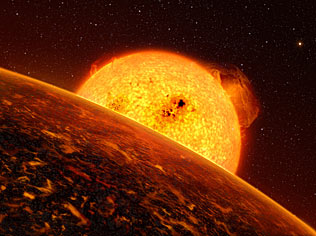
This artists' rendition shows a super-Earth, or low mass exoplanet, orbiting close to its parent star. Credit:  Keck Observatory

This artists’ rendition shows a super-Earth, or low mass exoplanet, orbiting close to its parent star. Credit: Keck Observatory
Another possibility is the eccentric orbit itself may be enough to keep life happy, at least for a while. If the planet is colder and stiffer, and orbiting far from its star, it’s possible the tidal flexing would serve as an energy source for life to survive.

Think of a situation like Europa near Jupiter, where some scientists believe the moon could have a subsurface ocean heated by interactions with the gas giant.

The model covers planets that are between the size of Earth and 2.5 times larger, and future studies will aim to see how layers in the planet change over time.

Source: NASA

Tagged as:
Europa,
super earth,
tidal heating

NameExoWorlds, an IAU Worldwide Contest to Name Alien Planets, Continues Controversy

NameExoWorlds, an IAU Worldwide Contest to Name Alien Planets, Continues Controversy:


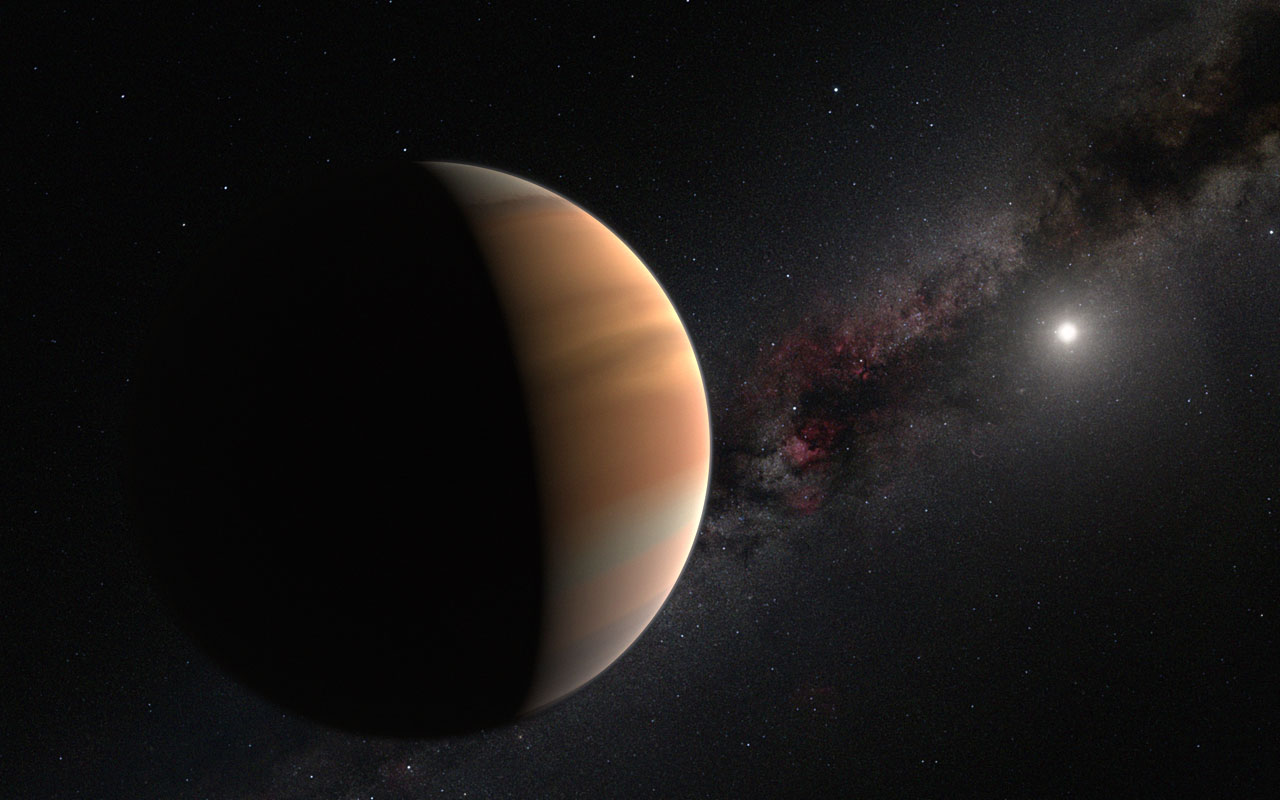
This artist's impression of an exoplanet currently represents a distant world with an alien name, some long grocery list of numbers. But now, the IAU is giving you the chance to rename it with a little jazz. Image Credit: IAU/M. Kornmesser/N. Risinger (skysurvey.org)

This artist’s impression of an exoplanet currently represents a distant world with an alien name. But now, the IAU is giving you the chance to rename it with a little jazz. Image Credit: IAU / M. Kornmesser / N. Risinger (skysurvey.org)
The International Astronomical Union has unveiled a worldwide contest, NameExoWorlds, which gives the public a role in naming planets and their host stars beyond the solar system.

It’s the latest chapter in a years-long controversy over how celestial objects, including exoplanets, are classified and named.

Although the IAU has presided over the long process of naming astronomical objects for nearly a century, until last year they didn’t feel the need to include exoplanets on this long list.

As late as March 2013, the IAU’s official word on naming exoplanets was: “The IAU sees no need and has no plan to assign names to these objects at the present stage of our knowledge.” Since there was seemingly going to be so many exoplanets, the IAU saw it too difficult to name them all.

Other organizations, however, such as the SETI institute and the space company Uwingu leapt at the opportunity to engage the public in providing names for exoplanets. Their endeavors been widely popular with the general public, but generated discussion about how official the names would be.

The IAU issued a later statement in April 2014 (which Universe Today covered with vigor) and claimed that these two campaigns had no bearing on the official naming process. By August 2014, the IAU had introduced new rules for naming exoplanets, drastically changing their stance and surprising many.

Now in partnership with Zooniverse, a citizen-science organization, the IAU has drawn up a list of 305 well-characterized exoplanets in 206 solar systems. Starting in September, astronomy organizations can register for the opportunity to select planets for naming.

In October, the IAU plans to ask the registered organizations to vote for the 20 to 30 worlds on the list that they want to name. The exact number will depend on the number of registered groups. In December, those groups can propose names for the worlds that get the most votes. Groups can only propose names in accordance with the following set of rules. A name must be:

—   16 characters or less in length

—   Preferably one word

—   Pronounceable (in some language)

—   Non-offensive

—   Not too similar to an existing name of an astronomical object

Starting in March 2015, the list of proposed names will be put up to an Internet vote. The winners will be validated by the IAU, and announced during a ceremony at the IAU General Assembly in Honolulu in August 2015.

The popular name for a given exoplanet won’t replace the scientific name. But it will carry the IAU seal of approval.

Astronomer Alan Stern, principal investigator of the New Horizons mission to Pluto and CEO of Uwingu told Universe Today’s Senior Editor, Nancy Atkinson, that he was not surprised by the IAU’s new statement. “To my eye though, it’s just more IAU elitism, they can’t seem to get out of their elitist rut thinking they own the Universe.”

“Uwingu’s model is in our view far superior — people can directly name planets around other stars, with no one having to approve the choices,” Stern continued. “With 100 billion plus planets in the galaxy, why bother with committees of elites telling people what they do and don’t approve of?”

If nothing else, the controversy has sparked multiple venues to name exoplanets and more importantly learn about these alien worlds.

Tagged as:
exoplanets,
IAU,
Uwingu

Blast! Sun Pops Off A Moderate Solar Flare. Could Others Follow Soon?

Blast! Sun Pops Off A Moderate Solar Flare. Could Others Follow Soon?:


With a watchful NASA spacecraft capturing its moves, the Sun sent off a “mid-level” solar flare on Tuesday (July 8) that you can watch (over and over again) in the video above. The Solar Dynamics Observatory caught the explosion around 12:20 p.m. EDT (4:20 p.m. UTC), which led into a coronal mass ejection that sent a surge of solar material into space.

Solar flares can be disruptive to Earth communications and also cause auroras in the atmosphere. In this case, the M6 solar flare created “short-lived impacts to high frequency radio communications on the sunlit side of Earth … as a result,” wrote the National Oceanic and Atmospheric Administration in a forecast July 8.

In this case, however, the coronal mass ejection (seen by the Solar Dynamics Observatory) is not expected to hit Earth. But with the Sun around its maximum of solar activity in the 11-year cycle, other eruptions could head into space in the coming days. M is considered a moderate flare and X the strongest kind.

“Solar activity is low, but the quiet is unlikely to persist,” wrote SpaceWeather.com in an update published today (July 10). “There are three sunspots with unstable magnetic fields capable of strong eruptions: AR2108, AR2109, AR2113. NOAA forecasters estimate a 75% chance of M-flares and 15% chance of X-flares on July 10th.”

This flare caused a surge in shortwave activity that you can hear in this audio file, recorded by New Mexico amateur astronomer Thomas Ashcraft. “Radio bursts such as these are sparked by shock waves moving through the sun’s atmosphere,” SpaceWeather added. “Set in motion by flares, these shock waves excite plasma instabilitties that emit static-y radio waves.”

A moderate solar flare erupts on the sun July 8, 2014 in this image from NASA's Solar Dynamics Observatory. The image uses a wavelength of light (131 Angstroms) that emphasizes the hot material of the sun. Credit: NASA/SDO

A moderate solar flare erupts on the sun July 8, 2014 in this image from NASA’s Solar Dynamics Observatory. The image uses a wavelength of light (131 Angstroms) that emphasizes the hot material of the sun. Credit: NASA/SDO
Tagged as:
coronal mass ejection,
solar flare

Merging Giant Galaxies Sport ‘Blue Bling’ in New Hubble Pic

Merging Giant Galaxies Sport ‘Blue Bling’ in New Hubble Pic:


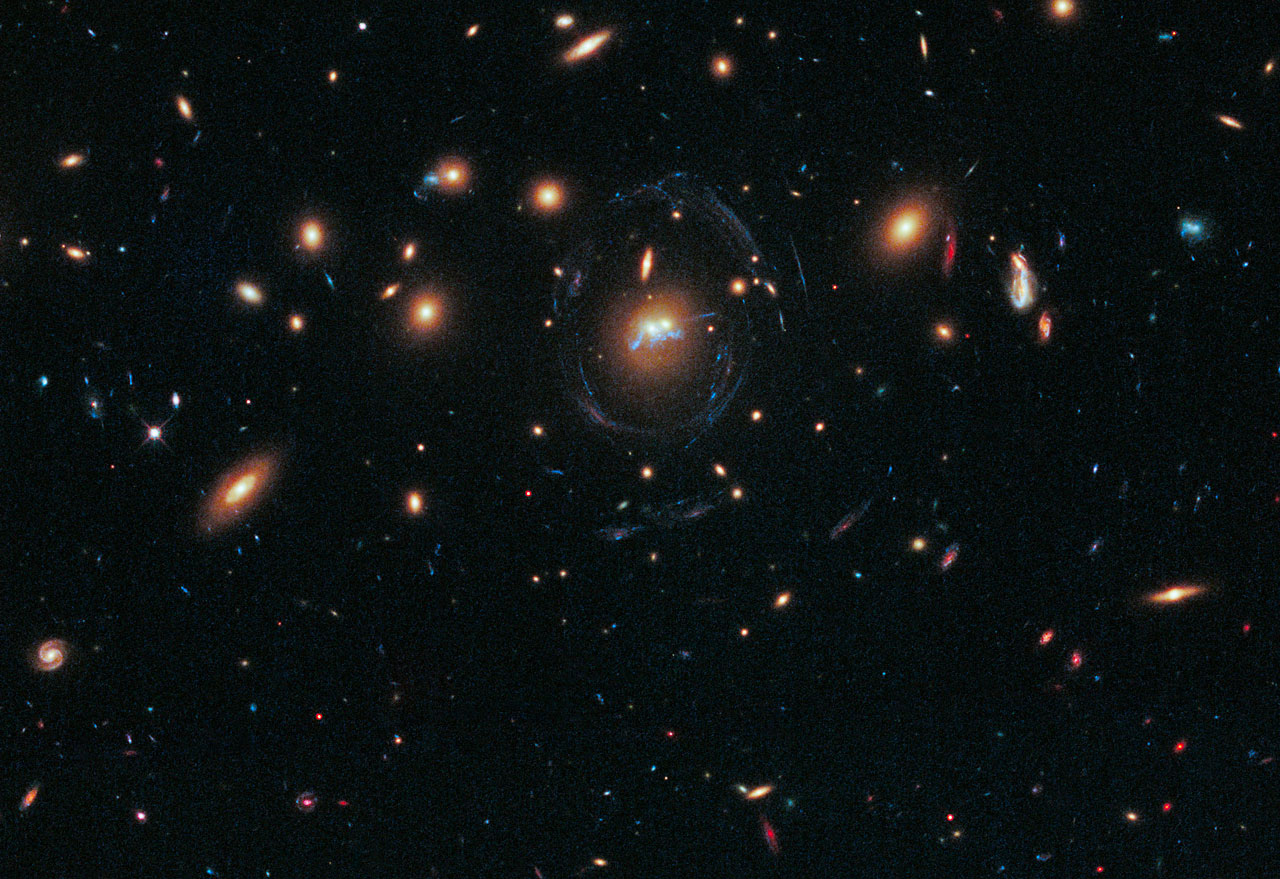
In this new Hubble image shows two galaxies (yellow, center) from the cluster SDSS J1531+3414 have been found to be merging into one and a "chain" of young stellar super-clusters are seen winding around the galaxies's nuclei. The galaxies are surrounded by an egg-shaped blue ring caused by the immense gravity of the cluster bending light from other galaxies beyond it. Credit: NASA/ESA/Grant Tremblay

In this new Hubble image shows two galaxies (yellow, center) from the cluster SDSS J1531+3414 have been found to be merging into one and a “chain” of young stellar super-clusters are seen winding around the galaxies’s nuclei. The galaxies are surrounded by an egg-shaped blue ring caused by the immense gravity of the cluster bending light from other galaxies beyond it. Credit: NASA/ESA/Grant Tremblay
On a summer night, high above our heads, where the Northern Crown and Herdsman meet, a titanic new galaxy is being born 4.5 billion light years away. You and I can’t see it, but astronomers using the Hubble Space Telescope released photographs today showing the merger of two enormous elliptical galaxies into a future  heavyweight adorned with a dazzling string of super-sized star clusters.

The two giants, each about 330,000 light years across or more than three times the size of the Milky Way, are members of a large cluster of galaxies called SDSS J1531+3414. They’ve strayed into each other’s paths and are now helpless against the attractive force of gravity which pulls them ever closer.

A few examples of merging galaxies. NASA, ESA, the Hubble Heritage Team (STScI/AURA)-ESA/Hubble Collaboration and A. Evans (University of Virginia, Charlottesville/NRAO/Stony Brook University), K. Noll (STScI), and J. Westphal (Caltech)

A few examples of merging galaxies. NASA, ESA, the Hubble Heritage Team (STScI/AURA)-ESA/Hubble Collaboration and A. Evans (University of Virginia, Charlottesville/NRAO/Stony Brook University), K. Noll (STScI), and J. Westphal (Caltech)
Galactic mergers are violent events that strip gas, dust and stars away from the galaxies involved and can alter their appearances dramatically, forming large gaseous tails, glowing rings, and warped galactic disks. Stars on the other hand, like so many pinpoints in relatively empty space, pass by one another and rarely collide.

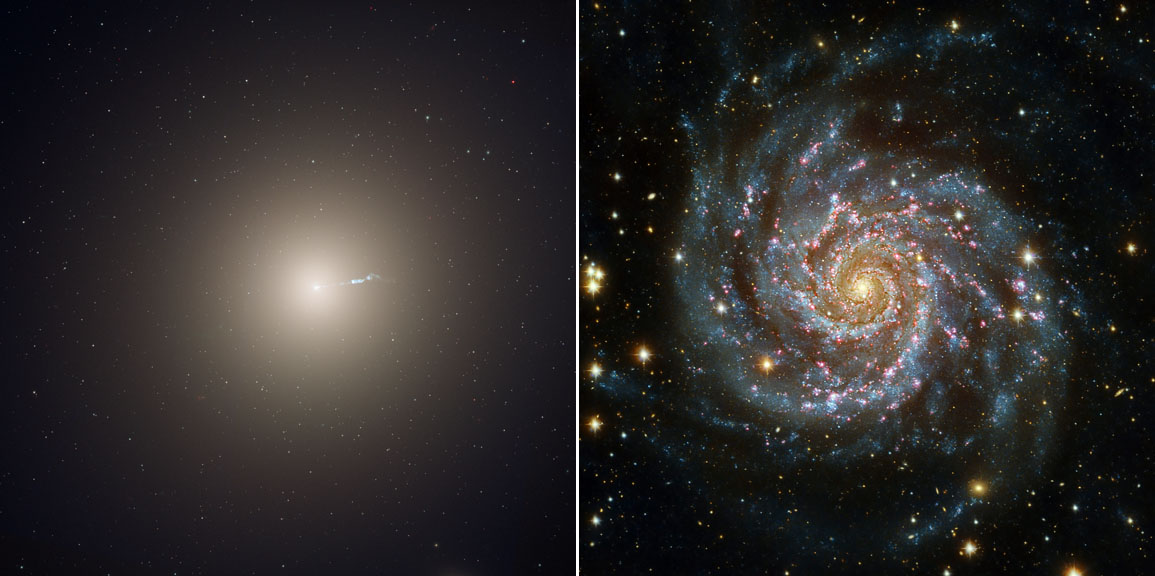
Elliptical galaxies get their name from their oval and spheroidal shapes. They lack the spiral arms, rich reserves of dust and gas and pizza-like flatness that give spiral galaxies like Andromeda and the Milky Way their multi-faceted character. Ellipticals, although incredibly rich in stars and globular clusters, generally appear featureless.

The differences between elliptical and spiral galaxies is easy to see. M87 at left and M74, both photographed with the Hubble Space Telescope. Credit: NASA/ESA

The differences between elliptical and spiral galaxies is easy to see. M87 at left and M74, both photographed with the Hubble Space Telescope. What look like stars around M87 are really globular star clusters. Credit: NASA/ESA
But these two monster ellipticals appear to be different. Unlike their gas-starved brothers and sisters, they’re rich enough in the stuff needed to induce star formation. Take a look at that string of blue blobs stretching across the center – astronomers call it a great example of ‘beads on a string’ star formation. The knotted rope of gaseous filaments with bright patches of new star clusters stems from the same physics which causes rain or water from a faucet to fall in droplets instead of streams. In the case of water, surface tension makes water ‘snap’ into individual droplets; with clouds of galactic gas, gravity is the great congealer.

Close up of the two elliptical galaxies undergoing a merger. The blue blobs are giant star clusters forming from gas colliding and collapsing into stars during the merger. Click for the scientific paper on the topic. Credit: NASA/ESA/Grant Tremblay

Close up of the two elliptical galaxies undergoing a merger. The blue blobs are giant star clusters forming from gas colliding and collapsing into stars during the merger. Click to read the scientific paper on the topic. Credit: NASA/ESA/Grant Tremblay
Nineteen compact clumps of young stars make up the length of this ‘string’, woven together with narrow filaments of hydrogen gas. The star formation spans 100,000 light years, about the size of our galaxy, the Milky Way. Astronomers still aren’t sure if the gas comes directly from the galaxies or has condensed like rain from X-ray-hot halos of gas surrounding both giants.

The blue arcs framing the merger have to do with the galaxy cluster’s enormous gravity, which warps the fabric of space like a lens, bending and focusing the light of more distant background galaxies into curvy strands of blue light. Each represents a highly distorted image of a real object.


Simulation of the Milky Way-Andromeda collision 4 billion years from now

Four billion years from now, Milky Way residents will experience a merger of our own when the Andromeda Galaxy, which has been heading our direction at 300,000 mph for millions of years, arrives on our doorstep. After a few do-si-dos the two galaxies will swallow one another up to form a much larger whirling dervish that some have already dubbed ‘Milkomeda’. Come that day, perhaps our combined galaxies will don a string a blue pearls too.

Tagged as:
elliptical,
galaxy,
Hubble,
merger,
Milkomeda,
SDSS J1531+3414,
spiral