Sunday, July 30, 2017

MILKY WAY ? What Is the Name Of Our Galaxy?

What Is the Name Of Our Galaxy?:

Since prehistoric times, human beings have looked up at at the night sky and pondered the mystery of the band of light that stretches across the heavens. And while theories have been advanced since the days of Ancient Greece as to what it could be, it was only with the birth of modern astronomy that scholars have come come to know precisely what it is – i.e. countless stars at considerable distances from Earth.

The term “Milky Way”, a term which emerged in Classical Antiquity to describe the band of light in the night sky, has since gone on to become the name for our galaxy. Like many others in the known Universe, the Milky Way is a barred, spiral galaxy that is part of the Local Group – a collection of 54 galaxies. Measuring 100,000 – 180,000 light-years in diameter, the Milky Way consists of between 100 and 400 billion stars.

Structure:

The Milky Way consists of a Galactic Center that is shaped like a bar and a Galactic Disk made up of spiral arms, all of which is surrounded by the Halo – which is made up of old stars and globular clusters. The Center, also known as “the bulge”,  is a dense concentration of mostly old stars that measures about 10,000 light years in radius. This region is also the rotational center of the Milky Way.


Illustration of the supermassive black hole at the center of the Milky Way. Credit: NRAO/AUI/NSF


Illustration of the supermassive black hole at the center of the Milky Way. Credit: NRAO/AUI/NSF
The Galactic Center is also home to an intense radio source named Sagittarius A*, which is believed to have a supermassive black hole (SMBH) at its center. The presence of this black hole has been discerned due to the apparent gravitational influence it has on surrounding stars. Astronomers estimate that it has a mass of between 4.1. and 4.5 million Solar masses.

Outside the barred bulge at the Galactic Center is the Galactic Disk of the Milky Way. This consists of stars, gas and dust which is organized into four spiral arms. These arms typically contain a higher density of interstellar gas and dust than the Galactic average, as well as a greater concentration of star formation. While there is no consensus on the exact structure or extent of these spiral arms, they are commonly grouped into two or four different arms.

In the case of four arms, this is based on the traced paths of gas and younger stars in our galaxy, which corresponds to the Perseus Arm, the Norma and Outer Arm, the Scutum-Centaurum Arm, and the Carina-Sagittarius Arm. There are also at least two smaller arms, which include the Cygnus Arm and the Orion Arm. Meanwhile, surveys based on the presence of older stars show only two major spirals arms – the Perseus arm and the Scutum–Centaurus arm.

Beyond the Galactic Disk is the Halo, which is made up of old stars and globular clusters – 90% of which lie within 100,000 light-years (30,000 parsecs) from the Galactic Center. Recent evidence provided by X-ray observatories indicates that in addition to this stellar halo, the Milky way also has a halo of hot gas that extends for hundreds of thousands of light years.
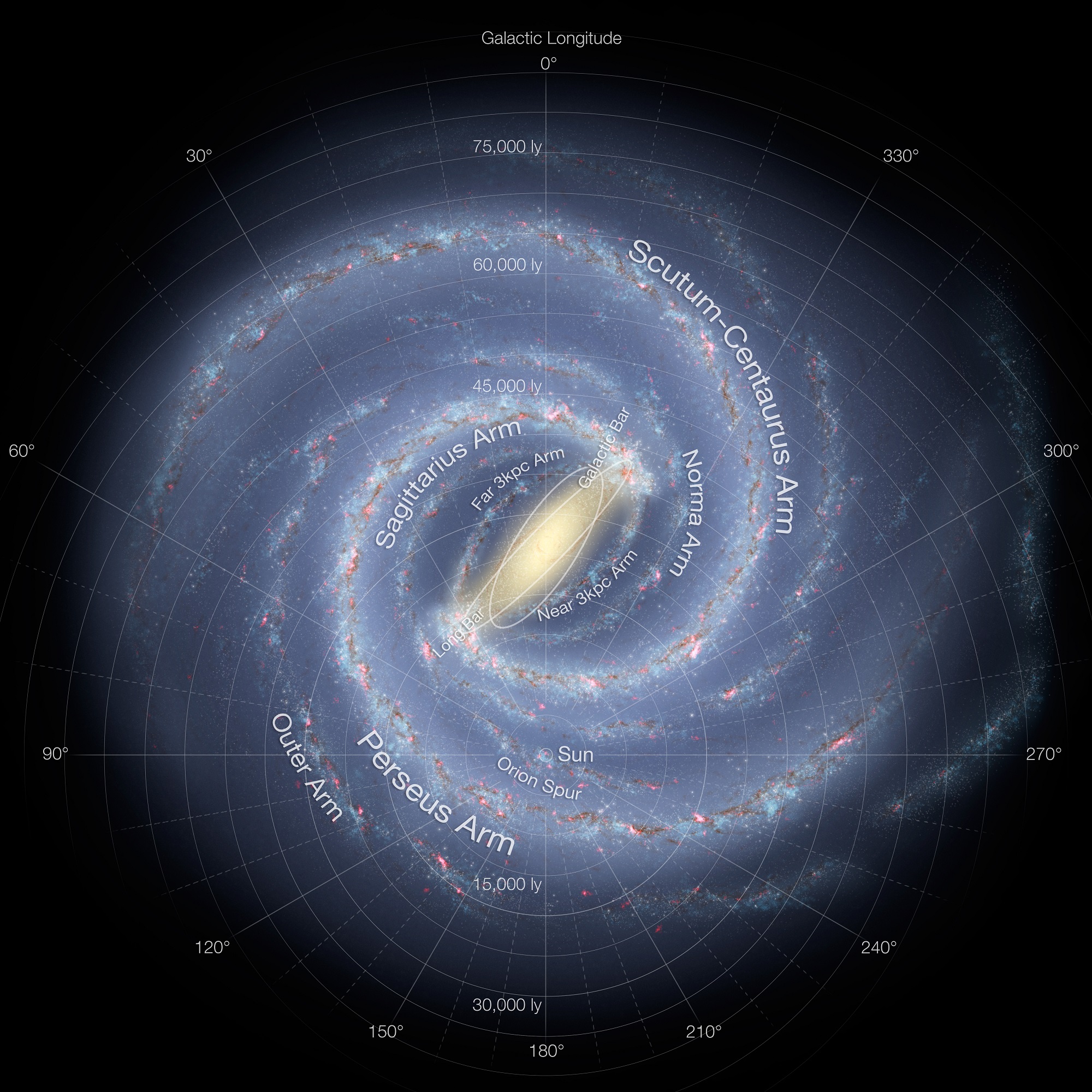


Artist’s conception of the spiral structure of the Milky Way with two major stellar arms and a bar. Credit: NASA/JPL-Caltech/ESO/R. Hurt

Size and Mass:

The Galactic Disk of the Milky Way Galaxy is approximately 100,000 light years in diameter and about 1,000 light years thick. It is estimated to contain between 100 and 400 billion stars, though the exact figure depends on the number of very low-mass M-type (aka. red dwarf) stars. This is difficult to determine because these stars also have low-luminosity compared to other class.
The distance from the Sun to the Galactic Center is estimated to be between 25,000 to 28,000 light years (7,600 to 8,700 parsecs). The Galactic Center’s bar (aka. its “bulge”)  is thought to be about 27,000 light-years in length and is composed primarily of red stars, all of which are thought to be ancient. The bar is surrounded by the ‘5-kpc ring’, a region that contains much of the galaxy’s molecular hydrogen and where star-formation is most intense.

The Galactic Disk has a diameter of between 70,000 and 100,000 light-years. It does not have a sharp edge, a radius beyond which there are no stars. However, the number of stars drops slowly with distance from the center. Beyond a radius of roughly 40,000 light years, the number of stars drops much faster the farther you get from the center.

Location of the Solar System:

The Solar System is located near the inner rim of the Orion Arm, a minor spiral arm located between the Carina–Sagittarius Arm and the Perseus Arm. This arm measures some 3,500 light-years (1,100 parsecs) across,  approximately 10,000 light-years (3,100 parsecs) in length, and is at a distance of about 25,400 to 27,400 light years (7.78 to 8.4 thousand parsecs) from the Galactic Center.

History of Observation:

Our galaxy was named because of the way the haze it casts in the night sky resembled spilled milk. This name is also quite ancient. It is translation from the Latin “Via Lactea“, which in turn was translated from the Greek for Galaxias, referring to the pale band of light formed by stars in the galactic plane as seen from Earth.

Persian astronomer Nasir al-Din al-Tusi (1201–1274) even spelled it out in his book Tadhkira: “The Milky Way, i.e. the Galaxy, is made up of a very large number of small, tightly clustered stars, which, on account of their concentration and smallness, seem to be cloudy patches. Because of this, it was likened to milk in color.”

Astronomers had long suspected the Milky Way was made up of stars, but it wasn’t proven until 1610, when Galileo Galilei turned his rudimentary telescope towards the heavens and resolved individual stars in the band across the sky. With the help of telescopes, astronomers realized that there were many, many more stars in the sky, and that all of the ones that we can see are a part of the Milky Way.


In 1755, Immanuel Kant proposed that the Milky Way was a large collection of stars held together by mutual gravity. Just like the Solar System, this collection would be rotating and flattened out as a disk, with the Solar System embedded within it. Astronomer William Herschel (discoverer of Uranus) tried to map its shape in 1785, but he didn’t realize that large portions of the galaxy are obscured by gas and dust, which hide its true shape.

It wasn’t until the 1920s, when Edwin Hubble provided conclusive evidence that the spiral nebulae in the sky were actually whole other galaxies, that the true shape of our galaxy was known. Thenceforth, astronomers came to understand that the Milky Way is a barred, spiral galaxy, and also came to appreciate how big the Universe truly is.

The Milky Way is appropriately named, being the vast and cloudy mass of stars, dust and gas it is. Like all galaxies, ours is believed to have formed from many smaller galaxies colliding and combining in the past. And in 3 to 4 billion years, it will collide with the Andromeda Galaxy to form an even larger mass of stars, gas and dust. Assuming humanity still exists by then (and survives the process) it should make for some interesting viewing!

We have written many interesting articles about the Milky Way here at Universe Today. Here’s 10 Interesting Facts About the Milky Way, How Big is the Milky Way?, Why is our Galaxy Called the Milky Way?, What is the Closest Galaxy to the Milky Way?, Where is the Earth in the Milky Way?, The Milky Way has Only Two Spiral Arms, and It’s Inevitable: Milky Way, Andromeda Galaxy Heading for Collision.

If you’d like more info on galaxies, check out Hubblesite’s News Releases on Galaxies, and here’s NASA’s Science Page on Galaxies.

We’ve also recorded an episode of Astronomy Cast about the Milky Way. Listen here, Episode 99: The Milky Way.

Sources:

The post What Is the Name Of Our Galaxy? appeared first on Universe Today.

MILKY WAY - The Milky Way over Monument Valley

The Milky Way over Monument Valley:

Discover the cosmos! Each day a different image or photograph of our fascinating universe is featured, along with a brief explanation written by a professional astronomer.

2017 July 26


See Explanation. Moving the cursor over the image will bring up an annotated version. Clicking on the image will bring up the highest resolution version available.
Explanation: You don't have to be at Monument Valley to see the Milky Way arc across the sky like this -- but it helps. Only at Monument Valley USA would you see a picturesque foreground that includes these iconic rock peaks called buttes. Buttes are composed of hard rock left behind after water has eroded away the surrounding soft rock. In the featured image taken a month ago, the closest butte on the left and the butte to its right are known as the Mittens, while Merrick Butte can be seen farther to the right. Green airglow fans up from the horizon. High overhead stretches a band of diffuse light that is the central disk of our spiral Milky Way Galaxy. The band of the Milky Way can be spotted by almost anyone on almost any clear night when far enough from a city and surrounding bright lights, but a sensitive digital camera is needed to capture these colors in a dark night sky.

CONSTELLATION A Sagittarius Triplet

A Sagittarius Triplet:

Discover the cosmos! Each day a different image or photograph of our fascinating universe is featured, along with a brief explanation written by a professional astronomer.

2017 July 27


See Explanation. Clicking on the picture will download the highest resolution version available.
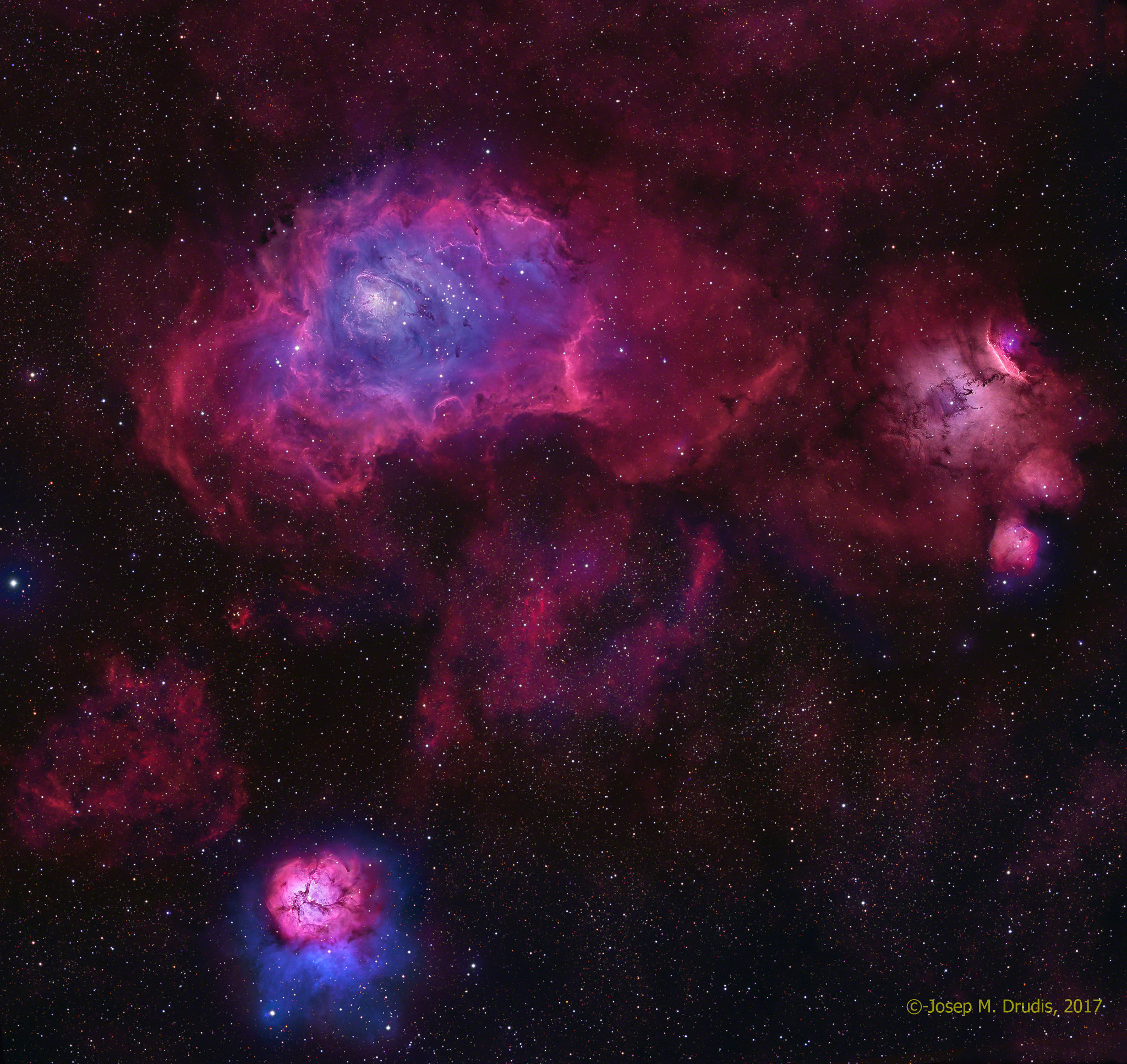
Explanation: These three bright nebulae are often featured on telescopic tours of the constellation Sagittarius and the crowded starfields of the central Milky Way. In fact, 18th century cosmic tourist Charles Messier cataloged two of them; M8, the large nebula above and left of center, and colorful M20 near the bottom of the frame. The third emission region includes NGC 6559, right of M8 and separated from the larger nebula by a dark dust lane. All three are stellar nurseries about five thousand light-years or so distant. Over a hundred light-years across the expansive M8 is also known as the Lagoon Nebula. M20's popular moniker is the Trifid. Glowing hydrogen gas creates the dominant red color of the emission nebulae. In striking contrast, blue hues in the Trifid are due to dust reflected starlight. The colorful composite skyscape was recorded with two different telescopes to capture a widefield image of the area and individual close-ups at higher resolution.

PHOTOGRAPH - Aurora Slathers up the Sky

Aurora Slathers up the Sky:

Discover the cosmos! Each day a different image or photograph of our fascinating universe is featured, along with a brief explanation written by a professional astronomer.

2017 July 29


See Explanation. Clicking on the picture will download the highest resolution version available.


Aurora Slathers up the Sky

Image Credit: Jack Fischer, Expedition 52, NASA


Explanation: Like salsa verde on your favorite burrito, a green aurora slathers up the sky in this June 25 snapshot from the International Space Station. About 400 kilometers (250 miles) above Earth, the orbiting station is itself within the upper realm of the auroral displays. Aurorae have the signature colors of excited molecules and atoms at the low densities found at extreme altitudes. Emission from atomic oxygen dominates this view. The tantalizing glow is green at lower altitudes, but rarer reddish bands extend above the space station's horizon. The orbital scene was captured while passing over a point south and east of Australia, with stars above the horizon at the right belonging to the constellation Canis Major, Orion's big dog. Sirius, alpha star of Canis Major, is the brightest star near the Earth's limb.

Tomorrow's picture: end of the world


< | Archive | Submissions | Index | Search | Calendar | RSS | Education | About APOD | Discuss | >


Authors & editors: Robert Nemiroff (MTU) & Jerry Bonnell (UMCP)

NASA Official: Phillip Newman Specific rights apply.

NASA Web Privacy Policy and Important Notices

A service of: ASD at NASA / GSFC

& Michigan Tech. U.

Wednesday, July 26, 2017

MOON LANDER - Astrobotic's Private Moon Lander Will Launch in 2019 on Atlas V Rocket

Astrobotic's Private Moon Lander Will Launch in 2019 on Atlas V Rocket:

Astrobotic's Private Moon Lander Will Launch in 2019
Artist's illustration of Astrobotic's Peregrine lunar lander on the surface of the moon.
Credit: Astrobotic


A private moon lander now has a ride to space for its maiden lunar mission in 2019.

Pittsburgh-based Astrobotic's robotic Peregrine lander will lift off atop a United Launch Alliance (ULA) Atlas V rocket on its first trip to the moon's surface two years from now, representatives of both companies announced today (July 26).

"Astrobotic is thrilled to select a ULA launch vehicle as the means to get Peregrine to the moon," Astrobotic CEO John Thornton said in a statement. "By launching with ULA, Astrobotic can rest assured our payload customers will ride on a proven launch vehicle with a solid track record of success."

During the 2019 mission, Peregrine will carry 77 lbs. (35 kilograms) of payload to the lunar surface. Astrobotic has already signed 11 contracts with customers who want to participate in this flight, company representatives said.

This first mission is a demonstration designed to prove out Peregrine's capabilities. Astrobotic envisions the lander eventually entering relatively frequent service, ferrying up to 585 lbs. (265 kg) at a time to the moon for a variety of customers, from government space agencies such as NASA to companies that aim to exploit lunar resources, Astrobotic representatives said.

Peregrine may not be the first private lander to touch down on the moon, however, even if Astrobotic's 2019 schedule holds. Five teams remain in the Google Lunar X Prize (GLXP), which will award $20 million to the first privately funded group to land a robotic spacecraft on the moon, move it at least 1,640 feet (500 meters) and have it beam home high-resolution photos and imagery.

These five teams — Hakuto, Moon Express, SpaceIL, Synergy Moon and TeamIndus — have until the end of the year to accomplish these goals; the prize expires after Dec. 31, 2017.

Astrobotic was a participant in the GLXP, but the company dropped out last year.

Follow Mike Wall on Twitter @michaeldwall and Google+. Follow us @Spacedotcom, Facebook or Google+. Originally published on Space.com.

BLACK HOLES - Boom! Powerful Cosmic Explosion May Hint at How Black Holes Form

Boom! Powerful Cosmic Explosion May Hint at How Black Holes Form:

Boom! Powerful Cosmic Explosion May Hint at How Black Holes Form
An artist's illustration of a gamma-ray burst, an energetic blast of jets that fly at nearly the speed of light from a massive star collapsing into a black hole. New research has revealed more about how the blasts are generated and how they evolve over time.
Credit: NASA's Goddard Space Flight Center


An ultrapowerful, superfast explosion in space is providing new insight into how dying stars turn into black holes.

An international team of researchers looked at a gamma-ray explosion called GRB 160625B that brightened the sky in June 2016. Gamma-ray bursts are among the most powerful explosions in the universe, but they are typically tough to track because they are very short-lived (sometimes lasting just a few milliseconds).

"Gamma-ray bursts are catastrophic events, related to the explosion of massive stars 50 times the size of our sun," said Eleonora Troja, lead author of the new study and an assistant research scientist in astronomy at University of Maryland. "If you ranked all the explosions in the universe based on their power, gamma-ray bursts would be right behind the Big Bang." [Record Breaking Gamma-Ray Burst Captured By Fermi (Video)]

"In a matter of seconds, the process can emit as much energy as a star the size of our sun would in its entire lifetime," Troja said in a statement. "We are very interested to learn how this is possible."

Two key findings emerged from the observations, gathered using several ground- and space-based telescopes. The first step was better model what happens as the dying star collapses. The data suggests that the black hole creates a strong magnetic field that initially overwhelms jets of matter and energy formed because of the explosion. Then, the magnetic field breaks down, the study authors said.

In the next phase, the magnetic field diminishes, allowing matter to dominate the jets. Before, scientists thought that jets could be dominated only by the magnetic field or matter — not both.

Another insight concerns what kind of radiation is responsible for the bright phase at the beginning of the burst, which astronomers call the "prompt" phase. Before, several types of radiation were considered, including so-called blackbody radiation (heat emission from an object) and inverse Compton radiation (which happens when accelerated particles transfer energy to photons), according to the statement.

It turns out that a phenomenon called synchrotron radiation is behind the prompt phase. This kind of radiation happens when electrons accelerate in a curved or spiral pathway, propelled along by an organized magnetic field.

"Synchrotron radiation is the only emission mechanism that can create the same degree of polarization and the same spectrum we observed early in the burst," Troja said.

The fading afterglow of GRB 160625B, a gamma-ray burst recorded in June 2016. Here, data from Arizona State University's Reionization And Transients Infrared (RATIR) camera, on a telescope at Mexico's National Astronomical Observatory in Baja California, shows the burst from June 26 to Aug. 20, 2016.
Credit: Nathaniel Butler/ASU


"Our study provides convincing evidence that the prompt gamma-ray burst emission is driven by synchrotron radiation," she added. "This is an important achievement because, despite decades of investigation, the physical mechanism that drives gamma-ray bursts had not yet been unambiguously identified."

Gathering information about GRB 160625B required many telescopes to work together quickly. NASA's Fermi Gamma-ray Space Telescope first saw the explosion, and the ground-based Russia's MASTER-IAC telescope, which is located at the Teide Observatory in Spain's Canary Islands, quickly joined with observations in optical light.

MASTER-IAC's observations were key to understanding the evolution of GRB 160625B's magnetic field, the research team said. The magnetic field can influence polarized light (light waves that vibrate in a single plane) emanating from the burst. In a rare achievement, the telescope measured the proportion of polarized light to total light through almost the entire explosion.

"There is very little data on polarized emission from gamma-ray bursts. This burst was unique because we caught the polarization state at an early stage," said study co-author Alexander Kutyrev, an associate astronomy research scientist at the University of Maryland and an associate scientist at NASA's Goddard Space Flight Center.

"This is hard to do because it requires a very fast reaction time, and there are relatively few telescopes with this capability," Kutyrev added. "This paper shows how much can be done, but to get results like this consistently, we will need new rapid-response facilities for observing gamma-ray bursts."

Other participating telescopes included NASA's Swift Gamma-ray Burst Mission (X-ray and ultraviolet), the multi-institution Reionization and Transient Infrared/Optical Project camera (at Mexico's National Astronomical Observatory in Baja California), the National Radio Astronomy Observatory's Very Large Array in New Mexico, and the Commonwealth Scientific Industrial Research Organisation's Australia Telescope Compact Array.

The new research was detailed today (July 26) in the journal Nature.

Follow us @Spacedotcom, Facebook and Google+. Original article on Space.com.

MARS - Ancient Volcanoes on Mars Could Have Been the Place for Life

Ancient Volcanoes on Mars Could Have Been the Place for Life:


For decades, Mars has been the focal point of intense research. Beginning in the 1960s, literally dozens of robotic spacecraft, orbiters and rovers have explored Mars’ atmosphere and surface, looking for clues to the planet’s past. From this, scientists now know that billions of years ago, Mars was a warmer, wetter place. Not only did liquid water exist on its surface, but it is possible life existed there in some form as well.

Granted, some recent findings have cast some doubt in this, indicating that Mars’ surface may have been hostile to microbes. But a new study from an international team of scientists indicates that evidence life could be found in volcanic deposits. Specifically, they argue that within the massive geological structure known as Valles Marineris, there may be ancient volcanoes that have preserved ancient microbes.

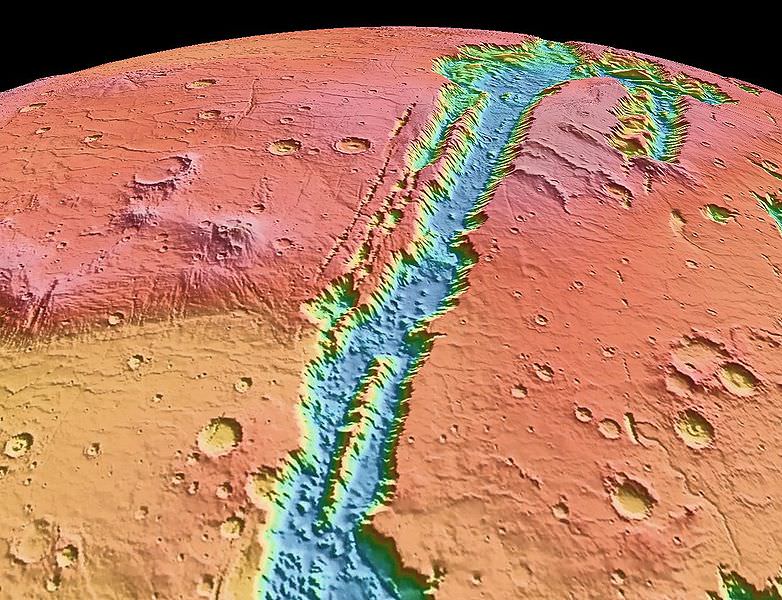
The study, titled “Amazonian Volcanism Inside Valles Marineris on Mars“, recently appeared in the journal Earth and Planetary Science Letters. Led by Petr Brož of the Institute of Geophysics at the Czech Academy of Sciences (AVCR), the team examined Mars’ famous Valles Marineris region – a canyon system stretching for 4000 km (2485.5 mi) – for signs of recent geological activity, which opens up the possibility of there also being fossilized life there.


Valles Marineris, part of NASA World Wind map of Mars. Credit: NASA
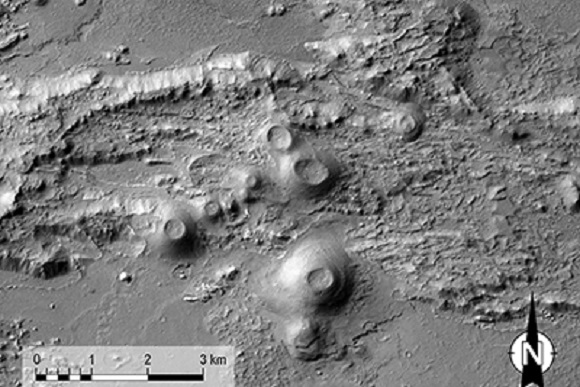
The team began by examining the Coprates Chasma canyon, one of the lowest points in Valles Marineris, which is home to over 130 volcanoes and solidified lava flows. This consisted of analyzing high-resolution images of the region that were taken by NASA’s Mars Reconnaissance Orbiter (MRO), which revealed cones of basaltic lava (aka. scoria) and ash that measured around 400-meters (1300 ft) high.

After examining the cones’ surface patterns and morphological details, they confirmed that these were indeed the remains of lava volcanoes (and not mud volcanoes, which was another possibility). In addition, they also noted similarities between these cone and others on Mars where mud volcanism is not possible – as well as similarities with volcanic cones here on Earth.

As Ernst Hauber, a researcher from the Institute of Planetary Research at the German Aerospace Center (DLR) and a co-author on the study, explained in a AVCR press release:

“The spatial distribution of the cones also suggests their volcanic origin. They appear to occur more frequently along tectonic fractures that formed the trough in the surface and whose fracture interfaces continue into the subsurface, creating pathways for the magma to ascend.”
Even more surprising was the apparent age of the volcanoes, which was very young. On Mars, the main period of volcanic activity ended during Mars’ Hesperian Period – which ran from 3.7 to approximately 3.0 billion years ago. And while images acquired by the Mars Express mission have shown indications of younger volcanoes (occurring 500 million years ago), these tend to be located in volcanic provinces.


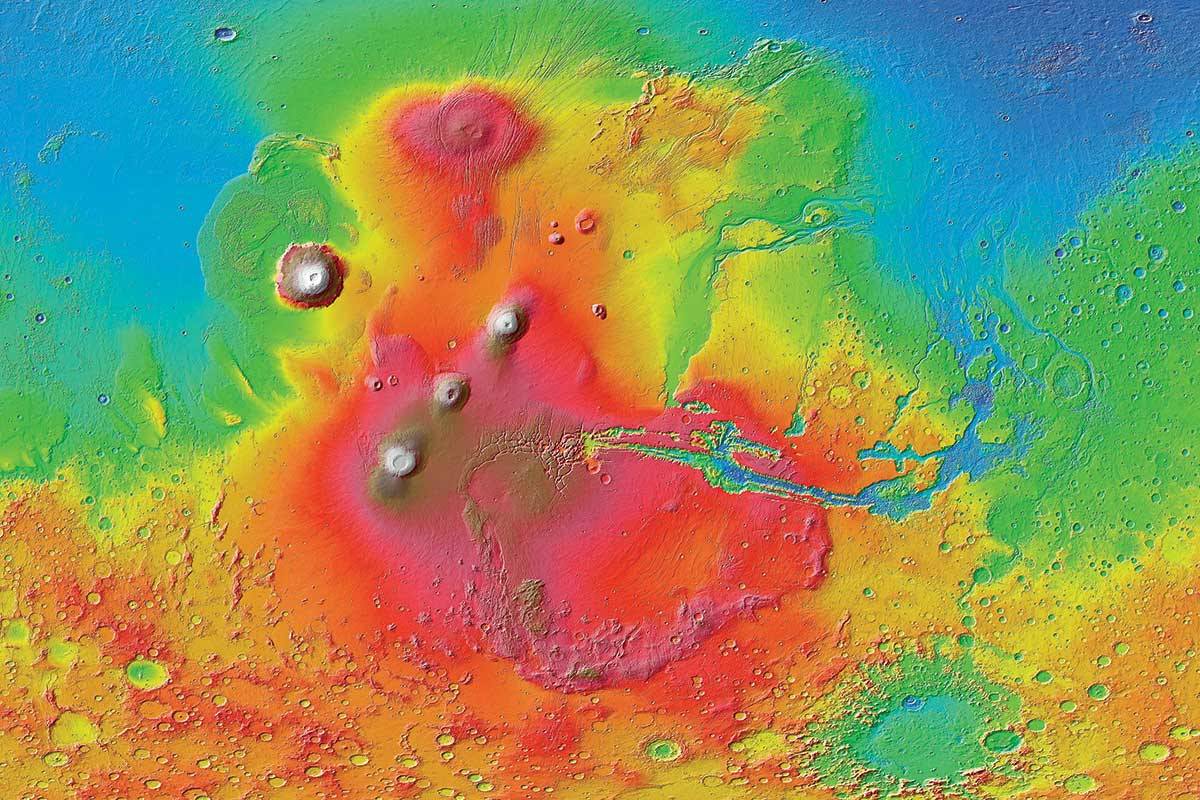
A colorized image of the surface of Mars taken by the Mars Reconnaissance Orbiter. The line of three volcanoes is the Tharsis Montes, with Olympus Mons to the northwest. Valles Marineris is to the east. Image: NASA/JPL-Caltech/ Arizona State University


A colorized image of the surface of Mars taken by the Mars Reconnaissance Orbiter. The line of three volcanoes is the Tharsis Montes, with Olympus Mons to the northwest. Valles Marineris is to the east. Image: NASA/JPL-Caltech/ Arizona State University
A good example of this is the Tharsis Bulge, which is located several thousand km from the Coprates Chasma canyon. It is here that the Tharses Montes mountain chain is located, which consists of the shield volcanoes of Ascraeus Mons, Pavonis Mons and Arsia Mons. Olympus Mons, the tallest mountain in the Solar System (with an elevation of 22 km or 13.6 mi), is located at the edge of this region.

In contrast, the volcanic cones spotted in the Coprates Chasma canyon were estimates to be between 200 and 400 million years of age, placing them in the most recent geological period known as the Amazonian (3.0 billion years ago to the present day). This effectively demonstrates that these volcanoes formed late in Mars’ history and far away from volcanic areas like Tharsis and Elysium.

It also demonstrates that these volcanoes were not part of the original formation of Valles Marineris, which is believed to be related to the formation of the Tharsis Bulge. This all took place between the Noachian to Late Hesperian periods of Mars (ca. 3.5 billion years ago), which was the last time Mars experienced widespread geological activity.

Last, but not least, the team used the Compact Reconnaissance Imaging Spectrometer (CRISM) aboard the MRO to learn more about the mineral compositions of the region’s lava and volcanic cones. Once again, their findings proved to be surprising, and could indicate that the Coprates Chasma region is a suitable location to search for evidence of ancient life on Mars.


Image of young volcanoes at the base of Coprates Chasma on Mars, obtained by the Mars Reconnaissance Orbiter. Credit: NASA/JPL/University of Arizona
Essentially, the CRISM data indicated the presence of high-silica content minerals in the volcanic rock, which included opaline-like substances at one of the peaks. Opaline silicates, it should be noted, are water-bearing materials that are often produced by hydrothermal processes – where silicate structures form from supersaturated, hot solutions of minerals that cool to become solid.

On Earth, microorganisms are often found within opal deposits since they form in energy and mineral-rich environments, where microbial lifeforms thrive. The presence of these minerals in the Coprates Chasma region could therefore mean that ancient microorganisms once thrived there. Moreover, such organisms could also be fossilized within the mineral-rich lava rock, making it a tempting target for future research.

As Hauber indicated, the appeal of Coprates Chasma doesn’t end there, and future mission will surely want to make exploring this region a priority:

“Coprates Chasma is not just interesting with regard to the question of previous life on Mars. The region would also be an excellent landing site for future Mars Rovers. Here we could investigate many scientifically important and interesting topics. Analyzing samples for their elemental isotopic fractions would allow us to determine with far greater precision when the volcanoes were actually active.

“On the towering, steep walls, the geologic evolution of the Valles Marineris is presented to us almost like a history book – gypsum strata and layers of old, crustal rocks can be observed, as well as indications for liquid water trickling down the slopes even today during the warm season. That is as much Mars geology as you can get!”


Scientists were able to gauge the rate of water loss on Mars by measuring the ratio of water and HDO from today and 4.3 billion years ago. Credit: Kevin Gill
In other words, this low-lying region could be central to future studies that attempt to unlock the history and geological evolution of the Red Planet. The payoffs of studying this region not only include determining if Mars had life in the past, but when and how it went from being a warmer, wetter environment to the cold, dessicated landscape we know today.

In the future, NASA, the ESA, the China National Space Agency (CNSA) and Roscosmos all hope to mount additional robotic missions to Mars. In addition, NASA and even SpaceX hope to send crewed missions to the planet in the hopes of learning more about its past – and possibly future – habitability. Between its geological history, greater atmospheric pressure, and the possibility of fossilized life, one or more of these missions may be headed to Valles Marineris to have a look around.

Further Reading: The Czech Academy of Science, Earth and Planetary Science Letters

The post Ancient Volcanoes on Mars Could Have Been the Place for Life appeared first on Universe Today.

MINI-SHUTTLE Dream Chaser Mini-Shuttle to Fly ISS Resupply Missions on ULA Atlas V

Dream Chaser Mini-Shuttle to Fly ISS Resupply Missions on ULA Atlas V:


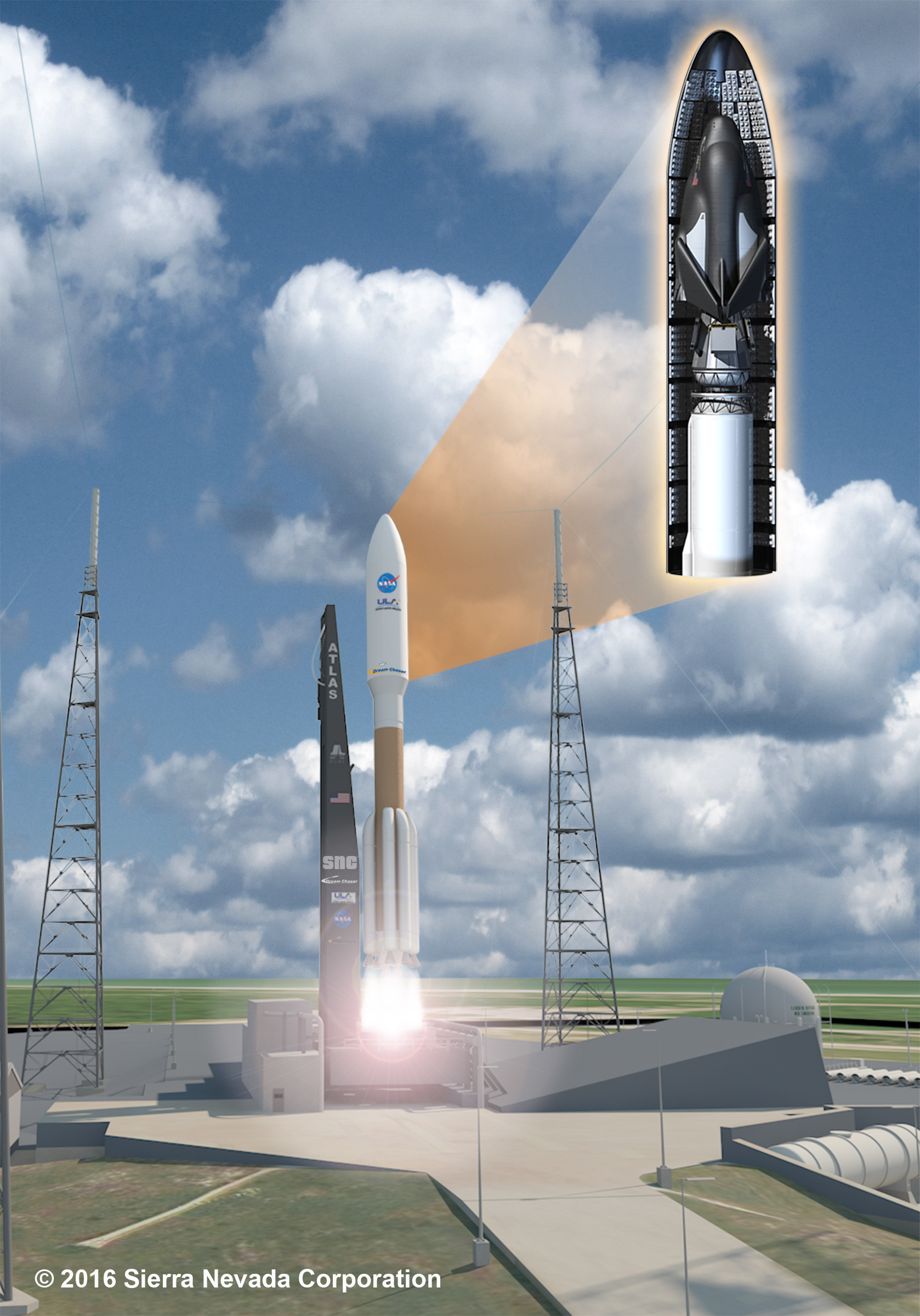
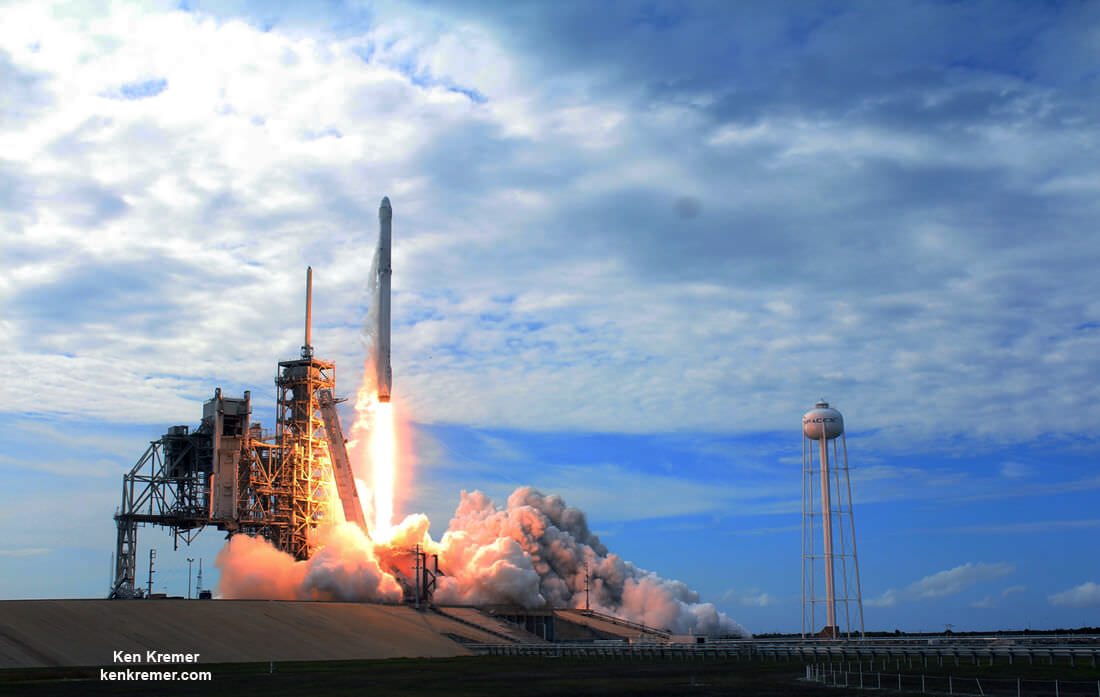
Artist’s concept of the Sierra Nevada Corporation Dream Chaser spacecraft launching atop the United Launch Alliance Atlas V rocket in the 552 configuration on cargo missions to the International Space Station. Credit: ULA
The first two missions of the unmanned Dream Chaser mini-shuttle carrying critical cargo to the International Space Station (ISS) for NASA will fly on the most powerful version of the Atlas V rocket and start as soon as 2020, announced Sierra Nevada Corporation (SNC) and United Launch Alliance (ULA).

“We have selected United Launch Alliance’s Atlas V rocket to launch our first two Dream Chaser® spacecraft cargo missions,” said SNC of Sparks, Nevada.

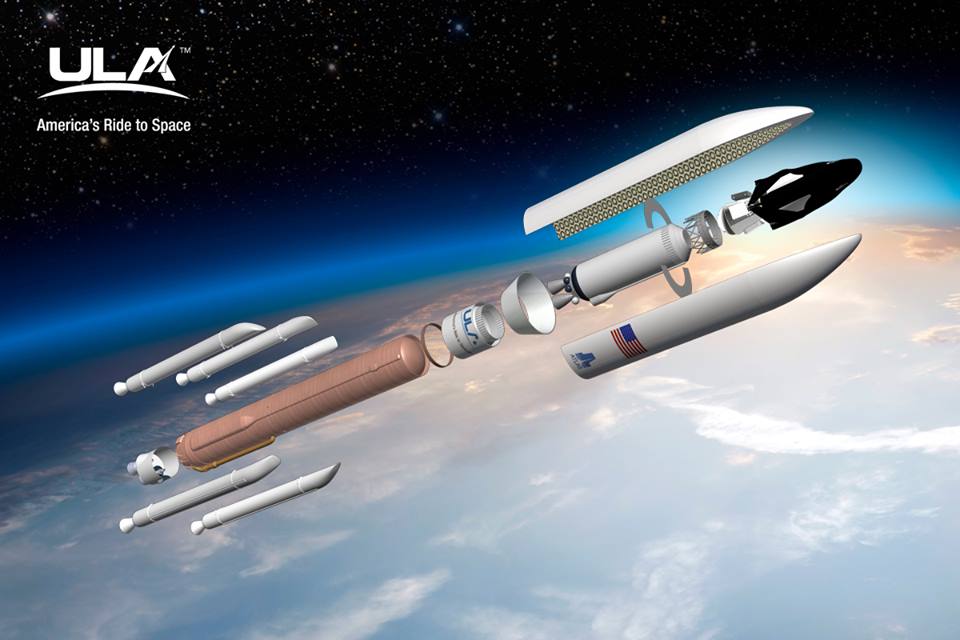
Dream Chaser will launch atop the commercial Atlas V in its most powerful configuration, dubbed Atlas V 552, with five strap on solid rocket motors and a dual engine Centaur upper stage while protectively tucked inside a five meter diameter payload fairing – with wings folded.

Blast off of Dream Chaser loaded with over 5500 kilograms of cargo mass for the space station crews will take place from ULA’s seaside Space Launch Complex-41 on Cape Canaveral Air Force Station in Florida.


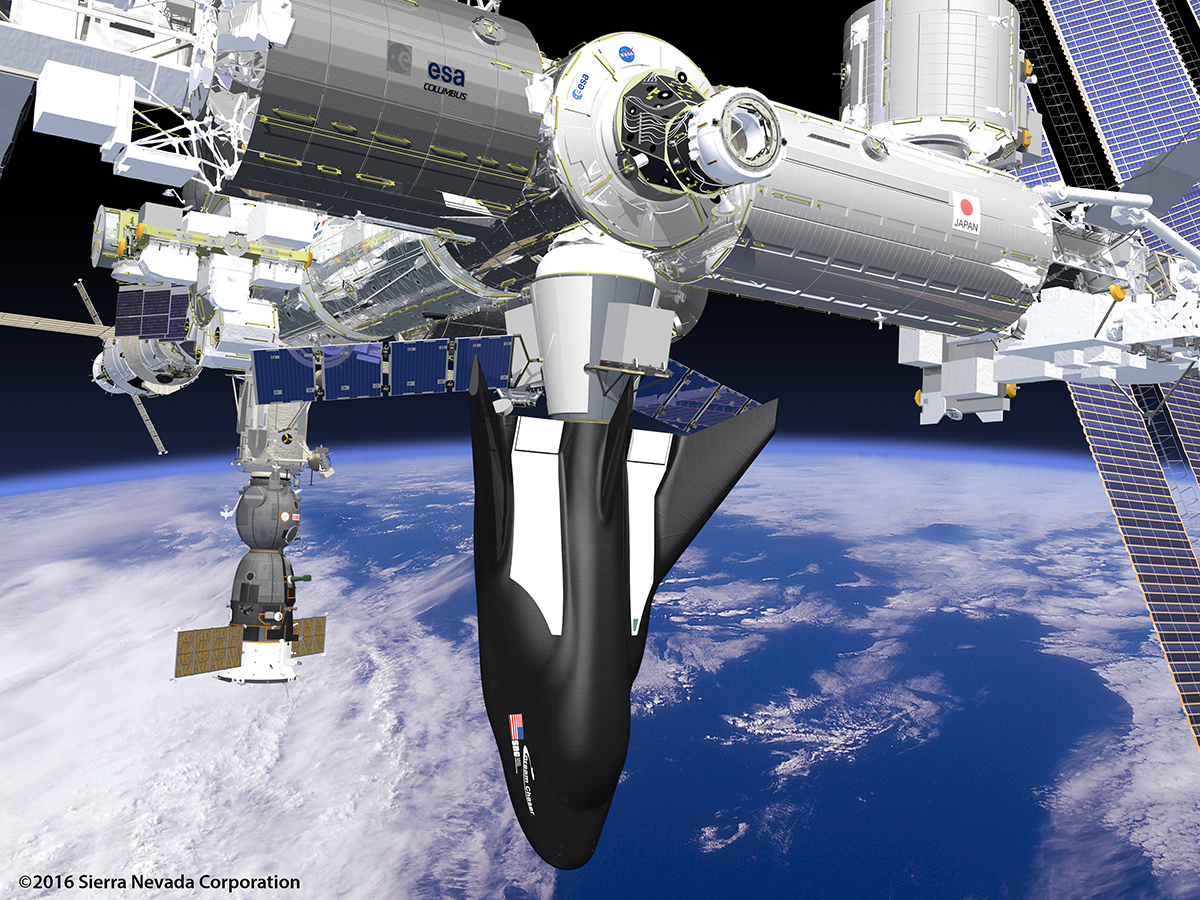
Sierra Nevada Corporation’s Dream Chaser spacecraft docks at the International Space Station.
Credits: Sierra Nevada Corporation
The unique lifting body design enables runway landings for Dream Chaser, similar to the NASA’s Space Shuttle at the Shuttle Landing Facility runway at NASA’s Kennedy Space Center in Florida.

The ULA Atlas V enjoys a 100% success rate. It has also been chosen by Boeing to ferry crews on piloted missions of their CST-100 Starliner astronaut space taxi to the ISS and back. The Centaur upper stage will be equipped with two RL-10 engines for both Dream Chaser and Starliner flights.

“SNC recognizes the proven reliability of the Atlas V rocket and its availability and schedule performance makes it the right choice for the first two flights of the Dream Chaser,” said Mark Sirangelo, corporate vice president of SNC’s Space Systems business area, in a statement.

“Humbled and honored by your trust in us,” tweeted ULA CEO Tory Bruno following the announcement.

Liftoff of the maiden pair of Dream Chaser cargo missions to the ISS are expected in 2020 and 2021 under the Commercial Resupply Services 2 (CRS2) contract with NASA.


Rendering of Launch of SNC’s Dream Chaser Cargo System Aboard an Atlas V Rocket. Credit: SNC
“ULA is pleased to partner with Sierra Nevada Corporation to launch its Dream Chaser cargo system to the International Space Station in less than three years,” said Gary Wentz, ULA vice president of Human and Commercial Systems.

“We recognize the importance of on time and reliable transportation of crew and cargo to Station and are honored the Atlas V was selected to continue to launch cargo resupply missions for NASA.”

By utilizing the most powerful variant of ULA’s Atlas V, Dream Chaser will be capable of transporting over 5,500 kilograms (12,000 pounds) of pressurized and unpressurized cargo mass – including science experiments, research gear, spare part, crew supplies, food, water, clothing and more per ISS mission.

“In addition, a significant amount of cargo, almost 2,000 kilograms is directly returned from the ISS to a gentle runway landing at a pinpoint location,” according to SNC.

“Dream Chaser’s all non-toxic systems design allows personnel to simply walk up to the vehicle after landing, providing immediate access to time-critical science as soon as the wheels stop.”

“ULA is an important player in the market and we appreciate their history and continued contributions to space flights and are pleased to support the aerospace community in Colorado and Alabama,” added Sirangelo.

Under the NASA CRS-2 contract awarded in 2016, Dream Chaser becomes the third ISS resupply provider, joining the current ISS commercial cargo vehicle providers, namely the Cygnus from Orbital ATK of Dulles, Virginia and the cargo Dragon from SpaceX of Hawthorne, California.

NASA decided to plus up the number of ISS commercial cargo providers from two to three for the critical task of ensuring the regular delivery of critical science, crew supplies, provisions, spare parts and assorted gear to the multinational crews living and working aboard the massive orbiting outpost.

NASA’s CRS-2 contracts run from 2019 through 2024 and specify six cargo missions for each of the three commercial providers.

By adding a new third provider, NASA simultaneously gains the benefit of additional capability and flexibility and also spreads out the risk.

Both SpaceX and Orbital ATK suffered catastrophic launch failures during ISS resupply missions, in June 2015 and October 2014 respectively, from which both firms have recovered.

Orbital ATK and SpaceX both successfully launched ISS cargo missions this year. Indeed a trio of Orbital ATK Cygnus spacecraft have already launched on the Atlas V, including the OA-7 resupply mission in March 2017.


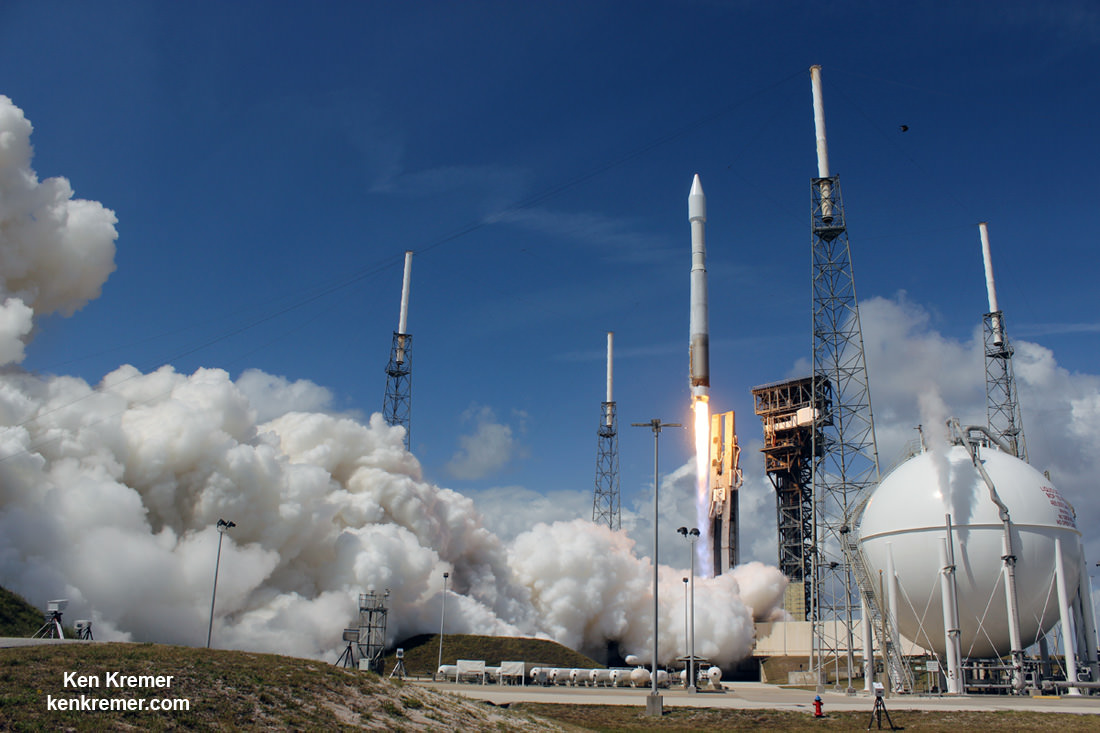
Orbital ATK’s seventh cargo delivery flight to the International Space Station -in tribute to John Glenn- launched at 11:11 a.m. EDT April 18, 2017, on a United Launch Alliance Atlas V rocket from Space Launch Complex 41 on Cape Canaveral Air Force Station in Florida. Credit: Ken Kremer/kenkremer.com
Unlike the Cygnus which burns up on reentry and Dragon which lands via parachutes, the reusable Dream Chaser is capable of low-g reentry and runway landings. This is very beneficial for sensitive scientific experiments and allows much quicker access by researchers to time critical cargo.


1st Reused SpaceX Dragon cargo craft lifts off from Launch Complex 39A at NASA’s Kennedy Space Center in Florida at 5:07 p.m. June 3, 2017 on CRS-11 mission carrying 3 tons of research equipment, cargo and supplies to the International Space Station. Credit: Ken Kremer/kenkremer.com
Dream Chaser has been under development for more than 10 years. It was originally developed as a manned vehicle and a contender for NASA’s commercial crew vehicles. When SNC lost the bid to Boeing and SpaceX in 2014, the company opted to develop this unmanned variant instead.

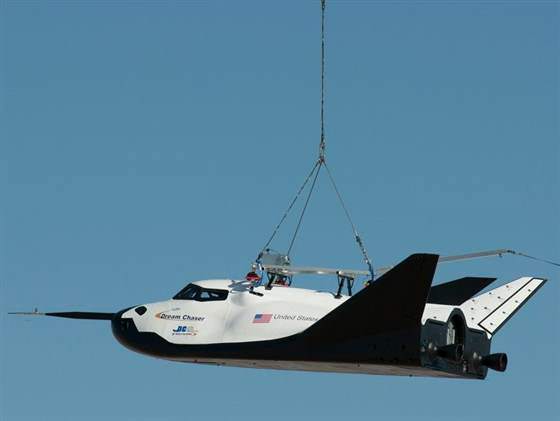
A full scale test version of the original Dream Chaser is currently undergoing ground tests at NASA’s Armstrong Flight Research Center in California. Approach and landing tests are planned for this fall.

Other current cargo providers to the ISS include the Russian Progress and Japanese HTV vessels.

Watch for Ken’s onsite space mission reports direct from the Kennedy Space Center and Cape Canaveral Air Force Station, Florida.

Stay tuned here for Ken’s continuing Earth and Planetary science and human spaceflight news.


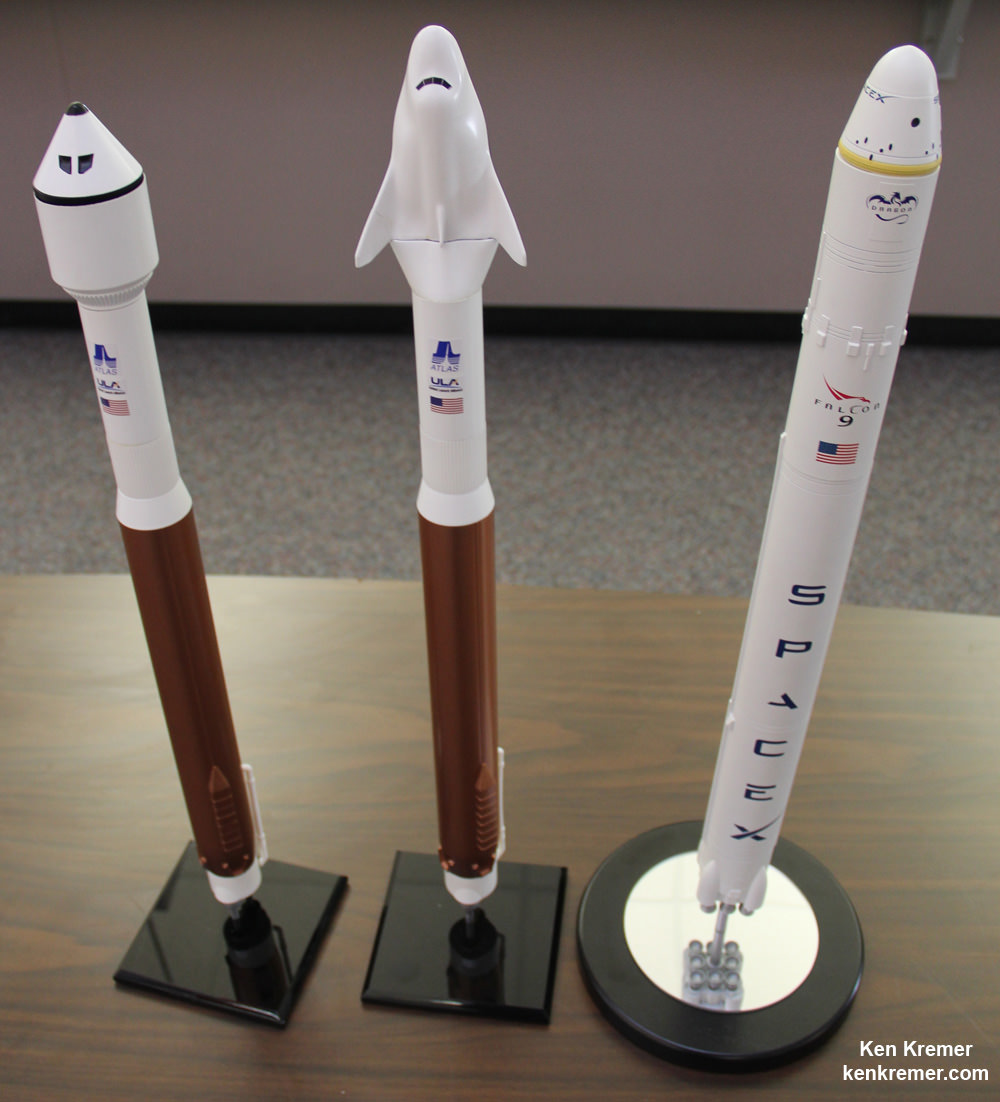
Scale models of NASA’s Commercial Crew program vehicles and launchers; Boeing CST-100, Sierra Nevada Dream Chaser, SpaceX Dragon. Credit: Ken Kremer/kenkremer.com


Sierra Nevada Dream Chaser engineering test article in flight during prior captive-carry tests. Credit: NASA
The post Dream Chaser Mini-Shuttle to Fly ISS Resupply Missions on ULA Atlas V appeared first on Universe Today.

EARTH ORBIT - Ready to Leave Low Earth Orbit? Prototype Construction Begins for a Deep Space Habitat

Ready to Leave Low Earth Orbit? Prototype Construction Begins for a Deep Space Habitat:


In 2010, NASA accounted its commitment to mount a crewed mission to Mars by the third decade of the 21st century. Towards this end, they have working hard to create the necessary technologies – such as the Space Launch System (SLS) rocket and the Orion spacecraft. At the same time, they have partnered with the private sector to develop the necessary components and expertise needed to get crews beyond Earth and the Moon.

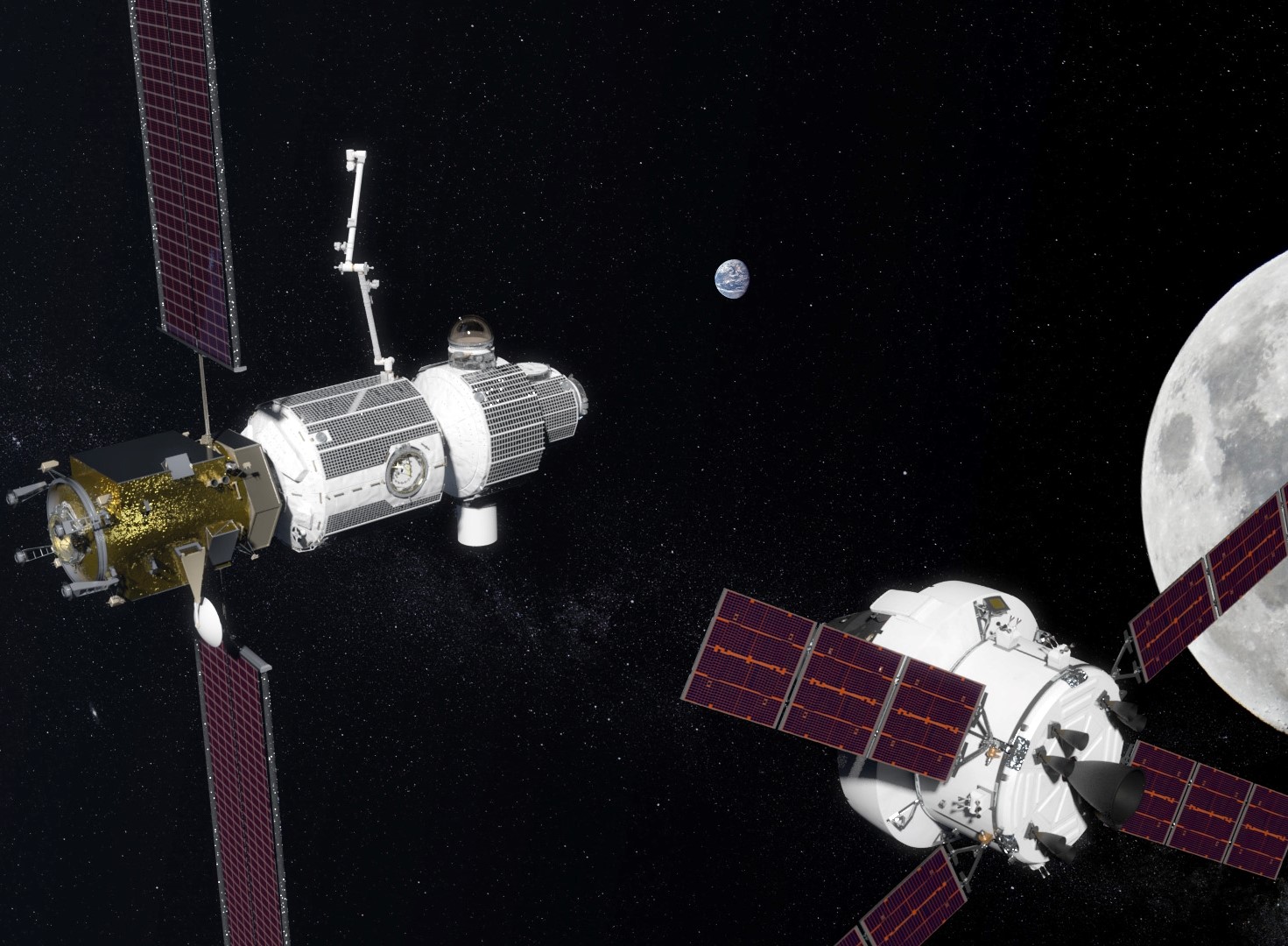
To this end, NASA recently awarded a Phase II contract to Lockheed Martin to create a new space habitat that will build on the lessons learned from the International Space Station (ISS). Known as the Deep Space Gateway, this habitat will serve as a spaceport in lunar orbit that will facilitate exploration near the Moon and assist in longer-duration missions that take us far from Earth.

The contract was awarded as part of the Next Space Technologies for Exploration Partnership (NextSTEP) program, which NASA launched in 2014. In April of 2016, as part of the second NextSTEP Broad Agency Announcement (NextSTEP-2) NASA selected six U.S. companies to begin building full-sized ground prototypes and concepts for this deep space habitat.


Artist’s impression of the Deep Space Gateway, currently under development by Lockheed Martin. Credit: NASA
Alongside such well-known companies like Bigelow Aerospace, Orbital ATK and Sierra Nevada, Lockheed Martin was charged with investigating habitat designs that would enhance missions in space near the Moon, and also serve as a proving ground for missions to Mars. Intrinsic to this is the creation of something that can take effectively integrate with SLS and the Orion capsule.

In accordance with NASA’s specifications on what constitutes an effective habitat, the design of the Deep Space Gateway must include a pressurized crew module, docking capability, environmental control and life support systems (ECLSS), logistics management, radiation mitigation and monitoring, fire safety technologies, and crew health capabilities.

The design specifications for the Deep Space Gateway also include a power bus, a small habitat to extend crew time, and logistics modules that would be intended for scientific research. The propulsion system on the gateway would rely on high-power electric propulsion to maintain its orbit, and to transfer the station to different orbits in the vicinity of the Moon when required.

With a Phase II contract now in hand, Lockheed Martin will be refining the design concept they developed for Phase I. This will include building a full-scale prototype at the Space Station Processing Facility at NASA’s Kennedy Space Center at Cape Canaveral, Florida, as well as the creation of a next-generation Deep Space Avionics Integration Lab near the Johnson Space Center in Houston.


Artist’s concept of space habitat operating beyond Earth and the Moon. Credit: NASA
As Bill Pratt, Lockheed Martin’s NextSTEP program manager, said in a recent press statement:

“It is easy to take things for granted when you are living at home, but the recently selected astronauts will face unique challenges. Something as simple as calling your family is completely different when you are outside of low Earth orbit. While building this habitat, we have to operate in a different mindset that’s more akin to long trips to Mars to ensure we keep them safe, healthy and productive.”
The full-scale prototype will essentially be a refurbished Donatello Multi-Purpose Logistics Module (MPLM), which was one of three large modules that was flown in the Space Shuttle payload bay and used to transfer cargo to the ISS. The team will also be relying on “mixed-reality prototyping”, a process where virtual and augmented reality are used to solve engineering issues in the early design phase.

“We are excited to work with NASA to repurpose a historic piece of flight hardware, originally designed for low Earth orbit exploration, to play a role in humanity’s push into deep space,” said Pratt. “Making use of existing capabilities will be a guiding philosophy for Lockheed Martin to minimize development time and meet NASA’s affordability goals.”

The Deep Space Gateway will also rely on the Orion crew capsule’s advanced capabilities while crews are docked with the habitat. Basically, this will consist of the crew using the Orion as their command deck until a more permanent command module can be built and incorporated into the habitat. This process will allow for an incremental build-up of the habitat and the deep space exploration capabilities of its crews.


Credit: NASA
As Pratt indicated, when uncrewed, the habitat will rely on systems that Lockheed Martin has incorporated into their Juno and MAVEN spacecraft in the past:

“Because the Deep Space Gateway would be uninhabited for several months at a time, it has to be rugged, reliable and have the robotic capabilities to operate autonomously. Essentially it is a robotic spacecraft that is well-suited for humans when Orion is present. Lockheed Martin’s experience building autonomous planetary spacecraft plays a large role in making that possible.”
The Phase II work will take place over the next 18 months and the results (provided by NASA) are expected to improve our understanding of what is needed to make long-term living in deep space possible. As noted, Lockheed Martin will also be using this time to build their Deep Space Avionics Integration Laboratory, which will serve as an astronaut training module and assist with command and control between the Gateway and the Orion capsule.

Beyond the development of the Deep Space Gateway, NASA is also committed to the creation of a Deep Space Transport – both of which are crucial for NASA’s proposed “Journey to Mars”. Whereas the Gateway is part of the first phase of this plan – the “Earth Reliant” phase, which involves exploration near the Moon using current technologies – the second phase will be focused on developing long-duration capabilities beyond the Moon.


NASA’s Journey to Mars. NASA is developing the capabilities needed to send humans to an asteroid by 2025 and Mars in the 2030s. Credit: NASA/JPL
For this purpose, NASA is seeking to create a reusable vehicle specifically designed for crewed missions to Mars and deeper into the Solar System. The Deep Space Transport would rely on a combination of Solar Electric Propulsion (SEP) and chemical propulsion to transport crews to and from the Gateway – which would also serve as a servicing and refueling station for the spacecraft.

This second phase (the “Proving Ground” phase) is expected to culminate at the end of the 2020s, at which time a one-year crewed mission will take place. This mission will consist of a crew being flown to the Deep Space Gateway and back to Earth for the purpose of validating the readiness of the system and its ability to conduct long-duration missions independent of Earth.

This will open the door to Phase Three of the proposed Journey, the so-called “Earth Indepedent” phase. At this juncture, the habitation module and all other necessary mission components (like a Mars Cargo Vehicle) will be transferred to an orbit around Mars. This is expected to take place by the early 2030s, and will be followed (if all goes well) by missions to the Martian surface.

While the proposed crewed mission to Mars is still a ways off, the architecture is gradually taking shape. Between the development of spacecraft that will get the mission components and crew to cislunar space – the SLS and Orion – and the development of space habitats that will house them, we are getting closer to the day when astronauts finally set foot on the Red Planet!

Further Reading: NASA, Lockheed Martin

The post Ready to Leave Low Earth Orbit? Prototype Construction Begins for a Deep Space Habitat appeared first on Universe Today.

DARK MATTER - Cosmologists Produce New Maps of Dark Matter Dynamics

Cosmologists Produce New Maps of Dark Matter Dynamics:


Slice through the celestial equator showing the radial component of the velocity field (in kilometres per second). Blue regions are falling towards us and red regions are flying away from us. Galaxies of the Sloan Digital Sky Survey main galaxy sample are overplotted. In the centre of the slice, the infalling dynamics of the Sloan Great Wall, one of the largest structure of the known Universe, can be observed


New maps of dark matter dynamics in the Universe have been produced by a team of international cosmologists. Using advanced computer modelling techniques, the research team has translated the distribution of galaxies into detailed maps of matter streams and velocities for the first time. The research was carried out by leading cosmologists from the UK, France and Germany.

Dr Florent Leclercq from the University of Portsmouth’s Institute of Cosmology and Gravitation said: “Dark matter is a substance of yet unknown nature that scientists believe makes up more than 80 per cent of the total mass of the Universe. As it does not emit or react to light, its distribution and evolution are not directly observable and have to be inferred.”

The researchers used legacy survey data obtained during 2000 – 2008 from the Sloan Digital Sky Survey (SDSS), a major three-dimensional survey of the Universe. The survey has deep multi-color images of one fifth of the sky and spectra for more than 900,000 galaxies.

The new dark matter maps cover the Northern Sky up to a distance of 600 megaparsecs, which is the equivalent of looking back about two billion years.

The researchers used a set of phase-space analysis tools and built on research from 2015, which reconstructed the initial conditions of the nearby Universe.

Dr Leclercq said: “Adopting a phase-space approach discloses a wealth of information, which was previously only analysed in simulations and thought to be inaccessible using observations.

“Accessing this information in galaxy surveys opens up new ways of assessing the validity of theoretical models in light of observations.”

The research is published in the Journal of Cosmology and Astroparticle Physics.

Credit: port.ac.uk

GALAXIES - Astronomers Find Young Galaxies that Appeared Soon After the Big Bang

Astronomers Find Young Galaxies that Appeared Soon After the Big Bang:


False-color image of a 2-square-degree region of the LAGER survey field, created from images taken in the optical at 500 nm (blue), in the near-infrared at 920 nm (red) and in a narrow-band filter centered at 964 nm (green). The small white boxes indicate the positions of the 23 LAEs discovered in the survey. The detailed insets (yellow) show two of the brightest LAEs. Image by Zhenya Zheng (SHAO) and Junxian Wang (USTC)


ASU astronomers Sangeeta Malhotra and James Rhoads, working with international teams in Chile and China, have discovered 23 young galaxies, seen as they were 800 million years after the Big Bang. The results from this sample have been recently published in the Astrophysical Journal.

Long ago, about 300,000 years after the beginning of the universe (the Big Bang), the universe was dark. There were no stars or galaxies, and the universe was filled with neutral hydrogen gas. In the next half-billion years or so, the first galaxies and stars appeared. Their energetic radiation ionized their surroundings, illuminating and transforming the universe.

This dramatic transformation, known as re-ionization, occurred sometime in the interval between 300 million years and 1 billion years after the Big Bang. Astronomers are trying to pinpoint this milestone more precisely, and the galaxies found in this study help in this determination.

“Before re-ionization, these galaxies were very hard to see, because their light is scattered by gas between galaxies, like a car’s headlights in fog,” Malhotra said. “As enough galaxies turn on and ‘burn off the fog’ they become easier to see. By doing so, they help provide a diagnostic to see how much of the ‘fog’ remains at any time in the early universe.”

To detect these galaxies, Malhotra and Rhoads have been using the Dark Energy Camera (DECam), one of the new powerful instruments in the astronomy field. DECam is installed at the National Optical Astronomy Observatory (NOAO)’s 4-meter Blanco Telescope, located at the Cerro Tololo Inter-American Observatory (CTIO), in northern Chile, at an altitude of 7,200 feet.

“Several years ago, we carried out a similar study using a 64-megapixel camera that covers the same amount of sky as the full moon,” Rhoads said. “DECam, by comparison, is a 570-megapixel camera and covers 15 times the area of the full moon in a single image.”

DECam was recently made even more powerful when it was equipped with a special narrowband filter, designed at ASU’s School of Earth and Space Exploration (SESE), primarily by Rhoads and Zhenya Zheng (who was a SESE postdoctoral fellow and is currently at the Shanghai Astronomical Observatory in China), with assistance from Alistair Walker of NOAO.

“We spent several months refining the design of the filter profile, optimizing the design to get maximum sensitivity in our search,” said Zheng, the lead author of this study.

The galaxy search using the ASU-designed filter and DECam is part of the ongoing “Lyman Alpha Galaxies in the Epoch of Reionization” project (LAGER). It is the largest uniformly selected sample that goes far enough back in the history of the universe to reach cosmic dawn.

“The combination of large survey size and sensitivity of this survey enables us to study galaxies that are common but faint, as well as those that are bright but rare, at this early stage in the universe,” said Malhotra.

Junxian Wang, a co-author on this study and the lead of the Chinese LAGER team, adds that “our findings in this survey imply that a large fraction of the first galaxies that ionized and illuminated the universe formed early, less than 800 million years after the Big Bang.”

The next steps for the team will be to build on these results. They plan to continue to search for distant star-forming galaxies over a larger volume of the universe and to further investigate the nature of some of the first galaxies in the universe. 

Credit: asu.edu

ASTRONOMY - Large, Distant Comets More Common Than Previously Thought

Large, Distant Comets More Common Than Previously Thought:


A new study suggests that distant “long-period” comets—which take more than 200 years to orbit the sun—are more common than previously thought. This illustration shows how the researchers used data from NASA's Wide-field Infrared Survey Explorer (WISE) spacecraft to determine the nucleus sizes of several of these distant comets. They subtracted a model of how dust and gas behave in comets in order to obtain the core size. Credit: NASA/JPL-Caltech


Comets that take more than 200 years to make one revolution around the sun are notoriously difficult to study. Because they spend most of their time far from our area of the solar system, many "long-period comets" will never approach the sun in a person's lifetime. In fact, those that travel inward from the Oort Cloud—a group of icy bodies beginning roughly 300 billion kilometers away from the sun—can have periods of thousands or even millions of years.

NASA's Wide-field Infrared Survey Explorer (WISE) spacecraft has delivered new insights about these distant wanderers. A team of astronomers led by James Bauer, a research professor of astronomy at the University of Maryland, found that there are about seven times more long-period comets measuring at least 1 kilometer across than previously predicted.

The researchers also found that long-period comets are, on average, nearly twice as large as "Jupiter family” comets, whose orbits are shaped by Jupiter’s gravity and have periods of less than 20 years. The findings were published July 14, 2017, in The Astronomical Journal.

"The number of comets speaks to the amount of material left over from the solar system's formation," Bauer said. "We now know that there are more relatively large chunks of ancient material coming from the Oort Cloud than we thought."

The Oort Cloud is too distant to be seen by current telescopes, but is thought to be a spherical distribution of small icy bodies at the outermost edge of the solar system. The density of comets within it is low, so the odds of comets colliding within it are low. Long-period comets that WISE observed probably got kicked out of the Oort Cloud millions of years ago. The observations were carried out in 2010 during the spacecraft's primary mission, before it was renamed NEOWISE and reactivated to target near-Earth objects (NEOs) in 2013.

"Our study is a rare look at objects perturbed out of the Oort Cloud," said Amy Mainzer, a co-author of the study based at NASA's Jet Propulsion Laboratory in Pasadena, California and principal investigator of the NEOWISE mission. "They are the most pristine examples of what the solar system was like when it formed."

Astronomers already had broader estimates of how many long-period and Jupiter family comets are in our solar system, but had no good way of measuring the sizes of long-period comets. This is because the cloud of gas and dust that surrounds each comet—known as a coma—appears hazy in images and obscures the comet’s nucleus.

By using WISE data that shows the infrared glow of the coma, the scientists were able to "subtract" the coma from each comet and estimate the size of the nucleus. The data came from WISE observations of 164 cometary bodies—including 95 Jupiter family comets and 56 long-period comets.

The results reinforce the idea that comets that pass by the sun more frequently tend to be smaller than those spending much more time away from the sun. That is because Jupiter family comets get more heat exposure, which causes volatile substances like water to sublimate and drag away other material from the comet’s surface as well.

"Our results mean there's an evolutionary difference between Jupiter family and long-period comets," Bauer said.

The existence of so many more long-period comets than predicted suggests that more of them have likely impacted planets, delivering icy materials from the outer reaches of the solar system.

Researchers also found clustered orbits among the long-period comets they studied, suggesting there could have been larger bodies that broke apart to form these groups.

The results will be important for assessing the likelihood of comets impacting our solar system's planets, including Earth.

"Comets travel much faster than asteroids, and some of them are very big," Mainzer said. "Studies like this will help us define what kind of hazard long-period comets may pose." 

NASA's Jet Propulsion Laboratory in Pasadena, California, managed and operated WISE for NASA's Science Mission Directorate in Washington, D.C. The NEOWISE project is funded by the Near-Earth Object Observation Program, now part of NASA’s Planetary Defense Coordination Office. The spacecraft was put into hibernation mode in 2011 after twice scanning the entire sky, thereby completing its main objectives. In September 2013, WISE was reactivated, renamed NEOWISE and assigned a new mission to assist NASA's efforts to identify potentially hazardous near-Earth objects.

Credit: umd.edu

THE UNIVERSE - International Research Team Sheds Light on the Earth’s ‘Twin Planet’

International Research Team Sheds Light on the Earth’s ‘Twin Planet’:


Examples of new types of cloud morphology discovered on the night side of Venus thanks to Venus Express (ESA) and the infrared telescope IRTF (NASA): stationary waves (Venus Express, up-left corner), “net” patterns (IRTF, up-right), mysterious filaments (Venus Express, down-left) and dynamical instabilities (Venus Express, down-right). CREDITS: ESA, NASA, J. Peralta (JAXA) and R. Hueso (UPV/EHU).


A research paper published by Nature Astronomy sheds light on the so far unexplored nightside circulation at the upper cloud level of Venus. Researchers from the Rhenish Institute for Environmental Research at the University of Cologne are part of an international research project which has now presented its preliminary findings. They discovered unexpected patterns of slow motion and abundant stationary waves in Venus’s nighttime sky.

Venus is often referred to as Earth's twin because both planets share a similar size and surface composition. Also, they both have atmospheres with complex weather systems. But that is about where the similarities end: Venus is one the most hostile places in our solar system. Its atmosphere consists of 96.5 percent carbon dioxide, with surface temperatures of constantly about 500 degrees Celsius. Venus is a slowly rotating planet – it needs about 243 terrestrial days to complete one rotation. We would expect its atmosphere to rotate with the same rhythm, but in fact it takes only four days. This phenomenon is called superrotation, and it causes substantial turbulences in the planet’s atmosphere. The scientists do not yet fully understand its origin and motor, but are working on an answer to this puzzle. The many waves in the planet's atmosphere may play an important role.

The preliminary research results were generated by an international collaboration headed by the Institute of Space and Astronautical Science, Japan Aerospace Exploration Agency (JAXA). Experts in space and astronautical science and astrophysics from universities and institutions in Japan, Spain, Italy, and Germany are cooperating in the project. From Germany, the Rhenish Institute for Environmental Research at the University of Cologne and the Center for Astronomy and Astrophysics at the Technical University of Berlin are involved.

The research team analysed data generated by the spacecraft Venus Express to investigate components of Venus’s complex atmosphere, including thermal measurements with regard to horizontal and vertical wave patterns. The data also included first global measurements from the tracking of individual features in thermal emission images at 3.8 and 5.0 µm (micrometer) during 2006–2008 and 2015.

Vertical information in unison with horizontal data help to understand the nature of the observed wave patterns. The vertical information from the VeRa instrument (an atmosphere experiment in Venus Express emits radio waves which the scientists then interpret) could help to identify the observed waves as buoyancy waves. This, in turn, is crucial for the analysis of atmospheric processes. 

Dr. Silvia Tellmann is Vice-Director of the Department of Planetary Research at the Rhenish Institute for Environmental Research at the University of Cologne. She is an expert on the structure, dynamics, and circulation of planetary atmospheres and a co-author of the study. ‘We were able to relate the stationary gravity waves found at higher altitudes with the surface elevations of Venus’, she says. ‘Hence, the waves can be explained with wind currents caused by topographical obstacles. We assume that these stationary waves are substantial for the continuity of the superrotation in the atmosphere of Venus.’

Credit: uni-koeln.de