Sunday, November 1, 2015

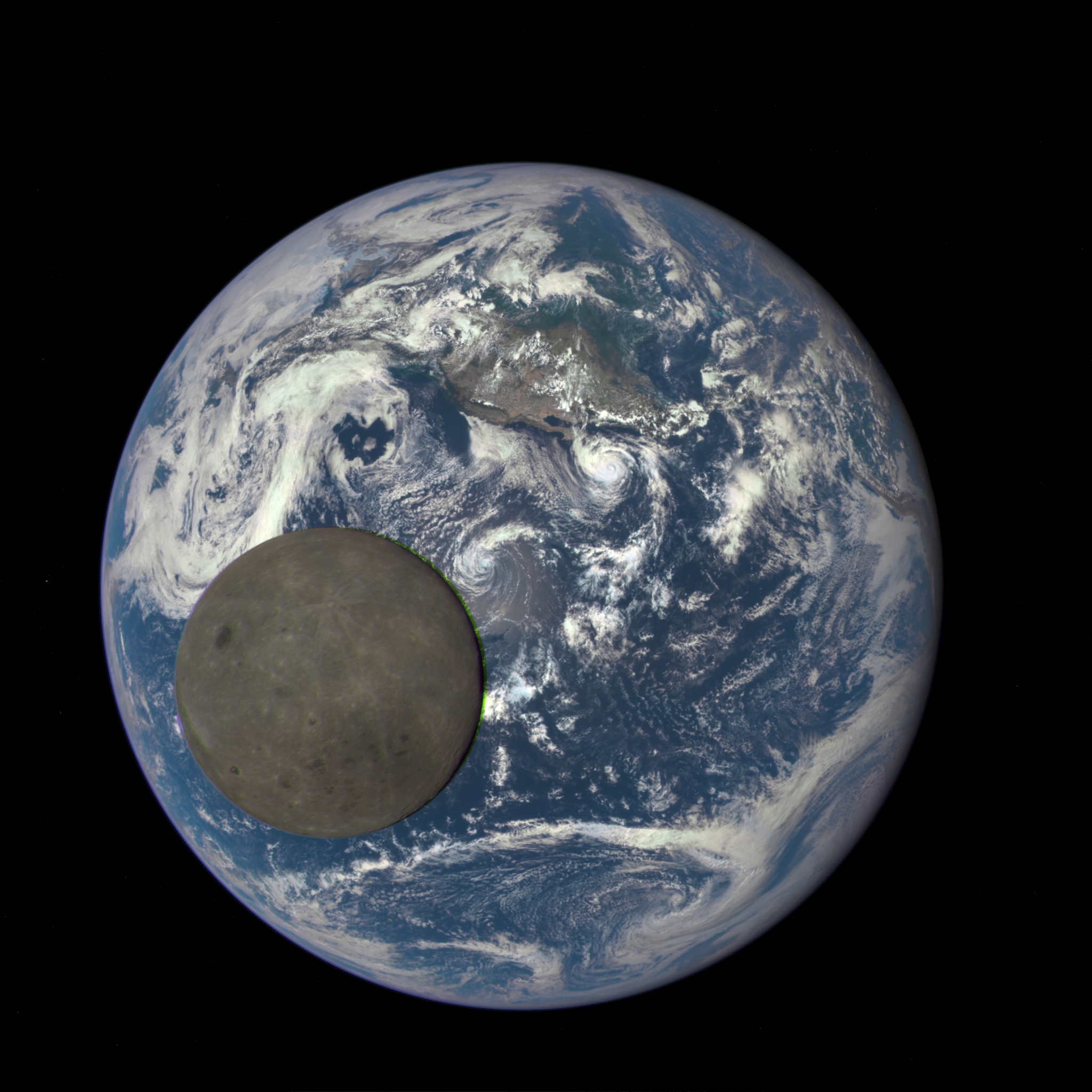
Full Earth, Full Moon

Full Earth, Full Moon: APOD: 2015 August 7 - Full Earth, Full Moon


Discover the cosmos! Each day a different image or photograph of our fascinating universe is featured, along with a brief explanation written by a professional astronomer.


2015 August 7

See Explanation. Clicking on the picture will download the highest resolution version available.


Full Moon, Full Earth
Image Credit: NASA, NOAA/DSCOVR
Explanation: The Moon was new on July 16. Its familiar nearside facing the surface of planet Earth was in shadow. But on that date a million miles away, the Deep Space Climate Observatory (DSCOVR) spacecraft's Earth Polychromatic Imaging Camera (EPIC) captured this view of an apparently Full Moon crossing in front of a Full Earth. In fact, seen from the spacecraft's position beyond the Moon's orbit and between Earth and Sun, the fully illuminated lunar hemisphere is the less familiar farside. Only known since the dawn of the space age, the farside is mostly devoid of dark lunar maria that sprawl across the Moon's perpetual Earth-facing hemisphere. Only the small dark spot of the farside's Mare Moscoviense (Sea of Moscow) is clear, at the upper left. Planet Earth's north pole is near 11 o'clock, with the North America visited by Hurricane Dolores near center. Slight color shifts are visible around the lunar edge, an artifact of the Moon's motion through the field caused by combining the camera's separate exposures taken in quick succession through different color filters. While monitoring the Earth and solar wind for space weather forcasts, about twice a year DSCOVR can capture similar images of Moon and Earth together as it crosses the orbital plane of the Moon.

Tomorrow's picture: light-weekend

< | Archive | Submissions | Search | Calendar | RSS | Education | About APOD | Discuss | >

Authors & editors: Robert Nemiroff (MTU) & Jerry Bonnell (UMCP)
NASA Official: Phillip Newman Specific rights apply.
NASA Web Privacy Policy and Important Notices
A service of: ASD at NASA / GSFC
& Michigan Tech. U.


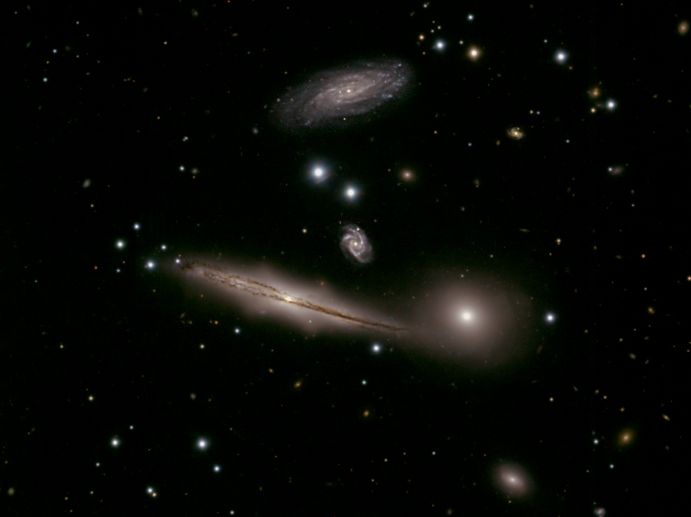
HCG 87: A Small Group of Galaxies

HCG 87: A Small Group of Galaxies: APOD: 2015 August 9 - HCG 87: A Small Group of Galaxies


Discover the cosmos! Each day a different image or photograph of our fascinating universe is featured, along with a brief explanation written by a professional astronomer.


2015 August 9


See Explanation. Clicking on the picture will download the highest resolution version available.


HCG 87: A Small Group of Galaxies
Image Credit: GMOS-S Commissioning Team, Gemini Observatory
Explanation: Sometimes galaxies form groups. For example, our own Milky Way Galaxy is part of the Local Group of Galaxies. Small, compact groups, like Hickson Compact Group 87 (HCG 87) shown above, are interesting partly because they slowly self-destruct. Indeed, the galaxies of HCG 87 are gravitationally stretching each other during their 100-million year orbits around a common center. The pulling creates colliding gas that causes bright bursts of star formation and feeds matter into their active galaxy centers. HCG 87 is composed of a large edge-on spiral galaxy visible near the image center, an elliptical galaxy visible to its right, and a spiral galaxy visible near the top. The small spiral near the center might be far in the distance. Several stars from our Galaxy are also visible in the foreground. Studying groups like HCG 87 allows insight into how all galaxies form and evolve.

Follow APOD on: Facebook, Google Plus, or Twitter
Tomorrow's picture: arching through space

< | Archive | Submissions | Index | Search | Calendar | RSS | Education | About APOD | Discuss | >

Authors & editors: Robert Nemiroff (MTU) & Jerry Bonnell (UMCP)
NASA Official: Phillip Newman Specific rights apply.
NASA Web Privacy Policy and Important Notices
A service of: ASD at NASA / GSFC
& Michigan Tech. U.


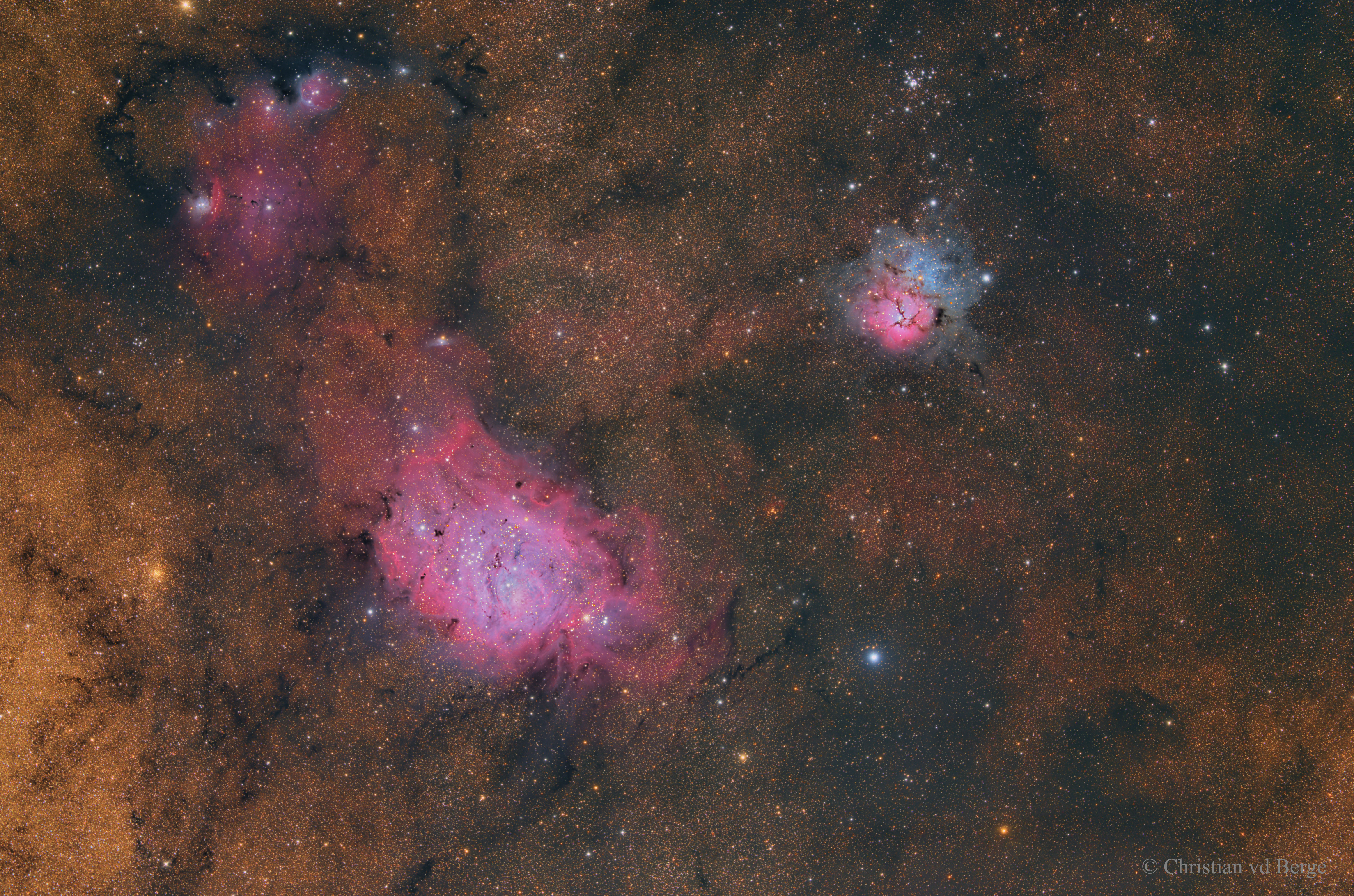
A Sagittarius Triplet

A Sagittarius Triplet: APOD: 2015 August 10 - A Sagittarius Triplet


Discover the cosmos! Each day a different image or photograph of our fascinating universe is featured, along with a brief explanation written by a professional astronomer.


2015 August 10


See Explanation. Clicking on the picture will download the highest resolution version available.


A Sagittarius Triplet
Image Credit & Copyright: Christian vd Berge (DSLR Astrophotograhy)
Explanation: These three bright nebulae are often featured in telescopic tours of the constellation Sagittarius and the crowded starfields of the central Milky Way. In fact, 18th century cosmic tourist Charles Messier cataloged two of them; M8, the large nebula left of center, and colorful M20 on the right. The third, NGC 6559, is above M8, separated from the larger nebula by a dark dust lane. All three are stellar nurseries about five thousand light-years or so distant. The expansive M8, over a hundred light-years across, is also known as the Lagoon Nebula. M20's popular moniker is the Trifid. Glowing hydrogen gas creates the dominant red color of the emission nebulae, with contrasting blue hues, most striking in the Trifid, due to dust reflected starlight. The colorful skyscape recorded with telescope and digital camera also includes one of Messier's open star clusters, M21, just above the Trifid.

Astrophysicists: Browse 1,000+ codes in the Astrophysics Source Code Library
Tomorrow's picture: doubly rare

< | Archive | Submissions | Index | Search | Calendar | RSS | Education | About APOD | Discuss | >

Authors & editors: Robert Nemiroff (MTU) & Jerry Bonnell (UMCP)
NASA Official: Phillip Newman Specific rights apply.
NASA Web Privacy Policy and Important Notices
A service of: ASD at NASA / GSFC
& Michigan Tech. U.


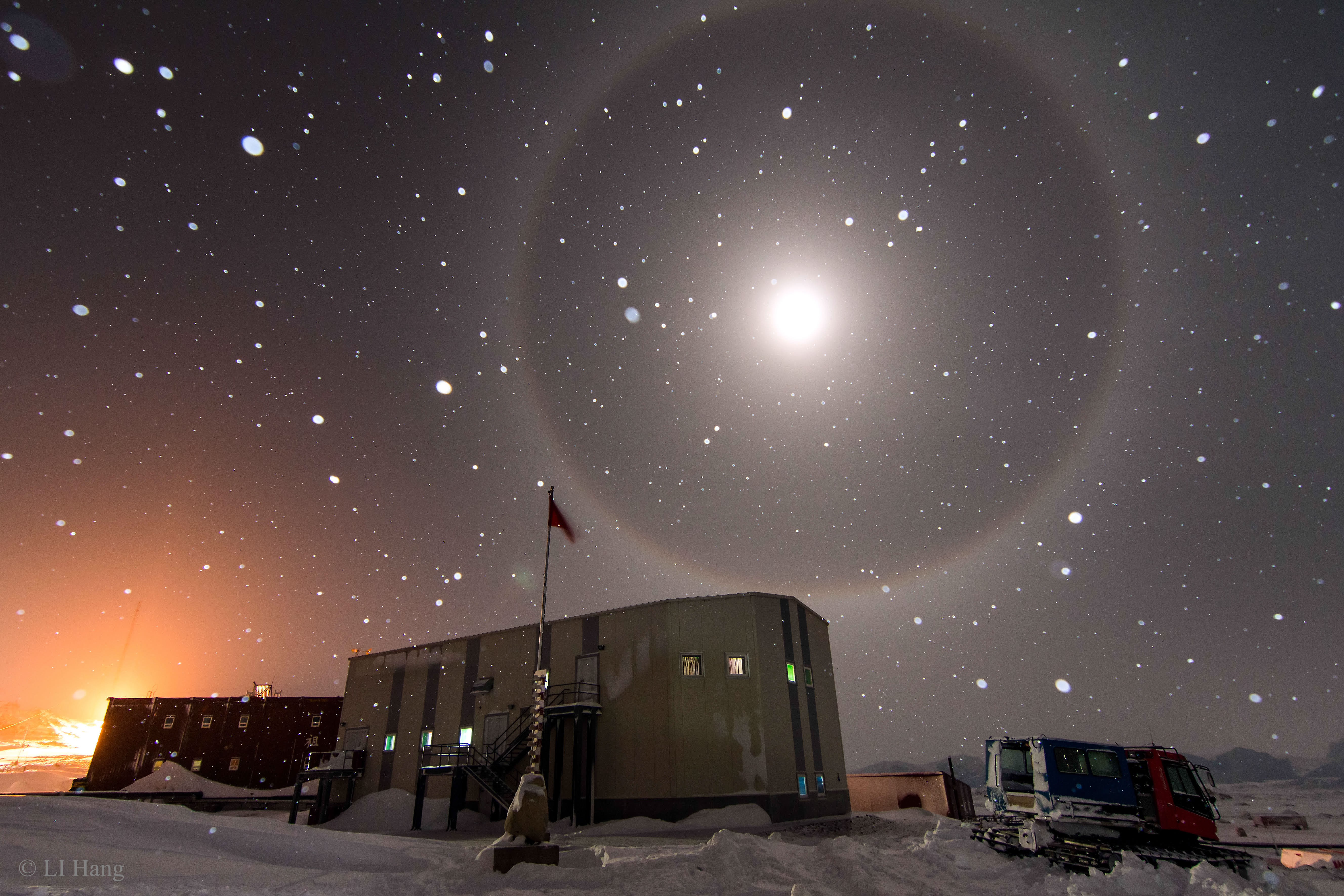
A Blue Moon Halo over Antarctica

A Blue Moon Halo over Antarctica:

Discover the cosmos! Each day a different image or photograph of our fascinating universe is featured, along with a brief explanation written by a professional astronomer.

2015 August 11


See Explanation. Clicking on the picture will download the highest resolution version available.
Explanation: Have you ever seen a halo around the Moon? Such 22 degree rings around the Moon -- caused by ice crystals falling in the Earth's atmosphere -- are somewhat rare. OK, but have you ever seen a blue moon? Given the modern definition of blue moon -- the second full moon occurring in a calendar month -- these are also rare. What is featured above might therefore be considered doubly rare -- a halo surrounding a blue moon. The featured image was taken late last month near Zhongshan Station in Antarctica. Visible in the foreground are a power generating house and a snowmobile. What might seem to be stars in the background are actually illuminated snowflakes near the camera.

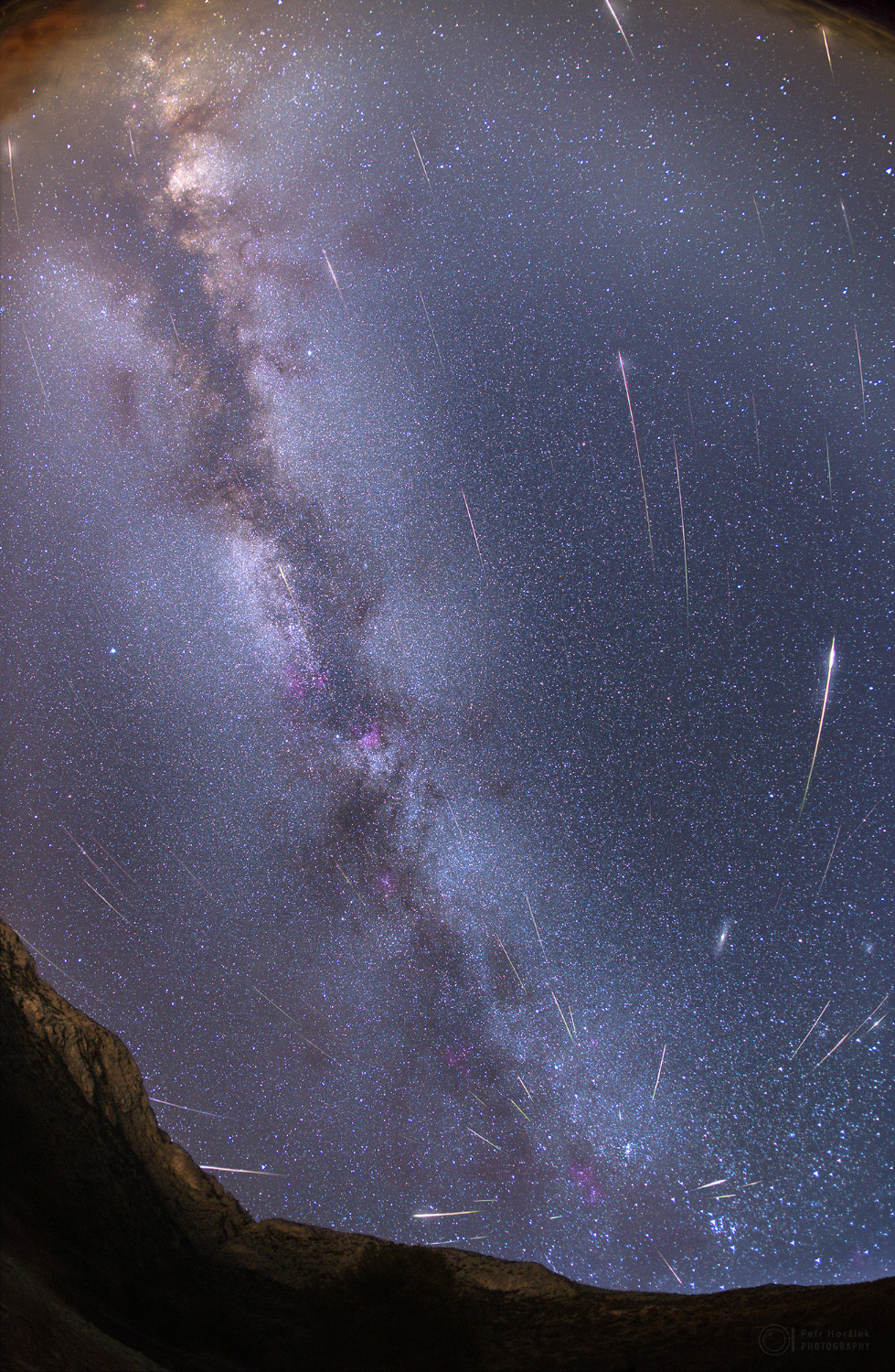
Moonless Meteors and the Milky Way

Moonless Meteors and the Milky Way: APOD: 2015 August 13 - Moonless Meteors and the Milky Way


Discover the cosmos! Each day a different image or photograph of our fascinating universe is featured, along with a brief explanation written by a professional astronomer.


2015 August 13


See Explanation. Clicking on the picture will download the highest resolution version available.


Moonless Meteors and the Milky Way
Image Credit & Copyright: Petr Horálek
Explanation: Have you watched the Perseid meteor shower? Though the annual shower's predicted peak was last night, meteor activity should continue tonight (August 13/14), best enjoyed by just looking up in clear, dark skies after midnight. Of course, this year's Perseid shower has the advantage of being active near the August 14 New Moon. Since the nearly New Moon doesn't rise before the morning twilight many fainter meteors are easier to spot until then, with no interference from bright moonlight. The Perseid meteor shower last occurred near a New Moon in 2013. That's when the exposures used to construct this image were made, under dark, moonless skies from Hvar Island off the coast of Croatia. The widefield composite includes 67 meteors streaming from the heroic constellation Perseus, the shower's radiant, captured during 2013 August 8-14 against a background of faint zodiacal light and the Milky Way. The next moonless Perseid meteor shower will be in August 2018.

Tomorrow's picture: pixels in space

< | Archive | Submissions | Search | Calendar | RSS | Education | About APOD | Discuss | >

Authors & editors: Robert Nemiroff (MTU) & Jerry Bonnell (UMCP)
NASA Official: Phillip Newman Specific rights apply.
NASA Web Privacy Policy and Important Notices
A service of: ASD at NASA / GSFC
& Michigan Tech. U.


Comet Dust over Enchanted Rock

Comet Dust over Enchanted Rock:

Discover the cosmos! Each day a different image or photograph of our fascinating universe is featured, along with a brief explanation written by a professional astronomer.

2015 August 14
See Explanation. Clicking on the picture will download the highest resolution version available.
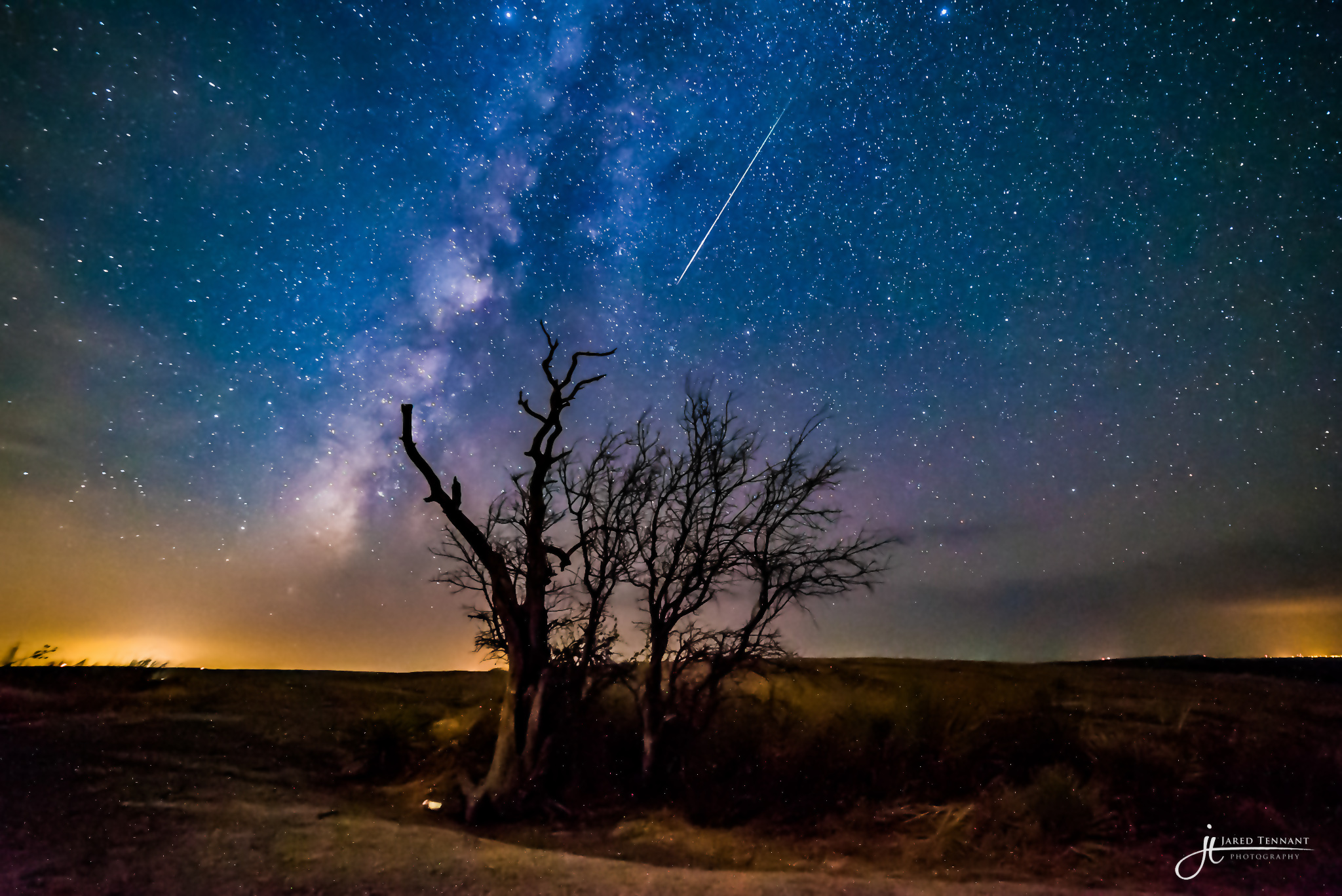
Explanation: Dusty debris from periodic Comet Swift-Tuttle was swept up by planet Earth this week. Vaporized by their passage through the dense atmosphere at 59 kilometers per second, the tiny grains produced a stream of Perseid meteors. A bright, colorful Perseid meteor flash was captured during this 20 second exposure. It made its ephemeral appearance after midnight on August 12, in the moonless skies over the broad granite dome of Enchanted Rock State Natural Area, central Texas, USA. Below the Perseid meteor, trees stand in silhouette against scattered lights along the horizon and the faint Milky Way, itself cut by dark clouds of interstellar dust.

Andromeda Rising over the Alps

Andromeda Rising over the Alps:

Discover the cosmos! Each day a different image or photograph of our fascinating universe is featured, along with a brief explanation written by a professional astronomer.

2015 August 17


See Explanation. Clicking on the picture will download the highest resolution version available.
Explanation: Have you ever seen the Andromeda galaxy? Although M31 appears as a faint and fuzzy blob to the unaided eye, the light you see will be over two million years old, making it likely the oldest light you ever will see directly. Now rising near a few hours after sunset from mid-latitude northern locations, Andromeda is rising earlier each night and will be visible to northerners all night long starting in September. The featured image captured Andromeda rising above the Italian Alps last month. As cool as it may be to see this neighboring galaxy to our Milky Way with your own eyes, long duration camera exposures can pick up many faint and breathtaking details. Recent data indicates that our Milky Way Galaxy will collide and coalesce with the slightly larger Andromeda galaxy in a few billion years.

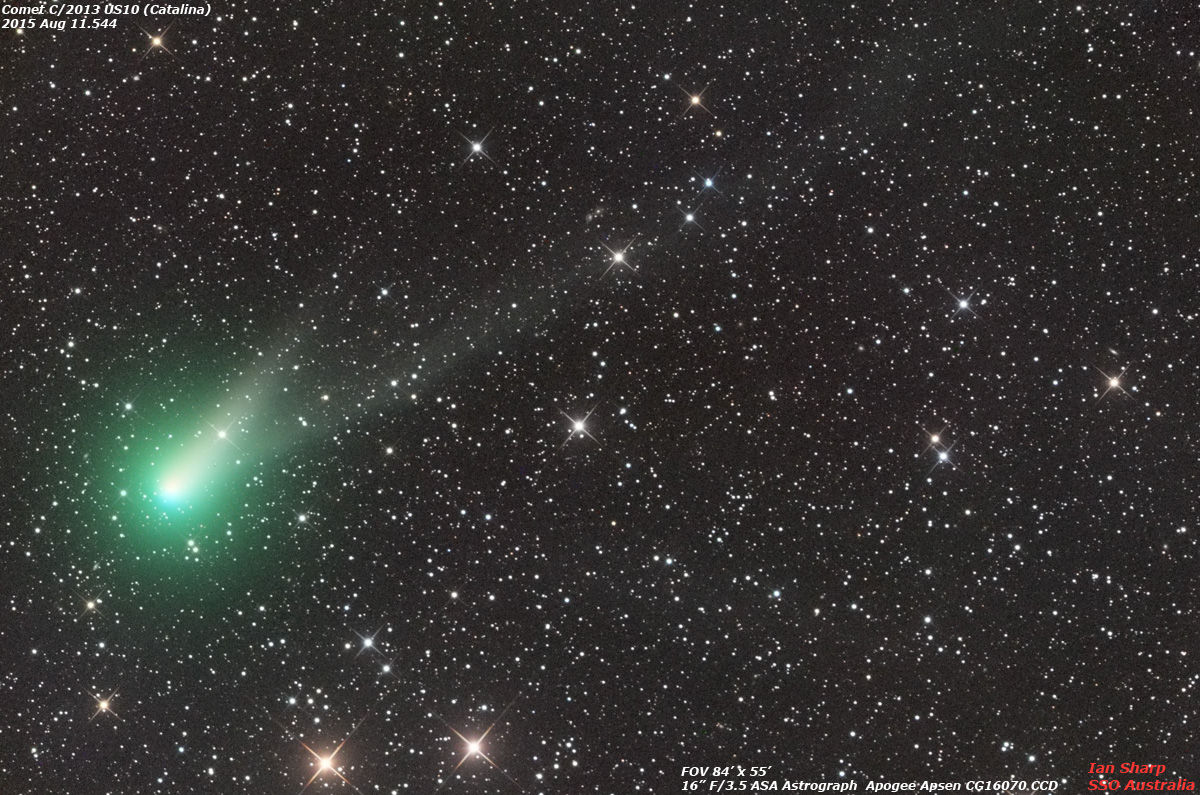
Announcing Comet Catalina

Announcing Comet Catalina:

Discover the cosmos! Each day a different image or photograph of our fascinating universe is featured, along with a brief explanation written by a professional astronomer.

2015 August 18


See Explanation. Clicking on the picture will download the highest resolution version available.
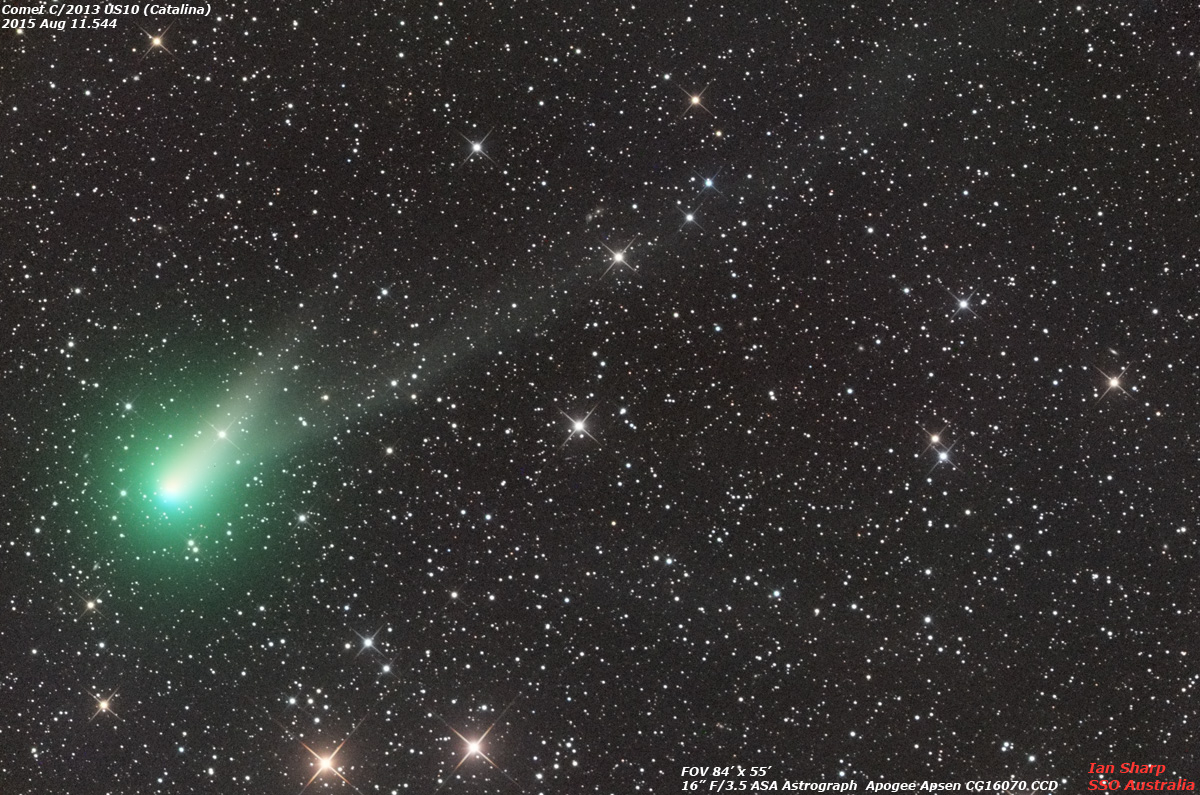
Explanation: Will Comet Catalina become visible to the unaided eye? Given the unpredictability of comets, no one can say for sure, but it seems like a good bet. The comet was discovered in 2013 by observations of the Catalina Sky Survey. Since then, Comet C/2013 US10 (Catalina) has steadily brightened and is currently brighter than 8th magnitude, making it visible with binoculars and long-duration camera images. As the comet further approaches the inner Solar System it will surely continue to intensify, possibly becoming a naked eye object sometime in October and peaking sometime in late November. The comet will reside primarily in the skies of the southern hemisphere until mid-December, at which time its highly inclined orbit will bring it quickly into northern skies. Featured above, Comet Catalina was imaged last week sporting a green coma and two growing tails.

Central Cygnus Skyscape

Central Cygnus Skyscape:

Discover the cosmos! Each day a different image or photograph of our fascinating universe is featured, along with a brief explanation written by a professional astronomer.

2015 August 19
See Explanation. Clicking on the picture will download the highest resolution version available.
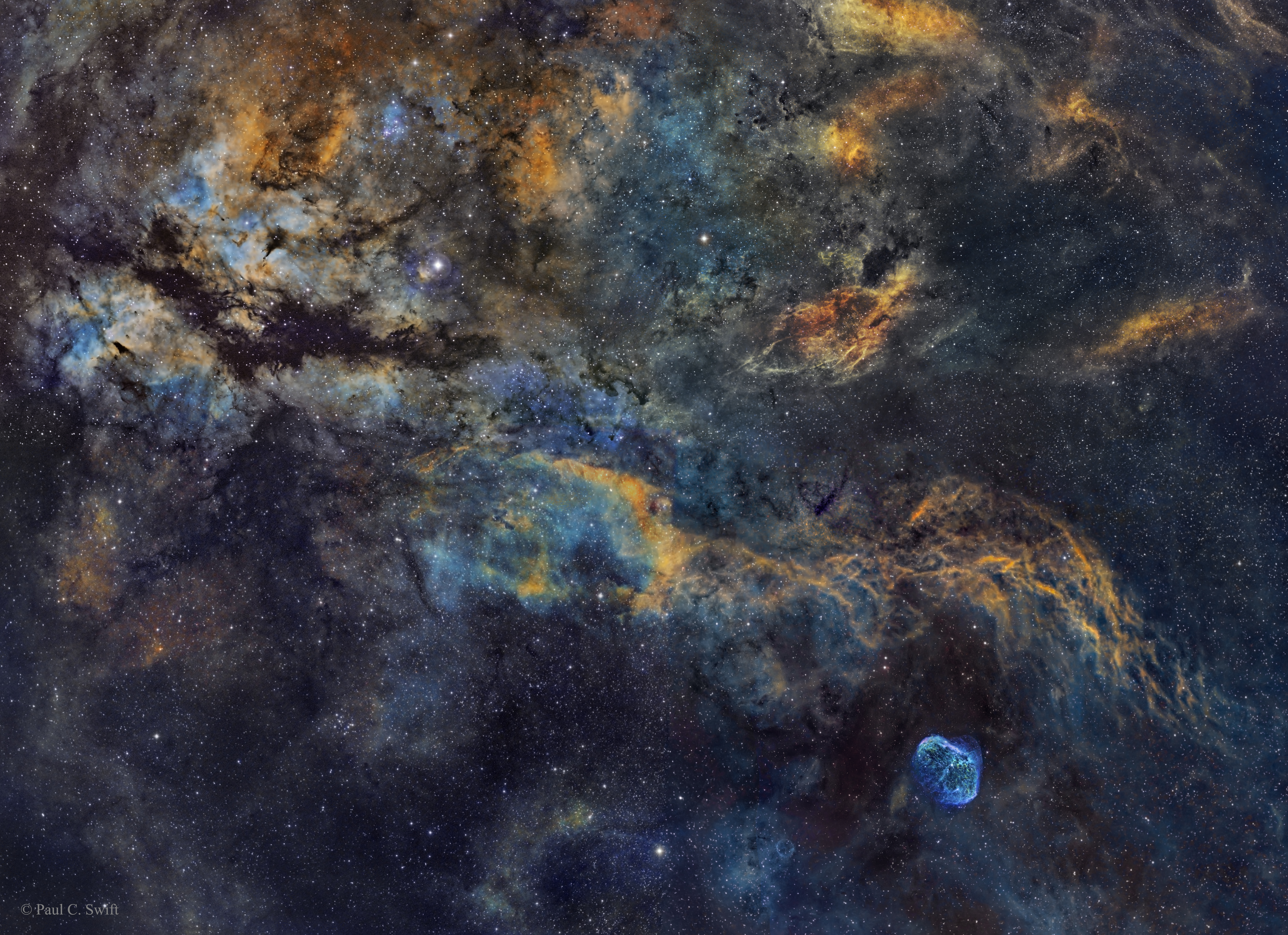
Explanation: In cosmic brush strokes of glowing hydrogen gas, this beautiful skyscape unfolds across the plane of our Milky Way Galaxy and the center of the northern constellation Cygnus the Swan. The featured image spans about six degrees. Bright supergiant star Gamma Cygni (Sadr) to the upper left of the image center lies in the foreground of the complex gas and dust clouds and crowded star fields. Left of Gamma Cygni, shaped like two luminous wings divided by a long dark dust lane is IC 1318, whose popular name is understandably the Butterfly Nebula. The more compact, bright nebula at the lower right is NGC 6888, the Crescent Nebula. Some distance estimates for Gamma Cygni place it at around 1,800 light-years while estimates for IC 1318 and NGC 6888 range from 2,000 to 5,000 light-years.

M27: Not a Comet

M27: Not a Comet: APOD: 2015 August 20 - M27: Not a Comet


Discover the cosmos! Each day a different image or photograph of our fascinating universe is featured, along with a brief explanation written by a professional astronomer.


2015 August 20
See Explanation. Clicking on the picture will download the highest resolution version available.


M27: Not a Comet
Image Credit & Copyright: Francesco di Biase
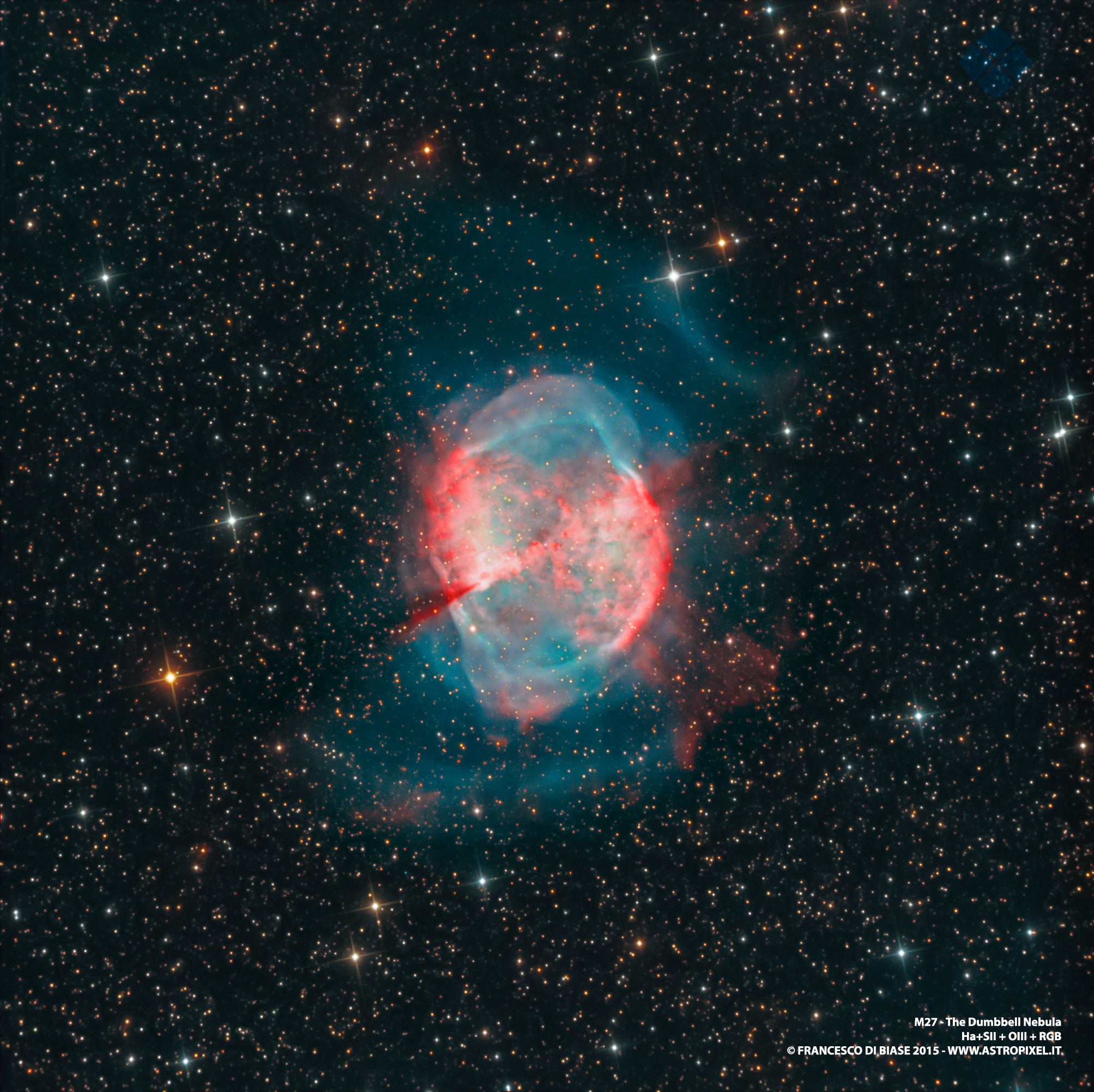
Explanation: While hunting for comets in the skies above 18th century France, astronomer Charles Messier diligently kept a list of the things he encountered that were definitely not comets. This is number 27 on his now famous not-a-comet list. In fact, 21st century astronomers would identify it as a planetary nebula, but it's not a planet either, even though it may appear round and planet-like in a small telescope. Messier 27 (M27) is an excellent example of a gaseous emission nebula created as a sun-like star runs out of nuclear fuel in its core. The nebula forms as the star's outer layers are expelled into space, with a visible glow generated by atoms excited by the dying star's intense but invisible ultraviolet light. Known by the popular name of the Dumbbell Nebula, the beautifully symmetric interstellar gas cloud is over 2.5 light-years across and about 1,200 light-years away in the constellation Vulpecula. This impressive color composite highlights details within the well-studied central region and fainter, seldom imaged features in the nebula's outer halo. It incorporates broad and narrowband images recorded using filters sensitive to emission from sulfur, hydrogen and oxygen atoms.

Tomorrow's picture: pixels in space

< | Archive | Submissions | Search | Calendar | RSS | Education | About APOD | Discuss | >

Authors & editors: Robert Nemiroff (MTU) & Jerry Bonnell (UMCP)
NASA Official: Phillip Newman Specific rights apply.
NASA Web Privacy Policy and Important Notices
A service of: ASD at NASA / GSFC
& Michigan Tech. U.


Sprites from Space

Sprites from Space:

Discover the cosmos! Each day a different image or photograph of our fascinating universe is featured, along with a brief explanation written by a professional astronomer.

2015 August 21


See Explanation. Clicking on the picture will download the highest resolution version available.
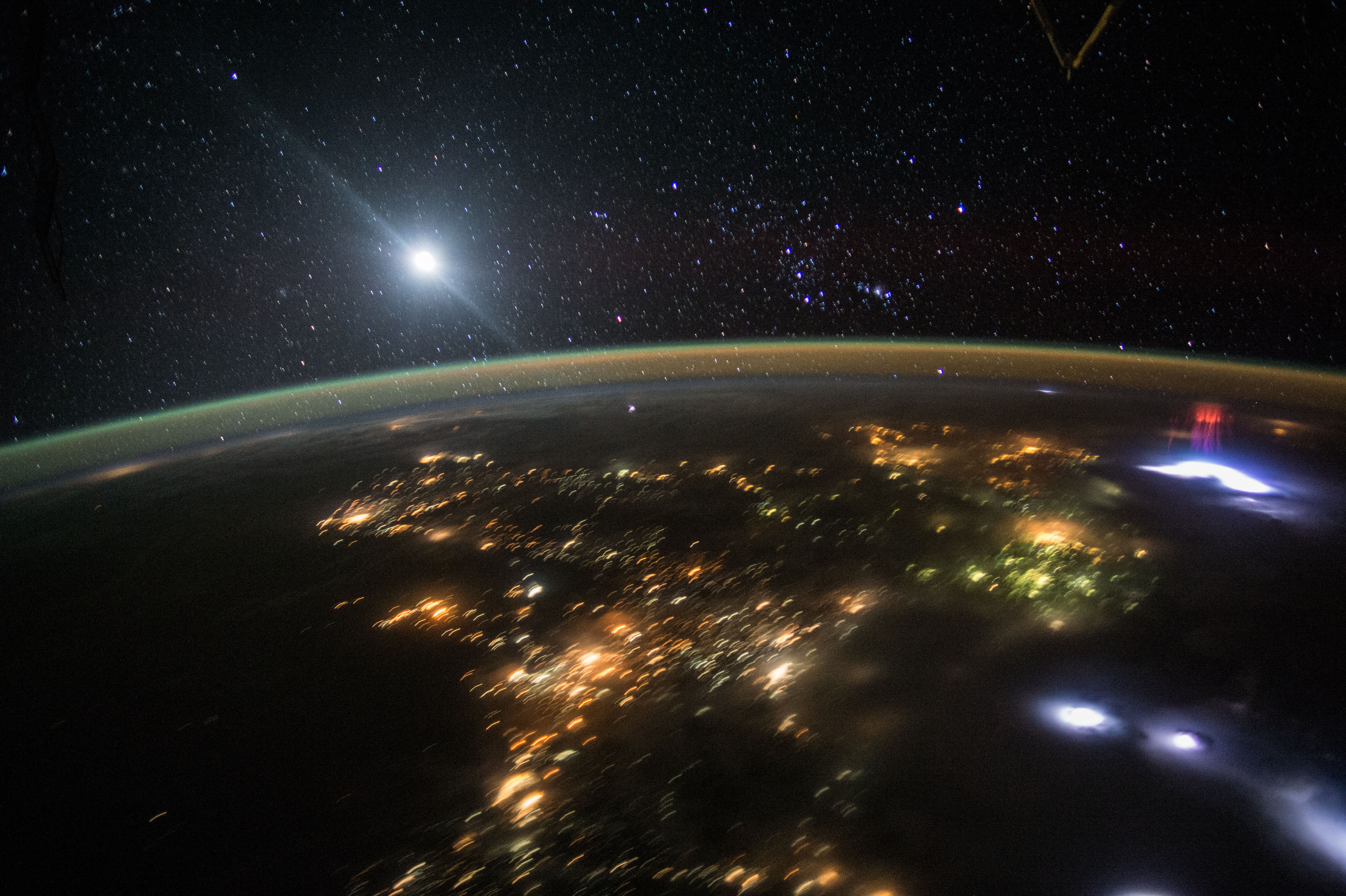
Explanation: An old Moon and the stars of Orion rose above the eastern horizon on August 10. The Moon's waning crescent was still bright enough to be overexposed in this snapshot taken from another large satellite of planet Earth, the International Space Station. A greenish airglow traces the atmosphere above the limb of the planet's night. Below, city lights and lightning flashes from thunderstorms appear over southern Mexico. The snapshot also captures the startling apparition of a rare form of upper atmospheric lightning, a large red sprite caught above a lightning flash at the far right. While the space station's orbital motion causes the city lights to blur and trail during the exposure, the extremely brief flash of the red sprite is sharp. Now known to be associated with thunderstorms, much remains a mystery about sprites including how they occur, their effect on the atmospheric global electric circuit, and if they are somehow related to other upper atmospheric lightning phenomena such as blue jets or terrestrial gamma flashes.

Giant Cluster Bends Breaks Images

Giant Cluster Bends Breaks Images: APOD: 2015 August 23 - Giant Cluster Bends Breaks Images


Discover the cosmos! Each day a different image or photograph of our fascinating universe is featured, along with a brief explanation written by a professional astronomer.


2015 August 23


See Explanation. Clicking on the picture will download the highest resolution version available.


Giant Cluster Bends, Breaks Images
Image Credit: NASA, ESA, H. Lee & H. Ford (Johns Hopkins U.)
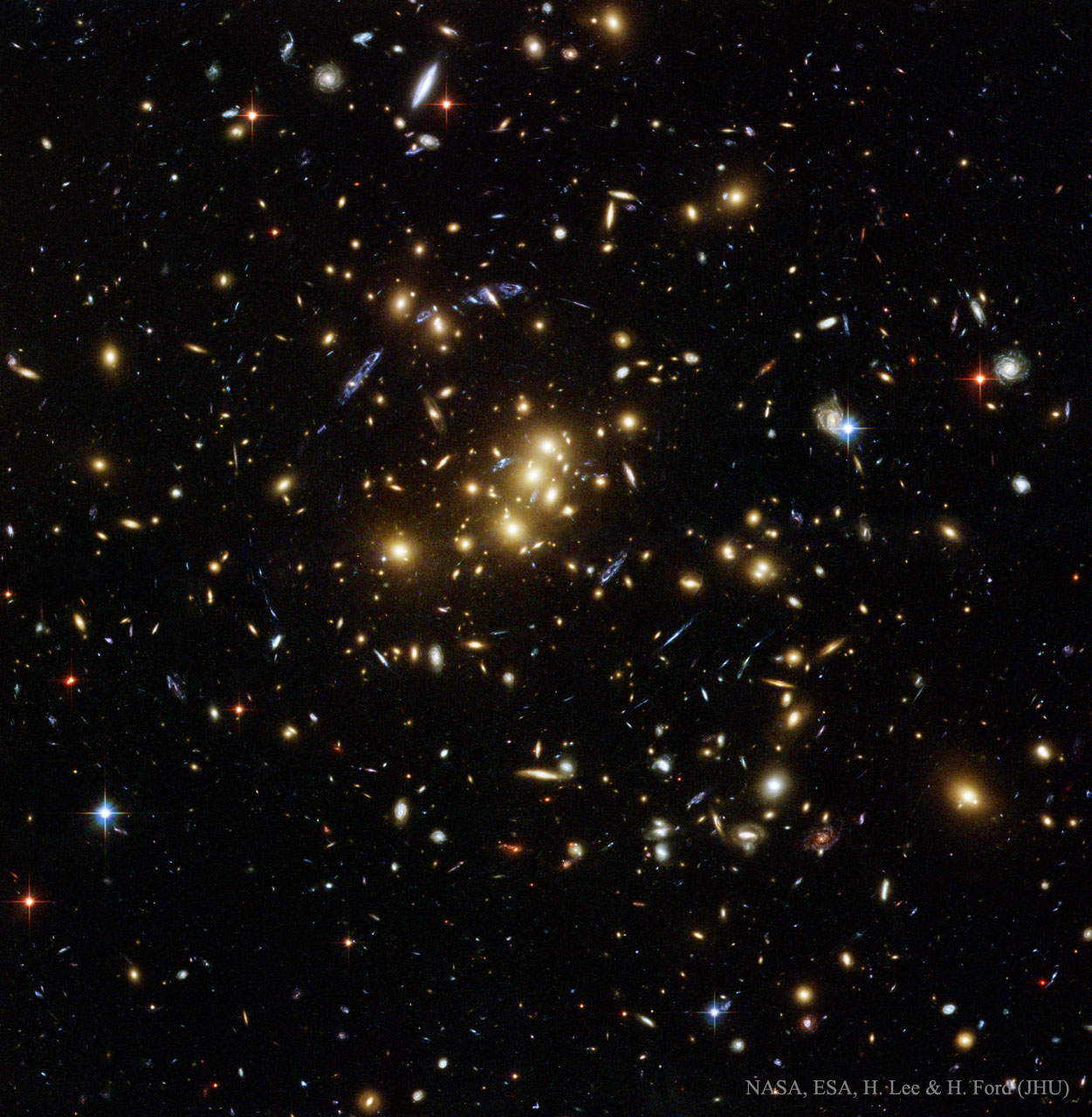
Explanation: What are those strange blue objects? Many of the brightest blue images are of a single, unusual, beaded, blue, ring-like galaxy which just happens to line-up behind a giant cluster of galaxies. Cluster galaxies here typically appear yellow and -- together with the cluster's dark matter -- act as a gravitational lens. A gravitational lens can create several images of background galaxies, analogous to the many points of light one would see while looking through a wine glass at a distant street light. The distinctive shape of this background galaxy -- which is probably just forming -- has allowed astronomers to deduce that it has separate images at 4, 10, 11, and 12 o'clock, from the center of the cluster. A blue smudge near the cluster center is likely another image of the same background galaxy. In all, a recent analysis postulated that at least 33 images of 11 separate background galaxies are discernable. This spectacular photo of galaxy cluster CL0024+1654 from the Hubble Space Telescope was taken in November 2004.

Tomorrow's picture: triple gray

< | Archive | Submissions | Index | Search | Calendar | RSS | Education | About APOD | Discuss | >

Authors & editors: Robert Nemiroff (MTU) & Jerry Bonnell (UMCP)
NASA Official: Phillip Newman Specific rights apply.
NASA Web Privacy Policy and Important Notices
A service of: ASD at NASA / GSFC
& Michigan Tech. U.


Dione, Rings, Shadows, Saturn

Dione, Rings, Shadows, Saturn: APOD: 2015 August 24 - Dione, Rings, Shadows, Saturn


Discover the cosmos! Each day a different image or photograph of our fascinating universe is featured, along with a brief explanation written by a professional astronomer.


2015 August 24


See Explanation. Clicking on the picture will download the highest resolution version available.


Dione, Rings, Shadows, Saturn
Image Credit: Cassini Imaging Team, SSI, JPL, ESA, NASA
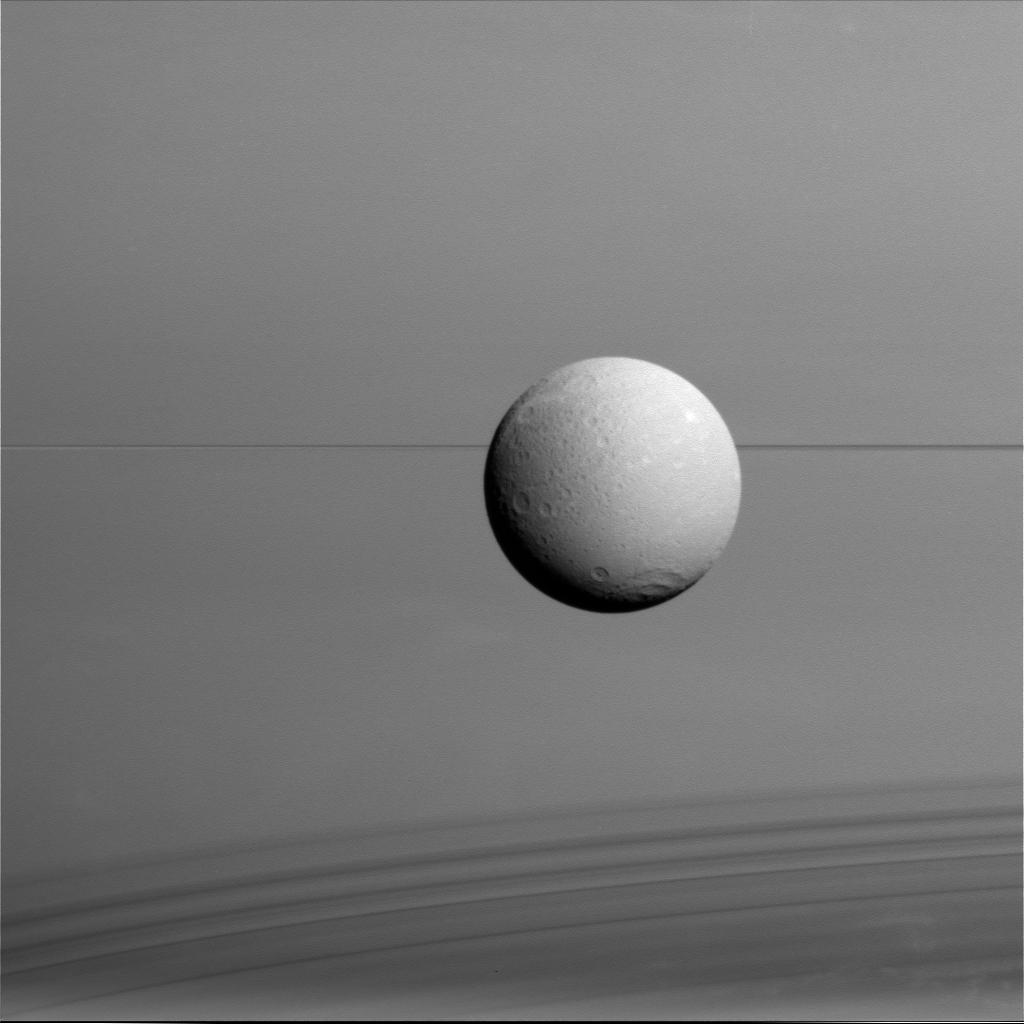
Explanation: What's happening in this strange juxtaposition of moon and planet? First and foremost, Saturn's moon Dione was captured here in a dramatic panorama by the robotic Cassini spacecraft currently orbiting the giant planet. The bright and cratered moon itself spans about 1100-km, with the large multi-ringed crater Evander visible on the lower right. Since the rings of Saturn are seen here nearly edge-on, they are directly visible only as a thin horizontal line that passes behind Dione. Arcing across the bottom of the image, however, are shadows of Saturn's rings, showing some of the rich texture that could not be seen directly. In the background, few cloud features are visible on Saturn. The featured image was taken during the last planned flyby of Dione by Cassini, as the spacecraft is scheduled to dive into Saturn's atmosphere during 2017.

Teachers: Find classroom astronomy images through APOD's Index or Search engine.
Tomorrow's picture: skyfall washington

< | Archive | Submissions | Index | Search | Calendar | RSS | Education | About APOD | Discuss | >

Authors & editors: Robert Nemiroff (MTU) & Jerry Bonnell (UMCP)
NASA Official: Phillip Newman Specific rights apply.
NASA Web Privacy Policy and Important Notices
A service of: ASD at NASA / GSFC
& Michigan Tech. U.


Meteors and Milky Way over Mount Ranier

Meteors and Milky Way over Mount Ranier: APOD: 2015 August 25 - Meteors and Milky Way over Mount Rainier


Discover the cosmos! Each day a different image or photograph of our fascinating universe is featured, along with a brief explanation written by a professional astronomer.


2015 August 25


See Explanation. Clicking on the picture will download the highest resolution version available.


Meteors and Milky Way over Mount Rainier
Image Credit & Copyright: Matthew Dieterich
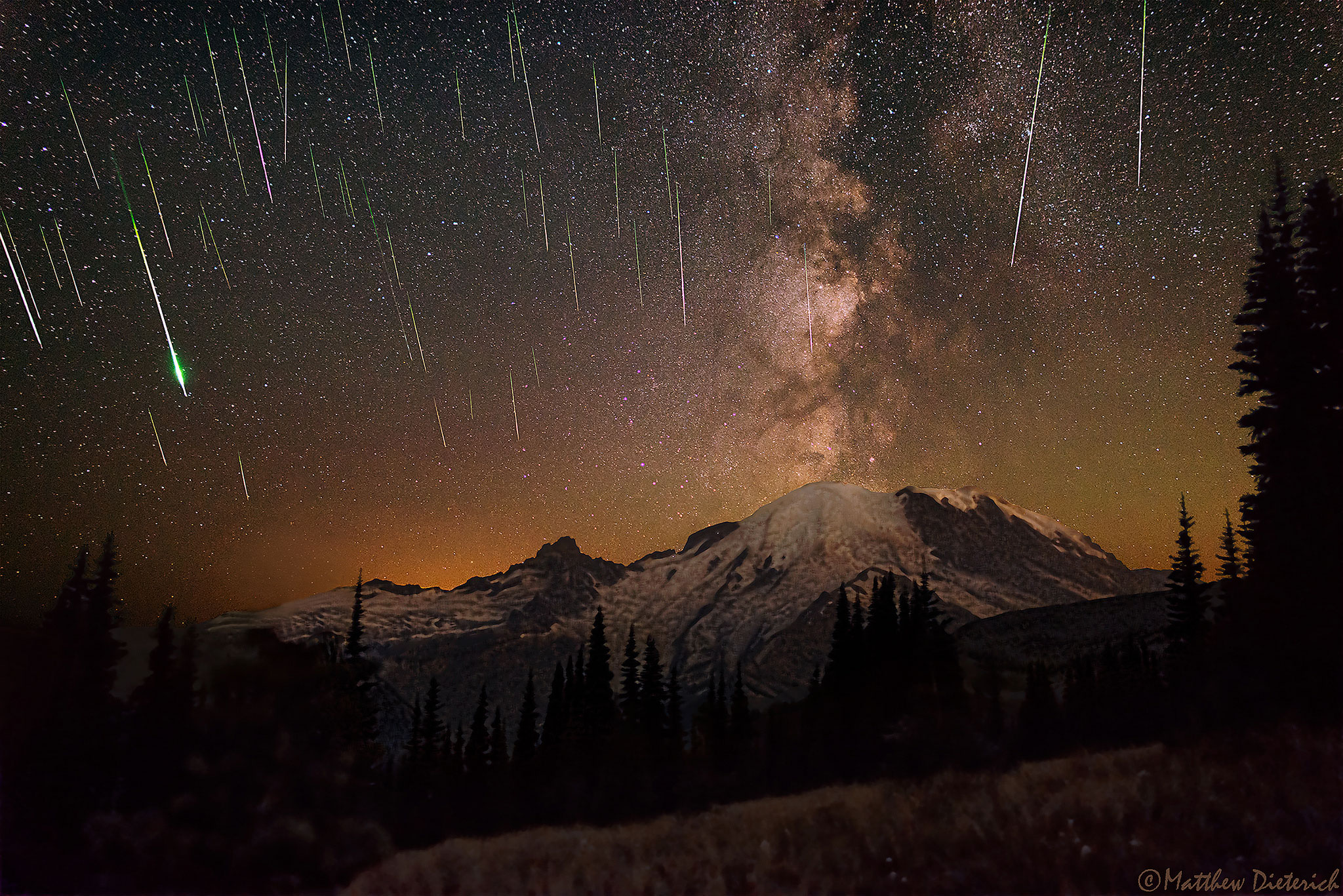
Explanation: Despite appearances, the sky is not falling. Two weeks ago, however, tiny bits of comet dust were. Featured here is the Perseids meteor shower as captured over Mt. Rainier, Washington, USA. The image was created from a two-hour time lapse video, snaring over 20 meteors, including one that brightened dramatically on the image left. Although each meteor train typically lasts less than a second, the camera was able to capture their color progressions as they disintegrated in the Earth's atmosphere. Here an initial green tint may be indicative of small amounts of glowing magnesium atoms that were knocked off the meteor by atoms in the Earth's atmosphere. To cap things off, the central band of our Milky Way Galaxy was simultaneously photographed rising straight up behind the snow-covered peak of Mt. Rainier. Another good meteor shower is expected in mid-November when debris from a different comet intersects Earth as the Leonids.

Follow APOD on Facebook: in English or Spanish
Tomorrow's picture: hanging out

< | Archive | Submissions | Index | Search | Calendar | RSS | Education | About APOD | Discuss | >

Authors & editors: Robert Nemiroff (MTU) & Jerry Bonnell (UMCP)
NASA Official: Phillip Newman Specific rights apply.
NASA Web Privacy Policy and Important Notices
A service of: ASD at NASA / GSFC
& Michigan Tech. U.


The Large Cloud of Magellan

The Large Cloud of Magellan: APOD: 2015 August 27 - The Large Cloud of Magellan


Discover the cosmos! Each day a different image or photograph of our fascinating universe is featured, along with a brief explanation written by a professional astronomer.


2015 August 27


See Explanation. Clicking on the picture will download the highest resolution version available.


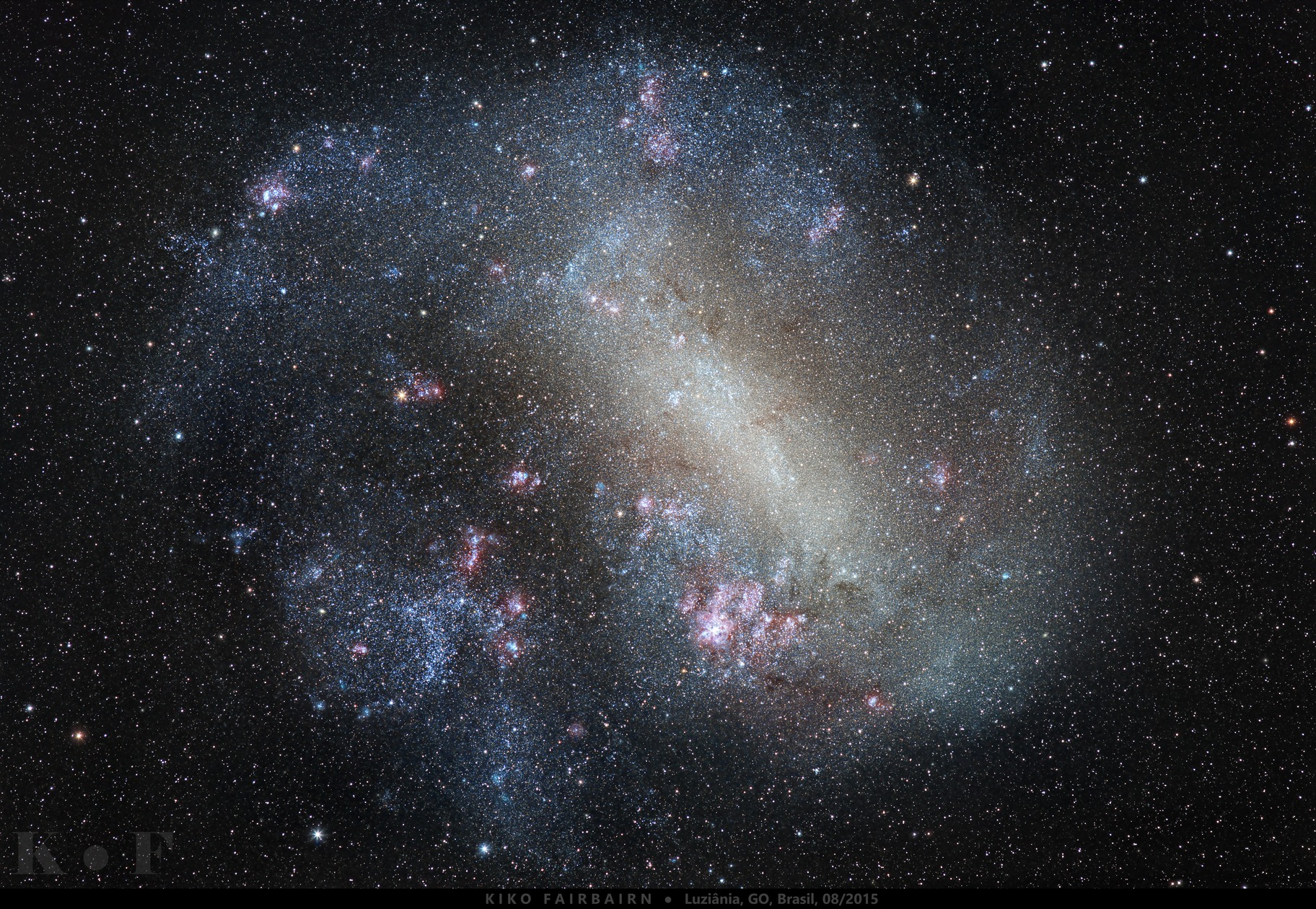
The Large Cloud of Magellan
Image Credit & Copyright: Carlos Fairbairn
Explanation: The 16th century Portuguese navigator Ferdinand Magellan and his crew had plenty of time to study the southern sky during the first circumnavigation of planet Earth. As a result, two fuzzy cloud-like objects easily visible to southern hemisphere skygazers are known as the Clouds of Magellan, now understood to be satellite galaxies of our much larger, spiral Milky Way galaxy. About 160,000 light-years distant in the constellation Dorado, the Large Magellanic Cloud (LMC) is seen here in a remarkably deep, colorful, image. Spanning about 15,000 light-years or so, it is the most massive of the Milky Way's satellite galaxies and is the home of the closest supernova in modern times, SN 1987A. The prominent patch below center is 30 Doradus, also known as the magnificent Tarantula Nebula, is a giant star-forming region about 1,000 light-years across.

Tomorrow's picture: Puppis A

< | Archive | Submissions | Search | Calendar | RSS | Education | About APOD | Discuss | >

Authors & editors: Robert Nemiroff (MTU) & Jerry Bonnell (UMCP)
NASA Official: Phillip Newman Specific rights apply.
NASA Web Privacy Policy and Important Notices
A service of: ASD at NASA / GSFC
& Michigan Tech. U.


Puppis A Supernova Remnant

Puppis A Supernova Remnant: APOD: 2015 August 28 - Puppis A Supernova Remnant


Discover the cosmos! Each day a different image or photograph of our fascinating universe is featured, along with a brief explanation written by a professional astronomer.


2015 August 28


See Explanation. Clicking on the picture will download the highest resolution version available.


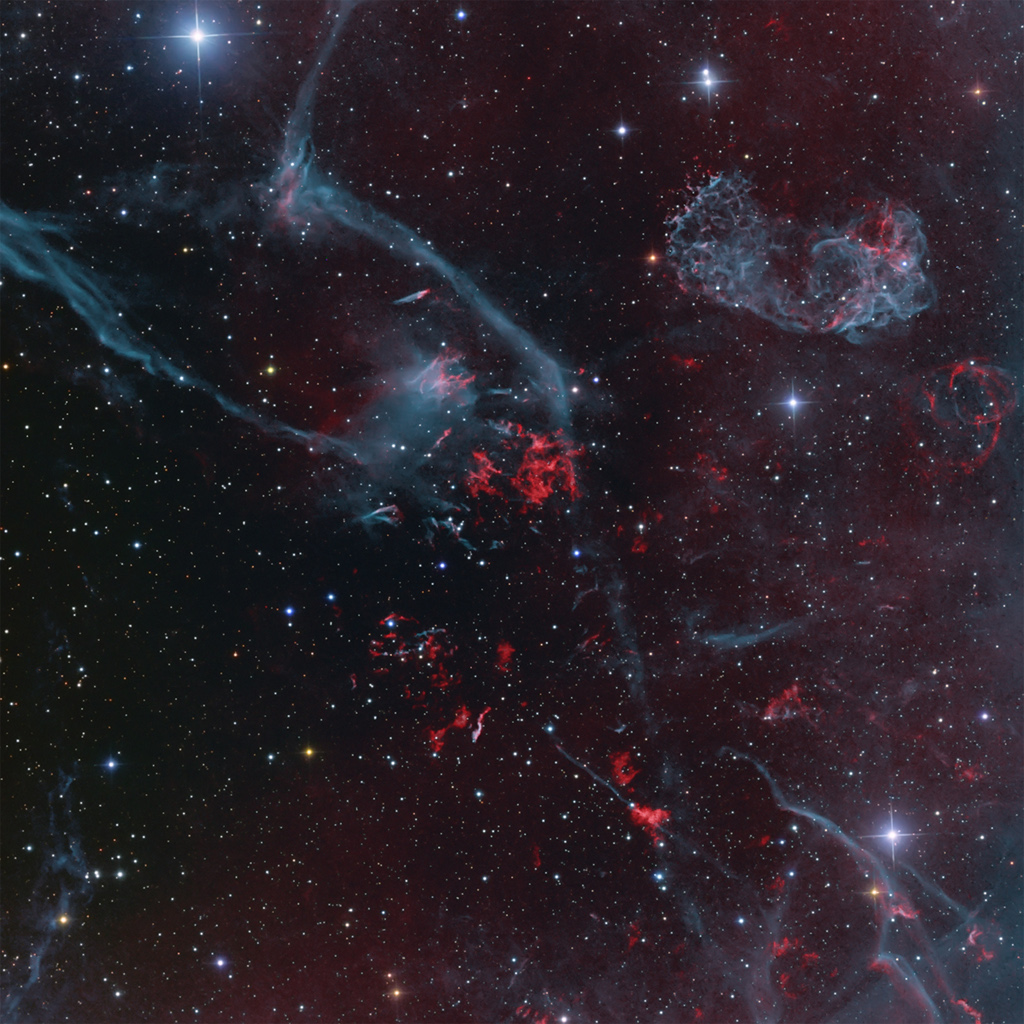
Puppis A Supernova Remnant
Image Credit & Copyright: Don Goldman
Explanation: Driven by the explosion of a massive star, supernova remnant Puppis A is blasting into the surrounding interstellar medium about 7,000 light-years away. At that distance, this colorful telescopic field based on broadband and narrowband optical image data is about 60 light-years across. As the supernova remnant expands into its clumpy, non-uniform surroundings, shocked filaments of oxygen atoms glow in green-blue hues. Hydrogen and nitrogen are in red. Light from the initial supernova itself, triggered by the collapse of the massive star's core, would have reached Earth about 3,700 years ago. The Puppis A remnant is actually seen through outlying emission from the closer but more ancient Vela supernova remnant, near the crowded plane of our Milky Way galaxy. Still glowing across the electromagnetic spectrum Puppis A remains one of the brightest sources in the X-ray sky.

Tomorrow's picture: seagull nebula

< | Archive | Submissions | Search | Calendar | RSS | Education | About APOD | Discuss | >

Authors & editors: Robert Nemiroff (MTU) & Jerry Bonnell (UMCP)
NASA Official: Phillip Newman Specific rights apply.
NASA Web Privacy Policy and Important Notices
A service of: ASD at NASA / GSFC
& Michigan Tech. U.


The Seagull Nebula

The Seagull Nebula: APOD: 2015 August 29 - The Seagull Nebula


Discover the cosmos! Each day a different image or photograph of our fascinating universe is featured, along with a brief explanation written by a professional astronomer.


2015 August 29


See Explanation. Clicking on the picture will download the highest resolution version available.


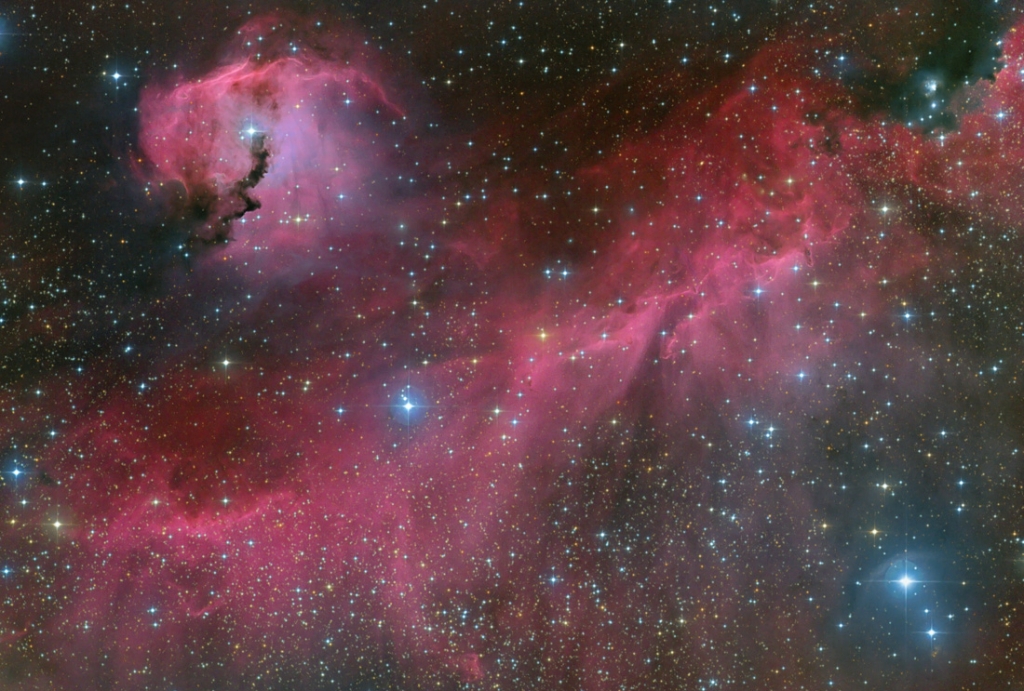
The Seagull Nebula
Image Credit & Copyright: Dieter Willasch (Astro-Cabinet)
Explanation: A broad expanse of glowing gas and dust presents a bird-like visage to astronomers from planet Earth, suggesting its popular moniker - The Seagull Nebula. This portrait of the cosmic bird covers a 1.6 degree wide swath across the plane of the Milky Way, near the direction of Sirius, alpha star of the constellation Canis Major. Of course, the region includes objects with other catalog designations: notably NGC 2327, a compact, dusty emission region with an embedded massive star that forms the bird's head (aka the Parrot Nebula, above center). Dominated by the reddish glow of atomic hydrogen, the complex of gas and dust clouds with bright young stars spans over 100 light-years at an estimated 3,800 light-year distance.

Tomorrow's picture: ancient stars

< | Archive | Submissions | Search | Calendar | RSS | Education | About APOD | Discuss | >

Authors & editors: Robert Nemiroff (MTU) & Jerry Bonnell (UMCP)
NASA Official: Phillip Newman Specific rights apply.
NASA Web Privacy Policy and Important Notices
A service of: ASD at NASA / GSFC
& Michigan Tech. U.


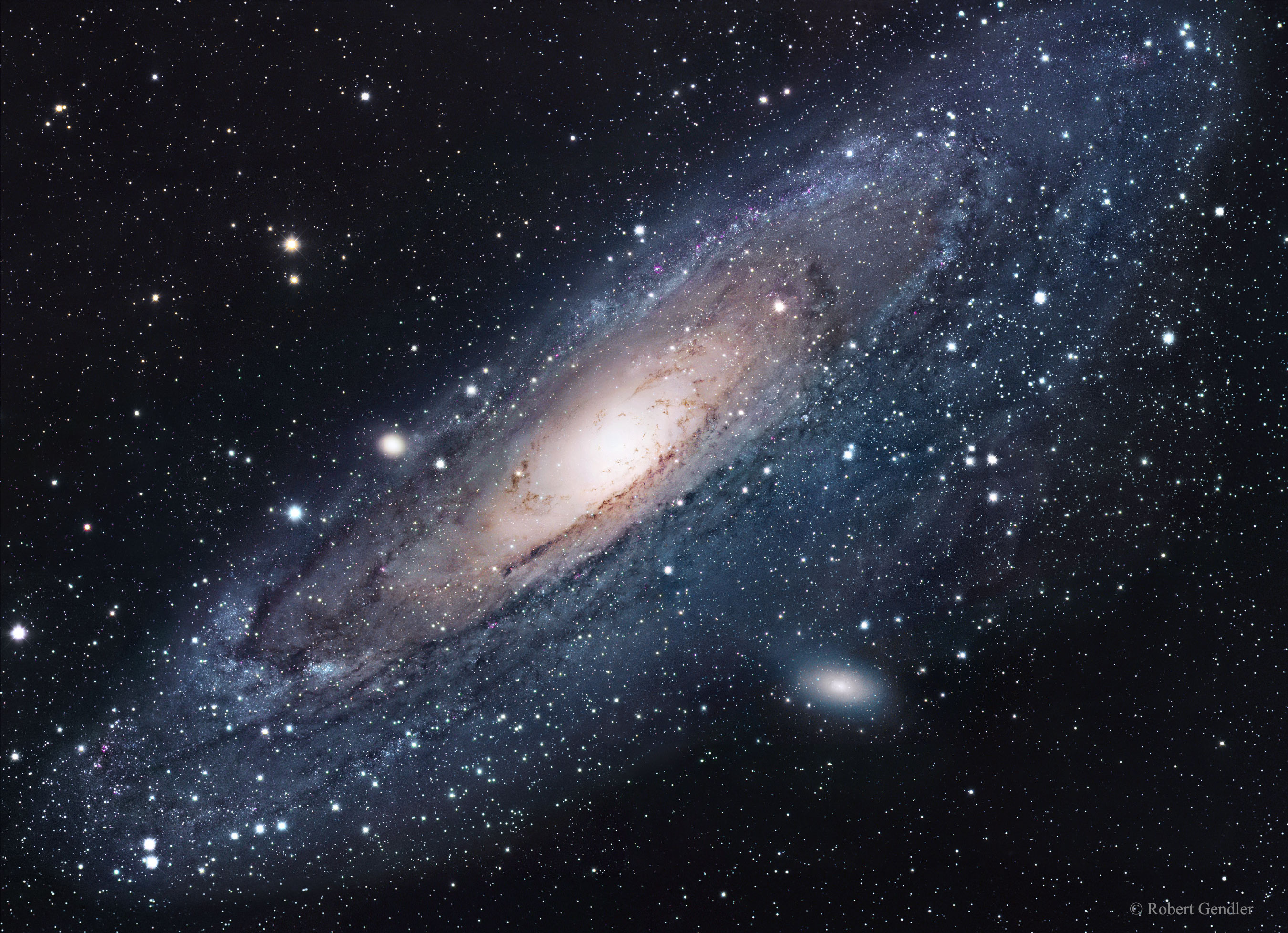
M31: The Andromeda Galaxy

M31: The Andromeda Galaxy:

Discover the cosmos! Each day a different image or photograph of our fascinating universe is featured, along with a brief explanation written by a professional astronomer.

2015 August 30


See Explanation. Clicking on the picture will download the highest resolution version available.
Explanation: What is the nearest major galaxy to our own Milky Way Galaxy? Andromeda. In fact, our Galaxy is thought to look much like Andromeda. Together these two galaxies dominate the Local Group of galaxies. The diffuse light from Andromeda is caused by the hundreds of billions of stars that compose it. The several distinct stars that surround Andromeda's image are actually stars in our Galaxy that are well in front of the background object. Andromeda is frequently referred to as M31 since it is the 31st object on Messier's list of diffuse sky objects. M31 is so distant it takes about two million years for light to reach us from there. Although visible without aid, the above image of M31 is a digital mosaic of 20 frames taken with a small telescope. Much about M31 remains unknown, including exactly how long it will before it collides with our home galaxy.

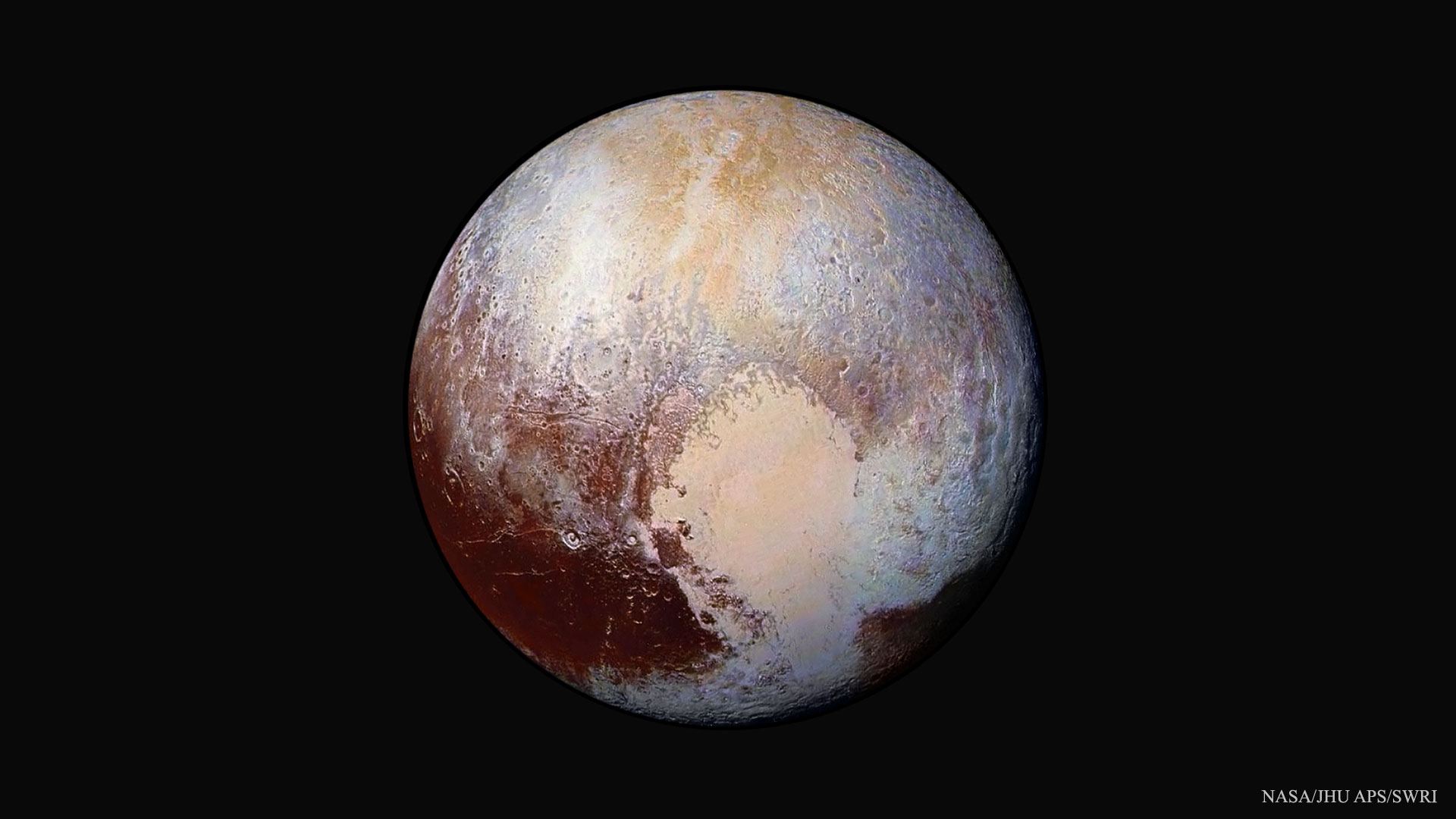
Pluto in Enhanced Color

Pluto in Enhanced Color: APOD: 2015 August 31 - Pluto in Enhanced Color


Discover the cosmos! Each day a different image or photograph of our fascinating universe is featured, along with a brief explanation written by a professional astronomer.


2015 August 31


See Explanation. Clicking on the picture will download the highest resolution version available.


Pluto in Enhanced Color
Image Credit: NASA, Johns Hopkins Univ./APL, Southwest Research Inst.
Explanation: Pluto is more colorful than we can see. Color data and images of our Solar System's most famous dwarf planet, taken by the robotic New Horizons spacecraft during its flyby in July, have been digitally combined to give an enhanced view of this ancient world sporting an unexpectedly young surface. The featured enhanced color image is not only esthetically pretty but scientifically useful, making surface regions of differing chemical composition visually distinct. For example, the light-colored heart-shaped Tombaugh Regio on the lower right is clearly shown here to be divisible into two regions that are geologically different, with the leftmost lobe Sputnik Planum also appearing unusually smooth. New Horizons now continues on beyond Pluto, will continue to beam back more images and data, and will soon be directed to change course so that it can fly past asteroid 2014 MU69 in 2019 January.

Pluto Images with Brief Explanations: APOD Pluto Search
Tomorrow's picture: through the earth

< | Archive | Submissions | Index | Search | Calendar | RSS | Education | About APOD | Discuss | >

Authors & editors: Robert Nemiroff (MTU) & Jerry Bonnell (UMCP)
NASA Official: Phillip Newman Specific rights apply.
NASA Web Privacy Policy and Important Notices
A service of: ASD at NASA / GSFC
& Michigan Tech. U.