Friday, December 12, 2014

Rosetta’s Instruments Direct Scientists to Look Elsewhere for the Source of Earth’s Water

Rosetta’s Instruments Direct Scientists to Look Elsewhere for the Source of Earth’s Water:


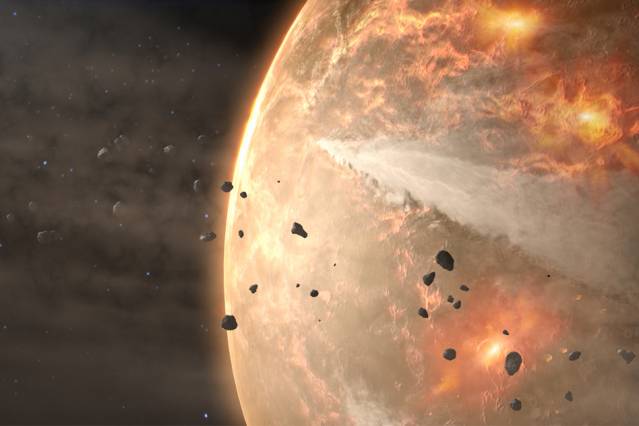
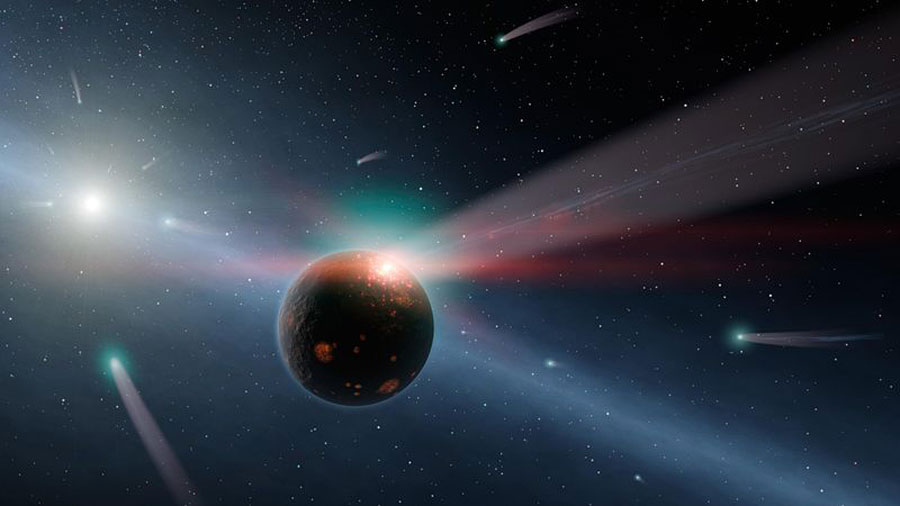
Illustration of a rocky planet being bombarded by comets. Earth may have appeared similarly early in its development. WHile indeed such comet impacts did occur, new in situ observations by Rosetta of comet 67P indicate that comets were likely not the primary source of water delivered to the Earth.(Image credit: NASA/JPL-Caltech)


Illustration of a rocky planet’s being bombarded by comets. Earth may have appeared similarly early in its development. While indeed such comet impacts did occur, new in situ observations by Rosetta of comet 67P indicate that comets were likely not the primary source of water delivered to the Earth. (Image credit: NASA/JPL-Caltech)
Where did all of our water come from? What might seem like a simple question has challenged and intrigued planetary scientists for decades. So results just released by Rosetta mission scientists have been much anticipated and the observations of the Rosetta spacecraft instruments are telling us to look elsewhere. The water of comet 67P/Churyumov-Gerasimenko does not resemble Earth’s water.

Because the Earth was extremely hot early in its formation, scientists believe that Earth’s original water should have boiled away like that from a boiling kettle. Prevailing theories have considered two sources for a later delivery of water to the surface of the Earth once conditions had cooled. One is comets and the other is asteroids. Surely some water arrived from both sources, but the question has been which one is the predominant source.

There are two areas of our Solar System in which comets formed about 4.6 billion years ago. One is the Oort cloud far beyond Pluto. Everything points to Comet 67P’s origins being the other birthplace of comets – the Kuiper Belt in the region of Neptune and Pluto. The Rosetta results are ruling out Kuiper Belt comets as a source of Earth’s water. Previous observations of Oort cloud comets, such as Hyakutake and Hale-Bopp, have shown that they also do not have Earth-like water. So planetary scientists must reconsider their models with weight being given to the other possible source – asteroids.

The question of the source of Earth’s water has been tackled by Earth-based instruments and several probes which rendezvous with comets. In 1986, the first flyby of a comet – Comet 1P/Halley, an Oort cloud comet – revealed that its water was not like the water on Earth. How the water from these comets –Halley’s and now 67P – differs from Earth’s is in the ratio of the two types of hydrogen atoms that make up the water molecule.


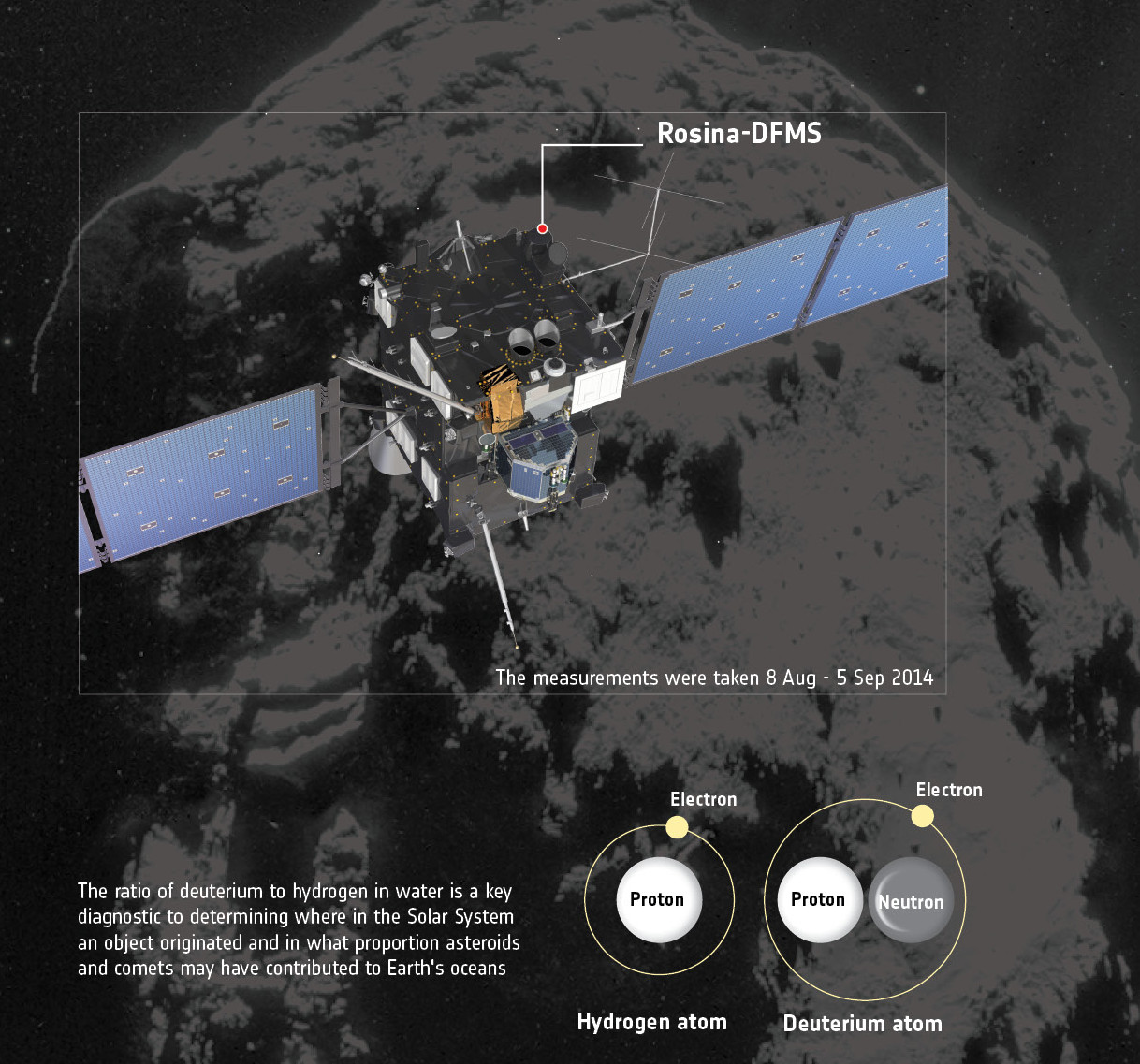
Illustration of the Rosetta spacecraft showing the location of the ROSINA mass spectrometer instrument, DFMS. The difference between a Deuterium and Hydrogen atom are also illustrated. A water molecule with Deuterium is known as heavy water due to the additional mass of D vs. H (an extra neutron). (Credit: ESA/Rosetta)


Illustration of the Rosetta spacecraft showing the location of the ROSINA mass spectrometer instrument, DFMS. The difference between a Deuterium and Hydrogen atom is also illustrated. A water molecule with Deuterium is known as heavy water due to the additional mass of Dueterium vs. Hydrogen (i.e., an extra neutron). (Credit: ESA/Rosetta)
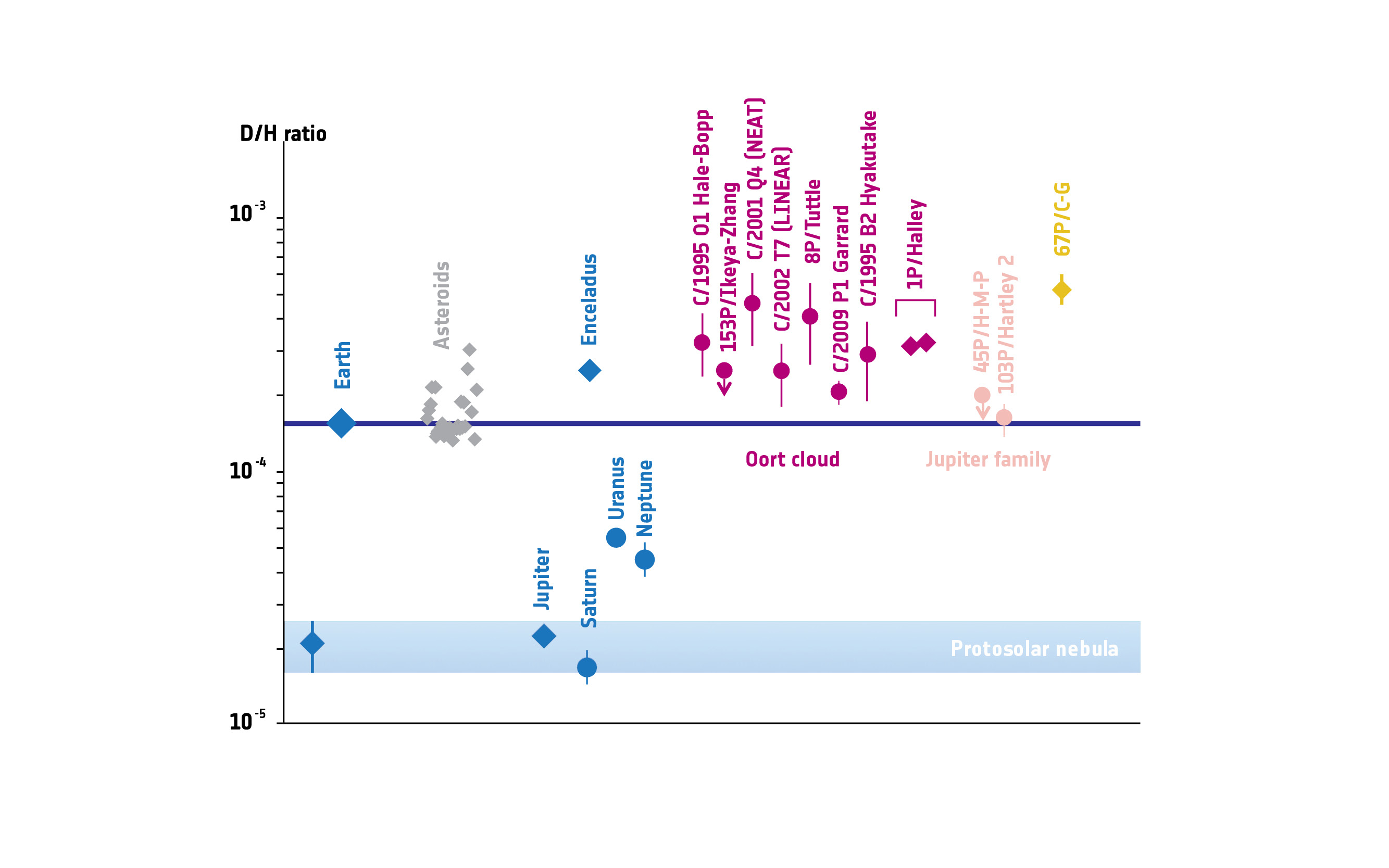
Measurements by spectrometers revealed how much Deuterium  – a heavier form of the Hydrogen atom – existed in relation to the most common type of Hydrogen in these comets. This ratio, designated as D/H, is about 1 in 6000 in Earth’s ocean water. For the vast majority of comets, remote or in-situ measurements have found a ratio that is higher which does not support the assertion that comets delivered water to the early Earth surface, at least not much of it.

Most recently, Hershel space telescope observations of comet Hartley 2 (103P/Hartley) caused a stir in the debate of the source of Earth’s water. The spectral measurements of the comet’s light revealed a D/H ratio just like Earth’s water. But now the Hershel observation has become more of an exception because of Rosetta’s latest measurements.


A plot displaying the Deuterium/Hydrogen (D/H) ratio of Solar System objects. Only asteroids have a D/H ratio that matches the Earths and comets with the exception of two so far measured have higher ratios. Objects are grouped by color. Planets & moons (blue), chrondritic meteorites from the asteroid belt (grey), Oort cloud comets(purple), Jupiter family comets(pink). Diamond markers = In Situ measurements, Circles = remote astronomical measurements(Credit: Altwegg et al. 2014)


A plot displaying the Deuterium/Hydrogen (D/H) ratio of Solar System objects. Asteroids have a D/H ratio that matches that of the Earth, while comets – except for two measured to date – have higher ratios. Objects are grouped by color: planets & moons (blue), chrondritic meteorites from the asteroid belt (grey), Oort cloud comets (purple), and Jupiter family comets (pink). Diamond markers = In Situ measurements; circles = remote astronomical measurements. (Credit: Altwegg, et al. 2014)
The new measurements of 67P were made by the ROSINA Double Focusing Mass Spectrometer (DFMS) on board Rosetta. Unlike remote observations using light which are less accurate, Rosetta was able to accurately measure the quantities of Deuterium and common Hydrogen surrounding the comet. Scientists could then simply determine a ratio. The results are reported in the paper “67P/Churyumov-Gerasimenko, a Jupiter Family Comet with a high D/H ratio” by K. Altwegg, et al., published in the 10 December 2014 issue of Science.


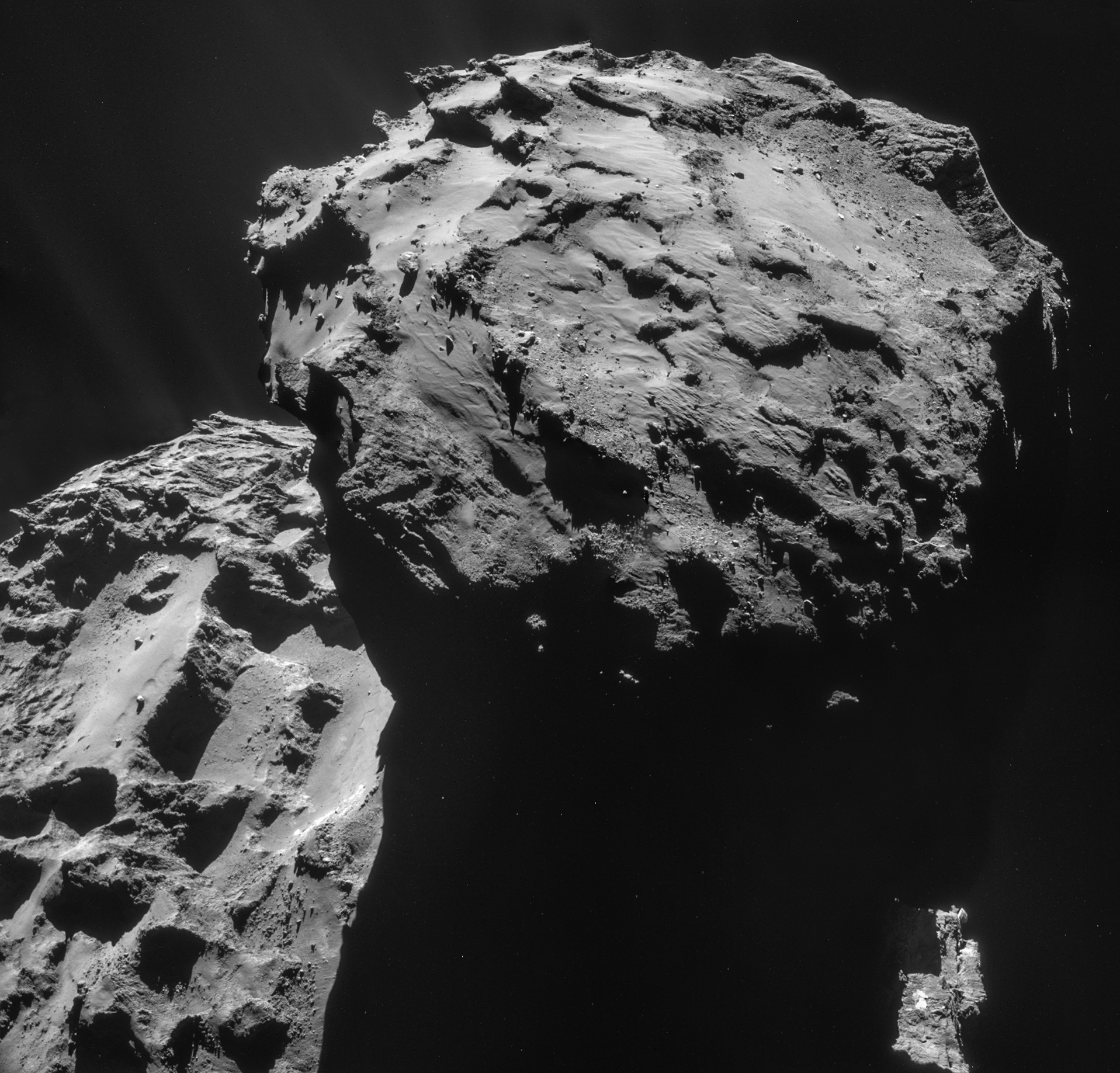
New Rosetta mission findings do not exclude comets as a source of water in and on the Earth's crust but does indicate comets were a minor contribution. A four-image mosaic comprises images taken by Rosetta’s navigation camera on 7 December from a distance of 19.7 km from the centre of Comet 67P/Churyumov-Gerasimenko. (Credit: ESA/Rosetta/Navcam Imager)


New Rosetta mission findings do not exclude comets as a source of water in and on the Earth’s crust but does indicate comets were a minor contribution. A four-image mosaic comprises images taken by Rosetta’s navigation camera on 7 December from a distance of 19.7 km from the centre of Comet 67P/Churyumov-Gerasimenko. (Credit: ESA/Rosetta/Navcam Imager)
The ROSINA instrument observations determined a ratio of 5.3 ± 0.7 × 10⁻⁴, which is approximately 3 times the ratio of D/H for Earth’s water. These results do not exclude comets as a source of terrestrial water but they do redirect scientists to consider asteroids as the predominant source. While asteroids have much lower water content compared with comets, asteroids, and their smaller versions, meteoroids, are more numerous than comets. Every meteor/falling star that we see burning up in our atmosphere delivers a myriad of compounds, including water, to Earth. Early on, the onslaught of meteoroids and asteroids impacting Earth was far greater. Consequently, the small quantities of water added delivered by each could add up to what now lies in the oceans, lakes, streams, and even our bodies.

References:

D/H Ratio of Water on Earth Measured with DFMS

67P/Churyumov-Gerasimenko, a Jupiter family comet with a high D/H ratio

Rosetta fuels the debate on the Origin of Earth’s Water

The Provenances of Asteroids, and Their Contributions to the Volatile Inventories of the Terrestrial Planets

Recent Universe Today related article:

What Percent of Earth is Water?


About 

Contributing writer Tim Reyes is a former NASA software engineer and analyst who has supported development of orbital and lander missions to the planet Mars since 1992. He has an M.S. in Space Plasma Physics from University of Alabama, Huntsville.

Galactic Get-Together has Impressive Light Display

Galactic Get-Together has Impressive Light Display:


NGC 2207 and IC 2163


At this time of year, there are lots of gatherings often decorated with festive lights. When galaxies get together, there is the chance of a spectacular light show as is the case with NGC 2207 and IC 2163

Located about 130 million light years from Earth, in the constellation of Canis Major, this pair of spiral galaxies has been caught in a grazing encounter. NGC 2207 and IC 2163 have hosted three supernova explosions in the past 15 years and have produced one of the most bountiful collections of super bright X-ray lights known. These special objects - known as "ultraluminous X-ray sources" (ULXs) - have been found using data from NASA's Chandra X-ray Observatory.

As in our Milky Way galaxy, NGC 2207 and IC 2163 are sprinkled with many star systems known as X-ray binaries, which consist of a star in a tight orbit around either a neutron star or a "stellar-mass" black hole. The strong gravity of the neutron star or black hole pulls matter from the companion star. As this matter falls toward the neutron star or black hole, it is heated to millions of degrees and generates X-rays.

ULXs have far brighter X-rays than most "normal" X-ray binaries. The true nature of ULXs is still debated, but they are likely a peculiar type of X-ray binary. The black holes in some ULXs may be heavier than stellar mass black holes and could represent a hypothesized, but as yet unconfirmed, intermediate-mass category of black holes.

This composite image of NGC 2207 and IC 2163 contains Chandra data in pink, optical light data from the Hubble Space Telescope in red, green, and blue (appearing as blue, white, orange, and brown), and infrared data from the Spitzer Space Telescope in red.

More information at http://chandra.harvard.edu/photo/2014/ngc2207/index.html

-Megan Watzke, CXC

Rosetta Comet Water Different Than Earth Water

Rosetta Comet Water Different Than Earth Water:

This composite is a mosaic comprising four individual NAVCAM images taken from 19 miles This composite is a mosaic comprising four individual NAVCAM images taken from 19 miles (31 kilometers) from the center of comet 67P/Churyumov-Gerasimenko on Nov. 20, 2014. Image credit: ESA/Rosetta/NAVCAM

› Full image and caption
The European Space Agency's Rosetta spacecraft has found the water vapor from comet 67P/Churyumov-Gerasimenko to be significantly different from that found on Earth. The discovery fuels the debate on the origin of our planet's oceans.

The measurements, by the Rosetta Orbiter Spectrometer for Ion and Neutral Analysis (ROSINA) instrument, were made in the month following the arrival of the spacecraft on Aug. 6. It is one of the most anticipated early results of the mission, because the origin of Earth's water is still an open question.

More information can be found on ESA's Rosetta website at:

http://bit.ly/1yzbQEi

Comets are time capsules containing primitive material left over from the epoch when the sun and its planets formed. Rosetta's lander obtained the first images taken from a comet's surface and will provide analysis of the comet's possible primordial composition. Rosetta will be the first spacecraft to witness at close proximity how a comet changes as it is subjected to the increasing intensity of the sun's radiation. Observations will help scientists learn more about the origin and evolution of our solar system and the role comets may have played in seeding Earth with water, and perhaps even life.

Rosetta is an ESA mission with contributions from its member states and NASA. The Jet Propulsion Laboratory, Pasadena, California, a division of the California Institute of Technology in Pasadena, manages the U.S. contribution of the Rosetta mission for NASA's Science Mission Directorate in Washington. JPL also built the MIRO instrument and hosts its principal investigator, Samuel Gulkis. The Southwest Research Institute (San Antonio and Boulder) developed the Rosetta orbiter's IES and Alice instruments, and hosts their principal investigators, James Burch (IES) and Alan Stern (Alice).

For more information on the U.S. instruments aboard Rosetta, visit:

http://rosetta.jpl.nasa.gov

More information about Rosetta is available at:

http://www.esa.int/rosetta

Media Contact

DC Agle

Jet Propulsion Laboratory, Pasadena, Calif.

818-393-9011

agle@jpl.nasa.gov

Markus Bauer

European Space Agency, Noordwijk, Netherlands

011-31-71-565-6799

markus.bauer@esa.int

2014-424

Thursday, December 11, 2014

An "Hour of Code" with Color, Images, and Astronomy

An "Hour of Code" with Color, Images, and Astronomy:

For many, it might be hard to imagine living a life without computers and technology. In fact, it’s become so much a part of our society that we may not realize how dependent we are on technology.

But who does the work that enables these computers to fit into our daily lives? Who gets to learn how to code? A project called “Hour of Code” as well as Computer Science Education Week is seeking to address that question by increasing access to coding opportunities for elementary, middle and high school students, and particularly girls and underrepresented students of color.

Here at the Chandra X-ray Center we strongly believe in this goal as well. We’ve joined forces with other members of the astronomical community, including an astronomer at the American Astronomical Society, others at the Smithsonian Astrophysical Observatory, as well as partners at Google's CS First and Pencil Code, to create a project for the “Hour of Code” that combines color, astronomy, and coding: http://event.pencilcode.net/home/hoc2014/


Caption: Students can color the Universe with real astronomy data from NASA telescopes and other observatories.

Working with NASA and other data from exploded stars, to star-forming regions, to the area around black holes, students learn basic coding (for beginners - no experience required) and follow a video tutorial to create a real world application of science, technology and even art.


Caption: Learn basic coding for beginners with a video tutorial to create a real-world application. http://recolor.pencilcode.net/

By enabling students to use real data from NASA’s Chandra X-ray Observatory, along with other astronomical data, this project helps show just how integral coding is in the pursuit of learning about our Universe. We hope it’s an example of the exciting ways that computer science – from routine tasks in our every day lives to the extraordinary quest to explore the cosmos – is part of it all.

Many thanks to David Bau, August Muench, Matthew Dawson & Cait Sydney Pickens for letting Chandra help out with the project!

-Megan Watzke & Kim Arcand, Chandra

Monday, December 8, 2014

Meteorite May Contain Proof of Life on Mars, Researchers Say

Meteorite May Contain Proof of Life on Mars, Researchers Say:

The idea that Mars could have supported life at one time is the subject of ongoing debate. Image credit: NASA


The idea that Mars could have supported life at one time is the subject of ongoing debate. Image credit: NASA
Mars is currently home to a small army robotic rovers, satellites and orbiters, all of which are busy at work trying to unravel the deeper mysteries of Earth’s neighbor. These include whether or not the planet ever had liquid water on its surface, what the atmosphere once looked like, and – most importantly of all – if it ever supported life.

And while much has been learned about Martian water and its atmosphere, the all-important question of life remains unanswered. Until such time as organic molecules – considered to be the holy grail for missions like Curiosity – are found, scientists must look elsewhere to find evidence of Martian life.

According to a recent paper submitted by an international team of scientists, that evidence may have arrived on Earth three and a half years ago aboard a meteorite that fell in the Moroccan desert. Believed to have broken away from Mars 700,000 years ago, so-called Tissint meteorite has internal features that researchers say appear to be organic materials.

The paper appeared in the scientific journal Meteoritics and Planetary Sciences. In it, the research team – which includes scientists from the Swiss Federal Institute of Technology in Lausanne (EPFL) – indicate organic carbon is located inside fissures in the rock. All indications are the meteorite is Martian in origin.

“So far, there is no other theory that we find more compelling,” says Philippe Gillet, director of EPFL’s Earth and Planetary Sciences Laboratory. He and his colleagues from China, Japan and Germany performed a detailed analysis of organic carbon traces from a Martian meteorite, and have concluded that they have a very probable biological origin.


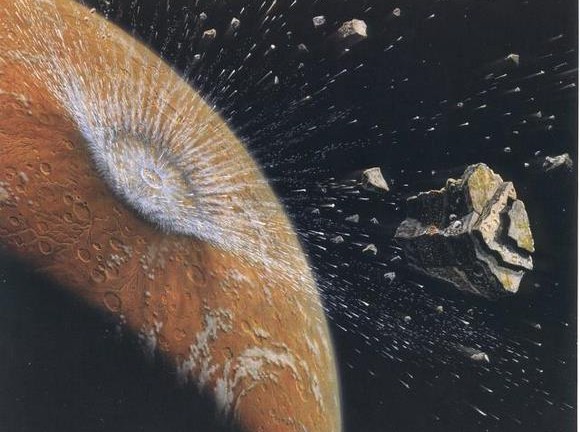
Artist's conception of an fragment as it blasts off from Mars. Boulder-sized planetary fragments could be a mechanism that carried life between Mars and Earth, UA planetary scientist Jay Melosh says. (Credit: The Planetary Society)


Artist’s conception of an fragment as it blasts off from Mars as a result of a meteor impact. Credit: The Planetary Society
The scientists argue that carbon could have been deposited into the fissures of the rock when it was still on Mars by the infiltration of fluid that was rich in organic matter.

If this sounds familiar, you may recall a previous Martian meteorite named ALH84001, found in the Allen Hills region in Antarctica. In 1996 NASA researchers announced they had found evidence within ALH84001 that strongly suggested primitive life may have existed on Mars more than 3.6 billion years ago. While subsequent studies of the now famous Allen Hills Meteorite shot down theories that the Mars rock held fossilized alien life, both sides continue to debate the issue.

This new research on the Tissint meteorite will likely be reviewed and rebutted, as well.

The researchers say the meteorite was likely ejected from Mars after an asteroid crashed on its surface, and fell to Earth on July 18, 2011, and fell in Morocco in view of several eyewitnesses.

Upon examination, the alien rock was found to have small fissures that were filled with carbon-containing matter. Several research teams have already shown that this component is organic in nature, but they are still debating where the carbon came from.

Chemical, microscopic and isotope analysis of the carbon material led the researchers to several possible explanations of its origin. They established characteristics that unequivocally excluded a terrestrial origin, and showed that the carbon content were deposited in the Tissint’s fissures before it left Mars.

This research challenges research proposed in 2012 that asserted that the carbon traces originated through the high-temperature crystallization of magma. According to the new study, a more likely explanation is that liquids containing organic compounds of biological origin infiltrated Tissint’s “mother” rock at low temperatures, near the Martian surface.


A piece of the Tissint meteorite that came to Earth via Mars. Credit: EPFL/Alain Herzog


A piece of the Tissint meteorite that landed on Earth on July 18th, 2011. Credit: EPFL/Alain Herzog
These conclusions are supported by several intrinsic properties of the meteorite’s carbon, e.g. its ratio of carbon-13 to carbon-12. This was found to be significantly lower than the ratio of carbon-13 in the CO2 of Mars’s atmosphere, previously measured by the Phoenix and Curiosity rovers.

Moreover, the difference between these ratios corresponds perfectly with what is observed on Earth between a piece of coal – which is biological in origin – and the carbon in the atmosphere.

The researchers note that this organic matter could also have been brought to Mars when very primitive meteorites – carbonated chondrites – fell on it. However, they consider this scenario unlikely because such meteorites contain very low concentrations of organic matter.

“Insisting on certainty is unwise, particularly on such a sensitive topic,” warns Gillet. “I’m completely open to the possibility that other studies might contradict our findings. However, our conclusions are such that they will rekindle the debate as to the possible existence of biological activity on Mars – at least in the past.”

Be sure to check out these videos from EPFL News, which include an interview with Philippe Gillet, EPFL and co-author of the study:


And this video explaining the history of the Tissint meteor:


Further Reading: EPFL


About 

Author, freelance writer, educator, Taekwon-Do instructor, and loving hubby, son and Island boy!

10 Facts About the Milky Way

10 Facts About the Milky Way:


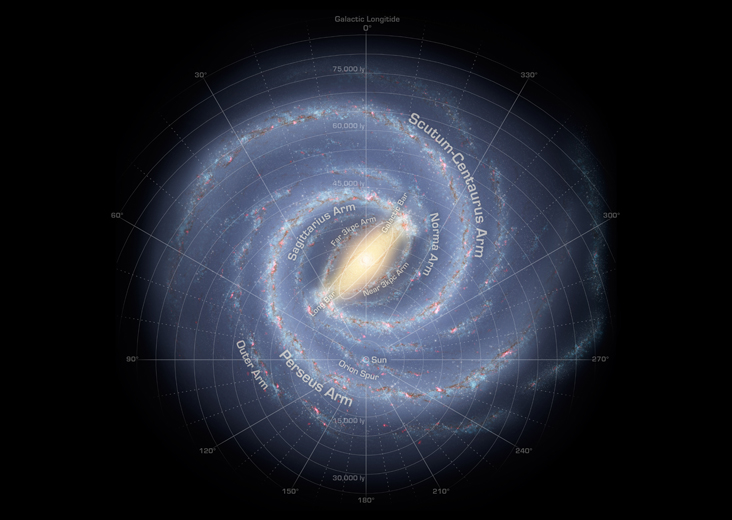
This annotated artist's conception illustrates our current understanding of the structure of the Milky Way galaxy. Image Credit: NASA


This annotated artist’s conception illustrates our current understanding of the structure of the Milky Way galaxy. Image Credit: NASA
The Milky Way Galaxy is an immense and very interesting place. Not only does it measure some 100,000–120,000 light-years in diameter, it is home to planet Earth, the birthplace of humanity. Our Solar System resides roughly 27,000 light-years away from the Galactic Center, on the inner edge of one of the spiral-shaped concentrations of gas and dust particles called the Orion Arm.

But within these facts about the Milky Way lie some additional tidbits of information, all of which are sure to impress and inspire. Here are ten such facts, listed in no particular order:


1. It’s warped.For starters, the Milky Way is a disk about 120,000 light years across with a central bulge that has a diameter of 12,000 light years (see the Guide to Space article for more information). The disk is far from perfectly flat though, as can be seen in the picture below. In fact, it is warped in shape, a fact which astronomers attribute to the our galaxy’s two neighbors -the Large and Small Magellanic clouds.

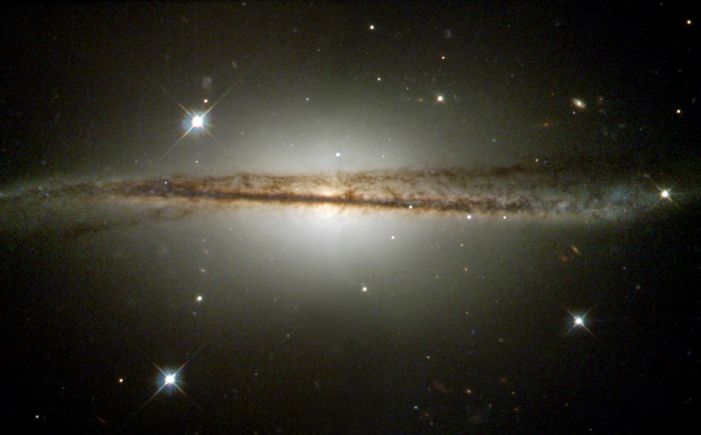
These two dwarf galaxies — which are part of our “Local Group” of galaxies and may be orbiting the Milky Way — are believed to have been pulling on the dark matter in our galaxy like in a game of galactic tug-of-war. The tugging creates a sort of oscillating frequency that pulls on the galaxy’s hydrogen gas, of which the Milky Way has lots of (for more information, check out How the Milky Way got its Warp).


The Spiral Galaxy ESO 510-13 is warped similar to our own. Credit: NASA/Hubble Heritage Team (STScI / AURA), C. Conselice (U. Wisconsin / STScI/ NASA


The warp of Spiral Galaxy ESO 510-13 is similar to that of our own. Credit: NASA/Hubble
2. It has a halo, but you can’t directly see it.Scientists believe that 90% of our galaxy’s mass consists of dark matter, which gives it a mysterious halo. That means that all of the “luminous matter” – i.e. that which we can see with the naked eye or a telescopes – makes up less than 10% of the mass of the Milky Way. Its halo is not the conventional glowing sort we tend to think of when picturing angels or observing comets.

In this case, the halo is actually invisible, but its existence has been demonstrated by running simulations of how the Milky Way would appear without this invisible mass, and how fast the stars inside our galaxy’s disk orbit the center.

The heavier the galaxy, the faster they should be orbiting. If one were to assume that the galaxy is made up only of matter that we can see, then the rotation rate would be significantly less than what we observe. Hence, the rest of that mass must be made up of an elusive, invisible mass – aka. “dark matter” – or matter that only interacts gravitationally with “normal matter”.

To see some images of the probable distribution and density of dark matter in our galaxy, check out The Via Lactea Project.

3. It has over 200 billion starsAs galaxies go, the Milky Way is a middleweight. The largest galaxy we know of, which is designated IC 1101, has over 100 trillion stars, and other large galaxies can have as many as a trillion. Dwarf galaxies such as the aforementioned Large Magellanic Cloud have about 10 billion stars. The Milky Way has between 100-400 billion stars; but when you look up into the night sky, the most you can see from any one point on the globe is about 2,500. This number is not fixed, however, because the Milky Way is constantly losing stars through supernovae, and producing new ones all the time (about seven per year).


These images taken by the Spitzer Space Telescope show the dust and gas concentrations around a supernova. Credit: NASA/JPL-Caltech


These images taken by the Spitzer Space Telescope show dust and gas concentrations around a distant supernova. Credit: NASA/JPL-Caltech
4. It’s really dusty and gassy.Though it may not look like it to the casual observer, the Milky Way is full of dust and gas. This matter makes up a whopping 10-15% of the luminous/visible matter in our galaxy, with the remainder being the stars. Our galaxy is roughly 100,000 light years across, and we can only see about 6,000 light years into the disk in the visible spectrum. Still, when light pollution is not significant, the dusty ring of the Milky Way can be discerned in the night sky.

The thickness of the dust deflects visible light (as is explained here) but infrared light can pass through the dust, which makes infrared telescopes like the Spitzer Space Telescope extremely valuable tools in mapping and studying the galaxy. Spitzer can peer through the dust to give us extraordinarily clear views of what is going on at the heart of the galaxy and in star-forming regions.

5. It was made from other galaxies.The Milky Way wasn’t always as it is today – a beautiful, warped spiral. It became its current size and shape by eating up other galaxies, and is still doing so today. In fact, the Canis Major Dwarf Galaxy is the closest galaxy to the Milky Way because its stars are currently being added to the Milky Way’s disk. And our galaxy has consumed others in its long history, such as the Sagittarius Dwarf Galaxy.

6. Every picture you’ve seen of the Milky Way from above is either another galaxy or an artist’s interpretation.Currently, we can’t take a picture of the Milky Way from above. This is due to the fact that we are inside the galactic disk, about 26,000 light years from the galactic center. It would be like trying to take a picture of your own house from the inside. This means that any of the beautiful pictures you’ve ever seen of a spiral galaxy that is supposedly the Milky Way is either a picture of another spiral galaxy, or the rendering of a talented artist.

Imaging the Milky Way from above is a long, long way off. However, this doesn’t mean that we can’t take breathtaking images of the Milky Way from our vantage point!


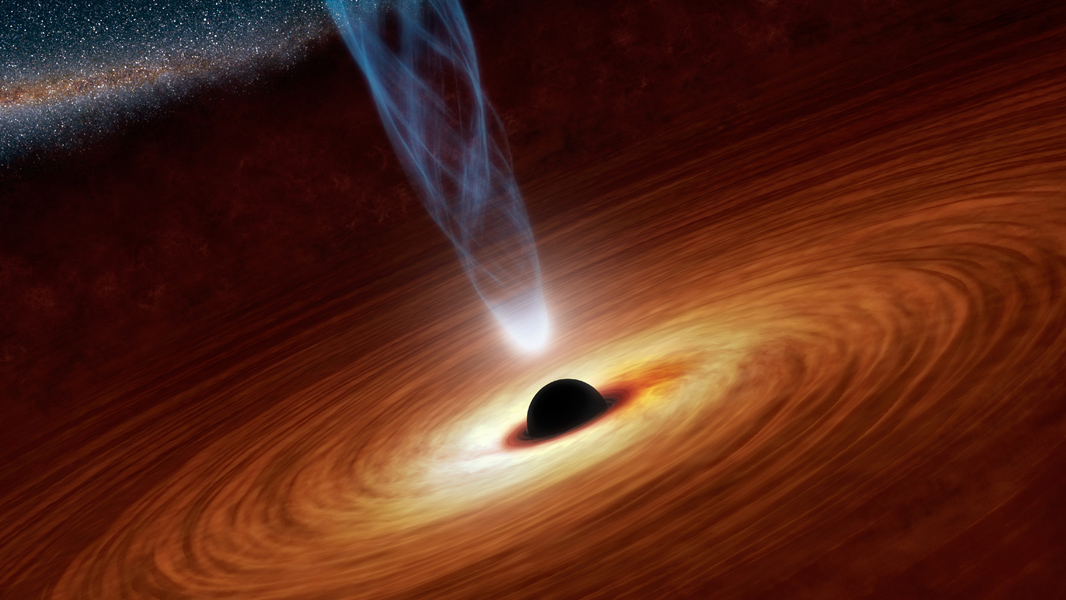
Artist's concept of Sagittarius A, the supermassive black hole at the center of our galaxy. Credit: NASA/JPL


Artist’s concept of Sagittarius A, the supermassive black hole at the center of our galaxy. Credit: NASA/JPL-Caltech
7. There is a black hole at the center.Most larger galaxies have a supermassive black hole (SMBH) at the center, and the Milky Way is no exception. The center of our galaxy is called Sagittarius A*, a massive source of radio waves that is believed to be a black hole that measures 22,500 kilometers (14 million miles) across – about the size of Mercury’s orbit. But this is just the black hole itself.

All of the mass trying to get into the black hole – called the accretion disk – forms a disk that has 4.6 million times the mass of our Sun and would fit inside the orbit of the Earth. Though like other black holes, Sgr A* tries to consume anything that happens to be nearby, star formation has been detected near this behemoth astronomical phenomenon.

8. It’s almost as old as the Universe itself.The most recent estimates place the age of the Universe at about 13.7 billion years. Our Milky Way has been around for about 13.6 billion of those years, give or take another 800 million. The oldest stars in our the Milky Way are found in globular clusters, and the age of our galaxy is determined by measuring the age of these stars, and then extrapolating the age of what preceded them.

Though some of the constituents of the Milky Way have been around for a long time, the disk and bulge themselves didn’t form until about 10-12 billion years ago. And that bulge may have formed earlier than the rest of the galaxy.

9. It’s part of the Virgo Supercluster, a group of galaxies within 150 million light years.As big as it is, the Milky Way is part of an even larger galactic structures. Our closest neighbors include the Large and Small Magellanic Clouds, and the Andromeda Galaxy – the closest spiral galaxy to the Milky Way. Along with some 50 other galaxies, the Milky Way and its immediate surroundings make up a cluster known as the Local Group.

And yet, this is still just a small fraction of our stellar neighborhood. Father out, we find that the Milky Way is part of an even larger grouping of galaxies known as the Virgo Supercluster. Superclusters are groupings of galaxies on very large scales that measure in the hundreds of millions of light years in diameter. In between these superclusters are large stretches of open space where intrepid explorers or space probes would encounter very little in the way of galaxies or matter.

In the case of the Virgo Supercluster, at least 100 galaxy groups and clusters are located within it massive 33 megaparsec (110 million light-year) diameter. And a 2014 study indicates that the Virgo Supercluster is only a lobe of a greater supercluster, Laniakea, which is centered on the Great Attractor.

10. It’s on the moveThe Milky Way, along with everything else in the Universe, is moving through space. The Earth moves around the Sun, the Sun around the Milky Way, and the Milky Way as part of the Local Group, which is moving relative to the Cosmic Microwave Background (CMB) radiation – the radiation left over from the Big Bang.

The CMB is a convenient reference point to use when determining the velocity of things in the universe. Relative to the CMB, the Local Group is calculated to be moving at a speed of about 600 km/s, which works out to about 2.2 million km/h. Such speeds stagger the mind and squash any notions of moving fast within our humble, terrestrial frame of reference!

For many more facts about the Milky Way, visit the Guide to Space, listen to the Astronomy Cast episode on the Milky Way, or visit the Students for the Exploration and Development of Space at seds.org..

Further Reading: SEDS.org


About 

Author, freelance writer, educator, Taekwon-Do instructor, and loving hubby, son and Island boy!
Earth May Have Lost Some Primoridial Atmosphere to Meteors

Earth May Have Lost Some Primoridial Atmosphere to Meteors:


4.5 billion years ago, during the Hadean Eon, Earth was bombarded regularly by meteorites. Credit: NASA


4.5 billion years ago, during the Hadean Eon, Earth was bombarded regularly by meteorites. Credit: NASA
During the Hadean Eon, some 4.5 billion years ago, the world was a much different place than it is today. As the name Hades would suggest (Greek for “underworld”), it was a hellish period for Earth, marked by intense volcanism and intense meteoric impacts. It was also during this time that outgassing and volcanic activity produced the primordial atmosphere composed of carbon dioxide, hydrogen and water vapor.

Little of this primordial atmosphere remains, and geothermal evidence suggests that the Earth’s atmosphere may have been completely obliterated at least twice since its formation more than 4 billion years ago. Until recently, scientists were uncertain as to what could have caused this loss.

But a new study from MIT, Hebrew Univeristy, and Caltech indicates that the intense bombardment of meteorites in this period may have been responsible.

This meteoric bombardment would have taken place at around the same time that the Moon was formed. The intense bombardment of space rocks would have kicked up clouds of gas with enough force to permanent eject the atmosphere into space. Such impacts may have also blasted other planets, and even peeled away the atmospheres of Venus and Mars.

In fact, the researchers found that small planetesimals may be much more effective than large impactors –  such as Theia, whose collision with Earth is believed to have formed the Moon – in driving atmospheric loss. Based on their calculations, it would take a giant impact to disperse most of the atmosphere; but taken together, many small impacts would have the same effect.


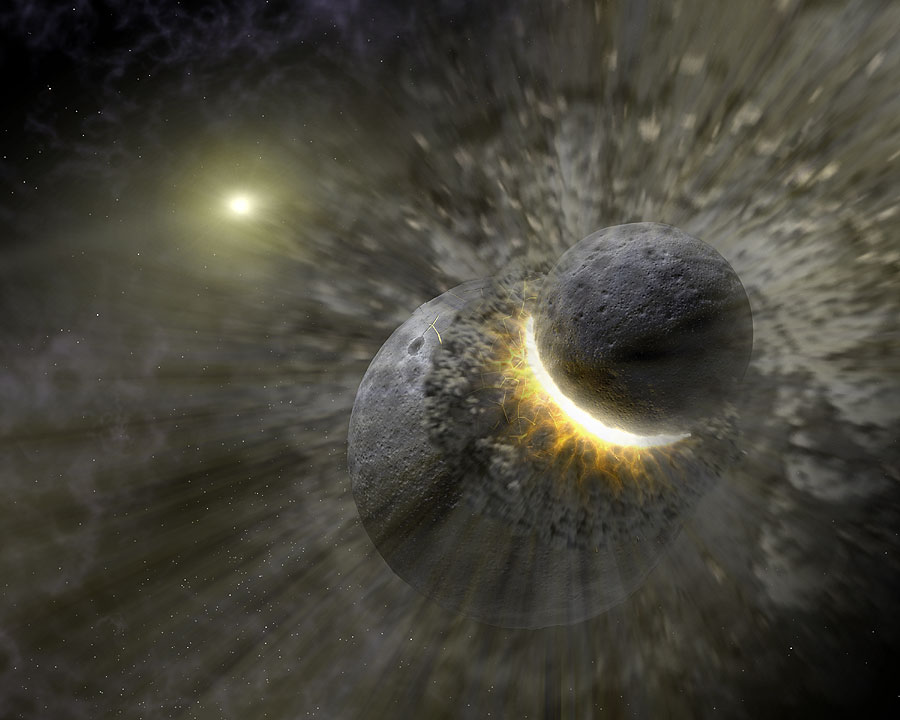
Artist's concept of a collision between proto-Earth and Theia, believed to happened 4.5 billion years ago. Credit: NASA


Artist’s concept of a collision between proto-Earth and Theia, believed to happened 4.5 billion years ago. Credit: NASA
Hilke Schlichting, an assistant professor in MIT’s Department of Earth, Atmospheric and Planetary Sciences, says understanding the drivers of Earth’s ancient atmosphere may help scientists to identify the early planetary conditions that encouraged life to form.

“[This finding] sets a very different initial condition for what the early Earth’s atmosphere was most likely like,” Schlichting says. “It gives us a new starting point for trying to understand what was the composition of the atmosphere, and what were the conditions for developing life.”

What’s more, the group examined how much atmosphere was retained and lost following impacts with giant, Mars-sized and larger bodies and with smaller impactors measuring 25 kilometers or less.

What they found was that a collision with an impactor as massive as Mars would have the necessary effect of generating a massive a shockwave through the Earth’s interior and potentially ejecting a significant fraction of the planet’s atmosphere.

However, the researchers determined that such an impact was not likely to have occurred, since it would have turned Earth’s interior into a homogenous slurry. Given the appearance of diverse elements observed within the Earth’s interior, such an event does not appear to have happened in the past.

A series of smaller impactors, by contrast, would generate an explosion of sorts, releasing a plume of debris and gas. The largest of these impactors would be forceful enough to eject all gas from the atmosphere immediately above the impact zone. Only a fraction of this atmosphere would be lost following smaller impacts, but the team estimates that tens of thousands of small impactors could have pulled it off.


An artistic conception of the early Earth, showing a surface pummeled by large impact, resulting in extrusion of deep seated magma onto the surface. At the same time, distal portion of the surface could have retained liquid water. Credit: Simone Marchi


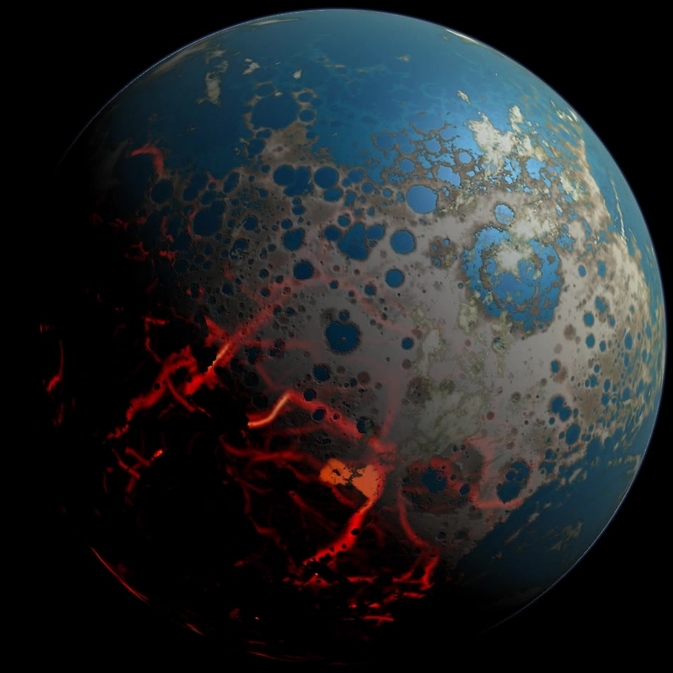
Artist’s concept of the early Earth, showing a surface pummeled by large impacts. Credit: Simone Marchi
Such a scenario did likely occur 4.5 billion years ago during the Hadean Eon. This period was one of galactic chaos, as hundreds of thousands of space rocks whirled around the solar system and many are believed to have collided with Earth.

“For sure, we did have all these smaller impactors back then,” Schlichting says. “One small impact cannot get rid of most of the atmosphere, but collectively, they’re much more efficient than giant impacts, and could easily eject all the Earth’s atmosphere.”

However, Schlichting and her team realized that the sum effect of small impacts may be too efficient at driving atmospheric loss. Other scientists have measured the atmospheric composition of Earth compared with Venus and Mars; and compared to Venus, Earth’s noble gases have been depleted 100-fold. If these planets had been exposed to the same blitz of small impactors in their early history, then Venus would have no atmosphere today.

She and her colleagues went back over the small-impactor scenario to try and account for this difference in planetary atmospheres. Based on further calculations, the team identified an interesting effect: Once half a planet’s atmosphere has been lost, it becomes much easier for small impactors to eject the rest of the gas.

The researchers calculated that Venus’ atmosphere would only have to start out slightly more massive than Earth’s in order for small impactors to erode the first half of the Earth’s atmosphere, while keeping Venus’ intact. From that point, Schlichting describes the phenomenon as a “runaway process — once you manage to get rid of the first half, the second half is even easier.”

This gave rise to another important question: What eventually replaced Earth’s atmosphere? Upon further calculations, Schlichting and her team found the same impactors that ejected gas also may have introduced new gases, or volatiles.

“When an impact happens, it melts the planetesimal, and its volatiles can go into the atmosphere,” Schlichting says. “They not only can deplete, but replenish part of the atmosphere.”


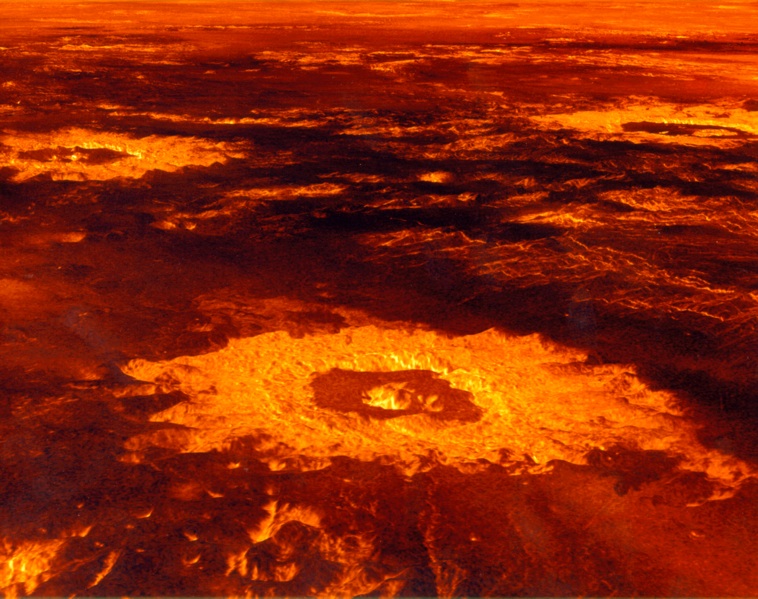
The "impact farm:, an area on Venus marked by impact craters and volcanic activity. Credit: NASA/JPL


The “impact farm:, an area on Venus marked by impact craters and volcanic activity. Credit: NASA/JPL
The group calculated the amount of volatiles that may be released by a rock of a given composition and mass, and found that a significant portion of the atmosphere may have been replenished by the impact of tens of thousands of space rocks.

“Our numbers are realistic, given what we know about the volatile content of the different rocks we have,” Schlichting notes.

Jay Melosh, a professor of earth, atmospheric, and planetary sciences at Purdue University, says Schlichting’s conclusion is a surprising one, as most scientists have assumed the Earth’s atmosphere was obliterated by a single, giant impact. Other theories, he says, invoke a strong flux of ultraviolet radiation from the sun, as well as an “unusually active solar wind.”

“How the Earth lost its primordial atmosphere has been a longstanding problem, and this paper goes a long way toward solving this enigma,” says Melosh, who did not contribute to the research. “Life got started on Earth about this time, and so answering the question about how the atmosphere was lost tells us about what might have kicked off the origin of life.”

Going forward, Schlichting hopes to examine more closely the conditions underlying Earth’s early formation, including the interplay between the release of volatiles from small impactors and from Earth’s ancient magma ocean.

“We want to connect these geophysical processes to determine what was the most likely composition of the atmosphere at time zero, when the Earth just formed, and hopefully identify conditions for the evolution of life,” Schlichting says.

Schlichting and her colleagues have published their results in the February edition of the journal Icarus.

Further Reading: MIT News


About 

Author, freelance writer, educator, Taekwon-Do instructor, and loving hubby, son and Island boy!
Venus Express May Be Out Of Fuel After Death-Duelling Maneuvers

Venus Express May Be Out Of Fuel After Death-Duelling Maneuvers:

by Elizabeth Howell on December 5, 2014


Artist's concept of Venus Express. Credit: ESA


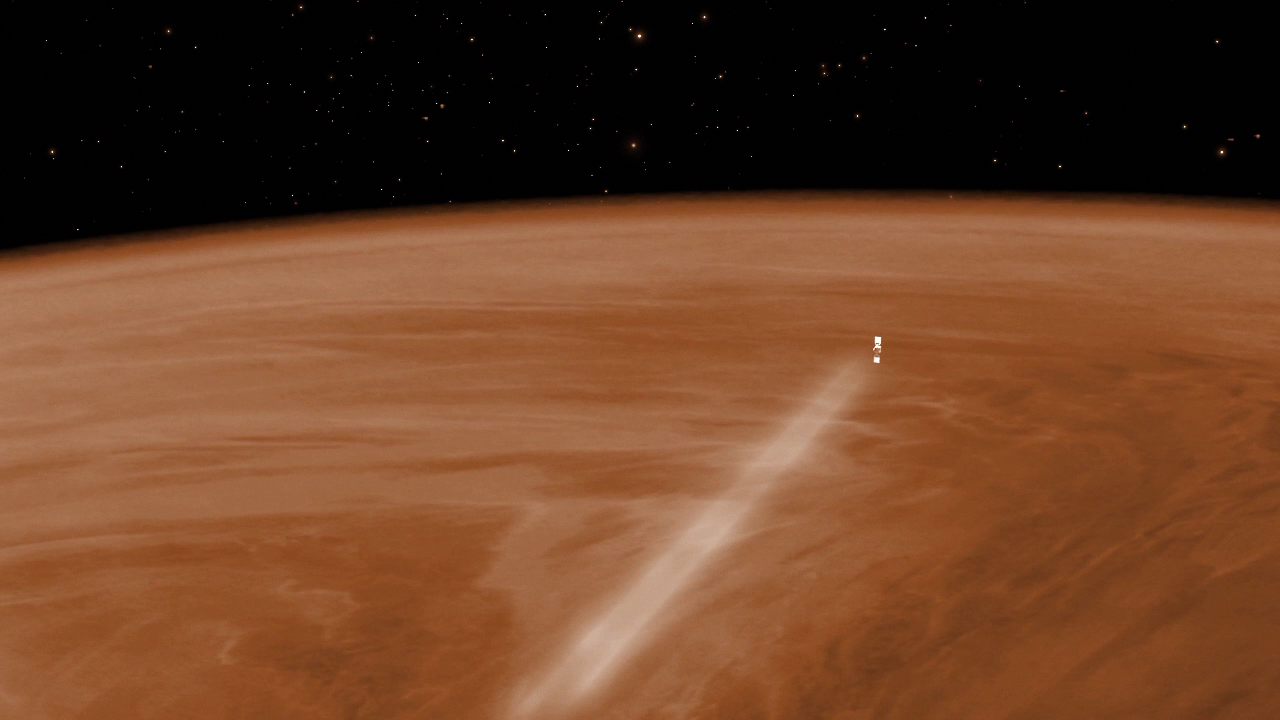
Artist’s concept of Venus Express. Credit: ESA
After more than eight years orbiting a hellish planet, Venus Express is showing its age. The spacecraft made some risky maneuvers this summer, dipping down into the atmosphere as it nears the end of its mission. Now, the European Space Agency reports it has mostly lost contact with the probe. The reason could be lack of fuel.

The “anomaly” started Nov. 28 when the agency’s operations center lost touch with the spacecraft. Since then, ground stations at ESA and NASA have been trying to hail the probe. All they’ve received since then is a little bit of telemetry showing that the spacecraft has it solar panels pointing towards the Sun, and it’s slowly rotating.


Artist's conception of Venus Express doing an aerobraking maneuver in the atmosphere in 2014. Credit: ESA–C. Carreau


Artist’s conception of Venus Express doing an aerobraking maneuver in the atmosphere in 2014. Credit: ESA–C. Carreau
“It is possible that the remaining fuel on board VEX was exhausted,” ESA wrote in a blog post, pointing out that in recent weeks it has been trying to raise the spacecraft’s altitude for more science observations. But with the spacecraft spinning, its high-gain antenna is likely out of contact with Earth and it’s hard to reach it.

“The operations team is currently attempting to downlink the table of critical events that is stored in protected memory on board, which may give details of the sequence of events which occurred over the past few days,” ESA added. “The root cause of the anomaly (fuel situation or otherwise) remains to be established.”

We’ll keep you posted as events arise.

Source: European Space Agency


About 

Elizabeth Howell is the senior writer at Universe Today. She also works for Space.com, Space Exploration Network, the NASA Lunar Science Institute, NASA Astrobiology Magazine and LiveScience, among others. Career highlights include watching three shuttle launches, and going on a two-week simulated Mars expedition in rural Utah. You can follow her on Twitter @howellspace or contact her at her website.

Pluto Spacecraft Wakes Up For An Exciting Close Encounter Next Year

Pluto Spacecraft Wakes Up For An Exciting Close Encounter Next Year:


Artist's conception of the New Horizons spacecraft at Pluto. Credit: Johns Hopkins University Applied Physics Laboratory/Southwest Research Institute (JHUAPL/SwRI)


Artist’s conception of the New Horizons spacecraft at Pluto. Credit: Johns Hopkins University Applied Physics Laboratory/Southwest Research Institute (JHUAPL/SwRI)
Pluto, humanity is getting ready to change your image. The New Horizons spacecraft is awake once more after emerging from hibernation as planned yesterday (Dec. 6). And after a decade of sailing through space, there will be a historic first encounter with the dwarf planet in July.

The story may not end there, either. Mission managers are working hard to make the case that since New Horizons is way “out there” anyway, it would be a great idea to put the spacecraft past another object later in the mission. That hope rides heavily on the success of the Pluto encounter July 14.

“Technically, this was routine, since the wake-up was a procedure that we’d done many times before,” said Glen Fountain, New Horizons project manager at the Johns Hopkins Applied Physics Laboratory, in a statement. “Symbolically, however, this is a big deal. It means the start of our pre-encounter operations.”


The New Horizons spacecraft takes off on Jan. 19, 2006 from the Kennedy Space Center for its planned close encounter with Pluto. Credit: NIKON/Scott Andrews/NASA


The New Horizons spacecraft takes off on Jan. 19, 2006 from the Kennedy Space Center for its planned close encounter with Pluto. Credit: NIKON/Scott Andrews/NASA
It’s been a neat few years for the mighty machine, even before getting to the main event. New Horizons launched from the Kennedy Space Center in 2006 and made a close pass by Jupiter and its moons in 2007, doing some science en route — including catching a huge explosion from Io, a volcanic moon.

Since then, the spacecraft has dutifully been sending back pictures from across the Solar System, including a picture of Neptune’s moon Triton, and several of Pluto — the first time a spacecraft will venture that far. In between the science work and checking out systems, New Horizons spent two-thirds of the journey sleeping to conserve energy for the big show.

Up next for the spacecraft will be several weeks of checkouts and also putting together the commands to make sure New Horizons is successfully guided past Pluto and its moons (a process that got complicated over the years as more moons were discovered.) After that, if the spacecraft holds out and the budget is approved, managers want to swing it past a Kuiper Belt Object.


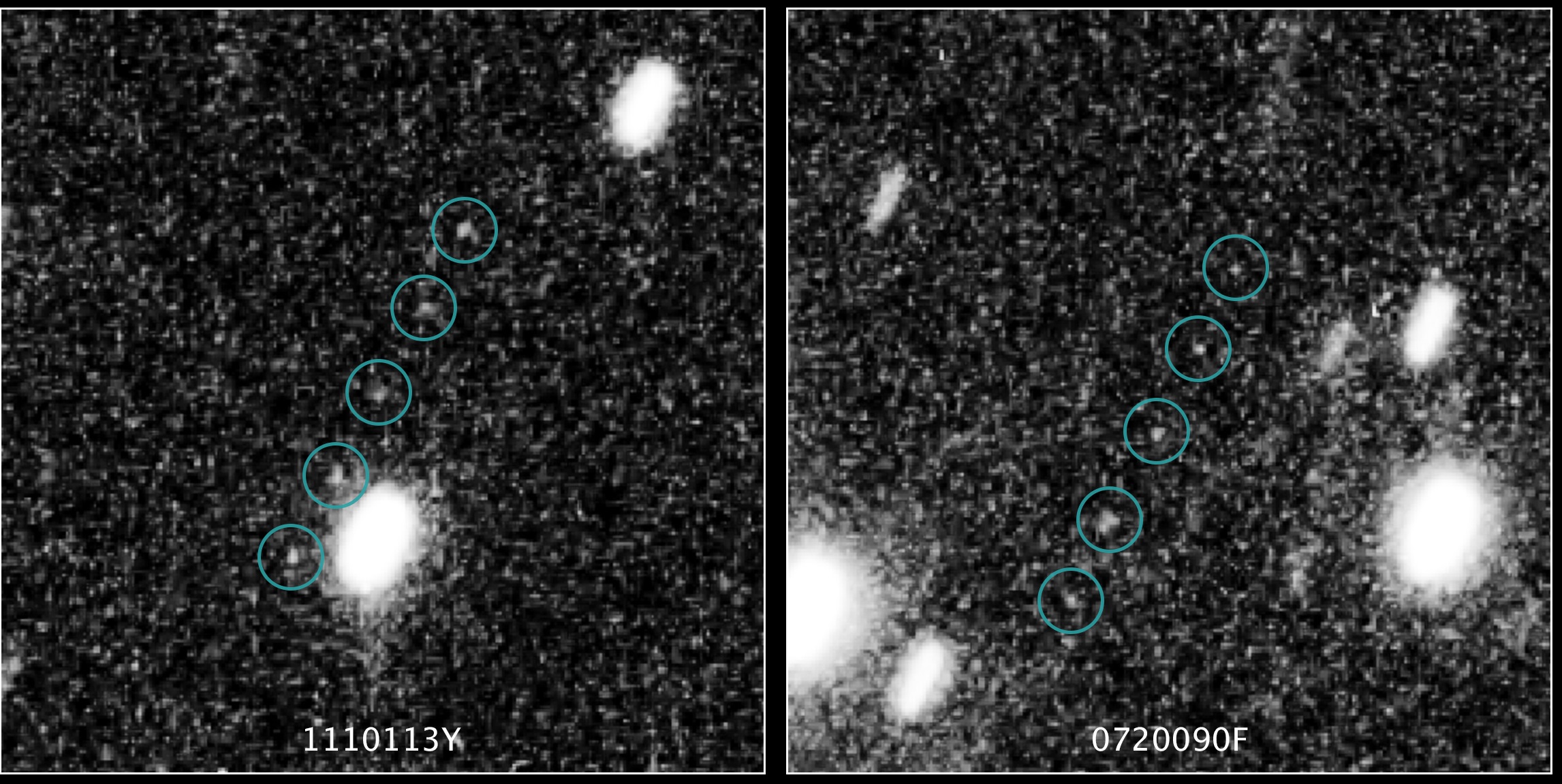
Two potential targets for the New Horizons mission emerge in these Hubble Space Telescope multiple-exposure images. Both are about four billion miles (6.4 billion kilometers) away. NASA, ESA, SwRI, JHU/APL, and the New Horizons KBO Search Team


Two potential targets for the New Horizons mission emerge in these Hubble Space Telescope multiple-exposure images. Both are about four billion miles (6.4 billion kilometers) away. NASA, ESA, SwRI, JHU/APL, and the New Horizons KBO Search Team
The Kuiper Belt is a collection of icy bodies past Neptune’s orbit. These small worlds are believed to be building blocks of the Solar System, showing off a time billions of years ago when there were no planets or moons — just chunks of rocks and ice, which slowly collided and coalesced over millions of years to form the familiar landscape we see today.

New Horizons team members plan to ask for more money for this mission in late 2016, as they gather information via the Hubble Space Telescope and other sources to make their case. (They already have some targets in mind.) But the focus will definitely be on Pluto in the coming months.

Next year, by the way, will see another planned close encounter with a dwarf planet when NASA’s Dawn spacecraft gets to Ceres in the spring.


About 

Elizabeth Howell is the senior writer at Universe Today. She also works for Space.com, Space Exploration Network, the NASA Lunar Science Institute, NASA Astrobiology Magazine and LiveScience, among others. Career highlights include watching three shuttle launches, and going on a two-week simulated Mars expedition in rural Utah. You can follow her on Twitter @howellspace or contact her at her website.

Workaholic Hubble Telescope Will Eventually Burn To Death: Report

Workaholic Hubble Telescope Will Eventually Burn To Death: Report:


The Hubble Space Telescope viewed by the STS-125 shuttle repair crew in 2009. Credit: NASA


The Hubble Space Telescope viewed by the STS-125 shuttle repair crew in 2009. Credit: NASA
The Hubble Space Telescope has delivered an amazing near quarter-century of science from all over the universe. Even this year, it’s delivered results to think about: the shrinking Great Red Spot on Jupiter (see picture below), helping New Horizons hunt for flyby targets after Pluto, and enhancing our view of deep space.

But that didn’t come cheap. Four astronaut servicing missions (including one to fix a mirror that was launched with myopia) were required to keep the telescope going since 1990. Hubble has never been more scientifically productive, according to a recent NASA review, but a new article asks if Hubble is destined to die a fiery death when its orbit decays in the next eight to 10 years.

“NASA doesn’t have any official plans for upgrading the telescope, meaning its hardware will grow old and out-of-date in the coming years,” reads the article in Popular Science. “Without assistance, Hubble can’t maintain its orbit forever, and eventually Earth’s gravity will pull the telescope to a fiery death.”

That’s not to say NASA is going to abandon the cosmos — far from it. Besides NASA’s other space telescopes, the successor James Webb Space Telescope is planned to launch in 2018 to chart the universe in other wavelengths. But a review from April warns that ceasing operations of Hubble would not be prudent until James Webb is up, running, and doing its own work productively. That’s a narrow window of time considering Hubble is expected to work well until about 2020.


The Hubble Space Telescope shows the shrinking size of Jupiter's Great Red Spot in this series of images taken between 1995 and 2014. Credit: NASA, ESA, and A. Simon (Goddard Space Flight Center)


The Hubble Space Telescope shows the shrinking size of Jupiter’s Great Red Spot in this series of images taken between 1995 and 2014. Credit: NASA, ESA, and A. Simon (Goddard Space Flight Center)
The Hubble Space Telescope senior review panel submitted a report on March that overall praised the observatory’s work, and which also talked about its potential longevity. As is, Hubble is expected to work until at least 2020, the review stated. The four science instruments are expected to be more than 85% reliable until 2021, and most “critical subsystems” should exceed 80% until that same year.

The report urges that experienced hands are kept around as the telescope degrades in the coming years, but points out that Hubble has backups that should keep the observatory as a whole going for a while.

There are no single-point failure modes on Hubble that could take down the entire observatory. It has ample redundancy. Planned mitigations for numerous possible sub-system failures or degraded performance have been developed in advance via the project’s Life-Extension Initiatives campaign. Hubble will likely degrade gracefully, with loss or degradation of individual science instrument modes and individual sub-system components.
In NASA’s response to the Senior Review for several missions (including Hubble), the agency said that the telescope has been approved (budgetarily speaking) until 2016, when an incremental review will take place. Further in the future, things get murky.


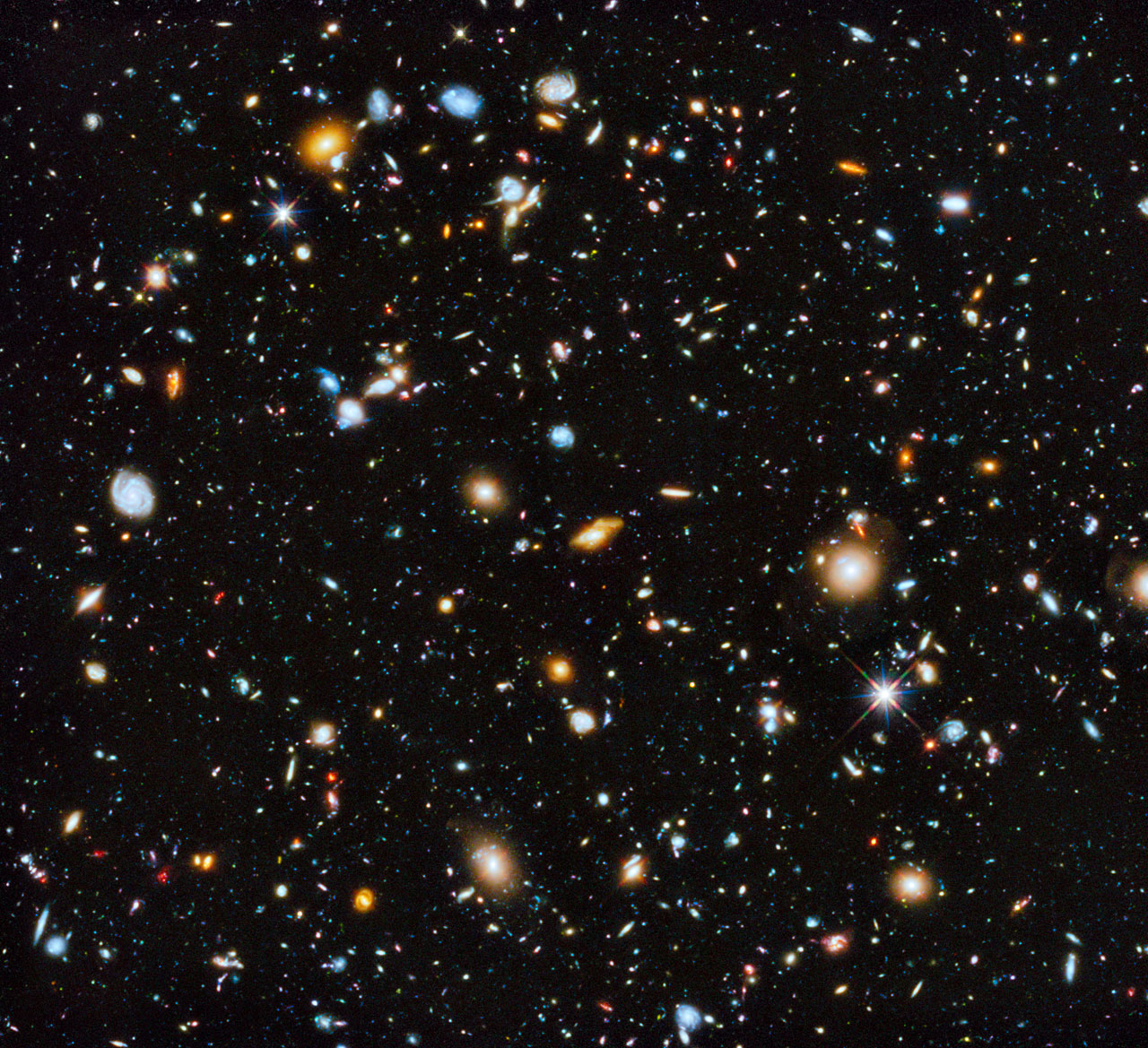
The Hubble Ultra Deep Field seen in ultraviolet, visible, and infrared light. Image Credit: NASA, ESA, H. Teplitz and M. Rafelski (IPAC/Caltech), A. Koekemoer (STScI), R. Windhorst (Arizona State University), and Z. Levay (STScI)


The Hubble Ultra Deep Field seen in ultraviolet, visible, and infrared light. Image Credit: NASA, ESA, H. Teplitz and M. Rafelski (IPAC/Caltech), A. Koekemoer (STScI), R. Windhorst (Arizona State University), and Z. Levay (STScI)
The just-tested Orion spacecraft won’t be ready to take crews until the mid-2020s, and so far (according to the Popular Science article) the commercial crew program isn’t expected to include a servicing mission.

According to STS-125 astronaut Michael Good, who currently serves in the Commercial Crew Program, the space agency isn’t looking into the possibility of using private companies to fix Hubble, but he says there’s always a chance that could happen. “One of the reasons we’re doing Commercial Crew is to enable this capability to get into lower Earth orbit,” says Good. “But it’s certainly in the realm of possibility.”
Much can happen in a decade — maybe a surge in robotic intelligence would make an automated mission more possible — but then there is the question of priorities. If NASA chooses to rescue Hubble, are there other science goals the agency would need to push aside to accomplish it? What is best? Feel free to leave your feedback in the comments.


About 

Elizabeth Howell is the senior writer at Universe Today. She also works for Space.com, Space Exploration Network, the NASA Lunar Science Institute, NASA Astrobiology Magazine and LiveScience, among others. Career highlights include watching three shuttle launches, and going on a two-week simulated Mars expedition in rural Utah. You can follow her on Twitter @howellspace or contact her at her website.

C/2014 Q2 Lovejoy – A Binocular Comet in Time for Christmas

C/2014 Q2 Lovejoy – A Binocular Comet in Time for Christmas:


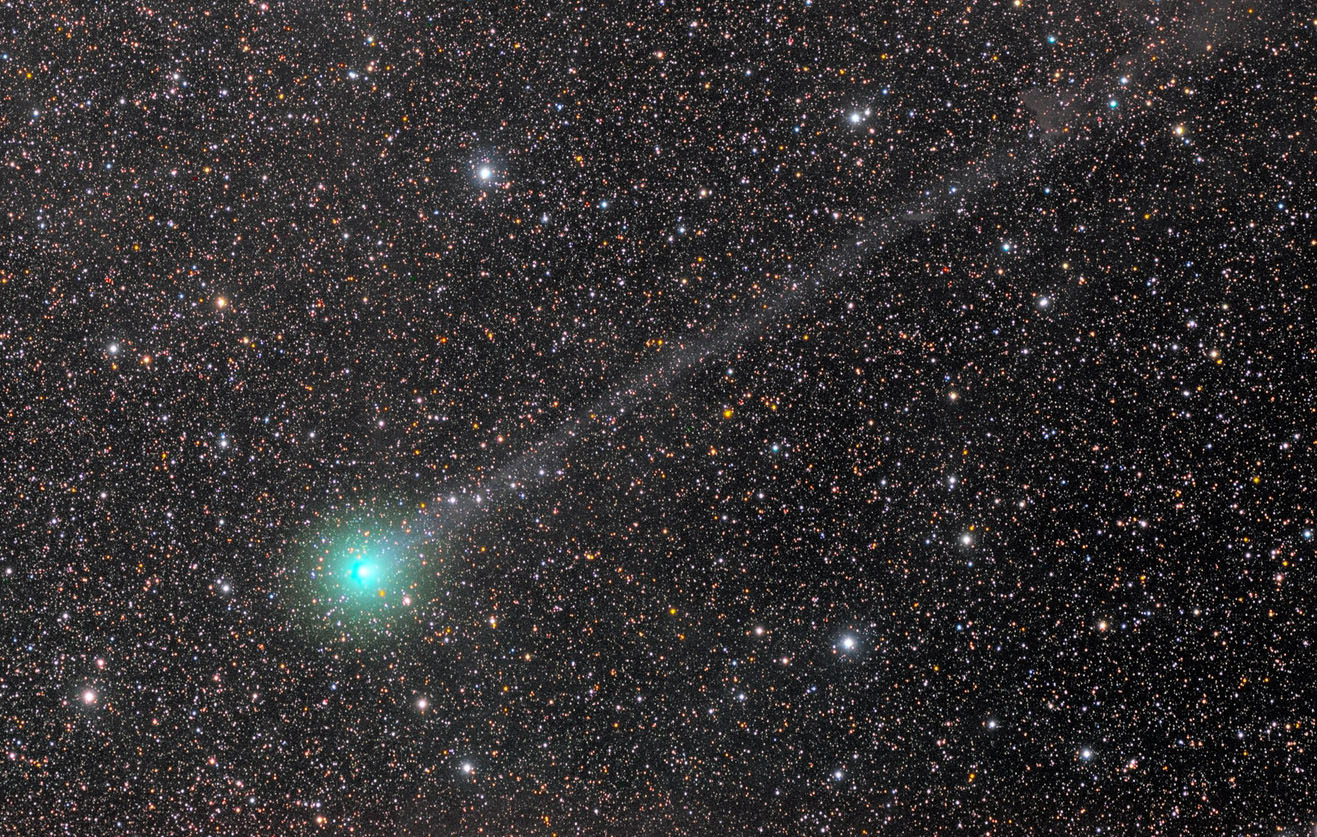
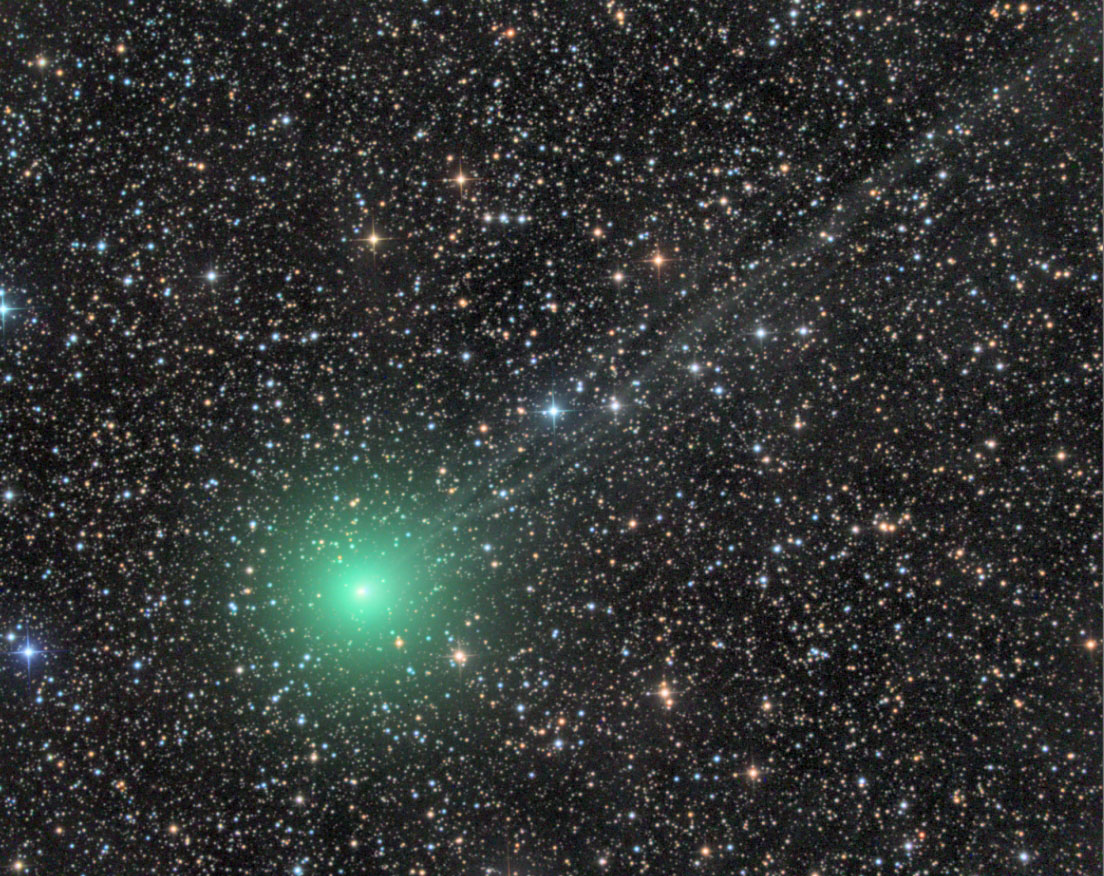
Like a Christmas ornament dangling from string, Comet Lovejoy Q2 is headed north and coming into good view for northern hemisphere observers in the next two weeks. This photo was taken on November 26th. Credit: Rolando Ligustri


Like a Christmas ornament dangling from string, Comet Lovejoy Q2 is just now coming into good view for northern hemisphere observers. This photo was taken on November 26th and shows a bright coma and long, delicate ion tail. Credit: Rolando Ligustri
Hmmm. Something with a long white beard is making an appearance in northern skies this week. Could it be Santa Claus? No, a bit early for the jolly guy yet, but comet watchers will soon find a special present under the tree this season.  Get ready to unwrap Comet Lovejoy Q2, now bright enough to spot in a pair of 10×50 binoculars.


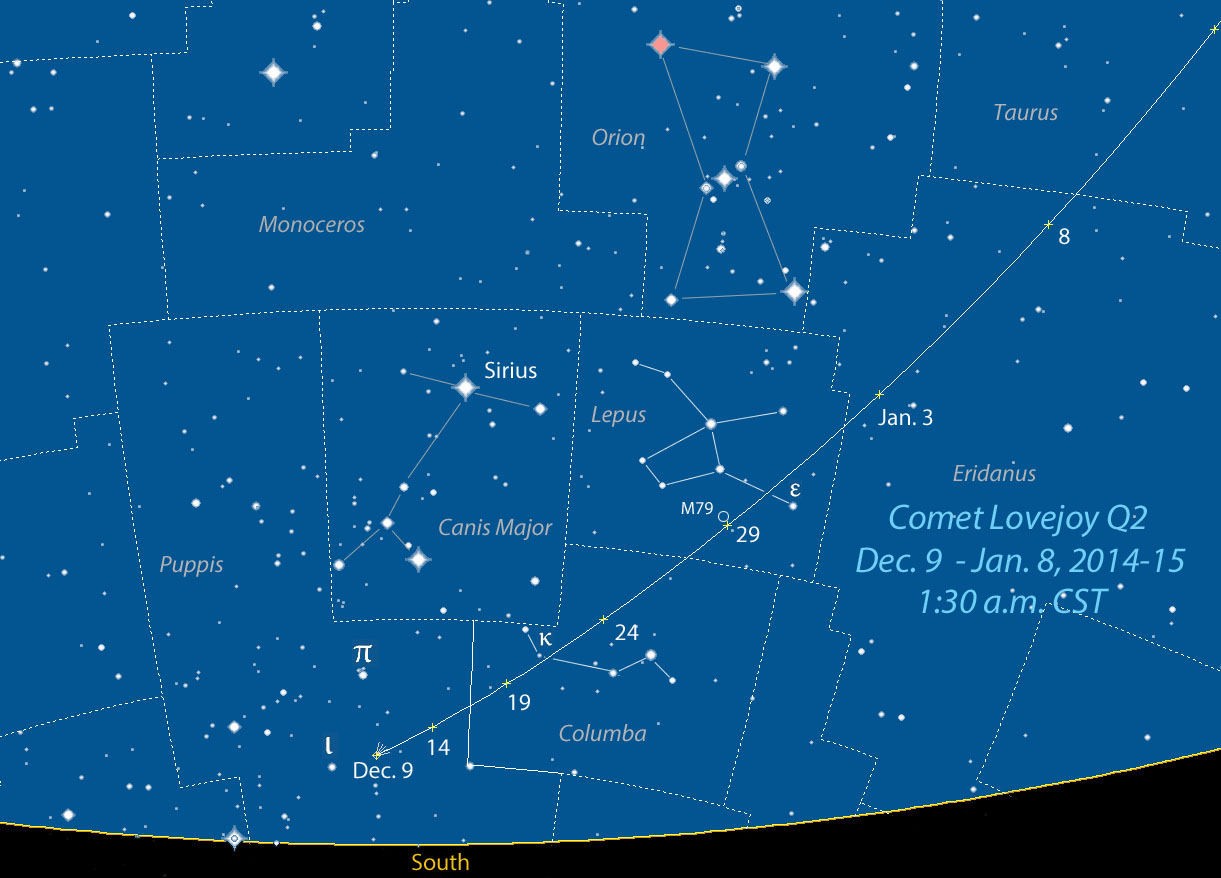
Comet Lovejoy Q2 starts out low in the southern sky below Canis Major this week but quickly zooms northward. Visibility improves with each passing night. Source: Chris Marriott's SkyMap software


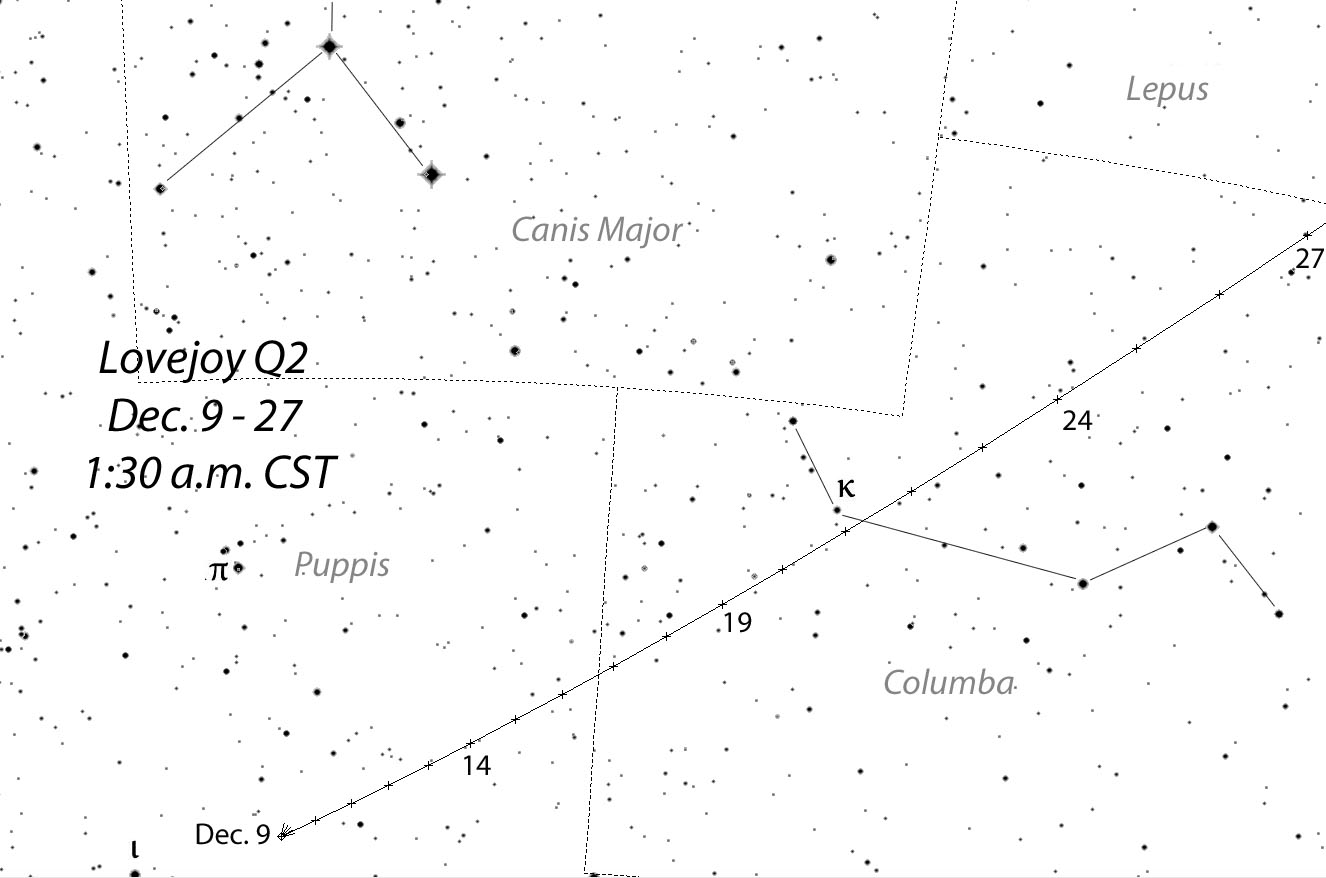
Comet Lovejoy Q2 starts out low in the southern sky in Puppis this week (6° max. altitude on Dec. 9) but quickly zooms north and west with each passing night. On the night of December 28-29, the comet will pass 1/3° from the bright globular cluster M79 in Lepus. This map shows the sky and comet’s position facing south from 42° north latitude around 1:30 a.m. CST. Source: Chris Marriott’s SkyMap software
Following a rocket-like trajectory into the northern sky, this visitor from deep space is no longer reserved for southern skywatchers alone. If you live in the central U.S., Lovejoy Q2 pokes its head from Puppis in the early morning hours this week. Glowing at magnitude +7.0-7.5, it’s a faint, fuzzy cotton ball in binoculars from a dark sky and visible in telescopes as small as 3-inches (7.5 cm). With the Moon past full and phasing out of the picture, comet viewing will continue to improve in the coming nights. What fun to watch Lovejoy gradually accelerate from its present turtle-like amble to agile cheetah as it leaps from Lepus to Taurus at the rate of 3° a day later this month. Why the hurry? The comet is approaching Earth and will pass nearest our planet on January 7th at a distance of 43.6 million miles (70.2 million km). Perihelion follows some three weeks later on January 30th.


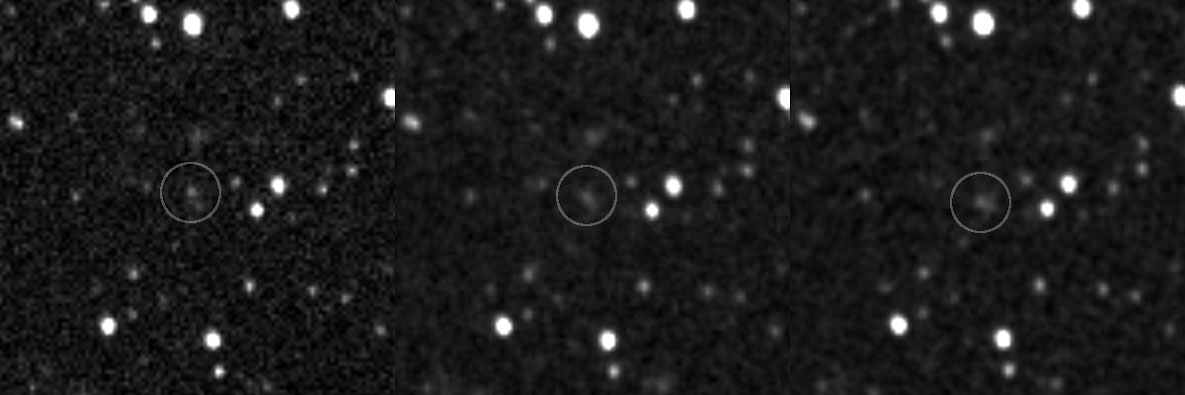
Image triplet taken by Terry Lovejoy on which he discovered the comet. The comet moves slightly counterclockwise around the larger fuzzy spot. Credit: Terry Lovejoy


Terry Lovejoy discovered the comet in this triplet of images taken on August 17th. The comet moves slightly counterclockwise around the larger fuzzy spot during the sequence. Credit: Terry Lovejoy
The new object is Australian amateur Terry Lovejoy’s 5th comet discovery. He captured images of the faint, 15th magnitude wisp on August 17th with a Celestron C-8 fitted with a CCD camera at his roll-off roof observatory in Brisbane, Australia. Comet Lovejoy Q2 has a period of about 11,500 years with an orbit steeply inclined to the plane of the Solar System (80.3°), the reason for its sharp northern climb. As December gives way to January the comet crosses from below to above the plane of the planets.


Another awesome shot of Comet Lovejoy Q2 taken on November 26, 2014. Gases in the coma fluoresce green in the Sun's ultraviolet light. Credit: Damian Peach


Another awesome shot of Comet Lovejoy Q2 taken on November 26, 2014. Gases in the coma including carbon and cyanogen fluoresce green in the Sun’s ultraviolet light. The comet’s moderately condensed coma currently measures about 8 arc minutes across or 1/4 the size of the full Moon. Credit: Damian Peach
Comet Lovejoy is expected to brighten to perhaps 5th magnitude as it approaches Earth, making it faintly visible with the naked eye from a dark sky site. Now that’s what I call a great way to start the new year!

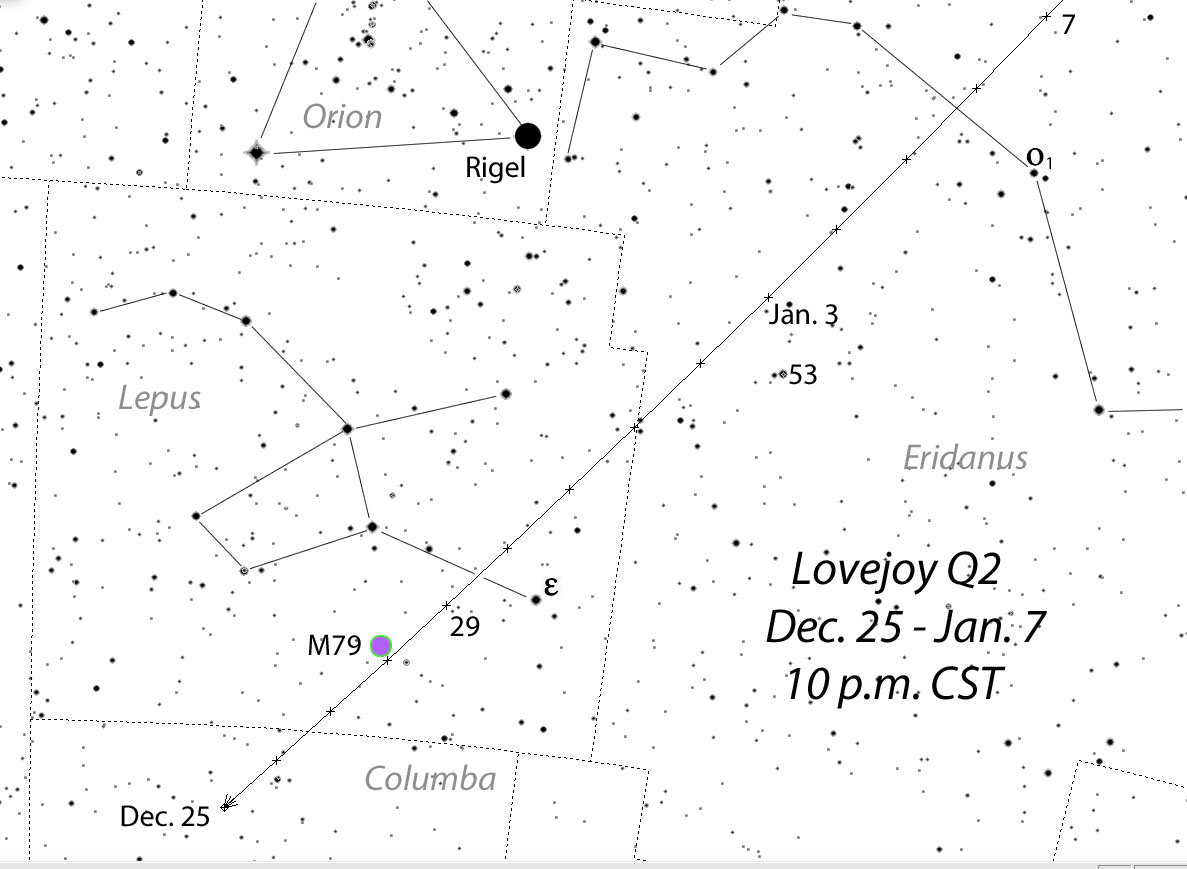
To help you find it, use the top map to get oriented; the detailed charts (below) show stars to magnitude +8.0. Click each to enlarge and then print out a copy for use at night. Bonus! Comet Lovejoy will pass only 10 arc minutes (1/3°) south of the 8th magnitude globular cluster M79 on December 28-29 – a great opportunity for astrophotographers and observers alike. Both comet and cluster will pose side by side in the same binocular and telescopic field of view. In early January I’ll post fresh maps to help you track the comet all through next month, too.


Detailed map showing the comet tomorrow morning through December 27th in the early morning hours (CST). Stars shown to magnitude +8.0. Source: Chris Marriott's SkyMap software


Detailed map showing the comet tomorrow December 9th through December 27th in the early morning hours (CST). Stars shown to magnitude +8.0. Source: Chris Marriott’s SkyMap software


Because Comet Lovejoy rapidly moves into the evening sky by mid-late December, its position on this detailed map is shown at 10 p.m. (CST) nightly. Credit:


Because Comet Lovejoy moves rapidly into the evening sky by mid-late December, its position on this detailed map is shown for 10 p.m. (CST) nightly. Credit: Chris Marriott’s SkyMap software


About 

I'm a long-time amateur astronomer and member of the American Association of Variable Star Observers (AAVSO). My observing passions include everything from auroras to Z Cam stars. Every day the universe offers up something both beautiful and thought-provoking. I also write a daily astronomy blog called Astro Bob.