Thursday, October 23, 2014

Water On The Moon Was Blown in by Solar Wind

Water On The Moon Was Blown in by Solar Wind:

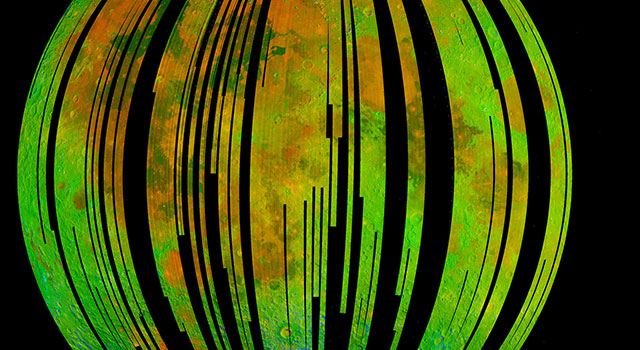
Near-infrared image of the Moon's surface by NASA's Moon Mineralogy Mapper on the Indian Space Research Organization's Chandrayaan-1 mission Image credit: ISRO/NASA/JPL-Caltech/Brown Univ./USGS


Near-infrared image of the Moon’s surface by the Indian Space Research Organization’s Chandrayaan-1 mission. Image credit: ISRO/NASA/JPL-Caltech/Brown Univ./USGS
When they first set foot on the Moon, the Apollo 11 astronauts painted a picture of the landscape as a bone-dry desert. So astronomers were naturally surprised when in 2009, three probes showed that a lot of water is locked up in minerals in the soil. There has been some debate as to where the water came from, but now two researchers with the National Museum of Natural History in Paris, France, have determined that most of the water in the soil on the surface of the Moon was formed due to protons in the solar wind colliding with oxygen in lunar dust, rather than from comet or meteorite impacts.


The first hints that there was water on the Moon came when India’s Chandrayaan-1 found hints of water across the lunar surface when it measured a dip in reflected sunlight at a wavelength absorbed only by water and hydroxyl, a molecule that contains one atom of hydrogen and one atom of oxygen.

To help clarify this picture, NASA scientists turned to data collected by two of their space probes – the Cassini probe, which buzzed the moon in 1999 on its way to Saturn, and NASA’s Deep Impact spacecraft, which flew past the moon in June 2009 en route to an encounter with the comet Hartley 2. Both spacecraft confirmed the evidence of water and hydroxyl, molecules that are likely both present on the moon.
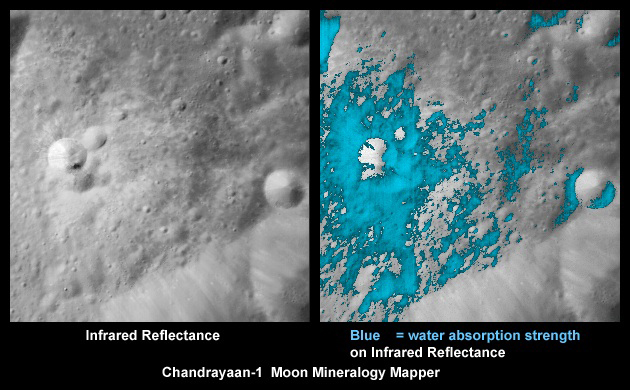
Lunar Crater as imaged by NASA's Moon Mineralogy Mapper. Image Credit: SRO/NASA/JPL-Caltech/USGS/Brown Univ.


Lunar Crater as imaged by NASA’s Moon Mineralogy Mapper. Image Credit: SRO/NASA/JPL-Caltech/USGS/Brown Univ.
There were three likely explanations as to how that water got there. Comets and meteorites were two possibilities, while others believed it may be caused by solar wind. In the latter case, the water would have been formed by streams of plasma emanating from the sun’s upper atmosphere and smashing high-energy protons into the moon’s surface. Cosmic rays from outside the solar system could inject ions into lunar rocks as well, causing chemical changes that create water.

To find out the likeliest source of the water, Alice Stephant and Francois Robert measured the ratio of hydrogen and deuterium in soil samples from the Apollo 16 and Apollo 17 missions. They ran the samples through a type of mass spectrometer that not only detects which isotopes are present but how deep down they are in a surface sample.

In studying tiny grains of lunar soil samples, they found that the reduction of oxygen from silicates in the soil by protons from the solar wind was almost certainly the means by which the water was generated. They came to that conclusion through determining the lithium isotope ratio in the samples which gave the isotope ratio for the hydrogen. From that, they were able to calculate the deuterium-hydrogen ratio which they compared to the amount of water actually in the granule sample.

Because there tends to be more deuterium further from the sun, each possible source of lunar water should give a different ratio. Comets and meteorites have distinctive proportions, while protons from the solar wind or cosmic rays would each have different ratios.

What they found was that on average, the granules contained just 15 percent water from somewhere else (presumably comets or meteorites) leaving the rest to have been formed due to the solar wind interaction. They note also that for some samples, all of the water was due to solar wind interaction.

“We confirm that result,” said Stephant. “Water-rich meteorite and comet impacts do not bring important amounts of water to the surface of the moon.”

Alberto Saal at Brown University in Providence, Rhode Island, is pleased with the result. “I think the idea that most of the water in the surface of the moon comes from solar wind implantations is most likely correct,” he says.

In their paper published in Proceedings of the National Academy of Sciences, Alice Stephant and François Robert describe their study and the results they found. However, they were also quick to point out that their conclusions only relate to water found on the surface of the moon – whereas the origin of the water below the surface is still open to interpretation.

Further reading: PNAS


About 

Author, freelance writer, educator, Taekwon-Do instructor, and loving hubby, son and Island boy!

MRO Spies Tiny, Bright Nucleus During Comet Flyby

MRO Spies Tiny, Bright Nucleus During Comet Flyby:

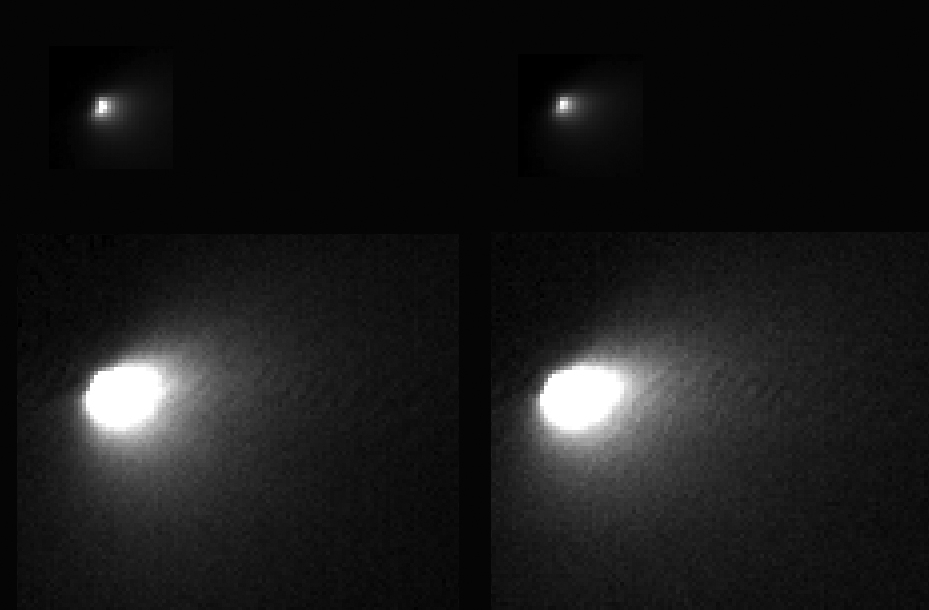
High resolution image pairs made with HiRISE camera on MRO during Comet Siding Spring's closest approach to Mars on October 19. Shown at top are images of the nucleus region and inner coma. Those at bottom were exposed to show the bigger coma beginning of a tail. Credit: NASA/JPL/Univ. of Arizona


High resolution image pairs made with HiRISE camera on MRO during Comet Siding Spring’s closest approach to Mars on October 19. Shown at top are images of the nucleus region and inner coma. Those at bottom were exposed to show the bigger coma and the beginning of a tail. Credit: NASA/JPL/Univ. of Arizona
Not to be outdone by the feisty Opportunity Rover, the HiRISE camera on NASA’s Mars Reconnaissance Orbiter (MRO) turned in its homework this evening with a fine image of comet C/2013 Siding Spring taken during closest approach on October 19.

The highest-resolution images were acquired by HiRISE at the minimum distance of 85,750 miles (138,000 km). The image has a scale of 453 feet (138-m) per pixel.

The top set of photos uses the full dynamic range of the camera to accurately depict brightness and detail in the nuclear region and inner coma. Prior to its arrival near Mars astronomers estimated the nucleus or comet’s core diameter at around 0.6 mile (1 km). Based on these images, where the brightest feature is only 2-3 pixels across, its true size is shy of 1/3 mile or 0.5 km. The bottom photos overexpose the comet’s innards but reveal an extended coma and the beginning of a tail extending to the right.

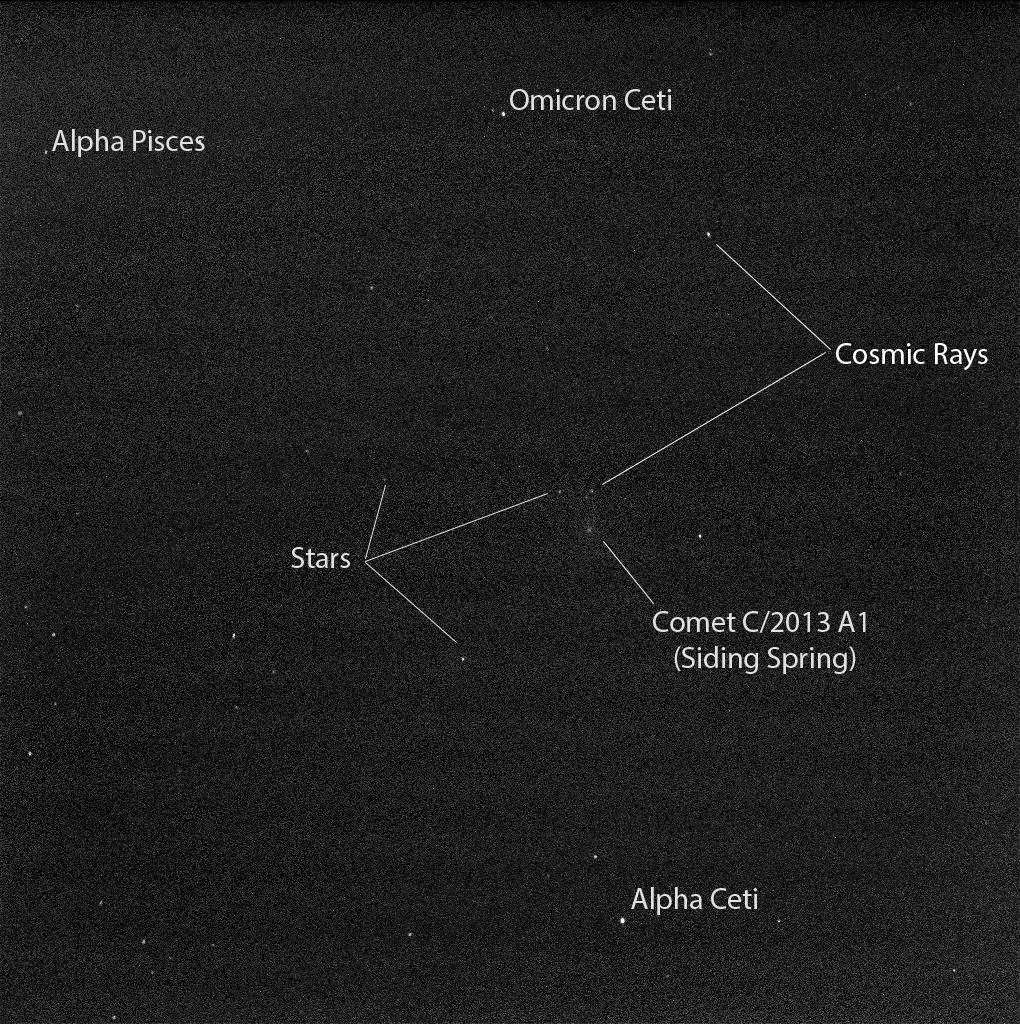
Annotated photo of Comet Siding Spring taken by the Opportunity Rover on October 19 when near closest approach. Credit: NASA/JPL-Caltech/Cornell Univ./ASU/TAMU


Annotated photo of Comet Siding Spring taken by the Opportunity Rover on October 19 when near closest approach. Credit: NASA/JPL-Caltech/Cornell Univ./ASU/TAMU
To photograph a fast-moving target from orbit, engineers at Lockheed-Martin in Denver precisely pointed and slewed the spacecraft based on comet position calculations by engineers at JPL. To make sure they knew exactly where the comet was, the team photographed the comet 12 days in advance when it was barely bright enough to register above the detector’s noise level. To their surprise, it was not exactly where orbital calculations had predicted it to be. Using the new positions, MRO succeeded in locking onto the comet during the flyby. Without this “double check” its cameras may have missed seeing Siding Spring altogether!

Meanwhile, the Jet Propulsion Lab has released an annotated image showing the stars around the comet in the photo taken by NASA’s Opportunity Rover during closest approach. From Mars’ perspective the comet passed near Alpha Ceti in the constellation Cetus, but here on Earth we see it in southern Ophiuchus not far from Sagittarius.

Comet Siding Spring continues on its way today past the planet Mars in this photo taken on October 20. Copyright: Rolando Ligustri


Comet Siding Spring continues on its way today past the planet Mars in this photo taken on October 20. Copyright: Rolando Ligustri
“It’s excitingly fortunate that this comet came so close to Mars to give us a chance to study it with the instruments we’re using to study Mars,” said Opportunity science team member Mark Lemmon of Texas A&M University, who coordinated the camera pointing. “The views from Mars rovers, in particular, give us a human perspective, because they are about as sensitive to light as our eyes would be.”

After seeing photos from both Earth and Mars I swear I’m that close to picturing this comet in 3D in my mind’s eye. NASA engineers and scientists deserve a huge thanks for their amazing and successful effort to turn rovers and spacecraft, intended for other purposes, into comet observatories in a pinch and then deliver results within 24 hours. Nice work!


About 

I'm a long-time amateur astronomer and member of the American Association of Variable Star Observers (AAVSO). My observing passions include everything from auroras to Z Cam stars. Every day the universe offers up something both beautiful and thought-provoking. I also write a daily astronomy blog called Astro Bob.

How to Take Great Photographs of the October 23rd Partial Solar Eclipse and More

How to Take Great Photographs of the October 23rd Partial Solar Eclipse and More:

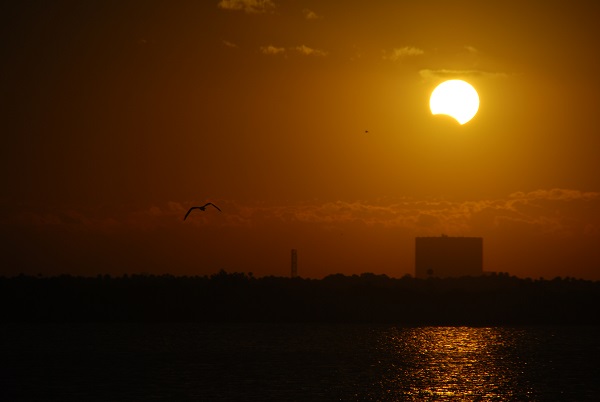
The Partially eclipsed Sun rising over the Vehicle Assembly Building on the Florida Space Coast on November 3rd, 2013.


The partially eclipsed Sun rising over the Vehicle Assembly Building on the Florida Space Coast on November 3rd, 2013. Photo by author.
Get those solar viewers out… the final eclipse of 2014 occurs this Thursday on October 23rd, and most of North America has a front row seat. Though this solar eclipse will be an exclusively partial one as the Moon takes a ‘bite’ out the disk of the Sun, such an event is always fascinating to witness. And for viewers across the central U.S. and Canada, it will also provide the chance to photograph the setting crescent Sun along with foreground objects.

Michael Zieler


A map showing the eclipse prospects over the CONUS. (click to enlarge). Credit: Michael Zeiler @EclipseMaps, www.thegreatamericaneclipse.com.
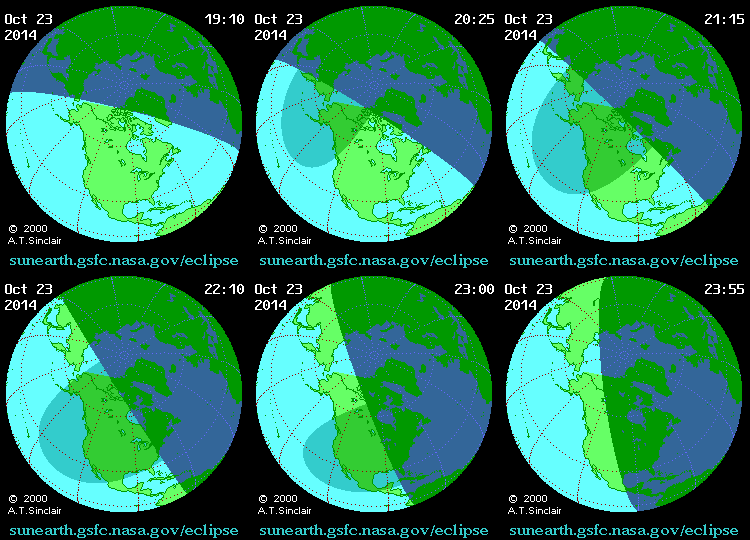
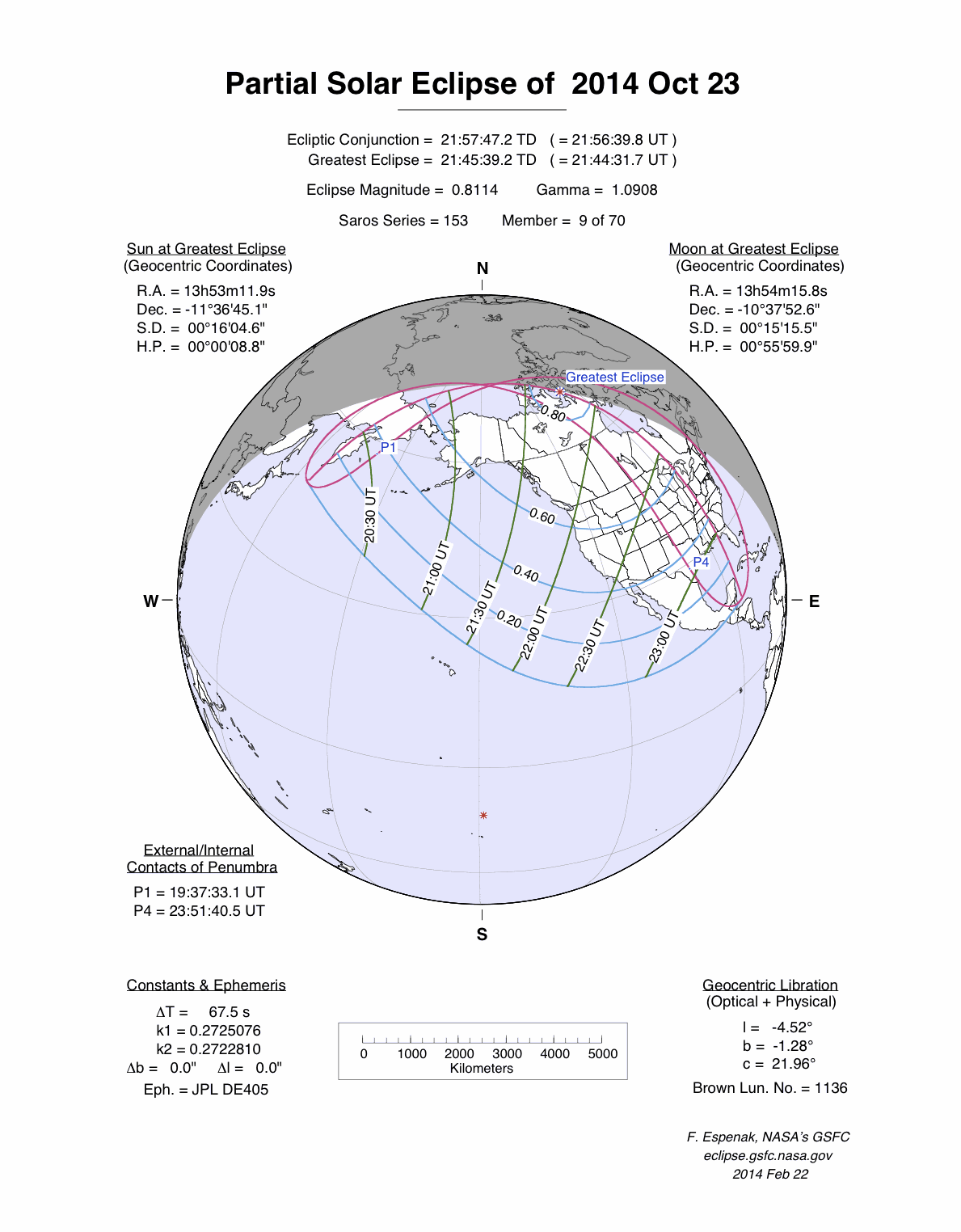
The shadow or ‘antumbra’ of the Moon just misses northern limb of the Earth on October 23rd, resulting in a solar eclipse that reaches a maximum of 81% partial as seen from the high Canadian Arctic. The eclipse would be annular in any event had the Moon’s shadow touched down on Earth’s surface, as the Moon just passed apogee on October 18th. The penumbral cone of the Moon’s shadow touches down at 19:38 UT in the Bering Sea just west of the International Date Line before racing eastward across North America to depart the Earth over southern Texas at 23:52 UT.

NASA/GSFC


An animated .gif of this week’s partial solar eclipse.  Credit: NASA/GSFC/A.T. Sinclair.
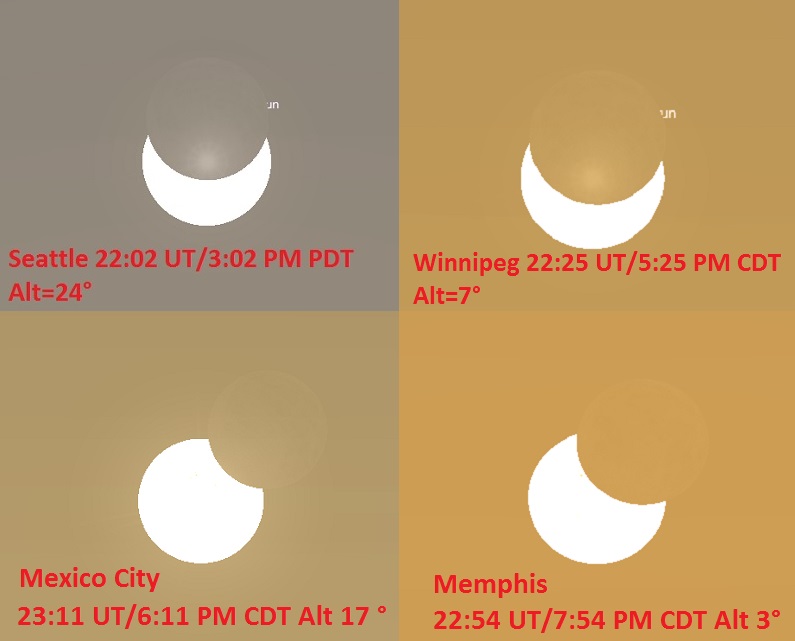
The farther northwest you are, the greater the eclipse: For example, Anchorage and Seattle will see 54.8% and 54.5% of the Sun obscured by the Moon, while Mexico City and Phoenix, Arizona will see 4.8% and 33% of the Sun’s disk obscured.

A key region will be the zone of longitude running a few hundred miles east and to the west of Ontario, the Great Lakes and the Mississippi River, which will see the Sun setting during greatest eclipse.

Stellarium


Simulated views of the October 23rd partial solar eclipse from around North America. Created using Stellarium.
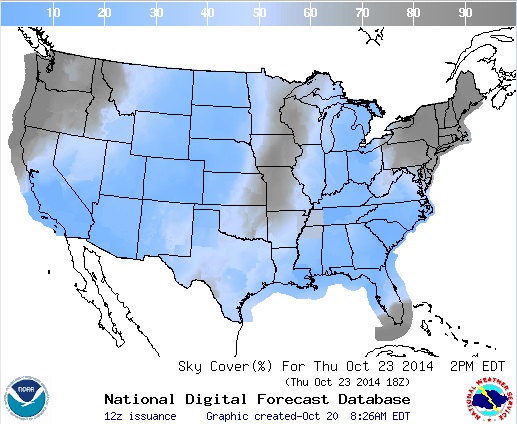
Successful sunset viewing of the eclipse will call for a clear, uncluttered western horizon. As of 48+ hours out, the current weather prospects call for clear skies across most of the U.S. on Thursday, with the exception of the U.S. northwest… but you only need a gap in the clouds to observe an eclipse!

NOAA


Predicted cloud cover for the CONUS hours prior to the start of the Oct 23 partial solar eclipse. Credit: NWS/NOAA.
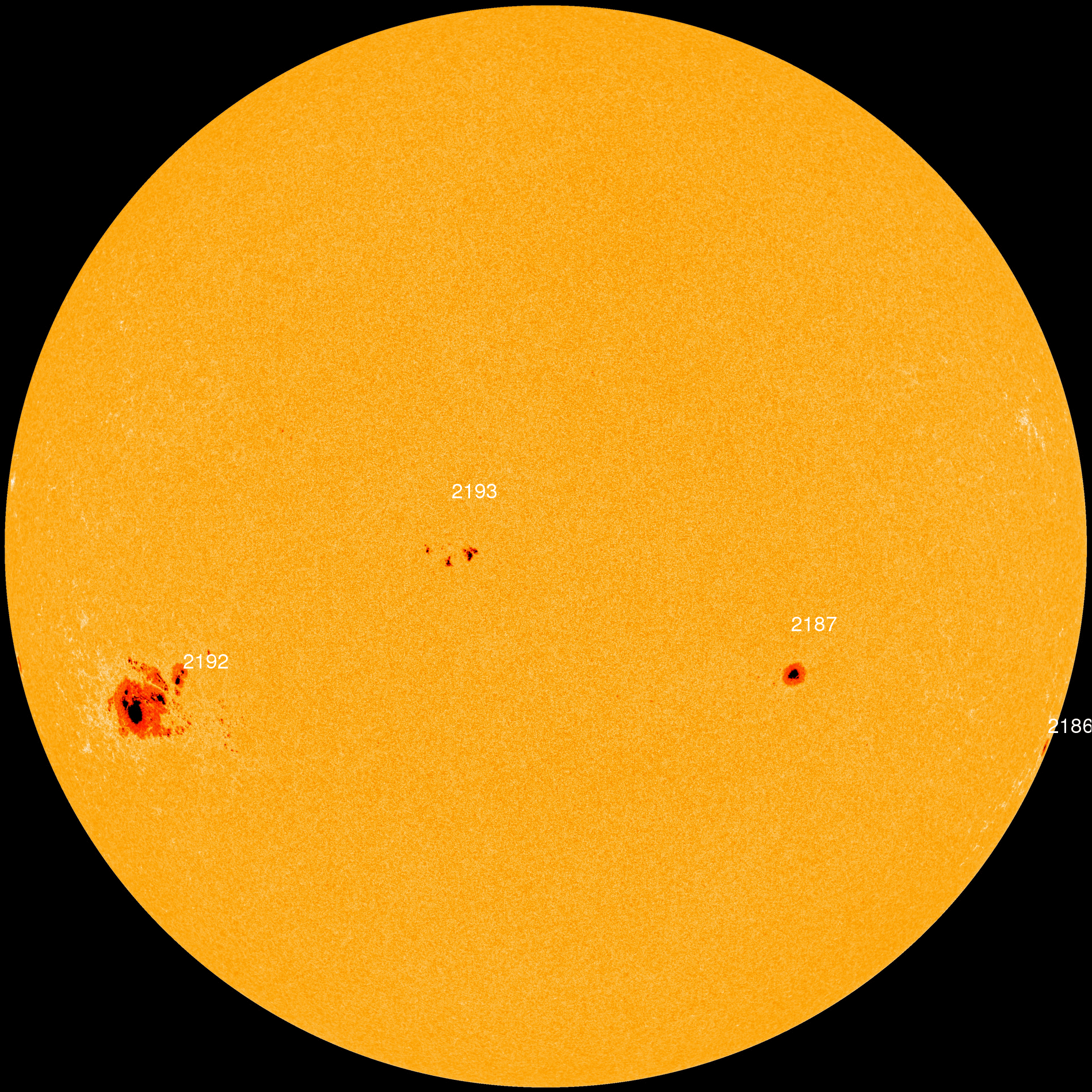
It’s also worth noting that massive sunspot region AR 2192 is currently turned Earthward and will make for a very active and photogenic Sun during Thursday’s eclipse.

SDO/HMI


Sunspot activity leading up to this week’s eclipse. Credit: NASA/SDO/HMI
Proper safety precautions must be taken while observing the Sun through all stages of a partial solar eclipse. Don’t end up like 19th century psychologist Gustav Fechner, who blinded himself staring at the Sun! With the recent interest in the event, we’ve been fielding lots of questions on eclipse imaging, which presents safety challenges of its own.

blogger-image-845084267


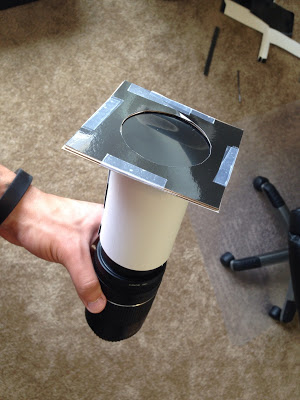
An homemade solar optical filter using Baader film. Credit: Eric Teske/Stellar Neophyte.
Imaging the Sun with a solar filter is pretty straightforward. Glass solar filters for telescopes fitting over the full aperture of the instrument can be had from Orion for about $100 USD, and we’ve made inexpensive filter masks out of Baader AstroSolar Safety Film for everything from binoculars to DLSR cameras to telescopes. Make sure these fit snugly in place, and inspect them for pin holes prior to use. Also, be sure to cover or remove any finderscopes as well. And throw away those old screw-on eyepiece filters sold by some department store scope manufacturers in the 60s and 70s, as they can overheat and crack!

Catching the eclipsed Sun with a silhouetted foreground requires more practice. We’ve had great luck using a DSLR and a neutral density filter to take the f-stop and glare down while preserving the foreground view. Remember, though, an ND filter is for photographic use only… never stare at the Sun through one! Likewise, you’ll need to physically block off your camera’s viewfinder to resist the same temptation of looking while aiming. Shooting several quick frames at 1/1000th of a second or faster will help get the ISO/f-stop settings for the local illumination just right. Even 1% sunlight is surprisingly bright, as we noticed observing the May 10th 1994 annular eclipse from the shores of Lake Erie.

You’ll also need a lens with a focal length of 200mm or better to have the Sun appear larger than a dot in your images. Several key landmarks, such as the Saint Louis Arch and the Sears Tower in Chicago lie along the key sunset zone Thursday and  would make great potential foreground shots… our top pick would be the 1978 World’s Fair Sunsphere Tower in Knoxville, Tennessee for a photo with a true visual double entendre. Scout out the geometry of such a shot the evening beforehand, and remember that you’ll need a good amount of distance (half a mile or more) for a building or foreground object to appear equal in size to the Sun.

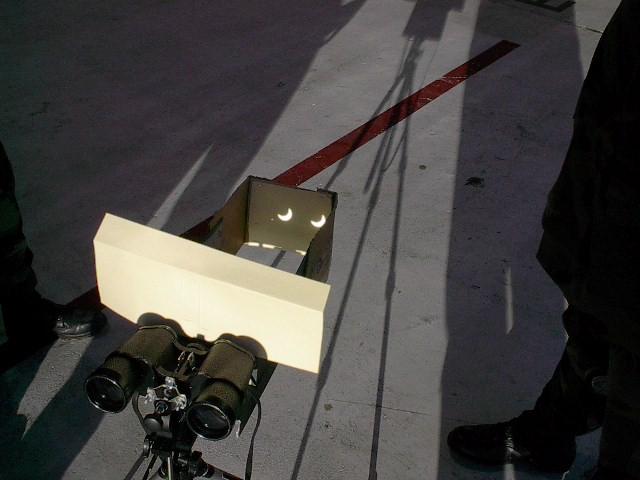
And don’t miss the spectacle going on around you during an eclipse as well. Projecting the disk of the Sun using a pinhole camera or binoculars onto a piece of paper makes for a great shot. Hundreds of crescents may litter the ground, caused by natural “pinhole projectors” such as gaps in leaves or latticework. And photographs of everyday folks wearing eclipse glasses standing enthralled by the ongoing event can be just as captivating as the eclipse itself.

Photo by author


Imaging a partial solar eclipse via a homemade shoebox binocular projector. Photo by author.
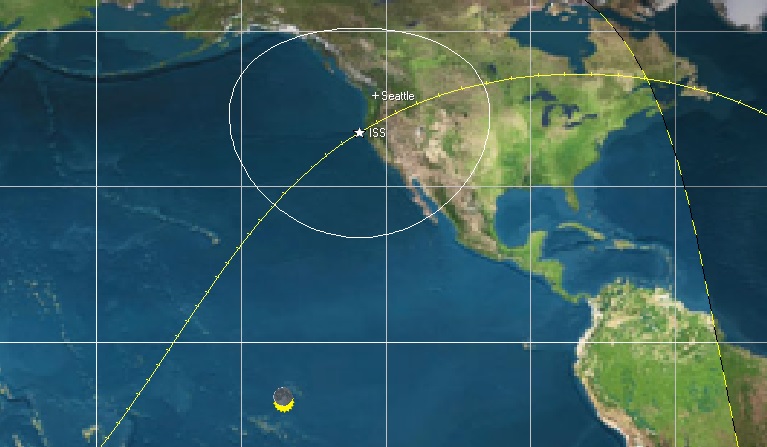
Up for a challenge? Another unique opportunity awaits eclipse viewers in the northwest, as the International Space Station will cross the disk of the Sun around ~21:08 UT during the eclipse. You’ll need to run video to catch such a speedy (about a second in duration) event, but it would make for a great capture! Be sure to check CALSky for predictions of ISS solar and lunar transits within 48 hours of the event.

ISS path


The path of the ISS over the US during the partial eclipse. Credit: Orbitron.
Robotic eyes in low Earth orbit will be watching the eclipse as well. JAXA’s Hinode and ESA’s Proba-2 routinely observe the Sun and will catch fleeting eclipses on successive passes on Thursday… in the case of Hinode, it may score a direct “hit” with an annular eclipse seen from space around 21:03 UT:


And don’t forget, we’re now less than three years out from the next total solar eclipse to (finally!) grace the United States from coast to coast on August 21st, 2017. This week’s partial solar eclipse offers a great test run to hone your photographic technique!

-Send those eclipse pics in to Universe Today’s Flickr forum.


About 

David Dickinson is an Earth science teacher, freelance science writer, retired USAF veteran & backyard astronomer. He currently writes and ponders the universe from Tampa Bay, Florida.

Could ‘Heavy Metal’ Frost Lurk Beneath Venus’ Hothouse Clouds?

Could ‘Heavy Metal’ Frost Lurk Beneath Venus’ Hothouse Clouds?:

A radar view of Venus taken by the Magellan spacecraft, with some gaps filled in by the Pioneer Venus orbiter. Credit: NASA/JPL

A radar view of Venus taken by the Magellan spacecraft, with some gaps filled in by the Pioneer Venus orbiter. Credit: NASA/JPL
Talk about using old data for a new purpose! Researchers re-examining information from the completed NASA Magellan mission found signs of what could be “heavy metal” frost on the hell-like surface. What the researchers saw in radio-wave reflectance is the highlands appear brighter, with dark spots in the tallest locations.

What substance exactly is causing the patches on the surface is unknown, and it is extremely hard to make predictions given the difficulty of simulating Venus’ 900-degree Fahrenheit (500-degree Celsius) surface temperature, which is also 90 times Earth’s air pressure at sea level.

“Like on Earth, the temperature changes with elevation,” stated Elise Harrington, an Earth sciences undergraduate at British Columbia’s Simon Fraser University who led the research. “Among the possibilities on Venus are a temperature dependent chemical-weathering process or heavy metal compound precipitating from the air – a heavy metal frost.”

Venus' volcano Sapas Mons, which was imaged by the Magellan mission in 1991. Credit: NASA


Venus’ volcano Sapas Mons, which was imaged by the Magellan mission in 1991. Credit: NASA
Scrutiny of a previously examined area on Venus, the Odva Regio highlands, saw a low radar reflection at 2,400 meters (7,900 feet), which progressively gets brighter until dark spots begin appearing and reflections drop at 4,700 meters (15,400 meters).

While previous research spotted a few of these patches, Harrington and supervisor Allan Treiman (Lunar and Planetary Institute) saw hundreds. There’s no radar-imaging spacecraft in orbit around Venus right now, but the authors hope that the finding will generate more interest in this planet. (Of note, the European Space Agency’s Venus Express is finishing up a mission there now, which included several daring atmosphere-skimming maneuvers earlier this year.)

The research was presented at the Geological Society of America meeting in Vancouver, British Columbia.

Source: Geological Society of America


About 

Elizabeth Howell is the senior writer at Universe Today. She also works for Space.com, Space Exploration Network, the NASA Lunar Science Institute, NASA Astrobiology Magazine and LiveScience, among others. Career highlights include watching three shuttle launches, and going on a two-week simulated Mars expedition in rural Utah. You can follow her on Twitter @howellspace or contact her at her website.

How NASA and SpaceX are Working Together to Land on Mars

How NASA and SpaceX are Working Together to Land on Mars:

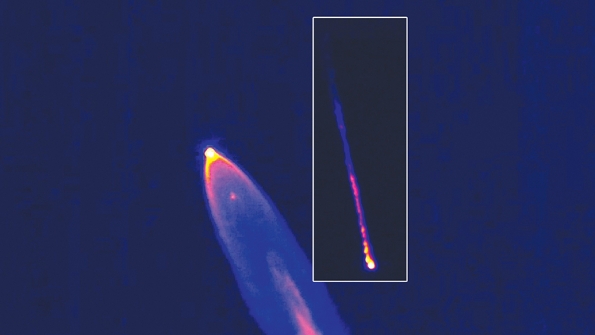
Thermal imagery of Falcon 9 rocket. Image Credit: NASA/Scifli Team/Applied Physics Laboratory Images


Thermal imagery of Falcon 9 rocket. Image Credit: NASA/Scifli Team/Applied Physics Laboratory Images
It is no secret that NASA is seeking out private space contractors to help bring some of its current plans to fruition. Naturally, these involve restoring indigenous launch capabilities to the US, but also include the more far-reaching goal of sending astronauts to Mars. Towards that end, NASA and SpaceX participated in an unprecedented data-sharing project that will benefit them both.

The project took place on Sept. 21st when, after multiple attempts, NASA and the U.S. Navy used a series of IR tracking cameras to capture footage of one of SpaceX’s Falcon 9 reusable rockets in flight. The cameras recorded the rocket as the second stage engine ignited and the first stage,  having detached and fallen away, reignited its engines to lower itself  back to Earth for a zero-g touchdown on the sea surface.

The resulting data is being shared between the two parties and will benefit them both.

For SpaceX, the benefit comes in the form of the detailed information NASA is providing on temperatures and aerodynamic loading on the Falcon 9 rocket, which will help them in their efforts to develop a reusable rocket system. For NASA, engineers are getting a chance to collect data on supersonic retro-propulsion that may one day help them to lower massive, multi-ton payloads onto the surface of Mars.

“Because the technologies required to land large payloads on Mars are significantly different than those used here on Earth, investment in these technologies is critical,” said Robert Braun, principal investigator for NASA’s Propulsive Descent Technologies (PDT) project and professor at the Georgia Institute of Technology in Atlanta. He’s also NASA former Chief Technologist. “This is the first high-fidelity data set of a rocket system firing into its direction of travel while traveling at supersonic speeds in Mars-relevant conditions. Analysis of this unique data set will enable system engineers to extract important lessons for the application and infusion of supersonic retro-propulsion into future NASA missions.”

Supersonic retro-propulsion basically means generating supersonic thrust to shed velocity after atmospheric entry. Alongside aerobraking, this is one of the proposed means of landing heavy equipment and habitats on Mars.

Braun is certainly no stranger to the concept. After returning to Georgia Tech, Braun – a specialist in entry, descent and landing (EDL) – worked with engineers from the university and various NASA centers to develop a proposal for a program to flight-test this concept.

At the time, NASA’s Space Technology Mission Directorate (STMD) rejected the plan for being too expensive, but the agency still needs a way to land payloads in excess of 20 tons if ever it wants to mount a human expedition to Mars. And given that the proposed mission is due to take place within the next 16 years, the more information they obtain now, the better.

In Depth: The Mars Landing Approach: The Problems of Landing Large Payloads on the Surface of Mars

Hence the decision to partner with SpaceX. Basically, the PDT Project struck a deal to use airborne infrared-imaging techniques – developed to study the Space Shuttle in flight after the Columbia accident – to gather data on the supersonic retro-propulsion SpaceX is currently using for its reusable launch vehicle development.

This sort of collaboration is without precedent, and as Braun told Universe Today via email, stands to benefit both participants immensely:

“This is the first high-fidelity data set of a rocket system firing into its direction of travel while traveling at supersonic speeds in Mars-relevant conditions. The synergy between NASA’s interest in improving its Mars entry, descent and landing capability and Space X’s interest and experimental operation of a reusable space transportation system provided a unique opportunity to obtain this data at low cost. Analysis of this unique data set will enable system engineers to extract important lessons for the infusion of supersonic retropropulsion into future NASA missions that may one day lower large payloads to the Mars surface while providing SpaceX with engineering insight to advance its development of a reusable space transportation system.”
After unsuccessful attempts to image the rocket on two previous missions – April 18 and July 14 – the project succeeded with the CRS-4 flight on Sept. 21st. Launched at night, NASA relied on two aircraft –  a WB-57 and a NP-3D Orion – equipped with mid-wave IR sensors to document re-entry of the rocket’s first stage.

The first stage is the part of the rocket that is ignited at launch and burns through the rocket’s ascent until it runs out of propellant, at which point it is discarded from the second stage and returns to Earth. It was during its return, or descent, that NASA captured quality infrared and high definition images and monitored changes in the smoke plume as the engines were turned on and off.

Watch the video of the footage:


For NASA, the period of the flight most relevant for future operations over Mars came when the first stage was traveling at about Mach 2 some 30,000 – 45,000 meters (100,000-150,000 ft.) above the surface. The two midwave IR sensors – mounted in a nose pod on the WB-57 and internally on the NP-3D – were about 60 nautical miles from the rocket when it reignited its engines for supersonic retro-propulsion.

That produced raw images in which the stage appeared 1 pixel wide and 10 pixels long, but subsequent enhancing by specialists at the Johns Hopkins University Applied Physics Laboratory improved the resolution dramatically.

“NASA’s interest in building our Mars entry, descent and landing capability and SpaceX’s interest and experimental operation of a reusable space transportation system enabled acquisition of these data at low cost, without standing up a dedicated flight project of its own,” said Charles Campbell, PDT project manager at NASA’s Johnson Space Center in Houston.

Engineers at NASA and SpaceX are now correlating that data with company telemetry from the Sept. 21st Falcon 9 launch of a Dragon cargo carrier to the International Space Station to learn exactly what the vehicle was doing in terms of engine-firing and maneuvering when it generated the signatures collected by the aircraft.

Further Reading: NASA


About 

Author, freelance writer, educator, Taekwon-Do instructor, and loving hubby, son and Island boy!

Mr. Fusion? Compact Fusion Reactor Will be Available in 5 Years Says Lockheed-Martin

Mr. Fusion? Compact Fusion Reactor Will be Available in 5 Years Says Lockheed-Martin:

Could the future of fusion driven rockets for interplantary or even interstellar travel be near at hand? Engineers at the Lockheed-Martin Skunk Works believe they will have a compact fusion reactor prototype operational in five years and in use within 10 years. (Illustration Credit:© David A. Hardy/www.astroart.org, Project Daedalus)


Could the future of fusion driven rockets for interplantary or even interstellar travel be near at hand? Engineers at the Lockheed-Martin Skunk Works believe they will have a compact fusion reactor prototype operational in five years and in use within 10 years. (Illustration Credit:© David A. Hardy/www.astroart.org, Project Daedalus)
The Farnsworth Fusor; Pons and Fleishmann. It seems the trail to fusion energy has long gone cold — stone cold, that is, and not cold as in cold fusion. Despite the promise of fusion providing a sustainable and safe energy source, fusion reactors are not a dime a dozen and they won’t be replacing coal fired power plants any time soon. Or will they? Lockheed-Martin Skunk Works announced a prototype compact fusion reactor that could be ready within five years. This revelation has raised eyebrows and sparked moments of enthusiasm.

But, let’s considers this story and where it all fits in both the history and future.


For every Skunk Works project that has made the runway such as the Stealth Fighter or SR-71 Blackbird, there are untold others that never see the light of day. This adds to the surprise and mystery of Lockheed-Martin’s willingness to release images and a detailed narrative describing a compact fusion reactor project. The impact that such a device would have on humanity can be imagined … and at the same time one imagines how much is unimaginable.

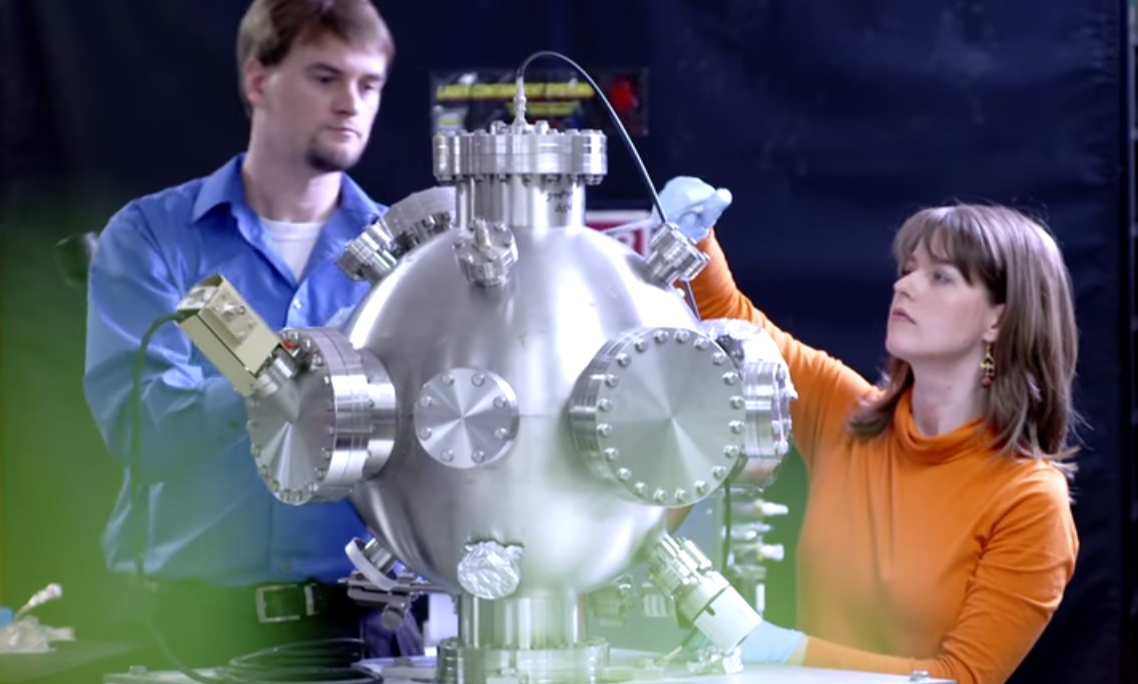
Lockheed-Martin engineers in the Skunkworks prepare a vessel, one component of an apparatus that they announced will lead to nuclear fusion in a truck-sized reactor within 5 years. An international effort is underway in Europe to create the worlds first practical tokamak fusion reactor, a much larger and costlier design that has never achieved the long sought "breakeven" point. (Photo Credit: Lockheed-Martin)


Lockheed-Martin engineers in the Skunkworks prepare a vessel, one component of an apparatus that they announced will lead to nuclear fusion in a truck-sized reactor within 5 years. An international effort is underway in Europe to create the world’s first practical tokamak fusion reactor, a much larger and costlier design that has never achieved the long sought “breakeven” point. (Photo Credit: Lockheed-Martin)
The program manager of the Skunk Works’ compact fusion reactor experiment is Tom Maguire. Maguire and his team places emphasis on the turn-around time for modifying and testing the compact fusion device. With the confidence they are expressing in their design and the ability to quickly build, test and modify, they are claiming only five years will be needed to reach a prototype.

What exactly the prototype represents was left unexplained, however. Maguire continues by saying that in 10 years, the device will be seen in military applications and in 20 years it will be delivered to the world as a replacement for the dirty energy sources that are in use today. Military apps at 10 years means that the device will be too expensive initially for civilian operations but such military use would improve performance and lower costs which could lead to the 20 year milestone moment if all goes as planned.

Their system uses magnetic confinement, the same basic principle behind the tokamak toroidal plasma confinement system that has received the greatest attention and government funding for over 50 years.

The ITER Tokamak Fusion Reactor is expected to begin operational testing in 2020 and begin producing deuterium-tritium fusion reactions in 2027. (Credits: ITER, Illus. T.Reyes)


The ITER Tokamak Fusion Reactor is expected to begin operational testing in 2020 and begin producing deuterium-tritium fusion reactions in 2027. (Credits: ITER, Illus. T.Reyes)
The International Thermonuclear Experimental Reactor (ITER) is currently under construction in Europe under the assumption that it will be the first net energy producing fusion generator ever. It is funded by the European Union, India, Japan, People’s Republic of China, Russia, South Korea and the United States. But there are cost over-runs and its price has gone from $5 billion to $50 billion.

ITER is scheduled to begin initial testing in 2019 about the time Lockheed-Martin’s compact fusion reactor prototype is expected. If Lockheed-Martin succeeds in their quest, they will effectively have skunked ITER and laid to waste a $50 billion international effort at likely 1/1000th the cost.

There are a few reasons Lockheed-Martin has gone out on a limb. Consider the potential. One ton of Uranium used in Fission reactors has as much energy as 1,500 tons of coal. But fission reactors produce radioactive waste and are a finite resource without breeder reactors, themselves a nuclear proliferation risk. Fusion produces 3 to 4 times more energy per reaction than fission. Additionally, the fuel — isotopes of hydrogen — is available from sea water — which is nearly limitless — and the byproducts are far less radioactive than with fission. Fusion generators once developed could provide our energy needs for millions of years.

More pragmatically, corporations promote their R&D. They are in a constant state of competition. They present a profile that ranges from the practical to the cutting edge to instill confidence in their Washington coffers. Furthermore, their competitors have high profile individuals and projects. A fusion project demonstrates that Lockheed-Martin is doing more than creating better mouse-traps.

To date, no nuclear fusion reactor has achieved breakeven. This is when the fusion device outputs as much energy as is input to operate it. Magnetic confinement such as the various tokamak designs, Lawrence Livermore’s laser-based inertial confinement method, and even the simple Philo Farnsworth Fusor can all claim to be generating energy from fusion reactions. They are just all spending more energy than their devices output.

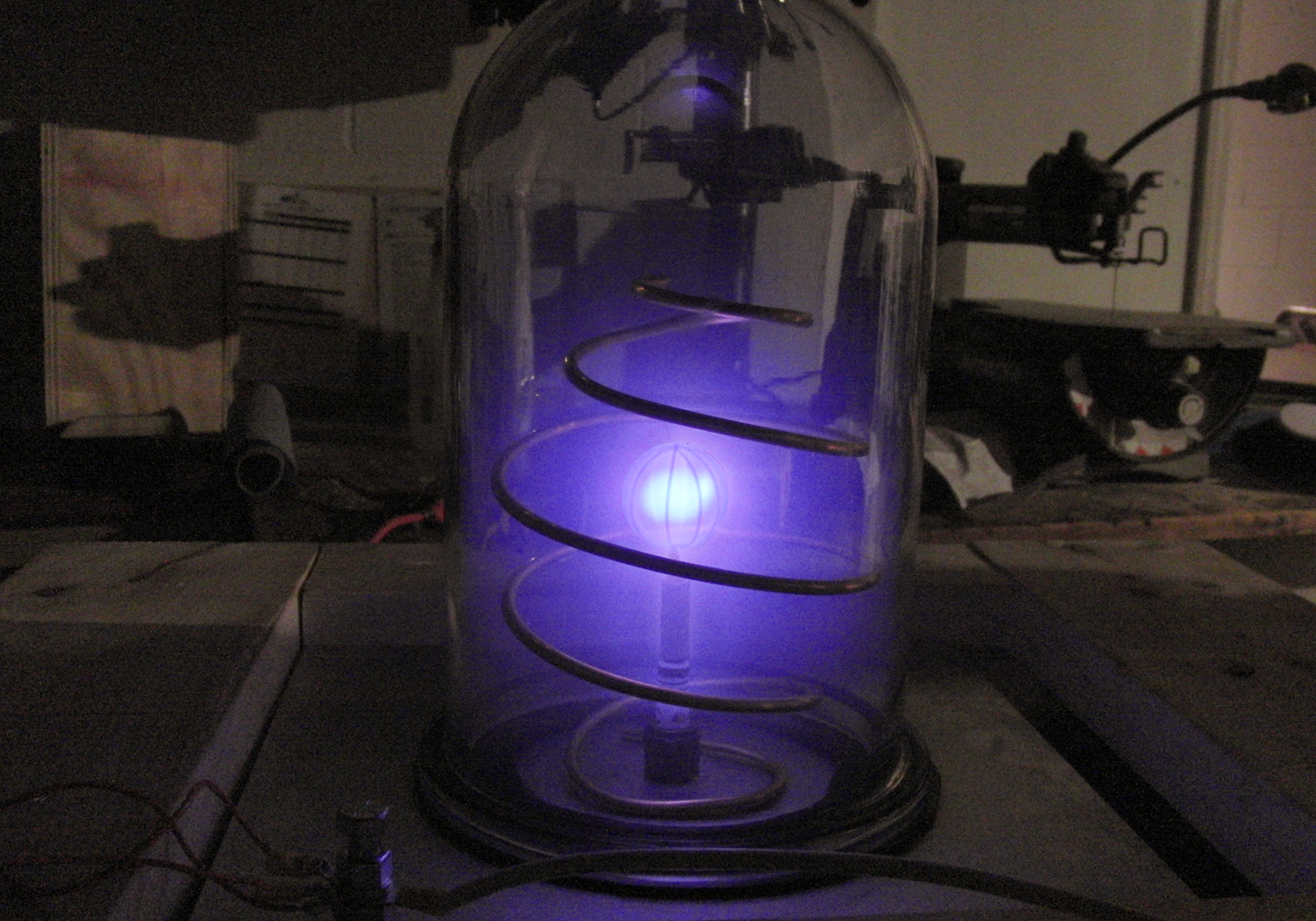
An example of a homemade Fusor. Originally invented in the 1960s by the inventor of the television, Philo Farnsworth. (Credit: Wikipedia, W.Jack)


An example of a homemade Fusor. Originally invented in the 1960s by the inventor of the television, Philo Farnsworth. (Credit: Wikipedia, W.Jack)
The fusor, invented in the 1960s by Farnsworth and Hirsh, is a electrostatic plasma confinement system. It uses electric fields to confine and accelerate ions through a central point at which some ions will collide with sufficient energy to fuse. Although the voltage needed is readily achieved by amateurs – about 4000 volts – not uncommon in household devices, no fusor has reached breakeven and theoretically never will. The challenge to reaching breakeven involves not just energy/temperature but also plasma densities. Replicating conditions that exist in the core of stars in a controllable way is not easy. Nevertheless, there is a robust community of “fusioneers” around the world and linked by the internet.

Mr Fusion, the compact fusion reactor that drove the 21st Century version of the DeLorian in Back to the Future. The movie trilogy grossed $1 billion at the box office. Mr Fusion could apparently function off of any water bearing material. (Credit: Universal Pictures)


Mr Fusion, the compact fusion reactor that drove the 21st Century version of the DeLorean in Back to the Future. The movie trilogy grossed $1 billion at the box office. Mr Fusion could apparently function off of any water bearing material. (Credit: Universal Pictures)
It remains to be seen who, what and when a viable fusion reactor will be demonstrated. With Lockheed-Martin’s latest announcement, once again, fusion energy is “just around the corner.” But many skeptics remain who will quickly state that commercial fusion energy remains 50 years in the future. So long as Maguire’s team meets milestones with expected performance improvements, their work will go on. The potential of fusion energy remains too great to dismiss categorically.

Source: Lockheed-Martin Products Page, Compact Fusion


About 

Contributing writer Tim Reyes is a former NASA software engineer and analyst who has supported development of orbital and lander missions to the planet Mars since 1992. He has an M.S. in Space Plasma Physics from University of Alabama, Huntsville.

Stunning View of Solar Systems Largest Volcano and Valles Marineris Revealed by India’s Mars Orbiter Mission

Stunning View of Solar Systems Largest Volcano and Valles Marineris Revealed by India’s Mars Orbiter Mission:

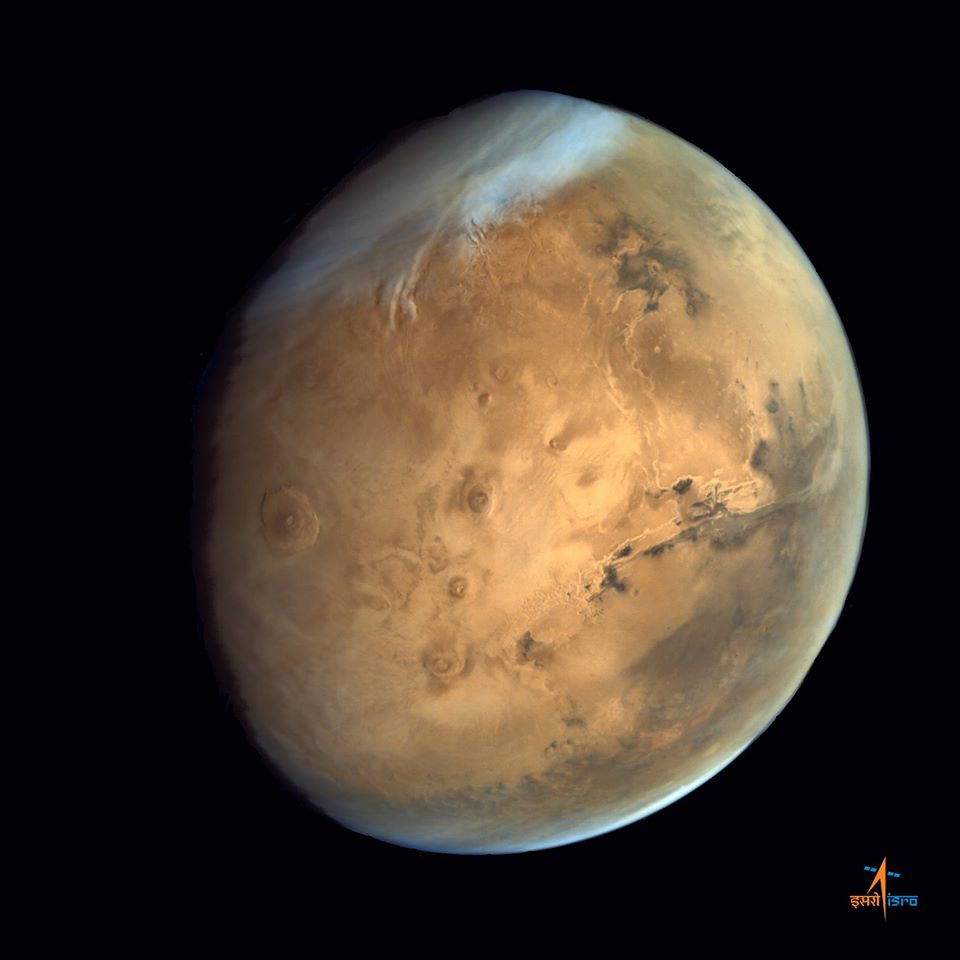
Olympus Mons, Tharsis Bulge and Valles Marineris from from ISRO's Mars Orbiter Mission. Credit: ISRO


Olympus Mons, Tharsis Bulge trio of volcanoes, and Valles Marineris from ISRO’s Mars Orbiter Mission. Note the clouds and south polar ice cap. Credit: ISRO
India’s Mars Orbiter Mission (MOM) has delivered another sweet treat – a stunning view of our Solar System’s largest volcano and the largest canyon.

Just days ago, MOM captured a new global image of the Red Planet dominated by Olympus Mons and Valles Marineris – which is the largest known volcano and the largest known canyon in the Solar System, respectively.

Situated right in between lies a vast volcanic plateau holding a trio of huge volcanoes comprising the Tharsis Bulge: Arsia Mons, Pavonis Mons, and Ascraeus Mons. All four volcanoes are shield volcanoes.

To give an idea of its enormity, Olympus Mons stands about three times taller than Mount Everest and is about the size of Arizona.

Olympus Mons from Mars orbit compared to the state of Arizona. Credit: NASA


Olympus Mons from Mars orbit compared to the state of Arizona. Credit: NASA
Olympus Mons is located in Mars’ western hemisphere and measures 624 kilometers (374 miles) in diameter, 25 km (16 mi) high, and is rimmed by a 6 km (4 mi) high scarp.

Valles Marineris is often called the “Grand Canyon of Mars.” It spans about as wide as the entire United States.

The Indian Space Research Organization (ISRO), India’s space agency which designed and developed the orbiter released the image on Oct. 17, barely two days ahead of the planet’s and spacecrafts’ extremely close encounter with comet Siding Spring.

By the way, a relieved ISRO tweeted MOM’s survival of her close shave with the once-in-a-lifetime cometary passage with gusto, soon after the swingby:

“Phew! Experience of a lifetime. Watched the #MarsComet #SidingSpring whizzing past the planet. I’m in my orbit, safe and sound.”

The new global image was taken by the tri-color camera as MOM swooped around the Red Planet in a highly elliptical orbit whose nearest point to Mars (periapsis) is at 421.7 km and farthest point (apoapsis) at 76,993.6 km, according to ISRO.

To date ISRO has released four global images of the Red Planet, including a 3-D view, reported here.

Olympus Mons, the Tharsis Bulge, and Valles Marineris are near the equator.

Valles Marineris stretches over 4,000 km (2,500 mi) across the Red Planet, is as much as 600 km wide, and measures as much as 7 kilometers (4 mi) deep.

Here’s a comparison view of the region taken by NASA’s Viking 1 orbiter in the 1970s.

Global Mosaic of Mars Centered on Valles Marineris


Global Mosaic of Mars Centered on Valles Marineris from NASA’s Viking 1 orbiter. Credit: NASA
MOM is India’s first deep space voyager to explore beyond the confines of her home planet’s influence and successfully arrived at the Red Planet only one month ago after the “history creating” orbital insertion maneuver on Sept. 23/24 following a ten month journey.

The $73 million MOM mission is expected to last at least six months.

MOM’s success follows closely on the heels of NASA’s MAVEN orbiter which also successfully achieved orbit barely two days earlier on Sept. 21 and could last 10 years or more.

With MOM’s arrival, India became the newest member of an elite club of only four entities that have launched probes that successfully investigated Mars – following the Soviet Union, the United States, and the European Space Agency (ESA).

Stay tuned here for Ken’s continuing Earth and planetary science and human spaceflight news.

Ken Kremer

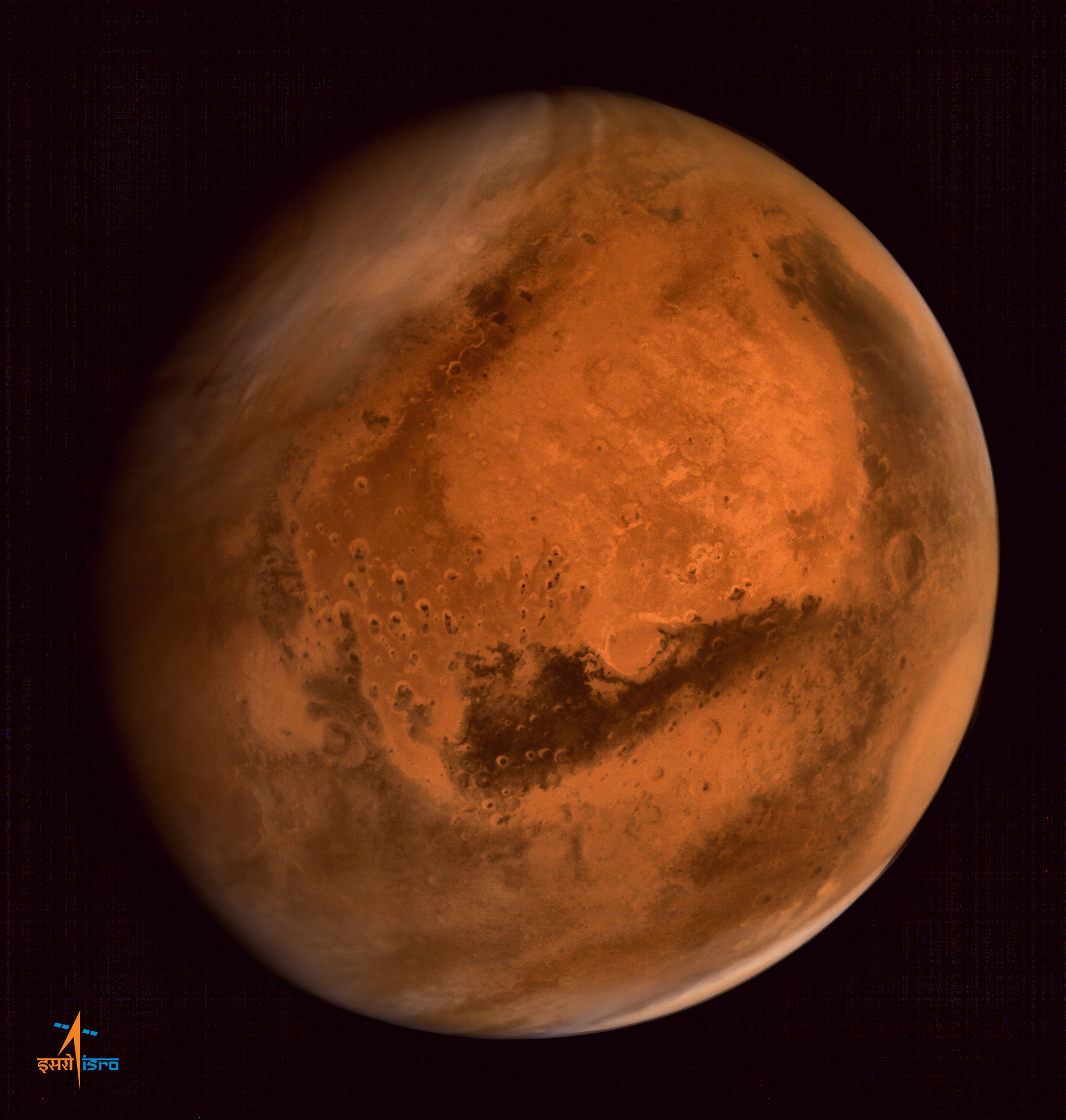
ISRO's Mars Orbiter Mission captures spectacular portrait of the Red Planet and swirling dust storms with the on-board Mars Color Camera from an altitude of 74500 km on Sept. 28, 2014. Credit: ISRO


ISRO’s Mars Orbiter Mission captures spectacular portrait of the Red Planet and swirling dust storms with the on-board Mars Color Camera from an altitude of 74,500 km on Sept. 28, 2014. Credit: ISRO


About 

Dr. Ken Kremer is a speaker, scientist, freelance science journalist (Princeton, NJ) and photographer whose articles, space exploration images and Mars mosaics have appeared in magazines, books, websites and calanders including Astronomy Picture of the Day, NBC, BBC, SPACE.com, Spaceflight Now and the covers of Aviation Week & Space Technology, Spaceflight and the Explorers Club magazines. Ken has presented at numerous educational institutions, civic & religious organizations, museums and astronomy clubs. Ken has reported first hand from the Kennedy Space Center, Cape Canaveral and NASA Wallops on over 40 launches including 8 shuttle launches. He lectures on both Human and Robotic spaceflight - www.kenkremer.com. Follow Ken on Facebook and Twitter

No, This Is Not a Photo of India on Diwali

No, This Is Not a Photo of India on Diwali:

Yes, it's India, but it's not a photo captured from space during Diwali night. (Credit: NASA)


Yes, it’s India, but it’s not a photo captured from space during Diwali night. (Credit: NOAA)
Diwali, the Indian festival of lights, falls on Thursday, Oct. 23 this year and with it come celebrations, gift-giving, and brilliant lighting and firework displays all across the subcontinent of India… but this isn’t a picture of that. What is it exactly? Find out below…

Over the past several years this image has repeatedly resurfaced online, especially around the time of Diwali. And understandably so: it’s a beautiful view of India seemingly decorated for the festival… one can easily imagine the entire country awash in colorful lights from shore to shore.

But it’s not a photo at all, or even a singular image. Rather it’s a composite of many images acquired from a USAF Defense Meteorological Satellite Program (DMSP) satellite over the course of several years, and assembled by NOAA scientist Chris Elvidge to show the country’s growing population and urban areas.

In a 2012 article by Robert Johnson on Business Insider a NASA spokesperson described the colors in the image: “The white lights were the only illumination visible before 1992. The blue lights appeared in 1992. The green lights in 1998. And the red lights appeared in 2003.”

So what does India look like at night during the five-day-long Diwali festival? Click here and see.

While city lighting in India is definitely visible from space, it’s not the rainbow explosion of neon colors that Internet hoaxers and uninformed online enthusiasts would eagerly have you believe. According to Adam Voiland on the NASA Earth Observatory site, “in reality, any extra light produced during Diwali is so subtle that it is likely imperceptible when observed from space.”

So this year, don’t fall for any false descriptions of this picture… and, Happy Diwali!

Sources: Business Insider, Mashable, NASA Earth Observatory, EarthSky. Read more about the 2014 celebration of Diwali here.

HT to Peter Caltner on Twitter for re-alerting me of this.


About 

A graphic designer in Rhode Island, Jason writes about space exploration on his blog Lights In The Dark, Discovery News, and, of course, here on Universe Today. Ad astra!

X-Ray Telescope Cracks Open Archives, Comes Up With Gassy Black Hole Gem

X-Ray Telescope Cracks Open Archives, Comes Up With Gassy Black Hole Gem:

by Elizabeth Howell on October 22, 2014
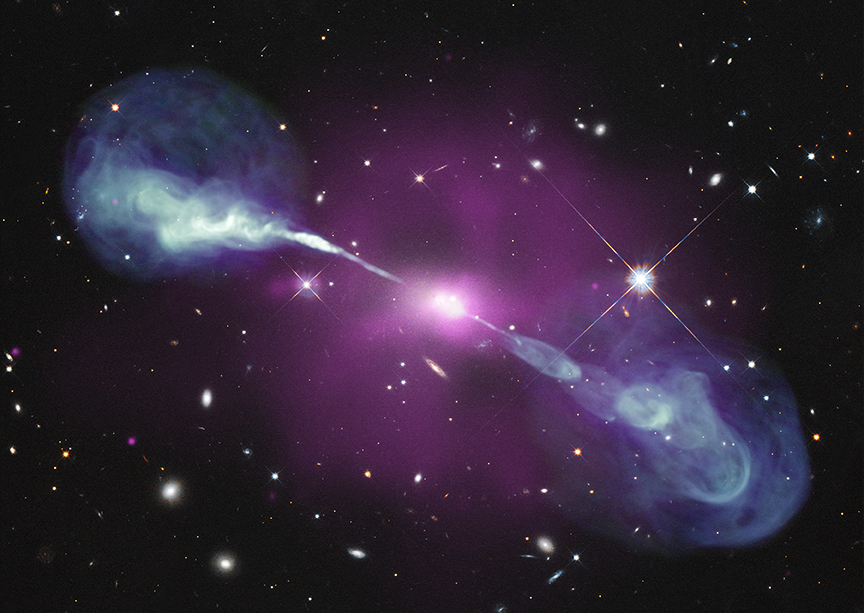
Six images that combine Chandra data with those from other telescopes. Credit: X-ray: NASA/CXC/SAO, Optical: NASA/STScI, Radio: NSF/NRAO/VLA).


Six images that combine Chandra data with those from other telescopes. Credit: X-ray: NASA/CXC/SAO, Optical: NASA/STScI, Radio: NSF/NRAO/VLA).
What a gem! This huge black hole in the middle of Hercules A is making gas around it super-heated to millions of degrees, making it shine brightly in X-Rays. The Chandra X-Ray Telescope captured the scene and in a new data release this week, telescope officials cracked open the archives to give us gems such as this.

The release comes as a part of American Archives Month, where every year Chandra officials go through the archives and pull out old Chandra data, combining it with the work of other telescopes to get as much information as possible about the objects being studied.

Chandra is one of three NASA “Great Observatories” still active, with the other two being the Hubble Space Telescope and the Spitzer Space Telescope. It’s been in operation now for more than 15 years.

You can see the six new pictures below. To read more about each of these objects, head on over to this link.

Six photos released from the Chandra X-Ray Observatory's archive in October 2014. Credit: NASA/CXC/SAO

Six photos released from the Chandra X-Ray Observatory’s archive in October 2014. Credit: NASA/CXC/SAO


About 

Elizabeth Howell is the senior writer at Universe Today. She also works for Space.com, Space Exploration Network, the NASA Lunar Science Institute, NASA Astrobiology Magazine and LiveScience, among others. Career highlights include watching three shuttle launches, and going on a two-week simulated Mars expedition in rural Utah. You can follow her on Twitter @howellspace or contact her at her website.

Beastly Sunspot Amazes, Heightens Eclipse Excitement

Beastly Sunspot Amazes, Heightens Eclipse Excitement:

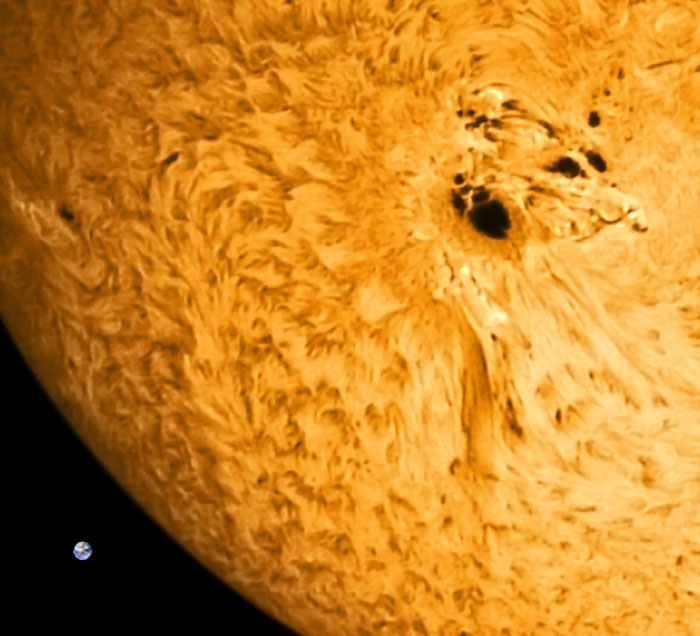
Ron Cottrell captured the sunspot group 2192 in all its swirly magnetic goodness in hydrogen-alpha light on October 19. To appreciate its size, he included the Earth (lower left) for reference. Credit: Ron Cottrell


Ron Cottrell captured the sunspot group 2192 in all its swirly magnetic goodness in hydrogen-alpha light on October 19. To appreciate its size, he included the Earth (lower left) for reference. Credit: Ron Cottrell
That’s one big, black blemish on the Sun today! Rarely have we been witness to such an enormous sunspot. Lifting the #14 welder’s glass to my eyes this morning I about jumped back and bumped into the garage.

Properly shielded, it was very easy to see with the naked eye. Unlike some other naked eye sunspots, this one showed structure. The eastern end was darker, the western half grayer and more extended.


Watch the giant spot rotate into view and grow right before your eyes in this 72-hour time-lapse video taken by SOHO’s HMI imager Oct. 18-20, 2014

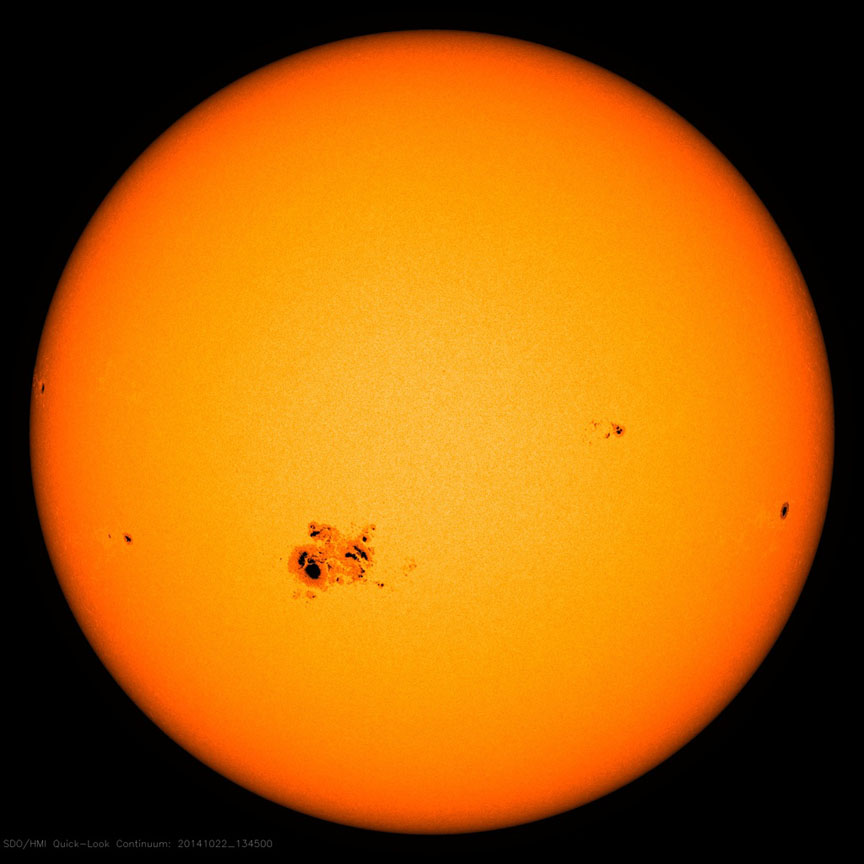
Through a small telescope, the mix of dark umbras scattered amid weirdly sculpted penumbral “islands” was incredible to see. Photographs like the one above are wonderful documents, but witnessing this beautiful complex magnetic mess with your own eyes is another experience altogether. Region 2192 continues to grow and size and complexity and is now the largest sunspot group of solar cycle 24 which began in 2009 – more than five years ago!

Active region 2192 is now the largest sunspot group to appear in over five years. Credit: Alex Young


Active region 2192 is now the largest sunspot group to appear in over five years. Compare to Jupiter and the Earth. Credit: SDO/HMI/Alex Young
Every sunspot marks a region on the Sun’s shiny outer skin called the photosphere where magnetic energy is concentrated. Strong magnetic fields within a sunspot group quell the turbulent churning of the photosphere, chilling the region by several thousand degrees. Sunspots appear dark against the Sun’s blazing disk because they’re cooler. Cooler meaning 8,000 F instead of 11,000 F, so yes, they’re still VERY hot.


Watch as Region 2192 crackles with energy and flares as seen in far ultraviolet light with NASA’s Solar Dynamics Observatory.

Energy stored in sunspots’ twisted magnetic fields can suddenly be released in violent, explosions called solar flares. Billions of tons of solar plasma – the sizzling mix of protons and electrons that composes the Sun – are heated to millions of degrees during the explosion and rapidly accelerated into space. Radiation from radio waves to X-rays and gamma rays fans out at the speed of light. Fortunately for us, our atmosphere and planetary magnetic field protect us from most of what flares can fling our way.

NASA's Solar Dynamics Observatory took this photo of the sun and Jupiter-sized sunspot 2192 this morning Oct. 22 at 8:45 a.m. CDT. The view in a small telescope equipped with a safe solar filter is even better! Credit: NASA


NASA’s Solar Dynamics Observatory took this photo of the Sun and Jupiter-sized sunspot region 2192 this morning Oct. 22 at 8:45 a.m. CDT. The view in a small telescope equipped with a safe solar filter is even better! Credit: NASA
But as the Sun rotates this monster into our line of sight, possibilities for Earth-directed flares and coronal mass ejections increase as do geomagnetic storms, the bringer of auroras. Already in the past 48 hours, the spot has dished out seven M-class flares and a powerful X-1 flare even before it has fully come into view.  There’s more to come – Region 2192 harbors an unstable beta-gamma-delta magnetic field ripe for additional flaring including more of the X-class variety.

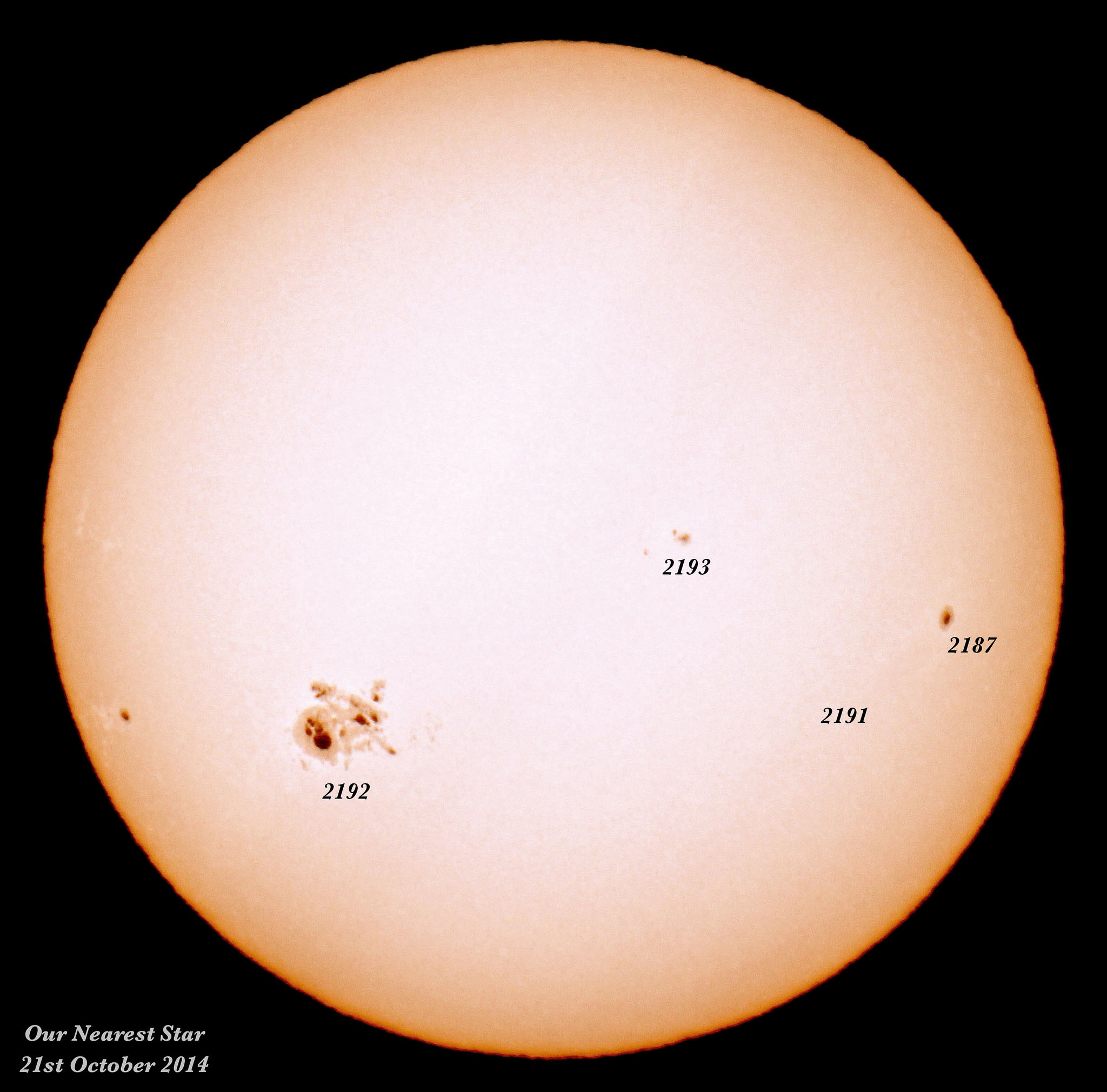
The sun on October 21 showing smaller sunspot regions along with our featured group. Credit: Sarah and Simon Fisher


The Sun on October 21 showing smaller sunspot regions along with our featured group. Credit: Sarah and Simon Fisher
There’s no doubt now that this behemoth will stick around to add a whole new dimension to tomorrow’s partial solar eclipse. I can’t wait to see the Moon’s black curve approach and at least partially occult the group from view. If you’re interested in getting some one-of-a-kind pictures of the scene, please see our own Dave Dickinson’s excellent guide on photographing the partial eclipse.

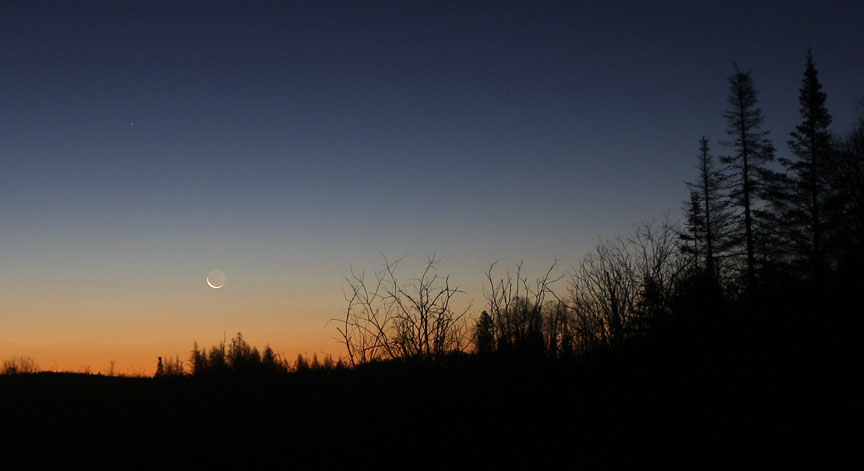
A sliver of a Moon rises in morning twilight today October 22 just a day away from its appointment with the Sun. Credit: Bob King


A sliver of a Moon rises in morning twilight today October 22 just a day away from its appointment with the Sun. Credit: Bob King
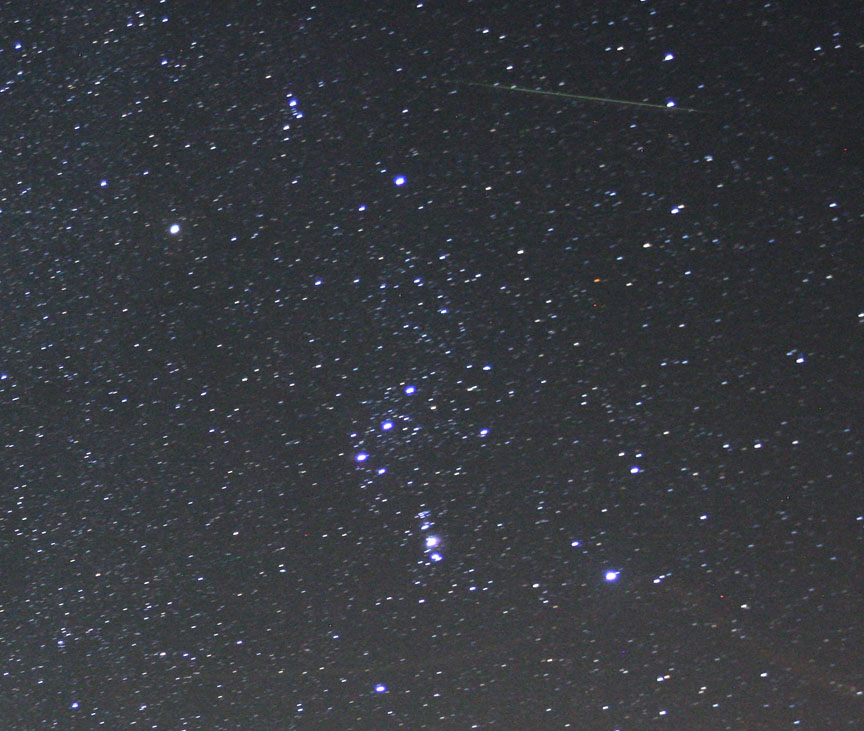
While we’re on the Moon, early morning risers had the pleasure of its company just one day before New Moon and solar eclipse. I was out watching the Orionid meteor shower. While not rich like the Perseids or Geminids I managed to catch a few including a few lucky shots with the camera.

An Orionid meteor slashes across the top of the frame directly above the constellation Orion early this morning October 22, 2014. Details: 24mm lens, f/2.8, 30-seconds at ISO 1600. Credit: Bob King


An Orionid meteor slashes across the top of the frame directly above the constellation Orion early this morning October 22, 2014. Details: 24mm lens, f/2.8, 30-seconds at ISO 1600. Credit: Bob King
The shower has peaked but will still be active the remainder of the week if you’re inclined to take a look. And I can’t resist. How about one last sweet close-up photo of sunspot group 2192? I have a feeling you won’t mind.

Monster Sunspot AR12192 taken by Karzaman Ahmad on October 21, 2014 from Langkawi Nagtional Observatory, Malaysia credit: Karzaman Ahmad and shared at spaceweather.com


Monster Sunspot AR12192 taken by Karzaman Ahmad on October 21, 2014, from Langkawi Nagtional Observatory, Malaysia. Credit: Karzaman Ahmad and shared at spaceweather.com. Click the image to see additional animations and photos on Alex Young’s site


About 

I'm a long-time amateur astronomer and member of the American Association of Variable Star Observers (AAVSO). My observing passions include everything from auroras to Z Cam stars. Every day the universe offers up something both beautiful and thought-provoking. I also write a daily astronomy blog called Astro Bob.

Is Dark Matter Coming From The Sun?

Is Dark Matter Coming From The Sun?:

A huge filament erupts from the Sun in 2012. Credit: NASA Goddard Space Flight Center


A huge filament erupts from the Sun in 2012. Credit: NASA Goddard Space Flight Center
For decades, astronomers and cosmologists have postulated that the Universe is filled with an invisible, mysterious mass known as “dark matter.” For decades, the search for this elusive matter has dominated the field of cosmology. Precise measurements were obtained over 20 years ago when dark matter was first mapped in galaxy halos. Only recently has the existence of dark matter over much larger scales than even galaxy clusters been detected.

Recently, a group of physicists analyzed over 12 years’ worth of telescope data, and have found a signal that some think could be the first detection of a source of dark matter.

And it appears to be coming from … our Sun.

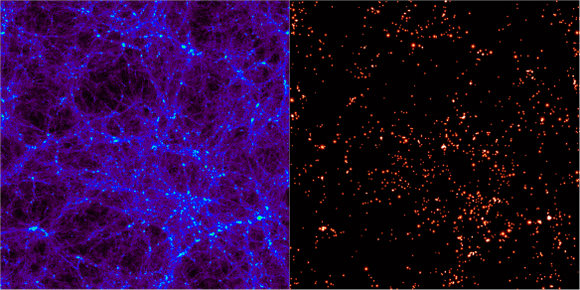
Distribution of dark matter when the Universe was about 3 billion years old, obtained from a numerical simulation of galaxy formation. The left panel displays the continuous distribution of dark matter particles, showing the typical wispy structure of the cosmic web, with a network of sheets and filaments, while the right panel highlights the dark matter halos representing the most efficient cosmic sites for the formation of star-bursting galaxies with a minimum dark matter halo mass of 300 billion times that of the Sun. Credit: VIRGO Consortium/Alexandre Amblard/ESA


Distribution of dark matter when the Universe was about 3 billion years old, obtained from a numerical simulation of galaxy formation. Credit: VIRGO Consortium/Alexandre Amblard/ESA
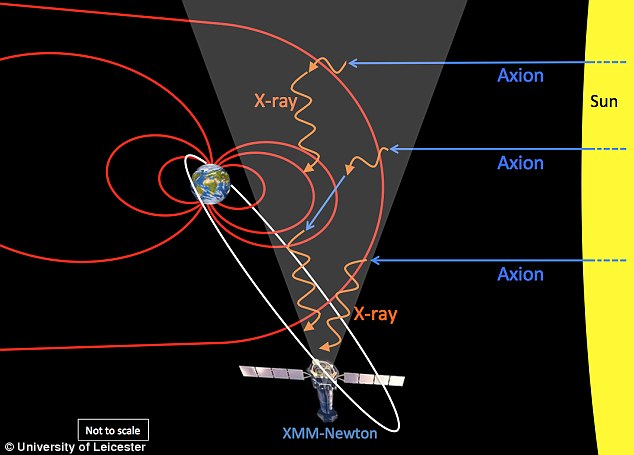
Using information obtained from the European Space Agency observatory, astronomers from the University of Leicester found variations in a stream of X-rays emanating from the Sun that match what would be expected if axions – a hypothetical dark-matter particle – were interacting with Earth’s magnetic field. If confirmed, the axion finding would be a huge discovery.

Axions were originally proposed to explain an anomaly in a different area of physics – the theory of the strong nuclear force, one of the four fundamental forces of nature. These uncharged, very light particles would be created in the Sun’s core and would barely interact with ordinary matter, which would allow them to zip through thousands of kilometers of solar plasma and escape into outer space.

But the axions that interacted with magnetic fields, such as the one that surrounds Earth, would be expected to turn into X-ray photons. Those photons are the particles the researchers say they may have seen.

The team found that as the European space telescope XMM-Newton (also called the X-ray Multi-Mirror Mission) passed through the strong magnetic field on the Sun-side of Earth, it saw a slightly more intense X-ray signal than when it was on the far side of Earth. Discounting known sources of X-rays, the background signal should be the same wherever the spacecraft is, according to the Leicester team.

In their 67-page paper, which was submitted in March of this year and appeared in this month’s issue of Monthly Notices of the Royal Astronomical Society, the researchers did their best to rule out more mundane phenomena – such as interaction between the solar wind and Earth’s magnetic field – before invoking axions as a source.

Axions interacting with Earth's magnetic field to form x-rays. Credit: University of Leicester


Axions interacting with Earth’s magnetic field to form x-rays, as detected by the ESA’s XMM-Newton probe. Credit: University of Leicester
One unusual aspect of this analysis is that it shows XMM-Newton picking up the X-ray photons, even though it is not looking straight into the Sun but at a right angle to it. This is odd because the photons are generally expected to continue in the same direction as the axions they were created from.

But the authors say that the axions could be scattered and end up in the telescope. The authors also show that hints of a similar signal can be found in data produced by NASA’s Chandra X-Ray Observatory, although a formal corroboration will take more data and years of analysis.

The concept of dark matter was first proposed by Jan Oort in 1932 to account for the orbital velocities of stars in the Milky Way, and then again by Fritz Zwicky in 1933 to account for evidence of “missing mass” in the orbital velocities of galaxies in clusters.

Dark matter has been widely studied, but much like the Higgs Boson, its existence was inferred despite a lack of direct evidence simply because it accounted for discrepancies in the observable data. According to consensus among cosmologists, dark matter could be composed primarily of a not yet characterized type of subatomic particle.

The leader of this most recent study, George Fraser  – an astronomer at the University of Leicester, UK – died just two days after he and his co-authors submitted the paper for publication. According to Andy Lawrence, an astronomer at the Institute for Astronomy in Edinburgh, UK, the study was Fraser’s “most astonishing swan song”.

Mike Watson, another astronomer at the University of Leicester (but who was not involved in the study), says that Fraser was an “exceptional scientist” and the mastermind behind the work. Even so, he expressed some skepticism towards the findings.

“The interpretation is quite appealing,” he said, “and on the human side of this is that we would all like it to be right, as it would be a great tribute to George. But that’s not how you do science.”

In addition, Fraser’s research team are not yet celebrating the publication of their findings, as there appears to be some anomalies in the data that has even them concerned.

“We found an unusual result that we can’t explain by any conventional method, and this axion theory does explain it,” said the study’s co-author Andy Read. “But it is just a hypothesis, and most hypotheses don’t make it.”

Others within the astronomical community are also not convinced that the axion interpretation is correct. Astronomer Peter Coles of the University of Sussex, UK, called the evidence “circumstantial.” In a post on his blog, “In the Dark”, he wrote, “It’s tantalising, but if you want to ask me where I’d put my money I’m afraid I’d probably go for messy local plasma physics rather than anything more fundamental.”

Still, the theory has its share of potential supporters. One such person is Igor Garcia Irastorza, who works on the CERN Axion Solar Telescope (CAST), based at the CERN physics laboratory near Geneva, Switzerland. He expressed that the idea was intriguing, but the kind of axion that would fit such a signal would clash with other astrophysical observations. And, as he said, the particles’ properties would have to be different than what has been theorized for decades.

Corroborating the Leicester findings will take cross-checks from other axion experiments that work in completely different ways to the telescopes, adds Konstantin Zioutas, who leads the CAST experiment. Only time will tell if a source of dark matter has been found, or if this is merely a hiccup in the ongoing search.

Further Reading: MNRAS
University of Leicester press release.


About 

Author, freelance writer, educator, Taekwon-Do instructor, and loving hubby, son and Island boy!