Thursday, September 18, 2014

The Remarkable Properties of Neutron Stars

The Remarkable Properties of Neutron Stars:

Note: An earlier version of this article appeared on this blog by Peter Edmonds.

The collapse of a massive star in a supernova explosion is an epic event. In less than a second a neutron star (or in some cases a black hole) is formed and the implosion is reversed, releasing prodigious amounts of light that can outshine billions of Suns. That is a spectacular way to be born. Here, I'll explain that the properties of neutron stars are no less spectacular, even though they are not as famous as their collapsed cousins, black holes.

Because of the incredible pressures involved in core collapse, the density of neutron stars is astounding: all of humanity could be squashed down to a sugar cube-sized piece of neutron star. The escape velocity from their surface is over half the speed of light but an approaching rocket ship would be stretched, then crushed and assimilated into the surface of the star in a moment. Resistance would be futile.


If this cricket ball were made of neutron star material it would weigh about 20 trillion kg, or about 40 times the estimated weight of the entire human population.
Another remarkable property is that neutron stars generate the most extreme magnetic fields known in the universe, up to a quadrillion times the strength of Earth's magnetic field. If one of these ultra-magnetic neutron stars, called a magnetar, flew past Earth within 100,000 miles, its magnetic field would destroy the data on every credit card on Earth. Luckily for our economy none are that close, but the distant ones can put on spectacular shows. In 2004 a magnetar underwent an extraordinary outburst and become one of the brightest objects ever observed in the sky, causing a disturbance in the Earth's ionosphere that was recorded around the globe, as described in this paper by astrophysicist Bryan Gaensler (@SciBry on Twitter) from the University of Sydney (my alma mater). That's impressive for an object about the size of a city that is located around 50 thousand light years away.


An artist's conception of the spectacular outburst from the magnetar SGR 1806-20, including magnetic field lines. After the initial flash, smaller pulsations in the data suggest hot spots on the rotating magnetar’s surface. This animation contains no audio, because "in space no-one can hear you scream". Credit: NASA

Neutron star behavior can be so odd and distinctive that their discovery was initially greeted as the possible discovery of extraterrestrial intelligence. The real explanation is that a pulsar, a rotating neutron star, was discovered. Pulsars have become such an important tool for physics research that two different Nobel Prizes have been awarded in their name, the first for their discovery by Antony Hewish. Many people - including myself - have argued that Jocelyn Bell Burnell should have been awarded part of the Nobel prize with Hewish, since she made the discovery, but in an expression of modesty or Imposter Syndrome, Bell Burnell later commented that she did not deserve the award. However, this does not diminish the significance of her discovery, and of the outstanding research that it enabled.


Jocelyn Bell Burnell with the radio telescope she used to discover pulsars. Credit: Jocelyn Bell Burnell.
The second Nobel prize was for Russell Hulse and Joseph Taylor, who discovered the first known binary pulsar, PSR1913+16, which has become extremely valuable for testing Einstein's Theory of General Relativity (GR). Since then other important objects have been discovered, including a double pulsar system known as PSR J0737-3039A/B that is one of the best objects available for testing GR and alternative theories of gravity, as explained in this paper by Michael Kramer from the University of Manchester.
Looking ahead in pulsar work, there is an exciting and ingenious project called the North American Nanohertz Observatory (NANOGrav) that is attempting a direct detection of gravitational waves, ripples in the fabric of space-time, using pulsars. Like several of the topics covered here this project deserves a dedicated blog post, but for now I'll just say that exotic objects like black hole binaries are expected to produce gravitational waves. Two of the pulsar experts leading this project are Scott Ransom from NRAO, whose enthusiasm for pulsars is well explained by the papers he writes, like this one: "Pulsars are cool. Seriously" and Victoria Kaspi, from McGill University, seen here speculating about some possible applications of pulsar research.
So far I've emphasized spectacular features of neutron stars and some famous results. These stories capture a lot of attention and do an excellent job at promoting astrophysics, but most research occurs in the gaps between catchy headlines and Nobel prizes. These gaps contain plenty of room for excellent research, much of it about understanding the nature of neutron stars, rather than testing fundamental physics with them.
Some of the most important open questions about neutron stars concern their size and structure. How large are they? What makes up their atmosphere? What is their core like?
One key advantage that neutron stars have over black holes is that their surface is visible to us, enabling much to be be learned about their atmospheres and interior structure. For example, in 2009, Wynn Ho from the University of Southampton and Craig Heinke from the University of Alberta, found evidence for a carbon atmosphere on the neutron star in the Cassiopeia A supernova remnant, using NASA's Chandra X-ray Observatory (note: I work at the Chandra X-ray Center in the Education and Public Outreach Group). This resolved a mystery about the nature of the neutron star, as the press release and Nature paper explain. An interesting side-note: the researchers calculate that the carbon atmosphere is only about 4 inches thick, as shown in the figure, because it has been compressed by a surface gravity that is 100 billion times stronger than on Earth. We're used to talking about massive scales and distances in astronomy, not small ones.


The properties of the carbon atmosphere on the neutron star in the Cassiopeia A supernova remnant are remarkable. It is only about four inches thick, has a density similar to diamond and a pressure more than ten times that found at the center of the Earth. As with the Earth's atmosphere, the extent of an atmosphere on a neutron star is proportional to the atmospheric temperature and inversely proportional to the surface gravity. The temperature is estimated to be almost two million degrees, much hotter than the Earth's atmosphere. However, the surface gravity on Cas A is 100 billion times stronger than on Earth, resulting in an incredibly thin atmosphere. Caption taken from Chandra web-site. Credit: NASA/CXC/M.Weiss
Heinke and Ho followed up this work with an even more interesting result, the first direct evidence for a superfluid, a bizarre, friction-free state of matter, at the center of a neutron star. First, a 4% drop in the temperature of the Cas A neutron star over 10 years was observed with Chandra and reported by Heinke et al. Then, two different papers, one in Physics Review Letters led by Dany Page from the National Autonomous University in Mexico and another in Monthly Notices of the Royal Astronomical Society led by Peter Shternin from the Ioffe Institute in St Petersburg, Russia independently came up with the same explanation. When the temperature of the neutron star fell below a critical level, a superfluid formed in the core of the star, forming neutrinos which travel outwards, taking energy with them. This causes the star to cool rapidly as observed with Chandra.


This image shows a composite of X-rays from Chandra (red, green, and blue) and optical data from the Hubble Space telescope (gold) of Cassiopeia A, the remains of a massive star that exploded in a supernova. The artist’s illustration in the inset shows a cutout of the interior of the neutron star where densities increase from the crust (orange) to the core (red) and finally to the part of the core where evidence for a superfluid has been found (inner red ball). The blue rays emanating from the center of the star represent the copious numbers of neutrinos -- nearly massless, weakly interacting particles -- that are created as the core temperature falls below a critical level and a neutron superfluid is formed, a process that began about 100 years ago as observed from Earth. These neutrinos escape from the star, taking energy with them and causing the star to cool much more rapidly. Credit: X-ray: NASA/CXC/UNAM/Ioffe/D.Page,P.Shternin et al; Optical: NASA/STScI; Illustration: NASA/CXC/M.Weiss
Other important information about the structure of neutron stars comes from studying the relationship between their size and mass. For a given mass, the size of a neutron star will depend on how stiff or soft the structure is. These are all relative terms, since by Earthly standards, nothing about neutron stars is soft.
Old neutron stars are typically faint objects, but when they pull material away from companion stars they can become much brighter, allowing good studies of their atmospheres. Observations of the amount of X-rays at different wavelengths, combined with theoretical models for their atmospheres, can allow the relationship between the radius and mass of the neutron star to be estimated. This work has been performed by Heinke, by Natalie Webb and Didier Barret (both from the Institut de Recherche en Astrophysique et Planétologie) as explained in this paper, and by Sebastien Guillot (Seb_Guillot on Twitter) from McGill University, in this paper. All of these observations were of neutron star binaries in globular clusters.
Neutron stars pulling material away from companions have also been observed to undergo bursts of X-rays, caused by thermonuclear explosions on their surfaces. These explosion can cause the atmosphere of the neutron star to expand. If observers catch one of these bursts they can follow as the star cools and calculate its surface area. When this area is combined with independent estimates of the distance to the neutron star, the relationship between the mass and radius of this object can be estimated. Two researchers who have applied this technique with great success are Feryal Ozel from the University of Arizona and Tolga Guver from Sabanci University, as described in this set of papers here, here, here, and here.
Each of the papers quoted in the previous two paragraphs provide information about the mass and radius of the neutron star and about their structure. However, there may be problems with relying too much on a single technique or a single object. A very good new paper by Andrew Steiner, from University of Washington, avoids this problem by combining all of the papers mentioned above: 4 neutron stars in globular clusters quietly pulling material from a companion and 4 undergoing X-ray bursts.


A Chandra X-ray Observatory image of 47 Tucanae, my favorite globular cluster. One of the neutron star binaries from Steiner et al. (2013), called X7, is labeled. Credit: NASA/CXC/Michigan State/A.Steiner et al.
Steiner et al. take these results and apply the latest neutron star models to estimate that the radius of a neutron star with a mass that is 1.4 times the mass of the Sun - a typical value - is between 10.4 and 12.9 km (6.5 to 8.0 miles), as we reported recently in a Chandra image release. They also estimate that the density at the center of a neutron star is almost ten times that of nuclear matter found in Earth-like conditions. This is equivalent to a pressure that is over ten trillion trillion times the pressure required for diamonds to form inside the Earth.
Using their results, Steiner et al. are able to compare their results with values derived from nuclear physics experiments performed on Earth, such as the distance between protons and neutrons in atomic nuclei. A larger neutron star radius implies that, on average, neutrons and protons in a heavy nucleus like Uranium are farther apart.
What is the core of a neutron star made of? It could be neutrons or it could be free quarks, the fundamental particles that combine to form protons and neutrons but which are not usually found in isolation. The paper by Steiner et al. cannot distinguish between these two possibilities, but there is potential to do so with future neutron star work.
There are many other interesting and important results about neutron stars. Regarding their structure, there are the very strong constraints that have come from pulsar work, such as the mass measurement of (1.97+/-0.04) solar masses by Demorest et al. (2010), with Scott Ransom as a co-author, that has already accumulated over 400 citations! An even larger neutron star mass might have been found by Romani et al. (2012). Then there are the astonishing spin rates that these incredibly massive, city-sized objects can reach, such as PSR J1748-2446ad which spins around 716 times a second, as reported by Hessels et al. (2006), with Ransom and Victoria Kaspi as co-authors.
I will continue to follow developments in neutron star research closely, as part of my job with Chandra but also because of my excellent location at Harvard-Smithsonian Center for Astrophysics (CfA), which has a regular stream of visitors covering a wide range of astrophysics. For example, Scott Ransom is giving a talk in early April about NANOGrav.
In the meantime, I may write a blog post or two on black holes, which are rumored to be interesting objects.

Wonder and Sublime in Space Imagery

Wonder and Sublime in Space Imagery:

An interdisciplinary and international group from Chandra, the Smithsonian Astrophysical Observatory, and experts in the field of aesthetics from the University of Otago, New Zealand, formed the Aesthetics and Astronomy group - known as the A&A project -- back in 2008 to explore how astronomy images are perceived.

Amanda Berry, an MFA graduate student at Kendall College of Art and Design in Michigan, is researching "space" as a visual knowledge field. She asked some great questions to the Aesthetics & Astronomy project, which Jeffrey Smith kindly answered. We thought you might enjoy the read:

--------------------------------------------------------------------------------------------------------------------------------------------
Pushing the very boundaries of observation with new tools and innovation, technology allows us to see father and father into the unknown. Hauntingly beautiful, what can we learn from the images of the universe?

Chandra

Technology does indeed allow us to see farther than we ever have before. And what we see is indeed stunning. But what do we learn? Well, one of the things we have discovered in our research is that it very much depends on who you are, and to a lesser degree, what kinds of information are provided to support that viewing. We have been using tools from the psychology of aesthetics to look at how regular people (like you and me) look at space images, and we have compared that to what astrophysicists see in them. You can read about this in some of our articles (which is probably how you found our group in the first place), but to summarize quickly, the general public starts with awe, and works their way toward trying to understand just what it is they are looking at. Astrophysicists kind of work the other way around. Those images are basically "data" to them. They interpret them the way a radiologist would look at an x-ray. What am I looking at? What was the purpose of producing the work in this fashion? What did the maker of the work want to highlight here? And if you ask an astrophysicist what is particularly interesting or important in a work he/she might point to something you didn't even notice was there!

Is space the next "terra incognita"? What drives us to search out and discover new things?

Well, I would turn to work in evolutionary psychology to answer that question (and that isn't my field!). But if you look at the history of humankind, you always see people reaching out, trying to find out what is around the next corner, over the next hill, beyond the horizon. Lisa and I live in New Zealand. About 1000 years ago, the Maori people left their island (not sure which one, but could have been Hawaii), in hand-built canoes, and took to the ocean to find new land. They travelled thousands of miles in these canoes to reach New Zealand. No certainty of food or fresh water, no idea what they might find or whom they might find there. And yet, they launched those canoes into the ocean. I think space is our frontier, but we explore it in different ways than other explorations.

The furthest reaches of our dreams, the most unimaginable, space lies at the foremost focus of scientists and dreamers, but is the quest for discovery dead?

I think that whenever we hit hard economic times like we are currently experiencing, there is a natural tendency to ask, "What is critical and what is just desirable?" I think we are seeing some of that. But, hard economic times abate, and I think the quest for discovery doesn't die, it just occasionally gets assigned a lesser priority. It's a bit hard to think that the last time we went to the moon was 40 years ago!

Phillip Fisher says in his book, Wonder, the Rainbow, and the Aesthetics of Rare Experiences “The experience of wonder no less than that of the sublime makes up part of the aesthetics of rare experiences. Each depends on moment in which we find ourselves struck by effects within nature whose power over us depends on their not being common or everyday.” Would images from space fall into this category of wonder and the sublime?

Well, let's start by defining sublime. Most folks think of the sublime as simply something that is the ultimate in wonderfulness; but that isn't what sublime means (and perhaps you already know this!). In art, the sublime is something that invokes a sense of awe and wonder that is tinged with fear or terror. There is typically the notion that there is danger lurking. You might see this in a painting where the perspective of the painter must be on a cliff edge or in front of a roaring oceanfront. If you go outside on a very clear moonless night and look at the sky, sometimes it seems overwhelming, and even a bit scary. That is the sublime. I think that space images fall into that category, especially if you seen them projecting very large as in an Imax or planetarium. If, on the other hand, you see them on your iPad, they are still wonderful and intriguing, but maybe slightly less inspiring of awe.

How does our being sighted creatures affect our quest for knowledge of the unknown? What are the limits of human vision and what role does technology play in the visual experience of space?

Very interesting question. Let me start simply. There is an ancient reptile that lives in New Zealand called the tuatara. When it is born, it has a very rudimentary third eye on the top of its head. It can only differentiate light and dark with this eye. The speculation is that this eye lets it spot danger from predator birds flying overhead. Human eyes have developed for human purposes, and looking at the stars really isn't all that important from an evolutionary perspective. That is, we do navigate from the stars, and determine when to plant crops from the location of constellations, etc., but it isn't really necessary to see the craters of the moon or the canals on Mars. Compare our eyes to that of a hawk that can see a mouse at a mile, or a possum that can see perfectly clearly at night. But all of that changed with the invention of the telescope, and then again with telescopes sent into space. We combine the data that we get from these telescopes with some creative assignation of colors and intensities to those data, and we find that there is much that we can make sense of and speculate on in space. And then we discover that not only are these images highly informative, they are stunningly beautiful as well.

How is the general public supposed to interpret the images of space? Is there a codex somewhere that would enlighten us as to what the colors mean?

Unfortunately, there is no codex (well maybe in a Dan Brown novel). And that is a big reason why we are conducting the research that we do. We are trying to find out what kinds of information and at what levels people respond to best.

Professor Jeffrey Smith

University of Otago

College of Education

Previously published at http://astroart.cfa.harvard.edu/wonder-and-sublime-in-space-imagery


Taken Under the "Wing" of the Small Magellanic Cloud

Taken Under the "Wing" of the Small Magellanic Cloud:

NGC 602

The Small Magellanic Cloud (SMC) is one of the Milky Way's closest galactic neighbors. Even though it is a small, or so-called dwarf galaxy, the SMC is so bright that it is visible to the unaided eye from the Southern Hemisphere and near the equator. Many navigators, including Ferdinand Magellan who lends his name to the SMC, used it to help find their way across the oceans.

Modern astronomers are also interested in studying the SMC (and its cousin, the Large Magellanic Cloud), but for very different reasons. Because the SMC is so close and bright, it offers an opportunity to study phenomena that are difficult to examine in more distant galaxies.

New Chandra data of the SMC have provided one such discovery: the first detection of X-ray emission from young stars with masses similar to our Sun outside our Milky Way galaxy. The new Chandra observations of these low-mass stars were made of the region known as the "Wing" of the SMC. In this composite image of the Wing the Chandra data is shown in purple, optical data from the Hubble Space Telescope is shown in red, green and blue and infrared data from the Spitzer Space Telescope is shown in red.

Astronomers call all elements heavier than hydrogen and helium - that is, with more than two protons in the atom's nucleus - "metals." The Wing is a region known to have fewer metals compared to most areas within the Milky Way. There are also relatively lower amounts of gas, dust, and stars in the Wing compared to the Milky Way.

Taken together, these properties make the Wing an excellent location to study the life cycle of stars and the gas lying in between them. Not only are these conditions typical for dwarf irregular galaxies like the SMC, they also mimic ones that would have existed in the early Universe.

More at http://chandra.harvard.edu/photo/2013/ngc602/

Carnival of Space

-Megan Watzke, CXC


X-Ray View of A Thousand-Year-Old Cosmic Tapestry

X-Ray View of A Thousand-Year-Old Cosmic Tapestry:

SN 1006

This year, astronomers around the world have been celebrating the 50th anniversary of X-ray astronomy. Few objects better illustrate the progress of the field in the past half-century than the supernova remnant known as SN 1006.

When the object we now call SN 1006 first appeared on May 1, 1006 A.D., it was far brighter than Venus and visible during the daytime for weeks. Astronomers in China, Japan, Europe, and the Arab world all documented this spectacular sight. With the advent of the Space Age in the 1960s, scientists were able to launch instruments and detectors above Earth's atmosphere to observe the Universe in wavelengths that are blocked from the ground, including X-rays. SN 1006 was one of the faintest X-ray sources detected by the first generation of X-ray satellites.

A new image of SN 1006 from NASA's Chandra X-ray Observatory reveals this supernova remnant in exquisite detail. By overlapping ten different pointings of Chandra's field-of-view, astronomers have stitched together a cosmic tapestry of the debris field that was created when a white dwarf star exploded, sending its material hurtling into space. In this new Chandra image, low, medium, and higher-energy X-rays are colored red, green, and blue respectively.

The Chandra image provides new insight into the nature of SN1006, which is the remnant of a so-called Type Ia supernova . This class of supernova is caused when a white dwarf pulls too much mass from a companion star and explodes, or when two white dwarfs merge and explode. Understanding Type Ia supernovas is especially important because astronomers use observations of these explosions in distant galaxies as mileposts to mark the expansion of the Universe.

The new SN 1006 image represents the most spatially detailed map yet of the material ejected during a Type Ia supernova. By examining the different elements in the debris field -- such as silicon, oxygen, and magnesium -- the researchers may be able to piece together how the star looked before it exploded and the order that the layers of the star were ejected, and constrain theoretical models for the explosion.

More at http://chandra.harvard.edu/photo/2013/sn1006/

-Megan Watzke, CXC

NASA's Chandra X-ray Observatory Finds Planet That Makes Star Act Deceptively Old

NASA's Chandra X-ray Observatory Finds Planet That Makes Star Act Deceptively Old:

Puppis A

A new study using data from NASA's Chandra X-ray Observatory has shown that a planet is making the star that it orbits act much older than it actually is, as explained in our latest press release. The artist's illustration featured in the main part of this graphic depicts the star, WASP-18, and its planet, WASP-18b.

WASP-18b is a "hot Jupiter," a giant exoplanet that orbits very close to its star, located about 330 light years from Earth. Specifically, the mass of WASP-18b is estimated to be about ten times that of Jupiter, yet it orbits its star about once every 23 hours. By comparison, it takes Jupiter about 12 years to complete one trip around the Sun from its great distance.

The new Chandra data of the WASP-18 system show that this huge planet is so close to its star that it may be causing a dampening of the star's magnetic field. As stars age, their X-ray and magnetic activity decreases. Astronomers determined that WASP-18 is only between 500 million and 2 billion years old, a relatively young age for a star. Given this age, astronomers expect that WASP-18 would be giving off copious amounts of X-rays.

Surprisingly, the long Chandra observations reveal no X-rays being emitted from WASP-18, as seen in the lower inset box. The same field-of-view in the upper inset box shows that in optical light WASP-18 is a bright source. Using established relations between the magnetic activity and X-ray emission of stars and their age, the researchers concluded that WASP-18 is about 100 times less active than it should be at its age.

The low amount of magnetic activity from WASP-18 is shown in the artist's illustration by the lack of sunspots and strong flares on the surface of the star. The weak X-ray emission from the star has relatively little effect on the outer atmosphere of the nearby planet, giving it a symmetrical appearance. By contrast, much stronger X-rays from the star CoRoT-2a are eroding the atmosphere of its nearby planet, producing a tail-like appearance.

More information at http://chandra.harvard.edu/photo/2014/wasp18/index.html

-Megan Watzke, CXC

NASA's Wind-Watching ISS-RapidScat Ready for Launch

NASA's Wind-Watching ISS-RapidScat Ready for Launch: Artist's rendering of NASA's ISS-RapidScat instrument (inset) Artist's rendering of NASA's ISS-RapidScat instrument (inset), which will launch to the International Space Station in 2014 to measure ocean surface wind speed and direction and help improve weather forecasts, including hurricane monitoring. It will be installed on the end of the station's Columbus laboratory. Credit: NASA/JPL-Caltech/Johnson Space Center.
› Larger image


September 12, 2014

The fourth SpaceX cargo mission to the International Space Station (ISS) under NASA's Commercial Resupply Services contract, carrying the ISS-RapidScat scatterometer instrument designed and built by NASA's Jet Propulsion Laboratory, Pasadena, California, is scheduled to launch Saturday, Sept. 20, from Space Launch Complex 40 at Cape Canaveral Air Force Station in Florida. The one-day adjustment in the launch date was made to accommodate preparations of the SpaceX Falcon 9 rocket and was coordinated with the station's partners and managers.

The company's Falcon 9 rocket, carrying its Dragon cargo spacecraft loaded with more than 5,000 pounds (2, 270 kilograms) of scientific experiments and supplies, will lift off at 11:16 p.m. PDT Sept. 19 (2:16 a.m. EDT Sept. 20). NASA Television coverage of the launch begins at 10:15 p.m. PDT (1:15 a.m. EDT). If for any reason the launch is postponed, the next launch opportunity is Saturday, Sept. 20, at approximately 10:53 p.m. PDT (Sunday, Sept. 21, at approximately 1:53 a.m. EDT).

The mission, designated SpaceX CRS-4, is the fourth of 12 SpaceX flights NASA contracted with the company to resupply the space station. It will be the fifth trip by a Dragon spacecraft to the orbiting laboratory.

The spacecraft's 2.5 tons of supplies, science experiments, and technology demonstrations include critical materials to support 255 science and research investigations that will occur during the station's Expeditions 40 and 41.

Science payloads include the ISS-Rapid Scatterometer to monitor ocean surface wind speed and direction; new biomedical hardware that will help facilitate prolonged biological studies of rodents in microgravity; and a study of a small flowering plant related to cabbage that allows scientists to study plant growth and adaptations in space.

New technology demonstrations aboard the Dragon spacecraft include the Special Purpose Inexpensive Satellite, or SpinSat, to test how a small satellite moves and positions itself in space using new thruster technology and the 3-D Printing In Zero-G Technology Demonstration, the first 3-D printer in space.

NASA will host a series of prelaunch news conferences Thursday, Sept. 18, and Friday, Sept. 19, at the agency's Kennedy Space Center in Florida, which will be carried live on NASA TV and the agency's website.

During panel discussions Sept. 18 at 6, 7 and 8 a.m. PDT (9, 10 and 11 a.m. EDT), scientists and researchers will discuss the various science and research studies, including RapidScat, 3-D printing in Zero-G, technology to measure bone density, and model organism research using rodents, fruit flies and plants.

NASA senior leaders will host a briefing Sept. 19 at 6 a.m. PDT (9 a.m. EDT), followed by a prelaunch news conference at 7 a.m. PDT (10 a.m. EDT), at the agency's Kennedy Space Center in Florida. All these briefings, which are subject to a change in time, will be carried live on NASA TV and the agency's website. A post-launch briefing will be held approximately 90 minutes after launch.

If launch occurs Sept. 20, NASA TV will provide live coverage Monday, Sept. 22, of the arrival of the Dragon cargo ship to the International Space Station. Grapple and berthing coverage will begin at 2:30 a.m. PDT (5:30 a.m. EDT) with grapple at approximately 4:30 a.m. PDT (7:30 a.m. EDT). Berthing coverage begins at 6:30 a.m. PDT (9:30 a.m. EDT).

The Dragon will remain attached to the space station's Harmony module for more than four weeks and then splash down in the Pacific Ocean off the coast of Baja California with almost two tons of experiment samples and equipment returning from the station.

ISS EARTH SCIENCE: TRACKING OCEAN WINDS PANEL

Thursday, Sept. 18 (L-2 days): A panel titled ISS Earth Science: Tracking Ocean Winds will be held at Kennedy's Press Site at 6 a.m. PDT (9 a.m. EDT). NASA Television will provide live coverage, as well as streaming Internet coverage.

Participants in the panel will be:

- Steve Volz, associate director for flight programs, Earth Science Division, Science Mission Directorate, NASA Headquarters

- Howard Eisen, ISS RapidScat project manager, NASA JPL

- Ernesto Rodriguez, ISS RapidScat project scientist, NASA JPL

ISS RESEARCH AND TECHNOLOGY PANEL

Thursday, Sept. 18 (L-2 days): An ISS Research and Technology Panel will be held at Kennedy's Press Site at 7 a.m. PDT (10 a.m. EDT). NASA Television will provide live coverage, as well as streaming Internet coverage.

Participants in the panel will be:

- Duane Ratliff, Center for the Advancement of Science in Space (CASIS)

- Mike Yagley, COBRA PUMA Golf, Director of Research and Testing

- Dr. Eugene (Gene) Boland, Techshot chief scientist

- Niki Werkheiser, 3D Printing in Zero-G project manager

ISS SCIENCE PANEL: MODEL ORGANISMS

Thursday, Sept. 18, (L-2 days): An ISS Science Panel on model organisms will be held at Kennedy's Press Site at 8 a.m. PDT (11 a.m. EDT). NASA Television will provide live coverage, as well as streaming Internet coverage.

Participants in the panel will be:

- Marshall Porterfield, division director, Space Life and Physical Sciences, NASA Human Exploration and Operations Mission Directorate (HEOMD)

- Ruth Globus, project scientist, Rodent Habitat/Rodent Research-1

- Sharmila Bhattacharya, principal investigator, Ames Student Fruit-Fly Experiment

- Shiela Neilson-Preiss, principal investigator, Micro-8

- John Kiss, principal investigator, Seedling Growth-2, University of Mississippi

NASA 'VIEW FROM THE TOP' BRIEFING

Friday, Sept. 19 (L-1 day): A NASA "View from the Top" briefing will be held at Kennedy's Press Site at 6 a.m. PDT (9 a.m. EDT). NASA Television will provide live coverage, as well as streaming Internet coverage.

Participants in the briefing will be:

- Sam Scimemi, International Space Station division director, HEOMD

- Jeff Sheehy, senior technologist for the Space Technology Mission Directorate

- Ellen Stofan, NASA chief scientist

PRELAUNCH NEWS CONFERENCE

Friday, Sept. 19 (L-1 day): The prelaunch news conference will be held at Kennedy's Press Site at 7 a.m. PDT (10 a.m. EDT). NASA Television will provide live coverage, as well as streaming Internet coverage.

Participants in the prelaunch news conference will be:

- Hans Koenigsmann, VP of Mission Assurance, SpaceX

- Dan Hartman, International Space Station Program

- Kathy Winters, launch weather officer, U.S. Air Force 45th Weather Squadron

POST-LAUNCH NEWS CONFERENCE

A post-launch news conference will be held at approximately 90 minutes after launch. NASA Television will provide live coverage, as well as streaming Internet coverage.

Participants in the post-launch news conference will be:

- Dan Hartman, International Space Station Program, Johnson Space Center, Houston

- Gwen Shotwell, SpaceX president

NASA TV LAUNCH COVERAGE

Saturday, Sept. 20 (Launch day): NASA TV live coverage will begin at 10:15 p.m. PDT Friday, Sept. 19 (1:15 a.m. EDT Saturday, Sept. 20) and conclude at approximately midnight PDT (3 a.m. EDT). For NASA TV downlink information, schedules and links to streaming video, visit:

http://www.nasa.gov/ntv

Audio only of the news conferences and launch coverage will be carried on the NASA "V" circuits, which may be accessed by dialing 321-867-1220, -1240, -1260 or -7135. On launch day, "mission audio," the launch conductor's countdown activities without NASA TV launch commentary, will be carried on 321-867-7135 starting at 10 p.m. PDT (1 a.m. EDT). Launch audio also will be available on local amateur VHF radio frequency 146.940 MHz heard within Brevard County on the Space Coast.

IN-FLIGHT NASA TV COVERAGE

If launch occurs Sept. 20, NASA TV will provide live coverage Monday, Sept. 22, of the arrival of the Dragon cargo ship to the International Space Station. Grapple and berthing coverage will begin at 2:30 a.m. PDT (5:30 a.m. EDT) with grapple at approximately 4:30 a.m. PDT (7:30 a.m. EDT). Berthing coverage begins at 6:30 a.m. PDT (9:30 a.m. EDT).

NASA WEB PRELAUNCH AND LAUNCH COVERAGE

Prelaunch and launch day coverage of the SpaceX CRS-4 flight will be available on the NASA website. Coverage will include live streaming and text updates beginning at 10:15 p.m. PDT (1:15 a.m. EDT) as the countdown milestones occur. On-demand streaming video, podcast and photos of the launch will be available shortly after liftoff. You can follow countdown coverage on our launch blog and learn more about the SpaceX CRS-4 mission by going to the mission home page at:

http://www.nasa.gov/SpaceX

TWITTER

The NASA News Twitter feed will be updated throughout the launch countdown. To access the NASA News Twitter feed, visit:

http://www.twitter.com/NASAKennedy

FACEBOOK

The NASA News Facebook feed will be updated throughout the launch countdown. To access the NASA Facebook feed, visit:

http://www.facebook.com/NASAKennedy

RECORDED STATUS

Recorded status reports on the launch of SpaceX CRS-4 and associated prelaunch activities will be provided on the Kennedy media phone line starting Wednesday, Sept. 17. The telephone number is 321-867-2525.

WEB ACTIVITIES UPDATES AND ADDITIONAL INFORMATION

For updates to these SpaceX CRS-4 prelaunch activities, go to:

http://www.nasa.gov/SpaceX

For video b-roll and other International Space Station media resources, visit:

http://www.nasa.gov/stationnews

For further information about the International Space Station, research in low-Earth orbit, NASA's commercial space programs and the future of American spaceflight, visit:

http://www.nasa.gov/station

For more information about SpaceX, visit:

http://www.spacex.com

For more information about ISS-RapidScat, visit:

http://winds.jpl.nasa.gov/missions/RapidScat/

Alan Buis
Jet Propulsion Laboratory, Pasadena, California
818-354-0474
alan.buis@jpl.nasa.gov

George Diller
Kennedy Space Center, Florida
321-867-2468
george.h.diller@nasa.gov

Stephanie Schierholz
NASA Headquarters, Washington
202-358-1100
stephanie.schierholz@nasa.gov

Dan Huot
Johnson Space Center, Houston
281-483-5111
daniel.g.huot@nasa.gov

2014-309

'J' Marks the Spot for Rosetta's Lander

'J' Marks the Spot for Rosetta's Lander: Image depicts the primary landing site on comet 67P/Churyumov-Gerasimenko Image depicts the primary landing site on comet 67P/Churyumov-Gerasimenko chosen for the European Space Agency's Rosetta mission. Image credit: ESA/Rosetta/MPS for OSIRIS Team MPS/UPD/LAM/IAA/SSO/INTA/UPM/DASP/IDA
› Full image and caption


September 15, 2014

The European Space Agency's Rosetta's lander, Philae, will target Site J, an intriguing region on comet 67P/Churyumov-Gerasimenko that offers unique scientific potential, with hints of activity nearby, and minimum risk to the lander compared to the other candidate sites. The 220-pound (100-kilogram) lander is scheduled to reach the surface on November 11, where it will perform in-depth measurements to characterize the nucleus. Rosetta is an international mission spearheaded by the European Space Agency with support and instruments provided by NASA.

Site J is on the "head" of the comet, an irregular shaped world that is just over 2.5 miles (four kilometers) across at its widest point. The decision to select Site J as the primary site was unanimous. The backup, Site C, is located on the "body" of the comet.

"As we have seen from recent close-up images, the comet is a beautiful but dramatic world - it is scientifically exciting, but its shape makes it operationally challenging," says Stephan Ulamec, Philae Lander Manager at the German Aerospace Center (DLR) in Cologne. "None of the candidate landing sites met all of the operational criteria at the 100-percent level, but Site J is clearly the best solution."

Over the weekend, the Landing Site Selection Group of engineers and scientists from Philae's Science, Operations and Navigation Center at the National Center of Space Studies of France (CNES), the Lander Control Center at DLR, and scientists representing the Philae Lander instruments and ESA's Rosetta team, met at CNES, Toulouse, France, to consider the available data and to choose the primary and backup sites.

A number of critical aspects had to be considered, not least that it had to be possible to identify a safe trajectory for deploying Philae to the surface and that the density of visible hazards in the landing zone should be minimized. Once on the surface, other factors come into play, including the balance of daylight and night-time hours, and the frequency of communications passes with the orbiter.

The descent to the comet is passive and it is only possible to predict that the landing point will be within a "landing ellipse" (typically a few hundred meters) in size. For each of Rosetta's candidate sites, a larger area -- four-tenths of a square mile (one square kilometer) -- was assessed. At Site J the majority of slopes are less than 30-degrees relative to the local vertical, reducing the chances of Philae toppling over during touchdown. Site J also appears to have relatively few boulders, and it receives sufficient daily illumination to recharge Philae and continue science operations on the surface beyond the initial battery-powered phase.

Provisional assessment of the trajectory to Site J found that the descent time of Philae to the surface would be about seven hours, a length that does not compromise the on-comet observations by using up too much of the battery during the descent.

Both Sites B and C were considered as the backup, but C was preferred because of a higher illumination profile and fewer boulders. Sites A and I had seemed attractive during first rounds of discussion, but were dismissed at the second round because they did not satisfy a number of the key criteria.

A detailed operational timeline will now be prepared to determine the precise approach trajectory of Rosetta in order to deliver Philae to Site J. The landing must take place before mid-November, as the comet is predicted to grow more active as it moves closer to the sun.

"There's no time to lose, but now that we're closer to the comet, continued science and mapping operations will help us improve the analysis of the primary and backup landing sites," says ESA Rosetta flight director Andrea Accomazzo from the European Space Operations Centre in Darmstadt, Germany. "Of course, we cannot predict the activity of the comet between now and landing, and on landing day itself. A sudden increase in activity could affect the position of Rosetta in its orbit at the moment of deployment and in turn the exact location where Philae will land, and that's what makes this a risky operation."

All commands for Philae's descent will be uploaded prior to the lander's separation from the Rosetta orbiter. Once deployed from Rosetta, Philae's descent will be autonomous, with the lander taking images and other observations of the comet's environment.

Philae will touch down at the equivalent of walking pace and then use harpoons and ice screws to fix itself onto the comet's surface. It will then make a 360-degree panoramic image of the landing site to help determine where and in what orientation it has landed. The initial science phase will then begin, with other instruments analyzing the plasma and magnetic environment, and the surface and subsurface temperature. The lander will also drill and collect samples from beneath the surface, delivering them to the on-board laboratory for analysis. The interior structure of the comet will also be explored by sending radio waves through the surface toward Rosetta.

"No one has ever attempted to land on a comet before, so it is a real challenge," says Fred Jansen, the ESA Rosetta mission manager from the European Space Research Technology Center, Noordwijk, the Netherlands. "The complicated 'double' structure of the comet has had a considerable impact on the overall risks related to landing, but they are risks worth taking to have the chance of making the first ever soft landing on a comet."

The landing date should be confirmed on September 26 after further trajectory analysis and the final Go/No Go for a landing at the primary site will follow a comprehensive readiness review on October 14.

Launched in March 2004, Rosetta was reactivated in January 2014 after a record 957 days in hibernation. Composed of an orbiter and lander, Rosetta's objectives since arriving at comet 67P/Churyumov-Gerasimenko earlier this month are to study the celestial object up close in unprecedented detail, prepare for landing a probe on the comet's nucleus in November, and track its changes through 2015, as it sweeps past the sun.

Comets are time capsules containing primitive material left over from the epoch when the sun and its planets formed. Rosetta's lander will obtain the first images taken from a comet's surface and will provide comprehensive analysis of the comet's possible primordial composition by drilling into the surface. Rosetta also will be the first spacecraft to witness at close proximity how a comet changes as it is subjected to the increasing intensity of the sun's radiation. Observations will help scientists learn more about the origin and evolution of our solar system and the role comets may have played in seeding Earth with water, and perhaps even life.

Rosetta is an ESA mission with contributions from its member states and NASA. Rosetta's Philae lander is provided by a consortium led by the German Aerospace Center, Cologne; Max Planck Institute for Solar System Research, Gottingen; National Center of Space Studies of France (CNES), Paris; and the Italian Space Agency, Rome. NASA's Jet Propulsion Laboratory in Pasadena, California, a division of the California Institute of Technology, manages the U.S. participation in the Rosetta mission for NASA's Science Mission Directorate in Washington.

For more information on the U.S. instruments aboard Rosetta, visit:

http://rosetta.jpl.nasa.gov

More information about Rosetta is available at:

http://www.esa.int/rosetta

DC Agle
Jet Propulsion Laboratory, Pasadena, Calif.
818-393-9011
agle@jpl.nasa.gov

Dwayne Brown
Headquarters, Washington
202-358-1726
dwayne.c.brown@nasa.gov

Markus Bauer
European Space Agency, Noordwijk, Netherlands
011-31-71-565-6799
markus.bauer@esa.int

2014-310

Pulse of a Dead Star Powers Intense Gamma Rays

Pulse of a Dead Star Powers Intense Gamma Rays: Powerful, Pulsating Core of Star The blue dot in this image marks the spot of an energetic pulsar -- the magnetic, spinning core of star that blew up in a supernova explosion. Image credit: NASA/JPL-Caltech/SAO
› Full image and caption


September 16, 2014

Our Milky Way galaxy is littered with the still-sizzling remains of exploded stars.

When the most massive stars explode as supernovas, they don't fade into the night, but sometimes glow ferociously with high-energy gamma rays. What powers these energetic stellar remains?

NASA's Nuclear Spectroscopic Telescope Array, or NuSTAR, is helping to untangle the mystery. The observatory's high-energy X-ray eyes were able to peer into a particular site of powerful gamma rays and confirm the source: A spinning, dead star called a pulsar. Pulsars are one of several types of stellar remnants that are left over when stars blow up in supernova explosions.

This is not the first time pulsars have been discovered to be the culprits behind intense gamma rays, but NuSTAR has helped in a case that was tougher to crack due to the distance of the object in question. NuSTAR joins NASA's Chandra X-ray Observatory and Fermi Gamma-ray Space Telescope, and the High Energy Stereoscopic System (H.E.S.S.) in Namibia, each with its own unique strengths, to better understand the evolution of these not-so-peaceful dead stars.

"The energy from this corpse of a star is enough to power the gamma-ray luminosity we are seeing," said Eric Gotthelf of Columbia University, New York. Gotthelf explained that while pulsars are often behind these gamma rays in our galaxy, other sources can be as well, including the outer shells of the supernova remnants, X-ray binary stars and star-formation regions. Gotthelf is lead author of a new paper describing the findings in the Astrophysical Journal.

In recent years, the Max-Planck Institute for Astronomy's H.E.S.S. experiment has identified more than 80 incredibly powerful sites of gamma rays, called high-energy gamma-ray sources, in our Milky Way. Most of these have been associated with prior supernova explosions, but for many, the primary source of observed gamma rays remains unknown.

The gamma-ray source pinpointed in this new study, called HESS J1640-465, is one of the most luminous discovered so far. It was already known to be linked with a supernova remnant, but the source of its power was unclear. While data from Chandra and the European Space Agency's XMM-Newton telescopes hinted that the power source was a pulsar, intervening clouds of gas blocked the view, making it difficult to see.

NuSTAR complements Chandra and XMM-Newton in its capability to detect higher-energy range of X-rays that can, in fact, penetrate through this intervening gas. In addition, the NuSTAR telescope can measure rapid X-ray pulsations with fine precision. In this particular case, NuSTAR was able to capture high-energy X-rays coming at regular fast-paced pulses from HESS J1640-465. These data led to the discovery of PSR J1640-4631, a pulsar spinning five times per second -- and the ultimate power source of both the high-energy X-rays and gamma rays.

How does the pulsar produce the high-energy rays? The pulsar's strong magnetic fields generate powerful electric fields that accelerate charged particles near the surface to incredible speeds approaching that of light. The fast-moving particles then interact with the magnetic fields to produce the powerful beams of high-energy gamma rays and X-rays.

"The discovery of a pulsar engine powering HESS J1640-465 allows astronomers to test models for the underlying physics that result in the extraordinary energies generated by these rare gamma-rays sources," said Gotthelf.

"Perhaps other luminous gamma-ray sources harbor pulsars that we can't detect," said Victoria Kaspi of McGill University, Montreal, Canada, a co-author on the study. "With NuSTAR, we may be able to find more hidden pulsars."

The new data also allowed astronomers to measure the rate at which the pulsar slows, or spins down (about 30 microseconds per year), as well as how this spin-down rate varies over time. The answers will help researchers understand how these spinning magnets -- the cores of dead stars -- can be the source of such extreme radiation in our galaxy.

NuSTAR is a Small Explorer mission led by Caltech and managed by NASA's Jet Propulsion Laboratory in Pasadena, California, for NASA's Science Mission Directorate in Washington. The spacecraft was built by Orbital Sciences Corporation in Dulles, Virginia. Its instrument was built by a consortium including Caltech, JPL, the University of California, Berkeley, Columbia University, New York, NASA's Goddard Space Flight Center, Greenbelt, Maryland, the Danish Technical University in Denmark, Lawrence Livermore National Laboratory in Livermore, California, ATK Aerospace Systems in Goleta, California, and with support from the Italian Space Agency (ASI) Science Data Center.

NuSTAR's mission operations center is at UC Berkeley, with the ASI providing its equatorial ground station located in Malindi, Kenya. The mission's outreach program is based at Sonoma State University, Rohnert Park, California. NASA's Explorer Program is managed by Goddard. JPL is managed by Caltech for NASA.

Whitney Clavin 818-354-4673
Jet Propulsion Laboratory, Pasadena, California
whitney.clavin@jpl.nasa.gov

2014-311

NASA Mars Spacecraft Ready for Sept. 21 Orbit Insertion

NASA Mars Spacecraft Ready for Sept. 21 Orbit Insertion: NASA's MAVEN spacecraft NASA's MAVEN spacecraft is quickly approaching Mars on a mission to study its upper atmosphere. When it arrives on September 21, 2014, MAVEN's winding journey from Earth will culminate with a dramatic engine burn, pulling the spacecraft into an elliptical orbit.

› Larger image


September 17, 2014

NASA's Mars Atmosphere and Volatile Evolution (MAVEN) spacecraft is nearing its scheduled Sept. 21 insertion into Martian orbit after completing a 10-month interplanetary journey of 442 million miles (711 million kilometers).

Flight Controllers at Lockheed Martin Space Systems in Littleton, Colorado, will be responsible for the health and safety of the spacecraft throughout the process. The spacecraft's mission timeline will place the spacecraft in orbit at approximately 6:50 p.m. PDT (9:50 p.m. EDT).

"So far, so good with the performance of the spacecraft and payloads on the cruise to Mars," said David Mitchell, MAVEN project manager at NASA's Goddard Space Flight Center in Greenbelt, Maryland. "The team, the flight system, and all ground assets are ready for Mars orbit insertion."

The orbit-insertion maneuver will begin with the brief firing of six small thruster engines to steady the spacecraft. The engines will ignite and burn for 33 minutes to slow the craft, allowing it to be pulled into an elliptical orbit with a period of 35 hours.

Following orbit insertion, MAVEN will begin a six-week commissioning phase that includes maneuvering the spacecraft into its final orbit and testing its instruments and science-mapping commands. Thereafter, MAVEN will begin its one-Earth-year primary mission to take measurements of the composition, structure and escape of gases in Mars' upper atmosphere and its interaction with the sun and solar wind.

"The MAVEN science mission focuses on answering questions about where did the water that was present on early Mars go, about where did the carbon dioxide go," said Bruce Jakosky, MAVEN principal investigator from the University of Colorado, Boulder's Laboratory for Atmospheric and Space Physics. "These are important questions for understanding the history of Mars, its climate, and its potential to support at least microbial life."

MAVEN launched Nov. 18, 2013, from Cape Canaveral, Florida, carrying three instrument packages. It is the first spacecraft dedicated to exploring the upper atmosphere of Mars. The mission's combination of detailed measurements at specific points in Mars' atmosphere and global imaging provides a powerful tool for understanding the properties of the Red Planet's upper atmosphere.

"MAVEN is another NASA robotic scientific explorer that is paving the way for our journey to Mars," said Jim Green, director of the Planetary Science Division at NASA Headquarters in Washington. "Together, robotics and humans will pioneer the Red Planet and the solar system to help answer some of humanity's fundamental questions about life beyond Earth."

The spacecraft's principal investigator is based at the Laboratory for Atmospheric and Space Physics at University of Colorado, Boulder. The university provided two science instruments and leads science operations, as well as education and public outreach, for the mission.

NASA Goddard Space Flight Center in Greenbelt, Maryland, manages the project and also provided two science instruments for the mission. Lockheed Martin built the spacecraft and is responsible for mission operations. The Space Sciences Laboratory at the University of California at Berkeley provided four science instruments for MAVEN. NASA's Jet Propulsion Laboratory (JPL) in Pasadena, California, provides navigation and Deep Space Network support, and Electra telecommunications relay hardware and operations. JPL manages the Mars Exploration Program for NASA.

To learn more about the MAVEN mission, visit:

http://www.nasa.gov/maven and http://mars.nasa.gov/maven/

Izumi Hansen and Elizabeth Zubritsky

NASA's Goddard Space Flight Center

Saturday, September 13, 2014

WONDERFUL PHOTOS Guide to Tonight’s Big Harvest Moon

Guide to Tonight’s Big Harvest Moon:


"The Harvest Moon", a circa 1833 oil painting by Samuel Palmer. Closely spaced moonrises meant extra light to bring in the crops in the days before electric lighting.

“The Harvest Moon”, a circa 1833 oil painting by Samuel Palmer. Closely spaced moonrises meant extra light to bring in the crops in the days before electric lighting.
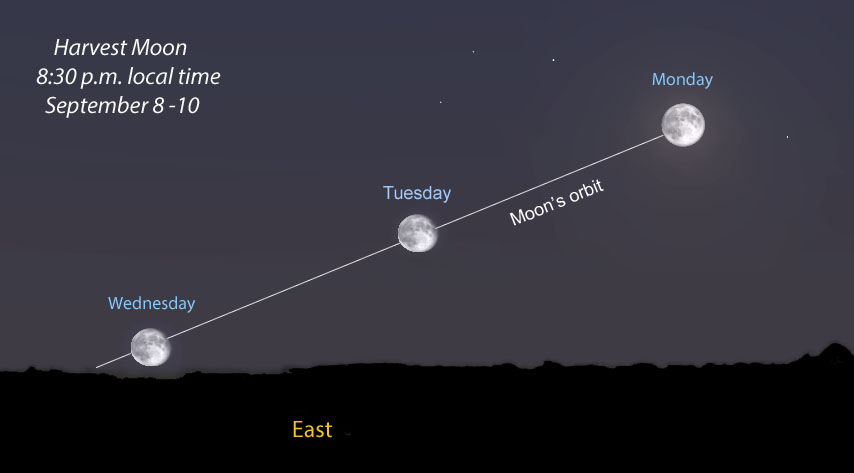
Tonight, September 8, the Harvest Moon rises the color of a fall leaf and spills its light across deserts, forests, oceans and cities. The next night it rises only a half hour later. And the next, too. The short gap of time between successive moonrises gave farmers in the days before electricity extra light to harvest their crops, hence the name.

The Harvest Moon is the full moon that falls closest to the autumnal equinox, the beginning of northern autumn. As the moon orbits the Earth, it moves eastward about one fist held at arm’s length each night and rises about 50 minutes later. You can see its orbital travels for yourself by comparing the moon’s nightly position to a bright star or constellation.

This full Moon is also a Proxigean or Perigee Full “Supermoon” (find out more about that here), which means the Moon is in a spot in its elliptical orbit where it is closer to Earth near the time it is full, making it look up to 15% larger than average full Moon.


Around the time of Harvest Moon, the full moon's path is tilted at a shallow angle to the eastern horizon making with successive moonrises only about a half hour apart instead of the usual 50 minutes. Source: Stellarium

Around the time of Harvest Moon, the full moon’s path is tilted at a shallow angle to the eastern horizon making with successive moonrises only about a half hour apart instead of the usual 50 minutes. Source: Stellarium
50 minutes is the usual gap between moonrises. But it can vary from 25 minutes to more than an hour depending upon the angle the moon’s path makes to the eastern horizon at rise time. In September that path runs above the horizon at a shallow angle. As the moon scoots eastward, it’s also moving northward this time of year.

This northward motion isn’t as obvious unless you watch the moon over the coming week. Then you’ll see it climb to the very top of its monthly path when it’s high overhead at dawn. The northward motion compensates for the eastward motion, keeping the September full moon’s path roughly parallel to the horizon with successive rise times only ~30 minutes apart.

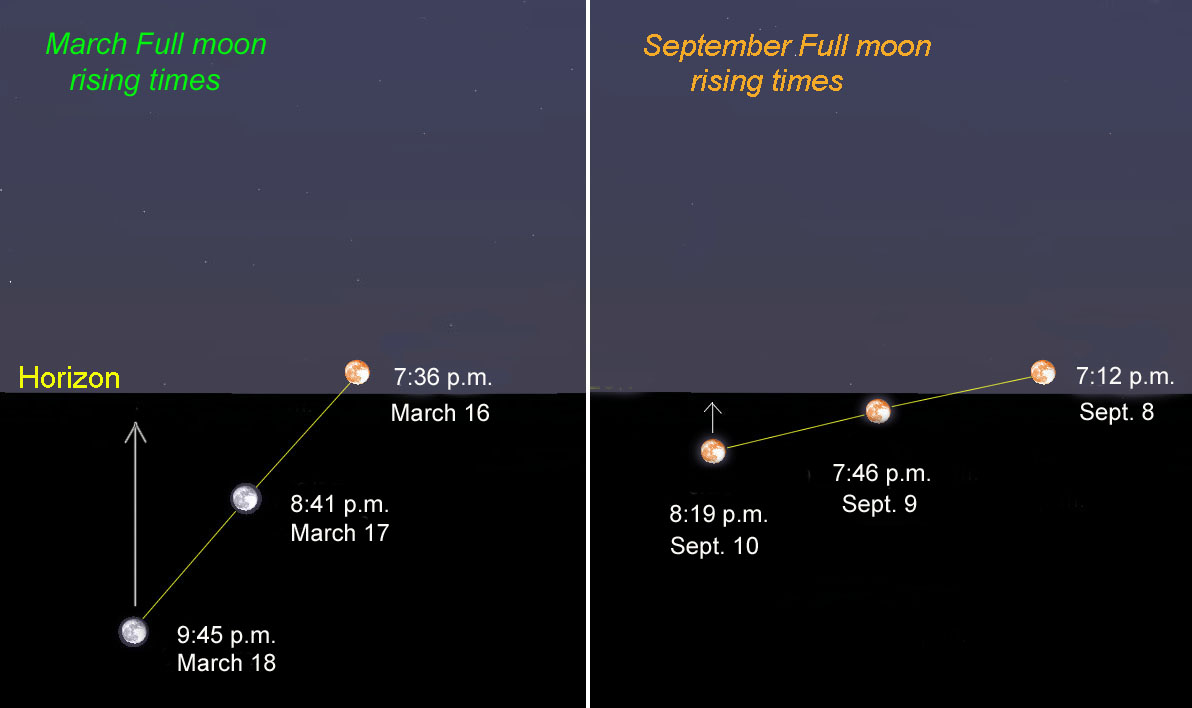
The angle of the moon’s path to the horizon makes all the difference in moonrise times. At full phase in spring, the path tilts steeply southward, delaying successive moonrises by over an hour. In September, the moon’s path is nearly parallel to the horizon with successive moonrises just 20+ minutes apart. Times are shown for the Duluth, Minn. region. Illustration: Bob King

The angle of the moon’s path to the horizon makes all the difference in moonrise times. At full phase in spring, the path tilts steeply southward, delaying successive moonrises by over an hour. In September, the moon’s path is nearly parallel to the horizon with successive moonrises just 30+ minutes apart. Times are shown for the Duluth, Minn. region. Illustration: Bob King
Exactly the opposite happened 6 months earlier this spring, when the moon’s path met the horizon at a steep angle. While it traveled the identical distance each night then as now, its tilted path dunked it much farther below the horizon night to night. The spring full moon moves east and south towards its lowest point in the sky. Seen from the northern hemisphere, that southward travel adds in extra time for the moon to reach the horizon and rise each successive night.

If all this is a bit mind-bending, don’t sweat it. Click HERE to find when the moon rises for your town and find a spot with a great view of the eastern horizon. You’ll notice the moon is orange or red at moonrise because the many miles of thicker atmosphere you look through when you gaze along the horizon scatters the shorter bluer colors from moonlight, tinting it red just as it does the sun.

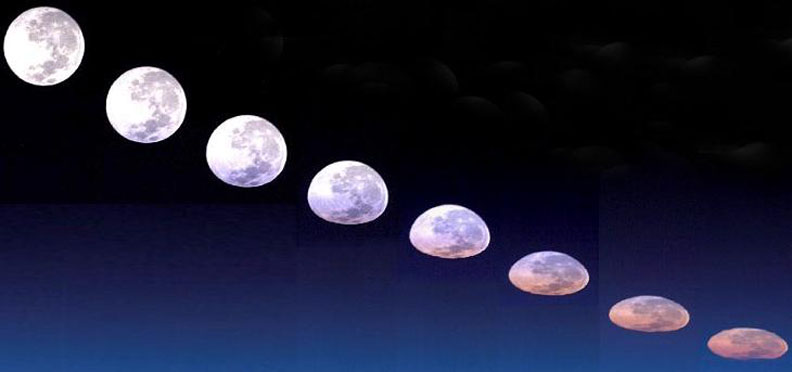
A series of photos of the full moon setting over Earth's limb taken by from space by NASA astronaut Don Pettit on April 16, 2003. Refraction causes a celestial object's light to be bent upwards, so it appears higher than it actually is. The bottom half of the moon, closer to the horizon, is refracted strongest and "pushed" upward into the top half, making it look squished. Credit: NASA

A series of photos of the full moon setting over Earth’s limb taken by from space by NASA astronaut Don Pettit on April 16, 2003. Refraction causes a celestial object’s light to be bent upwards, so it appears higher than it actually is. The bottom half of the moon, closer to the horizon, is refracted strongest and “pushed” upward into the top half, making it look squished. Credit: NASA
The moon will also appear squished due to atmospheric refraction. Air is densest right at the horizon and refracts or bends light more strongly than the air immediately above it. Air “lifts” the bottom of the moon – which is closer to the horizon – more than the top, squishing the two halves together into an egg or oval shape.

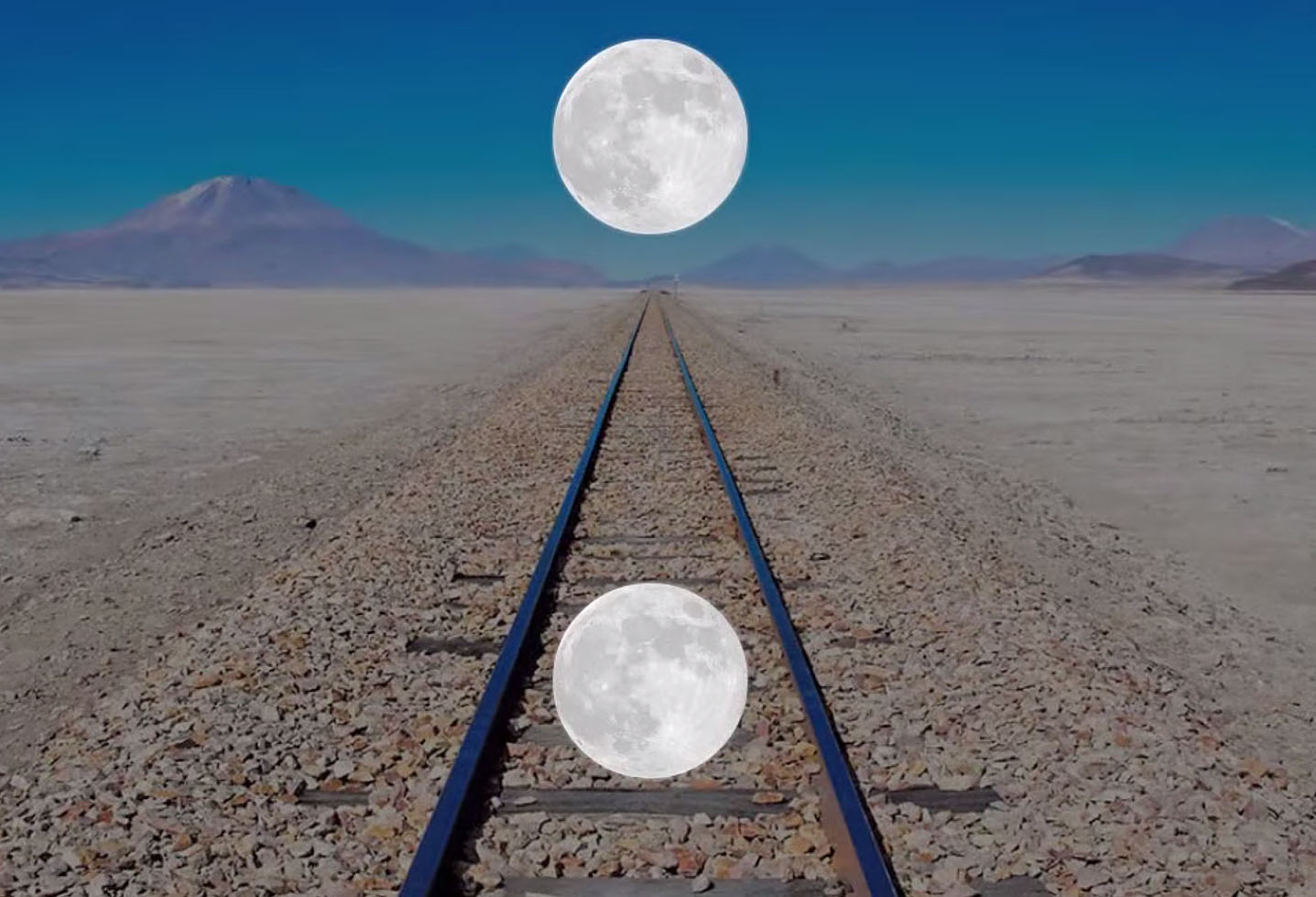
How we perceive the moon's size may have much to do with what's around it. In this illustration, most of us seen the bottom moon as smaller, but they're both exactly the same size. Crazy, isn't it? Credit: NASA

How we perceive the moon’s size may have much to do with what’s around it. In this illustration, most of us seen the bottom moon as smaller, but they’re both exactly the same size. Crazy, isn’t it? Credit: NASA
You may also be entranced Monday night by the Moon Illusion, where the full moon appears unnaturally large when near the horizon compared to when viewed higher up. No one has come up with a complete explanation for this intriguing aspect of our perception, but the link above offers some interesting hypotheses.

Can you see craters with your naked eye? Yes! Try tonight through Wednesday night. Plato is the trickiest. Credit: Bob King

Can you see craters with your naked eye? Yes! Try tonight through Wednesday night. Plato is the trickiest. Credit: Bob King
Finally, full moon is an ideal time to see several lunar craters with the naked eye. They’re not the biggest, but all, except Plato, are surrounded by bright rays of secondary impact craters that expand their size and provide good contrast against the darker lunar “seas”. Try with your eyes alone first, and if you have difficulty, use binoculars to get familiar with the landscape and then try again with your unaided eyes.

In contrast to the other craters, Plato is dark against a bright landscape. It’s a true challenge – I’ve tried for years but still haven’t convinced myself of seeing it. The others are easier than you’d think. Good luck and clear skies!

Tagged as:
full moon,
harvest moon,
Moon Illusion,
refraction

Gliese 15Ab: The Closest Known Super-Earth?

Gliese 15Ab: The Closest Known Super-Earth?:


An artist’s rendering of the newly discovered exoplanet OGLE-2013-BLG-0341LBb (far right) orbiting one star (right) of a binary red dwarf star system, from an Earth-type distance of approximately 0.9 Astronomical Units away. Image Credit: Cheongho Han, Chungbuk National University, Republic of Korea

An artist’s conception of the view from an exoplanet orbiting one star in a binary red dwarf system. Image Credit: Cheongho Han, Chungbuk National University, Republic of Korea
Our solar neighborhood is rich with planetary systems. Within 20 light-years we’ve detected sizzling gas giants and rocky planets orbiting closer to their host star than Mercury orbits the Sun.

Astronomers have now added one more to the list, and this one — a super-Earth dubbed Gliese 15Ab — ranks as one of the closest known exoplanets, circling its host star only 11.7 light-years away.

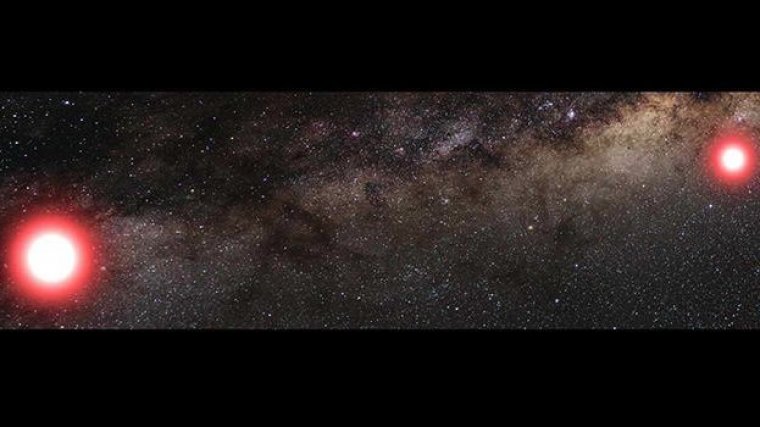
Gliese 15 is a binary system, with two cool, dim red dwarfs orbiting each other. Although red dwarfs are the most common type of star in the galaxy, they’re so intrinsically faint that not a single one (including the closest star to the Sun, Proxima Centauri) is visible to the naked eye.

Although Gliese 15A might appear faint from Earth, it is overwhelmingly bright compared to its barely reflective exoplanet. So unfortunately we can’t easily see the exoplanet directly. But it does leave an imprint on its host star. Its small gravitational tug makes Gliese 15A wobble ever so slightly as both orbit a mutual center of mass, known as the barycenter.

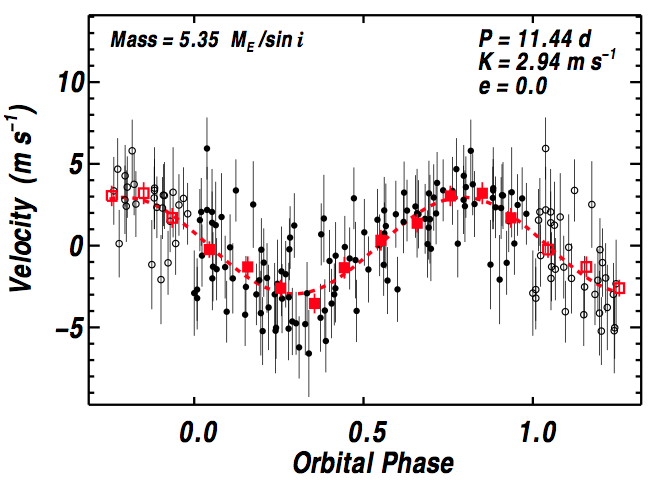
The star’s movement is then imprinted on its spectrum. As Gliese 15A moves away from the Earth, its spectral lines stretch to redder wavelengths. But as it moves toward the Earth, its spectral lines compress to shorter wavelengths.

Screen Shot 2014-09-08 at 3.52.34 PM

The radial velocities for Gliese 15Ab. Image Credit: Howard et al.
The change is minute. But the Keck 10-meter telescope, with an extremely high-resolution detector, can see such small changes. And from this tiny wobble, Andrew Howard and colleagues calculated that the planet is 5.35 times the mass of Earth and orbits its star in only 11.44 days, making it a hot super-Earth. And remember, it’s only 11.7 light-years away.

A handful of other planet candidates have been found that are closer, but all — including Gliese 15Ab — have yet to be confirmed by other research teams. In the long run, it may turn out that this hot super-Earth is the closest planet to our pale blue dot. Then again, it may not. That’s how science works.

Nonetheless, Gliese 15Ab might prove to be an exciting target for one of the new planet imagers that came online within the past year.

The findings will be published in the Astrophysical Journal and are available online.

Tagged as:
Gliese 15,
super earth

How Dark Matter Could Reduce The Fleet Of Galaxies Following The Milky Way

How Dark Matter Could Reduce The Fleet Of Galaxies Following The Milky Way:


On either side of the white line in the picture are two models of how dark matter is distributed in a galaxy similar to the Milky Way. At left, non-interacting cold dark matter creates satellite galaxies. At right, dark matter interacting with other particles makes the number of observed satellite galaxies smaller. Credit: Durham University

On either side of the white line in the picture are two models of how dark matter is distributed in a galaxy similar to the Milky Way. At left, non-interacting cold dark matter creates satellite galaxies. At right, dark matter interacting with other particles makes the number of observed satellite galaxies smaller. Credit: Durham University
Funny how small particle interactions can have such a big effect on the neighbors of the Milky Way. For a while, scientists have been puzzled about the dearth of small satellite galaxies surrounding our home galaxy.

They thought that cold dark matter in our galaxy should encourage small galaxies to form, which created a puzzle. Now, a new set of research suggests the dark matter actually interacted with small bits of normal matter (photons and neutrinos) and the dark matter scattered away, reducing the amount of material available for building galaxies.

“We don’t know how strong these interactions should be, so this is where our simulations come in,” stated Celine Boehm, a particle physicist at Durham University who led the research. “By tuning the strength of the scattering of particles, we change the number of small galaxies, which lets us learn more about the physics of dark matter and how it might interact with other particles in the Universe.”

Artist's conception of the Milky Way galaxy based on the latest survey data from ESO’s VISTA telescope at the Paranal Observatory. A prominent bar of older, yellower stars lies at galaxy center surrounded by a series of spiral arms. The galaxy spans some 100,000 light years. Credit: NASA/JPL-Caltech, ESO, J. Hurt

Artist’s conception of the Milky Way galaxy based on the latest survey data from ESO’s VISTA telescope at the Paranal Observatory. A prominent bar of older, yellower stars lies at galaxy center surrounded by a series of spiral arms. The galaxy spans some 100,000 light years. Credit: NASA/JPL-Caltech, ESO, J. Hurt
Dark matter is a poorly understood part of the Universe, which is frustrating for scientists because it (along with dark energy) is believed to make up the majority of our Cosmos. There are several postulated types of it, but the main thing to understand is dark matter is hard to detect (except, in certain cases, through its interactions with gravity.)

This isn’t the only explanation for why the galaxies are missing, the scientists caution. Perhaps the universe’s first stars were so hot that they affected the gas that other stars formed from, for example.

A paper on the research was published in the Monthly Notices of the Royal Astronomical Society and is also available in preprint version on Arxiv.

Source: Royal Astronomical Society

Tagged as:
Dark Matter

AMAZING PHOTO : Spectacular View of the Rosette Nebula

Astrophoto: Spectacular View of the Rosette Nebula:


The Rosette Nebula, taken on September 9, 2014. A 5 hour exposure, using an Epsilon 180 ED telescope, with filters of 3nm Astrodon combining Hydrogen-alpha, Oxygen and Sulfur II. Credit and copyright: César Cantú.

The Rosette Nebula, taken on September 9, 2014. A 5 hour exposure, using an Epsilon 180 ED telescope, with filters of 3nm Astrodon combining Hydrogen-alpha, Oxygen and Sulfur II. Credit and copyright: César Cantú.
Wow! Here’s a gorgeous view of the Rosette Nebula from astrophotographer César Cantú. The Rosette Nebula is a star-forming region about 5,000 light years from Earth, located in the constellation Monoceros. Winds from the young, hot, blue stars cleared the central hole. The central cluster of stars is also known as NGC 2244.

The image compiles about 5 hours of observing time and César used hydrogen-alpha, oxygen and sulfur filters.

Compare this new view to earlier images of the Rosette taken by César in 2011, and see more at his website, Astronomía Y Astrofotografía..


Want to get your astrophoto featured on Universe Today? Join our Flickr group or send us your images by email (this means you’re giving us permission to post them). Please explain what’s in the picture, when you took it, the equipment you used, etc.

Tagged as:
Astrophotos,
César Cantu,
Rosette Nebula