Friday, September 12, 2014

Bright Clumps in Saturn Ring Now Mysteriously Scarce

Bright Clumps in Saturn Ring Now Mysteriously Scarce:

Shadows and Rings
Cassini spied just as many regular, faint clumps in Saturn's narrow F ring, like those pictured here, as Voyager did, but it saw hardly any of the long, bright clumps that were common in Voyager images. Image credit: NASA/JPL-Caltech/SSI
› Full image and caption


September 08, 2014

Compared to the age of the solar system -- about four-and-a-half billion years -- a couple of decades are next to nothing. Some planetary locales change little over many millions of years, so for scientists who study the planets, any object that evolves on such a short interval makes for a tempting target for study. And so it is with the ever-changing rings of Saturn.

Case in point: Saturn's narrow, chaotic and clumpy F ring. A recent NASA-funded study compared the F ring's appearance in six years of observations by the Cassini mission to its appearance during the Saturn flybys of NASA's Voyager mission, 30 years earlier. The study team found that, while the overall number of clumps in the F ring remained the same, the number of exceptionally bright clumps of material plummeted during that time. While the Voyagers saw two or three bright clumps in any given observation, Cassini spied only two of the features during a six-year period. What physical processes, they wondered, could cause only the brightest of these features to decline sharply?

While a variety of features in Saturn's many rings display marked changes over multiple years, the F ring seems to change on a scale of days, and even hours. Trying to work out what is responsible for the ring's tumultuous behavior is a major goal for ring scientists working on Cassini.

"Saturn's F ring looks fundamentally different from the time of Voyager to the Cassini era," said Robert French of the SETI Institute in Mountain View, California, who led the study along with SETI Principal Investigator Mark Showalter. "It makes for an irresistible mystery for us to investigate."

The researchers hypothesize that the brightest clumps in the F ring are caused by repeated impacts into its core by small moonlets up to about 3 miles (5 kilometers) wide, whose paths around Saturn lie close to the ring and cross into it every orbit. They propose that the diminishing number of bright clumps results from a drop in the number of these little moonlets between the Voyager and Cassini eras.

As for what might have caused the moonlets to become scarce, the team has a suspect: Saturn's moon Prometheus. The F ring encircles the planet at a special location, near a place called the Roche limit -- get any closer to Saturn than this, and tidal forces from the planet's gravity tear apart smaller bodies. "Material at this distance from Saturn can't decide whether it wants to remain as a ring or coalesce to form a moon," French said. Prometheus orbits just inside the F ring, and adds to the pandemonium by stirring up the ring particles, sometimes leading to the creation of moonlets, and sometimes leading to their destruction.

Every 17 years, the orbit of Prometheus aligns with the orbit of the F ring in such a way that its influence is particularly strong. The study team thinks this periodic alignment might spur the creation of many new moonlets. The moonlets would then crash repeatedly through the F ring, like cars in a Hollywood high-speed chase, creating bright clumps as they smash across lanes of ring material. Fewer clumps would be created as time goes by, because the moonlets themselves are eventually destroyed by all the crashes.

As with any good scientific hypothesis, the researchers offer a way to test their ideas. It happens that the Voyager encounters with Saturn occurred a few years after the 1975 alignment between Prometheus and the F ring, and Cassini was present for the 2009 alignment. If the moon's periodic influence is indeed responsible for creating new moonlets, then the researchers expect that Cassini would see the F ring return to a Voyager-like number of bright clumps in the next couple of years.

"Cassini's continued presence at Saturn gives us an interesting opportunity to test this prediction," said Linda Spilker, Cassini project scientist at NASA's Jet Propulsion Laboratory in Pasadena, California, who was not involved in the study. "Whatever the result, we're certain to learn something valuable about how rings, as well as planets and moons, form and evolve."

The study by French and colleagues was published in the online edition of the Journal Icarus on July 15, 2014.

NASA's Jet Propulsion Laboratory manages the Voyager and Cassini-Huygens missions for NASA's Science Mission Directorate at NASA Headquarters in Washington.

More information about Cassini is available at:

http://www.nasa.gov/cassini

http://saturn.jpl.nasa.gov

Preston Dyches 818-354-5011

Jet Propulsion Laboratory, Pasadena, Calif.

preston.dyches@jpl.nasa.gov


Seth Shostak 650-960-4530

SETI Institute, Mountain View, Calif.

seth@seti.org


2014-302

Spitzer's SPLASH Project Dives Deep for Galaxies

Spitzer's SPLASH Project Dives Deep for Galaxies:

Scientists
Scientists "fish" for galaxies in this playful, digitally altered photo. The researchers are part of a program called SPLASH, which is using NASA's Spitzer Space Telescope to dive deep into the cosmic sea and find some of the most remote galaxies known. Early results are turning up surprisingly big "fish" -- massive galaxies -- in the darkest reaches of the universe, dating back to a time when our universe was less than one billion years old. Image credit: NASA/JPL-Caltech
› Full image and caption


September 09, 2014

A new survey of galaxies by NASA's Spitzer Space Telescope is taking a plunge into the deep and uncharted waters of our cosmos. In one of the longest surveys the telescope will have ever performed, astronomers have begun a three-month expedition trawling for faint galaxies billions of light-years away.

The results are already yielding surprises.

"If you think of our survey as fishing for galaxies in the cosmic sea, then we are finding many more big fish in deep waters than previously expected," said Charles Steinhardt of NASA's Infrared Processing and Analysis Center (IPAC) at the California Institute of Technology in Pasadena. Steinhardt is lead author of a new study appearing in the Astrophysical Journal Letters.

These early results from the SPLASH project, an international effort officially called the Spitzer Large Area Survey with Hyper-Suprime-Cam, build on previous evidence from Spitzer and other telescopes showing that the universe's earliest galaxies are more massive than expected. The project is turning up hundreds of hefty galaxies 100 times the mass of our own Milky Way, dating back to a time when our universe was less than one billion years old. (Our universe is 13.8 billion years old.)

The findings cast doubt on current models of galaxy formation, which struggle to explain how these remote and young galaxies grew so big so fast.

"Galaxies were being assembled faster than we thought, and we can only see this by finding large numbers of them with a survey like SPLASH," said Peter Capak, also of IPAC, and principal investigator of SPLASH.

While astronomers have seen such massive galaxies before, SPLASH is unique in finding large numbers of them. Now that Spitzer is in the "warm" phase of its mission, it dedicates more time to long-term projects such as this one. The telescope ran out of the coolant needed to chill some of its instruments in 2009, but two of its infrared channels work at the slightly warmer temperature. With fewer instruments, the telescope spends more time surveying large patches of sky.

By the end of the SPLASH survey, Spitzer will have spent 2,475 hours staring at two sky fields known as the Cosmic Evolution Survey (COSMOS) and Subaru/XMM-Newton deep field (SXDS), equivalent in size to about eight full moons. These are two of the darkest patches of sky, away from the plane of our Milky Way galaxy's flat spiral disk and its bright starlight. Many telescopes have studied these regions extensively at multiple wavelengths of light, spying the faint glow of millions of galaxies beyond our own. Spitzer's infrared vision helps weigh the galaxies, revealing their masses.

Astronomers are surprised by the early SPLASH results and its catch of "big fish." Current theories of star formation hold that the very first galaxies collided and merged, bulking up in size. In these models, the stars formed in bursts as these smaller galaxies smashed into each other. But this process takes time. Spitzer's finding of massive galaxies in an era between 800 and 1,600 million years after the birth of our universe barely leaves enough time for the galaxies' roughly one hundred billion stars to have formed.

"It's really hard to form something so massive so quickly," said Josh Speagle, co-author of the study from Harvard University, Cambridge, Massachusetts. "So it's entirely possible that these galaxies have been forming stars continuously since the moment they were born."

Another explanation is that the first-ever galaxies got their foothold in the universe sooner than thought. Astronomers think the first galaxies formed around 500 million years after the Big Bang. If galaxies started forming earlier than this, by about 400 million years after the Big Bang, then they might have had the time needed to merge with other galaxies and ultimately grow into the behemoths found by Spitzer.

Follow-up observations with a host of telescopes are now being planned to figure out exactly how these galaxies got so big. Japan's Subaru telescope atop Mauna Kea in Hawaii will collect deep optical images of the galaxies over the course of several years.

The technical Astrophysical Journal Letters paper is online at

http://iopscience.iop.org/2041-8205/791/2/L25/

NASA's Jet Propulsion Laboratory, Pasadena, California, manages the Spitzer Space Telescope mission for NASA's Science Mission Directorate, Washington. Science operations are conducted at the Spitzer Science Center at the California Institute of Technology in Pasadena. Spacecraft operations are based at Lockheed Martin Space Systems Company, Littleton, Colorado. Data are archived at the Infrared Science Archive housed at the Infrared Processing and Analysis Center at Caltech. Caltech manages JPL for NASA. For more information about Spitzer, visit:

http://spitzer.caltech.edu

http://www.nasa.gov/spitzer

Whitney Clavin 818-354-4673

Jet Propulsion Laboratory, Pasadena, Calif.

818-354-4673

whitney.clavin@jpl.nasa.gov


2014-303

NASA Research Aids Response to California Napa Quake

NASA Research Aids Response to California Napa Quake:

NASA's UAVSAR Studies Ground Deformation from Napa California Quake
NASA Uninhabited Aerial Vehicle Synthetic Aperture Radar data from flights over Napa Valley, California, on May 29 and Aug. 29 were used to measure ground deformation from the Aug. 24 magnitude 6.0 quake in South Napa. The analyses found the quake's surface rupture was more complex than anticipated. Image credit: NASA/JPL-Caltech/ASI/Google Earth
› Full image and caption


September 10, 2014

NASA data and expertise are proving invaluable in California's ongoing response to the Aug. 24 magnitude 6.0 earthquake in Napa Valley, northeast of San Francisco. The quake was the strongest to occur in the San Francisco Bay Area in a quarter-century and caused significant regional damage.

Analyses by scientists at NASA's Jet Propulsion Laboratory, Pasadena, California, of airborne data from NASA's Uninhabited Aerial Vehicle Synthetic Aperture Radar (UAVSAR), GPS data and radar imagery from the Italian Space Agency's COSMO-SkyMed satellites, are revealing important details of how the ground deformed in the region and the nature of the fault movements. In addition, a NASA-funded disaster decision support system has provided a series of rapid-response data maps to decision makers at the California Earthquake Clearinghouse. Those maps are being used to better direct response efforts.

NASA has been monitoring active earthquake faults in California using a variety of remote sensing and ground-based techniques. The JPL-developed UAVSAR, in use since 2009, is an L-band Interferometric Synthetic Aperture Radar instrument that flies mounted underneath a NASA C-20A Earth science research aircraft from NASA's Armstrong Flight Research Center, Edwards, California. UAVSAR is able to detect minute changes in Earth's surface that occur over time between flights of the instrument. UAVSAR has monitored the Napa area about every six months since November 2009.

A comparison of UAVSAR data collected on May 29, 2014, three months before the quake, and on Aug. 29, 2014, five days after the quake, reveals that multiple strands of the fault slipped near the quake's epicenter. A new UAVSAR image showing these changes is available at:

http://www.jpl.nasa.gov/spaceimages/details.php?id=PIA18801

The image colors represent the amount of ground motion between the two flights in the direction from a point on the ground to the instrument, which flies at an altitude of 41,000 feet (12,497 meters). Preliminary results indicate several inches/centimeters of horizontal slip occurred on the various strands of the fault.

Further UAVSAR data analyses will reveal how deep beneath Earth's surface the faults slipped and the amount of the slip. Initial GPS analyses, shown in the image by the yellow arrows, indicate an average slip of nearly 23.6 inches (60 centimeters) along a 9.3-mile-long (15-kilometer) fault. That is equivalent to a magnitude 6.1 earthquake. This suggests that the strands of the fault continued to slip after the main earthquake, but did not produce any large aftershocks.

The Aug. 29 UAVSAR flight was conducted to assess if the earthquake damaged any of the water conveyance infrastructure of the Sacramento Delta. By Aug. 31, UAVSAR data of ground movement along the San Pablo Bay shoreline were in the hands of the California Department of Water Resources, who used it to assess levee and aqueduct damage in support of their emergency response activities. It was also provided to the United States Geological Survey to direct their ground survey crews.

"NASA's UAVSAR radar imagery of the magnitude 6.0 Napa earthquake is being widely used to identify fault slip across the full Napa fault zone for the scientific, engineering and damage assessment communities and may result in the most comprehensive fault map ever produced for an earthquake in the United States," said Gerald Bawden, program scientist at NASA Headquarters, Washington.

JPL scientists, in collaboration with the Italian Space Agency's (ASI) Center for the Interpretation of Earth Observation Data and the Universita degli studi della Basilicata, also analyzed interferometric synthetic aperture radar images from ASI's COSMO-SkyMed satellites to calculate a map of the deformation of Earth's surface caused by the quake. The deformation is shown in a new false-color map that has been combined with shaded relief topography in gray. A pair of new maps created from these data can be viewed at:

http://www.jpl.nasa.gov/spaceimages/details.php?id=pia18798

The colors in the top map indicate the amount of permanent surface movement that occurred almost entirely due to the quake, as viewed by the satellite, during a one-month interval between two COSMO-SkyMed images acquired on July 26 and Aug. 27, 2014. Scientists use these maps to build detailed models of the fault and associated land movements to better understand the impact on future earthquake activity.

The second radar map is based on the same data as the first map, but highlights very small-scale ground deformation and evidence of the fault rupture visible on Earth's surface. The inset map shows a close-up of the color cycles, revealing a discontinuity in the color cycles that identifies a potential fault rupture cutting through the Napa County Airport. United States Geological Survey and California Geological Survey field crews investigated this feature and were able to verify that the fault did break Earth's surface at this location, along a previously unidentified fault rupture.

The full COSMO-SkyMed interferogram was processed by the NASA JPL-Caltech Advanced Rapid Imaging and Analysis (ARIA) team as part of a joint collaboration between JPL; the California Institute of Technology, Pasadena; ASI's Centro Interpretazione Dati di Osservazione della Terra (CIDOT); and the Universita degli Studi della Basilicata.

The rapid response data maps developed under NASA's E-DECIDER (Emergency Data Enhanced Cyber-Infrastructure for Disaster Evaluation and Response) disaster decision support system were provided to the California Earthquake Clearinghouse to help decision makers direct response efforts. The E-DECIDER products may be viewed at:

http://www.jpl.nasa.gov/spaceimages/details.php?id=PIA18797

They include an aftershock forecast map that highlights where aftershocks are likely to occur; a strain magnitude map that highlights areas where the greatest ground deformation has occurred based on a fault model; and InLET (Internet Loss Estimation Tool), which provides immediate post-event estimates of casualties and building damage for planning purposes and early response after an earthquake before more detailed data become available.

For more on the UAVSAR Napa earthquake studies, visit:

http://www.jpl.nasa.gov/news/news.php?release=2014-293

The NASA UAVSAR project serves as a technology and applications testbed for a NASA spaceborne L-band synthetic aperture radar mission now under formulation. When launched, this mission would extend the UAVSAR regional capability to a global scope. More information on this mission can be found at:

http://nisar.jpl.nasa.gov

NASA monitors Earth's vital signs from land, air and space with a fleet of satellites and ambitious airborne and ground-based observation campaigns. NASA develops new ways to observe and study Earth's interconnected natural systems with long-term data records and computer analysis tools to better see how our planet is changing. The agency shares this unique knowledge with the global community and works with institutions in the United States and around the world that contribute to understanding and protecting our home planet.

For more information about NASA's Earth science activities in 2014, visit:

http://www.nasa.gov/earthrightnow

Alan Buis

Jet Propulsion Laboratory, Pasadena, California

818-354-0474

alan.buis@jpl.nasa.gov


2014-306

NEWS : First Map of Rosetta's Comet

First Map of Rosetta's Comet:

Distinct Terrains on Rosetta's Comet
This view of the "belly" and part of the "head" of comet 67P/Churyumov-Gerasimenko indicates several morphologically different regions. Image credit: ESA/Rosetta/MPS for OSIRIS Team/MPS/UPD/LAM/IAA/SSO/INTA/UPM/DASP/IDA

› Full image and caption


September 11, 2014

Scientists have found that the surface of comet 67P/Churyumov-Gerasimenko -- the target of study for the European Space Agency's Rosetta mission -- can be divided into several regions, each characterized by different classes of features. High-resolution images of the comet reveal a unique, multifaceted world.

ESA's Rosetta spacecraft arrived at its destination about a month ago and is currently accompanying the comet as it progresses on its route toward the inner solar system. Scientists have analyzed images of the comet's surface taken by OSIRIS, Rosetta's scientific imaging system, and defined several different regions, each of which has a distinctive physical appearance. This analysis provides the basis for a detailed scientific description of 67P's surface. A map showing the comet's various regions is available at:

http://go.nasa.gov/1pU26L2

"Never before have we seen a cometary surface in such detail," says OSIRIS Principal Investigator Holger Sierks from the Max Planck Institute for Solar System Science (MPS) in Germany. In some of the images, one pixel corresponds to a scale of 30 inches (75 centimeters) on the nucleus. "It is a historic moment -- we have an unprecedented resolution to map a comet," he says.

The comet has areas dominated by cliffs, depressions, craters, boulders and even parallel grooves. While some of these areas appear to be quiet, others seem to be shaped by the comet's activity, in which grains emitted from below the surface fall back to the ground in the nearby area.

"This first map is, of course, only the beginning of our work," says Sierks. "At this point, nobody truly understands how the surface variations we are currently witnessing came to be."

As both comet 67P and Rosetta travel closer to the sun during the next few months, the OSIRIS team and other instruments on the payload will monitor the surface to look for changes. While scientists do not expect the borderlines they have identified for the comet's different regions to vary dramatically, even subtle transformations of the surface may help to explain how cometary activity created such a breathtaking world.

The new comet maps will offer valuable insights for members of the Rosetta team, who plan to gather in Toulouse, France, on September 13 and 14, to determine a primary and backup landing site from five candidates they previously had selected.

The scientific imaging system, OSIRIS, was built by a consortium led by the Max Planck Institute for Solar System Research (Germany) in collaboration with Center of Studies and Activities for Space, University of Padua (Italy), the Astrophysical Laboratory of Marseille (France), the Institute of Astrophysics of Andalusia, CSIC (Spain), the Scientific Support Office of the European Space Agency (Netherlands), the National Institute for Aerospace Technology (Spain), the Technical University of Madrid (Spain), the Department of Physics and Astronomy of Uppsala University (Sweden) and the Institute of Computer and Network Engineering of the TU Braunschweig (Germany). OSIRIS was financially supported by the national funding agencies of Germany (DLR), France (CNES), Italy (ASI), Spain, and Sweden and the ESA Technical Directorate.

Rosetta is an ESA mission with contributions from its member states and NASA. Rosetta's Philae lander is provided by a consortium led by DLR, MPS, CNES and ASI. Rosetta will be the first mission in history to rendezvous with a comet, escort it as it orbits the sun, and deploy a lander to its surface.

For more information on the U.S. instruments aboard Rosetta, visit:

http://rosetta.jpl.nasa.gov

More information about Rosetta is available at:

http://www.esa.int/rosetta

DC Agle

Jet Propulsion Laboratory, Pasadena, Calif.

818-393-9011

agle@jpl.nasa.gov


2014-308

Sunday, September 7, 2014

A New Marker Might Better Track the Solar Cycle

A New Marker Might Better Track the Solar Cycle:


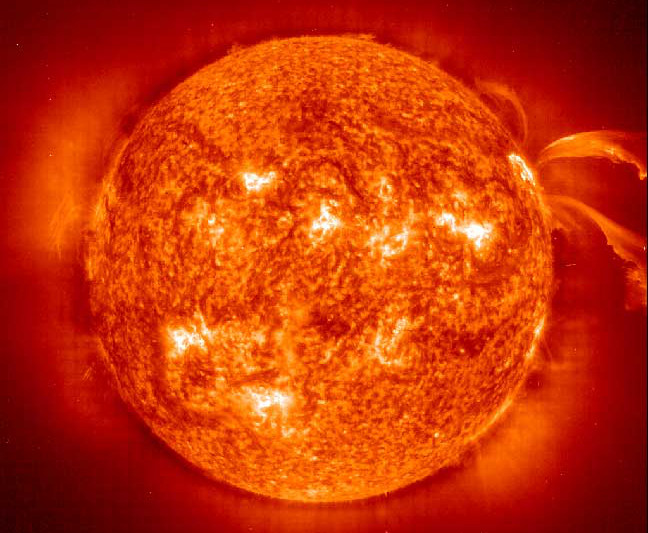
This image from the Solar and Heliospheric Observatory (SOHO) Extreme ultraviolet Imaging Telescope (EIT) image shows large magnetically active regions and a pair of curving erupting prominences on June 28, 2000 during the current solar cycle 23 maximum. Prominences are huge clouds of relatively cool dense plasma suspended in the Sun's hot, thin corona. Magnetically active regions cause the principal total solar irradiance variations during each solar cycle. The hottest areas appear almost white, while the darker red areas indicate cooler temperatures. Credit: NASA & European Space Agency (ESA)

This image from the Solar and Heliospheric Observatory (SOHO) Extreme ultraviolet Imaging Telescope (EIT) shows large magnetically active regions and a pair of curving erupting prominences on June 28, 2000 during the solar cycle 23 maximum. Credit: NASA & European Space Agency (ESA)
Approximately every 11 years the Sun becomes violently active, putting on a show of magnetic activity for aurora watchers and sungazers alike. But the timing of the solar cycle is far from precise, making it hard to determine the exact underlying physics.

Typically astronomers use sunspots to map the course of the solar cycle, but now an international team of astronomers have discovered a new marker: brightpoints, small bright spots in the solar atmosphere that allow us to observe the constant turmoil of material inside the Sun.

The new markers provide a new method in understanding how the Sun’s magnetic field evolves over time, suggesting a deeper and longer cycle.

A well-behaved Sun flips its north and south magnetic poles every 11 years. The cycle begins when the field is weak and dipolar. But the Sun’s rotation is faster at its equator than at its poles, and this difference stretches and tangles the magnetic field lines, ultimately producing sunspots, prominences, and sometimes flares.

“Sunspots have been the perennial marker for understanding the mechanisms that rule the sun’s interior,” said lead author Scott McIntosh, from the National Center for Atmospheric Research, in a news release. “But the processes that make sunspots are not well understood, and far less, those that govern their migration and what drives their movement.”

So McIntosh and colleagues developed a new tracking devise: spots of extreme ultraviolet and X-ray light, known as brightpoints in the Sun’s atmosphere, or corona.

“Now we can see there are bright points in the solar atmosphere, which act like buoys anchored to what’s going on much deeper down,” said McIntosh. “They help us develop a different picture of the interior of the sun.”

McIntosh and colleagues dug through the wealth of data available from the Solar and Heliospheric Observatory and the Solar Dynamics Observatory. They noticed that multiple bands of these markers also move steadily toward the equator over time. But they do so on a different timescale than sunspots.

At solar minimum there might be two bands in the northern hemisphere (one positive and one negative) and two bands in the southern hemisphere (one negative and one positive). Due to their close proximity, bands of opposite charge easily cancel one another, causing the Sun’s magnetic system to be calmer, producing fewer sunspots and eruptions.

But once the two low-latitude bands reach the equator, their polarities cancel each other out and the bands abruptly disappear — a process that takes 19 years on average.

The Sun is now left with just two large bands that have migrated to about 30 degrees latitude. Without the nearby band, the polarities don’t cancel. At this point the Sun’s calm face begins to become violently active as sunspots start to grow rapidly.

Solar maximum only lasts so long, however, because the process of generating a new band of opposite polarity has already begun at high latitudes.


In this scenario, it is the magnetic band’s cycle that truly defines the solar cycle. “Thus, the 11-year solar cycle can be viewed as the overlap between two much longer cycles,” said coauthor Robert Leamon, from Montana State University in Bozeman.

The true test, however, will come with the next solar cycle. McIntosh and colleagues predict that the Sun will enter a solar minimum somewhere in the last half of 2017, and the first sunspots of the next cycle will appear near the end of 2019.

The findings have been published in the Sept. 1 issue of the Astrophysical Journal and are available online.

Second Possible Proto-Planet Found In System Pretty Close To Earth

Second Possible Proto-Planet Found In System Pretty Close To Earth:


This artist's conception shows a newly formed star surrounded by a swirling protoplanetary disk of dust and gas. Credit: University of Copenhagen/Lars Buchhave

This artist’s conception shows a newly formed star surrounded by a swirling protoplanetary disk of dust and gas. Credit: University of Copenhagen/Lars Buchhave
Astronomers have found what they believe is a second protoplanet around HD100546, a youngster star that may also host a planet under formation that is the size of Jupiter.

This new find is at least times the size of Jupiter and about the equivalent distance of Saturn to our own Sun, which means the planet would not be habitable as far as we can tell. It was spotted using a way of measuring carbon monoxide emission that seems to change its velocity and position in the same way that a planet would be expected to be orbiting the star.

The emission itself could be coming from a disk of gas surrounding the planet, or perhaps from the object’s tidal interactions with the gas and dust enveloping the young star, which is only 335 light-years from Earth.

“This system is very close to Earth relative to other disk systems. We’re able to study it at a level of detail that you can’t do with more distant stars. This is the first system where we’ve been able to do this,” stated Sean Brittain, an associate professor of astronomy and astrophysics at Clemson University in South Carolina.

“Once we really understand what’s going on, the tools that we are developing can then be applied to a larger number of systems that are more distant and harder to see.”

The study was published in the Astrophysical Journal.

Source: Clemson University

Tagged as:
HD100546

MAVEN Mars Orbiter Ideally Poised to Uniquely Map Comet Siding Spring Composition – Exclusive Interview with Principal Investigator Bruce Jakosky

MAVEN Mars Orbiter Ideally Poised to Uniquely Map Comet Siding Spring Composition – Exclusive Interview with Principal Investigator Bruce Jakosky:


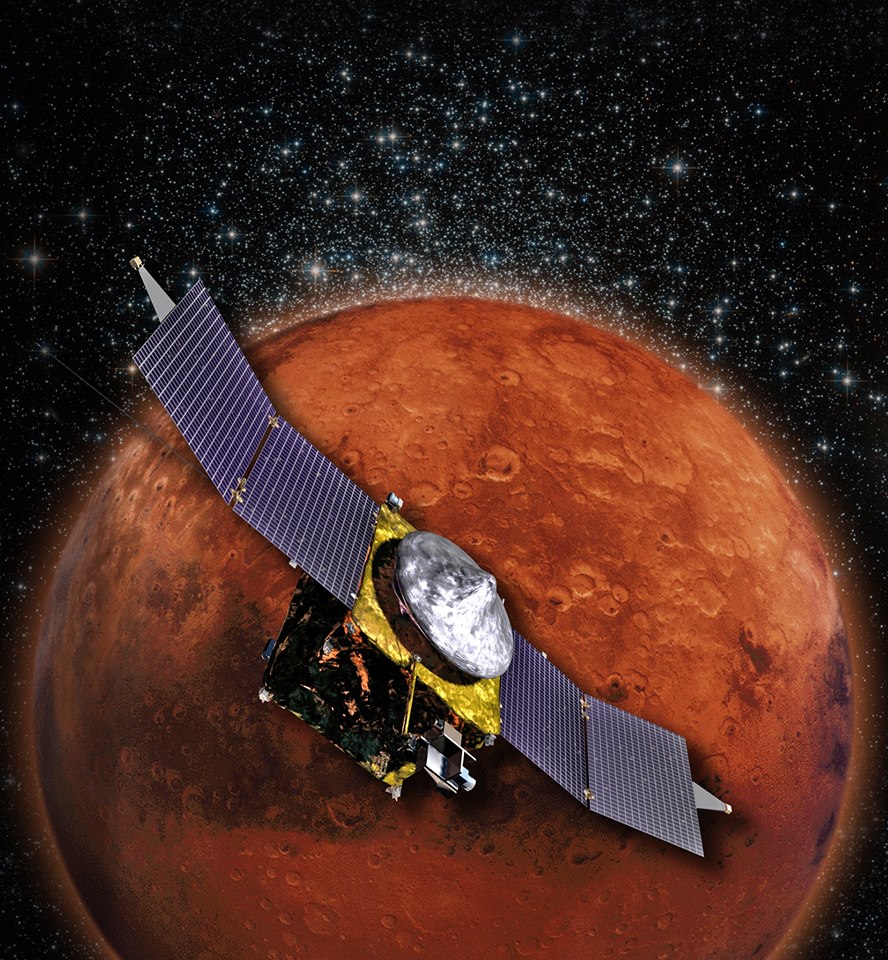
MAVEN is NASA’s next Mars Orbiter and will investigate how the planet lost most of its atmosphere and water over time. Credit: NASA

MAVEN is NASA’s next Mars Orbiter and will investigate how the planet lost most of its atmosphere and water over time. Credit: NASA
NASA’s MAVEN Mars Orbiter is “ideally” instrumented to uniquely “map the composition of Comet Siding Spring” in great detail when it streaks past the Red Planet during an extremely close flyby on Oct. 19, 2014 – thereby providing a totally “unexpected science opportunity … and a before and after look at Mars atmosphere,” Prof. Bruce Jakosky, MAVEN’s Principal Investigator of CU-Boulder, CO, told Universe Today in an exclusive interview.

The probes state-of-the-art ultraviolet spectrograph will be the key instrument making the one-of-a-kind compositional observations of this Oort cloud comet making its first passage through the inner solar system on its millions year orbital journey.

“MAVEN’s Imaging Ultraviolet Spectrograph (IUVS) is the ideal way to observe the comet coma and tail,” Jakosky explained.

“The IUVS can do spectroscopy that will allow derivation of compositional information.”

“It will do imaging of the entire coma and tail, allowing mapping of composition.”

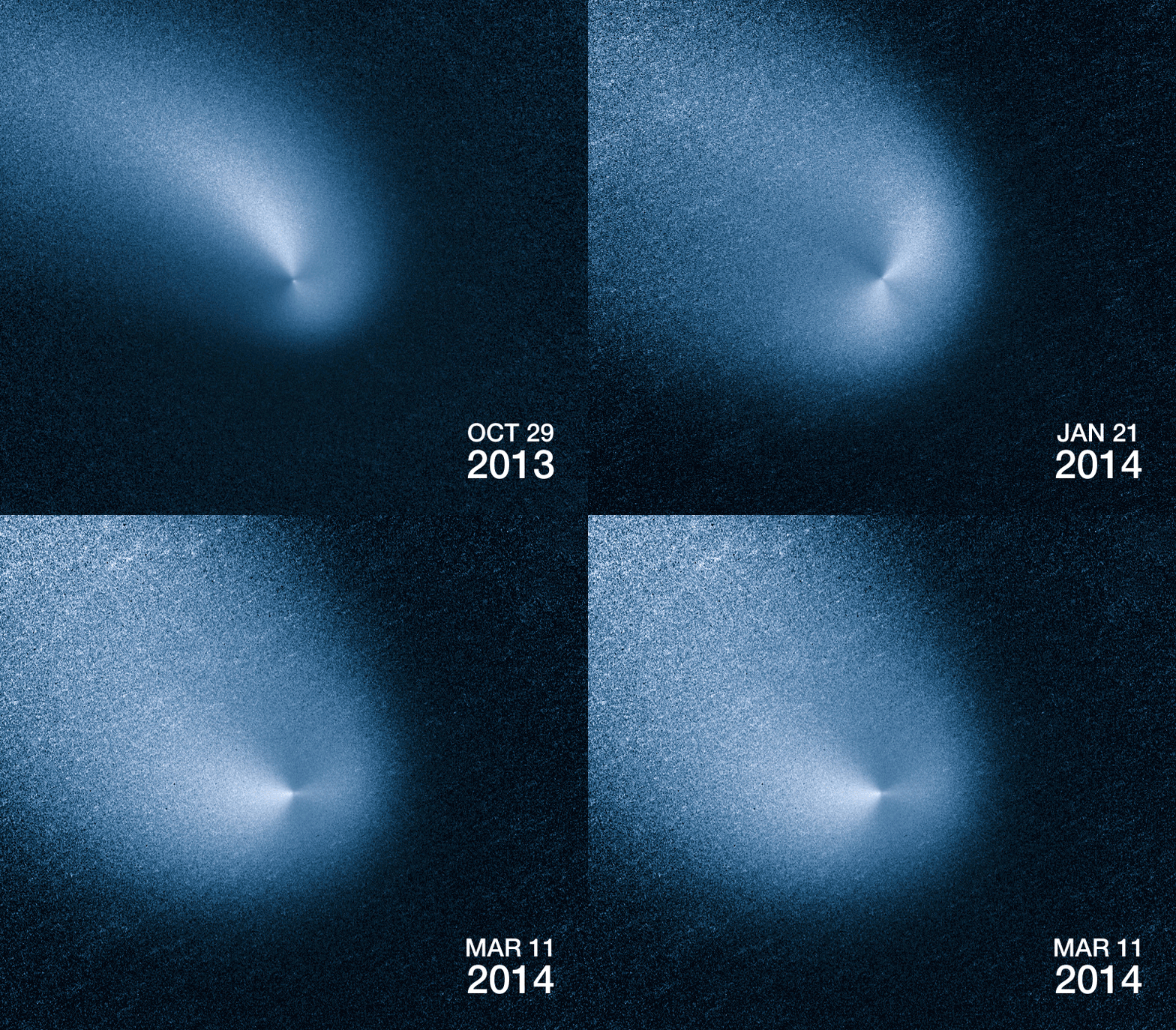
Hubble-Siding-Spring

Moreover the UV spectrometer is the only one of its kind amongst NASA’s trio of Martian orbiters making its investigations completely unique.

“IUVS is the only ultraviolet spectrometer that will be observing the comet close up, and that gives the detailed compositional information,” Jakosky elaborated

And MAVEN, or the Mars Atmosphere and Volatile Evolution, is arriving just in the nick of time to fortuitously capture this fantastic rich data set of a pristine remnant from the solar system’s formation.

The spacecraft reaches Mars in less than 15 days. It will rendezvous with the Red Planet on Sept. 21 after a 10 month interplanetary journey from Earth.

Furthermore, since MAVEN’s purpose is the first ever detailed study of Mars upper atmosphere, it will get a before and after look at atmospheric changes.

“We’ll take advantage of this unexpected science opportunity to make observations both of the comet and of the Mars upper atmosphere before and after the comet passage – to look for any changes,” Jakosky stated.

How do MAVEN’s observations compare to NASA’s orther orbiters Mars Odyssey (MO) and Mars Reconnaissance Orbiter (MRO), I asked?

“The data from the other orbiters will be complementary to the data from IUVS.”

“Visible light imaging from the other orbiters provides data on the structure of dust in the coma and tail. And infrared imaging provides information on the dust size distribution.”

How long will MAVEN make observations of Comet C/2013 A1 Siding Spring?

“We’ll be using IUVS to look at the comet itself, about 2 days before comet nucleus closest approach.”

“In addition, for about two days before and two days after nucleus closest approach, we’ll be using one of our “canned” sequences to observe the upper atmosphere and solar-wind interactions. “

“This will give us a detailed look at the upper atmosphere both before and after the comet, allowing us to look for differences.”

Describe the risk that Comet Siding Spring poses to MAVEN, and the timing?

“We have the encounter with Comet Siding Spring about 2/3 of the way through the commissioning phase we call transition.”

“We think that the risk to the spacecraft from comet dust is minimal, but we’ll be taking steps to reduce the risk even further so that we can move on toward our science mission.”

“Throughout this entire period, though, spacecraft and instrument health and safety come first.”

What’s your overall hope and expectation from the comet encounter?

“Together [with the other orbiters], I’m hoping it will all provide quite a data set!

“From Mars, the comet truly will fill the sky!” Jakosky gushed.

What’s the spacecraft status today?

“Everything is on track.”

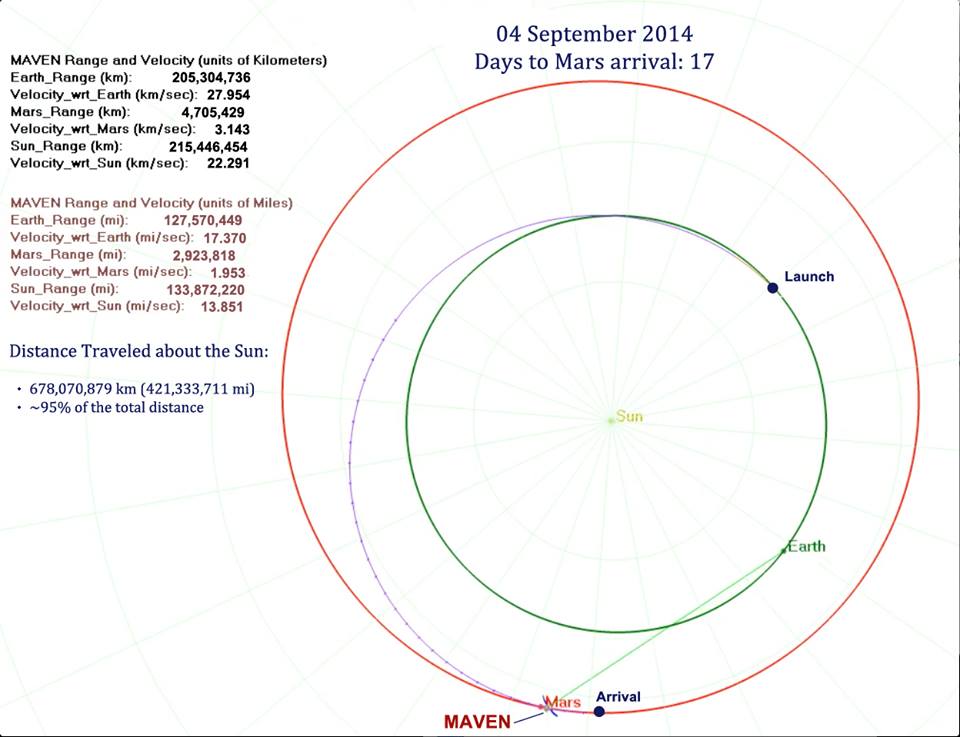
Maven spacecraft trajectory to Mars. Credit: NASA

Maven spacecraft trajectory to Mars. Credit: NASA

Tagged as:
C/2013 A1 Siding Spring,
Comet Siding Spring,
Comets,
Mars,
Mars MAVEN,
Mars Reconnaissance Orbiter (MRO),
MAVEN,
MO,
MRO,
NASA,
Oort cloud,
Oort cloud comets,
red planet

NASA Briefing: Space Station Earth Observations

NASA Briefing: Space Station Earth Observations:

Artist's rendering of NASA's ISS-RapidScat instrument
Artist's rendering of NASA's ISS-RapidScat instrument (inset), which will launch to the International Space Station in 2014 to measure ocean surface wind speed and direction and help improve weather forecasts, including hurricane monitoring. It will be installed on the end of the station's Columbus laboratory. Credit: NASA/JPL-Caltech/Johnson Space Center.
› Full image and caption


September 04, 2014

NASA opens a new era this month in its exploration of our home planet with the launch of the first in a series of Earth science instruments to the International Space Station. A media briefing on this addition to NASA's Earth-observing program will air at 10 a.m. PDT (1 p.m. EDT) Monday, Sept. 8, on NASA Television and the agency's website.

The first Earth-observing instrument to be mounted on the exterior of the space station will launch from Cape Canaveral Air Force Station, Florida, on the next SpaceX Commercial Resupply Services flight. ISS-RapidScat will monitor ocean winds for climate research, weather predictions and hurricane monitoring from the space station's unique vantage point.

The second instrument is the Cloud-Aerosol Transport System (CATS), a laser instrument that will measure clouds and the location and distribution of pollution, dust, smoke and other particulates in the atmosphere. CATS will follow ISS-RapidScat on the fifth SpaceX space station resupply flight.

The briefing will take place at the agency's Headquarters in Washington. The briefing panelists are:

-- Julie Robinson, ISS Program chief scientist, NASA's Johnson Space Center, Houston

-- Steve Volz, associate director for flight programs in the Earth Science Division, NASA Headquarters, Washington

-- Melanie Miller, lead SpaceX-4 robotics officer, Johnson Space Center

-- Ernesto Rodriguez, ISS-RapidScat project scientist, NASA's Jet Propulsion Laboratory, Pasadena, California

-- Matthew McGill, CATS principal investigator, NASA's Goddard Space Flight Center, Greenbelt, Maryland

The briefing will be streamed live on the agency's website at:

http://www.nasa.gov/nasatv

Media and the public can join the conversation using #EarthRightNow and #ISS, and ask questions using #askNASA.

For more on NASA Earth science launches, research and applications, visit:

http://www.nasa.gov/earthrightnow

For more information about the International Space Station, visit:

http://www.nasa.gov/station

Alan Buis

Jet Propulsion Laboratory, Pasadena, Calif.

818-354-0474

Alan.Buis@jpl.nasa.gov


Steve Cole / Joshua Buck

NASA Headquarters, Washington

202-358-0918 / 202-358-1100

stephen.e.cole@nasa.gov / jbuck@nasa.gov


2014-286

JPL to Host 'NASA Social' Highlighting Comets

JPL to Host 'NASA Social' Highlighting Comets:

Artist's concept of comet C/2013 A1 Siding Spring. On Oct. 19
Artist's concept of comet C/2013 A1 Siding Spring. On Oct. 19, the comet will have a very close pass at Mars, just 82,000 miles (132,000 kilometers) from the planet. Image credit: NASA/JPL

› Larger image


September 04, 2014

NASA will hold a one-day NASA Social for up to 50 of its social media followers on Oct. 13, 2014, at the agency's Jet Propulsion Laboratory in Pasadena, Calif.

The NASA Social will highlight two upcoming comet events: the close flyby of Mars by Comet C/2013 A1 Siding Spring on Oct. 19, and the European Space Agency's ongoing Rosetta mission, including the planned landing of the Philae probe on comet 67P/Churyumov-Gerasimenko in mid-November.

The event will offer people who connect with NASA through Twitter, Facebook, Google+ and other social networks, the opportunity to interact with scientists and engineers working on the Rosetta Mission and several Mars missions. Participants will interact with fellow space enthusiasts and members of NASA's social media team. They will also get a behind-the-scenes tour of JPL that includes:

- Spacecraft Assembly Facility, where hardware for upcoming missions is under construction

- Earth Science Center, where data from many of the agency's Earth-observing missions are showcased in interactive displays

- Mars Yard, where engineering models of NASA's Curiosity rover are tested in a sandy, Mars-like environment

NASA Social participants are welcome to attend the annual JPL Open House, which takes place on Saturday, Oct. 11, and Sunday, Oct. 12. The free public event, themed "Welcome to Our Universe," will include exhibits and demonstrations from numerous space missions. An interactive art installation inspired by comet 67P/Churyumov-Gerasimenko will also be on display.

Registration for this NASA Social is now open, and closes at 2 p.m. PDT (5 p.m. EDT) on Sept. 8, 2014. People who actively collect, report, analyze and disseminate news on social networking platforms are encouraged to apply. Selection is not random. Those chosen must prove through the registration process they meet specific criteria. Registration is for one person, aged 18 and over only, and is non-transferable. Selected attendees are responsible for their own expenses for travel, accommodation, food and other amenities.

Since 2009, NASA has held over 80 NASA Social events at venues across the United States. The program has brought thousands of people together for unique social media experiences of exploration and discovery.

For more information on the event and to register, go to:

http://www.nasa.gov/nasasocial-comets-2014

For more about comet C/2013 A1 Siding Spring, visit:

http://mars.nasa.gov/comets/sidingspring

For more information on the U.S. instruments aboard Rosetta, visit:

http://rosetta.jpl.nasa.gov

More information about Rosetta is available at:

http://www.esa.int/rosetta

JPL manages the U.S. contribution to the Rosetta mission for NASA's Science Mission Directorate in Washington. JPL also built the MIRO instrument and hosts its principal investigator, Samuel Gulkis. JPL manages the Mars Exploration Program for NASA.

The California Institute of Technology in Pasadena manages JPL for NASA.

Courtney O'Connor

Jet Propulsion Laboratory, Pasadena, Calif.

818-354-2274

courtney.m.o'connor@jpl.nasa.gov


2014-299

Thursday, September 4, 2014

Astrophoto: Clouds Above, Clouds Below

Astrophoto: Clouds Above, Clouds Below:


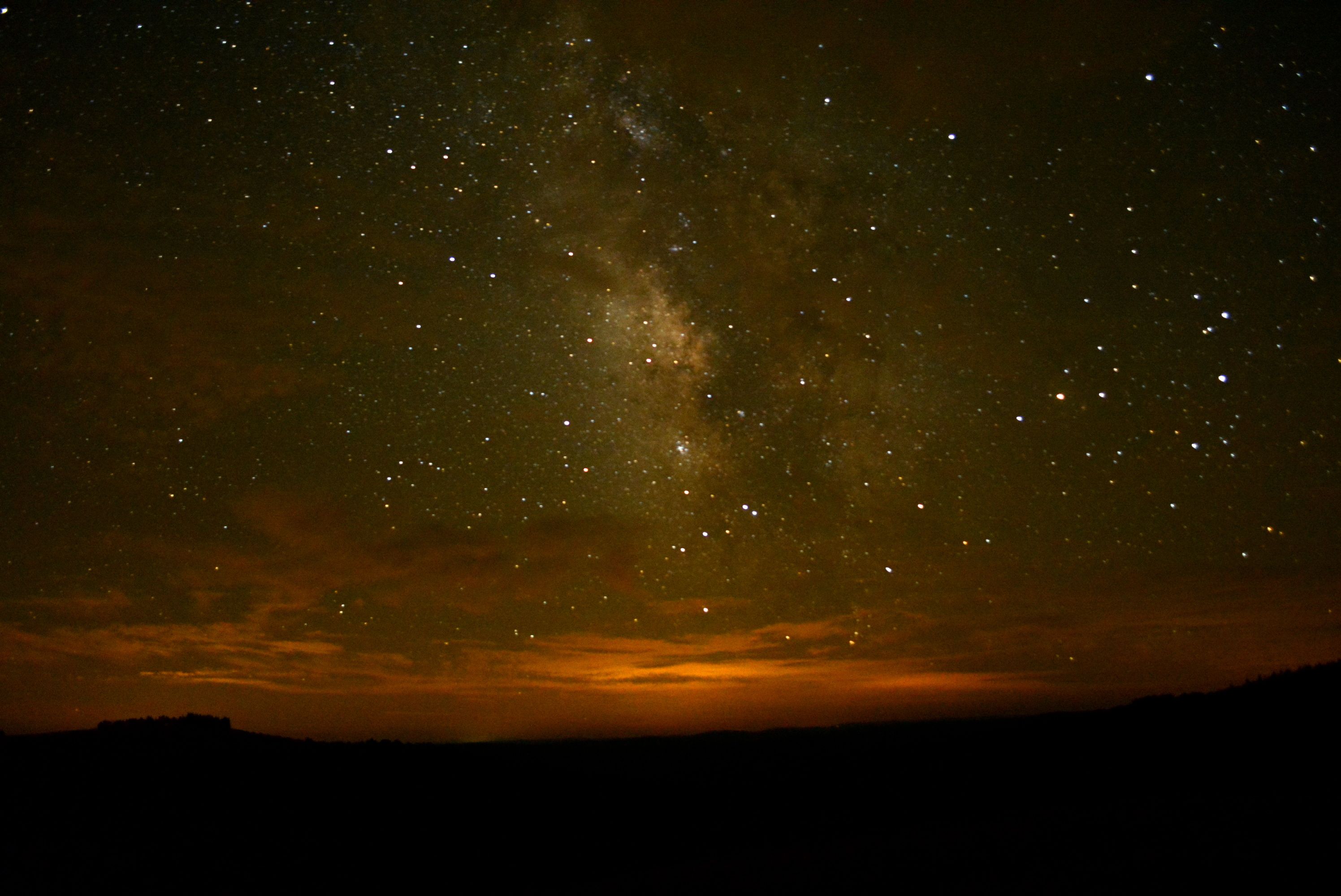
A northern hemisphere summertime view of the Milky Way in Sagittarius. Credit and copyright: Greg Redfern.

A northern hemisphere summertime view of the Milky Way in Sagittarius. Credit and copyright: Greg Redfern.
What a gorgeous view of the dusty cloud of the Milky Way arch hovering over clouds low on the horizon here on Earth! Fellow NASA Solar System Ambassador Greg Redfern took this image of our galactic center in the constellation Sagittarius.

“If you have dark skies look to the south to see this grand spectacle,” Greg said via email. “It stretches across the entire sky.”

Greg shot the image during the Almost Heaven Star Party, an annual astronomy event sponsored by the Northern Virginia Astronomy Club. The star party is held in Spruce Knob, West Virginia, which boasts the darkest skies in the mid-Atlantic region of the US.

Tagged as:
Astrophotos,
milky way,
Sagittarius

Weird X-Rays: What Happens When Eta Carinae’s Massive Stars Get Close?

Weird X-Rays: What Happens When Eta Carinae’s Massive Stars Get Close?:


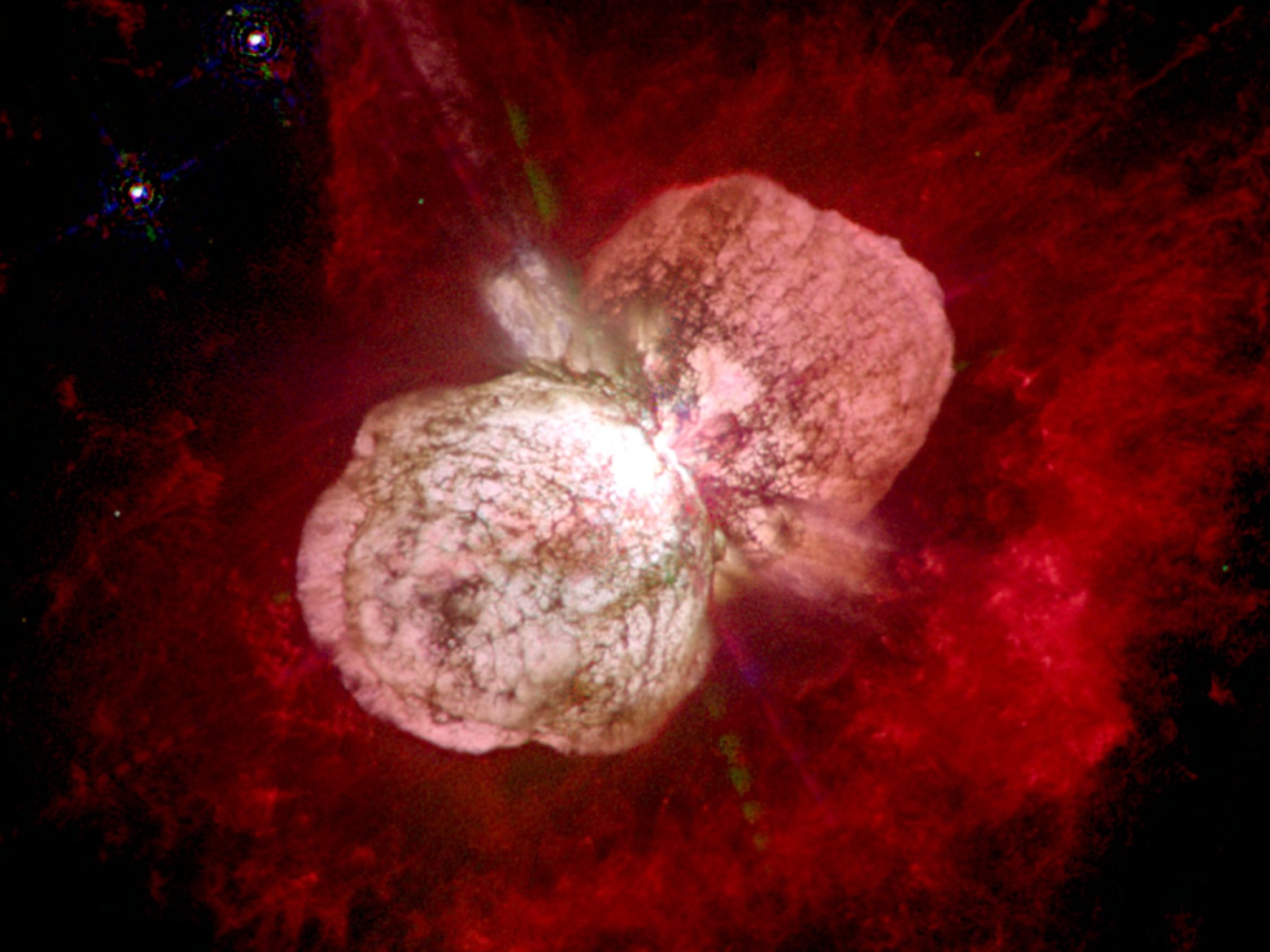
Eta Carinae, one of the most massive stars known. Image credit: NASA

Eta Carinae, one of the most massive stars known. Image credit: NASA
While the stars appear unchanging when you take a quick look at the night sky, there is so much variability out there that astronomers will be busy forever. One prominent example is Eta Carinae, a star system that erupted in the 19th century for about 20 years, becoming one of the brightest stars you could see in the night sky. It’s so volatile that it’s a high candidate for a supernova.

The two stars came again to their closest approach this month, under the watchful eye of the Chandra X-Ray Observatory. The observations are to figure out a puzzling dip in X-ray emissions from Eta Carinae that happen during every close encounter, including one observed in 2009.

The two stars orbit in a 5.5-year orbit, and even the lesser of them is massive — about 30 times the mass of the Sun. Winds are flowing rapidly from both of the stars, crashing into each other and creating a bow shock that makes the gas between the stars hotter. This is where the X-rays come from.

Here’s where things get interesting: as the stars orbit around each other, their distance changes by a factor of 20. This means that the wind crashes differently depending on how close the stars are to each other. Surprisingly, the X-rays drop off when the stars are at their closest approach, which was studied closely by Chandra when that last occurred in 2009.

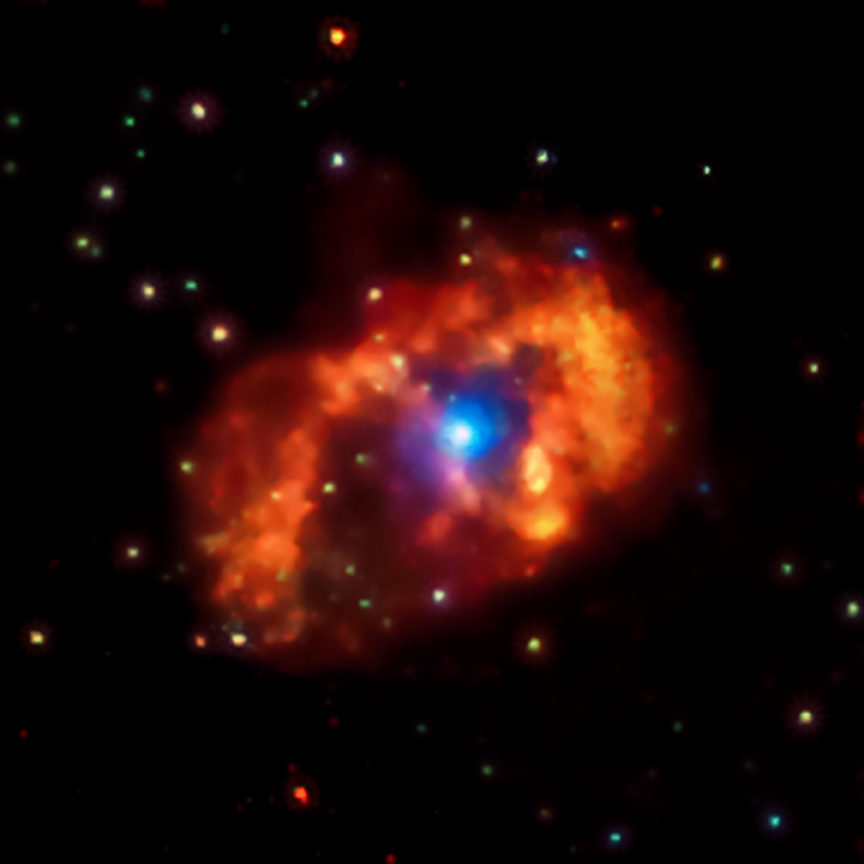
Eta Carinae shines brightly in X-rays in this image from the Chandra X-Ray Observatory.

Eta Carinae shines brightly in X-rays in this image from the Chandra X-Ray Observatory.
“The study suggests that part of the reason for the dip at periastron is that X-rays from the apex are blocked by the dense wind from the more massive star in Eta Carinae, or perhaps by the surface of the star itself,” a Chandra press release stated.

“Another factor responsible for the X-ray dip is that the shock wave appears to be disrupted near periastron, possibly because of faster cooling of the gas due to increased density, and/or a decrease in the strength of the companion star’s wind because of extra ultraviolet radiation from the massive star reaching it.”

More observations are needed, so researchers are eagerly looking forward to finding out what Chandra dug up in the latest observations. A research paper on this was published earlier this year in the Astrophysical Journal, which you can also read in preprint version on Arxiv. The work was led by Kenji Hamaguchi, who is with NASA’s Goddard Space Flight Center in Maryland.

Source: Chandra X-Ray Observatory

Tagged as:
eta Carinae

A Cosmic Collision: Our Best View Yet of Two Distant Galaxies Merging

A Cosmic Collision: Our Best View Yet of Two Distant Galaxies Merging:


The Atacama Large Millimeter/submillimeter Array (ALMA) and many other telescopes on the ground and in space have been used to obtain the best view yet of a collision that took place between two galaxies when the Universe was only half its current age. The astronomers enlisted the help of a galaxy-sized magnifying glass to reveal otherwise invisible detail. These new studies of the galaxy H-ATLAS J142935.3-002836 have shown that this complex and distant object looks surprisingly like the well-known local galaxy collision, the Antennae Galaxies. In this picture you can see the foreground galaxy that is doing the lensing, which resembles how our home galaxy, the Milky Way, would appear if seen edge-on. But around this galaxy there is an almost complete ring — the smeared out image of a star-forming galaxy merger far beyond. This picture combines the views from the NASA/ESA Hubble Space Telescope and the Keck-II telescope on Hawaii (using adaptive optics). Credit: ESO/NASA/ESA/W. M. Keck Observatory

This image combines the views from the Hubble Space Telescope and the Keck-II observatory to show a foreground galaxy (a spiral galaxy viewed edge-on) and an almost complete ring: the smeared out image of a star-forming merger beyond. Credit: ESO / NASA / ESA / W. M. Keck Observatory
An international team of astronomers has obtained the best view yet of two galaxies colliding when the universe was only half its current age.

The team relied heavily on space- and ground-based telescopes, including the Hubble Space Telescope, the Atacama Large Millimeter/submillimeter Array (ALMA), the Keck Observatory, and the Karl Jansky Very Large Array (VLA). But the greatest asset was a chance cosmic alignment.

“While astronomers are often limited by the power of their telescopes, in some cases our ability to see detail is hugely boosted by natural lenses created by the universe,” said lead author Hugo Messias of the Universidad de Concepción in Chile and the Centro de Astronomia e Astrofísica da Universidade de Lisboa in Portugal.

Such a rare cosmic alignment plays visual tricks, where the intervening lens (be it a galaxy or a galaxy cluster) appears to bend and even magnify the distant light. This effect, called gravitational lensing, allows astronomers to study objects which would not be visible otherwise and to directly compare local galaxies with much more remote galaxies, seen when the universe was significantly younger.

The distant object in question, dubbed H-ATLAS J142935.3-002836, was originally spotted in the Herschel Astrophysical Terahertz Large Area Survey (H-ATLAS). Although very faint in visible light pictures, it is among the brightest gravitationally lensed objects in the far-infrared regime found so far.

The Hubble and Keck images reveal that the foreground galaxy is a spiral galaxy, seen edge-on. Although the galaxy’s large dust clouds obscure part of the background light, both ALMA and VLA can observe the sky at longer wavelengths, which are unaffected by dust.

Using the combined data, the team discovered that the background system was actually an ongoing collision between two galaxies.

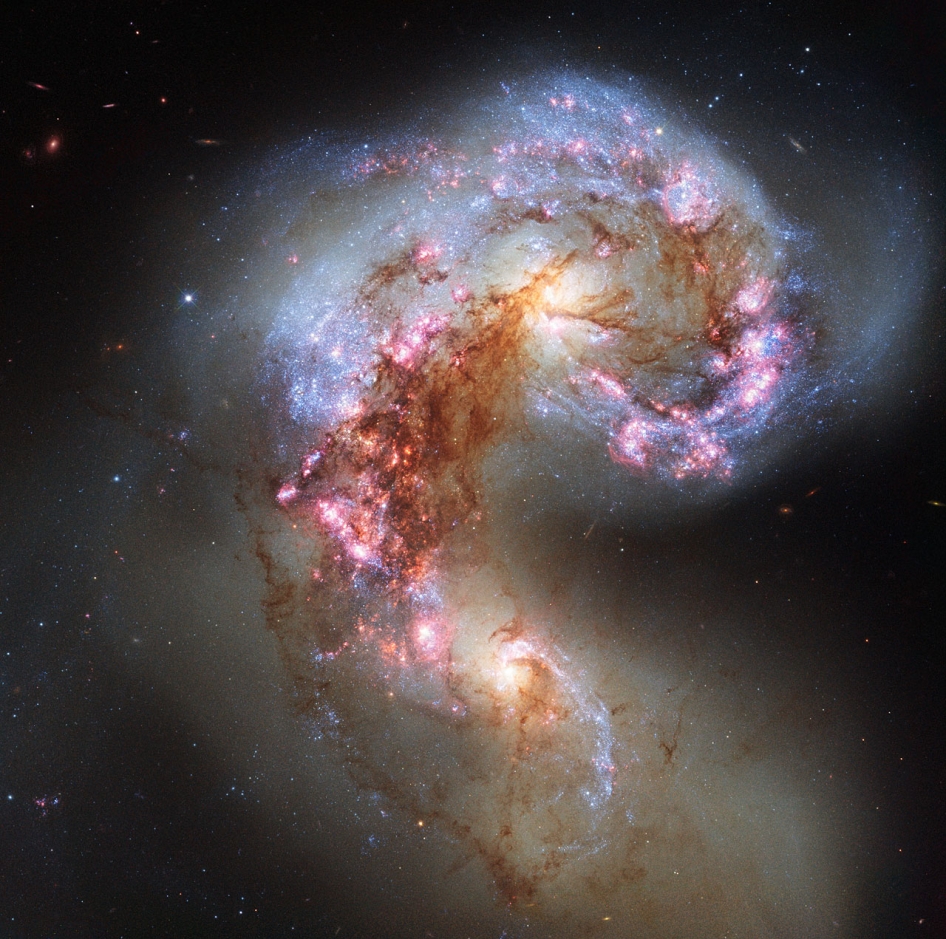
The Antennae galaxies. Credit: Hubble / ESA

The Antennae galaxies. Credit: Hubble / ESA
First, the team noticed that these two galaxies resembled a much closer system: the Antennae galaxies, two galaxies that have spent the past few hundred million years in a whirling embrace as they merge together. The similarity suggested a collision, but ALMA — with its high sensitivity and spatial resolution — was able to verify it.

ALMA has the unique ability to detect the emission from carbon monoxide, as opposed to other telescopes, which might only be able to probe the absorption along the line of sight. This allowed astronomers to measure the velocity of the gas in the more distant object. With this information, they were able to show that the lensed galaxy is indeed an ongoing galactic collision.

Such collisions naturally enhance star formation. Any gas within the galaxies will feel a headwind, much as a runner feels a wind even on the stillest day, and become compressed enough to spark star formation. Sure enough, ALMA shows that the two galaxies are forming hundreds of new stars each year.

“ALMA enabled us to solve this conundrum because it gives us information about the velocity of the gas in the galaxies, which makes it possible to disentangle the various components, revealing the classic signature of a galaxy merger,” said ESO’s Director of Science and coauthor of the new study, Rob Ivison. “This beautiful study catches a galaxy merger red handed as it triggers an extreme starburst.”

The findings have been published in the Aug. 26 issue of Astronomy & Astrophysics and is available online.

Tagged as:
ALMA,
galaxies colliding,
Gravitational Lensing

Fingerprint From a First-Generation Star?

Fingerprint From a First-Generation Star?:


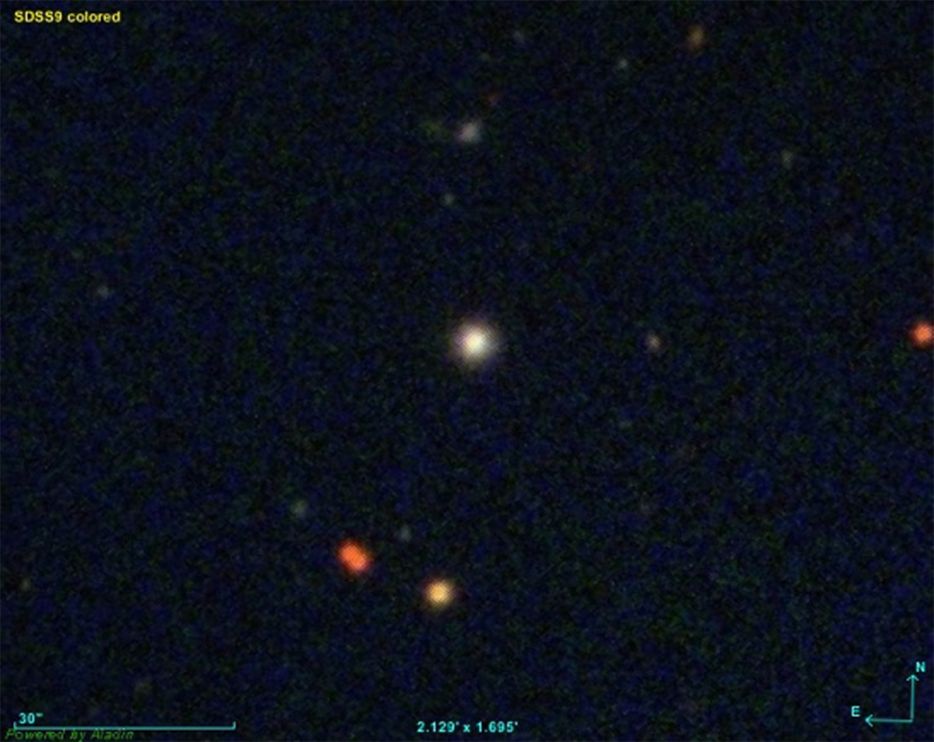
SDSS001820.5-093939.2 (seen in white) is a small, second-generation star bearing the chemical imprint of one of the universe's first stars.  It shines at an apparent magnitude of 15.8, just south of the celestial equator in the constellation Cetus. Credit: SDSS / NAO

SDSS001820.5-093939.2 (seen in white) is a small, second-generation star bearing the chemical imprint of one of the universe’s first stars. It shines at an apparent magnitude of 15.8, just south of the celestial equator in the constellation Cetus. Credit: SDSS / NAO
The young universe was composed of a pristine mix of hydrogen, helium, and a tiny trace of lithium. But after hundreds of millions of years, it began to cool and giant clouds of the primordial elements collapsed to form the first stars.

The first “Population III” stars were extremely massive and bright, synthesizing the first batches of heavy elements, and erupting as supernovae after relatively short lifetimes of just a few million years. This cycle of star birth and death has steadily produced and dispersed more heavy elements throughout cosmic history.

Astronomers haven’t spotted any of the first stars still shining today. But now, a team using the 8.2-meter Subaru Telescope has discovered an ancient low-mass star that likely formed from the elements produced in the supernova explosion of a very massive first generation star.

Pop III stars with masses exceeding 100 times that of the Sun would have died in a peculiar explosion that theorists call a pair-instability supernova.

Like its lower-energy comrade, a pair-instability supernova occurs when a massive star no longer produces enough energy to counteract the inward pull of gravity. But with so much mass, the star’s core is squeezed to such a high temperature and pressure that runaway nuclear reactions power a devastating explosion. The whole star is obliterated and no compact remnant, such as a black hole or neutron star, is left behind.

Astronomers have seen hints of these rare events before. But now, Wako Aoiki from the National Astronomical Observatory of Japan and colleagues have approached the search in a different way, by finding a star that bears the chemical fingerprints of these ancient explosions.

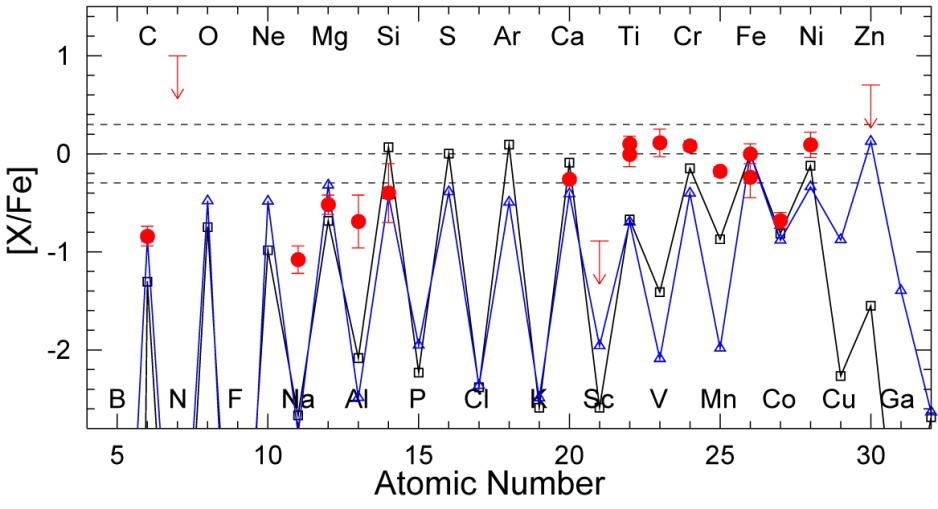
The elements we see lacing a star’s surface provide a key to understanding the supernova that preceded the star’s birth. And the star, dubbed SDSS001820.5-093939.2, exhibits a peculiar set of chemical abundance ratios. It has high levels of heavy elements, such as nickel, calcium, and iron, but low levels of light elements, such as carbon, magnesium and cobalt.

Note that the star is still metal poor in the grand scheme of things. Its iron abundance is 1/100 of the solar level. But compared with most metal-poor stars, where the iron abundance can be 1/100,000 or less of the solar level, the star is metal rich.

The chemical abundance ratios (with respect to iron) of SDSS J0018-0939 (red circles) compared with model prediction for explosions of very-massive stars. The black line indicates the model of a pair-instability supernova by a star with 300 solar masses, whereas the blue line shows the model of an explosion caused by a core-collapse of a star with 1000 solar masses. The abundance ratios of sodium (Na) and aluminum (Al), which are not well-reproduced by these models, might be produced during the evolution of stars before the explosion, but that is not included in the current model. (Credit: NAOJ)

The chemical abundance ratios (with respect to iron) of SDSS J0018-0939 (red circles) compared with model prediction for explosions of very-massive stars. The black line indicates the model of a pair-instability supernova by a star with 300 solar masses, whereas the blue line shows the model of an explosion caused by a core-collapse of a star with 1000 solar masses. The abundance ratios of sodium (Na) and aluminum (Al), which are not well-reproduced by these models, might be produced during the evolution of stars before the explosion, but that is not included in the current model. (Credit: NAOJ)
These odd fingerprints suggest the star formed from material seeded by the death of a very massive Pop III star. In fact, the chemical composition of the star matches the elements that pair-instability supernovae are predicted to create.

The team notes that this is the only star of about 500 in the same low-metallicity range that has this peculiar makeup. It is — at the moment — our only window into the early universe and the first generation of stars.

The paper was published Aug. 22 in Science and is available online.

Tagged as:
Pair-instability supernovae,
Population III stars

What Lit up the Universe? Astronomers May be on the Brink of an Answer

What Lit up the Universe? Astronomers May be on the Brink of an Answer:


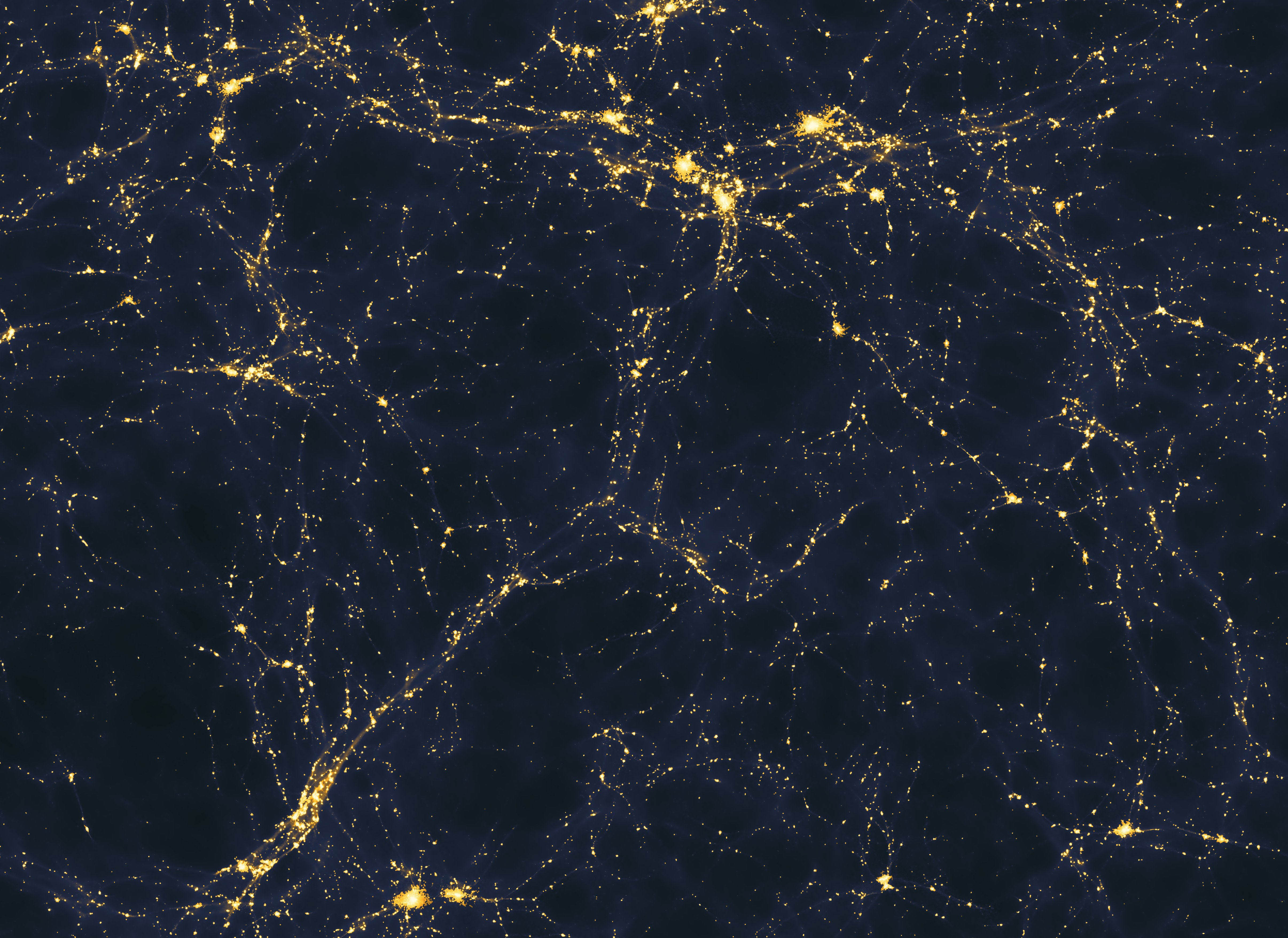
A computer model shows one scenario for how light is spread through the early universe on vast scales (more than 50 million light years across). Astronomers will soon know whether or not these kinds of computer models give an accurate portrayal of light in the real cosmos. Credit: Andrew Pontzen/Fabio Governato

A computer model shows one scenario for how light is spread through the early universe on vast scales (more than 50 million light years across). Astronomers will soon know whether or not these kinds of computer models give an accurate portrayal of light in the real cosmos. Credit: Andrew Pontzen / Fabio Governato
Most scientists can see, hear, smell, touch or even taste their research. But astronomers can only study light — photons traveling billions of light-years across the cosmos before getting scooped up by an array of radio dishes or a single parabolic mirror orbiting the Earth.

Luckily the universe is overflowing with photons across a spectrum of energies and wavelengths. But astronomers don’t fully understand where most of the light, especially in the early universe, originates.

Now, new simulations hope to uncover the origin of the ultraviolet light that bathes — and shapes — the early cosmos.

“Which produces more light? A country’s biggest cities or its many tiny towns?” asked lead author Andrew Pontzen in a press release. “Cities are brighter, but towns are far more numerous. Understanding the balance would tell you something about the organization of the country. We’re posing a similar question about the universe: does ultraviolet light come from numerous but faint galaxies, or from a smaller number of quasars?”

Answering this question will give us a valuable insight into the way the universe built its galaxies over time. It will also help astronomers calibrate their measurements of dark energy, the mysterious agent that is somehow accelerating the universe’s expansion.

The problem is that most of intergalactic space is impossible to see directly. But quasars — brilliant galactic centers fueled by black holes rapidly accreting material — shine brightly and illuminate otherwise invisible matter. Any intervening gas will absorb the quasar’s light and leave dark lines in the arriving spectrum.

“Because they can be seen at such great distances, quasars are a useful probe for finding out the properties of the universe,” said Pontzen. “Distant quasars can be used as a backlight, and the properties of the gas between them and us are imprinted on the light.


Multiple clouds of intervening hydrogen gas leave a “forest” of hydrogen absorption lines in the quasar’s spectrum. But, crucially, not all gas in the universe contributes to these dark lines. When hydrogen is bombarded by ultraviolet light, it becomes ionized — the electron separates from the proton — which renders it transparent.

So the pattern of absorption lines visible in a quasar’s spectrum map out the location of neutral and ionized regions in between the quasar and the Earth.

This pattern will tell astronomers the main contributing light source in the early universe. Quasars are fairly limited in number but individually extremely bright. If they caused most of the radiation, the pattern will be far from uniform, with some areas nearly transparent and others strongly opaque. But if galaxies, which are far more numerous but much dimmer, caused most of the radiation, the pattern will be very uniform, with evenly spaced absorption lines.

Current samples of quasars aren’t quite big enough for a robust analysis of the subtle differences between the two scenarios. But Pontzen and colleagues show that a number of new surveys should shed light on the question.

The team is hopeful the DESI (Dark Energy Spectroscopic Instrument) survey, which will look at about a million distant quasars in order to better understand dark energy, will also show the distribution of intervening gas.

“It’s amazing how little is known about the objects that bathed the universe in ultraviolet radiation while galaxies assembled into their present form,” said coauthor Hiranya Peiris. “This technique gives us a novel handle on the intergalactic environment during this critical time in the Universe’s history.”

The paper was published Aug. 27 in the Astrophysical Journal Letters and is available online.

Tagged as:
Cosmology,
quasars

First Glimpse of a Young Galactic Core Forming in the Early Universe

First Glimpse of a Young Galactic Core Forming in the Early Universe:


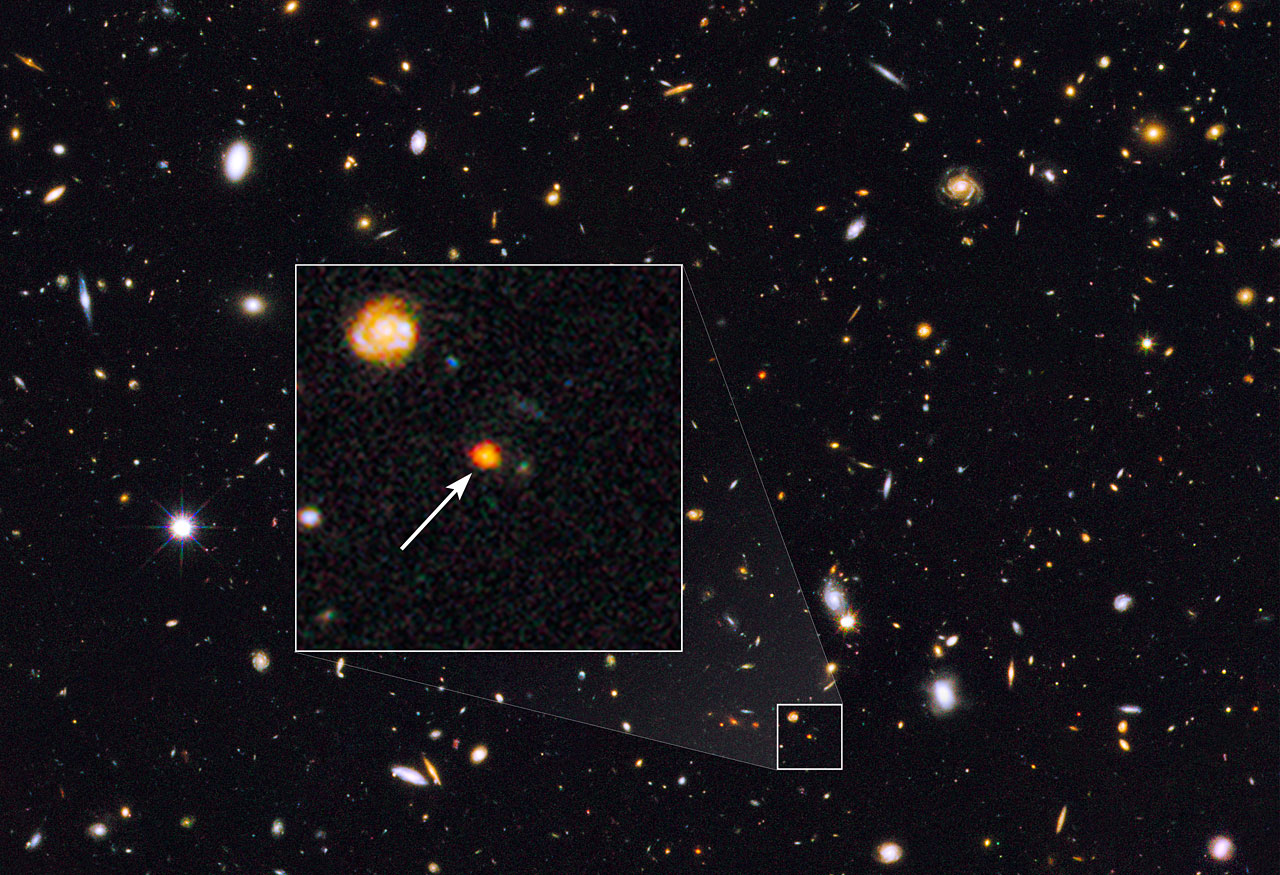
This image shows observations of a newly discovered galaxy core dubbed GOODS-N-774, taken by the NASA/ESA Hubble Space Telescope's Wide Field Camera 3 and Advanced Camera for Surveys. The core is marked by the box inset, overlaid on a section of the Hubble GOODS-N, or GOODS North, field (Great Observatories Origins Deep Survey). Credit: NASA, ESA, and E. Nelson (Yale University, USA)

The galactic core, dubbed GOODS-N-774, as seen by the Hubble Space Telescope’s Wide Field Camera 3 and Advanced Camera for Surveys. The core is marked by the box insert, and is overlaid on a section of the Hubble GOODS north field (Great Observatories Origins Deep Survey). Credit: NASA / ESA / E. Nelson (Yale University)
Astronomers have spotted, for the first time, a dense galactic core blazing with the light of millions of newborn stars in the early universe.

The finding sheds light on how elliptical galaxies, the large, gas-poor gatherings of older stars, may have first formed in the early universe. It’s a question that has eluded astronomers for decades.

The research team first uncovered the compact galactic core, dubbed GOODS-N-774, in images from the Hubble Space Telescope. Later observations from the Spitzer Space Telescope, the Herschel Space Observatory, and the W.M. Keck Observatory helped make this a true scientific finding.

The core formed 11 billion years ago, when the universe was less than 3 billion years old. Although only a fraction of the size of the Milky Way, at that time it already contained above twice as many stars as our own galaxy.

Theoretical simulations suggest that giant elliptical galaxies form from the inside out, with a large core marking the very first stages of formation. But most searches for these forming cores have come up empty handed, making this a first observation and a phenomenal find.

“We really hadn’t seen a formation process that could create things that are this dense,” explained lead author Erica Nelson from Yale University in a press release. “We suspect that this core-formation process is a phenomenon unique to the early universe because the early universe, as a whole, was more compact. Today, the universe is so diffuse that it cannot create such objects anymore.”

Alongside determining the galaxy’s size from the Hubble images, the team dug into archived far-infrared images from Spitzer and Herschel to calculate how fast the compact galaxy is creating stars. It seems to be producing 300 stars per year, a rate 30 times greater than the Milky Way.

The frenzied star formation likely occurs because the galactic core is forming deep inside a gravitational well of dark matter. Its unusually high mass constantly pulls gas in, compressing it and sparking star formation.

But these bursts of star formation create dust, which blocks the visible light. This helps explain why astronomers haven’t seen such a distant core before, as they may have been easily missed in previous surveys.

The team thinks that shortly after the early time period we can see, the core stopped forming stars. It likely then merged with other smaller galaxies, until it transformed into a much greater galaxy, similar to the more massive and sedate elliptical galaxies we see today.

“I think our discovery settles the question of whether this mode of building galaxies actually happened or not,” said coauthor Pieter van Dokkum from Yale University. “The question now is, how often did this occur?”

The team suspects that other galactic cores are abundant, but hidden behind their own dust. Future infrared telescopes, such as the James Webb Space Telescope, should be able to find more of these early objects.

The paper was published Aug. 27 in Nature and is available online.

Tagged as:
Early Universe,
elliptical galaxies

Astronomers Spot Pebble-Size Dust Grains in the Orion Nebula

Astronomers Spot Pebble-Size Dust Grains in the Orion Nebula:


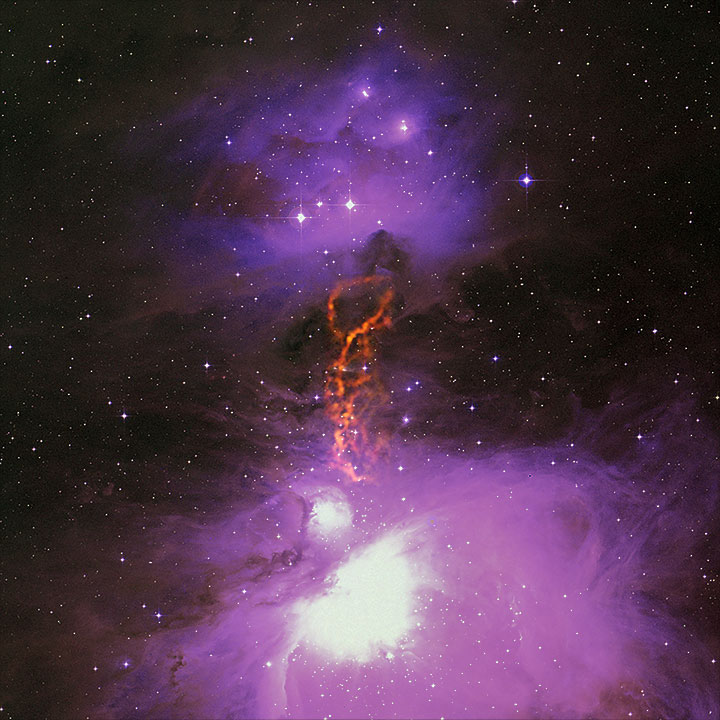
Radio/optical composite of the Orion Molecular Cloud Complex showing the OMC-2/3 star-forming filament. GBT data is shown in orange. Uncommonly large dust grains there may kick-start planet formation. Credit: S. Schnee, et al.; B. Saxton, B. Kent (NRAO/AUI/NSF); We acknowledge the use of NASA's SkyView Facility located at NASA Goddard Space Flight Center.

A radio (orange) and optical composite of the Orion Molecular Cloud Complex showing the OMC-2/3 star-forming filament. Credit: S. Schnee, et al. / B. Saxton, B. Kent (NRAO/AUI/NSF)
Stars and planets form out of vast clouds of dust and gas. Small pockets in these clouds collapse under the pull of gravity. But as the pocket shrinks, it spins rapidly, with the outer region flattening into a disk.

Eventually the central pocket collapses enough that its high temperature and density allows it to ignite nuclear fusion, while in the turbulent disk, microscopic bits of dust glob together to form planets. Theories predict that a typical dust grain is similar in size to fine soot or sand.

In recent years, however, millimeter-size dust grains — 100 to 1,000 times larger than the dust grains expected — have been spotted around a few select stars and brown dwarfs, suggesting that these particles may be more abundant than previous thought. Now, observations of the Orion nebula show a new object that may also be brimming with these pebble-size grains.

The team used the National Science Foundation’s Green Bank Telescope to observe the northern portion of the Orion Molecular Cloud Complex, a star-forming region that spans hundreds of light-years. It contains long, dust-rich filaments, which are dotted with many dense cores. Some of the cores are just starting to coalesce, while others have already begun to form protostars.

Based on previous observations from the IRAM 30-meter radio telescope in Spain, the team expected to find a particular brightness to the dust emission. Instead, they found that it was much brighter.

“This means that the material in this region has different properties than would be expected for normal interstellar dust,” said Scott Schnee, from the National Radio Astronomy Observatory, in a press release. “In particular, since the particles are more efficient than expected at emitting at millimeter wavelengths, the grains are very likely to be at least a millimeter, and possibly as large as a centimeter across, or roughly the size of a small Lego-style building block.”

Such massive dust grains are hard to explain in any environment.

Around a star or a brown dwarf, it’s expected that drag forces cause large particles to lose kinetic energy and spiral in toward the star. This process should be relatively fast, but since planets are fairly common, many astronomers have put forth theories to explain how dust hangs around long enough to form planets. One such theory is the so-called dust trap: a mechanism that herds together large grains, keeping them from spiraling inward.

But these dust particles occur in a rather different environment. So the researchers propose two new intriguing theories for their origin.

The first is that the filaments themselves helped the dust grow to such colossal proportions. These regions, compared to molecular clouds in general, have lower temperatures, high densities, and lower velocities — all of which encourage grain growth.

The second is that the rocky particles originally grew inside a previous generation of cores or even protoplanetary disks. The material then escaped back into the surrounding molecular cloud.

This finding further challenges theories of how rocky, Earth-like planets form, suggesting that millimeter-size dust grains may jump-start planet formation and cause rocky planets to be much more common than previously thought.

The paper has been accepted for publication in the Monthly Notices of the Royal Astronomical Society.

Tagged as:
Dust Grains,
exoplanets,
planet formation,
Rocky Planets