Thursday, September 4, 2014

Observing Neptune: A Guide to the 2014 Opposition Season

Observing Neptune: A Guide to the 2014 Opposition Season:


Credit

The planet Neptune as seen by the Voyager 2 spacecraft during its 1989 flyby. Credit: NASA/JPL.
Never seen Neptune? Now is a good time to try, as the outermost ice giant world reaches opposition this weekend at 14:00 Universal Time (UT) or 10:00 AM EDT on Friday, August 29th. This means that the distant world lies “opposite” to the Sun as seen from our Earthly perspective and rises to the east as the Sun sets to the west, riding high in the sky across the local meridian near midnight.

2014 finds Neptune shining at magnitude +7.6 in the constellation of Aquarius. Unfortunately, the planet is too faint to be seen with the naked eye, but can be sighted using a good pair of binoculars if know exactly where to look for it. Though the telescope, Neptune exhibits a tiny blue-gray disk 6” across — 300 “Neptunes” would fit across the apparent diameter of the Full Moon — that’s barely discernible. Don’t be afraid to crank up the magnification in your quest. We’ve found Neptune on years previous by patently examining suspect stars one by one, looking for the one in the field that stubbornly refuses to focus to a star-like point. Make sure your optics are well collimated to attempt this trick. Neptune will exhibit a tiny fuzzy disk, much like a second-rate planetary nebula. In fact, this is where “planetaries” get their moniker, as the pesky deep sky objects resembled planets in those telescopes of yore…

Looking eastward

The position of Neptune, looking eastward on the night of opposition around an hour after sunset. Created using Stellarium.
The 1846 discovery of Neptune stood as a vindication of the (then) new-fangled theory of Newtonian gravitational dynamics. Uranus was discovered just decades before by Sir William Hershel in 1781, and it stubbornly refused to follow predictions concerning its position. French astronomer Urbain Le Verrier correctly assumed that an unseen body was tugging on Uranus, predicted the position of the suspect object in the sky, and the race was on. On the night of September 24th, Heinrich Louis d’Arrest and Johann Gottfried Galle observing from the Berlin observatory became the first humans to gaze upon the new world referring to it as such. Did you know: Galileo actually sketched Neptune near Jupiter in 1612? And those early 18th century astronomers got a lucky break… had Neptune happened to have been opposite to Uranus in its orbit, it might’ve eluded discovery for decades to come!

It’s also sobering to think that Neptune has only recently completed a single orbit of the Sun in 2011 since its discovery. Opposition of Neptune occurs once every 368 days, meaning that opposition is slowly moving forward by about three days a year on our Gregorian calendar and will soon start occurring in northern hemisphere Fall.

September 15th

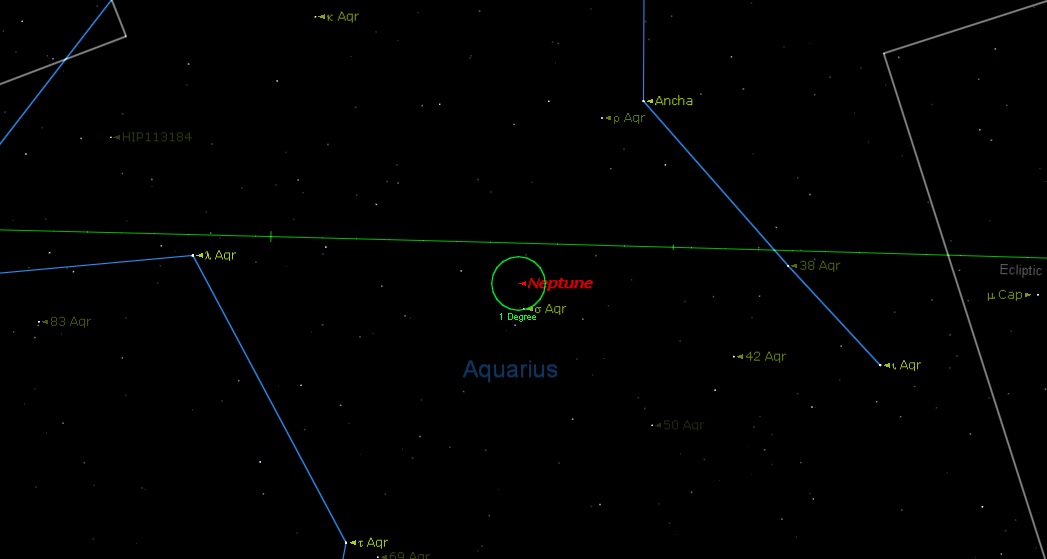
Neptune and a one degree field (green) circle. Note that it passes the bright naked eye star Sigma Aquarii on September 15th. Created using Starry Night Education Software.
Now for the “wow factor” of what you’re actually seeing. Though tiny, Neptune is actually 24,622 kilometres in diameter, which is 58 times as big as the Earth in volume and over 17 times as massive. Neptune is 29 A.U.s or 4.3 billion kilometres from Earth at opposition, meaning the light we see took almost four hours to transit from Neptune to your backyard.

Neptune is currently south of the equator, and won’t be north of it again until 2027.

Next month, keep an eye on Neptune as it passes less than half a degree north of the +4.8 magnitude star Sigma Aquarii through mid-September, making a great guide to find the planet…

Aug 29

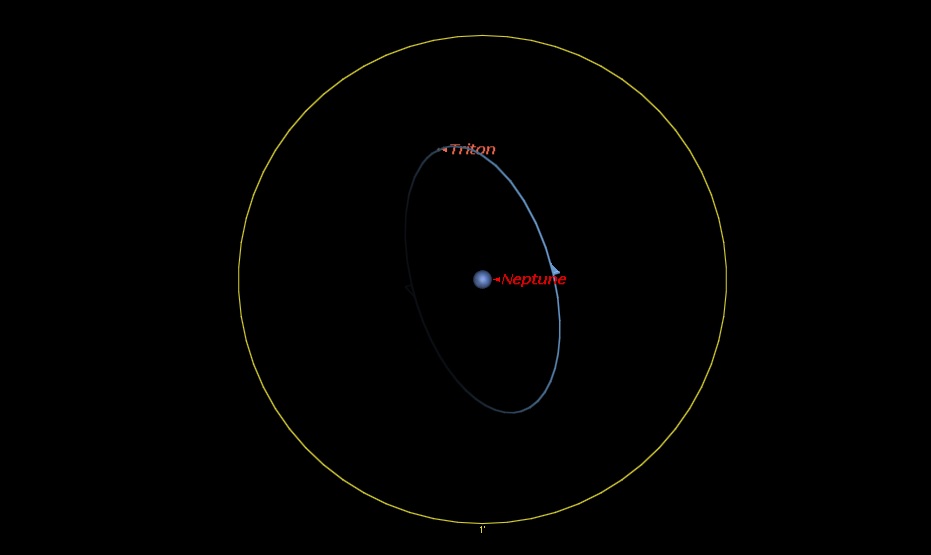
The orbit of Triton on the evening of August 29th, superimposed on a one arc minute field of view. Created using Starry Night Software.
Still not enough of a challenge? Try tracking down Neptune’s large moon, Triton. Orbiting the planet in a retrograde path once every 5.9 days, Triton is within reach of a large backyard scope at magnitude +14. Triton never strays more than 15” from the disk of Neptune, but opposition is a great time to cross this curious moon off of your observing life list. Neptune has 14 moons at last count.

And speaking of Triton, NASA recently released a new map of the moon. We’ve only gotten one good look at Triton, Neptune, and its retinue of moons back in 1989 when Voyager 2 conducted the only flyby of the planet to date.  Will Pluto turn out to be Triton’s twin when New Horizons completes its historic flyby next summer?

The Moon also passes 4.3 degrees north of Neptune on September 8th on its way to “Supermoon 3 of 3” for 2014 on the night of September 8th/9th. Fun fact: a cycle of occultations of Neptune by the Moon commences on June 2016.

When will we explore Neptune once more? Will a dedicated “Neptune orbiter” ever make its way to the planet in our lifetimes? All fun things to ponder as you check out the first planet discovered using scientific reasoning this weekend.

Tagged as:
2014 astronomy,
discovery of neptune,
neptune 2014,
neptune opposition,
observing neptune,
observing triton

Enjoy This Eye-Meltingly Awesome Photo of Our Sun

Enjoy This Eye-Meltingly Awesome Photo of Our Sun:


Photo of the Sun captured and processed by Alan Friedman. (All rights reserved.)

Photo of the Sun captured and processed by Alan Friedman. Click for a larger version. (© Alan Friedman. All rights reserved.)
Here’s yet another glorious photo of our home star, captured and processed by New York artist and photographer Alan Friedman on August 24, 2014. Alan took the photo using his 90mm hydrogen-alpha telescope – aka “Little Big Man” –  from his backyard in Buffalo, inverted the resulting image and colorized it to create the beautiful image above. Fantastic!

Hydrogen is the most abundant element in our Sun. The “surface” of the Sun and the layer just above it — the photosphere and chromosphere — are regions where atomic hydrogen exists profusely in upper-state form, and it’s these layers that hydrogen alpha photography reveals in the most detail.

In Alan’s image from Aug. 24 several active sunspot regions can be seen, as well as long snaking filaments (which show up bright in this inverted view – in optical light they appear darker against the face of the Sun) and several prominences rising up along the Sun’s limb, one of which along the left side stretching completely off the frame a hundred thousand miles into space!

Click here to see the image above as well as some close-ups from the same day on Alan’s astrophotography website AvertedImagination.com. And you can learn more about how (and why) Alan makes such beautiful images of our home star here.

Photo © Alan Friedman. All rights reserved.

Tagged as:
Alan Friedman,
hydrogen alpha,
photography,
prominence,
solar,
sun

Radio Telescopes Resolve Pleiades Distance Debate

Radio Telescopes Resolve Pleiades Distance Debate:


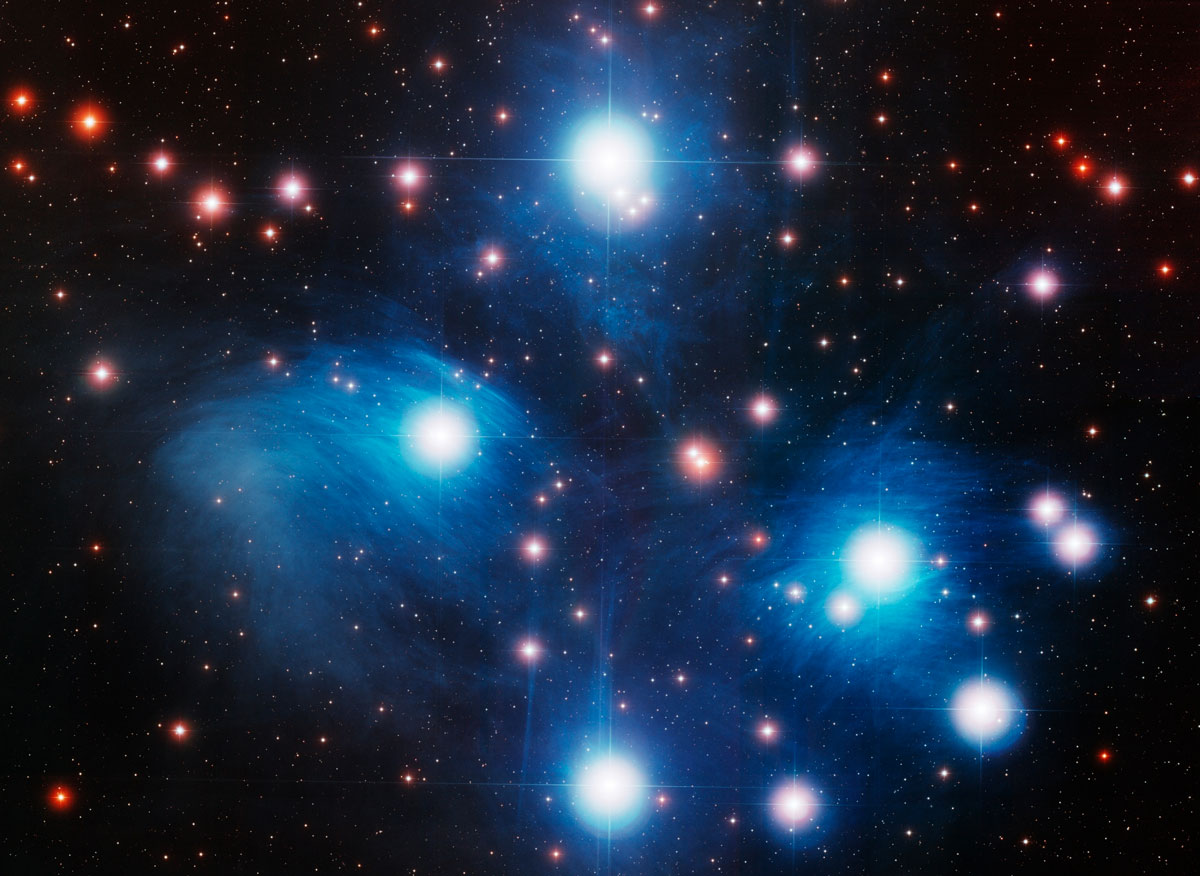
An optical image of the Pleiades. Credit: NOAO / AURA / NSF

An optical image of the Pleiades. Credit: NOAO / AURA / NSF
Fall will soon be at our doorstep. But before the leaves change colors and the smell of pumpkin fills our coffee shops, the Pleiades star cluster will mark the new season with its earlier presence in the night sky.

The delicate grouping of blue stars has been a prominent sight since antiquity. But in recent years, the cluster has also been the subject of an intense debate, marking a controversy that has troubled astronomers for more than a decade.

Now, a new measurement argues that the distance to the Pleiades star cluster measured by ESA’s Hipparcos satellite is decidedly wrong and that previous measurements from ground-based telescopes had it right all along.

The Pleiades star cluster is a perfect laboratory to study stellar evolution. Born from the same cloud of gas, all stars exhibit nearly identical ages and compositions, but vary in their mass. Accurate models, however, depend greatly on distance. So it’s critical that astronomers know the cluster’s distance precisely.

A well pinned down distance is also a perfect stepping stone in the cosmic distance ladder. In other words, accurate distances to the Pleiades will help produce accurate distances to the farthest galaxies.

With parallax technique, astronomers observe object at opposite ends of Earth's orbit around the Sun to precisely measure its distance. CREDIT: Alexandra Angelich, NRAO/AUI/NSF.

With the parallax technique, astronomers observe object at opposite ends of Earth’s orbit around the Sun to precisely measure its distance. Credit: Alexandra Angelich, NRAO / AUI / NSF
But accurately measuring the vast distances in space is tricky. A star’s trigonometric parallax — its tiny apparent shift against background stars caused by our moving vantage point — tells its distance more truly than any other method.

Originally the consensus was that the Pleiades are about 435 light-years from Earth. However, ESA’s Hipparcos satellite, launched in 1989 to precisely measure the positions and distances of thousands of stars using parallax, produced a distance measurement of only about 392 light-years, with an error of less than 1%.

“That may not seem like a huge difference, but, in order to fit the physical characteristics of the Pleiades stars, it challenged our general understanding of how stars form and evolve,” said lead author Carl Melis, of the University of California, San Diego, in a press release. “To fit the Hipparcos distance measurement, some astronomers even suggested that some type of new and unknown physics had to be at work in such young stars.”

If the cluster really was 10% closer than everyone had thought, then the stars must be intrinsically dimmer than stellar models suggested. A debate ensued as to whether the spacecraft or the models were at fault.

To solve the discrepancy, Melis and his colleagues used a new technique known as very-long-baseline radio interferometry. By linking distant telescopes together, astronomers generate a virtual telescope, with a data-gathering surface as large as the distances between the telescopes.

The network included the Very Long Baseline Array (a system of 10 radio telescopes ranging from Hawaii to the Virgin Islands), the Green Bank Telescope in West Virginia, the William E. Gordon Telescope at the Arecibo Observatory in Puerto Rico, and the Effelsberg Radio Telescope in Germany.

“Using these telescopes working together, we had the equivalent of a telescope the size of the Earth,” said Amy Miouduszewski, of the National Radio Astronomy Observatory (NRAO). “That gave us the ability to make extremely accurate position measurements — the equivalent of measuring the thickness of a quarter in Los Angeles as seen from New York.”

After a year and a half of observations, the team determined a distance of 444.0 light-years to within 1% — matching the results from previous ground-based observations and not the Hipparcos satellite.

“The question now is what happened to Hipparcos?” Melis said.

The spacecraft measured the position of roughly 120,000 nearby stars and — in principle — calculated distances that were far more precise than possible with ground-based telescopes. If this result holds up, astronomers will grapple with why the Hipparcos observations misjudged the distances so badly.

ESA’s long-awaited Gaia observatory, which launched on Dec. 19, 2013, will use similar technology to measure the distances of about one billion stars. Although it’s now ready to begin its science mission, the mission team will have to take special care, utilizing the work of ground-based radio telescopes in order to ensure their measurements are accurate.

The findings have been published in the Aug. 29 issue of Science and is available online.

Tagged as:
Hipparcos,
parallax,
Stellar Distances,
stellar evolution,
Very-long Baseline Interferometry

Caterpillar Comet Poses for Pictures En Route to Mars

Caterpillar Comet Poses for Pictures En Route to Mars:


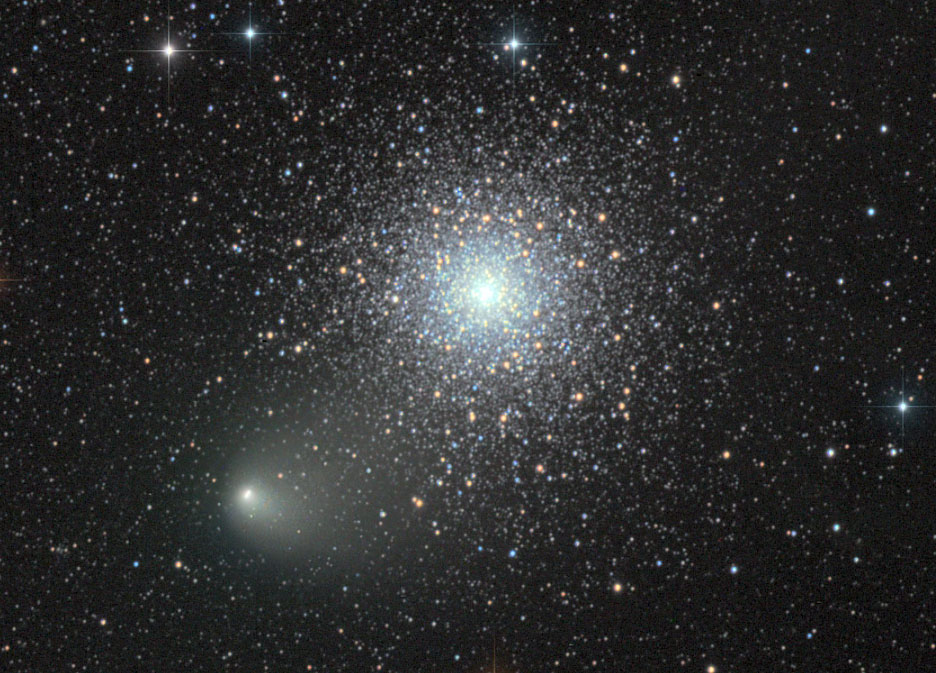
Comet C/2013 A1 Siding Spring passed between the Small Magellanic Cloud (left) and the rich globular cluster NGC 130 on August 29, 2014. Credit: Rolando Ligustri

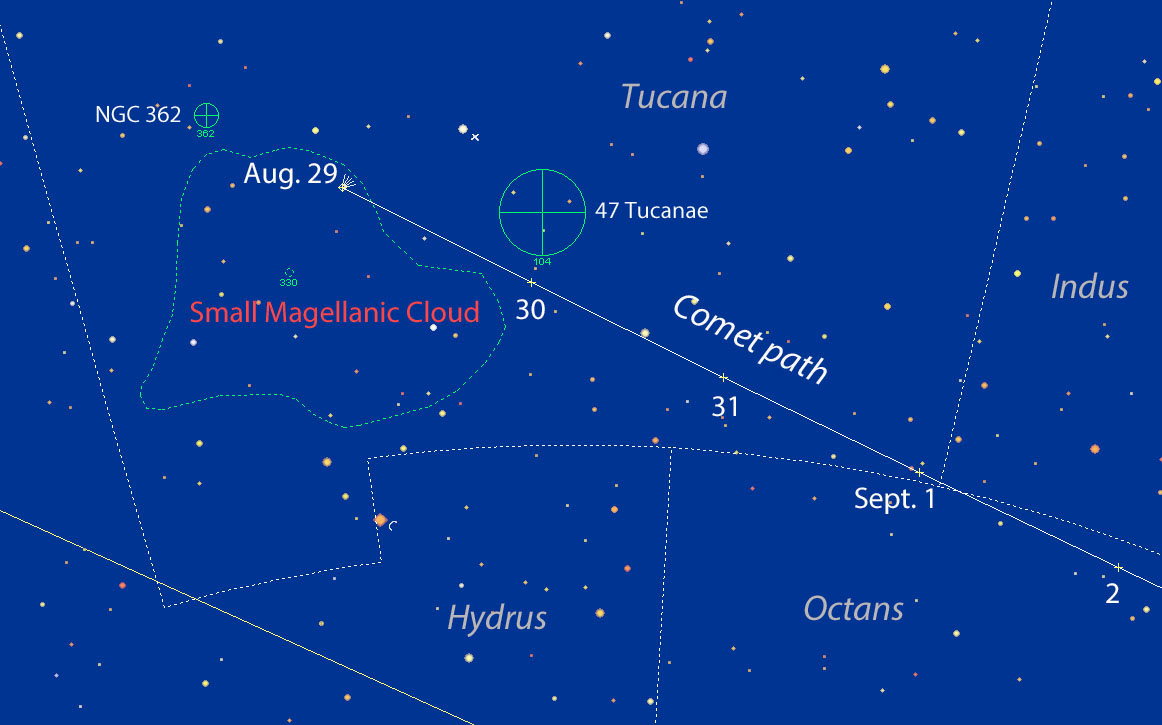
Comet C/2013 A1 Siding Spring wriggles between the globular clusters NGC 362 (upper left) and 47 Tucanae (NGC 104) while skirting the edge of the Small Magellanic Cloud on August 29, 2014. Credit: Rolando Ligustri
Now that’s pure gorgeous. As Comet C/2013 A1 Siding Spring sidles towards its October 19th encounter with Mars, it’s passing a trio of sumptuous deep sky objects near the south celestial pole this week. Astrophotographers weren’t going to let the comet’s picturesque alignments pass without notice. Rolando Ligustri captured this remarkable view using a remote, computer-controlled telescope on August 29th. It shows the rich assemblage of stars and star clusters that comprise the Small Magellanic Cloud, one of the Milky Way’s satellite galaxies located 200,000 light years away.

A photo taken one day earlier on August 28th captures the comet and NGC 362 in a tight pairing. Credit: Damian Peach

A photo taken one day earlier on August 28th captures the comet and NGC 362 in close embrace. Credit: Damian Peach
Looking like a fuzzy caterpillar, Siding Spring seems to crawl between the little globular cluster NGC 362 and the  rich swarm called  47 Tucanae, one of the few globulars bright enough to see with the naked eye. C/2013 A1 is currently circumpolar from many locations south of the equator and visible all night long. Glowing at around magnitude +9.5 with a small coma and brighter nucleus, a 6-inch or larger telescope will coax it from a dark sky. Siding Spring dips farthest south on September 2-3 (Dec. -74º) and then zooms northward for Scorpius and Sagittarius. It will encounter additional deep sky objects along the way, most notably the bright open cluster M7 on October 5-6, before passing some 82,000 miles from Mars on October 19th.

Map showing Comet Siding Spring's recent and upcoming travels near the Small Magellanic Cloud. Positions are shown nightly for Alice Springs, Australia. Source: Chris Marriott's SkyMap

Map showing Comet Siding Spring’s recent and upcoming travels near the Small Magellanic Cloud. Positions are shown nightly for Alice Springs, Australia. Source: Chris Marriott’s SkyMap
While the chance of a Mars impact is near zero, the fluffy comet’s fluffy coma and broad tail, both replete with tiny but fast-moving (~125,000 mph) dust particles, might pose a hazard for spacecraft orbiting the Red Planet. Assuming either coma or tail grows broad enough to sweep across the Martian atmosphere, impacting dust might create a spectacular meteor shower. Mars Rover cameras may be used to photograph the comet before the flyby and to capture meteors during its closest approach. NASA plans to ‘hide’ its orbiting probes on the opposite side of the planet for a brief time during the approximately 4-hour-long encounter just in case.

Today, Siding Spring’s coma or temporary atmosphere measures about 12,000 miles (19,300 km) wide. While I can’t get my hands on current dust production rates, in late January, when it was farther from the sun than at present, C/2013 A1 kicked out ~800,000 lbs per hour (~100 kg/sec). On October 19th, observers across much of the globe with 6-inch or larger instruments will witness the historic encounter with their own eyes at dusk in the constellation Sagittarius.

Tagged as:
47 Tucanae,
coma,
Comet C/2013 A1 (Siding Spring),
Small Magellanic Cloud

Tonight’s Moon-Mars-Saturn Trio Recalls Time of Terror

Tonight’s Moon-Mars-Saturn Trio Recalls Time of Terror:


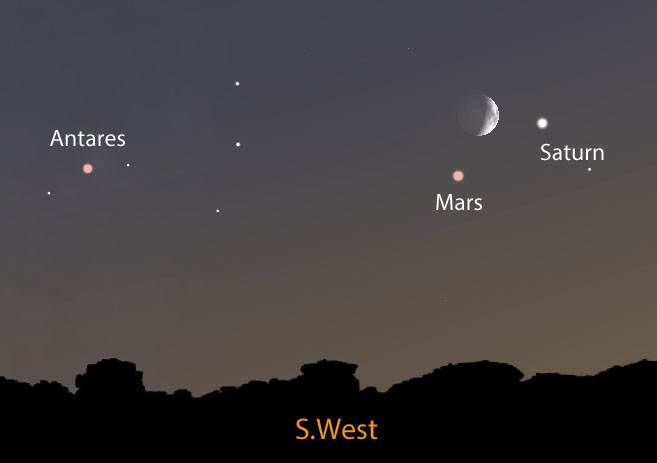
The crescent moon, Saturn and Mars will form a compact triangle in the southwestern sky in this evening August 31st. 3.5º separate the moon and Saturn; Mars and Saturn will be 5º apart. Stellarium

The crescent moon, Saturn and Mars will form a compact triangle in the southwestern sky in this evening August 31st. 3.5º separate the moon and Saturn; Mars and Saturn will be 5º apart. This view shows the sky looking southwest 45 minutes after sunset. Stellarium
Check it out. Look southwest at dusk tonight and you’ll see three of the solar system’s coolest personalities gathering for a late dinner. Saturn, Mars and the waxing crescent moon will sup in Libra ahead of the fiery red star Antares in Scorpius. All together, a wonderful display of out-of-this-world worlds.

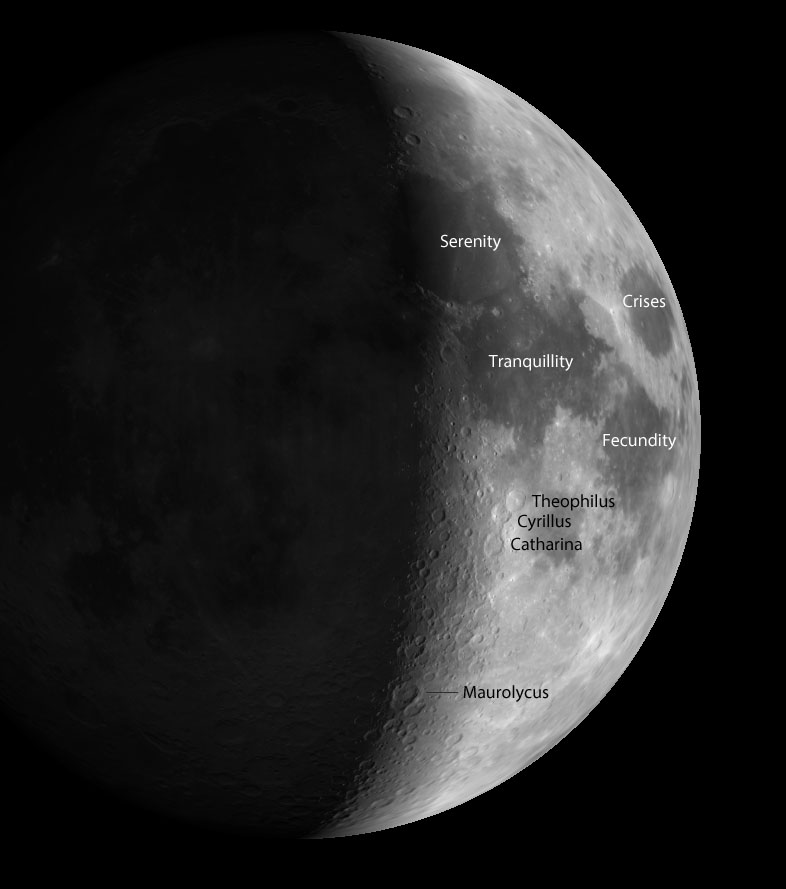
Four dark lunar seas, also called 'maria' (MAH-ree-uh), pop out in binoculars. Four featured craters are also highlighted - the triplet of Theophilus, Cyrillus and Catharina and Maurolycus, named after Francesco Maurolico, a 16th century Italian scientist. Credit: Virtual Moon Atlas / Christian LeGrande, Patrick Chevalley

Four dark lunar seas, also called ‘maria’ (MAH-ree-uh), pop out in binoculars. Four featured craters are also highlighted – the triplet of Theophilus, Cyrillus and Catharina and Maurolycus, named after Francesco Maurolico, a 16th century Italian scientist. Credit: Virtual Moon Atlas / Christian LeGrande, Patrick Chevalley
If you have binoculars, take a closer look at the thick lunar crescent. Several prominent lunar seas, visible to the naked eye as dark patches, show up more clearly and have distinctly different outlines even at minimal magnification. Each is a plain of once-molten lava that oozed from cracks in the moon’s crust after major asteroid strikes 3-3.5 billion years ago.

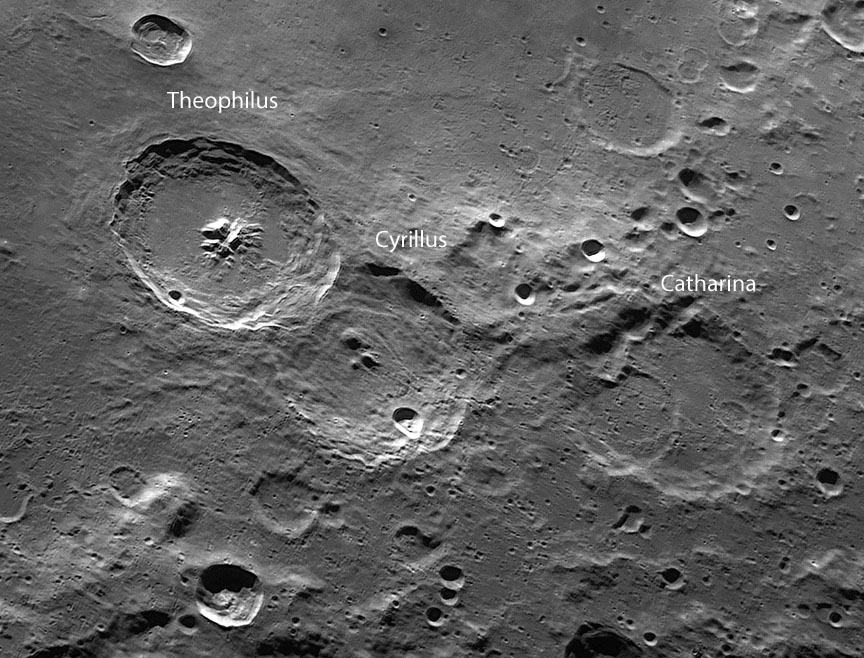
Larger craters also come into view at 10x including the remarkable trio of Theophilus, Cyrillus and Catharina, each of which spans about 60 miles (96 km) across. Even in 3-inch telescope, you’ll see that Theophilus partly overlaps Cyrillus, a clear indicator that the impact that excavated the crater happened after Cyrillus formed.

Close-up of our featured trio of craters. Sharpness indicates freshness. Comparing the three, the Theophilus impact clearly happened after the others. Craters gradually become eroded over time from micrometeorite impacts, solar wind bombardment, moonquakes and extreme day-to-night temperature changes. Credit: Damian Peach

Close-up of our featured trio of craters. Sharpness indicates freshness. Comparing the three, the Theophilus impact clearly happened after the others. Craters gradually become eroded over time from micrometeorite impacts, solar wind bombardment, moonquakes and extreme day-to-night temperature changes. Credit: Damian Peach
Notice that the rim Theophilus crater is still relatively crisp and fresh compared to the older, more battered outlines of its neighbors. Yet another sign of its relative youth.

Astronomers count craters on moons and planets to arrive at relative ages of their surfaces. Few craters indicate a youthful landscape, while many overlapping ones point to an ancient terrain little changed since the days when asteroids bombarded all the newly forming planets and moons. Once samples of the moon were returned from the Apollo missions and age-dated, scientists could then assign absolute ages to particular landforms. When it comes to planets like Mars, crater counts are combined with estimates of a landscape’s age along with information about the rate of impact cratering over the history of the solar system. Although we have a number of Martian meteorites with well-determined ages, we don’t know from where on Mars they originated.

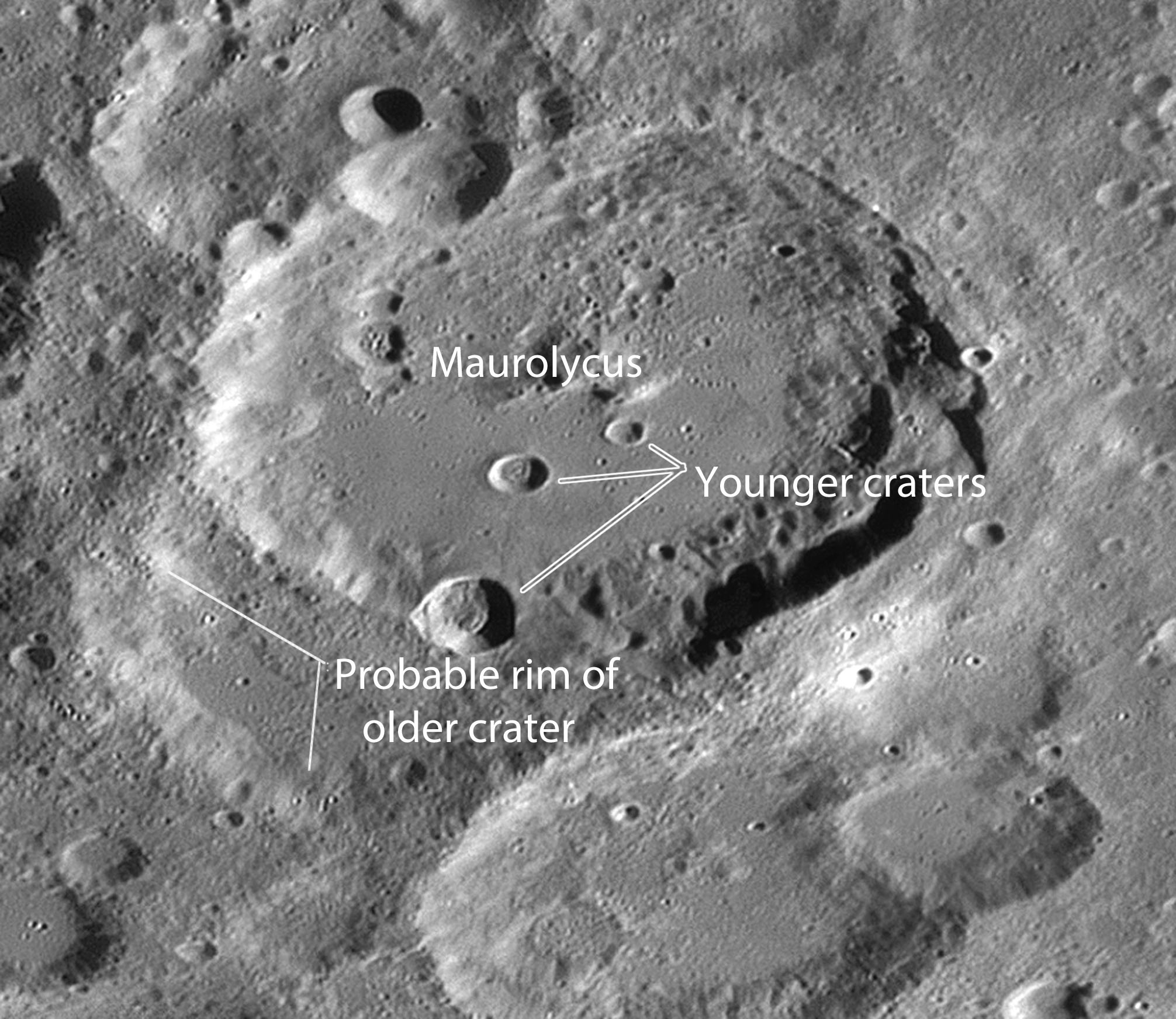
At least three different impact sequences are illustrated in this photo. Maurolycus appears to lie atop an older crater, while younger, sharp-rimmed craters pock its center and southern rim. Even a 3-inch telescope will show signs of all three ages. Credit: Damian Peach

At least three different impact sequences are illustrated in this photo. Maurolycus appears to lie atop an older crater, while younger, sharp-rimmed craters pock its center and southern rim. Even a 3-inch telescope will show signs of all three ages. Credit: Damian Peach
Another crater visible in 10x binoculars tonight is Maurolycus (more-oh-LYE-kus), a great depression 71 miles (114 km) across located in the moon’s southern hemisphere in a region rich with overlapping craters. Low-angled sunlight highlighting the crater’s rim will make it pop near the moon’s terminator, the dividing line between lunar day and night.

Like Theophilus, Maurolycus overlaps a more ancient, unnamed crater best seen in a small telescope. Notice that Maurolycus is no spring chicken either; its floor bears the scares of more recent impacts.

Putting it all into context, despite their varying relative ages, most of the moon’s craters are ancient, punched out by asteroid and comet bombardment more than 3.8 billion years ago. To look at the moon is to see a fossil record of a time when the solar system was a terrifyingly untidy place. Asteroids beat down incessantly on the young planets and moons.

Despite the occasional asteroid scare and meteorite fall, we live in relative peace now. Think what early life had to endure to survive to the present. Deep inside, our DNA still connects us to the terror of that time.

Tagged as:
crater,
impact,
Mars,
Maurolycus,
Moon,
Saturn,
Theophilus

25 Days from Mars – India’s MOM is in Good Health!

25 Days from Mars – India’s MOM is in Good Health!:


India’s Mars Orbiter Mission (MOM) marked 100 days out from Mars on June 16, 2014 and the Mars Orbit Insertion engine firing when it arrives at the Red Planet on September 24, 2014 after its 10 month interplanetary journey.  Credit ISRO

India’s Mars Orbiter Mission (MOM) is closing in on the Red Planet and the Mars Orbit Insertion engine firing when it arrives on September 24, 2014 after its 10 month interplanetary journey. Credit ISRO
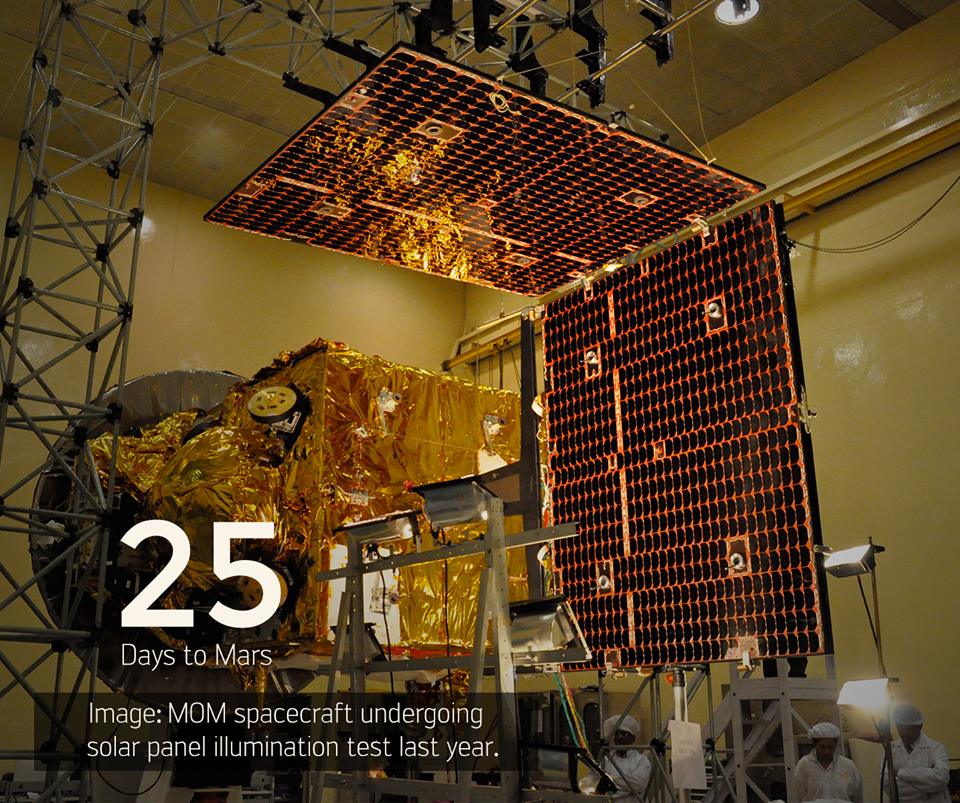
Now less than 25 days from the history making rendezvous with the Red Planet and the critical Mars Orbital Insertion (MOI) engine firing, India’s MOM is in good health!

The Mars Orbiter Mission, or MOM, counts as India’s first interplanetary voyager and the nation’s first manmade object to orbit the 4th rock from our Sun on September 24, 2014 – if all goes well.

MOM was designed and developed by the Indian Space Research Organization (ISRO).

“MOM and its payloads are in good health,” reports ISRO in a new update.

As of today, Aug. 31, MOM has traveled a total distance of over 622 million km in its heliocentric arc towards Mars, says ISRO. It is currently 199 million km away from Earth.

25 Days to Mars Orbit Insertion engine firing for ISRO’s Mars Orbiter Mission (MOM) on Sept. 24, 2014. Prelaunch images show MOM undergoing solar panel illumination tests during 2013 prior to launch.  Credit: ISRO

25 Days to Mars Orbit Insertion engine firing for ISRO’s Mars Orbiter Mission (MOM) on Sept. 24, 2014. Prelaunch images show MOM undergoing solar panel illumination tests during 2013 prior to launch. Credit: ISRO
Altogether the probe has completed over 90% of the journey to Mars.

In the past week alone it has traveled over 20 million km and is over 10 million miles further from Earth. It is now less than 9 million kilometers away from Mars

Round trip radio signals communicating with MOM now take some 21 minutes.

The 1,350 kilogram (2,980 pound) probe has been streaking through space for nearly ten months.

To remain healthy and accomplish her science mission ahead, the spacecraft must fire the 440 Newton liquid fueled main engine to brake into orbit around the Red Planet on September 24, 2014 – where she will study the atmosphere and sniff for signals of methane.

The do or die MOI burn on September 24, 2014 places MOM into an 377 km x 80,000 km elliptical orbit around Mars.

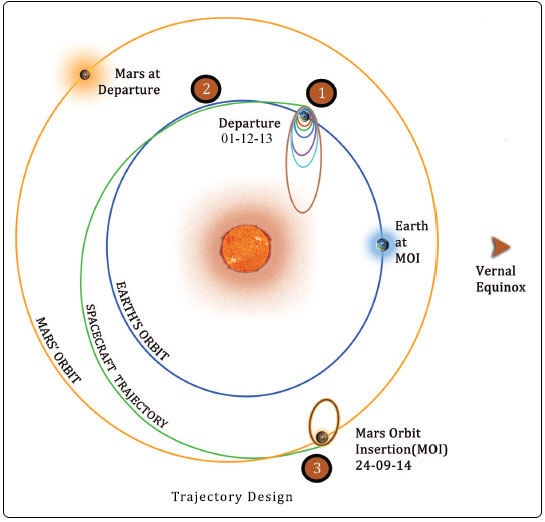
Trans Mars Injection (TMI), carried out on Dec 01, 2013 at 00:49 hrs (IST) has moved the spacecraft in the Mars Transfer Trajectory (MTT). With TMI the Earth orbiting phase of the spacecraft ended and the spacecraft is now on a course to encounter Mars after a journey of about 10 months around the Sun. Credit: ISRO

Trans Mars Injection (TMI), carried out on Dec 01, 2013 at 00:49 hrs (IST) moved the spacecraft into the Mars Transfer Trajectory (MTT). With TMI the Earth orbiting phase of the spacecraft ended and the spacecraft is now on a course to encounter Mars after a journey of about 10 months around the Sun. Credit: ISRO
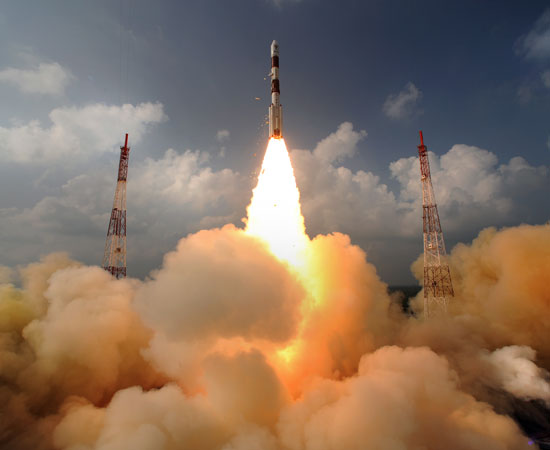
MOM was launched on Nov. 5, 2013 from India’s spaceport at the Satish Dhawan Space Centre, Sriharikota, atop the nations indigenous four stage Polar Satellite Launch Vehicle (PSLV) which placed the probe into its initial Earth parking orbit.

MOM is streaking to Mars along with NASA’s MAVEN orbiter, which arrives a few days earlier on September 21, 2014.

Although MOM’s main objective is a demonstration of technological capabilities, it will also study the planet’s atmosphere and surface.

The probe is equipped with five indigenous instruments to conduct meaningful science – including a tri color imager (MCC) and a methane gas sniffer (MSM) to study the Red Planet’s atmosphere, morphology, mineralogy and surface features. Methane on Earth originates from both geological and biological sources – and could be a potential marker for the existence of Martian microbes.

Stay tuned here for Ken’s continuing MOM, MAVEN, Opportunity, Curiosity, Mars rover and more planetary and human spaceflight news.

Ken Kremer

Clouds on the ground !  The sky seems inverted for a moment ! Blastoff of India’s Mars Orbiter Mission (MOM) on Nov. 5, 2013 from the Indian Space Research Organization’s (ISRO) Satish Dhawan Space Centre SHAR, Sriharikota. Credit: ISRO

Clouds on the ground ! The sky seems inverted for a moment ! Blastoff of India’s Mars Orbiter Mission (MOM) on Nov. 5, 2013 from the Indian Space Research Organization’s (ISRO) Satish Dhawan Space Centre SHAR, Sriharikota. Credit: ISRO

Tagged as:
indian space program,
Indian Space Research Organization,
ISRO,
Mars,
Mars MAVEN,
Mars Orbiter Mission,
MAVEN,
methane on Mars,
MOM,
NASA,
PSLV,
red planet

Astrophoto: I Need Warp Speed in 3 Minutes or We’re All Dead

Astrophoto: I Need Warp Speed in 3 Minutes or We’re All Dead:


Is Earth going at warp speed in this image? This is a composite of two photographs, one for the foreground and one for the sky.  The photographer  zoomed in on the image of the Milky Way for the last 10 seconds of the exposure to give it a 'warp speed' look.  Credit and copyright: Mike Taylor/Mike Taylor Photography.

Is Earth going at warp speed in this image? This is a composite of two photographs, one for the foreground and one for the sky. The photographer zoomed in on the image of the Milky Way for the last 10 seconds of the exposure to give it a ‘warp speed’ look. Credit and copyright: Mike Taylor/Mike Taylor Photography.
Whoa! Having just returned from the science and science fiction mashup that is Dragon Con, my mind is still combining the two. Then I saw this image from Mike Taylor, which is one of the most unique Milky Way images I’ve ever seen. Perfect!

Mike said he combined two images, one for the foreground and one for the night sky image of the Milky Way. “I zoomed in on the Milky Way for the last 10 seconds of the exposure to give it the “warp speed” look,” he said.

He calls the image “Somniloquy” which is a term that describes the act of talking while asleep. Yep. I’m pretty sure that happened at Dragon Con, too….

Check out another awesome Milky Way image by Mike, below.


This is a 7 image vertical panorama of the night sky in Maine where the late Summer Milky Way makes a dramatic background for a small shack and tree.  Credit and copyright: Mike Taylor/Mike Taylor Photography.

This is a 7 image vertical panorama of the night sky in Maine where the late Summer Milky Way makes a dramatic background for a small shack and tree. Credit and copyright: Mike Taylor/Mike Taylor Photography.
Mike noted this image was taken right next to a cell tower that emits a red light over the landscape throughout the night. “Normally I would change the color balance but I decided to leave the red color in the foreground (although I toned it down quite a bit) to add to the overall feeling of the image,” he said. Mike stitched the images together via PTGui and processed through Lightroom 5 & Photoshop CS5.

Nikon D600 & 14-24 @ 14mm

f/2.8 – 7 x 30 secs – ISO 4000

08/28/14 – 10:20PM

You can see a discussion of this image on Mike’s G+ page.


The specs on the ‘warp speed’ image:

Milky Way image taken with a Nikon D600 & 14-24mm at 24mm, f/2.8 – 30 seconds at ISO 4000 on 05/30/14 at 1:38 AM at Goblin Valley State Park, Utah.

Foreground image also taken with the same camera at f/5.6 – 1/60 seconds at ISO 100 on 05/25/14 at 6:28 PM, on Potash Rd near Moab, Utah.

Mike offers photography classes, and you can find out more about when/where here.

Want to get your astrophoto featured on Universe Today? Join our Flickr group or send us your images by email (this means you’re giving us permission to post them). Please explain what’s in the picture, when you took it, the equipment you used, etc.

Tagged as:
Astrophotos,
DragonCon,
Mike Taylor,
milky way,
warp speed

NASA’s MAVEN Orbiter 3 Weeks and 4 Million Miles from Mars

NASA’s MAVEN Orbiter 3 Weeks and 4 Million Miles from Mars:


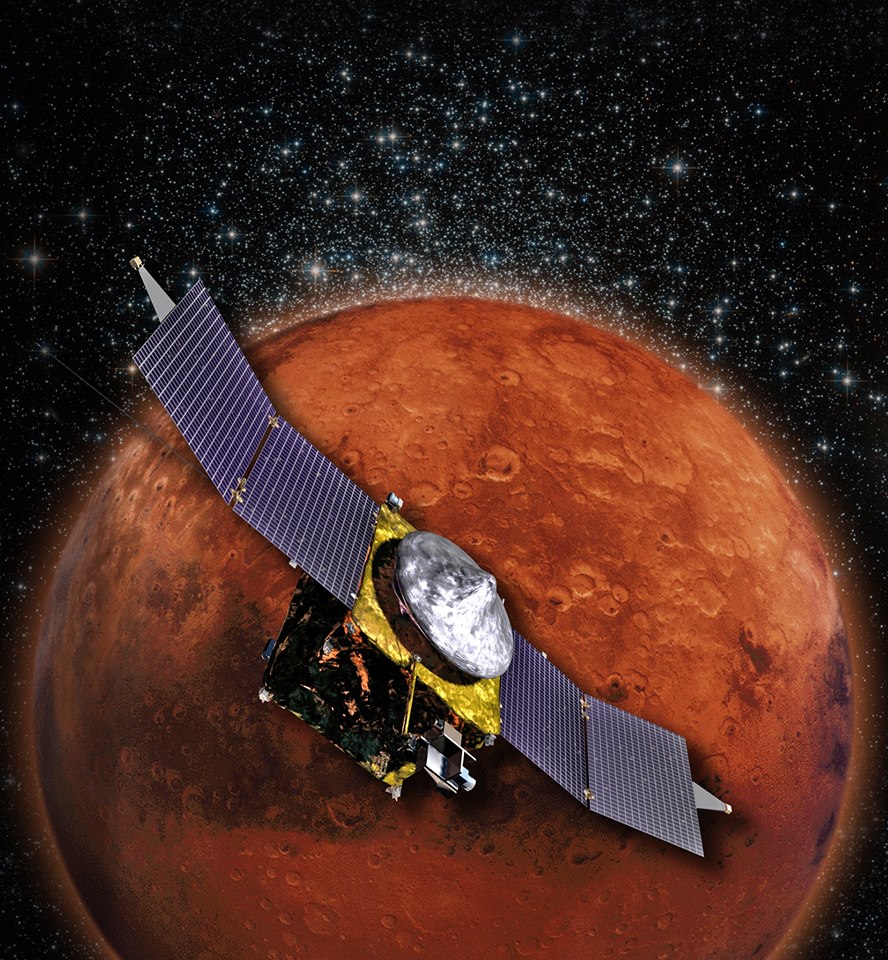
NASA’s MAVEN spacecraft is depicted in orbit around an artistic rendition of planet Mars, which is shown in transition from its ancient, water-covered past, to the cold, dry, dusty world that it has become today.  Credit: NASA

NASA’s MAVEN spacecraft is depicted in orbit around an artistic rendition of planet Mars, which is shown in transition from its ancient, water-covered past, to the cold, dry, dusty world that it has become today. Credit: NASA
Now just 3 weeks and 4 million miles (6 million kilometers) from rendezvous with Mars, NASA’s ground breaking Mars Atmosphere and Volatile Evolution (MAVEN) orbiter is tracking precisely on course for the crucial Mars Orbital Insertion (MOI) engine firing slated for September 21, 2014.

It’s been a picture perfect flight so far during the ten and a half month interplanetary voyage from Earth to Mars.

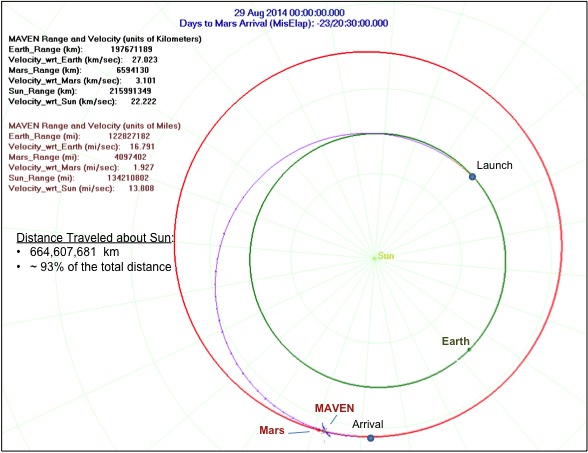
As of August 29th, MAVEN was 198 million kilometers (123 million miles) from Earth and 6.6 million kilometers (4.1 million miles) from Mars. Its velocity is 22.22 kilometers per second (49,705 miles per hour) as it moves on a heliocentric around the Sun.

“MAVEN continues on a smooth journey to Mars. All spacecraft systems are operating nominally,” reported David Mitchell, MAVEN Project Manager at NASA’s Goddard Space Flight Center, in an update.

MAVEN is NASA’s next Mars Orbiter and will investigate how the planet lost most of its atmosphere and water over time. Credit: NASA

MAVEN is NASA’s next Mars Orbiter and will investigate how the planet lost most of its atmosphere and water over time. Credit: NASA
In fact, MAVEN’s navigation from Earth to Mars has been so perfect that the team will likely cancel the final Trajectory Correction Maneuver (TCM) that had been planned for September 12.

The team will make a final decision on whether TCM-4 is necessary on Sept. 4.

Previously the team also cancelled TCM-3 that had been planned for July 23 because it was “not warranted.”

“We are tracking right where we want to be,” says Mitchell.

TCM-1 and TCM-2 took place as scheduled in December 2013 and February 2014, Bruce Jakosky, MAVEN’s Principal Investigator told Universe Today.

These thruster firings ensure the craft is aimed on the correct course through interplanetary space.

See MAVEN’s trajectory route map below.

Maven spacecraft trajectory to Mars. Credit: NASA

Maven spacecraft trajectory to Mars. Credit: NASA
“Since we are now in a ‘pre-Mars Orbit Insertion (MOI) moratorium’, all instruments are powered off until after we arrive at the Red Planet,” according to Mitchell.


Tagged as:
ancient Mars,
Atlas V rocket,
cape canaveral,
kennedy space center,
loss of Mars water,
Mars,
Mars MAVEN,
MAVEN,
NASA,
red planet,
Search for Life,
ULA

Get Set for the Super (or Do You Say Harvest?) Full Moon 3 of 3 for 2014

Get Set for the Super (or Do You Say Harvest?) Full Moon 3 of 3 for 2014:


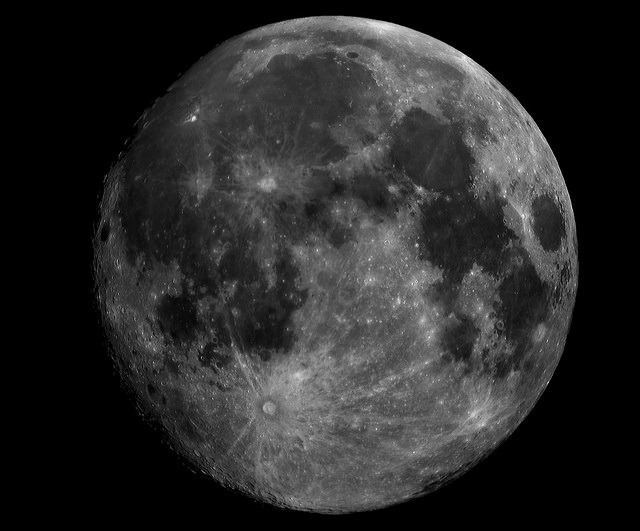
Last month's supermoon within 24 hours of perigee. Credit: Blobrana

Last month’s supermoon within 24 hours of perigee. Credit: Blobrana
Time to dust off those ‘what is a perigee Full Moon’ explainer posts… the supermoon once again cometh this weekend to a sky near you.

Yes. One. More. Time.

We’ve written many, many times — as have many astronomy writers — about the meme that just won’t die. The supermoon really brings ‘em out, just like werewolves of yore… some will groan, some will bemoan the use of a modernized term inserted into the common astronomical vernacular that was wrought by an astrologer, while others will exclaim that this will indeed be the largest Full Moon EVER…

But hey, it’s a great chance to explain the weird and wonderful motion of our nearest natural neighbor in space. Thanks to the Moon, those astronomers of yore had some great lessons in celestial mechanics 101. Without the Moon, it would’ve been much tougher to unravel the rules of gravity that we take for granted when we fling a probe spaceward.

The Moon reaches Full on Tuesday, September 9th at 1:38 Universal Time (UT), which is 9:38 PM EDT on the evening of the 8th. The Moon reaches perigee at less than 24 hours prior on September 8th at 3:30 UT — 22 hours and 8 minutes earlier, to be precise — at a distance 358,387 kilometres distant. This is less than 2,000 kilometres from the closest perigee than can occur, and 1,491 kilometres farther away than last month’s closest perigee of the year, which occurred 27 minutes prior to Full Moon.

A Proxigean or Perigee Full “Supermoon” as reckoned by our preferred handy definition of “a Full Moon occurring within 24 hours of perigee” generally occurs annually in a cycle of three over two lunar synodic periods, and moves slowly forward by just shy of a month through the Gregorian calendar per year. The next cycle of “supermoons” starts on August 30th, 2015, and you can see our entire list of cycles out through 2020 here.

What’s the upshot of all this? Well, aside from cluttering inboxes and social media with tales of the impending supermoon this weekend, the rising Moon will appear 33.5’ arc minutes in diameter as opposed to its usually quoted average of 30’ in size. And remember, that’s in apparent size as seen from our Earthly vantage point… can you spy a difference from one Full Moon to the next? Fun fact: the rising Moon is actually farther away from you to the tune of about one Earth radius than when it’s directly overhead at the zenith.

Fed up with supermoon-mania? The September Full Moon also has a more pedestrian name: The Harvest Moon. Actually, this is the Full Moon that falls nearest to the September Equinox, marking the start of the astronomical season of Fall in the northern hemisphere and Spring in the southern. In the current first half of the 21st century, the September Equinox falls on the 22nd or 23rd, meaning that the closest Full Moon (and thus the Harvest Moon) can sometimes fall in October, as last happened in 2009 and will occur again in 2017. In this instance, the September Full Moon would then be referred to as the Corn Moon as reckoned by the Algonquins, and is occasionally referred to as the Drying Grass Moon by Sioux tribes. In 2014, the Harvest Full Moon “misses” falling in October by about 32 hours!

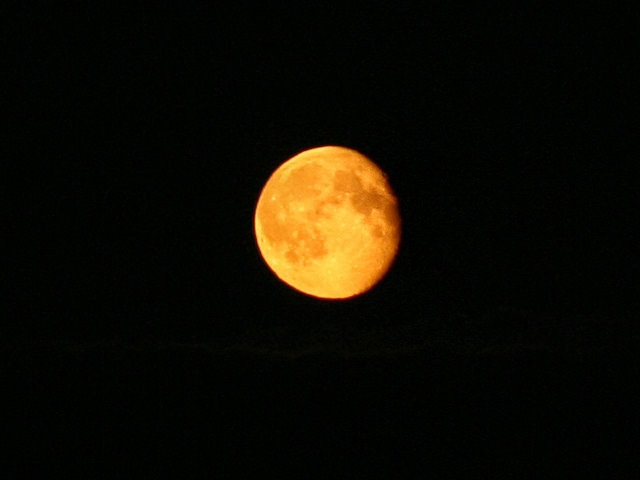
July 14th

The waning gibbous Moon of July 14th, 2014- shortly after the first supermoon of the year. Credit: Blobrana.
So, why is it known as the Harvest Moon? Well, in the age before artificial lighting (and artificial light pollution) the rising of the Full Moon as the Sun sets allowed for a few hours of extra illumination to bring in crops. In October, the same phenomenon gave hunters a few extra hours to track game by the light of the Full Hunters Moon, both essential survival activities before the onset of the long winter.

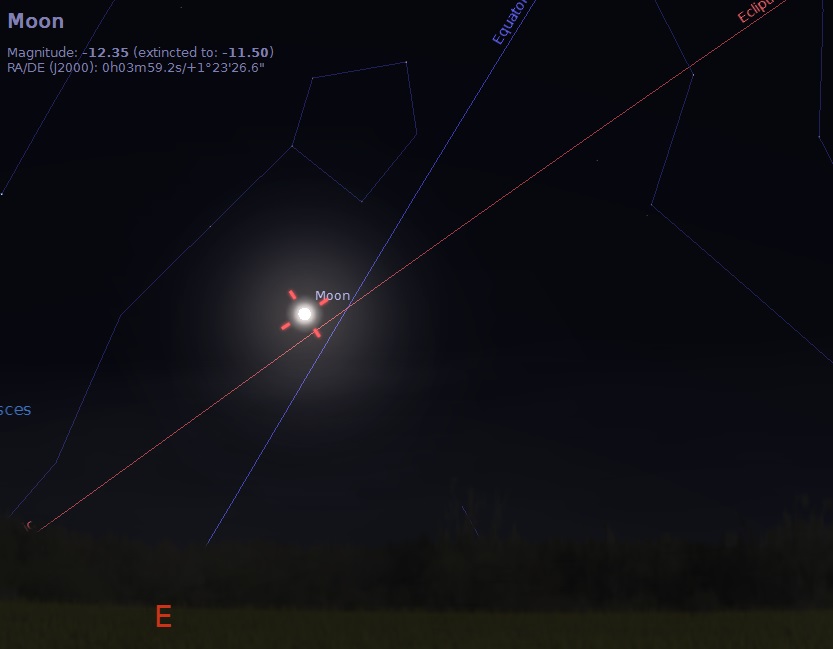
And that Full Harvest Moon seems to “stick around” on successive evenings. This is due to the relatively shallow angle of the evening ecliptic to the eastern horizon as seen from mid-northern latitudes in September.

September 8th

The rising Full Moon on the evening of September 8th as seen from latitude 40 degrees north. Note the shallow angle of the ecliptic. Created using Stellarium.
Here’s a sample of rising times for the Moon this month as seen from Baltimore, Maryland at 39.3 degrees north latitude:

Saturday, September 6th: 5:43 PM EDT

Sunday, September 7th: 6:23 PM EDT

Monday, September 8th: 7:05 PM EDT

Tuesday, September 9th: 7:44 PM EDT

Wednesday, September 10th: 8:22 PM EDT

Note the Moon rises only ~40 minutes later on each successive evening.

Stephen Rahn

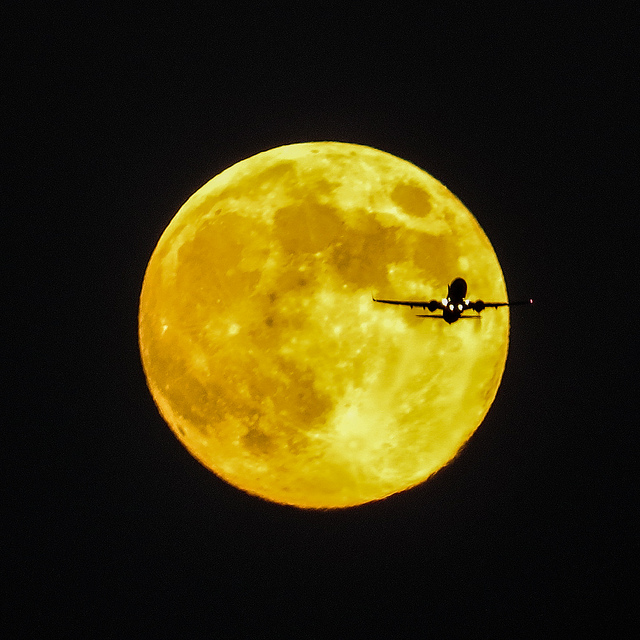
The Full Harvest Moon of 2013 plus aircraft. Credit: Stephen Rahn.
We’re also headed towards a “shallow year” in 2015, as the Moon bottoms out relative to the ecliptic and only ventures 18 degrees 20’ north and south of the celestial equator at shallow minimum. This is due to what’s known as the Precession of the Line of Apsides as the gravitational pull of the Sun slowly drags the orbit of the Moon round the earth once every 8.85 years. The nodes where the ecliptic and path of the Moon meet — and solar and lunar eclipses occur — also move slowly in an opposite direction of the Moon’s motion, taking just over twice as long as the Precession of the Line of Apsides to complete one revolution around the ecliptic at 18.6 years. This is one of the more bizarre facts about the motion of the Moon: its orbital tilt of 5.1 degrees is actually fixed with respect to the ecliptic as traced out by the Earth’s orbit about the Sun, not our rotational axis. Native American and ancient Northern European knew of this, and the next “Long Night’s Moon” also called a “Lunar Standstill” when the Moon rides high in the northern hemisphere sky is due through 2024-2025.

Credit:

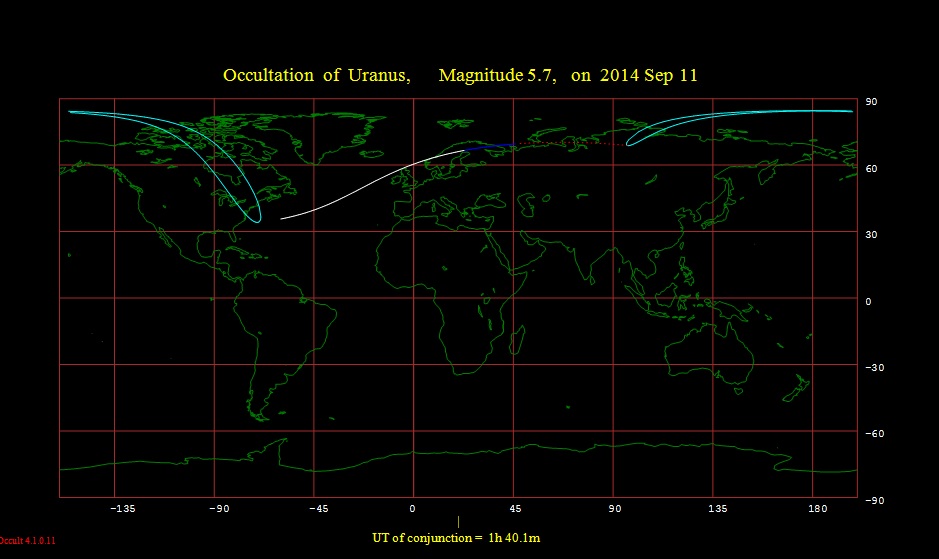
The footprint of the September 11th occultation of Uranus. Credit: Occult 4.0.
And to top it off, the Moon occults Uranus just two days after Full on September 11th as seen from northeastern North America, Greenland, Iceland and northern Scandinavia. We’re in a cycle of occultations of Uranus by the Moon from late 2014 through 2015, and this will set the ice giant up for a spectacular close pass, and a rare occultation of the planet for a remote region in the Arctic during the October 8th total lunar eclipse…

More to come!

Tagged as:
drying grass moon,
full moon,
harvest moon,
motion of the moon,
next supermoon,
Supermoon,
what is a supermoon

Meet Laniakea, Our Home Supercluster

Meet Laniakea, Our Home Supercluster:


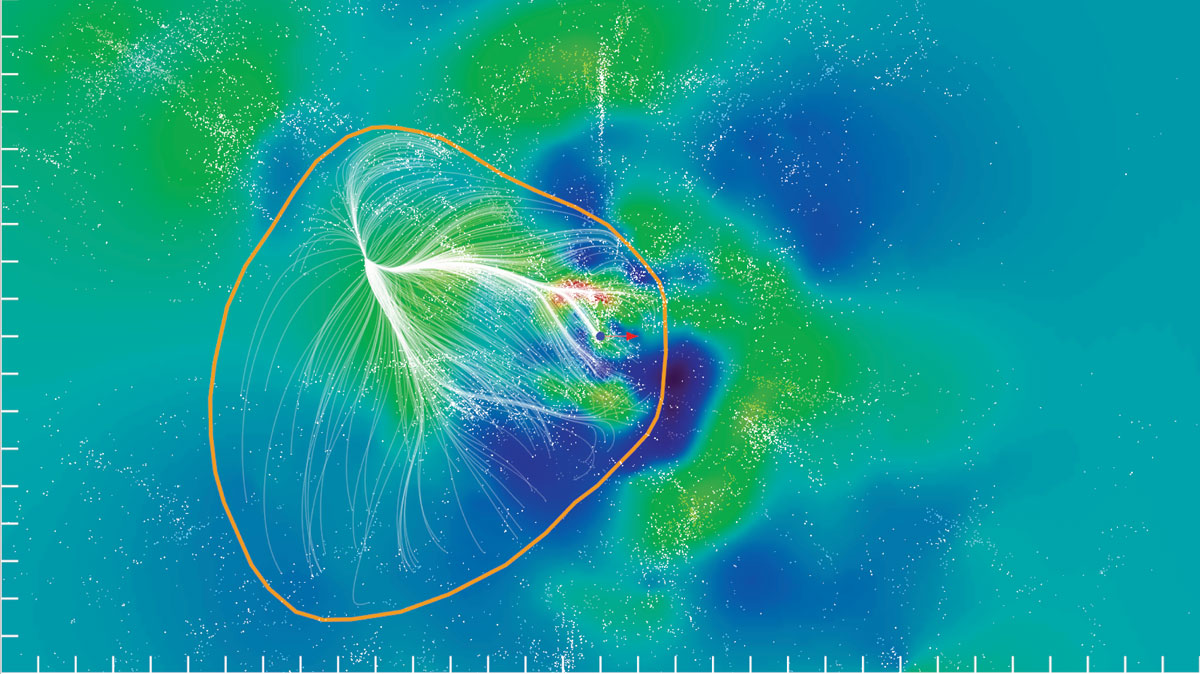
A slice of the Laniakea Supercluster in the supergalactic equatorial plane -- an imaginary plane containing many of the most massive clusters in this structure. The colors represent density within this slice, with red for high densities and blue for voids -- areas with relatively little matter. Individual galaxies are shown as white dots. Velocity flow streams within the region gravitationally dominated by Laniakea are shown in white, while dark blue flow lines are away from the Laniakea local basin of attraction. The orange contour encloses the outer limits of these streams, a diameter of about 160 Mpc. This region contains the mass of about 100 million billion suns. Credit: SDvision interactive visualization software by DP at CEA/Saclay, France.

A slice of the Laniakea Supercluster. The colors represent density, with red for high densities and blue for voids. Individual galaxies are shown as white dots. The Milky Way is the blue dot toward the right-hand edge of the circled region. Credit: SDvision interactive visualization software by DP at CEA/Saclay, France.
Our cosmic address extends well beyond Earth, past the Milky Way and toward the farthest reaches of the universe. But now astronomers are adding another line: the Laniakea Supercluster, which takes its name from the Hawaiin term “lani” meaning heaven and “akea” meaning spacious or immeasurable.

And the name is true to its meaning. The supercluster extends more than 500 million light-years and contains the mass of 100 quadrillion Suns in 100,000 large galaxies. This research is the first to trace our local supercluster on such a large scale.

“We have finally established the contours that define the supercluster of galaxies we can call home,” said lead researcher R. Brent Tully, from the University of Hawaii’s Institute for Astrophysics, in a news release. “This is not unlike finding out for the first time that your hometown is actually part of much larger country that borders other nations.”

Superclusters — aggregates of clusters of galaxies — rank among the largest structures in the universe. Although these structures are interconnected in a web of filaments, their exact outlines and boundaries are hard to define.

Large three-dimensional maps (think Sloan Digital Sky Survey) calculate a galaxy’s location based on its galactic redshift, the shifts in its spectrum due to its apparent motion as space itself expands. But Tully and colleagues used peculiar redshifts, the shifts in a galaxy’s spectrum due to the local gravitational landscape, instead.

In other words, the team is mapping the galaxies by examining their impact on the motions of other galaxies. A galaxy caught in the midst of multiple galaxies will find itself in a massive tug-of-war, where the balance of the surrounding gravitational forces will dictate its motion.

Typically this method is only viable for the local universe where the peculiar velocities are high enough compared with the expansion velocities, which increase with distance (a galaxy recedes faster the farther away it is). But Tully and colleagues used a new algorithm, which revealed the large-scale patterns created by galaxies’ motions.

Not only did this allow them to map our home supercluster, but to clarify the role of the Great Attractor, a dense region in the vicinity of Centaurus, Norma, and Hydra clusters that influences the motion of our Local Group and other groups of galaxies. They revealed that the Great Attractor is a large gravitational valley that draws all galaxies inward.

The team also discovered other structures, including a region named Shapley, toward which Laniakea is moving.

The findings have been published in the Sept. 4 issue of Nature.


Tagged as:
Great Attractor,
supercluster

How Do You Land on a Comet? Very Carefully.

How Do You Land on a Comet? Very Carefully.:


After a ten year journey, Rosetta and Philae will attempt the first soft landing upon a comet's surface. (Credits: ESA, Composite, T.Reyes)

After a ten year journey, Rosetta and Philae will attempt the first soft landing upon a comet’s surface. (Credits: ESA, Composite, T.Reyes)
ESA has announced that on September 15, the team from the Rosetta mission will reveal the landing site for the Philae lander. After traveling on a 10-year, 6.4 billion kilometer journey, Rosetta has been gently captured by comet 67P/Churyumov-Gerasimenko, an oddly-shaped and mysterious two-lobed comet. Yet, how will the small Philea attempt the landing? Very carefully, because a second chance is not possible. Philae cannot pull up and try again.

In contrast to NASA’s Deep Impact mission which directed a high speed impactor onto the surface of comet Tempel 1, ESA’s Philae lander is designed to execute the first soft landing. The landing must be as gentle as any landing that a respectable bird might accomplish. Philae’s nominal landing speed is about 1.0 meter/sec, that is, 2.2 mph. But like the Deep Impact impactor, Philae is flying solo. Software onboard will function alone without assistance from ground control.

The circumstances surrounding this momentous event – the first landing on a comet – has quite an amazing history and geography. Philae is truly a European Union mission with the design distributed across Europe, spanning from Hungary to Finland to Spain, Ireland to Italy and including UK and Germany.

As is common, the project development spanned several years. A sample return mission was considered the next step after ESA’s Giotto mission that studied Halley’s Comet, but Rosetta evolved out of the cancelled NASA mission Comet Rendezvous Asteroid Flyby (CRAF). ESA could not afford a sample return mission on its own, so Rosetta used the CRAF design but without sample return. Instead it would rendezvous and orbit a comet and include a lander.

Rosetta’s mission began on March 2, 2004 from the Guiana Space Centre in French Guiana and it now flies quietly alongside a comet 400 million kilometers from Earth. 67p is falling towards the Sun and perihelion will be on August 13, 2015.

Escape from Devil's Island, 14 Km off the coast from the Guiana Space Centre is no longer through the jungles of South America. For Rosetta, it was straight up, then eastward and then finally into a Solar orbit to catch 67P/Churyumov-Gerasimenko. (Photo Credit: ESA)

Escape from Devil’s Island, 14 Km off the coast from the Guiana Space Centre is no longer through the jungles of South America. For Rosetta, it was straight up, then eastward and then finally into a Solar orbit to catch 67P/Churyumov-Gerasimenko. (Photo Credit: ESA)
Illustration of Philae on a cometary surface. The actual surface of 67P/Churyumov-Gerasimenko is actually as dark as a barbecue briquette. (Credit: ESA)

Illustration of Philae on a cometary surface. The actual surface of 67P/Churyumov-Gerasimenko is actually as dark as a barbecue briquette. (Credit: ESA)
An illustration of the elements of the Philae landing dynamics. (Credit: Simulation of the Landing of Rosetta Philae on Comet 67P, M. Hilchenbach, et al., Max Planck Institute

An illustration of the elements of the Philae landing dynamics. (Credit: “Simulation of the Landing of Rosetta Philae on Comet 67P”, M. Hilchenbach, et al., Max Planck Institute)
The technology of Philae is 1990s technology. However, the landing mechanisms may not be much different if designed today. Consider that the 7 minutes of terror – Entry, Descent and Landing of the Mars Rovers (MER) was also accomplished with 1990s computer hardware and you can express some relief and assurance that such technology is up to the task of landing on a comet.

Illustration and Photo of Philae Pendulum Tests. The force of impact on the wall simulates the force due to descent velocity, comet's gravity and cold thrusters upon touchdown. (Credit: Simulation of the Landing of Rosetta Philae on Comet 67P, M. Hilchenbach, et al., Max Planck Institute)

Illustration and Photo of Philae Pendulum Tests. The force of impact on the wall simulates the force due to descent velocity, comet’s gravity and cold thrusters upon touchdown. (Credit: Simulation of the Landing of Rosetta Philae on Comet 67P, M. Hilchenbach, et al., Max Planck Institute)
How will the team make their choice of landing spots? The performance specifications of the lander and the mechanisms it can employ to attach to the surface sets definite constraints on the choice of landing location.

The landing mechanisms are: landing legs with ice screws, propulsion system and harpoons. The legs were designed with the intent of landing softly. The harpoons are designed to secure Philae to the surface. The gravity of the comet is so weak, Philae could bounce off the surface or roll over. The purpose of the harpoons – to be fired at the moment of contact — is to prevent bouncing off the surface or tipping over. The direction and strength of gravity at the landing site will not be absolutely known so there is the risk of roll over after landing, albeit very slowly. Tipping over is mitigated by screws under the footpads to penetrate the surface immediately after landing.

The Philae Lander anchoring harpoon with the integrated MUPUS-accelerometer and temperature sensor. (Credit: "Philae Lander Fact Sheet", ESA)

The Philae Lander anchoring harpoon with the integrated MUPUS-accelerometer and temperature sensor. (Credit: “Philae Lander Fact Sheet”, ESA)
Philae also has a flywheel for stabilization during descent and landing and a dampening system between the landing legs’ carriage and the probe’s body. The dampener is meant to make the landing inelastic — meaning no bouncing. However, there is a set limit to how much the probe’s body can tilt (or twist) upon surface contact. Any tilt will impose a rotating force on the probe which will need to be countered by the propulsion pushing down and the harpoons. Philae does not carry a stick of bubble gum or any duct tape, which have been known by Earthlings to come in handy in a pinch.

Clean Room photo of Philae with Principal Investigator Dr. Helmut Rosenbauer, Director at the Max-Planck-Institute for Aeronomy. Philae's mass is 100 kg including 21 kg of instrument payload It's dimensions are 1 × 1 × 0.8 meters  (3.3 × 3.3 × 2.6 ft) Photo Credit: Max Planck Institute, Filser)

Clean Room photo of Philae with Principal Investigator Dr. Helmut Rosenbauer, Director at the Max-Planck-Institute for Aeronomy. Philae’s mass is 100 kg including 21 kg of instrument payload It’s dimensions are 1 × 1 × 0.8 meters (3.3 × 3.3 × 2.6 ft) Photo Credit: Max Planck Institute, Filser)
The Philae design was actually developed with a different comet in mind, 46P/Wirtanen, which is smaller (~.5 to 1 mile) than 67P. So the speed at landing on the surface was nominally 0.5 m/sec, however, now with the larger 67P/Churyumov–Gerasimenko, the landing speed could be 2 or 3 times greater. In December 2002, there was an Ariane 5 launch failure, one month before launch of Rosetta and Philae to comet Wirtanen. Because of the necessary failure investigation, the launch was scrubbed and the only launch window to undertake the trajectory to Wirtanen was lost. The present comet 67P was then chosen. Mission engineers were aware of the mass difference and consequently had to modify Philae’s landing gear to withstand the greater forces upon landing on 67P/Churyumov–Gerasimenko.

Philae illustration showing the landing feet ice screws and the two harpoons (blue), below the center pedestal (dampener) (Credit: ESA)

Philae illustration showing the landing feet ice screws and the two harpoons (blue), below the center pedestal (dampener) (Credit: ESA)
Knowing the comet’s gravity, rotation axis and period are critical. Rosetta mission planners are working feverishly to determine the direction of gravity at the possible landing sites.

Philae has a simple cold gas propulsion system and its purpose is not to slow down the descent, as we often imagine for landers, but rather to push the lander onto the surface. Rosetta will accurately push off Philae at the right time, speed and direction to reach the landing spot.

So imagine if you will that it is the mid-1990s and you are designing a lander. It must accomplish the landing on its own, without help from Earth — except for what is built into the mechanisms and software. Philae’s software operates on a simple computer chip in the Command, Data and Management System (CDMS) jointly developed and tested in Hungary – Institute for Particle and Nuclear Physics, Wigner Research Centre for Physics, Hungarian Academy of Sciences and Germany – the Max Planck Institute. The Hungarian Institute also constructed the Power Subsystem (PSS) which is critical to Philae’s success. The PSS must produce and store power while enduring extremes in temperature and periods of no sunlight.

The computer processing power is about the same as that of a 1990s hand calculator, however, the chips used were radiation hardened to survive space conditions. Philae’s systems will be watching and making navigation corrections throughout the descent. Nothing fancy, this is a simple and straightforward execution with a modest control system on board. Nevertheless, it has everything necessary to accomplish the soft landing on a comet.

When studying the design, I first imagined that Philae would make a long descent and the comet would make a full rotation. But rather, Rosetta will be navigated to somewhere between 2 to 10 km above the comet surface then release Philae. Because of the comet’s odd shape, the probes could be 4 km above the surface at one time and then just 2 km at another, due to the rotation of the comet. The odd rotating shape means that the gravity field effecting the descent will be constantly changing. One might compare the effects of 67P’s gravity on Philae as similar to the motion of a well thrown knuckleball (e.g., Wakefield, Wilhelm). Catchers resort to using a larger catchers mitt and likewise, the landing zone (or ellipse) is 1 square kilometer, sizable considering 67P’s dimensions are 3.5 × 4 km (2.2 × 2.5 miles).

Five candidate landing sites on 67P as viewed from three perspectives. Down selection from 10 to 5 was announced August 25. The final selection is to be announced by September 14th for the landing scheduled on November 11th. (Photo Credit: ESA)

Five candidate landing sites on 67P as viewed from three perspectives. Down selection from 10 to 5 was announced August 25. The final selection is to be announced by September 14th for the landing scheduled on November 11th. (Photo Credit: ESA)
There is a also a modest tug of war going on between the mission planners and the researchers. For any mission that lands on a surface, for example, landers on Mars, there is the need to weigh safety against the return on investment. For the latter, the return is scientific return: measurements and observations of the most incredibly fascinating places you can imagine. For Philae, it gets one chance to land and one location to study, in contrast to the Mars Rovers which have traversed diverse terrain away from its landing site.

If anyone recalls the lander simulations that one could play on a computer or even a hand calculator, the simulations for Philae are a bit more challenging. Mission planners must have a good estimate of the comet’s gravity field, as strange as it is. They must know the rotation axis and rate of the comet accurately, and also know the relative position of Rosetta and Philae at the beginning of the descent.

The steps for the landing are: 1) release Philae towards the comet, 2) Descent: the comet is rotating and its gravity is weirdly pulling on the little probe during descent. Sounds like fun and one can be certain that mission planners are loving it. The descent that is undertaken is likely to be about 2 hours long. With a rotation period of 12.7 hours, the comet will rotate about 20%. But wait, there’s more. Rosetta is moving too and its orbital motion will be carried by Philae. This motion will offset the comet’s rotation to some degree.

Artist's illustration of Philae upon touchdown. The lander is capable of landing on up to 30% slopes.  (Credits: ESA)

Artist’s illustration of Philae upon touchdown. The lander is capable of landing on up to 30% slopes. (Credits: ESA)
3) Touchdown is when the CDMS will earn its badge of honor. Upon touchdown, the control system will  fire the cold thrusters to push Philae snugly onto the surface. At the same time, the two harpoons will be fired to, hopefully, pierce and latch onto the cometary surface. To further prevent bounce or tipping, the dampener will absorb energy of the touchdown. Philae is likely to have some transverse velocity on touchdown and this will translate into a torque and a tipping action which the Harpoons and cold thrusters will reckon with.

So one can imagine that all the variables and possibilities have been considered by the mission planners. But not so fast. This is Humanity’s first visit to the surface of a comet. The name Rosetta and Philae were chosen because comets are like a Rosetta Stone that is revealing the secrets of our origins – the early formation of the planets. Carl Sagan explained that we are all made of star stuff but more recently, about 4.3 billion years ago, it was comet stuff that may have delivered the building blocks of life and possibly even the water that fills our oceans. We do not know for certain but studying, landing upon, touching and analyzing 67P/Churyumov–Gerasimenko will increase our understanding of the link between comets and the Earth.

Journey of the Rosetta probe to a comet. Linked to ESA animated illustration of the 10 year journey. (Credit: ESA)

The Journey of the Rosetta probe to the comet 67P/Churyumov-Gerasimenko. Image, linked to the ESA animation of the 10 year journey. (Credit: ESA)
Tagged as:
philae lander

One Planet, Two Stars: A System More Common Than Previously Thought

One Planet, Two Stars: A System More Common Than Previously Thought:


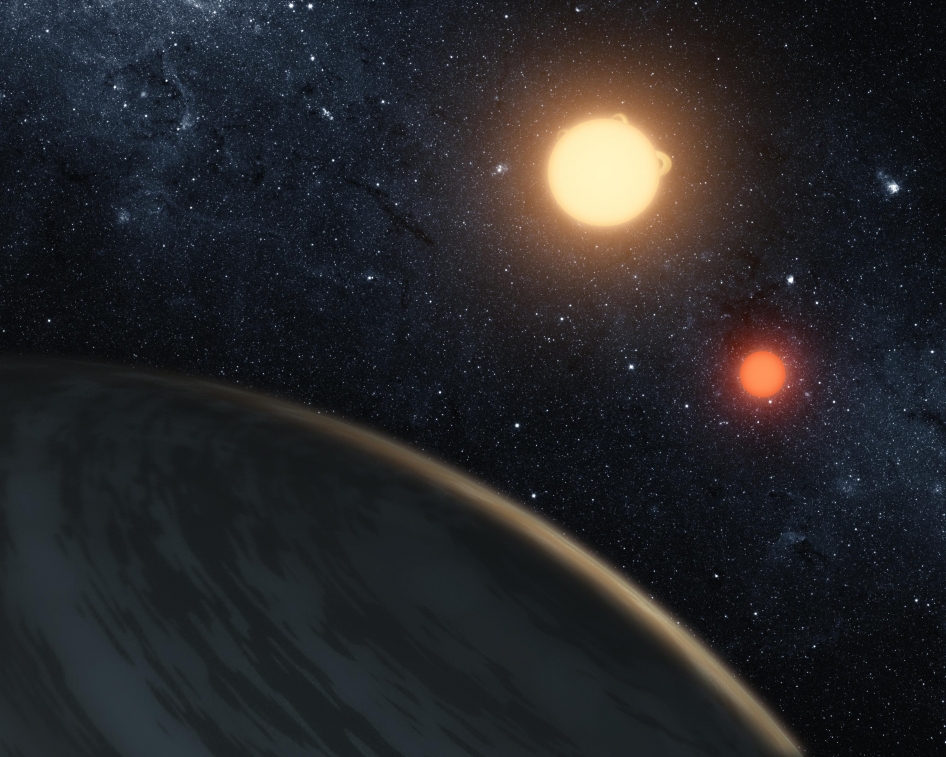
An artist's conception of a circumbinary planet. Credit: NASA/JPL-Caltech/T. Pyle

An artist’s conception of a circumbinary planet. Credit: NASA / JPL-Caltech / T. Pyle
There are few environments more hostile than a planet circling two stars. Powerful tidal forces from the stars can easily destroy the rocky building blocks of planets or grind a newly formed planet to dust. But astronomers have spotted a handful of these hostile worlds.

A new study is even suggesting that these extreme systems exist in abundance, with roughly half of all exoplanets orbiting binary stars.

NASA’s crippled Kepler space telescope is arguably the world’s most successful planet hunter, despite the sudden end to its main mission last May. For nearly four years, Kepler continuously monitored 150,000 stars searching for tiny dips in their light when planets crossed in front of them.

As of today, astronomers have confirmed nearly 1,500 exoplanets using Kepler data alone. But Kepler’s database is immense. And according to the exoplanet archive there are over 7,000 “Kepler Objects of Interest,” dubbed KOIs, that might also be exoplanets.

There are a seeming endless number of questions waiting to be answered. But one stands out: how many exoplanets circle two stars? Binary stars have long been known to be commonplace — about half of the stars in the Milky Way are thought to exist in binary systems.

A team of astronomers, led by Elliott Horch from Southern Connecticut State University, has shown that stars with exoplanets are just as likely to have a binary companion. In other words, 40 to 50 percent of the host stars are actually binary stars.

“It’s interesting and exciting that exoplanet systems with stellar companions turn out to be much more common than was believed even just a few years ago,” said Horch in a news release.

The research team made use of the latest technology, speckle imaging, to take a second look at KOI stars and search for any companion stars. In using this technique, astronomers obtain rapid images of a small portion of the sky surrounding the star. They then combine the images using a complex set of algorithms, which yields a final picture with a resolution better than the Hubble Space Telescope.

Speckle imaging allows astronomers to detect companion stars that are up to 125 times fainter than the target, but only a small distance away (36,000 times smaller than the full Moon). For the majority of Kepler stars, this equates to finding a companion within 100 times the distance from the Sun to the Earth.

The team was surprised to find that roughly half of their targets had companion stars.

“An interesting consequence of this finding is that in the half of the exoplanet host stars that are binary we can not, in general, say which star in the system the planet actually orbits,” said coauthor Steve B. Howell from the NASA Ames Research Center.

The new findings, soon to be published in the Astrophysical Journal, further advance our need to understand these exotic systems and the harrowing environments they face.

Tagged as:
Circumbinary Planets

The Rains Of Titan Change When They Hit Underground Reservoirs: Study

The Rains Of Titan Change When They Hit Underground Reservoirs: Study:


An illustration of a Titanic lake by Ron Miller. All rights reserved. Used with permission.

An illustration of a Titanic lake by Ron Miller. All rights reserved. Used with permission.
Titan — that moon of Saturn that has what some scientists consider precursors to elements for life — is a neat place to study because it also has a liquid cycle. But how the hydrocarbons move from the moon’s hundreds of lakes and seas into the atmosphere and the crust is still being examined.

A new study suggests that rainfall on Titan changes when it interacts with underground icy clathrates, which are watery structures that can include methane or ethane. This can make it easier for reservoirs to be created.

“We knew that a significant fraction of the lakes on Titan’s surface might possibly be connected with hidden bodies of liquid beneath Titan’s crust, but we just didn’t know how they would interact,” stated lead author Olivier Mousis, a Cassini research associate at the University of Franche-Comté in France. “Now, we have a better idea of what these hidden lakes or oceans could be like.”

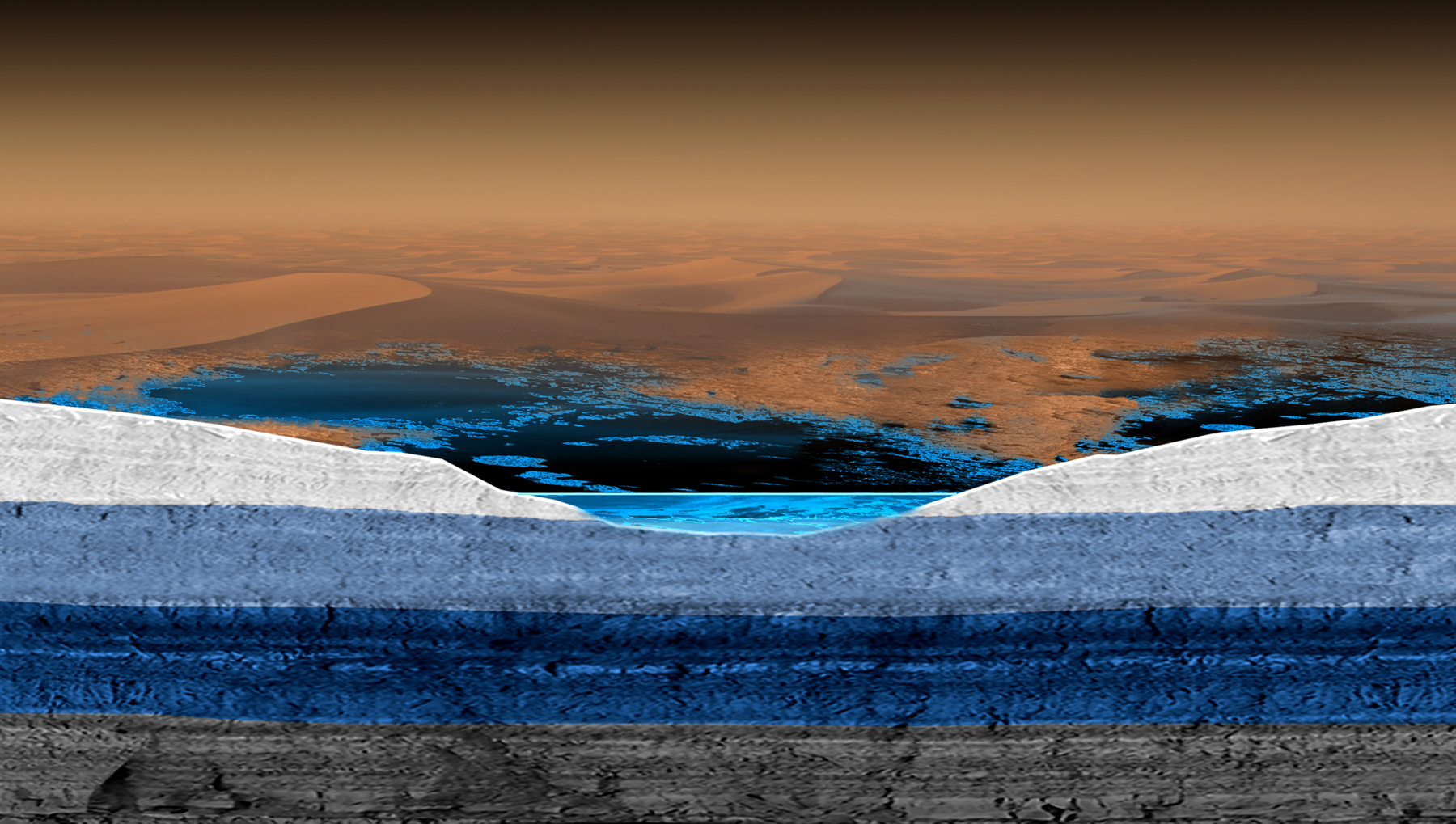
Artist's conception of a possible structure for underground liquid reservoirs on Saturn moon's Titan. Credit: ESA/ATG medialab

Artist’s conception of a possible structure for underground liquid reservoirs on Saturn moon’s Titan. From top, the layers include a porous icy crust, alkanofer in porous icy crust, expanding clathrate layer in porous icy crust and a non-porous icy crust. Credit: ESA/ATG medialab
This information is based on models of how the reservoirs would move through the crust of the icy moon. Clathrates would form at the bottom of reservoirs (which are filled with methane) and gradually split its molecules into solid and liquid components. Over time, this would transform the methane into propane or ethane.

“Importantly, the chemical transformations taking place underground would affect Titan’s surface,” the Jet Propulsion Laboratory stated.

“Lakes and rivers fed by springs from propane or ethane subsurface reservoirs would show the same kind of composition, whereas those fed by rainfall would be different and contain a significant fraction of methane. This means researchers could examine the composition of Titan’s surface lakes to learn something about what is happening deep underground.”

More about the research is available in the print version of the Sept. 1 edition of Icarus. Of note, the Cassini spacecraft is going to do another flyby of Titan in 17 days — its 105th, according to the spacecraft website.

Source: Jet Propulsion Laboratory

Tagged as:
lakes on Titan,
Titan