Wednesday, August 6, 2014

How to Tell the Age of a Sun-like Star? Try ‘Gyrochronology’

How to Tell the Age of a Sun-like Star? Try ‘Gyrochronology’:


Credit: NASA/European Space Agency

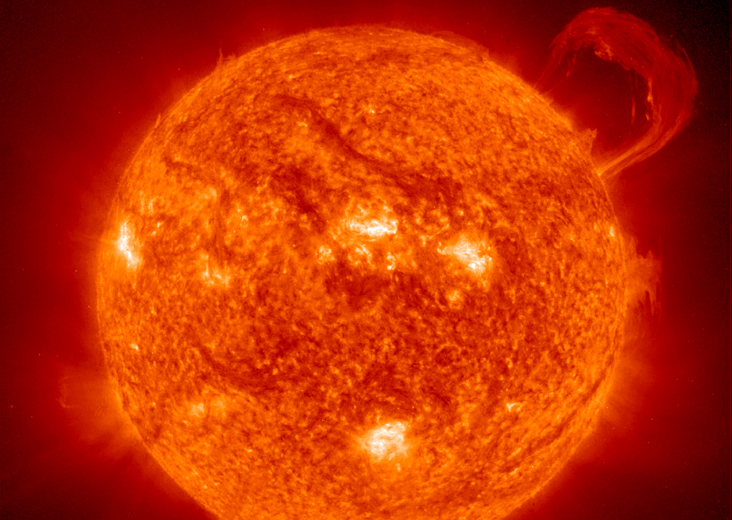
Our active Sun. Image Credit: NASA / European Space Agency
There’s no doubt the term “Earth-like” is a bit of a misnomer. It requires only that a planet is both Earth-size (less than 1.25 times Earth’s girth and less than twice Earth’s mass) and circles its host star within the habitable zone.

But defining a “Sun-like” star may be just as difficult. A solar twin should have a temperature, mass, age, radius, metallicity, and spectral type similar to the Sun. Although measuring most of these factors isn’t easy, aging a star is extremely difficult, and astronomers tend to ignore it when concluding if a star is Sun-like or not.

This is less than ideal, given that our Sun and all stars change over time. Thankfully a technique — gyrochronology — is allowing astronomers to measure stellar ages based only on spin and find true solar analogues.

“We have found stars with properties that are close enough to those of the Sun that we can call them ‘solar twins,’” said lead author Jose Dias do Nascimento from the Harvard-Smithsonian Center for Astrophysics (CfA) in a press release.

do Nascimento and colleagues measured the spin of 75 stars by looking for changes in brightness caused by dark star spots, rotating in and out of view. Although this difference is minute, clocking in at a few percent or less, NASA’s Kepler spacecraft excels at extracting such small changes in brightness.

On average, the sampled stars spin once every 19 days, compared to the 25-day rotation period of the Sun. This makes most of the stars slightly younger than the Sun, as younger stars spin faster than older ones.

The relationship between stellar spin and age was determined in previous research by Soren Meibom (CfA) and colleagues, who measured the rotation rates for stars in a one-billion-year-old cluster. Since the stars already had a known age, the team could measure their spin rates and calibrate the previous relationship.

Using this method, do Nascimento and colleagues found 22 true solar analogues within their data set of 75 stars.

“With solar twins we can study the past, present, and future of stars like our Sun,” said do Nascimento. “Consequently, we can predict how planetary systems like our solar system will be affected by the evolution of their central stars.”

The results were accepted for publication in The Astrophysical Journal Letters and are available online.

Tagged as:
gyrochronology,
Stellar Aging

Water Or Not? Fresh Martian Trenches Primarily Due To Carbon Dioxide Freezes, Study Says

Water Or Not? Fresh Martian Trenches Primarily Due To Carbon Dioxide Freezes, Study Says:


Mars Reconnaissance Orbiter

Artist Illustration of the Mars Reconnaissance Orbiter
Does liquid water currently flow on the surface of Mars? Fresh-looking trenches on the Red Planet have come under a lot of scrutiny, including a 2010 study concluding that 18 dune gullies were primarily formed by carbon dioxide freezing.

A new study looking at several more gullies comes to about the same conclusion. Researchers examined images of 356 sites, with each of these sites captured multiple times on camera. Of the 38 of these sites that showed changes since 2006, the researchers concluded site changes happened in the winter — when it’s too cold for any liquid water to flow.

“As recently as five years ago, I thought the gullies on Mars indicated activity of liquid water,” stated lead author Colin Dundas of the U.S. Geological Survey’s Astrogeology Science Center in Arizona.

“We were able to get many more observations, and as we started to see more activity and pin down the timing of gully formation and change, we saw that the activity occurs in winter.”

Observations were made using NASA’s long-running Mars Reconnaissance Orbiter mission, which has been in orbit there since 2006. The researchers said that these lengthy missions are important for examining and confirming findings, because they can revisit data over time and change their conclusions, as needed, as more evidence comes in. Pictures were taken by the High Resolution Imaging Science Experiment (HiRISE) camera.

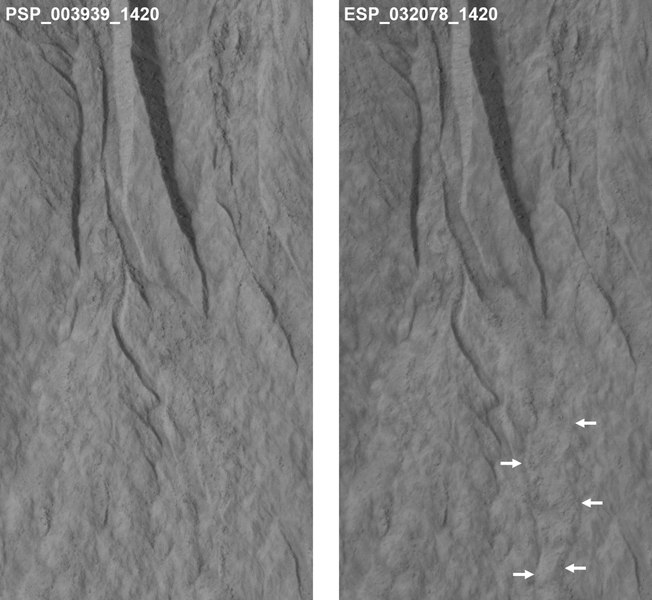
A 164-yard (150-meter) wide swath of Martian surface at 37.7 degrees south latitude, 192.9 degrees east longitude shows gullies changing between passes of the Mars Reconnaissance Orbiter. The earlier image, at left, was taken May 30, 2007. Near the arrows on the image on right, which was taken May 31, 2013, is a "rubbly flow" near the channel's mouth. Credit: NASA/JPL-Caltech/Univ. of Arizona

A 164-yard (150-meter) wide swath of Martian surface at 37.7 degrees south latitude, 192.9 degrees east longitude shows gullies changing between passes of the Mars Reconnaissance Orbiter. The earlier image, at left, was taken May 30, 2007. Near the arrows on the image on right, which was taken May 31, 2013, is a “rubbly flow” near the channel’s mouth. Credit: NASA/JPL-Caltech/Univ. of Arizona
The first images of gullies in 2000 sparked speculation that liquid water could be responsible for changing the surface today. It’s true that Mars has water frozen in its poles, and observations with several NASA rovers show strong evidence that water once flowed on the surface. But, these trenches are unlikely to show evidence that liquid water is flowing right now.

“Frozen carbon dioxide, commonly called dry ice, does not exist naturally on Earth, but is plentiful on Mars. It has been linked to active processes on Mars such as carbon dioxide gas geysers and lines on sand dunes plowed by blocks of dry ice,” NASA stated.

“One mechanism by which carbon-dioxide frost might drive gully flows is by gas that is sublimating from the frost providing lubrication for dry material to flow. Another may be slides due to the accumulating weight of seasonal frost buildup on steep slopes.”

The team added that smaller features could be the result of liquid water, such as this recent study using MRO. It’ll be interesting to see what other data is churned up as the fleet of orbiters continues making observations, and other scientists weigh in on the results.

The work will be published in the journal Icarus.

Source: Jet Propulsion Laboratory

Tagged as:
High Resolution Imaging Science Experiment (HiRISE),
mars reconnaissance orbiter

Found! Seven Dwarfs Surround The ‘Pinwheel Galaxy’ Field Of View

Found! Seven Dwarfs Surround The ‘Pinwheel Galaxy’ Field Of View:


This Hubble image reveals the gigantic Pinwheel Galaxy (M101), one of the best known examples of "grand design spirals," and its supergiant star-forming regions in unprecedented detail. Astronomers have searched galaxies like this in a hunt for the progenitors of Type Ia supernovae, but their search has turned up mostly empty-handed. Credit: NASA/ESA

This Hubble image reveals the gigantic Pinwheel Galaxy (M101), one of the best known examples of “grand design spirals”. Credit: NASA/ESA
Using a unique type of telescope that includes long-range lenses, astronomers at Yale University have found seven dwarf galaxies surrounding the well-known Pinwheel Galaxy, M101.

It’s unclear if the septuplets are actually orbiting the pinwheel, or just happen to be in the same field of view. But astronomers at Yale say that this shows the so-called Dragonfly Telephoto Array is working well, and they are planning follow-up observations to see what else they can find.

“The previously unseen galaxies may yield important insights into dark matter and galaxy evolution, while possibly signaling the discovery of a new class of objects in space,” Yale University stated in a release.

The galaxies escaped detection before because their light is so diffuse, but this is what the telescope is designed to pick up. The telescope is constructed of eight telephoto lenses (similar to what you would use to photograph a sporting event) that include “special coating” to stop any light from scattering inside. The telescope is called “Dragonfly” because like an insect, it has multiple eyes for looking at things.

Seven new dwarf galaxies shine in the field of view surrounding M101, the Pinwheel Galaxy. Credit: Yale University

Seven new dwarf galaxies shine in the field of view surrounding M101, the Pinwheel Galaxy. Credit: Yale University
Follow-up observations will come with the Hubble Space Telescope. If it turns out that these galaxies are not bound to M101, the results will be equally interesting to astronomers.

“There are predictions from galaxy formation theory about the need for a population of very diffuse, isolated galaxies in the universe,” stated Allison Merritt, a Yale graduate student who led the research.

“It may be that these seven galaxies are the tip of the iceberg, and there are thousands of them in the sky that we haven’t detected yet.”

The research was published in Astrophysical Journal Letters and is also available in preprint version on Arxiv.

Source: Yale University

The Dragonfly Telephoto Array, a unique Yale University telescope used to look for diffuse light in galaxies. Credit: Yale University

The Dragonfly Telephoto Array, a unique Yale University telescope used to look for diffuse light in galaxies. Credit: Yale University
Tagged as:
dragonfly telephoto array,
M101,
Pinwheel Galaxy

Contest: Get Your Video On The International Space Station

Contest: Get Your Video On The International Space Station:


A view of the International Space Station as seen by the last departing space shuttle crew, STS-135. Credit: NASA

A view of the International Space Station as seen by the last departing space shuttle crew, STS-135. Credit: NASA
If you’re starting your career, good with a video and love space, here’s your big chance to showcase your work in an exclusive screening location — the International Space Station! A new Lunar and Planetary Institute-led contest is inviting people to send in their videos to talk about how space helps out humanity. More details below the jump.

“Through the international Humans in Space Art Challenge, we invite you to explore ‘How will humans use space science, and technology to benefit humanity?’ and to express your answer creatively in a video three minutes long or less,” reads the description of the challenge.

“Video artwork can be of any style, featuring original animation, sketches, music, live action drama, poetry, dance, Rube Goldberg machines, apps, etc. … Individuals or teams of participants should include one clear reference to the International Space Station in their videos and can use space station footage if desired.”

The contest is open to “college students and early career professionals”, according to the webpage. The due date for the challenge is Nov. 15, 2014. Full requirements and contact information for the contest organizers are available on this page.

New VLT Observations Clear Up Dusty Mystery

New VLT Observations Clear Up Dusty Mystery:


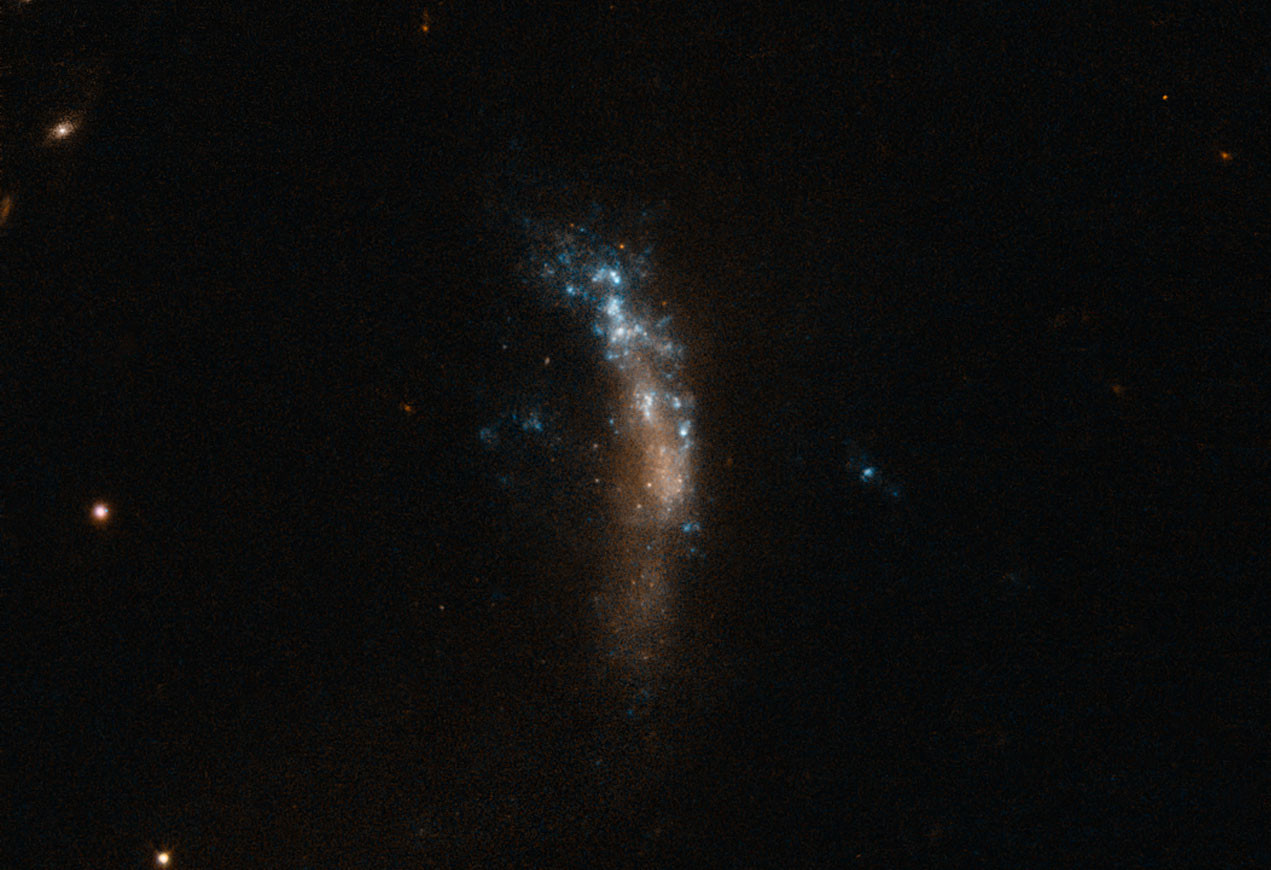
The dwarf galaxy UGC 5189A, site of the supernova SN 2010jl. Image Credit: ESO

The dwarf galaxy UGC 5189A, site of the supernova SN 2010jl. Image Credit: ESO
The Universe is overflowing with cosmic dust. Planets form in swirling clouds of dust around a young star; Dust lanes hide more-distant stars in the Milky Way above us; And molecular hydrogen forms on the dust grains in interstellar space.

Even the soot from a candle is very similar to cosmic carbon dust. Both consist of silicate and amorphous carbon grains, although the size grains in the soot are 10 or more times bigger than typical grain sizes in space.

But where does the cosmic dust come from?

A group of astronomers has been able to follow cosmic dust being created in the aftermath of a supernova explosion. The new research not only shows that dust grains form in these massive explosions, but that they can also survive the subsequent shockwaves.

Stars initially draw their energy by fusing hydrogen into helium deep within their cores. But eventually a star will run out of fuel. After slightly messy physics, the star’s contracted core will begin to fuse helium into carbon, while a shell above the core continues to fuse hydrogen into helium.

The pattern continues for medium to high mass stars, creating layers of different nuclear burning around the star’s core. So the cycle of star birth and death has steadily produced and dispersed more heavy elements throughout cosmic history, providing the substances necessary for cosmic dust.

“The problem has been that even though dust grains composed of heavy elements would form in supernovae, the supernova explosion is so violent that the grains of dust may not survive,” said coauthor Jens Hjorth, head of the Dark Cosmology Center at the Niels Bohr Institute in a press release. “But cosmic grains of significant size do exist, so the mystery has been how they are formed and have survived the subsequent shockwaves.”

The team led by Christa Gall used ESO’s Very Large Telescope at the Paranal Observatory in northern Chile to observe a supernova, dubbed SN2010jl, nine times in the months following the explosion, and for a tenth time 2.5 years after the explosion. They observed the supernova in both visible and near-infrared wavelengths.

SN2010jl was 10 times brighter than the average supernova, making the exploding star 40 times the mass of the Sun.

“By combining the data from the nine early sets of observations we were able to make the first direct measurements of how the dust around a supernova absorbs the different colours of light,” said lead author Christa Gall from Aarhus University. “This allowed us to find out more about the dust than had been possible before.”

The results indicate that dust formation starts soon after the explosion and continues over a long time period.

The dust initially forms in material that the star expelled into space even before it exploded. Then a second wave of dust formation occurs, involving ejected material from the supernova. Here the dust grains are massive — one thousandth of a millimeter in diameter — making them resilient to any following shockwaves.

“When the star explodes, the shockwave hits the dense gas cloud like a brick wall. It is all in gas form and incredibly hot, but when the eruption hits the ‘wall’ the gas gets compressed and cools down to about 2,000 degrees,” said Gall. “At this temperature and density elements can nucleate and form solid particles. We measured dust grains as large as around one micron (a thousandth of a millimeter), which is large for cosmic dust grains. They are so large that they can survive their onward journey out into the galaxy.”

If the dust production in SN2010jl continues to follow the observed trend, by 25 years after the supernova explosion, the total mass of dust will have half the mass of the Sun.

The results have been published in Nature and are available for download here. Niels Bohr Institute’s press release and ESO’s press release are also available.

Tagged as:
Dust formation,
Supernovae,
Very Large Telescope

Comet Jacques Is Back! Joins Venus and Mercury at Dawn

Comet Jacques Is Back! Joins Venus and Mercury at Dawn:


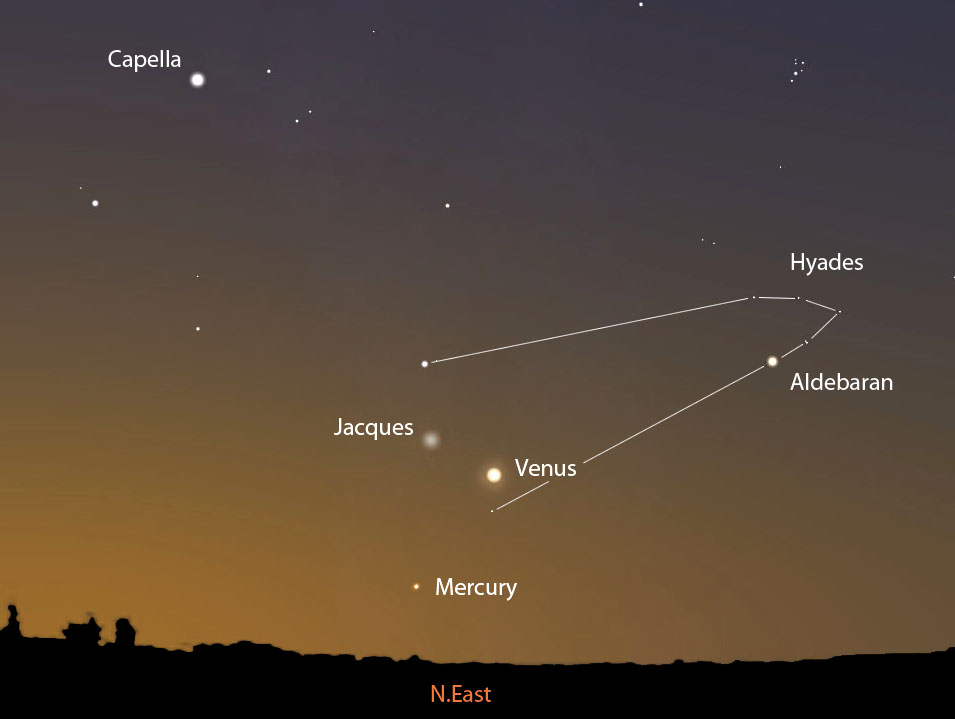
Will you see it? Comet Jacques will pass about 3.5 degrees north of brilliant Venus tomorrow morning July 13. This map shows the sky facing northeast about 1 hour before sunrise. Stellarium

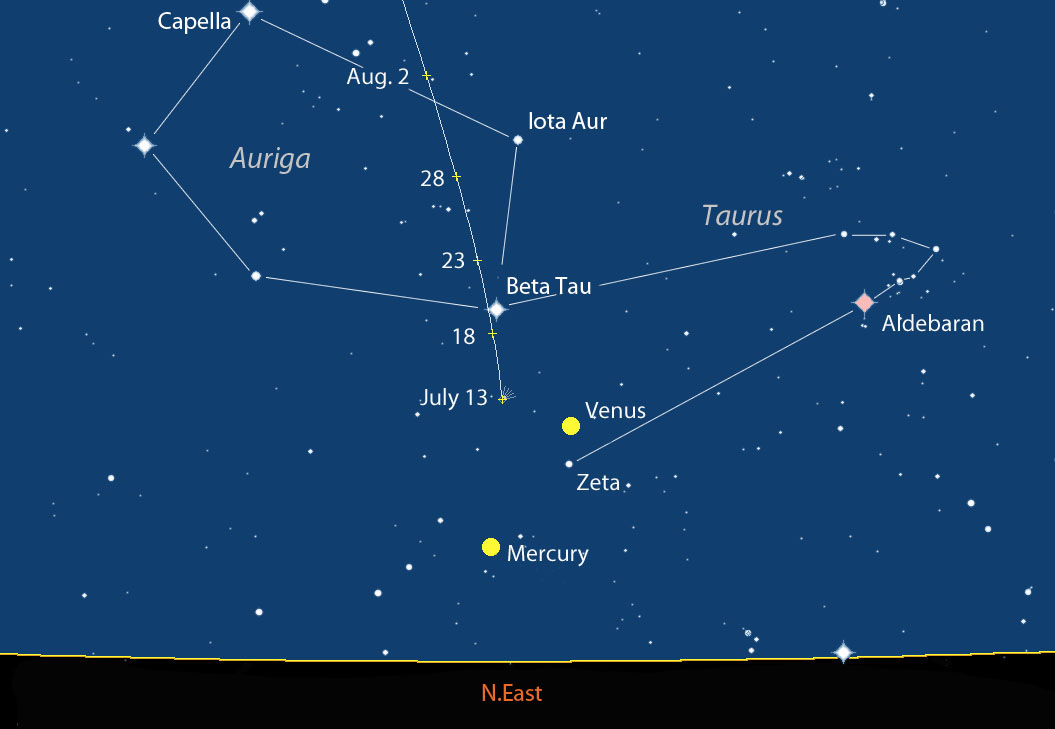
Will you see it? Comet Jacques will pass about 3.5 degrees north of brilliant Venus tomorrow morning July 13. This map shows the sky facing northeast about 1 hour before sunrise when the comet will be 10° high in the northeastern sky. Stellarium
Comet C/2014 E2 Jacques has returned! Before it disappeared in the solar glow this spring, the comet reached magnitude +6, the naked eye limit. Now it’s back at dawn, rising higher each morning as it treks toward darker skies. Just days after its July 2 perihelion, the fuzzball will be in conjunction with the planet Venus tomorrow morning July 13. With Mercury nearby, you may have the chance to see this celestial ‘Rat Pack’ tucked within a 8° circle.

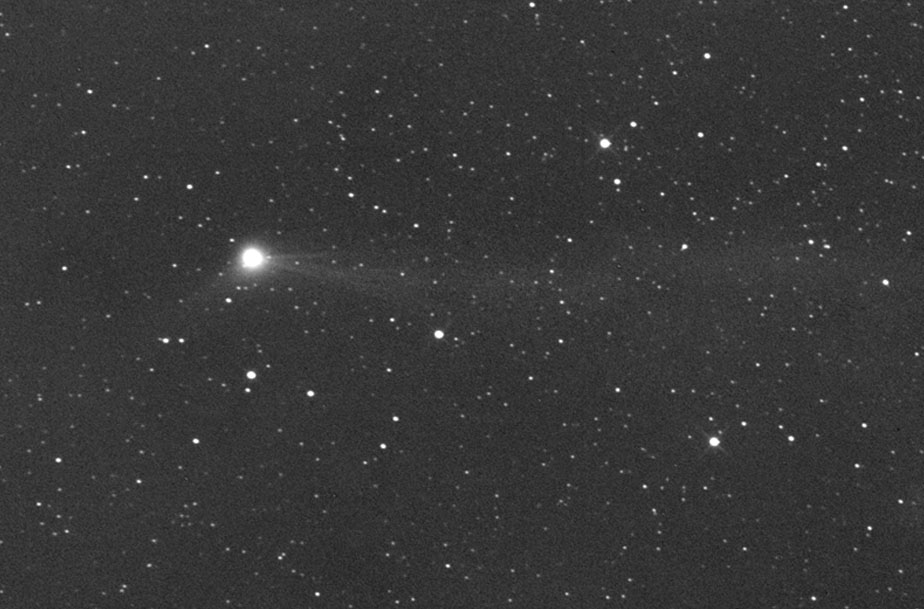
First photo of Comet Jacques on its return to the morning sky taken on July 7. Credit: Gerald Rhemann

First photo of Comet Jacques on its return to the morning sky taken on July 11. Two tails are visible – a short, dust tail pointing to the lower left of the coma and longer gas or ion tail to the right. Credit: Gerald Rhemann
While I can guarantee you’ll see Venus and probably Mercury (especially if you use binoculars), morning twilight and low altitude will undoubtedly make spotting Comet Jacques challenging. A 6-inch telescope might nail it. Look for a small, fuzzy cloud with a brighter core against the bluing sky. Patience is the sky observer’s most useful tool. It won’t be long before the comet’s westward motion combined with the seasonal drift of the stars will loft it into darkness again.

Use this map to follow Comet Jacques as it moves west across Taurus and Auriga over the next few weeks. Planet positions are shown for July 13 with stars to magnitude +6. Jacques' position is marked every 5 days. Source: Chris Mariott's SkyMap

Use this map to follow Comet Jacques as it moves west across Taurus and Auriga over the next few weeks. Planet positions are shown for July 13 with stars to magnitude +6. Jacques’ position is marked every 5 days. Click to enlarge. Source: Chris Mariott’s SkyMap
A week from now, when the moon’s slimmed to half, the comet will be nearly twice as high and should be easily visible in 50mm binoculars at the start of morning twilight.

Comet Jacques is expected to remain around magnitude +6 through the remainder of July into early August and then slowly fade. It will be well-placed in Perseus at the time of the Perseid meteor shower on Aug. 12-13. Closest approach to Earth occurs on August 29 at 52.4 million miles (84.3 million km). Good luck and let us know if you see it.

Tagged as:
comet jacques,
Mercury,
Venus

Into The Black? Maybe Radio Bursts Are From Outside The Galaxy After All, Study Says

Into The Black? Maybe Radio Bursts Are From Outside The Galaxy After All, Study Says:


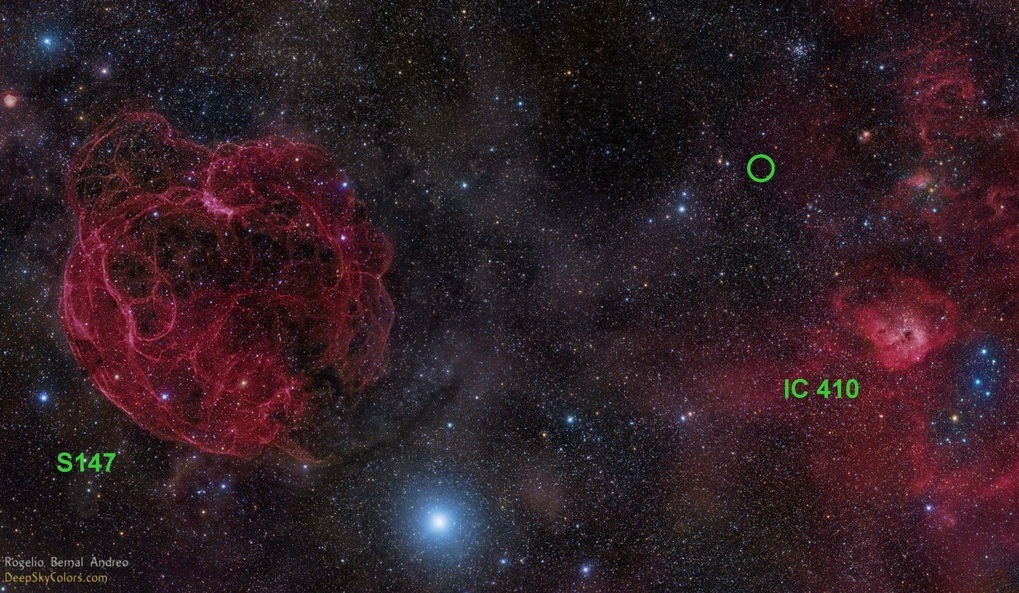
Image of the sky where the radio burst FRB 121102 was found, in the constellation Auriga. You can see its location with a green circle. At left is supernova remnant S147 and at right, a star formation area called IC 410. Credit: Rogelio Bernal Andreo (DeepSkyColors.com)

Image of the sky where the radio burst FRB 121102 was found, in the constellation Auriga. You can see its location with a green circle. At left is supernova remnant S147 and at right, a star formation area called IC 410. Credit: Rogelio Bernal Andreo (DeepSkyColors.com)
Where are these radio bursts coming from? Astronomers have heard these signals from the sky several times, but always with the same telescope (Parkes Observatory in Australia). There was debate about whether these were coming from inside or outside the galaxy, or even from Earth itself (given only the one observatory was detecting them.)

A new study with a different telescope, the Arecibo Observatory in Puerto Rico, concludes that the bursts are from outside the galaxy. This is the first time one of these bursts have been found in the northern hemisphere of the sky.

“Our result is important because it eliminates any doubt that these radio bursts are truly of cosmic origin,” stated Victoria Kaspi, an astrophysics researcher at McGill University who participated in the research. “The radio waves show every sign of having come from far outside our galaxy – a really exciting prospect.”

Fast radio bursts are a flurry of radio waves that last a few thousandths of a second, and at any given minute there are only seven of these in the sky on average, according to the Max Planck Institute for Radio Astronomy. Their cause is unknown. They could be anything from black holes, to neutron stars coming together, to the magnetic field of pulsars (a type of neutron star) flaring up — or something else.

Arecibo Observatory in Puerto Rico. Credit: NAIC - Arecibo Observatory, a facility of the NSF

Arecibo Observatory in Puerto Rico. Credit: NAIC – Arecibo Observatory, a facility of the NSF
The pulse was found Nov. 2, 2012 in the constellation Auriga. Astronomers believe it is from quite far away from measuring its plasma dispersion, or the slowdown of radio waves as they crash into interstellar electrons. This particular source had triple the maximum dispersion than what would be found inside the galaxy, astronomers stated.

“The brightness and duration of this event, and the inferred rate at which these bursts occur, are all consistent with the properties of the bursts previously detected by the Parkes telescope in Australia,” stated Laura Spitler, who led the research. (She was at Cornell University when the study began, but is now at the Max Planck Institute for Radio Astronomy in Bonn, Germany.)

But other research has been back-and-forth on whether these are actually extragalactic bursts. One 2013 paper supposed it could be colliding neutron stars from far away, while another said it could instead be nearby stars flaring up.

The research was published in the Astrophysical Journal and is also available in preprint version on Arxiv.

Source: McGill University and the Max Planck Institute for Radio Astronomy

Tagged as:
arecibo observatory,
fast radio burst,
radio burst

Your Weekend ‘SuperMoon’ Photos from Around the World

Your Weekend ‘SuperMoon’ Photos from Around the World:


The big proxigean full Moon rises over Daganzo de Arriba, near Madrid, Spain on July 12, 2014. Credit and copyright: Alvaro Ibañez Perez.

The big proxigean full Moon rises over Daganzo de Arriba, near Madrid, Spain on July 12, 2014. Credit and copyright: Alvaro Ibañez Perez.
Did you hear there was something special about the full Moon this weekend… that it would be, well… really super? I heard about it on every newscast I watched or listened to. Even xkcd got into the ‘Supermoon’ craze. The July “Buck” Moon was the first of three Supermoons on tap for 2014, where the Moon is at its perigee, the closest point to Earth in its orbit, close to the time when it is “officially” full.

If you didn’t hear about it, (or weren’t paying attention) you may not have noticed anything different, as its not radically different from a regular full Moon. Read all the detail of what a Supermoon is here. But as Geoff Chester of the US Naval Observatory, said on NASA’s website, “However, if it gets people out and looking at the night sky and maybe hooks them into astronomy, then it’s a good thing,”

And people were out with their cameras, too! Here’s a great collection of full Moon images from this weekend, as seen in our Flickr Gallery.

An over-exposed beauty showing the full Moon rising through the clouds on July 12, 2014 near  Bromsgrove, England, United Kingdom. Credit and copyright: Sarah and Simon Fisher.

An over-exposed beauty showing the full Moon rising through the clouds on July 12, 2014 near Bromsgrove, England, United Kingdom. Credit and copyright: Sarah and Simon Fisher.
The rising "super moon" of July 12, 2014, rising above a canola field in southern Alberta, Canada.  Credit and copyright: Alan Dyer/Amazing Sky Photography.

The rising “super moon” of July 12, 2014, rising above a canola field in southern Alberta, Canada. Credit and copyright: Alan Dyer/Amazing Sky Photography.
A Mississippi Super Moonscape on July 12, 2014. Credit and Copyright: Veronica M Photography.

A Mississippi Super Moonscape on July 12, 2014. Credit and Copyright: Veronica M Photography.
The 'Supermoon' setting on the morning of July 13, 2014 at around 6 am local time near Kapiolani, Honolulu, Hawaii. Credit and copyright:  Henry Weiland.

The ‘Supermoon’ setting on the morning of July 13, 2014 at around 6 am local time near Kapiolani, Honolulu, Hawaii. Credit and copyright: Henry Weiland.
A 3-exoposure of the full Moon on July 12, 2014, taken near Cap-Rouge, Quebec City, Quebec, Canada. Credit and copyright:  Denis Marquis.

A 3-exoposure of the full Moon on July 12, 2014, taken near Cap-Rouge, Quebec City, Quebec, Canada. Credit and copyright: Denis Marquis.
The July 12, 2014 Supermoon or perigee full moon shares the night sky with fireworks from a display in Chester, New York. Credit and copyright: Tom Bushey.

The July 12, 2014 Supermoon or perigee full moon shares the night sky with fireworks from a display in Chester, New York. Credit and copyright: Tom Bushey.
Moonrise with a flyby. July 13, 2014 from the UK. Credit and copyright: SculptorLil on Flickr.

Moonrise with a flyby. July 13, 2014 from the UK. Credit and copyright: SculptorLil on Flickr.
The rising waning Moon on July 13, 2014, from near Bedfordshire, UK. Credit and copyright: DawnSunrise on Flickr.

The rising waning Moon on July 13, 2014, from near Bedfordshire, UK. Credit and copyright: DawnSunrise on Flickr.
Thanks to everyone who submitted images! Check out even more great images in Universe Today’s Flickr Group!


Be advised that this month’s big full Moon was not the closest of the year. The closest Full Moon of 2014 occurs next month on August 10th at 18:11 Universal Time (UT) or 1:44 PM EDT. On that date, the Moon reaches perigee or its closest approach to the Earth at 356,896 kilometres distant at 17:44, less than an hour from Full.

Tagged as:
Moon,
Supermoon,
supermoon 2014

A Stunning Image of our Home Star

A Stunning Image of our Home Star:


Sunspots and a detached prominence photographed on July 11, 2014. (© Alan Friedman, All Rights Reserved.)

Sunspots and a detached prominence photographed on July 11, 2014. (© Alan Friedman, All Rights Reserved.)
Active regions 2108 and 2109 are now passing around the limb of the Sun, but not before solar photography specialist Alan Friedman grabbed a few pictures of them on Friday!   The image above, captured by Alan from his location in Buffalo, NY, shows the two large sunspots nestled in a forest of solar spicules while a large detached prominence hovers several Earth-diameters inside the corona. A beautiful snapshot of our home star!

Captured in hydrogen-alpha wavelengths, the image above has been colored by Alan, rotated 90 degrees counterclockwise, and inverted from the original. The sunspots and standing prominence are cooler in Ha than the surrounding chromosphere and corona, and so actually photograph darker.

A view of sunspot 2109 in visible light can be seen below:

AR2109 photographed by Alan Friedman on July 11, 2014.

AR2109 photographed by Alan Friedman on July 11, 2014.
Sunspots are the result of magnetic fields rising up from deep within the Sun, preventing convection from occurring in large areas on the Sun’s surface and thereby creating relatively cooler regions we see as dark spots. They can often be many times the size of Earth and can be sources of powerful solar flares.

See these and more images by Alan on his blog here.

Images © Alan Friedman. All rights reserved.

Tagged as:
Alan Friedman,
astrophotography,
hydrogen alpha,
prominence,
Star,
sun,
sunspot

DARPA’s Experimental Space Plane XS-1 Starts Development

DARPA’s Experimental Space Plane XS-1 Starts Development:


Concept images for DARPA’s Experimental Spaceplane (XS-1) program. Credit: DARPA.

Concept images for DARPA’s Experimental Spaceplane (XS-1) program. Credit: DARPA.
The Defense Advanced Research Projects Agency (DARPA) is looking to develop a fully-reusable unmanned spaceplane, and they are now ready to start working their proposed Experimental Spaceplane (XS-1). The agency has put together a “special forces” of sorts in the space industry, awarding prime contracts for the first phase of development to a combination of six companies. These six are a combination of “old” and “new” space companies and are:


The Boeing Company (working with Blue Origin, LLC)

Masten Space Systems (working with XCOR Aerospace)

Northrop Grumman Corporation (working with Virgin Galactic)

“We chose performers who could prudently integrate existing and up-and-coming technologies and operations, while making XS-1 as reliable, easy-to-use and cost-effective as possible,” Jess Sponable, DARPA program manager. “We’re eager to see how their initial designs envision making spaceflight commonplace—with all the potential military, civilian and commercial benefits that capability would provide.”


Each commercial entity will be able to outline their vision of the XS-1, but DARPA wants the the spaceplane to provide aircraft-like access to space for deploying small satellites to orbit and it its development, they’d like to create technology for next-generation hypersonic vehicles, — and do it more affordably.

They envision that a reusable first stage would fly to hypersonic speeds at a suborbital altitude. Then, one or more expendable upper stages would separate and deploy a satellite into low Earth orbit (LEO). The reusable first stage would then return to earth, land and be prepared for the next flight.

Key to the development, DARPA says, are modular components, durable thermal protection systems and automatic launch, flight and recovery systems that should significantly reduce logistical needs, enabling rapid turnaround between flights.

DARPA’s key technical goals for the XS-1 include flying 10 times in 10 days, flying to Mach 10+ at least once and launching a representative small payload to orbit. The program also seeks to reduce the cost of access to space for 3,000- to 5,000-pound payloads to less than $5 million per flight.

Source: DARPA

Tagged as:
DARPA,
XS-1

What Created This Huge Crater In Siberia?

What Created This Huge Crater In Siberia?:


An 80-meter-wide crater recently discovered in  northern Siberia (Video screenshot)

An 80-meter-wide crater recently discovered in northern Siberia (video screenshot)
What is it with Russia and explosive events of cosmic origins? The 1908 Tunguska Explosion, the Chelyabinsk bolide of February 2013, and now this: an enormous 80-meter wide crater discovered in the Yamal peninsula in northern Siberia!

To be fair, this crater is not currently thought to be from a meteorite impact but rather an eruption from below, possibly the result of a rapid release of gas trapped in what was once frozen permafrost. The Yamal region is rich in oil and natural gas, and the crater is located 30 km away from its largest gas field. Still, a team of researchers are en route to investigate the mysterious hole further.

Watch a video captured by engineer Konstantin Nikolaev during a helicopter flyover below:


In the video the Yamal crater/hole has what appear to be streams of dry material falling into it. Its depth has not yet been determined.

Bill Chappell writes on NPR’s “The Two-Way”:

“The list of possible natural explanations for the giant hole includes a meteorite strike and a gas explosion, or possibly an eruption of underground ice.”
Dark material around the inner edge of the hole seems to suggest high temperatures during its formation. But rather than the remains of a violent impact by a space rock — or the crash-landing of a UFO, as some have already speculated — this crater may be a particularly explosive result of global warming.

According to The Siberian Times:

“Anna Kurchatova from Sub-Arctic Scientific Research Centre thinks the crater was formed by a water, salt and gas mixture igniting an underground explosion, the result of global warming. She postulates that gas accumulated in ice mixed with sand beneath the surface, and that this was mixed with salt – some 10,000 years ago this area was a sea.”
The crater is thought to have formed sometime in 2012.

Read more at The Siberian Times and NPR.

Tagged as:
crater,
explosion,
global warming,
hole,
impact,
meteorite,
Siberia,
sinkhole,
Yamal

ISON Stopped Making Dust Just Before It Passed By The Sun And Disintegrated

ISON Stopped Making Dust Just Before It Passed By The Sun And Disintegrated:


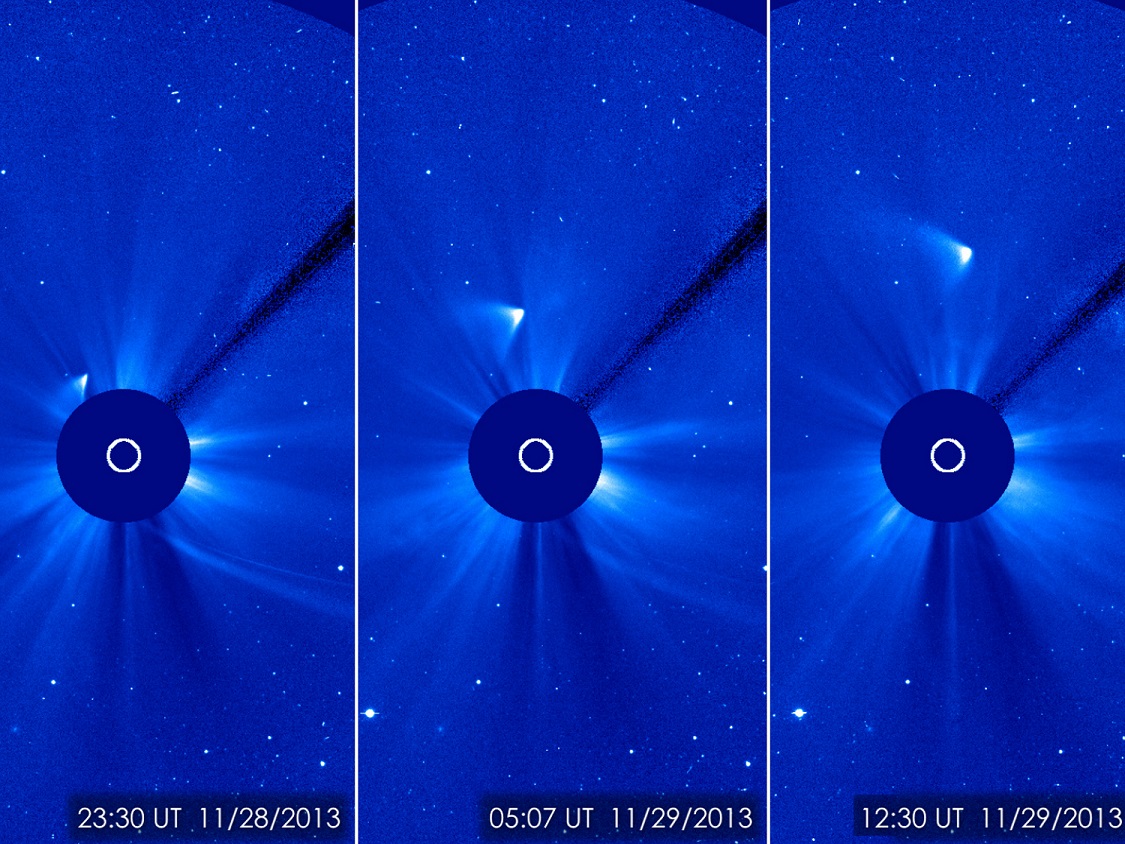
Bright, brighter, brightest: these views of Comet ISON after its closest approach to the sun Nov. 28 show that a small part of the nucleus may have survived the comet's close encounter with the sun. Images from the Solar and Heliospheric Observatory. Credit: ESA/NASA/SOHO/GSFC

Bright, brighter, brightest: these views of Comet ISON after its closest approach to the sun Nov. 28 show that a small part of the nucleus may have survived the comet’s close encounter with the sun. Images from the Solar and Heliospheric Observatory. Credit: ESA/NASA/SOHO/GSFC
Last year’s Thanksgiving adventure for astronomers happened when Comet ISON passed within 1.2 million kilometres (750,000 miles) of the Sun. While many people were hoping the comet would stick around and produce a good show, the comet disintegrated despite a brief flare-up shortly after passing perihelion.

Scientists have just modelled the production of dust on the comet and concluded there was a “violent outburst” that happened 8.5 hours before closest approach, when the comet spewed out 11,500 tonnes (12,765 tons) of material.

“It is most likely that the final break-up of the nucleus triggered this eruption, abruptly releasing gas and dust trapped inside the nucleus,” stated Werner Curdt from the Max Planck Institute of Solar System Research, who was the lead researcher on the project. “Within a few hours the dust production stopped completely.”

Because the last few parts of the comet’s encounter were obscured by an occulting disk on the Large Angle and Spectrometric Coronagraph on the Solar and Heliospheric Observatory (SOHO), astronomers decided to model the encounter based on other data they gathered before and after.

Comet ISON captured in an image from the Solar and Heliospheric Observatory (SOHO)'s Solar Ultraviolet Measurements of Emitted Radiation (SUMER) instrument. Credit: MPS

Comet ISON captured in an image from the Solar and Heliospheric Observatory (SOHO)’s Solar Ultraviolet Measurements of Emitted Radiation (SUMER) instrument. Credit: MPS
They did have one source of data, which was another instrument called the Solar Ultraviolet Measurements of Emitted Radiation (SUMER). It’s usually used to investigate plasma activity on the sun and not faint comets, but the scientists felt it could be repurposed. T

hey switched modes on the instrument and captured the tail in far ultraviolet light, light “emitted from the solar disc and reflected by the dust particles into space,” the European Space Agency stated.

Then they compared what they saw with computer simulations, coming up with the dust estimations.

The paper is available in the journal Astronomy & Astrophysics and also in preprint version on Arxiv.

Source: European Space Agency

Tagged as:
soho,
sumer

Cargo Ship’s Fiery Demise Could Help Predict What Happens When The Space Station Burns Up

Cargo Ship’s Fiery Demise Could Help Predict What Happens When The Space Station Burns Up:


Artist's conception of the final Automated Transfer Vehicle (ATV), Georges Lemaître, breaking up during re-entry following a cargo run to the International Space Station. Credit: ESA–D. Ducros

Artist’s conception of the final Automated Transfer Vehicle (ATV), Georges Lemaître, breaking up during re-entry following a cargo run to the International Space Station. Credit: ESA–D. Ducros
It’s sad to think about, but there will be a day sometime when the International Space Station makes its final journey — a destructive re-entry into Earth’s atmosphere. Historically, it’s been hard to break up large pieces of space hardware safely. Pieces of the Skylab space station famously rained down in Australia, while Mir’s demise triggered warnings across its re-entry path.

The European Space Agency sees an opportunity to gather more information for this future use: closely watching what happens when the final Automated Transfer Vehicle (ATV), Georges Lemaître, goes to the International Space Station and has its planned breakup in the atmosphere following the shipment.

They plan to record its last moments using a heat-seeking camera on the inside of the spacecraft. This sort of thing has been done before with NASA and the Japanese Aerospace Exploration Agency, but this will be a first for ESA.

“The data should also hold broader value,” stated Neil Murray, who is leading the project at the European Space Agency (ESA).

“The project is proceeding under our ‘Design for Demise’ effort to design space hardware in such a way that it is less likely to survive reentry and potentially endanger the public. Design for Demise in turn is part of the agency’s clean space initiative, seeking to render the space industry more environmentally friendly in space as well as on Earth.”

The Automated Transfer Vehicle Albert Einstein burning up on Nov. 2, 2013 at 12:04 GMT over an uninhabitated part of the Pacific Ocean. This picture was snapped from the International Space Station. Credit: ESA/NASA

The Automated Transfer Vehicle Albert Einstein burning up on Nov. 2, 2013 at 12:04 GMT over an uninhabitated part of the Pacific Ocean. This picture was snapped from the International Space Station. Credit: ESA/NASA
The camera will ride inside, bolted to a rack, and transmit the last 20 seconds of its lifetime to a special Reentry Satcom capsule that is designed to survive the breakup. The data will in turn be sent to Earth using an Iridium satellite.

While the SatCom will be protected by a heatshield, the challenge will be transmitting the information through the plasma generated as it falls at 6 to 7 kilometers (3.7 to 4.3 miles) a second. The breakup will happen at 80 kilometers (50 miles) and the plasma will be there until below an altitude of about 40 kilometers (25 miles), ESA stated.

“The fall will generate high-temperature plasma around it, but signals from its omnidirectional antenna should be able to make it through any gap in the plasma to the rear,” the agency added.

Georges Lemaître is expected to launch later this month and last six months in space before re-entry.

Source: European Space Agency

Tagged as:
atv,
automated transfer vehicle,
Georges Lemaître

Observing Challenge: 6 White Dwarf Stars to See in Your Backyard Telescope

Observing Challenge: 6 White Dwarf Stars to See in Your Backyard Telescope:


Dazzlimg Sirius, with its white dwarf companion to the lower left. Credit: NASA, ESA, H. Bond (STScI) and M. Barstow (University of Leicester).

Dazzling Sirius, with its white dwarf companion to the lower left. Credit: NASA, ESA, H. Bond (STScI) and M. Barstow (University of Leicester).
Looking for something off beat to observe? Some examples of curious astronomical objects lie within the reach of the dedicated amateur armed with a moderate-sized backyard telescope. With a little skill and persistence, you just might be able to track down a white dwarf star.  Unlike splashy nebulae or globular clusters, a white dwarf star will just appear as a speck, a tiny dot in the field of view of your telescope’s eyepiece. But just as in the case of observing other exotic objects such as red giants and quasars, part of the thrill of tracking down these astrophysical beasties is in knowing just what it is that you’re seeing. Heck, many amateur astronomers fail to realize that any white dwarf stars are within range of their instruments and have never tracked one down.

The astrophysical nature of white dwarf stars was first uncovered in the early 20th century. Most of the early white dwarf stars discovered were companions in binary star systems and this allowed astronomers to gauge their mass by following the orbital motion of such pairs over time. Soon, astronomers realized that they were looking at something peculiar, a new type of compact but massive stellar object that stubbornly refused to be pigeon-holed along the main sequence of the freshly conceived Hertzsprung-Russell diagram.

Today, we know that white dwarf stars are the remnants of stars which have long since passed the Red Giant stage. We say that a white dwarf is a degenerate star, and no, this not a commentary on its moral state. The Chandrasekhar limit gives us an upper limit in size for a white dwarf at about 1.4 solar masses, beyond which electron degeneracy pressure can no longer act against the inward pull of gravity. Our Sun will one day become a white dwarf, over 6 billion years from now. Think of cramming the mass of our star into the volume of the Earth and you have some idea just how dense a white dwarf is: a cubic centimetre of white dwarf weighs 250 about tons, and two cup fulls of white dwarf would weigh more than a Nimitz-class aircraft carrier.

Think of a white dwarf as a cooling ember of a star long past its hydrogen fusing prime. And white dwarfs will cool down to infrared radiating black dwarfs over trillions of years, far longer than the present 13.7 billion year age of the universe. In fact, the age of white dwarfs currently observed is one on the underpinning tenets of modern Big Bang cosmology.

All amazing stuff. In any event, here is a baker’s half dozen of white dwarf stars that you can find with a telescope tonight. A more extensive list of the nearest white dwarfs to the Earth can be found on Sol Station.

The orbit of Sirius B. Wikimedia Commons image in the Public Domain.

The orbit of Sirius B. Wikimedia Commons image in the Public Domain.
Sirius B:  This is the nearest white dwarf to the Earth at 8.6 light years distant. Shining at magnitude +8.5, Sirius B would be a cinch to see, if only dazzling Sirius A — the brightest star in our sky at magnitude -1.5 — were not nearby. Sirius B orbits its primary once every 50 years and will reach a maximum separation of 11.5” from its primary in 2025, a prime time to cross it off of your life list in the coming decade. Blocking the primary just out of the field of view, or using an occulting bar eyepiece is key to finding Sirius B.

Sirius B was discovered by American telescope maker Alvan Graham Clark in 1862. The Dogon people of Mali also have some curious myths surrounding the star Sirius.

Constellation: Canis Major

Right Ascension: 6 Hours 45’

Declination: -16° 43’

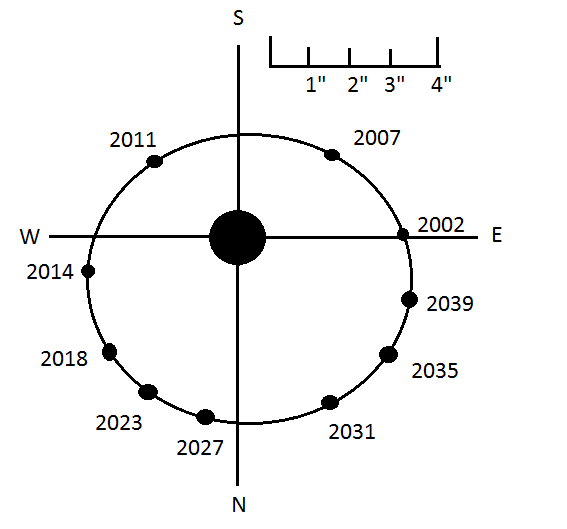
The apparent orbit of Procyon B through 2039. Graphic created by the author.

The apparent orbit of Procyon B through 2039. Graphic created by the author.
Procyon B: Located 11.5 light years distant, Procyon B was discovered in 1896 by John Martin Schaeberle from the Lick observatory. Shining at magnitude +10.7, the chief difficultly with spotting this white dwarf, as with Sirius B, is that it has a companion about 10 magnitudes – that’s 10,000 times brighter – nearby just 4.3” away.

Constellation: Canis Minor

Right Ascension: 7 hours 39’

Declination: +5 13’

Credit: Starry Night Education Software.

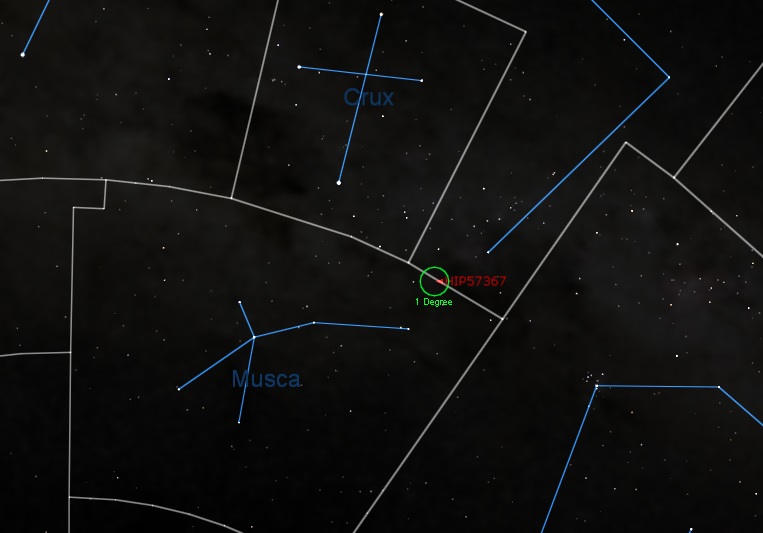
The location of GJ 440 (HIP 57367) in the southern sky. Credit: Starry Night Education Software.
-LP145-141: Also known as GJ 440, LP145-141 is one of the best southern hemisphere white dwarf stars on the list. LP145-141 is a solitary white dwarf shining at magnitude +11.5. Located 15 light years distant, LP145-141 is thought to be a member of the nearby Wolf 219 Moving Group of stars.

Constellation: Musca

Right Ascension: 11 Hours 46’

Declination: -64° 50’

Credit: Stellarium

The location of Van Maanen’s Star in the constellation Pisces. Credit: Stellarium
-Van Maanen’s Star: Shining at magnitude +12.4 and located 14.1 light years distant, Van Maanen’s star is the closest solitary white dwarf to Earth and the best example of a white dwarf for small telescopes. Discovered by Ariaan van Maanen in 1917, Van Maanen’s Star also has a very high proper motion of 3” per year.

Constellation: Pisces

Right Ascension: 00 Hours 49’

Declination: 05° 23’

Image by Author

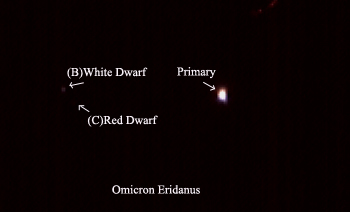
The 40 Omicron Eridani system. Image by Author
-40 Omicron Eridani B: This is a great one to track down. The triple system of 40 Omicron Eridani b contains a fine example of a red and white dwarf orbiting a main sequence star. Located 16.5 light years distant and shining at magnitude +9.5, Omicron Eridani was the first white dwarf star discovered in 1783 by Sir William Herschel, although its true nature wasn’t deduced until 1910. Omicron Eridani B is currently 82” from its primary, an easy split.

Constellation: Eridanus

Right Ascension: 4 Hours 15’

Declination: 7° 39’

-Stein 2051: Rounding off the list and located just over 18 light years distant, Stein 2051 is another example of a red dwarf/white dwarf pair. Stein 2051 b shines at a similar brightest to Van Maanen’s star at magnitude +12.4.

Constellation: Camelopardalis

Right Ascension: 04 Hours 31’

Declination: +58° 59’

Let us know about your trials and triumphs in hunting down these fascinating objects!

Tagged as:
nearest white dwarfs,
procyon b,
procyon b orbit,
Sirius B,
van maanens star,
white dwarf,
white dwarfs for amatuers
Distant Stellar Atmospheres Shed Light on How Jupiter-like Planets Form

Distant Stellar Atmospheres Shed Light on How Jupiter-like Planets Form:


Image Credit: NASA / R. J. Hall

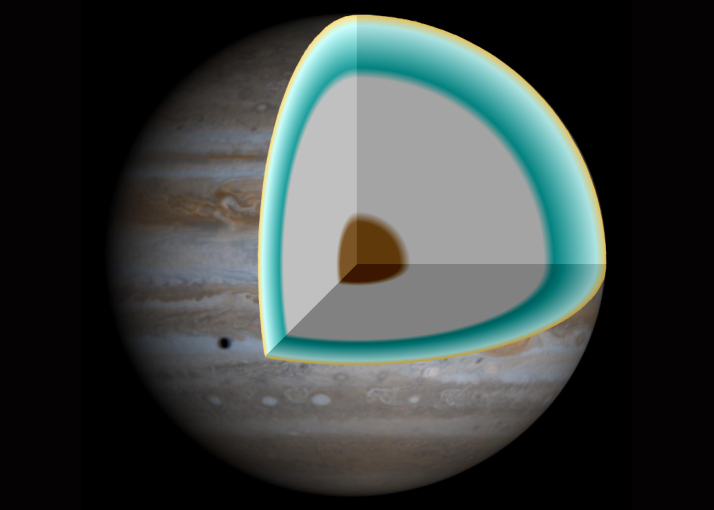
Jupiter’s rocky core. Image Credit: NASA / R. J. Hall
It’s likely that Jupiter-like planets’ origins root back to either the rapid collapse of a dense cloud or small rocky cores that glom together until the body is massive enough to accrete a gaseous envelope.

Although these two competing theories are both viable, astronomers have, for the first time, seen the latter “core accretion” theory in action. By studying the exoplanet’s host star they’ve shed light on the composition of the planet’s rocky core.

“Our results show that the formation of giant planets, as well as terrestrial planets like our own Earth, leaves subtle signatures in stellar atmospheres”, said lead author and PhD student Marcelo Tucci Maia from University of São Paulo, Brazil, in a press release.

Maia and colleagues pointed the 3.5-meter Canada-France-Hawaii Telescope toward the constellation Cygnus, in order to take a closer look at two Sun-like stars in the distant 16 Cyg triple-star system. Both stars, having formed together from the same gaseous disk over 10 billion years ago and having reached the same mass, are nearly solar twins.
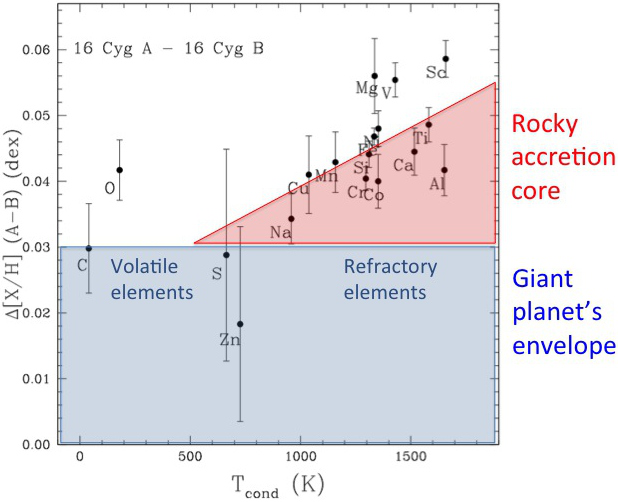
But only one star, 16 Cygni B, hosts a giant planet. By decomposing the light from the two stars into their wavelengths and looking at the difference between the two stars, the team was able to detect signatures left from the planet formation process on 16 Cygni B.

It’s the perfect laboratory to study the formation of giant planets.

Difference in chemical composition between the stars 16 Cyg A and 16 Cyg B, versus the condensation temperature of the elements in the proto-planetary nebula. If the stars had identical chemical compositions then the difference (A-B) would be zero. The star 16 Cyg A is richer in all elements relative to star 16 Cyg B. In other words, star 16 Cyg B, the host star of a giant planet, is deficient in all chemical elements, especially in the refractory elements (those with high condensation temperatures and that form dust grains more easily), suggesting evidence of a rocky core in the giant planet 16 Cyg Bb. Credits: M. Tucci Maia, J. Meléndez, I. Ramírez.

Difference in chemical composition between the stars 16 Cyg A and 16 Cyg B, versus the condensation temperature of the elements in the proto-planetary nebula. Image Credit: M. Tucci Maia, J. Meléndez, I. Ramírez.
Maia and colleagues found that the star 16 Cygni A is enhanced in all chemical elements relative to 16 Cygni B. Hence, the metals removed from 16 Cygni B were most likely removed from the protoplanetary disk in order to form the planet.

On top of the overall deficiency in all elements, 16 Cygni B has an added deficiency in the refractory elements — those with high condensation temperatures that form dust grains more easily — such as iron, aluminum, nickel, magnesium, scandium, and silicon. This helps verify what astronomers have expected all along: rocky cores are rich in refractory elements.

The team was able to decipher that these missing elements likely created a rocky core with a mass of about 1.5 to 6 Earth masses, which is similar to the estimate of Jupiter’s core.

“16 Cyg is a remarkable system, but certainly not unique,” said coauthor Ivan Ramírez from the University of Texas. “It is special because it is nearby; however, there are many other binary stars with twin components on which this experiment could be performed. This could help us find planet-host stars in binaries in a much more straightforward manner compared to all other planet-finding techniques we have available today.”

The results were accepted for publication in The Astrophysical Journal Letters and are available online.

Tagged as:
Core Accretion,
exoplanets,
Stellar Atmospheres

Astrophoto: Milky Way Rising Above Spectacular Lightning Display

Astrophoto: Milky Way Rising Above Spectacular Lightning Display:


The rise of the Milky Way and a spectacular lightning display in Mersing, Malaysia on June 28, 2014. Credit and copyright: Justin Ng.

The rise of the Milky Way and a spectacular lightning display in Mersing, Malaysia on June 28, 2014. Credit and copyright: Justin Ng.
Here’s another beautiful astrophoto, courtesy of photographer Justin Ng from Singapore. He’s currently on a photography trip to Malaysia and by chance captured this absolutely stunning view.

“Knowing that the sky would clear after sunset, I led a group of photographers to this location to film a time-lapse of the rising Milky Way above a lonely boat,” Justin explained via email, “but what happened soon after we started shooting was amazing. We were treated to a spectacular lightning display for about an hour from 9:30pm onwards before the clouds caught up with the rising Milky Way and dominated the skies eventually.”

The image is a result of stacking 12 photos (11 shots of lightnings and 1 shot for everything else) from his time-lapse sequence.

We’re looking forward to seeing the timelapse!

See more images from his current trip here, and you can see more of Justin’s fantastic astrophotography at his website, on G+, Facebook and Twitter.

Want to get your astrophoto featured on Universe Today? Join our Flickr group or send us your images by email (this means you’re giving us permission to post them). Please explain what’s in the picture, when you took it, the equipment you used, etc.

Tagged as:
Astrophotos,
Justin Ng,
lightning,
milky way

Dwarf Galaxies That Dance? Andromeda Observations Reveal A Larger Cosmic Mystery

Dwarf Galaxies That Dance? Andromeda Observations Reveal A Larger Cosmic Mystery:


Astrophoto: Andromeda Galaxy by Fabio Bortoli

Andromeda Galaxy. Credit: Fabio Bortoli
What is up with these dwarf galaxies? A survey of thousands of galaxies using the Sloan Digital Sky Survey reveals something interesting, which was first revealed by looking at the massive Andromeda Galaxy nearby Earth: dwarf galaxies orbiting larger ones are often in disc-shaped orbits and not distributed randomly, as astronomers expected.

The finding follows on from research in 2013 that showed that 50% of Andromeda’s dwarf galaxies are in a single plane about a million light-years in diameter, but only 300,000 light-years thick. Now with the larger discovery, scientists suspect that perhaps there is a yet-to-be found process that is controlling gas flow in the cosmos.

“We were surprised to find that a large proportion of pairs of satellite galaxies have oppositely directed velocities if they are situated on opposite sides of their giant galaxy hosts,” stated lead author Neil Ibata of Lycée International in France.

“Everywhere we looked, we saw this strangely coherent coordinated motion of dwarf galaxies,” added Geraint Lewis, a University of Sydney physicist. “From this we can extrapolate that these circular planes of dancing dwarfs are universal, seen in about 50 percent of galaxies. This is a big problem that contradicts our standard cosmological models. It challenges our understanding of how the universe works, including the nature of dark matter.”

The astronomers also speculated this could show something unexpected in the laws of physics, such as motion and gravity, but added it would take far more investigation to figure that out.

The findings were published in the journal Nature.

Source: University of Sydney

Tagged as:
Andromeda Galaxy,
dwarf galaxies,
dwarf galaxy,
M31,
Sloan Digital Sky Survey