Wednesday, August 6, 2014

Astrophoto: Kaleidoscopic View of Mars

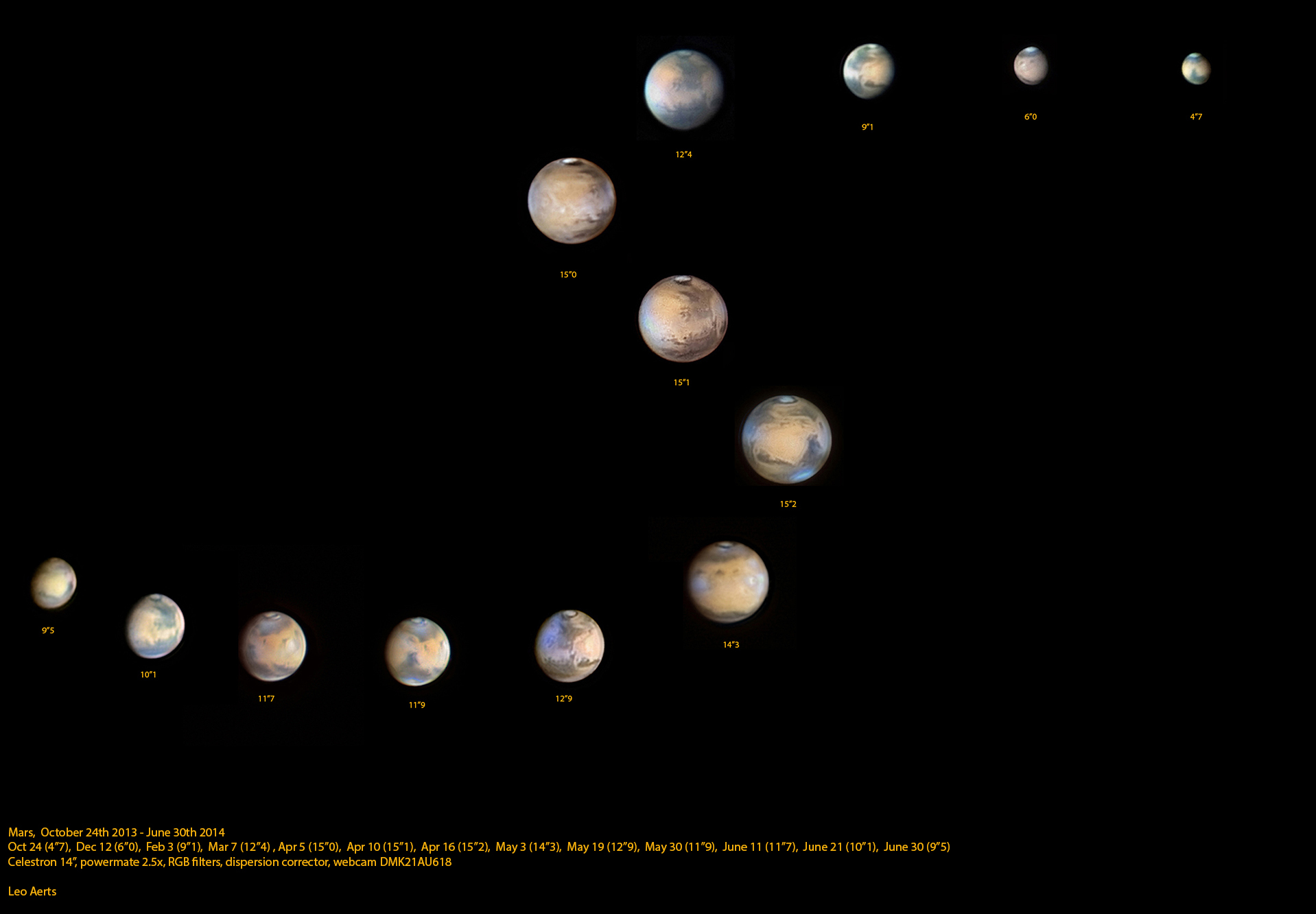
Astrophoto: Kaleidoscopic View of Mars:


8 months of Mars observations in a single image, from October 2013 ending end of June 2014. Credit and copyright: Leo Aerts.

8 months of Mars observations in a single image, from October 2013 ending end of June 2014. Credit and copyright: Leo Aerts.
Astrophotographer Leo Aerts from Belgium took advantage of the recent opposition of Mars and captured the Red Planet both “coming and going” in this montage of images taken from October 2013 to June of 2014. Mars reached opposition in April of this year, meaning it was closest to Earth, allowing for the brightest and best viewing.

Leo even shows the changing locations in the sky where Mars appeared across the months, allowing also for the apparent retrograde motion through Virgo during the months on either side of opposition.


Opposition of Mars (or any planet) means that planet and the Sun are on directly opposite sides of Earth. From our perspective on a spinning Earth, the other planet rises in the east just as the Sun sets in the west. Then, after staying up in the sky the entire night, the other planet sets in the west just as the Sun rises in the east.

Mars’ opposition happens about every 26 months. Opposition time is also a good time to send spacecraft to Mars, since our two planets are the closest, meaning less fuel (and time) will be needed to reach the planet. Hence, we’ve got two missions on their way to the Red Planet: MAVEN will arrive at Mars on September 21, 2014, and India’s Mars Orbiter Mission (MOM) will get there on September 24.

This year’s opposition was pretty close, but we’re currently on an improving trend: the next opposition in 2016 Mars will look even bigger and brighter and during the 2018 opposition, Mars will nearly be as close as it was in 2003.

Want to get your astrophoto featured on Universe Today? Join our Flickr group or send us your images by email (this means you’re giving us permission to post them). Please explain what’s in the picture, when you took it, the equipment you used, etc.

Tagged as:
Astrophotos,
Mars

First Exoplanet Discovered Beyond the “Snow Line”

First Exoplanet Discovered Beyond the “Snow Line”:


 This artist's conception shows the Uranus-sized exoplanet Kepler-421b, which orbits an orange, type K star about 1,000 light-years from Earth. Kepler-421b is the transiting exoplanet with the longest known year, circling its star once every 704 days. It is located beyond the "snow line" – the dividing line between rocky and gaseous planets – and might have formed in place rather than migrating from a different orbit. David A. Aguilar (CfA)

This artist’s conception shows the Uranus-size exoplanet Kepler-421b, which orbits an orange, type K star about 1,000 light-years from Earth. Image Credit: David A. Aguilar (CfA)
Data from NASA’s crippled Kepler space telescope has unleashed a windfall of hot Jupiters — sizzling gas giants that circle their host star within days — and only a handful of Earth-like planets. A quick analysis might make it seem as though hot Jupiters are far more common than their smaller and more distant counterparts.

But in large surveys, astronomers have to be careful of the observational biases introduced into their data. Kepler, for example, mainly finds broiling furnace worlds close to their host stars. These are easier to spot than small exoplanets that take hundreds of days to transit.

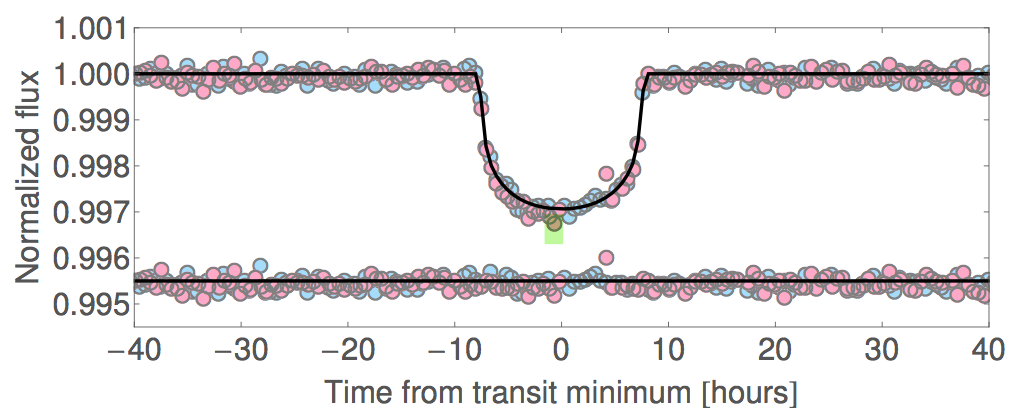
New data, however, shows a transiting exoplanet, Kepler-421b, with the longest known year, clocking in at 704 days.

“Finding Kepler-421b was a stroke of luck,” said lead author David Kipping from the Harvard-Smithsonian Center for Astrophysics in a press release. “The farther a planet is from its star, the less likely it is to transit the star from Earth’s point of view. It has to line up just right.”

Kepler-416b's folded light curve. Image Credit:

Kepler-421b’s folded light curve. Blue points are data from the first transit observed, and red points are the second transit.  Image Credit: Kipping et al.
Kepler-421b is roughly 4 times Earth’s girth and at least 60 times Earth’s mass. It circles its host star at about 1.2 times the distance from the Earth to the Sun. But because its host star is much smaller than our Sun, this places its orbit beyond the snow line — the dividing line between rocky and gas planets.

On Earth, snow lines typically form at high elevations where falling temperatures turn atmospheric moisture to snow. Similarly, in planetary systems, snow lines are thought to form in the distant, colder reaches of the stars’ disk.

Depending on the distance from the star, however, other more exotic molecules — such as carbon dioxide, methane, and carbon monoxide — can freeze and turn to snow. This forms a frost on dust grains: the building blocks of planets and comets.

“The snow line is a crucial distance in planet formation theory. We think all gas giants must have formed beyond this distance,” said Kipping.

The fact that this gas giant is still beyond this distance, roughly 4 billion years after formation, suggests that it’s the first non-migrating gas giant in a transiting system found.

Astronomers currently think gas giants form by small rocky cores that glom together until the body is massive enough to accrete a gaseous envelope. As they grow, they migrate inward, sometimes moving as close to their host star as Mercury is to the Sun.

Kepler-421b may be the first exoplanet discovered to have formed in situ. But further observations, especially those of its atmosphere, will help shed light on its formation history. Unfortunately given its long year, it won’t transit again until February, 2016.

The research has been accepted for publication in The Astrophysical Journal and is available online.

Tagged as:
Core Accretion Model,
exoplanets,
kepler space telescope,
snow line

Threatened Spitzer Telescope Gets NASA Nod For Extension, Subject To Congress Funding

Threatened Spitzer Telescope Gets NASA Nod For Extension, Subject To Congress Funding:


Artist's concept of NASA's Spitzer Space Telescope surrounded by examples of exoplanets it has looked at. Credit: NASA/JPL-Caltech

Artist’s concept of NASA’s Spitzer Space Telescope surrounded by examples of exoplanets it has looked at. Credit: NASA/JPL-Caltech
After NASA recommended in May that Spitzer space telescope officials send in a revised budget or face possible termination of operations, in a turnaround, the agency’s science mission directorate has now agreed to extend the mission for another two years.

The news broke on Twitter yesterday when the NASA Spitzer account shared the news. An update posted on its website said the decision is “subject to the availability of Congressional appropriations in FY [fiscal year] 2015″, but added that there will soon be a call out for observing time in that period.

Previously, NASA informed Spitzer officials that due to “constrained budget conditions” that their initial request to extend operations past fiscal 2015 was not approved, in line with recommendations from the NASA senior astrophysics review. While the mission was not terminated at that time, officials were asked to “respond with a request for a budget augmentation to conduct continued operations with reduced operations costs.”

The mission was being reviewed at the same time as other astrophysics missions, such as the Kepler planet-hunting space telescope that was asking for (and received) a new mission that would allow it to do useful science despite two busted reaction wheels, or pointing devices. The review said Spitzer was the most expensive of the missions reviewed, and that the telescope’s abilities were “significantly reduced” after it ran out of coolant in 2009.

The bow shock of Zeta Ophiuchi, another runaway star observed by Spitzer (NASA/JPL-Caltech)

The bow shock of Zeta Ophiuchi, another runaway star observed by Spitzer (NASA/JPL-Caltech)
In an update on the Spitzer website, officials shared more details but did not say if the budget had been reformulated in response to NASA’s suggestion.

We are very happy to report that Spitzer operations have been extended by the NASA Science Mission Directorate for two more years! The letter of direction states: “The Science Mission Directorate has made the decision to extend Spitzer operations for the next two years. The Spitzer observatory is an important resource for on-going infrared observations for research programs across the Science Mission Directorate, and, subject to the availability of Congressional appropriations in FY 2015, it will be continued. Both the Astrophysics and the Planetary Science Divisions have requested observing time commitments for FY 2015, and both Divisions have committed funding to support their observations.” We are working hard to get a call for observing proposals issued by the end of July. And thank you to all the people at NASA Headquarters and in the community that have worked so hard to support science with Spitzer.
In recent months, some of Spitzer’s work has included searching for targets for NASA’s asteroid mission, helping to find the coldest brown dwarf ever discovered, and assisting in challenging views about star cluster formation.

Tagged as:
nasa senior review

‘Lopsided’ Ghostly Galactic Halo Has Some Starry Surprises

‘Lopsided’ Ghostly Galactic Halo Has Some Starry Surprises:


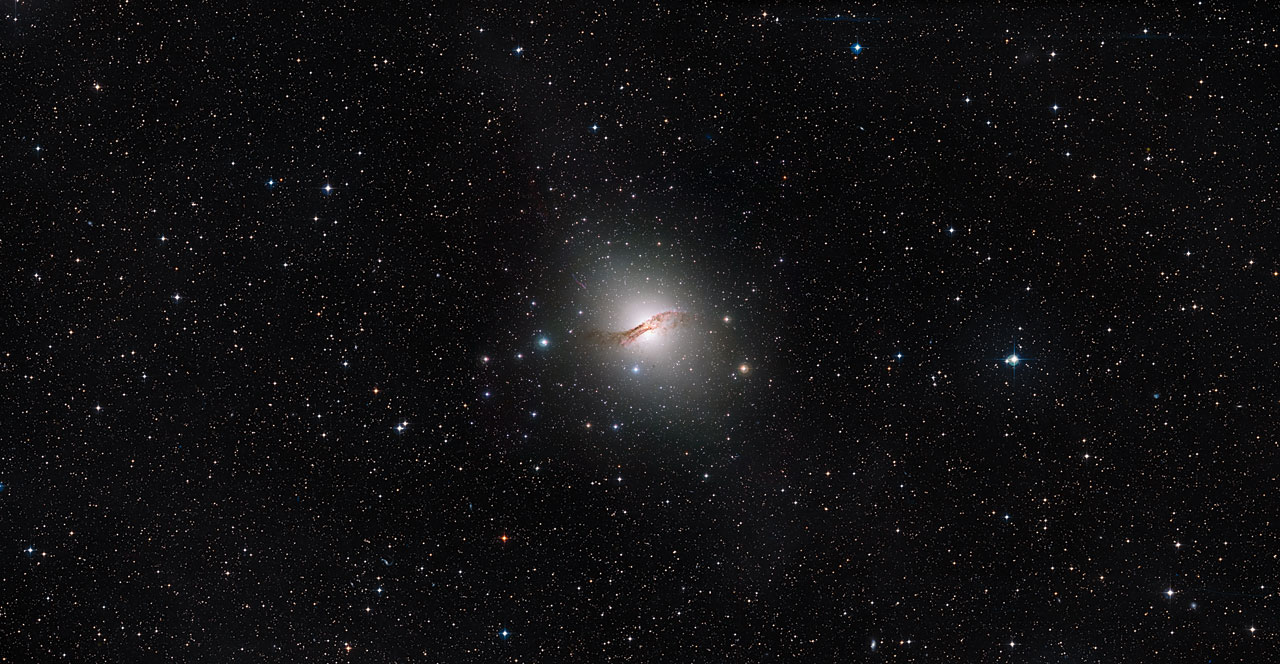
An image of Centaurus A. The halo goes across four degrees in the sky, about eight times the apparent width of the moon seen with the naked eye. The image was taken with the  Digitized Sky Survey 2 (DSS2), the MPG/ESO 2.2-metre telescope, and the NASA/ESA Hubble Space Telescope’s Advanced Camera for Surveys (ACS). Credit: ESA/Hubble, NASA, Digitized Sky Survey, MPG/ESO

An image of Centaurus A. The halo goes across four degrees in the sky, about eight times the apparent width of the moon seen with the naked eye. The image was taken with the Digitized Sky Survey 2 (DSS2), the MPG/ESO 2.2-metre telescope, and the NASA/ESA Hubble Space Telescope’s Advanced Camera for Surveys (ACS). Credit: ESA/Hubble, NASA, Digitized Sky Survey, MPG/ESO
Centaurus A — that popular target for astrophotographers in the southern hemisphere — has a much wider halo than expected, astronomers revealed. Turns out the galaxy’s ghostly glow is about eight times the apparent width of the full moon in the sky. Examining this halo in more detail could reveal much about how galaxies come together, astronomers said.

It’s relatively easy for scientists to spot the halo around the Milky Way since we are a part of it, but it’s much harder to observe them in other galaxies because they are so faint. Looking at Centaurus A (10 million to 16 million light-years away) required the power of two Hubble Space Telescope instruments: the Advanced Camera for Surveys and the Wide Field Camera 3.

“Tracing this much of a galaxy’s halo gives us surprising insights into a galaxy’s formation, evolution, and composition,” stated lead author Marina Rejkuba of the European Southern Observatory in Germany. “We found more stars scattered in one direction than the other, giving the halo a lopsided shape — which we hadn’t expected.”

The Centaurus A Extreme Deep Field. (Image Courtesy of Astrophotography byRolf Oslen. Used with Permision).

The Centaurus A Extreme Deep Field. (Image Courtesy of Astrophotography byRolf Oslen. Used with Permision).
The astronomers examined a region that is about 295,000 light-years across — more than double the diameter of the Milky Way’s 120,000 light years. The stars inside the glow appeared to have abundant heavier elements, even in the fringes of the galaxy — a contrast to the much lighter hydrogen and helium that are found in the fringes of the Milky Way and nearby spiral galaxies.

It’s possible the heavier stars arose because Centaurus A merged with a spiral galaxy long ago, removing stars from the intruder and sticking in Centaurus A, the astronomers said.

“Even at these extreme distances, we still haven’t reached the edge of Centaurus A’s halo, nor have we detected the very oldest generation of stars,” stated co-author Laura Greggio of Italy’s INAF (Istituto Nzaionale de Astrofisica, or National Institute for Astrophysics).

“This aged generation is very important. The larger stars from it are responsible for manufacturing the heavy elements now found in the bulk of the galaxy’s stars. And even though the large stars are long dead, the smaller stars of the generation still live on and could tell us a great deal.”

The results are available in Astrophysical Journal Letters and in preprint version on Arxiv.

Source: Hubble European Space Agency Information Centre

Tagged as:
centaurus A

Cosmic Fireworks: A Supernova Feast And Google+ Hangout For Chandra’s 15th Anniversary

Cosmic Fireworks: A Supernova Feast And Google+ Hangout For Chandra’s 15th Anniversary:


A collection of images from the Chandra X-Ray Observatory marking its 15th anniversary in space. Top, from left: the crab Nebula, supernova remnant G292.0+1.8 and the Crab Nebula. At bottom, supernova remnant 3C58. Credit: NASA/CXC/SAO

A collection of supernova remnant images from the Chandra X-Ray Observatory marking its 15th anniversary in space. Top, from left: the Crab Nebula, G292.0+1.8 and the Crab Nebula. At bottom, 3C58. Credit: NASA/CXC/SAO
It’s well past the Fourth of July, but you can still easily find fireworks in the sky if you look around. The Chandra X-Ray Observatory has been doing just that for the past 15 years, revealing what the universe looks like in these longer wavelengths that are invisible to human eyes.

Just in time for the birthday, NASA released four pictures that Chandra took of supernova (star explosion) remnants it has observed over the years. The pictures stand as a symbol of what the telescope has shown us so far.

“Chandra changed the way we do astronomy. It showed that precision observation of the X-rays from cosmic sources is critical to understanding what is going on,” stated Paul Hertz, NASA’s Astrophysics Division director, in a press release. “We’re fortunate we’ve had 15 years – so far – to use Chandra to advance our understanding of stars, galaxies, black holes, dark energy, and the origin of the elements necessary for life.”

The telescope launched into space in 1999 aboard the space shuttle and currently works at an altitude as high as 86,500 miles (139,000 miles). It is named after Indian-American astrophysicist Subrahmanyan Chandrasekhar; the name “Chandra” also means “moon” or “luminous” in Sanskrit.

And there’s more to come. You can learn more about Chandra’s greatest discoveries and its future in this Google+ Hangout, which will start at 3 p.m. EDT (7 p.m. EDT) at this link.

Split-Personality Pulsar Switches From Radio To Gamma-Rays

Split-Personality Pulsar Switches From Radio To Gamma-Rays:


Another snapshot of our strange universe: astronomers recently caught a pulsar — a particular kind of dense star — switch off its radio beacon while powerful gamma rays brightened fivefold.

“It’s almost as if someone flipped a switch, morphing the system from a lower-energy state to a higher-energy one,” stated lead researcher Benjamin Stappers, an astrophysicist at the University of Manchester, England.

“The change appears to reflect an erratic interaction between the pulsar and its companion, one that allows us an opportunity to explore a rare transitional phase in the life of this binary.”

The binary system includes pulsar J1023+0038 and another star that has a fifth of the mass of the sun. They’re close orbiting, spinning around each other every 4.8 hours. This means the companion’s days are numbered, because the pulsar is pulling it apart.


Artist’s conception of pulsar J1023 before (top) and after the radio beacon (visible in green) disappeared. Credit:
NASA’s Goddard Space Flight Center
In NASA’s words, here is what is going on:

In J1023, the stars are close enough that a stream of gas flows from the sun-like star toward the pulsar. The pulsar’s rapid rotation and intense magnetic field are responsible for both the radio beam and its powerful pulsar wind. When the radio beam is detectable, the pulsar wind holds back the companion’s gas stream, preventing it from approaching too closely. But now and then the stream surges, pushing its way closer to the pulsar and establishing an accretion disk.

Gas in the disk becomes compressed and heated, reaching temperatures hot enough to emit X-rays. Next, material along the inner edge of the disk quickly loses orbital energy and descends toward the pulsar. When it falls to an altitude of about 50 miles (80 km), processes involved in creating the radio beam are either shut down or, more likely, obscured.

The inner edge of the disk probably fluctuates considerably at this altitude. Some of it may become accelerated outward at nearly the speed of light, forming dual particle jets firing in opposite directions — a phenomenon more typically associated with accreting black holes. Shock waves within and along the periphery of these jets are a likely source of the bright gamma-ray emission detected by Fermi.
You can read more about the research in the Astrophysical Journal or in preprint version on Arxiv.

Source: NASA

Tagged as:
binary star,
J1023+0038,
Neutron Star,
pulsar

ESO’s La Silla Observatory Reveals Beautiful Star Cluster “Laboratory”

ESO’s La Silla Observatory Reveals Beautiful Star Cluster “Laboratory”:


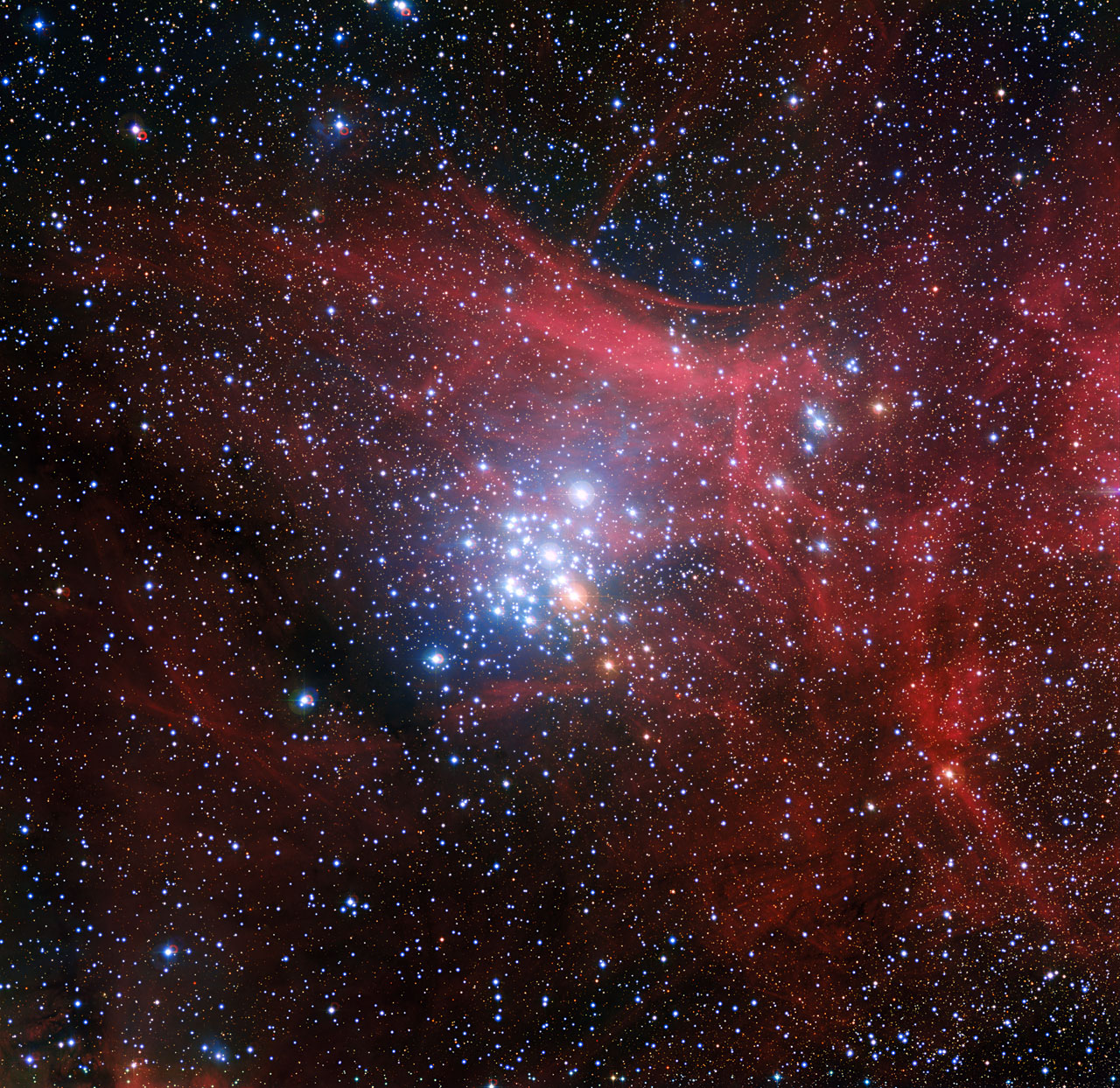
In this image from the Wide Field Imager on the MPG/ESO 2.2-metre telescope at ESO’s La Silla Observatory in Chile young stars huddle together against a backdrop of clouds of glowing gas and lanes of dust. The star cluster, known as NGC 3293, would have been just a cloud of gas and dust itself about ten million years ago, but as stars began to form it became the bright group we see here. Clusters like this are celestial laboratories that allow astronomers to learn more about how stars evolve. Credit: ESO/G. Beccari

In this image from the Wide Field Imager on the MPG/ESO 2.2-metre telescope at ESO’s La Silla Observatory in Chile young stars huddle together against a backdrop of clouds of glowing gas and lanes of dust. Image Credit: ESO / G. Beccari
Any human being knows the awe-inspiring wonder of a splash of stars against a dark backdrop. But it takes a skilled someone to truly appreciate a distant object viewed through an eyepiece. Your gut tightens as you realize that the tiny fuzzy blob is really thousands of light-years away.

That wave of amazement is encouraged by understanding and knowledge.

Stunning photographs of the cosmos further convey the beauty that arises form the simple interplay of dust, light and gas on absolutely massive and distant scales. The striking image above from ESO’s La Silla Observatory in Chile is but one example.

Stars are born in enormous clouds of gas and dust. Small pockets in these clouds collapse under the pull of gravity, eventually becoming so hot that they ignite nuclear fusion. The result is a cluster of tens to hundreds of thousands of stars bound together by their mutual gravitational attraction.

Every star in a cluster is roughly the same age and has the same chemical composition. They’re the closest thing astronomers have to a controlled laboratory environment.

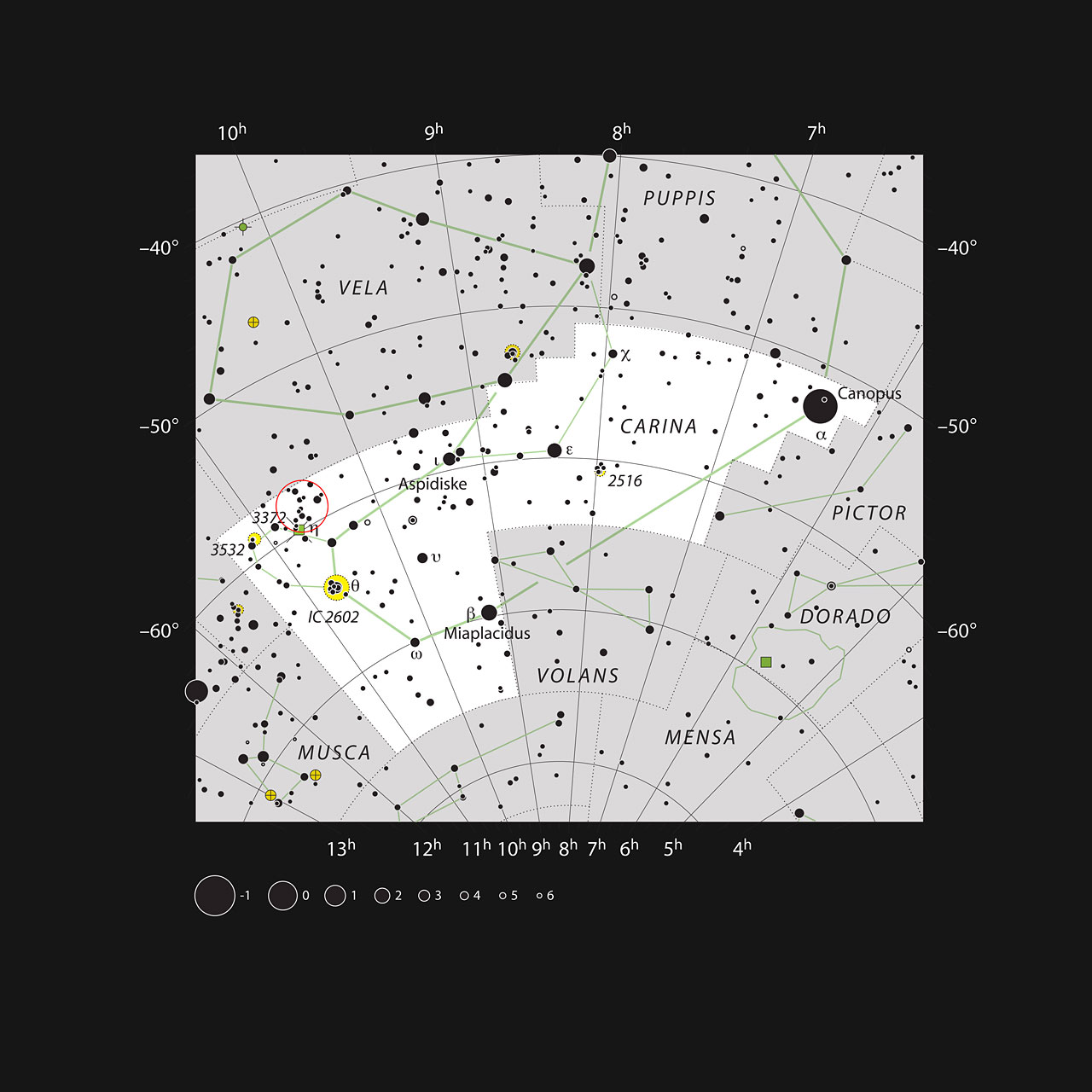
This chart shows the location of the bright open star cluster NGC 3293 in the southern constellation of Carina (The Keel). All the stars visible to the naked eye on a clear and dark night are marked, along with the positions of some nebulae and clusters. The location of NGC 3293 is marked with a red circle. This cluster is bright enough to be seen without optical aid in good conditions and is a spectacular sight in a moderate-sized telescope. Credit: ESO, IAU and Sky & Telescope

This chart shows the location of the bright open star cluster NGC 3293 (marked by a red circle) in the southern constellation of Carina. Image Credit: ESO / IAU / Sky & Telescope
The star cluster, NGC 3293, is located 8000 light-years from Earth in the constellation of Carina. It was first spotted by the French astronomer Nicolas-Louis de Lacaille during his stay in South Africa in 1751. Because it stands as one of the brightest clusters in the southern sky, de Lacaille was able to site it in a tiny telescope with an aperture of just 12 millimeters.

The cluster is less than 10 million years old, as can be seen by the abundance of hot, blue stars. Despite some evidence suggesting that there is still some ongoing star formation, it is thought that most, if not all, of the nearly 50 stars were born in one single event.

But even though these stars are all the same age, they do not all have the dazzling appearance of stars in their infancy. Some look positively elderly. The reason is simple: stars of different size, evolve at different speeds. More massive stars speed through their evolution, dying quickly, while less massive stars can live tens of billions of years.

Take the bright orange star at the bottom right of the cluster. Stars initially draw their energy from burning hydrogen into helium deep within their cores. But this star ran out of hydrogen fuel faster than its neighbors, and quickly evolved into a cool and bright, giant star with a contracted core but an extended atmosphere.

It’s now a cool, red giant, in a new stage of evolution, while its neighbors remain hot, young stars.

Eventually the star will collapse under its own gravity, throwing off its outer layers in a supernova explosion, and leaving behind a neutron star or a black hole. The peppering shock waves will likely initiate further star formation in the ever-changing laboratory.

Loading player…

Source: ESO

Tagged as:
ESO,
Open Star Clusters

Split-Personality Pulsar Switches From Radio To Gamma-Rays

Split-Personality Pulsar Switches From Radio To Gamma-Rays:


Another snapshot of our strange universe: astronomers recently caught a pulsar — a particular kind of dense star — switch off its radio beacon while powerful gamma rays brightened fivefold.

“It’s almost as if someone flipped a switch, morphing the system from a lower-energy state to a higher-energy one,” stated lead researcher Benjamin Stappers, an astrophysicist at the University of Manchester, England.

“The change appears to reflect an erratic interaction between the pulsar and its companion, one that allows us an opportunity to explore a rare transitional phase in the life of this binary.”

The binary system includes pulsar J1023+0038 and another star that has a fifth of the mass of the sun. They’re close orbiting, spinning around each other every 4.8 hours. This means the companion’s days are numbered, because the pulsar is pulling it apart.


Artist’s conception of pulsar J1023 before (top) and after the radio beacon (visible in green) disappeared. Credit:
NASA’s Goddard Space Flight Center
In NASA’s words, here is what is going on:

In J1023, the stars are close enough that a stream of gas flows from the sun-like star toward the pulsar. The pulsar’s rapid rotation and intense magnetic field are responsible for both the radio beam and its powerful pulsar wind. When the radio beam is detectable, the pulsar wind holds back the companion’s gas stream, preventing it from approaching too closely. But now and then the stream surges, pushing its way closer to the pulsar and establishing an accretion disk.

Gas in the disk becomes compressed and heated, reaching temperatures hot enough to emit X-rays. Next, material along the inner edge of the disk quickly loses orbital energy and descends toward the pulsar. When it falls to an altitude of about 50 miles (80 km), processes involved in creating the radio beam are either shut down or, more likely, obscured.

The inner edge of the disk probably fluctuates considerably at this altitude. Some of it may become accelerated outward at nearly the speed of light, forming dual particle jets firing in opposite directions — a phenomenon more typically associated with accreting black holes. Shock waves within and along the periphery of these jets are a likely source of the bright gamma-ray emission detected by Fermi.
You can read more about the research in the Astrophysical Journal or in preprint version on Arxiv.

Source: NASA

Tagged as:
binary star,
J1023+0038,
Neutron Star,
pulsar

Ultra-Deep Astrophoto: 75 Hours of the Antenna Galaxies

Ultra-Deep Astrophoto: 75 Hours of the Antenna Galaxies:


75 hours of observing time allows for this 'amateur' view of the Antennae galaxies in the constellation Corvus. Look closely to see the myriad of distant background galaxies that show up in the image, as well.  Credit and copyright:  Rolf Wahl Olsen.

75 hours of observing time allows for this ‘amateur’ view of the Antennae galaxies in the constellation Corvus. Look closely to see the myriad of distant background galaxies that show up in the image, as well. Credit and copyright: Rolf Wahl Olsen.
You might think the image above of the famous Antenna Galaxies was taken by a large ground-based or even a space telescope. Think again. Amateur astronomer Rolf Wahl Olsen from New Zealand compiled a total of 75 hours of observing time to create this ultra-deep view.

“To obtain a unique deep view of the faint tidal streams and numerous distant background galaxies I gathered 75 hours on this target during 38 nights from January to June 2014,” Rolf said via email. “At times it was rather frustrating because clouds kept interrupting my sessions.”

But he persisted, and the results are stunning.

He used his new 12.5″ f/4 Serrurier Truss Newtonian telescope, which he said gathers approximately 156% the amount of light over his old 10″ f/5 telescope.

Rolf even has put together comparison shots from the Hubble Space Telescope and the Very Large Telescope of the same field of view:


Comparison images from the Hubble Space Telescope and the Very Large Telescope, compared with the 75-hour ultra-deep image  by Rolf Wahl Olsen. Credit and copyright: Rolf Wahl Olsen.

Comparison images from the Hubble Space Telescope and the Very Large Telescope, compared with the 75-hour ultra-deep image by Rolf Wahl Olsen. Credit and copyright: Rolf Wahl Olsen.
And if you look even closer you can see an incredible field of distant background galaxies. “Apart from the Antennae itself, what I like most about this scene is the incredible number of distant background galaxies,” Rolf told Universe Today. “This area in Corvus seems very rich indeed. The full resolution image is worth having a look at just to see all these faint galaxies littering the background. There are many beautiful interacting pairs and groups which would be fantastic targets in themselves if they were only closer.”

Here’s a collage of some of the background galaxies that Rolf compiled:


A gallery of distant background galaxies in the same field of view as the Antenna Galaxies. Credit and copyright: Rolf Wahl Olsen.

A gallery of distant background galaxies in the same field of view as the Antenna Galaxies. Credit and copyright: Rolf Wahl Olsen.
See more of Rolf’s work at his website or on G+. You may remember that Rolf took the first amateur image of another solar system, at Beta Pictorus.

Want to get your astrophoto featured on Universe Today? Join our Flickr group or send us your images by email (this means you’re giving us permission to post them). Please explain what’s in the picture, when you took it, the equipment you used, etc.

Tagged as:
Antenna Galaxies,
Astrophotos,
Rolf Wahl Olsen

Hubble Finds 3 (Relatively) Dry Exoplanets, Raising Questions About Water Outside The Solar System

Hubble Finds 3 (Relatively) Dry Exoplanets, Raising Questions About Water Outside The Solar System:


Artist's conception of gas giant planet HD 209458b in the constellation Pegasus, which has less water vapor in its atmosphere than expected. Credit: NASA, ESA, G. Bacon (STScI) and N. Madhusudhan (UC)

Artist’s conception of gas giant planet HD 209458b in the constellation Pegasus, which has less water vapor in its atmosphere than expected. Credit: NASA, ESA, G. Bacon (STScI) and N. Madhusudhan (UC)
Surprise! Three planets believed to be good candidates for having water vapor in their atmosphere actually have much lower quantities than expected.

The planets (HD 189733b, HD 209458b, and WASP-12b) are “hot Jupiters” that are orbiting very close to their parent star, at a distance where it was expected the extreme temperatures would turn water into a vapor that could be seen from afar.

But observations of the planets with the Hubble Space Telescope, who have temperatures between 816 and 2,204 degrees Celsius (1,500 and 4,000 degrees Fahrenheit), show only a tenth to a thousandth of the water astronomers expected.

“Our water measurement in one of the planets, HD 209458b, is the highest-precision measurement of any chemical compound in a planet outside our solar system, and we can now say with much greater certainty than ever before that we’ve found water in an exoplanet,” stated Nikku Madhusudhan, an astrophysicist at the University of Cambridge, England who led the research. “However, the low water abundance we have found so far is quite astonishing.”

This finding, if confirmed by other observations, could force exoplanet formation theory to be revised and could even have implications for how much water is available in so-called “super-Earths”, rocky planets that are somewhat larger than our own, the astronomers said.

Kepler-62f, an exoplanet that is about 40% larger than Earth. It's located about 1,200 light-years from our solar system in the constellation Lyra. Credit: NASA/Ames/JPL-Caltech

Kepler-62f, an exoplanet that is about 40% larger than Earth. It’s located about 1,200 light-years from our solar system in the constellation Lyra. Credit: NASA/Ames/JPL-Caltech
That theory states that planets form over time as small dust particles stick to each other and grow into larger bodies. As it becomes a planet and takes on an atmosphere from surrounding gas bits, it’s believed that those elements should be “enhanced” in proportion to its star, especially in the case of oxygen. That oxygen in turn should be filled with water.

“We should be prepared for much lower water abundances than predicted when looking at super-Earths (rocky planets that are several times the mass of Earth),” Madhusudhan stated.

The research will be published today (July 24) in the Astrophysical Journal.

Source: NASA

Tagged as:
HD 189733b,
HD 209458b,
WASP-12b,
water

To Help Mars Rovers Phone Home, NASA Asks For Ideas To Close Looming Communications Gap

To Help Mars Rovers Phone Home, NASA Asks For Ideas To Close Looming Communications Gap:


Artist's conception of commercial satellites orbiting Mars and beaming information back to Earth. Credit: NASA/JPL-Caltech

Artist’s conception of commercial satellites orbiting Mars and beaming information back to Earth. Credit: NASA/JPL-Caltech
Remember during the government shutdown when it looked as though a NASA Mars mission would be delayed? Launch preparations continued because delaying the Mars Atmosphere and Volatile EvolutioN (MAVEN) spacecraft — which could have pushed its window back by years — would cause “imminent risk to life or property”, administrator Charles Bolden told Universe Today in November.

Both NASA’s Mars Reconnaissance Orbiter and Mars Odyssey currently provide a vital data link to send huge streams of information from the rovers on the surface, Opportunity and Curiosity. (And the Mars 2020 rover is coming up in a few years, too.) While both orbiters are working well, they are both well over their design lifetimes. MAVEN is now on its way to Mars and should get there in September.

MAVEN’s mission, however, is only designed to last for a year. While it could last longer, NASA is already thinking ahead for satellite backups — especially for the 2020s. And that could include commercial participation, according to a new request for information the agency put out this week.

“NASA has no scheduled Mars science orbiters after MAVEN arrives on the Red Planet in the fall,” the agency warned in a press release. “This creates the need to identify cost-effective options to ensure continuity of reliable, high-performance telecommunications relay services for the future.”

NASA’s Mars bound MAVEN spacecraft launches atop Atlas V booster at 1:28 p.m. EST from Space Launch Complex 41 at Cape Canaveral Air Force Station on Nov. 18, 2013. Image taken from the roof of the Vehicle Assembly Building (VAB) at NASA’s Kennedy Space Center.  Credit: Ken Kremer/kenkremer.com

NASA’s Mars bound MAVEN spacecraft launches atop Atlas V booster at 1:28 p.m. EST from Space Launch Complex 41 at Cape Canaveral Air Force Station on Nov. 18, 2013. Image taken from the roof of the Vehicle Assembly Building (VAB) at NASA’s Kennedy Space Center. Credit: Ken Kremer/kenkremer.com
The solicitation (which you can see here) proposes to have NASA purchase telecommunications services from some “commercial service provider” that would be responsible for operating and owning the satellites. This isn’t necessarily open only to industry, either. NASA says that organizations could include commercial providers, its own centers, universities, non-profits, federally funded research and development centers and even U.S. government and international organizations.

“We are looking to broaden participation in the exploration of Mars to include new models for government and commercial partnerships,” stated John Grunsfeld, associate administrator of NASA’s science mission directorate. “Depending on the outcome, the new model could be a vital component in future science missions and the path for humans to Mars.”

And it’s possible these orbiters could explore new technologies for Mars — specifically, laser/optical communications, which were used to great success on the Lunar Atmosphere and Dust Environment Explorer (LADEE) mission. And other laser missions are coming up. This could make it easier to send back movies from Mars as well as still pictures.

Source: NASA Jet Propulsion Laboratory

Tagged as:
mars 2020,
MAVEN,
Opportunity

Mapping Dark Matter 4.5 Billion Light-years Away

Mapping Dark Matter 4.5 Billion Light-years Away:


This image shows the galaxy MCS J0416.1–2403, one of six clusters targeted by the Hubble Frontier Fields programme. The blue in this image is a mass map created by using new Hubble observations combined with the magnifying power of a process known as gravitational lensing. In red is the hot gas detected by NASA’s Chandra X-Ray Observatory and shows the location of the gas, dust and stars in the cluster. The matter shown in blue that is separate from the red areas detected by Chandra consists of what is known as dark matter, and which can only be detected directly by gravitational lensing.Credit: ESA/Hubble, NASA, HST Frontier Fields. Acknowledgement: Mathilde Jauzac (Durham University, UK) and Jean-Paul Kneib (École Polytechnique Fédérale de Lausanne, Switzerland).

This image shows the galaxy cluster MCS J0416.1–2403. The blue is dark matter mapped in this study. Image Credit: ESA / Hubble, NASA
The Milky Way measures 100 to 120 thousand light-years across, a distance that defies imagination. But clusters of galaxies, which comprise hundreds to thousands of galaxies swarming under a collective gravitational pull, can span tens of millions of light-years.

These massive clusters are a complex interplay between colliding galaxies and dark matter. They seem impossible to map precisely. But now an international team of astronomers using the NASA/ESA Hubble Space Telescope has done exactly this — precisely mapping a galaxy cluster, dubbed MCS J0416.1–2403, 4.5 billion light-years away.

“Although we’ve known how to map the mass of a cluster using strong lensing for more than twenty years, it’s taken a long time to get telescopes that can make sufficiently deep and sharp observations, and for our models to become sophisticated enough for us to map, in such unprecedented detail, a system as complicated as MCS J0416.1–2403,” said coauthor Jean-Paul Kneib in a press release.

Measuring the amount and distribution of mass within distant objects can be extremely difficult. Especially when three quarters of all matter in the Universe is dark matter, which cannot be seen directly as it does not emit or reflect any light. It interacts only by gravity.

But luckily large clumps of matter warp and distort the fabric of space-time around them. Acting like lenses, they appear to magnify and bend light that travels past them from more distant objects.

This effect, known as gravitational lensing, is only visible in rare cases and can only be spotted by the largest telescopes. Even galaxy clusters, despite their massive size, produce minimal gravitational effects on their surroundings. For the most part they cause weak lensing, making even more distant sources appear as only slightly more elliptical across the sky.

However, when the alignment of the cluster and distant object is just right, the effects can be substantial. The background galaxies can be both brightened and transformed into rings and arcs of light, appearing several times in the same image. It is this effect, known as strong lensing, which helped astronomers map the mass distribution in MCS J0416.1–2403.

“The depth of the data lets us see very faint objects and has allowed us to identify more strongly lensed galaxies than ever before,” said lead author Dr Jauzac. “Even though strong lensing magnifies the background galaxies they are still very far away and very faint. The depth of these data means that we can identify incredibly distant background galaxies. We now know of more than four times as many strongly lensed galaxies in the cluster than we did before.”

Using Hubble’s Advanced Camera for Surveys, the astronomers identified 51 new multiply imaged galaxies around the cluster, quadrupling the number found in previous surveys. This effect has allowed Jauzac and her colleagues to calculate the distribution of visible and dark matter in the cluster and produce a highly constrained map of its mass.

The total mass within the cluster is 160 trillion times the mass of the Sun, with an uncertainty of 0.5%. It’s the most precise map ever produced.

But Jauzac and colleagues don’t plan on stopping here. An even more accurate picture of the galaxy cluster will have to include measurements from weak lensing as well. So the team will continue to study the cluster using ultra-deep Hubble imaging.

They will also use ground-based observatories to measure any shifts in galaxies’ spectra and therefore note the velocities of the contents of the cluster. Combining all measurements will not only further enhance the detail, but also provide a 3D model of the galaxies within the cluster, shedding light on its history and evolution.

This work has been accepted for publication in the Monthly Notices of the Royal Astronomy and is available online.

Tagged as:
Dark Matter,
galaxy cluster,
Gravitational Lensing

NASA preps for Nail-biting Comet Flyby of Mars

NASA preps for Nail-biting Comet Flyby of Mars:


This graphic depicts the orbit of comet C/2013 A1 Siding Spring as it swings around the sun in 2014. On Oct. 19, the comet will have a very close pass at Mars. Its nucleus will miss Mars by about 82,000 miles (132,000 kilometers). The comet's trail of dust particles shed by the nucleus might be wide enough to reach Mars or might also miss it. Credit: NASA/JPL

Simulation depicts comet C/2013 A1 Siding Spring during its close Mars flyby on Oct. 19. Its nucleus will miss Mars by about 82,000 miles (132,000 kilometers). The comet’s trail of dust particles shed by the nucleus might be wide enough to reach the planet. Click to see the interactive, animated view. Credit: Solarsystemscope.com
As Comet C/2013 A1 Siding Spring inches closer to the Red Planet, NASA’s taking steps to protect its fleet of orbiting Mars spacecraft. On October 19, the comet’s icy nucleus will miss the planet by just 82,000 miles (132,000 km). That’s 17 times closer than the closest recorded Earth-approaching comet, Lexell’s Comet in 1770.

Comet C/2013 A1 (Siding Spring) on July 11, 2014. The comet, discovered by comet hunter Rob McNaught from Siding Spring Observatory in New South Wales, Australia on January 3, 2013, shows a bright coma and well-developed tail. Credit: Joseph Brimacombe

Comet C/2013 A1 (Siding Spring) on July 11, 2014. The comet, discovered by comet hunter Robert McNaught from Siding Spring Observatory in New South Wales, Australia on January 3, 2013, shows a bright coma and well-developed tail. Credit: Joseph Brimacombe
No one’s worried about the tiny nucleus doing any damage. It’ll zip right by. Rather it’s dust particles embedded in vaporizing ice that concern NASA planners. Dust spreads into a broad tail that could potentially brush Mars’ upper atmosphere and strike an orbiter. A single particle of debris half a millimeter across may not seem like your mortal enemy, but when it’s traveling at 35 miles (56 km) per second relative to the spacecraft, one hit could spell trouble.

This graphic depicts the orbit of comet C/2013 A1 Siding Spring as it swings around the sun in 2014. On Oct. 19, the comet will have a very close pass at Mars. Its nucleus will miss Mars by about 82,000 miles (132,000 kilometers). The comet's trail of dust particles shed by the nucleus might be wide enough to reach Mars or might also miss it. Credit: NASA/JPL

The orbit of comet C/2013 A1 Siding Spring as it swings around the sun in 2014. NASA’s already begun moving the Mars orbiters toward safe positions in preparation for the upcoming flyby. Credit: NASA/JPL
“Three expert teams have modeled this comet for NASA and provided forecasts for its flyby of Mars,” explained Rich Zurek, chief scientist for the Mars Exploration Program at NASA’s Jet Propulsion Laboratory in Pasadena, California. “The hazard is not an impact of the comet nucleus, but the trail of debris coming from it. Using constraints provided by Earth-based observations, the modeling results indicate that the hazard is not as great as first anticipated. Mars will be right at the edge of the debris cloud, so it might encounter some of the particles — or it might not.”

The agency’s taking a prudent approach. NASA currently operates the Mars Reconnaissance Orbiter (MRO) and Mars Odyssey spacecraft with a third orbiter, MAVEN, currently on its way to the planet and expected to settle into orbit a month before the comet flyby. Teams operating the orbiters plan to have all spacecraft positioned on the opposite side of Mars when the comet is most likely to pass by.

Already, mission planners tweaked MRO’s orbit on July 2 to move it toward a safe position with a second maneuver to follow on August 27. A similar adjustment is planned for Mars Odyssey on August 5 and October 9 for the Mars Atmosphere and Volatile Evolution (MAVEN) probe. The time of greatest risk to the spacecraft is brief – about 20 minutes – when the widest part of the comet’s tail passes closest to the planet.

Will dust shed by the comet streak as meteors in the Martian sky on October 19?  The rovers will be watching. Credit: NASA/JPL

Will dust shed by the comet streak as meteors in the Martian sky on October 19? The rovers will be watching. Credit: NASA/JPL
One question I’m always asked is whether the Mars rovers are in any danger of dust-producing meteors in the comet’s wake. While the planet might get peppered with a meteor shower, its atmosphere is thick enough to incinerate cometary dust particles before they reach the surface, not unlike what happens during a typical meteor shower here on Earth. Rover cameras may be used to photograph the comet before the flyby and to capture meteors during the comet’s closest approach.

Despite concerns about dust, NASA knows a good opportunity when it sees one. In the days before and after the flyby, all three orbiters will conduct studies on the comet.

According to a recent NASA press release, instruments on MRO and Odyssey will examine the nucleus, coma and tail and possible effects on the Martian atmosphere:

Comet Siding Spring observed by the Spitzer Space Telescope in two wavelengths of infrared light in March 2014. The hint of blue-white corresponds to dust, red-orange to gas. Credit: NASA

Comet Siding Spring observed by the Spitzer Space Telescope in two wavelengths of infrared light in March 2014. The hint of blue-white corresponds to dust, red-orange to gas. Credit: NASA
“Odyssey will study thermal and spectral properties of the comet’s coma and tail. MRO will monitor Mars’ atmosphere for possible temperature increases and cloud formation, as well as changes in electron density at high altitudes and MAVEN will study gases coming off the comet’s nucleus as it’s warmed by the sun. The team anticipates this event will yield detailed views of the comet’s nucleus and potentially reveal its rotation rate and surface features.”

This is Comet Siding Spring’s first trip to the inner solar system. Expect exciting news as we peer up close at pristine ices and dust that have been locked in deep freeze since the time the planets formed.

For more information on the event, check out this NASA website devoted to the comet.

Tagged as:
C/2013 A1 Siding Spring,
comet,
Mars,
Mars Odyssey,
MAVEN,
MRO,
NASA
Stunning, Majestic New Timelapse from King’s Canyon and Sequoia National Parks

Stunning, Majestic New Timelapse from King’s Canyon and Sequoia National Parks:


A meteor streaks through the sky over Sequoia and Kings Canyon National Parks in California. Credit and copyright: Gavin Heffernan/Sunchaser Pictures.

A meteor streaks through the sky over Sequoia and Kings Canyon National Parks in California. Credit and copyright: Gavin Heffernan/Sunchaser Pictures.
Shooting the night sky from an area filled with canyons and towering trees might sound like a challenge, but Gavin Heffernan and his crew at Sunchaser Pictures have “majestically” succeeded with this new timelapse from Kings Canyon and Sequoia National Parks in California. They spent three days and two nights around the summer solstice, covering the 1,353 square miles of the two parks. They captured gorgeous night sky views, star trails, bright meteor streaks, and satellite passes — all framed by the magnificent landscape of the area.

“It was undoubtedly one of the most beautiful places I’ve ever seen, with incredible canyons, mountains, and vistas out of a fantasy novel,” Gavin told UT via email. “Far removed from any light pollution, the skies were equally stunning, with some epic milky ways, star trails, and the brightest meteor picture I’ve ever captured.” Image above — and see the new timelapse video below, with the meteor trails coming at 1:41 & 2:26:


Gavin said most night shots were captured with 25 second exposures on two Canon EOS 6D’s with a variety of wide, fast lenses, including a 24mm f1/4 and 28mm f1/8. The stunning star trails effect is created by tracing rotations of the Earth’s axis, using long exposures.

Star trails at dawn just as the Sun rises above the mountains in Kings Canyon. Credit and copyright: Gavin Heffernan.

Star trails at dawn just as the Sun rises above the mountains in Kings Canyon. Credit and copyright: Gavin Heffernan.
Find out more about this video on Vimeo and you can watch a “behind the scenes” video of what it took to make this video — including an encounter with a brown bear! — here.

KINGS from Sunchaser Pictures on Vimeo.

Tagged as:
Gavin Heffernan,
Kings Canyon and Sequoia National Parks,
meteors,
star trails,
Sunchaser Pictures,
Timelapse

Here’s Your Chance To Fund A Universe Today Project On The Pluto Planethood Debate

Here’s Your Chance To Fund A Universe Today Project On The Pluto Planethood Debate:


New Horizons

New Horizons spacecraft. Image Credit: NASA
This fall, Universe Today plans to get in-depth into the Pluto planethood debate. I (Elizabeth Howell) just launched a crowdfunding project on a new platform called Beacon that will allow me to fly down to Washington, D.C. for several days to interview Pluto scientists.

Should the project be funded, a few fun things are going to happen. Here, Universe Today readers will get a series of articles into the Pluto planethood debate. We’ll examine the controversial International Astronomical Union vote and why certain scientists still don’t believe Pluto is a dwarf planet today.

The question has special relevance today because NASA’s New Horizons spacecraft is on a journey to Pluto, and is less than a year from getting there. Examining Pluto will give scientists a window into how the solar system formed, which in turn gives us clues as to how the Earth came to be. We’ll have some stuff about the science as well; stay tuned for the details!

You’ll also get the chance to support astronomy education and outreach. I’m pleased to announce that Cosmoquest will be a partner on the project, receiving 15% of all proceeds for the project. If you contribute $250, $500 or $1,000, they will receive an additional 15% of your money. Contributors at this level will have their name mentioned in at least two of a series of six podcasts I will do for Cosmoquest’s 365 Days of Astronomy. There are other fun perks, too, so check out the Beacon page for more.

CosmoQuest-Logo-Full-sm3

As a freelance journalist, my challenge with doing travel stories is I have to pay my own way. Beacon solves that problem. It will allow me to spend a few days in person with scientists, gathering pictures and videos and podcasts, instead of relying on the phone interviews I usually conduct.

After paying contributions to Cosmoquest and to Beacon, every single cent remaining will be for travel expenses only. The money will give me a flight to Washington, D.C., a few nights in a reasonable hotel, and a car rental. I promise you that I’m extremely frugal — ask my mortgage broker — and I will spend every dollar of your contributions wisely. Additional money after $2,400 will allow me to draw a salary for the days I am there. If a substantial amount of extra money is raised, I’ll consider a second trip to D.C.

A NASA "poster" marking the one year to Pluto encounter by New Horizons. Credit: NASA

A NASA “poster” marking the one year to Pluto encounter by New Horizons. Credit: NASA
I’m not one to brag about my experience, but I will say that I’ve been proudly writing about space for a decade for many publications (including Universe Today). I’m one of the few journalists in Canada to focus on space virtually full-time. And I have covered some fun stories, such as three shuttle launches (2009-10), Chris Hadfield’s last mission (2012-13) and participating in a simulated Mars mission in Utah (early 2014). I see space as a field where I can always learn more, and this will be a great chance to share what I learn about Pluto with you.

Any questions? Feel free to get in touch with me at contact AT elizabethhowell DOT ca or to leave comments below. I likely won’t be able to respond until tomorrow as this launch coincidentally falls on a planned vacation day for me, but I promise that for the rest of the campaign I’ll answer your queries as fast as I can.

Tagged as:
beacon,
CosmoQuest,
is pluto a planet,
pluto planethood

Here’s Your Chance To Fund A Universe Today Project On The Pluto Planethood Debate

Here’s Your Chance To Fund A Universe Today Project On The Pluto Planethood Debate:


New Horizons

New Horizons spacecraft. Image Credit: NASA
This fall, Universe Today plans to get in-depth into the Pluto planethood debate. I (Elizabeth Howell) just launched a crowdfunding project on a new platform called Beacon that will allow me to fly down to Washington, D.C. for several days to interview Pluto scientists.

Should the project be funded, a few fun things are going to happen. Here, Universe Today readers will get a series of articles into the Pluto planethood debate. We’ll examine the controversial International Astronomical Union vote and why certain scientists still don’t believe Pluto is a dwarf planet today.

The question has special relevance today because NASA’s New Horizons spacecraft is on a journey to Pluto, and is less than a year from getting there. Examining Pluto will give scientists a window into how the solar system formed, which in turn gives us clues as to how the Earth came to be. We’ll have some stuff about the science as well; stay tuned for the details!

You’ll also get the chance to support astronomy education and outreach. I’m pleased to announce that Cosmoquest will be a partner on the project, receiving 15% of all proceeds for the project. If you contribute $250, $500 or $1,000, they will receive an additional 15% of your money. Contributors at this level will have their name mentioned in at least two of a series of six podcasts I will do for Cosmoquest’s 365 Days of Astronomy. There are other fun perks, too, so check out the Beacon page for more.

CosmoQuest-Logo-Full-sm3

As a freelance journalist, my challenge with doing travel stories is I have to pay my own way. Beacon solves that problem. It will allow me to spend a few days in person with scientists, gathering pictures and videos and podcasts, instead of relying on the phone interviews I usually conduct.

After paying contributions to Cosmoquest and to Beacon, every single cent remaining will be for travel expenses only. The money will give me a flight to Washington, D.C., a few nights in a reasonable hotel, and a car rental. I promise you that I’m extremely frugal — ask my mortgage broker — and I will spend every dollar of your contributions wisely. Additional money after $2,400 will allow me to draw a salary for the days I am there. If a substantial amount of extra money is raised, I’ll consider a second trip to D.C.

A NASA "poster" marking the one year to Pluto encounter by New Horizons. Credit: NASA

A NASA “poster” marking the one year to Pluto encounter by New Horizons. Credit: NASA
I’m not one to brag about my experience, but I will say that I’ve been proudly writing about space for a decade for many publications (including Universe Today). I’m one of the few journalists in Canada to focus on space virtually full-time. And I have covered some fun stories, such as three shuttle launches (2009-10), Chris Hadfield’s last mission (2012-13) and participating in a simulated Mars mission in Utah (early 2014). I see space as a field where I can always learn more, and this will be a great chance to share what I learn about Pluto with you.

Any questions? Feel free to get in touch with me at contact AT elizabethhowell DOT ca or to leave comments below. I likely won’t be able to respond until tomorrow as this launch coincidentally falls on a planned vacation day for me, but I promise that for the rest of the campaign I’ll answer your queries as fast as I can.

Tagged as:
beacon,
CosmoQuest,
is pluto a planet,
pluto planethood