Wednesday, August 6, 2014

Deep Astrophoto of LDN 673: The Place Where Stars are Born

Deep Astrophoto of LDN 673: The Place Where Stars are Born:


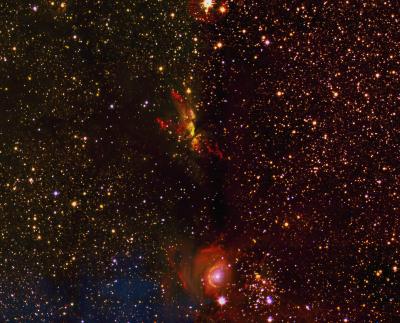
LDN 673, a molecular cloud complex in the constellation Aquila. Credit and copyright: Callum Hayton.

LDN 673, a molecular cloud complex in the constellation Aquila. Credit and copyright: Callum Hayton.
What a stunning view of this dark region of space! This image, by astrophotographer Callum Hayton shows LDN 673, a molecular cloud complex that lies in the constellation Aquila. This region is massive — around 67 trillion kilometers (42 trillion miles across), and it is between 300-600 light years from Earth. Observers in the northern hemisphere can find this region in the summer skies near the bright star Altair and the Summer Triangle.

Because the cloud lies on the galactic plane, the dark dust is back-lit by millions of stars in the Milky Way galaxy. This dusty cloud likely contains enough raw material to form hundreds of thousands of stars. Hayton explained on Flickr how the dust gets “eroded” away by stellar formation:

“When some of these clouds reach a certain mass they begin to collapse and fragment creating protostars,” Hayton wrote. “As the temperature and pressure at the centre of the protostar rises, sometimes it becomes so great that nuclear fusion begins and a star is born. In this image you can see where at least two young stars have eroded the dust around them and are now above the clouds casting light down on to the dust below.”

Gorgeous!

Want to get your astrophoto featured on Universe Today? Join our Flickr group or send us your images by email (this means you’re giving us permission to post them). Please explain what’s in the picture, when you took it, the equipment you used, etc.

Tagged as:
LDN 673,
molecular clouds,
stellar evolution

New Image Captures one of the Brightest Volcanoes Ever Seen in the Solar System

New Image Captures one of the Brightest Volcanoes Ever Seen in the Solar System:


Image of Io taken in the near-infrared with adaptive optics at the Gemini North telescope on August 29. In addition to the extremely bright eruption on the upper right limb of the satellite, the lava lake Loki is visible in the middle of Io’s disk, as well as the fading eruption that was detected earlier in the month by de Pater on the southern (bottom) limb. Io is about one arcsecond across. Image credit: Katherine de Kleer/UC Berkeley/Gemini Observatory/AURA

Image of Io taken in the near-infrared at the Gemini North telescope on August 29. In addition to the extremely bright eruption on the upper right limb of the satellite, the lava lake Loki is visible in the middle of Io’s disk, as well as the fading eruption that was detected earlier in the month by de Pater on the southern (bottom) limb. Image credit: Katherine de Kleer / UC Berkeley / Gemini Observatory / AURA
Jupiter’s innermost moon, Io — with over 400 active volcanoes, extensive lava flows and floodplains of liquid rock — is by far the most geologically active body in the Solar System. But last August, Io truly came alive with volcanism.

Three massive volcanic eruptions led astronomers to speculate that these presumed rare outbursts were much more common than previously thought. Now, an image from the Gemini Observatory captures what is one of the brightest volcanoes ever seen in our Solar System.

“We typically expect one huge outburst every one or two years, and they’re usually not this bright,” said lead author Imke de Pater from the University of California, Berkeley, in a press release. In fact, only 13 large eruptions were observed between 1978 and 2006. “Here we had three extremely bright outbursts, which suggest that if we looked more frequently we might see many more of them on Io.”

De Pater discovered the first two eruptions on August 15, 2013, from the W. M. Keck Observatory in Hawaii. The brightest was calculated to have produced a 50 square-mile, 30-feet thick lava flow, while the other produced flows covering 120 square miles. Both were nearly gone when imaged days later.

The third and even brighter eruption was discovered on August 29, 2013, at the Gemini observatory by UC Berkeley graduate student Katherine de Kleer. It was the first of a series of observations monitoring Io.

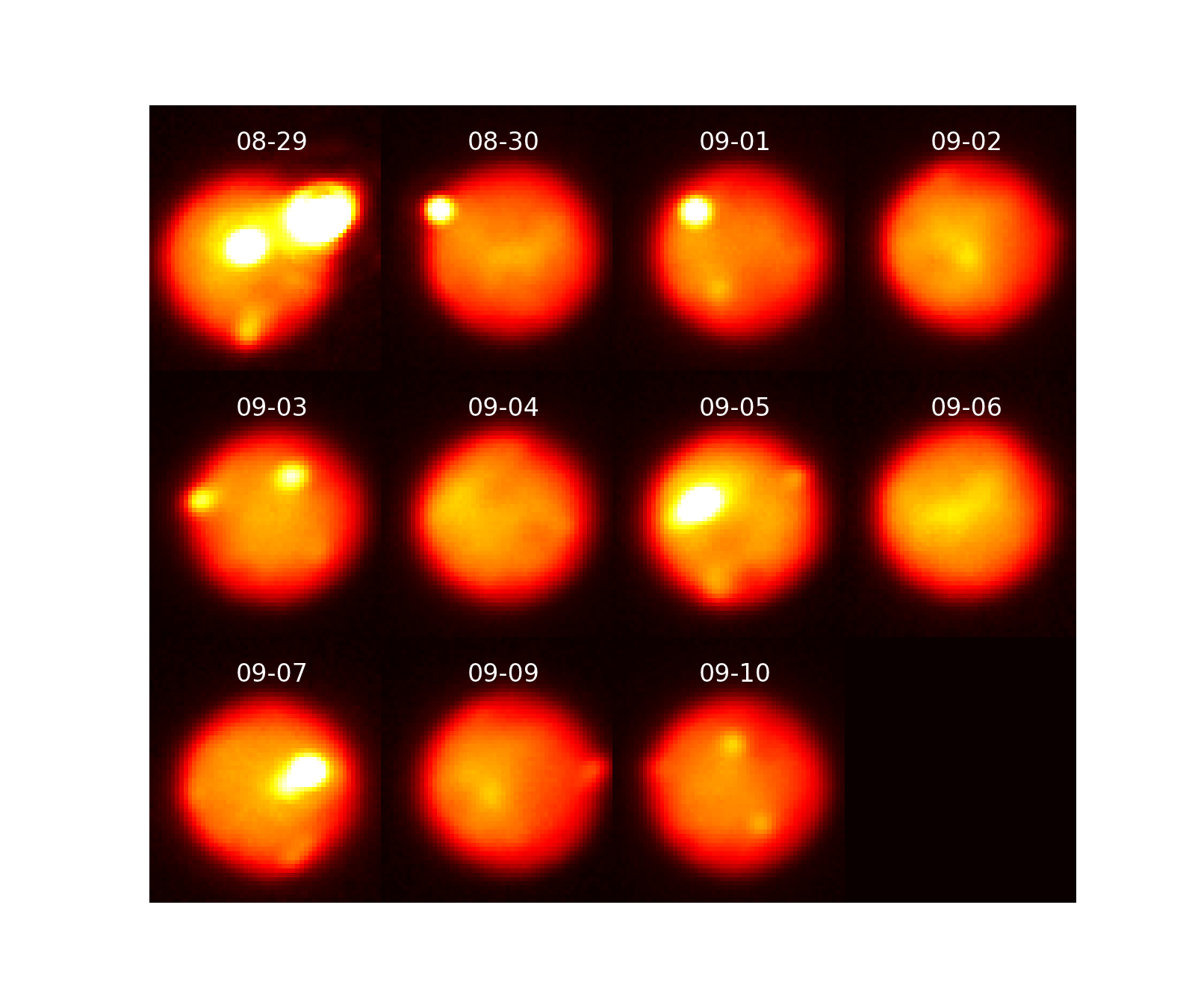
Images of Io taken in the near-infrared with adaptive optics at the Gemini North telescope tracking the evolution of the eruption as it decreased in intensity over 12 days. Due to Io’s rapid rotation, a different area of the surface is viewed on each night; the outburst is visible with diminishing brightness on August 29 & 30 and September 1, 3, & 10. Image credit: Katherine de Kleer/UC Berkeley/Gemini Observatory/AURA

Images of Io tracking the evolution of the eruption as it decreased in intensity over 12 days. Due to Io’s rapid rotation, a different area of the surface is viewed on each night; the outburst is visible with diminishing brightness on August 29 & 30 and September 1, 3, & 10. Image credit: Katherine de Kleer / UC Berkeley / Gemini Observatory / AURA
De Kleer and colleagues were able to track the heat of the third outburst for almost two weeks after its discovery. The team timed observations from Gemini and NASA’s nearby Infrared Telescope Facility to coincide with observations by the Japanese HISAKI spacecraft.

This allowed the observations to “represent the best day-by-day coverage of such an eruption,” said de Kleer. The team was able to conclude that the energy emitted from the late-August eruption was about 20 Terawatts, and expelled many cubic kilometers of lava.

“At the time we observed the event, an area of newly-exposed lava on the order of tens of square kilometers was visible,” said de Kleer. “We believe that it erupted in fountains from long fissures on Io’s surface, which were over ten-thousand-times more powerful than the lava fountains during the 2010 eruption of Eyjafjallajokull, Iceland, for example.”

The team hopes that monitoring Io’s surface annually will reveal the style of volcanic eruptions on the moon, the composition of the magma, and the spatial distribution of the heat flows. The eruptions may also shed light on an early Earth, when heat from the decay of radioactive elements — as opposed to the tidal forces influencing Io — created exotic, high-temperature lavas.

“We are using Io as a volcanic laboratory, where we can look back into the past of the terrestrial planets to get a better understanding of how these large eruptions took place, and how fast and how long they lasted,” said coauthor Ashley Davies.

The latest results have been published in the journal Icarus.

Tagged as:
Io,
Solar System,
volcanoes

Can A ‘Planet-Like Object’ Start Its Life Blazing As Hot As A Star?

Can A ‘Planet-Like Object’ Start Its Life Blazing As Hot As A Star?:


How WISE 70304-2705 could have evolved from a star to a "planet-like object". Credit: John Pinfield,

How WISE 70304-2705 could have evolved from a star to a “planet-like object”. Credit: John Pinfield,
Nature once again shows us how hard it is to fit astronomical objects into categories. An examination of a so-far unique brown dwarf — an object that is a little too small to start nuclear fusion and be a star — shows that it could have been as hot as a star in the ancient past.

The object is one of a handful of brown dwarfs that are called “Y dwarfs”. This is the coolest kind of star or star-like object we know of. These objects have been observed at least as far back as 2008, although they were predicted by theory before.

A group of scientists observed the object, called WISE J0304-2705, with NASA’s space-based Wide-field Infrared Survey Explorer (WISE). Looking at the spectrum of light it had emitted, which shows the object’s composition, has scientists saying that what the brown dwarf is made of suggests it is rather old — billions of years old.

“Our measurements suggest that this Y dwarf may have a composition … or age characteristic of one of the galaxy’s older members,” stated David Pinfield at the University of Hertfordshire, who led the research.

“This would mean its temperature evolution could have been rather extreme – despite starting out at thousands of degrees, this exotic object is now barely hot enough to boil a cup of tea.”

Size comparison of stellar vs substellar objects. (Credit: NASA/JPL-Caltech/UCB).

Size comparison of stellar vs substellar objects. (Credit: NASA/JPL-Caltech/UCB).
While the object started out hot, its interior never was quite enough to fuse hydrogen. That led to the extreme cooling visible today.

Models suggest the object would have begun its life shining at 2,800 degrees Celsius (5,072 Fahrenheit), for a phase that would have lasted for 20 million years. In the next 100 million years, its temperature would have almost halved to 1,500 Celsius (2,730 Fahrenheit).

And it would have kept cooling, with a temperature of 1,000 Celsius (1,832 Fahrenheit) after a billion years, and after billions of more years, the temperature we see today — somewhere between 100 Celsius (212 Fahrenheit) and 150 Celsius (302 Fahrenheit).

The paper will be published shortly in the Monthly Notices of the Royal Astronomical Society. The research is available in preprint version on Arxiv. One limitation of the research is the small number of Y dwarfs discovered, only about 20, which means that more observations will be needed to see if other objects could have had this same evolution.

Source: Royal Astronomical Society

Tagged as:
brown dwarf,
WISE

Sunday, August 3, 2014

NASA preps for Nail-biting Comet Flyby of Mars

NASA preps for Nail-biting Comet Flyby of Mars:


This graphic depicts the orbit of comet C/2013 A1 Siding Spring as it swings around the sun in 2014. On Oct. 19, the comet will have a very close pass at Mars. Its nucleus will miss Mars by about 82,000 miles (132,000 kilometers). The comet's trail of dust particles shed by the nucleus might be wide enough to reach Mars or might also miss it. Credit: NASA/JPL

Simulation depicts comet C/2013 A1 Siding Spring during its close Mars flyby on Oct. 19. Its nucleus will miss Mars by about 82,000 miles (132,000 kilometers). The comet’s trail of dust particles shed by the nucleus might be wide enough to reach the planet. Click to see the interactive, animated view. Credit: Solarsystemscope.com
As Comet C/2013 A1 Siding Spring inches closer to the Red Planet, NASA’s taking steps to protect its fleet of orbiting Mars spacecraft. On October 19, the comet’s icy nucleus will miss the planet by just 82,000 miles (132,000 km). That’s 17 times closer than the closest recorded Earth-approaching comet, Lexell’s Comet in 1770.

Comet C/2013 A1 (Siding Spring) on July 11, 2014. The comet, discovered by comet hunter Rob McNaught from Siding Spring Observatory in New South Wales, Australia on January 3, 2013, shows a bright coma and well-developed tail. Credit: Joseph Brimacombe

Comet C/2013 A1 (Siding Spring) on July 11, 2014. The comet, discovered by comet hunter Robert McNaught from Siding Spring Observatory in New South Wales, Australia on January 3, 2013, shows a bright coma and well-developed tail. Credit: Joseph Brimacombe
No one’s worried about the tiny nucleus doing any damage. It’ll zip right by. Rather it’s dust particles embedded in vaporizing ice that concern NASA planners. Dust spreads into a broad tail that could potentially brush Mars’ upper atmosphere and strike an orbiter. A single particle of debris half a millimeter across may not seem like your mortal enemy, but when it’s traveling at 35 miles (56 km) per second relative to the spacecraft, one hit could spell trouble.

This graphic depicts the orbit of comet C/2013 A1 Siding Spring as it swings around the sun in 2014. On Oct. 19, the comet will have a very close pass at Mars. Its nucleus will miss Mars by about 82,000 miles (132,000 kilometers). The comet's trail of dust particles shed by the nucleus might be wide enough to reach Mars or might also miss it. Credit: NASA/JPL

The orbit of comet C/2013 A1 Siding Spring as it swings around the sun in 2014. NASA’s already begun moving the Mars orbiters toward safe positions in preparation for the upcoming flyby. Credit: NASA/JPL
“Three expert teams have modeled this comet for NASA and provided forecasts for its flyby of Mars,” explained Rich Zurek, chief scientist for the Mars Exploration Program at NASA’s Jet Propulsion Laboratory in Pasadena, California. “The hazard is not an impact of the comet nucleus, but the trail of debris coming from it. Using constraints provided by Earth-based observations, the modeling results indicate that the hazard is not as great as first anticipated. Mars will be right at the edge of the debris cloud, so it might encounter some of the particles — or it might not.”

The agency’s taking a prudent approach. NASA currently operates the Mars Reconnaissance Orbiter (MRO) and Mars Odyssey spacecraft with a third orbiter, MAVEN, currently on its way to the planet and expected to settle into orbit a month before the comet flyby. Teams operating the orbiters plan to have all spacecraft positioned on the opposite side of Mars when the comet is most likely to pass by.

Already, mission planners tweaked MRO’s orbit on July 2 to move it toward a safe position with a second maneuver to follow on August 27. A similar adjustment is planned for Mars Odyssey on August 5 and October 9 for the Mars Atmosphere and Volatile Evolution (MAVEN) probe. The time of greatest risk to the spacecraft is brief – about 20 minutes – when the widest part of the comet’s tail passes closest to the planet.

Will dust shed by the comet streak as meteors in the Martian sky on October 19?  The rovers will be watching. Credit: NASA/JPL

Will dust shed by the comet streak as meteors in the Martian sky on October 19? The rovers will be watching. Credit: NASA/JPL
One question I’m always asked is whether the Mars rovers are in any danger of dust-producing meteors in the comet’s wake. While the planet might get peppered with a meteor shower, its atmosphere is thick enough to incinerate cometary dust particles before they reach the surface, not unlike what happens during a typical meteor shower here on Earth. Rover cameras may be used to photograph the comet before the flyby and to capture meteors during the comet’s closest approach.

Despite concerns about dust, NASA knows a good opportunity when it sees one. In the days before and after the flyby, all three orbiters will conduct studies on the comet.

According to a recent NASA press release, instruments on MRO and Odyssey will examine the nucleus, coma and tail and possible effects on the Martian atmosphere:

Comet Siding Spring observed by the Spitzer Space Telescope in two wavelengths of infrared light in March 2014. The hint of blue-white corresponds to dust, red-orange to gas. Credit: NASA

Comet Siding Spring observed by the Spitzer Space Telescope in two wavelengths of infrared light in March 2014. The hint of blue-white corresponds to dust, red-orange to gas. Credit: NASA
“Odyssey will study thermal and spectral properties of the comet’s coma and tail. MRO will monitor Mars’ atmosphere for possible temperature increases and cloud formation, as well as changes in electron density at high altitudes and MAVEN will study gases coming off the comet’s nucleus as it’s warmed by the sun. The team anticipates this event will yield detailed views of the comet’s nucleus and potentially reveal its rotation rate and surface features.”

This is Comet Siding Spring’s first trip to the inner solar system. Expect exciting news as we peer up close at pristine ices and dust that have been locked in deep freeze since the time the planets formed.

For more information on the event, check out this NASA website devoted to the comet.

Tagged as:
C/2013 A1 Siding Spring,
comet,
Mars,
Mars Odyssey,
MAVEN,
MRO,
NASA

Comet Jacques Makes a ‘Questionable’ Appearance

Comet Jacques Makes a ‘Questionable’ Appearance:


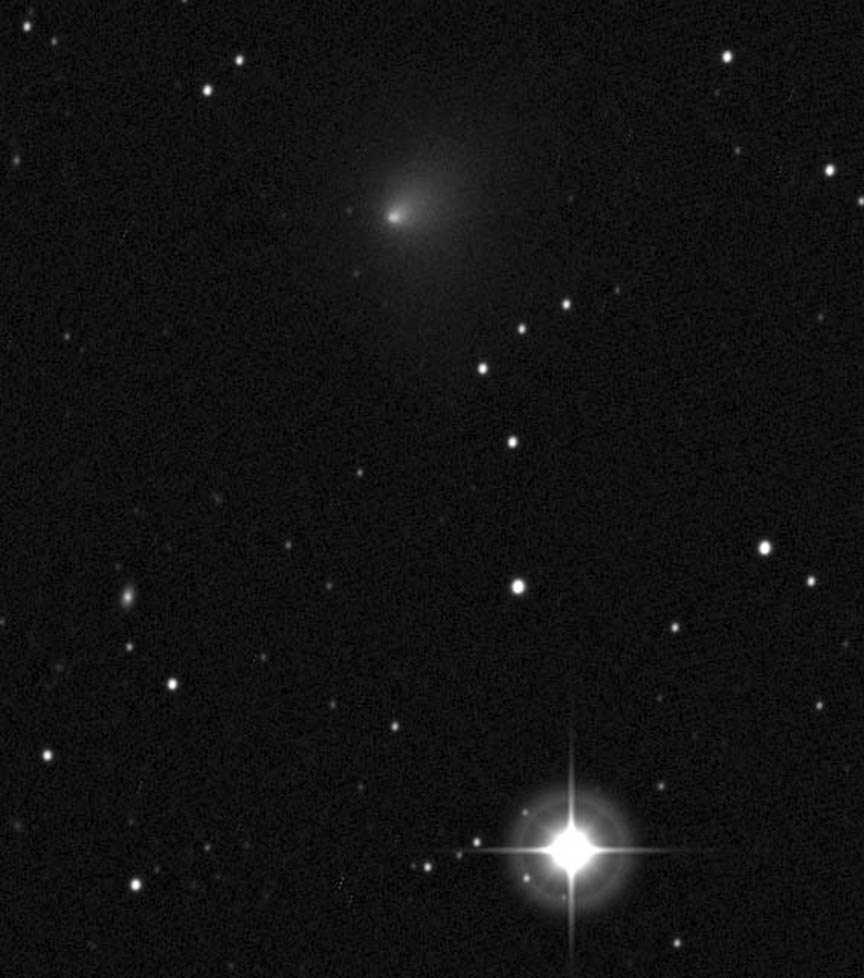
Comet Jacques and IC 405, better known as the Flaming Star Nebula, align to create a temporary question mark in the sky this morning July 26. Credit: Rolando Ligustri

Comet Jacques and IC 405, better known as the Flaming Star Nebula, align to create a temporary ‘question mark’ in the sky this morning July 26. Credit: Rolando Ligustri
What an awesome photo! Italian amateur astronomer Rolando Ligustri nailed it earlier today using a remote telescope in New Mexico and wide-field 4-inch (106 mm) refractor. Currently the brightest comet in the sky at magnitude 6.5, C/2014 E2 Jacques has been slowly climbing out of morning twilight into a darker sky over the last two weeks. This morning it passed the Flaming Star Nebula in the constellation Auriga. Together, nebula and pigtailed visitor conspired to ask a question of the sky in a rare display of celestial punctuation.  IC 405 is a combination emission-reflection nebula. Some of its light stems from starlight reflecting off grains of cosmic dust, but the deep red results from hydrogen excited to fluorescence by powerful ultraviolet light from those same stars. The depth of field hidden within the image is enormous: the nebula lies 1,500 light years away, the comet a mere 112 million miles or 75 million times closer. Coincidentally, the comet also glows in similar fashion. The short dust tail to the left of the coma is sunlight reflecting off minute grains of dust boiled from the nucleus. The long, straight tail is primarily composed of carbon monoxide gas fluorescing in ultraviolet light from the sun.

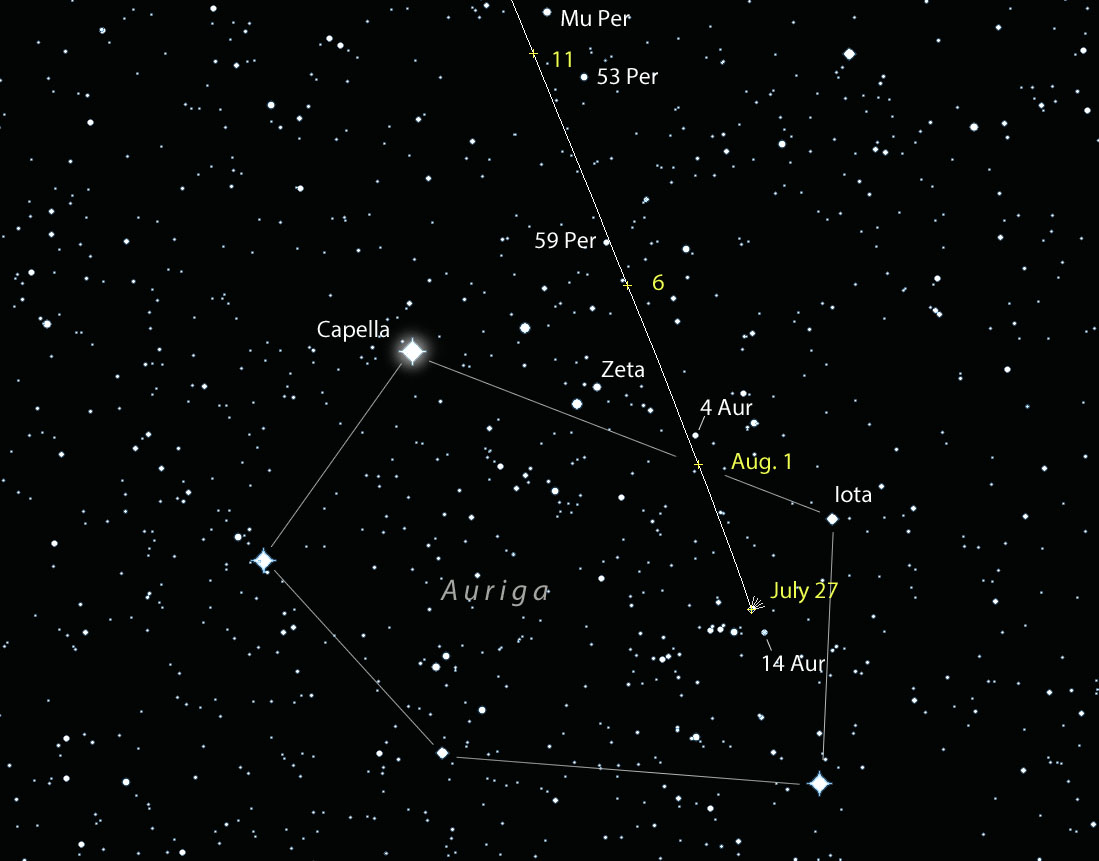
Follow Jacques in a small telescope or binoculars in its travels across Auriga into Perseus in the next two weeks before the moon interferes again. Comet positions are shown for 4 a.m. CDT every 5 days. Stars to magnitude +8.0. Click to enlarge. Source: Chris Marriott's SkyMap

Follow Jacques in a small telescope or binoculars in its travels across Auriga into Perseus during the next two weeks before the moonlight interferes. Comet positions are shown for 4 a.m. CDT every 5 days. Stars to magnitude +8.0. Click to enlarge. Source: Chris Marriott’s SkyMap
As Jacques swings toward its closest approach to Earth in late August, it’s gradually picking up speed from our perspective and pushing higher into the morning sky. A week ago, twilight had the upper hand. Now the comet’s some 20º high (two ‘fists’) above the northeastern horizon around 4 a.m. This morning I had no difficulty seeing it as a small, ‘fuzzy star’ in 10×50 binoculars. In my dusty but trusty 10-inch (25 cm) telescope at 76x, Comet Jacques was a dead ringer for one of those fuzzy dingle-balls hanging from a sombrero. I caught a hint of the very short dust tail but couldn’t make out the gas tail that shows so clearly in the photo. That will have to await darker skies.

Maybe you’d like to try your own eyes on Jacques. Start with a pair of 40mm or larger binoculars or small telescope and use the map above to help you spot it. Oh, and don’t forget to keep an exclamation mark handy. I promise that will be my only bad joke. Period.

Tagged as:
coma,
comet jacques,
IC 405,
ion tail,
Ligustri

Cool Infographic Compares the Chemistry of Planetary Atmospheres

Cool Infographic Compares the Chemistry of Planetary Atmospheres:


"The Chemistry of the Solar System" by Compound Interest's Andy Brunning

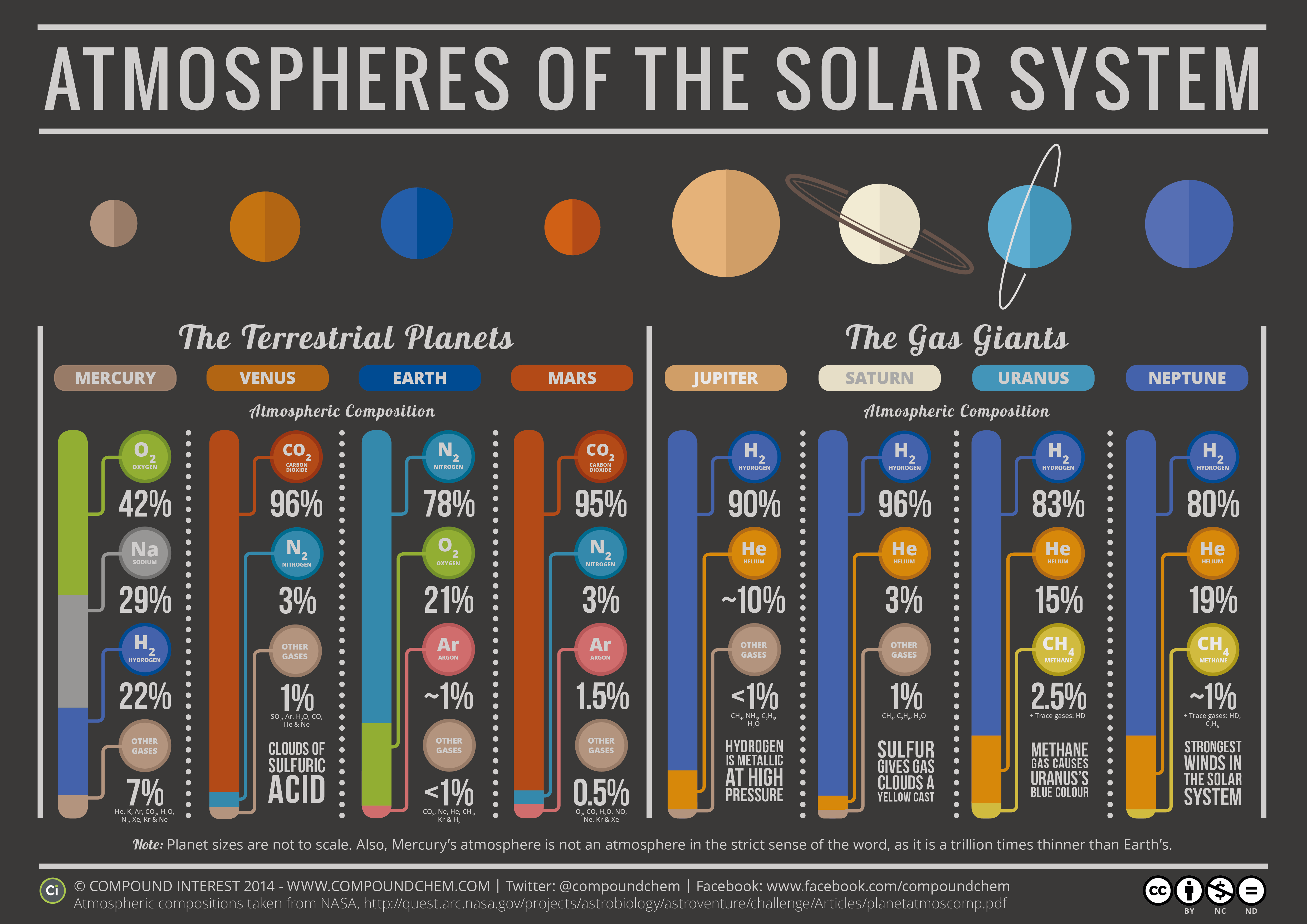
“Atmospheres of the Solar System” by Compound Interest’s Andy Brunning
Here on Earth we enjoy the nitrogen-oxygen atmosphere we’ve all come to know and love with each of the approximately 24,000 breaths we take each day (not to mention the surprisingly comfortable 14.7 pounds per square inch of pressure it exerts on our bodies every moment.) But every breath we take would be impossible (or at least quickly prove to be deadly) on any of the other planets in our Solar System due to their specific compositions. The infographic above, created by UK chemistry teacher Andy Brunning for his blog Compound Interest, breaks down — graphically, that is; not chemically — the makeup of atmospheres for each of the planets. Very cool!

In addition to the main elements found in each planet’s atmosphere, Andy includes brief notes of some of the conditions present.

“Practically every other planet in our solar system can be considered to have an atmosphere, apart from perhaps the extremely thin, transient atmosphere of Mercury, with the compositions varying from planet to planet. Different conditions on different planets can also give rise to particular effects.”

– Andy Brunning, Compound Interest
And if you’re thinking “hey wait, what about Pluto?” don’t worry — Andy has included a sort of postscript graphic that breaks down Pluto’s on-again, off-again atmosphere as well. See this and more descriptions of the atmospheres of the planets on the Compound Interest blog here.

Source: Compound Interest on Twitter

Tagged as:
atmosphere,
chemistry,
Compound Interest,
Earth,
planets,
Pluto,
Solar System

NASA Spacecraft Is Now Buzzing Mercury 62 Miles Above The Surface

NASA Spacecraft Is Now Buzzing Mercury 62 Miles Above The Surface:


Artist's conception of NASA's MESSENGER spacecraft above Mercury. Credit: JHUAPL

Artist’s conception of NASA’s MESSENGER spacecraft above Mercury. Credit: JHUAPL
Look out below! NASA’s MESSENGER spacecraft is at its lowest altitude of any spacecraft above Mercury, and over the next couple of months it’s going to get even lower above the planet.

The spacecraft — whose name stands for MErcury Surface, Space ENvironment, GEochemistry, and Ranging — is doing a close shave above the sun’s closest planet to look at the polar ice and its gravity and magnetic fields.

“This dip in altitude is allowing us to see Mercury up close and personal for the first time,” stated Ralph McNutt, the project scientist for MESSENGER at the Johns Hopkins University Applied Physics Laboratory (APL).

MESSENGER is the first-ever mission to orbit Mercury. It arrived at the planet in March 2011 and has now spent three Earth years or 14 Mercury years examining the cratered planet and its environment. The campaign has revealed many secrets about Mercury, ranging from the discovery of ice deposits to changes in its tenuous atmosphere due to the Sun.

The spacecraft made its lowest approach above the planet on July 25, at 62 miles (100 kilometers) and will keep moving lower due to “progressive changes” in its orbit, APL stated. By Aug. 19, the minimum altitude will be 50 km (31 miles), and then the closet approach will be on Sept. 12 at 25 km (16 miles).

After that, the team will temporarily raise the spacecraft’s orbit again before it makes a planned impact on the planet’s surface in March 2015. The NASA mission is operated and managed by Johns Hopkins University.

Credit: Johns Hopkins University Applied Physics Laboratory

When Good Meteor Showers Go Bad: Prospects for the 2014 Perseids

When Good Meteor Showers Go Bad: Prospects for the 2014 Perseids:


A 2013 Perseid. Credit:

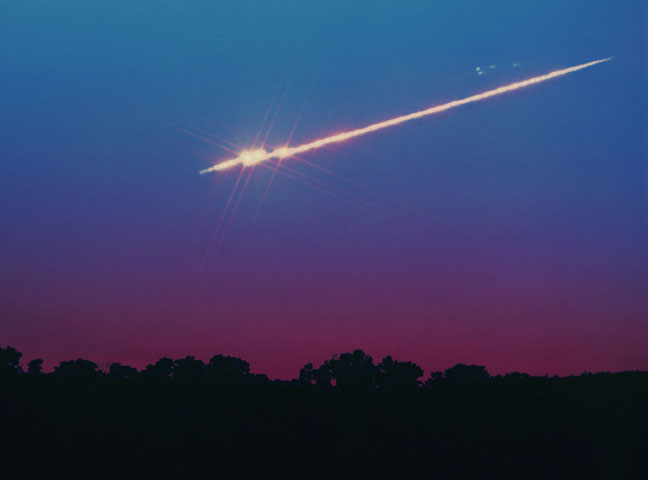
A brilliant capture of a 2013 Perseid fireball. Credit: Fred Locklear.
It’s that time of year again, when the most famous of all meteor showers puts on its best display.

Why are the Perseids such an all ‘round favorite of sky watchers?  Well, while it’s true that other annual meteor showers such as the Quadrantids and Geminids can exceed the Perseids in maximum output, the Perseids do have a few key things going for them. First, the shower happens in mid-August, which finds many northern hemisphere residents camping out under warm, dark skies prior to the start of the new school year. And second, unlike showers such as the elusive Quads which peak over just a few hours, the Perseids enjoy a broad span of enhanced activity, often covering a week or more.

Credit: JPL

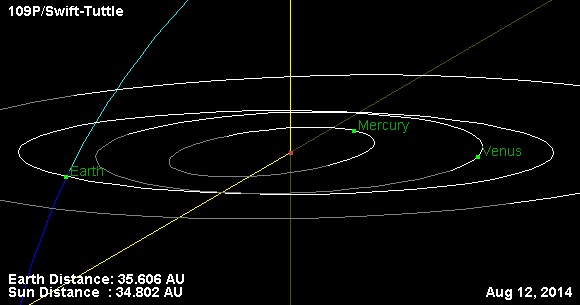
The orientation of the orbital path of Comet 109P/Swift-Tuttle and the position of the Earth on August 12th. Credit: JPL-Horizons.
These are all good reasons to start watching for Perseids now. Here’s the low down on the Perseid meteors for 2014:

The History: The Perseids are sometimes referred to as “The Tears of Saint Lawrence,” who was martyred right around the same date on August 10th, 258 A.D. The source of the shower is comet 109P Swift-Tuttle, which  was first identified as such by Schiaparelli in 1866. The comet itself visited the inner solar system again recently in 1992 on its 120 year orbit about the Sun, and rates were enhanced throughout the 1990s.

A 2013 Perseid pierces the plane of the Milky Way.

A 2013 Perseid pierces the plane of the Milky Way. Credit: Stephen Rahn.
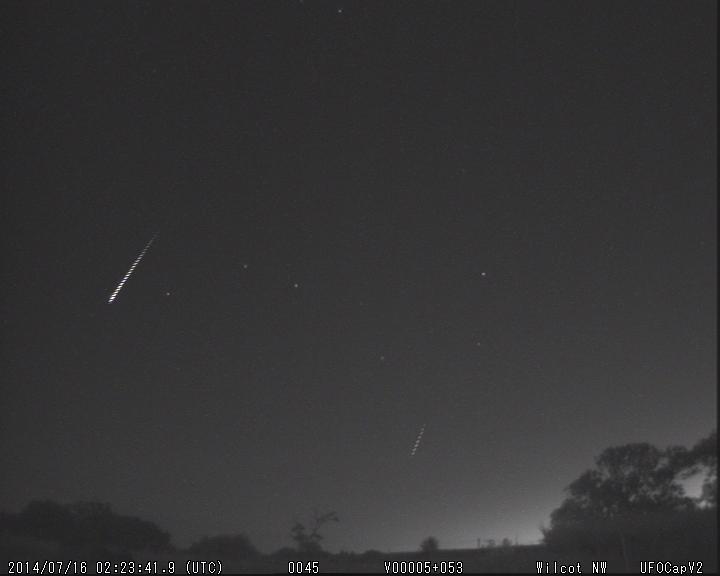
Unlike most showers, the Perseids have a very broad peak, and observers and automated networks such as UKMON and NASA’s All Sky Camera sites have already begun to catch activity starting in late July.

Credit: The UK-MON network.

A pair of early 2014 Perseids recently captured by UKMON’s Wilcot station. Credit: The UK-MON network.
In recent years, the rates for the Perseids have been lowering a bit but are still enhanced, with ZHRs at 91(2010), 58(2011), 122(2012), and 109(2013). It’s also worth noting that the Perseids typically exhibit a twin peak maximum within a 24 hour span. The International Meteor Organization maintains an excellent page for quick look data to check out what observers worldwide are currently seeing. The IMO also encourages observers worldwide to submit meteor counts by location. Note that the phase of the Moon was near Full in 2011, with observing circumstances very similar to 2014.

The Prospects for 2014: Unfortunately, the 2014 Perseid meteors have a major strike going against them this year: the Moon will be at waning gibbous during its peak and just two days past Full illumination. This will make for short exposure times and light polluted skies. There are, however, some observational strategies that you can use to combat this: one is to place a large building or hill between yourself and the Moon while you observe — another is to start your morning vigil a few days early, before the Moon reaches Full. The expected Zenithal Hourly Rate for 2014 is predicted to hover around 90 and arrive around 00:15 to 2:00 UT on August 13th favoring Europe, Africa and the Middle East.

Created by Author

The orientation of Earth’s shadow during the projected peak of the Perseids on August 13th at 00:15 Universal Time.  The positions where the Sun, Moon, and radiant of the Perseids are directly overhead are also noted. Created by Author.
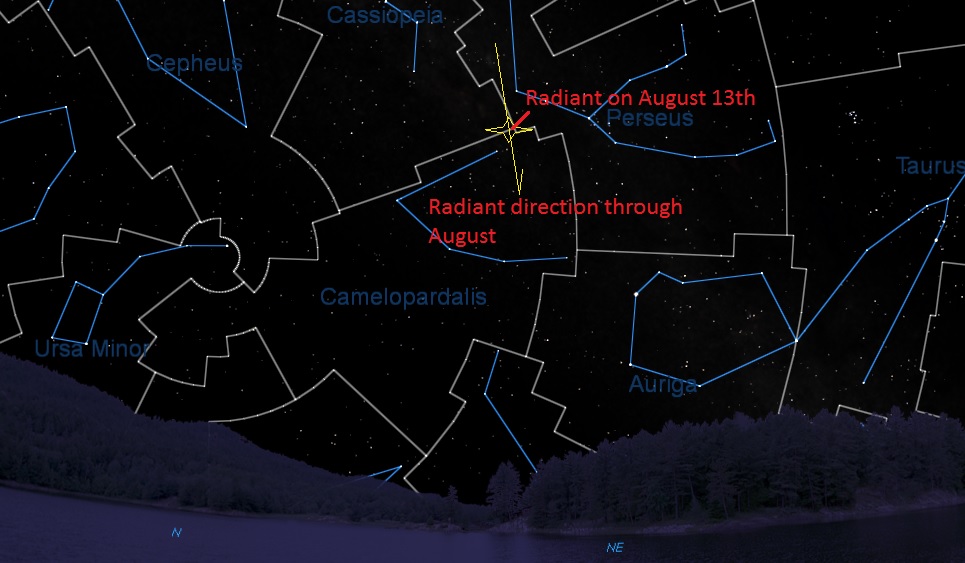
The Radiant: It’s strange but true: meteor shower radiants wander slightly across the sky during weeks surrounding peak activity, due mostly to the motion of the Earth around the Sun. Because of this, the radiant of the Perseids is not actually in the constellation Perseus on the date that it peaks! At its maximum, the radiant actually sits juuusst north of the constellation that it’s named for on the border of Camelopardalis and Cassiopeia. This is a great pedantic point to bring up with your friends on your August meteor vigil… they’ll sure be glad that you pointed this out to ‘em and hopefully, invite you back for next year’s Perseid watch.

The actual position of the radiant sits at 3 Hours 04’ Right Ascension and +58 degrees north declination.

Credit: Starry Night Education software.

The movement of the radiant of the Perseids. The sky is simulated for latitude 30 degrees north at 2:00 AM local on August 13th. Credit: Starry Night Education software.
Meteor-speak: Don’t know your antihelion from a zenithal hourly rate? We wrote a whole glossary that’ll have you talking meteors like a pro for Adrian West’s outstanding Meteorwatch site a few years back. Just remember, the crucial “ZHR” of a shower that is often quoted is an ideal extrapolated rate… light pollution, the true position of the radiant, observer fatigue and limited field of view all conspire to cause you to see less than this predicted maximum. The universe and its meteor showers are indeed a harsh mistress!

Observing: But don’t let this put you off. As Wayne Gretsky said, “You miss 100% of the shots that you don’t take,” and the same is true with meteor observing: you’re sure to see exactly zero if you don’t observe at all. Some of my most memorable fireball sightings over the years have been Perseids. And remember, the best time to watch for meteors is after local midnight, as the Earth is turned forward into the meteor stream. Remember, the car windshield (Earth) gets the bugs (meteors) moving down the summer highway…

Good luck, and let us know of those tales of Perseid hunting and send those meteor pics in to Universe Today!

Tagged as:
2014 perseids,
meteor observing,
perseid meteor shower,
perseid meteors,
perseid prospects,
swift-tuttle

Observing Alert – Delta Aquarid Meteor Shower Peaks Tonight

Observing Alert – Delta Aquarid Meteor Shower Peaks Tonight:


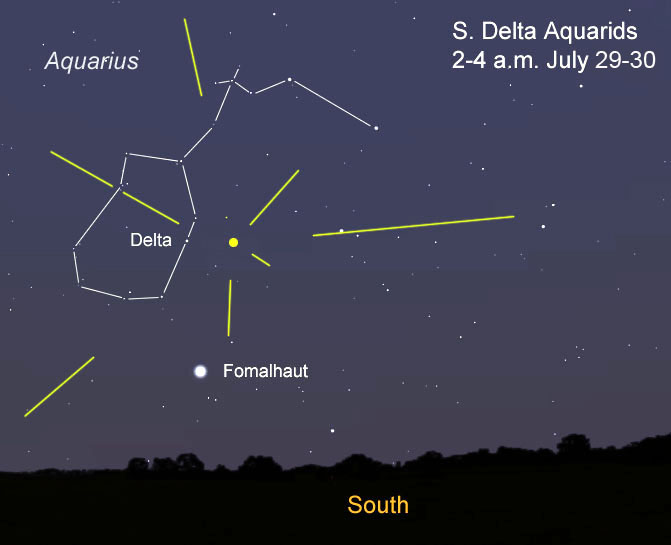
Watch for the southern Delta Aquarid meteor shower to peak over the next two mornings July 29-30. Credit: John Chumack

Watch for the southern Delta Aquarid meteor shower to peak over the next two mornings July 29-30. The best time for viewing for northern observers will be the hour before the start of dawn. Credit: John Chumack
With the southern Delta Aquarid meteor shower peaking tomorrow morning, the summer meteor-watching season officially begins. While not a rich shower from mid-northern latitudes, pleasant weather and a chance to see the flaming remains of a comet seem motivation enough to go out for a look. With a rate 10-15 per meteors an hour you’re bound to catch a few.

The farther south you live, the better it gets. Observers in the southern hemisphere can expect double that number because the shower’s radiant will be much higher in the sky. Any meteors flashing south of the radiant won’t get cut off by the southern horizon like they do further north.

The annual shower gets its name from Delta Aquarii, a dim star in the dim zodiac constellation Aquarius. You don’t need to know the constellations to enjoy the show, but if you know the general direction of the radiant you’ll be able to tell shower members from the nightly sprinkle of random meteors called sporadics. If you can trace the path of a meteor backward toward Aquarius, chances are it’s an Aquarid.


A Southern Delta Aquarid meteor captured on July 30, 2013. Credit: John Chumack
There are actually two meteor showers in Aquarius active this time of year – the northern and southern Delta Aquarids. The northern version sprinkles fewer meteors and peaks in mid-August.

The Southern Deltas peak over the next two mornings – July 29 and 30 – but will be out all week. Both serve as a warm-up for the upcoming Perseid meteor shower that climaxes on August 12.

Tonight’s shower will suffer no interference from moonlight, making for ideal meteor watching. Unfortunately, Perseid rates will be reduced by a bright waning gibbous moon.

Don’t be surprised if you see a few Perseids anyway. The shower’s just becoming active. If you can draw a meteor’s trail back to the northeastern sky, it just might be a member. Read more about Perseid prospects from our own David Dickinson.

Meteors from Delta Aquarid meteor shower radiate from near the star Delta Aquarii not far from the bright star Fomalhaut in the Southern Fish low in the south before dawn. Stellarium

Meteors from Delta Aquarid meteor shower radiate from near the star Delta Aquarii not far from the bright star Fomalhaut in the Southern Fish low in the south before dawn. Stellarium
Nearly all meteor showers originate from clouds of sand to seed-sized bits of debris spewed by vaporizing comet ice as they swing near the sun. The Delta Aquarids may trace its origin to dust boiled off Comet 96P/Machholz.

The best time to watch the shower is in the early morning hours before dawn when the radiant rises in the south-southeastern sky above the bright star Fomalhaut. Try to get away from city lights. Point your lawn chair south and spend some time in heavenly contemplation as you wait for Aquarius to toss a few javelins of light your way.

Tagged as:
96P/Machholz,
comet,
Delta Aquarid,
meteor shower,
radiant

X-ray Glow: Evidence of a Local Hot Bubble Carved by a Supernova

X-ray Glow: Evidence of a Local Hot Bubble Carved by a Supernova:


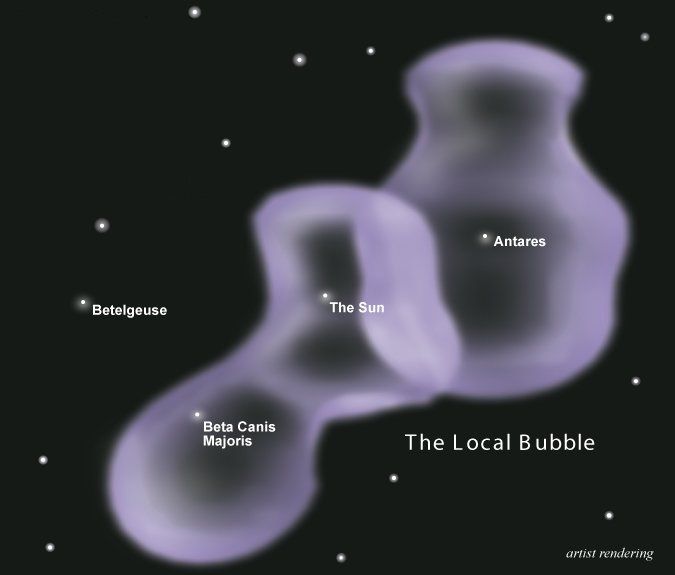
An artist's conception of the hot local bubble. Image Credit: NASA

An artist’s conception of the hot local bubble. Image Credit: NASA
I spent this past weekend backpacking in Rocky Mountain National Park, where although the snow-swept peaks and the dangerously close wildlife were staggering, the night sky stood in triumph. Without a fire, the stars, a few planets, and the surprisingly bright Milky Way provided the only light to guide our way.

But the night sky as seen by the human eye is relatively dark. Little visible light stretching across the cosmos from stars, nebulae, and galaxies actually reaches Earth. The entire night sky as seen by an X-ray detector, however, glows faintly.

The origins of the soft X-ray glow permeating the sky have been highly debated for the past 50 years. But new findings show that it comes from both inside and outside the Solar System.

Decades of mapping the sky in X-rays with energies around 250 electron volts — about 100 times the energy of visible light — revealed soft emission across the sky. And astronomers have long searched for its source.

At first, astronomers proposed a “local hot bubble” of gas — likely carved by a nearby supernova explosion during the past 20 million years — to explain the X-ray background. Improved measurements made it increasingly clear that the Sun resides in a region where interstellar gas is unusually sparse.

But the local bubble explanation was challenged when astronomers realized that comets were an unexpected source of soft X-rays. In fact, this process, known as solar wind charge exchange, can occur anywhere atoms interact with solar wind ions.

After this discovery, astronomers turned their eyes to within the Solar System and began to wonder whether the X-ray background might be produced by the ionized particles in the solar wind colliding with diffuse interplanetary gas.

In order to solve the outstanding mystery, a team of astronomers led by Massimilliano Galeazzi from the University of Miami developed an X-ray instrument capable of taking the necessary measurements.

Galeazzi and colleagues rebuilt, tested, calibrated, and adapted X-ray detectors originally designed by the University of Wisconsin and flown on sounding rockets in the 1970s. The mission was named DXL, for Diffuse X-ray emission from the Local Galaxy.

On Dec. 12, 2012, DXL launched from the White Sands Missile Range in New Mexico atop a NASA Black Brant IX sounding rocket. It reached a peak altitude of 160 miles and spent a total of five minutes above Earth’s atmosphere.

The data collected show that the emission is dominated by the local hot bubble, with, at most, 40 percent originating from within the Solar System.

“This is a significant discovery,” said lead author Massimiliano Galeazzi from the University of Miami in a press release. “Specifically, the existence or nonexistence of the local bubble affects our understanding of the galaxy in the proximity to the Sun and can be used as foundation for future models of the Galaxy structure.”

It’s now clear that the Solar System is currently passing through a small cloud of cold interstellar gas as it moves through the Milky Way.

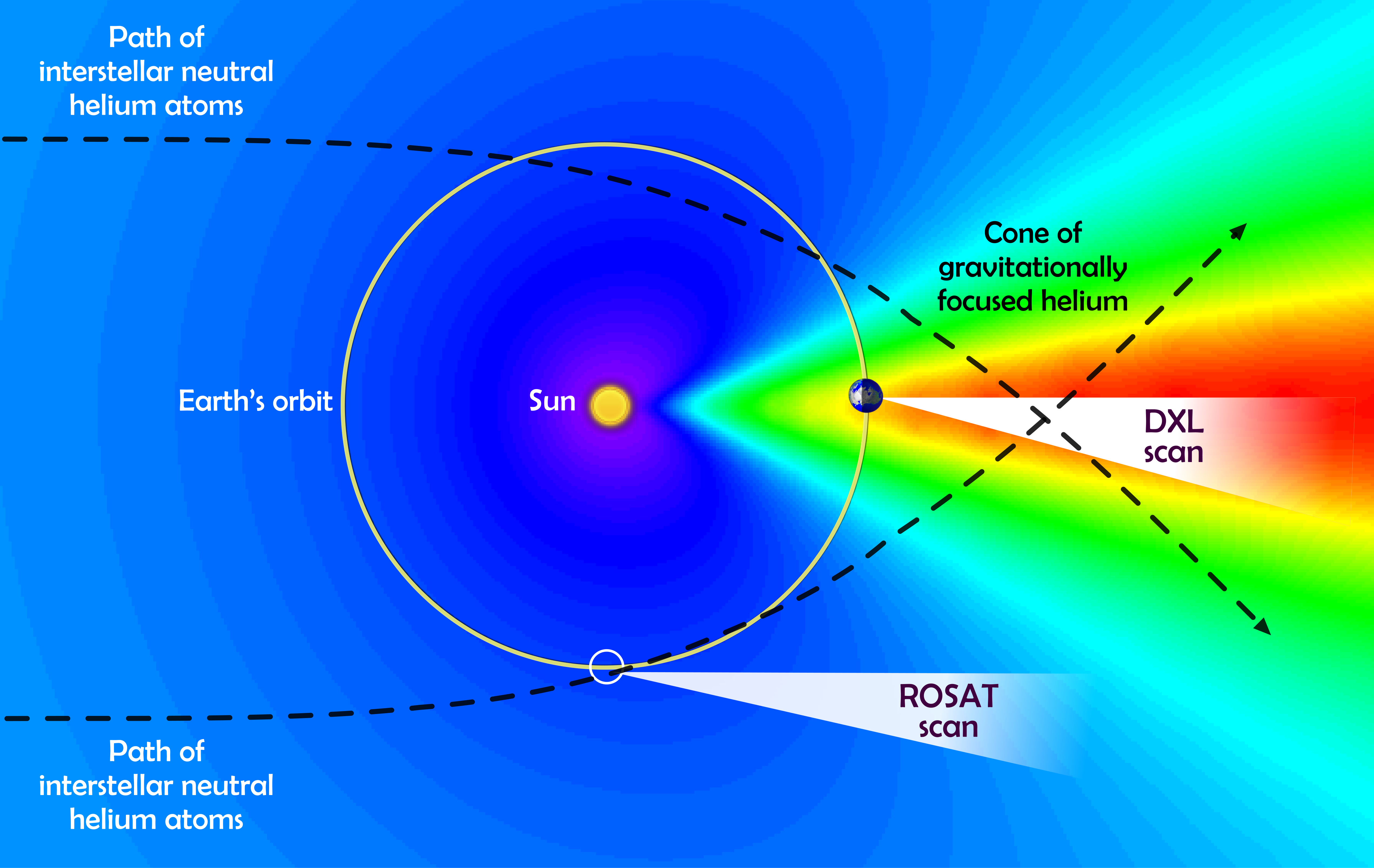
Colors indicate the density of interstellar helium near Earth and its enhancement in a downstream cone as the neutral atoms respond to the sun's gravity (blue is low density, red is high). Also shown are the observing angles for DXL and ROSAT. Image Credit:  NASA's Goddard Space Flight Center

Colors indicate the density of interstellar helium near Earth and its enhancement in a downstream cone as the neutral atoms respond to the sun’s gravity (blue is low density, red is high). Also shown are the observing angles for DXL and ROSAT. Image Credit: NASA’s Goddard Space Flight Center
The cloud’s neutral hydrogen and helium atoms stream through the Solar System at about 56,000 mph (90,000 km/h). The hydrogen atoms quickly ionize, but the helium atoms travel at a path largely governed by the Sun’s gravity. This creates a helium focusing cone — a breeze focused downstream from the Sun — with a much greater density of neutral atoms. These easily collide with solar wind ions and emit soft X-rays.

The confirmation of the local hot bubble is a significant development in our understanding of the interstellar medium, which is crucial for understanding star formation and galaxy evolution.

“The DXL team is an extraordinary example of cross-disciplinary science, bringing together astrophysicists, planetary scientists, and heliophysicists,” said coauthor F. Scott Porter from NASA’s Goddard Space Flight Center. “It’s unusual but very rewarding when scientists with such diverse interests come together to produce such groundbreaking results.”

The paper has been published in Nature.

Tagged as:
Local Hot Bubble,
Soft X-ray Emission,
Solar System

ALMA Observes Binary Star System with Wacky Disks

ALMA Observes Binary Star System with Wacky Disks:


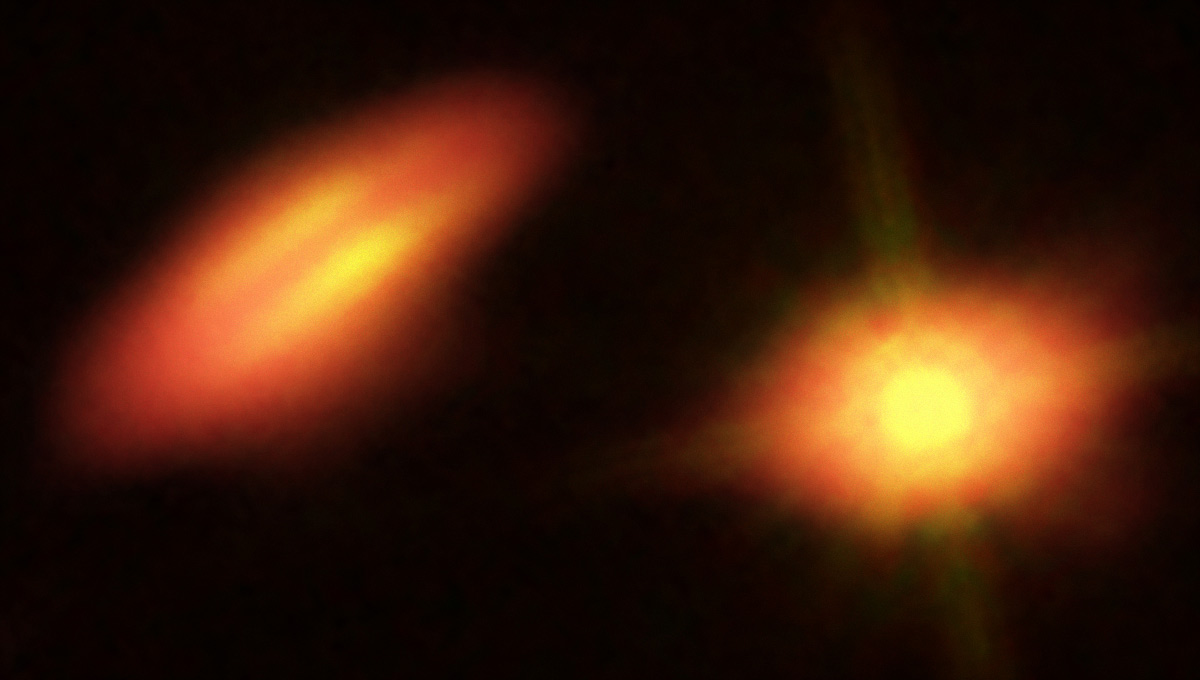
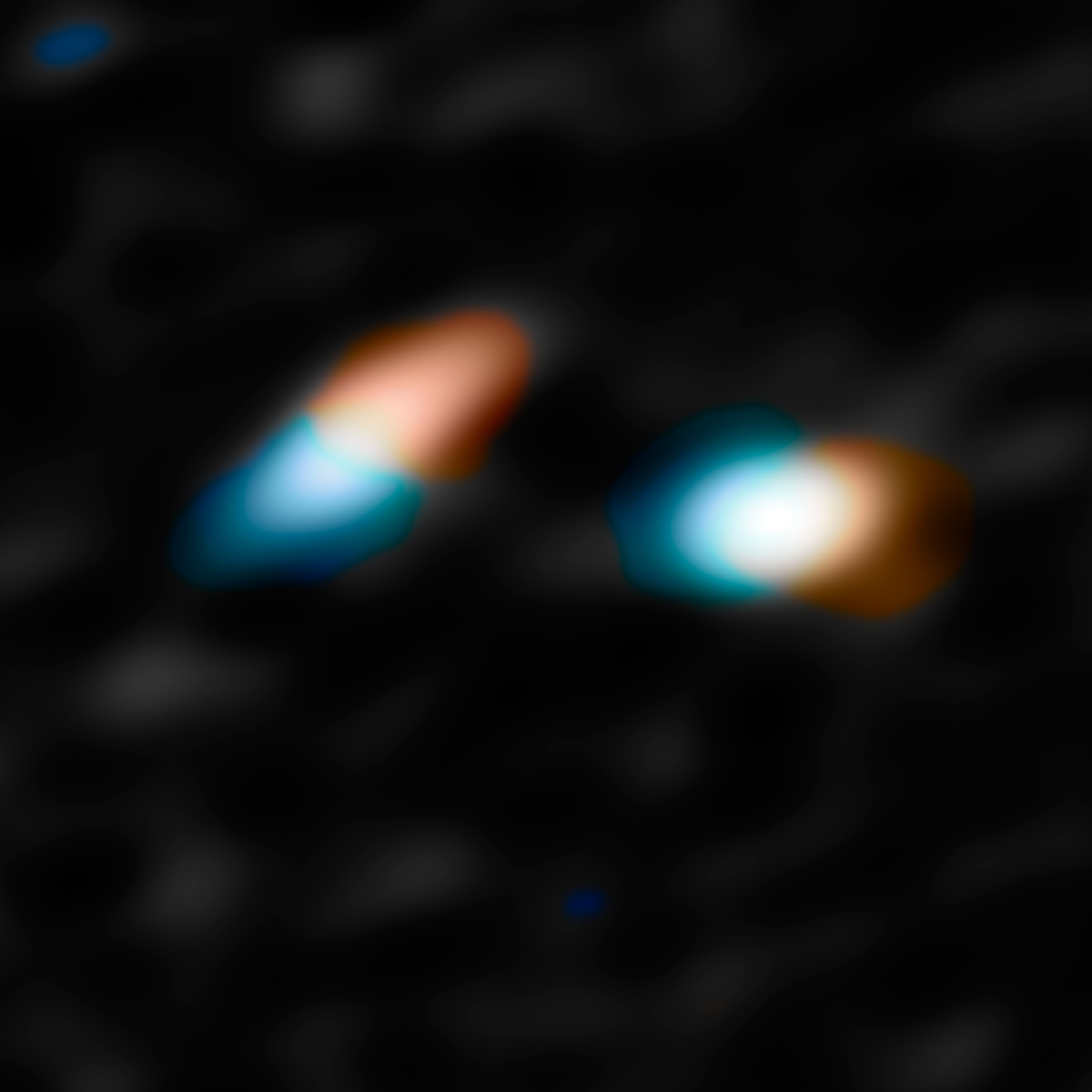
ALMA data of HK Tau shown in a composite image with Hubble infrared and optical data. Credit: B. Saxton (NRAO/AUI/NSF); K. Stapelfeldt et al. (NASA/ESA Hubble)

ALMA data of HK Tau shown in a composite image with Hubble infrared and optical data. Image Credit: B. Saxton / K. Stapelfeldt et al. / NASA / ESA
When it comes to exoplanets, we’ve discovered an array of extremes — alien worlds that seem more like science fiction than reality. But there are few environments more extreme than a binary star system in which planet formation can occur. Powerful gravitational perturbations from the two stars can easily grind a planet to dust, let alone prevent it from forming in the first place.

A new study has uncovered a striking pair of wildly misaligned planet-forming disks in the young binary star system HK Tau. It’s the clearest picture ever of protoplanetary disks around a double star, shedding light on the birth and eventual orbit of the planets in a multiple star system.

The “Atacama Large Millimeter/submillimeter Array (ALMA) has given us an unprecedented view of a main star and its binary companion sporting mutually misaligned protoplanetary disks,” said Eric Jensen from Swarthmore College in a press release. “In fact, we may be seeing the formation of a solar system that may never settle down.”

The two stars in the system — located roughly 450 light-years away in the constellation Taurus — are less than four million years old and are separated by about 58 billion kilometers, or 13 times the distance of Neptune from the Sun.

ALMA’s high sensitivity and unprecedented resolution allowed Jensen and colleagues to fully resolve the rotation of HK Tau’s two protoplanetary disks.

“It’s easier to observe spread-out gas and dust because it has more surface area – just in the same way that it might be hard to see a small piece of chalk from a distance, but if you ground up the chalk and dispersed the cloud of chalk dust, you could see it from farther away,” Jensen told Universe Today.

The key velocity data taken with ALMA that helped the astronomers determine that the disks in HK Tau were misaligned. The red areas represent material moving away from Earth and the blue indicates material moving toward us. Credit: NASA/JPL-Caltech/R. Hurt (IPAC)

The key velocity data taken with ALMA. The red areas represent material moving away from Earth and the blue indicates material moving toward us. Image Credit: NASA / JPL-Caltech / R. Hurt (IPAC)
The carbon monoxide gas orbits both stars in two broad belts that are clearly rotating — the side spinning away from us is redshifted, while the side spinning toward us is blueshifted.

“What we find in this binary system is that the two orbiting disks are oriented very differently from each other, with about a 60 or 70 degree angle between their orbital planes,” Jensen told Universe Today. Because the disks are so misaligned it’s clear that at least one is also out of sync with the orbit of their host stars.

“This clear misalignment has given us a remarkable look at a young binary star system,” said coauthor Rachel Akeson from the NASA Exoplanet Science Institute at the California Institute of Technology. “Though there have been hints before that this type of misaligned system exists, this is the cleanest and most striking example.”

Stars and planets form out of vast clouds of dust and gas. Small pockets in these clouds collapse under the pull of gravity. But as the pocket shrinks, it spins rapidly, with the outer region flattening into a turbulent disk. Eventually the central pocket becomes so hot and dense that it ignites nuclear fusion — in the birth of a star — while the outer disk — now the protoplanetary disk — begins to form planets.

Despite forming from a flat, regular disk, planets can end up in highly eccentric orbits, and may be misaligned with the star’s equator. One likely explanation is that a binary companion star influences them — but only if its orbit is initially misaligned with the planets.

“Because these disks are misaligned with the binary orbit, then so too will be the orbits of any planets they form,” Jensen told Universe Today. “So in the long run, the binary companion will influence those planet orbits, causing them to oscillate and tend to come more into line with the binary orbit, and at the same time become more eccentric.”

Looking forward, the researchers want to determine if this type of system is typical or not. If it is, then tidal forces from companion stars may easily explain the orbital properties that make the present sample of exoplanets so unlike the planets of our own Solar System.

The results will appear in Nature on July 31, 2014.

Tagged as:
ALMA,
protoplanetary disks

Mysterious Molecules in Space Named?

Mysterious Molecules in Space Named?:


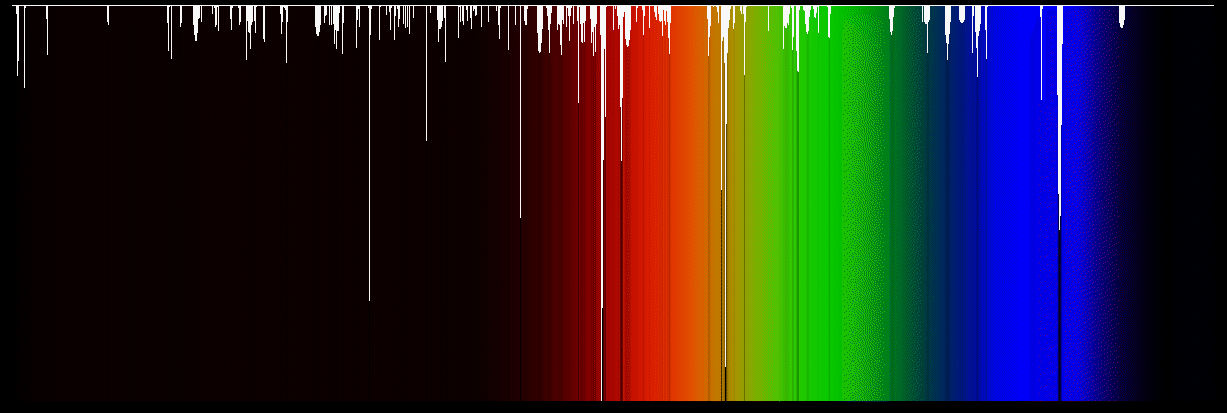
The diffuse interstellar bands. Image Credit: P. Jenniskens, F. X. Desert

The diffuse interstellar bands. Image Credit: P. Jenniskens, F. X. Desert
It’s a well-kept secret that the vacuum of space is not — technically speaking — a vacuum. Strong winds generated from supernova explosions push material into the interstellar medium, tainting space with the heavier elements generated by nuclear fusion. These lonely molecules account for a significant amount of all the hydrogen, carbon, silicon, and other atoms in the Universe.

Although these molecules remain mysterious, since we don’t know their exact chemical composition or atomic arrangements, they’re likely the cause of diffuse interstellar bands: unknown fingerprints within the spectra of distant astronomical objects.

New research, however, offers a tantalizing new possibility: these mysterious molecules may be silicon hydrocarbons.

Researchers on Earth should be able to identify the interstellar molecules easily. They simply have to demonstrate which molecules in the laboratory absorb light at the same wavelengths as the diffuse interstellar bands. But despite decades of effort, the identity of the molecules has remained a mystery.

“Not a single one has been definitively assigned to a specific molecule,” said coauthor Neil Reilly from the Harvard-Smithsonian Center for Astrophysics in a press release.

Now, Michael McCarthy from the Harvard-Smithsonian Center for Astrophysics, Reilly, and their colleagues are pointing to an unusual set of molecules — silicon-terminated carbon chain radicals such as SiC3H, SiC4H and SC5H — as potential twins to those found in interstellar space.

The researchers, however, were unable to create every spectral absorption line (over 400) responsible for the diffuse interstellar bands. But they think that longer molecules in this silicon-containing hydrocarbon family might cause the lines.

Absorption wavelength as a function of the number of carbon atoms in the silicon-terminated carbon chains SiC_(2n+1)H, for the extremely strong pi-pi electronic transitions. When the chain contains 13 or more carbon atoms - not significantly longer than carbon chains already known to exist in space - these strong transitions overlap with the spectral region occupied by the elusive diffuse interstellar bands (DIBs). CREDIT: D. Kokkin, ASU

Absorption wavelength as a function of the number of carbon atoms in the silicon-terminated carbon chains SiC_(2n+1)H. When the chain contains 13 or more carbon atoms — not significantly longer than carbon chains already known to exist in space — these strong transitions overlap with the spectral region occupied by the elusive diffuse interstellar bands. Image Credit: D. Kokkin, ASU
So the group remains cautious. History shows that while many possibilities have been proposed as the source of diffuse interstellar bands, none have been proven definitely. And they certainly need to conduct further research before they can say with certainty they’ve identified the mysterious interstellar molecules.

“The interstellar medium is a fascinating environment,” said McCarthy. “Many of the things that are quite abundant there are really unknown on Earth.”

Tagged as:
Diffuse Interstellar Bands,
Interstellar Molecules

Early Tidal and Rotational Forces Helped Shape Moon

Early Tidal and Rotational Forces Helped Shape Moon:


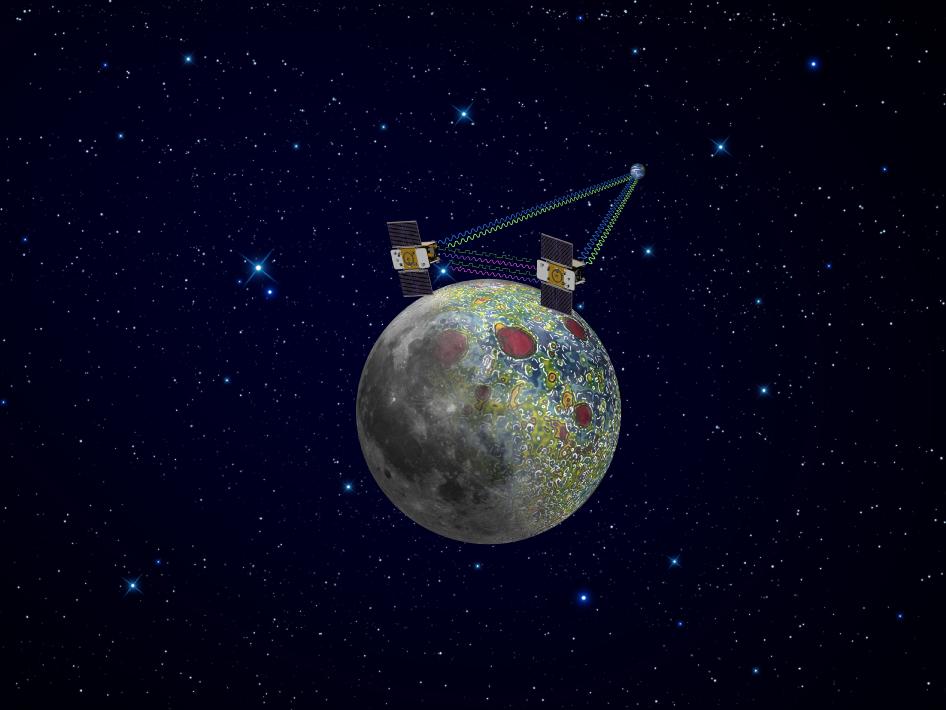
Using a precision formation-flying technique, the twin GRAIL spacecraft will map the moon's gravity field, as depicted in this artist's rendering. Radio signals traveling between the two spacecraft provide scientists the exact measurements required as well as flow of information not interrupted when the spacecraft are at the lunar farside, not seen from Earth. The result should be the most accurate gravity map of the moon ever made. The mission also will answer longstanding questions about Earth's moon, including the size of a possible inner core, and it should provide scientists with a better understanding of how Earth and other rocky planets in the solar system formed. GRAIL is a part of NASA's Discovery Program. Image credit: NASA/JPL-Caltech

An artist’s conception of how the twin GRAIL spacecraft map the moon’s gravity field. Image credit: NASA / JPL-Caltech
The shape of the moon deviates from a simple sphere in a way that scientists have struggled to explain. But new research shows that tidal forces during the moon’s early history can explain most of its large-scale topography. As the moon cooled and solidified more than four billion years ago, the sculpting effects of tidal and rotational forces became frozen in place.

Astronomers think the moon formed when a rogue planet, larger than Mars, struck the Earth in a great, glancing blow. A cloud rose 13,700 miles (22,000 kilometers) above the Earth, where it condensed into innumerable solid particles that orbited the Earth. Over time these moonlets combined to form the moon.

So the moon was sculpted by Earth’s gravity from the get-go. Although scientists have long postulated that tidal forces helped shape the molten moon, the new study provides a much more detailed understanding of the additional forces at play.

Ian Garrick-Bethell from UCSC and colleagues studied topographic data gathered by NASA’s Lunar Reconnaissance Orbiter (LRO) and information about the moon’s gravity field collected by the agency’s twin GRAIL (Gravity Recovery and Interior Laboratory) spacecraft.

Not long after the moon’s formation, the crust was decoupled from the mantle below by an intervening ocean of magma. This caused immense tidal forces. At the poles, where the flexing and heating was greatest, the crust became thinner, while the thickest crust formed at the equators. Garrick-Bethel likened this to a lemon shape with the long axis of the lemon pointing at the Earth.

But this process does not explain why the bulge is now only found on the far side of the moon. You would expect to see it on both sides, because tides have a symmetrical effect.

“In 2010, we found one area that fits the tidal heating effect, but that study left open the rest of the moon and didn’t include the tidal-rotational deformation. In this paper we tried to bring all those considerations together,” said Garrick-Bethell in a press release.

Any rotational forces would cause the spinning moon to flatten slightly at the poles and bulge out near the equator. It would have had a similar effect on the moon’s shape as the tidal heating did — both of which left distinct signatures in the moon’s gravity field. Because the crust is lighter than the underlying mantle, gravity signals reveal variations in the moon’s internal structure, many of which may be due to previous forces.

Interestingly, Garrick-Bethell and colleagues discovered that the moon’s overall gravity field is no longer aligned with the topography. The long axis of the moon doesn’t point directly toward Earth as it likely did when the moon first formed; instead, it’s offset by about 30 degrees.

“The moon that faced us a long time ago has shifted, so we’re no longer looking at the primordial face of the moon,” said Garrick-Bethell. “Changes in the mass distribution shifted the orientation of the moon. The craters removed some mass, and there were also internal changes, probably related to when the moon became volcanically active.”

The details and timing of these processes are still uncertain, but the new analysis should help shed light on the tidal and rotational forces abundant throughout the Solar System and the Galaxy. These simple forces, after all, have helped shape our nearest neighbor and the most distant exoplanet.

The results have been published today in Nature.

Tagged as:
Moon's Evolution,
Moon's Formation,
tidal forces

Numerous Jets Spied with New Sky Survey

Numerous Jets Spied with New Sky Survey:


Caption: The area shown here was part of the very first image taken for the UWISH2 survey. It shows on the top a region of massive star formation (called G35.2N) with two spectacular jets. On the bottom an intermediate mass young stellar cluster (Mercer14) can be seen. Several jets are visible in its vicinity, as well as a region of photo-ionized material surrounding a young massive star. Credit: University of Kent

The area shown here was part of the very first image taken for the UWISH2 survey. Near the top is a region of massive star formation (called G35.2N) with two spectacular jets. Near the bottom is an intermediate mass young stellar cluster (Mercer14). Several jets are visible in its vicinity, as well as a region of photo-ionized material surrounding a young massive star. Image Credit: University of Kent
Jets — narrow beams of matter spat out at a high speed — typically accompany the most enigmatic astronomical objects. We see them wherever gas accretes onto compact objects, such as newborn stars or black holes. But never before have astronomers detected so many at once.

This remarkable discovery is expected to prompt significant changes in our understanding of the planetary nebulae population in the Galaxy, as well as properties of jets ejected from young forming stars.

The results come from a five-year survey (officially dubbed UWISH2) covering approximately 180 degrees of the northern sky, or 1450 times the size of the full moon. The survey utilizes the 3.8-meter UK Infrared Telescope on Mauna Kea, Hawai’i.

Caption: This image shows a field that contains a newly discovered photogenic planetary nebulae. Internally dubbed by the research team as the "Jelly-Fish PN" it shows an almost circular ring of emission from molecular hydrogen with a variety of structure in the ring itself and inside. The central ionizing source responsible for the radiation is a white dwarf, which is too faint at the near infrared wavelengths to be visible in the image. Image Credit: University of Kent

This image shows a field that contains a newly discovered photogenic planetary nebulae, known as “Jelly-Fish PN.” It shows an almost circular ring of emission from molecular hydrogen with a variety of structure in the ring itself and inside. Image Credit: University of Kent
At these longer wavelengths, any cosmic dust becomes transparent, allowing us to see regions previously hidden from view. This includes jets from protostars and planetary nebulae, as well as supernova remnants, the illuminated edges of vast clouds of gas and dust, and the warm regions that envelope massive stars and their associated clusters of smaller stars.

Based on current estimates using these data, the project expects to identify about 1000 jets from young stars — at least 90 percent of which are new discoveries — as well as 300 planetary nebulae — at least 50 percent of which are also new.

“These discoveries are very exciting,” said lead author Dirk Froebrich from the University of Kent in a press release. “We will ultimately have much better statistics, meaning we will be able to investigate the physical mechanisms that determine the jet lengths, as well as their power. This will bring us much closer to answering some of the fundamental questions of star formation: How are these jets launched and how much energy, mass and momentum do they feed back into the surrounding interstellar medium.”

Tagged as:
jets,
UWISH2

Surprise! Classical Novae Produce Gamma Rays

Surprise! Classical Novae Produce Gamma Rays:


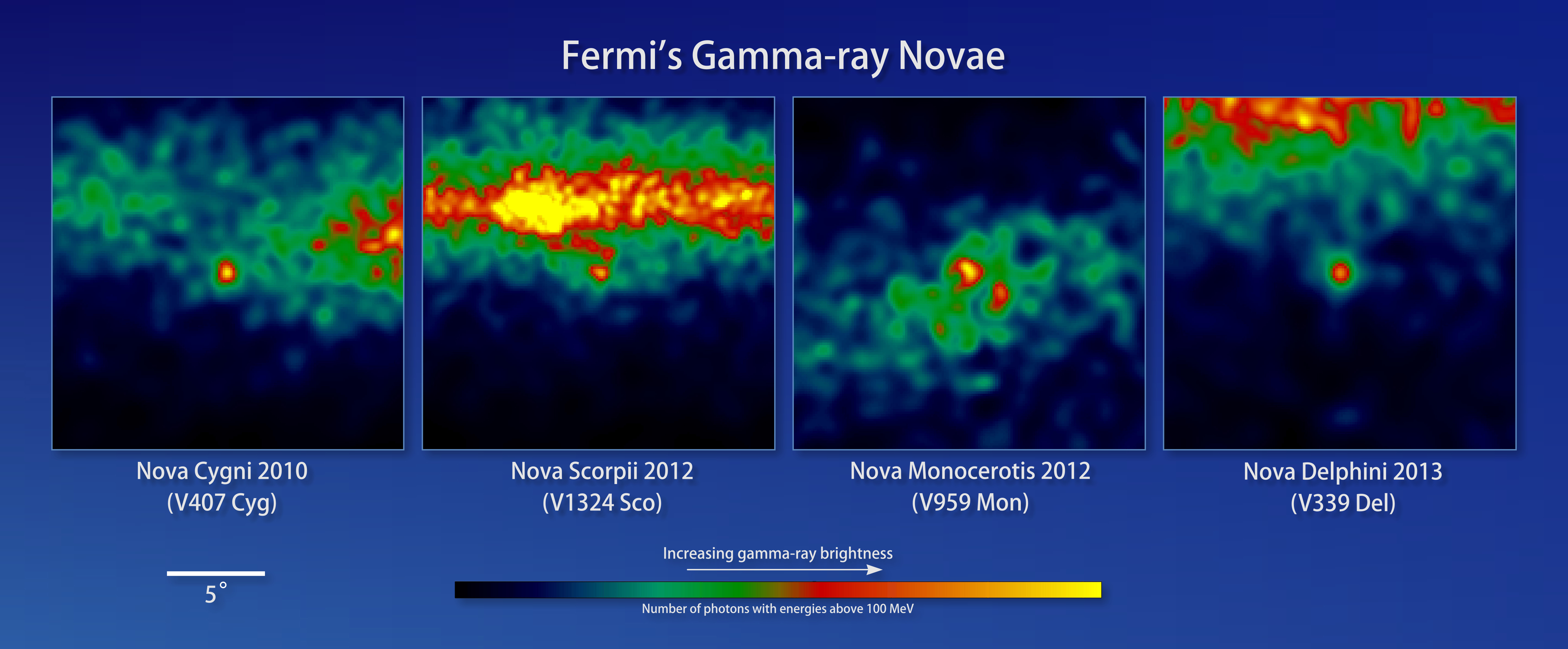
These images show Fermi data centered on each of the four gamma-ray novae observed by the LAT. Colors indicate the number of detected gamma rays with energies greater than 100 million electron volts (blue indicates lowest, yellow highest). Image Credit:  NASA/DOE/Fermi LAT Collaboration

These images show Fermi data centered on each of the four gamma-ray novae. Colors indicate the number of detected gamma rays with energies greater than 100 million electron volts (blue indicates lowest, yellow highest). Image Credit: NASA / DOE / Fermi LAT Collaboration
In a classical nova, a white dwarf siphons material off a companion star, building up a layer on its surface until the temperature and pressure are so high (a process which can take tens of thousands of years) that its hydrogen beings to undergo nuclear fusion, triggering a runaway reaction that detonates the accumulated gas.

The bright outburst, which releases up to 100,000 times the annual energy output of our Sun, can blaze for months. All the while, the white dwarf remains intact, with the potential of going nova again.

It’s a relatively straightforward picture — as far as complex astrophysics goes. But new observations with NASA’s Fermi Gamma-ray Space Telescope unexpectedly show that three classical novae — V959 Monocerotis 2012, V1324 Scorpii 2012, and V339 Delphini 2013 — and one rare nova, also produce gamma rays, the most energetic form of light.

“There’s a saying that one is a fluke, two is a coincidence, and three is a class, and we’re now at four novae and counting with Fermi,” said lead author Teddy Cheung from the Naval Research Laboratory in a press release.

The first nova detected in gamma rays was V407 Cygni — a rare star system in which a white dwarf interacts with a red giant — reported in March 2010.

One explanation for the gamma-ray emission is that the blast from the nova hits the hefty wind from the red giant, creating a shock wave that accelerates any charged particles to near the speed of light. These rapid particles, in turn, produce gamma rays.

But the gamma-ray peak follows the optical peak by a couple of days. This likely happens because the material the white dwarf ejects initially blocks the high-energy photons from escaping. So the gamma rays cannot escape until the material expands and thins.

But the later three novae are from systems that don’t have red giants and therefore the winds. There’s nothing for the blast wave to crash into.

“We initially thought of V407 Cygni as a special case because the red giant’s atmosphere is essentially leaking into space, producing a gaseous environment that interacts with the explosion’s blast wave,” said coauthor Steven Shore from the University of Pisa. “But this can’t explain more recent Fermi detections because none of those systems possess red giants.”

In a more typical system it’s likely that the blast creates multiple shock waves that expand into space at slightly different speeds. Faster shocks could blast into slower ones, creating the interaction necessary to produce gamma rays. Although, the team remains unsure if this is the case.

Astronomers estimate that between 20 and 50 novae occur each year in the Milky Way galaxy. Most go undetected, their visible light obscured by intervening dust, and their gamma rays dimmed by distance. Hopefully, future observations of nearby novae will shed light on the mysterious process producing gamma rays.

The results will appear in Science on August 1.

Tagged as:
Classical Novae,
Fermi Space Telescope,
Gamma rays