Sunday, August 3, 2014

Hubble Spots Farthest Lensing Galaxy Yet

Hubble Spots Farthest Lensing Galaxy Yet:


Credit: NASA, ESA, K.-V. Tran (Texas A&M University), and K. Wong (Academia Sinica Institute of Astronomy & Astrophysics)

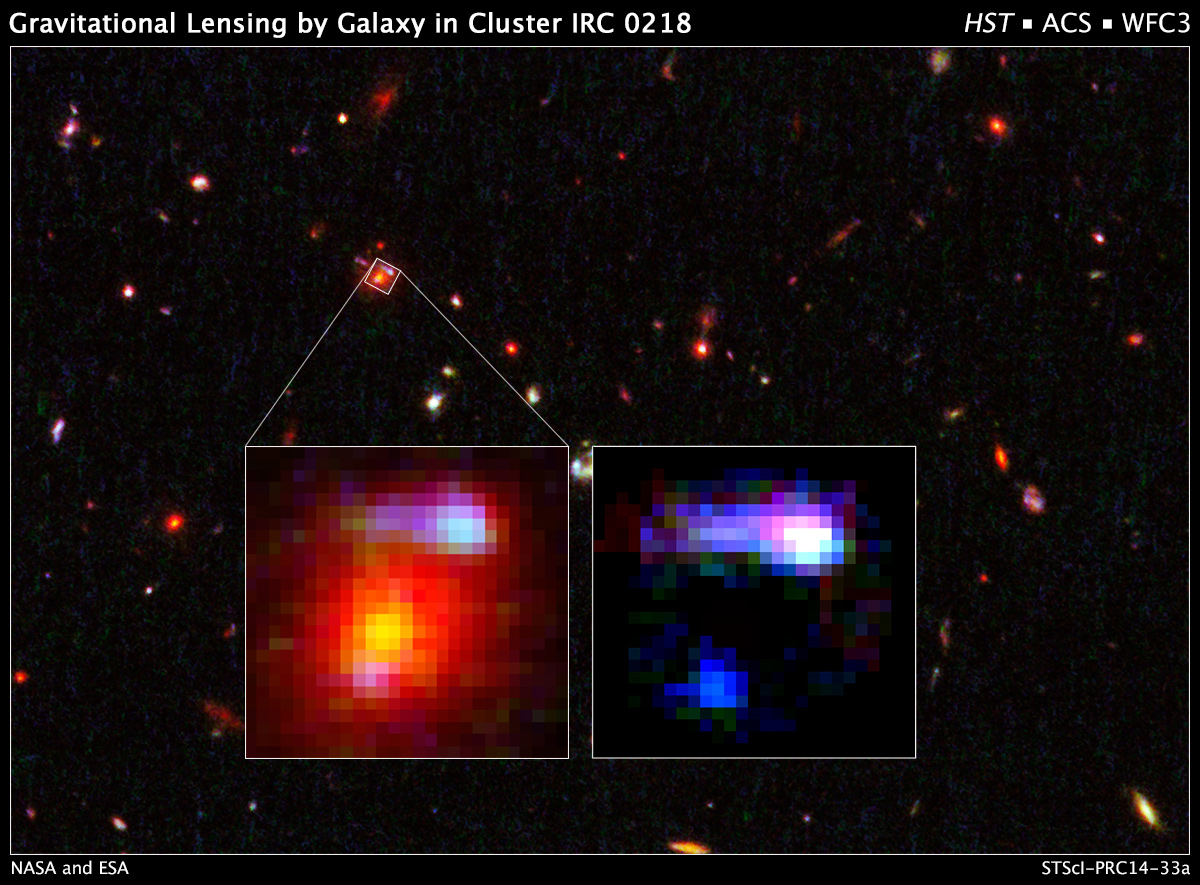
These Hubble Space Telescope images reveal the most distant cosmic lens yet found, a massive elliptical galaxy whose powerful gravity is magnifying the light from a faraway galaxy behind it. In the enlarged view, the lighter-colored blobs at the upper right and lower left are the distorted and magnified shapes of a more distant spiral galaxy behind the foreground elliptical. Image Credit: NASA, ESA, K.-V. Tran (Texas A&M University), and K. Wong (Academia Sinica Institute of Astronomy & Astrophysics)
Sometimes there’s a chance alignment — faraway in the universe, where objects are separated by unimaginable distances measured in billions of light-years — when a galaxy cluster in the foreground intersects light from an even more distant object. The conjunction plays visual tricks, where the galaxy cluster acts like a lens, appearing to magnify and bend the distant light.

The rare cosmic alignment can bring the distant universe into view. Now, astronomers have stumbled upon a surprise: they’ve detected the most distant cosmic magnifying glass yet.

Seen above as it looked 9.6 billion years ago, this monster elliptical galaxy breaks the previous record holder by 200 million light-years. It’s bending, distorting and magnifying the distant spiral galaxy, whose light has taken 10.7 billion years to reach Earth.

“When you look more than 9 billion years ago in the early universe, you don’t expect to find this type of galaxy-galaxy lensing at all,” said lead researcher Kim-Vy Tran from Texas A&M University in a Hubble press release.

“Imagine holding a magnifying glass close to you and then moving it much farther away. When you look through a magnifying glass held at arm’s length, the chances that you will see an enlarged object are high. But if you move the magnifying glass across the room, your chances of seeing the magnifying glass nearly perfectly aligned with another object beyond it diminishes.”

The team was studying star formation in data collected by the W. M. Keck Observatory in Hawai’i, when they came across a strong detection of hot hydrogen gas that appeared to arise form a massive, bright elliptical galaxy. It struck the team as odd. Hot hydrogen is a clear sign of star birth, but it was detected in a galaxy that looked far too old to be forming new stars.

“I was very surprised and worried,” Tran recalled. “I thought we had made a major mistake with our observations.”

So Tran dug through archived Hubble images, which revealed a smeared, blue object next to the larger elliptical. It was the clear signature of a gravitational lens.

“We discovered that light from the lensing galaxy and from the background galaxy were blended in the ground-based data, which was confusing us,” said coauthor Ivelina Momcheva of Yale University. “The Keck spectroscopic data hinted that something interesting was going on here, but only with Hubble’s high-resolution spectroscopy were we able to separate the lensing galaxy from the more distant background galaxy and determine that the two were at different distances. The Hubble data also revealed the telltale look of the system, with the foreground lens in the middle, flanked by a bright arc on one side and a faint smudge on the other — both distorted images of the background galaxy. We needed the combination of imaging and spectroscopy to solve the puzzle.”

By gauging the intensity of the background galaxy’s light, the team was able to measure the giant galaxy’s total mass. All in all it weighs 180 billion times more than our Sun. Although this may seem big, it actually weighs four times less than the Milky Way galaxy.

“There are hundreds of lens galaxies that we know about, but almost all of them are relatively nearby, in cosmic terms,” said lead author Kenneth Wong from the Academia Sinica Institute of Astronomy & Astrophysics. “To find a lens as far away as this one is a very special discovery because we can learn about the dark-matter content of galaxies in the distant past. By comparing our analysis of this lens galaxy to the more nearby lenses, we can start to understand how that dark-matter content has evolved over time.”

Interestingly, the lensing galaxy is underweight in terms of its dark-matter content. In the past, astronomers have assumed that dark matter and normal matter build up equally in a galaxy over time. But this galaxy, suggests this is not the case.

The team’s results appeared in the July 10 issue of The Astrophysical Journal Letters and is available online.

Tagged as:
Gravitational Lensing,
Hubble Space Telescope,
Keck Observatory

Rosetta’s Comet Is Too Hot For Complete Ice Surface, Spacecraft En Route Reveals

Rosetta’s Comet Is Too Hot For Complete Ice Surface, Spacecraft En Route Reveals:


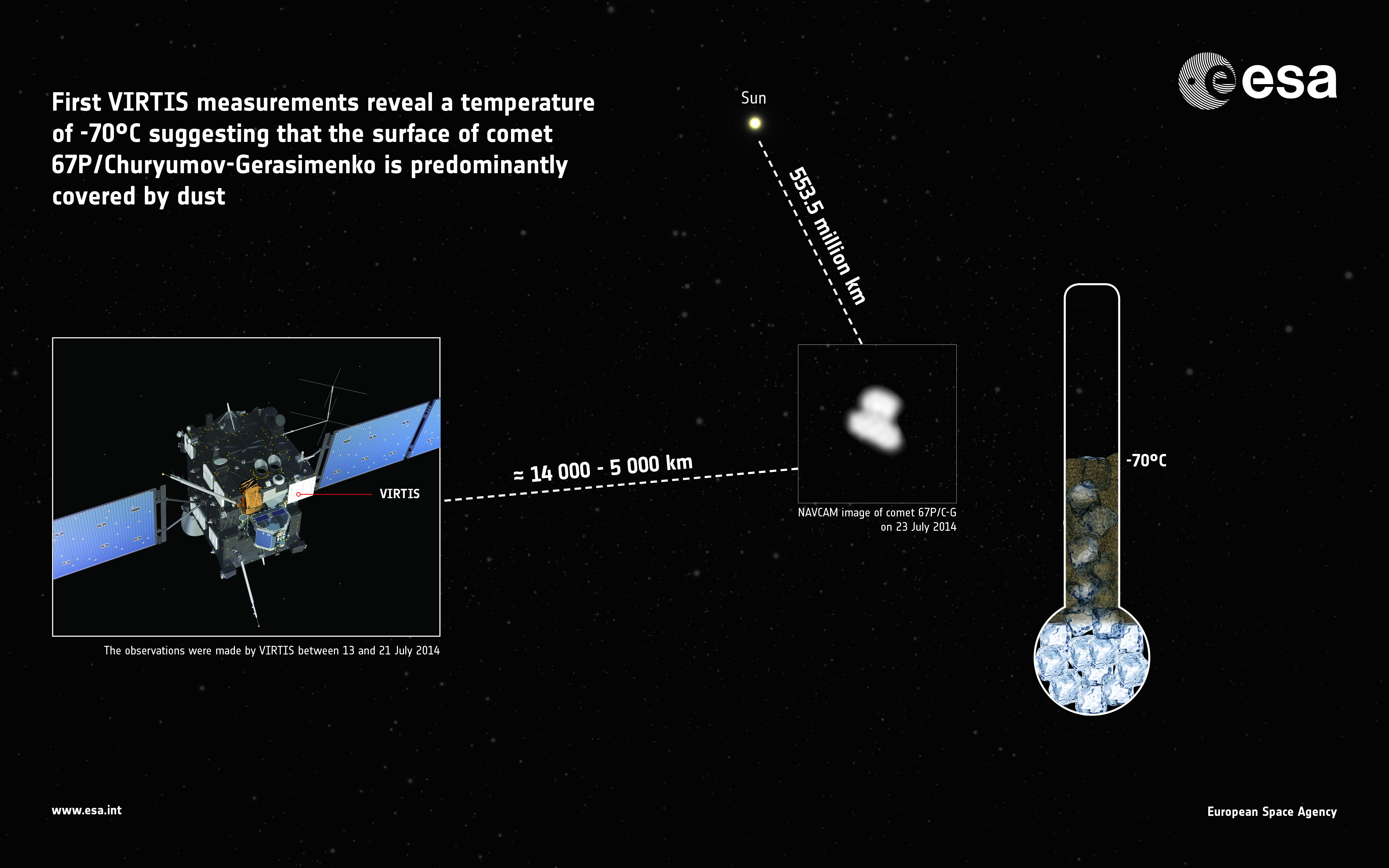
Graphic of the instrument on the Rosetta spacecraft that measured the comet's temperature in mid-July 2014. Credit: European Space Agency

Graphic of the instrument on the Rosetta spacecraft that measured the comet’s temperature in mid-July 2014. Credit: European Space Agency
Anyone eager for a comet countdown? It’s just a few days now until the Rosetta spacecraft arrives near Comet 67P/Churyumov–Gerasimenko on August 6, and with each passing day more detail becomes visible.

The “rubber duckie”-shaped comet has an average surface temperature of –70 degrees Celsius (-94 degrees Fahrenheit), which is far warmer than scientists expect. At 20 to 30 degrees Celsius (68 to 86 degrees Fahrenheit) warmer than predicted, the scientists say that the comet is too hot to be covered in ice. It must instead of a dark crust.

“This result is very interesting, since it gives us the first clues on the composition and physical properties of the comet’s surface,” stated Fabrizio Capaccioni, principal investigator of the visible, infrared and thermal imaging spectrometer (VIRTIS) that took the measurements.

Capaccioni, who is from Italy’s INAF-IAPS, led a team that took measurements of the comet between July 13 and July 21. What they found was also consistent with the findings from other close-up views of comets, such as 1P/Halley. Observations from afar already revealed that Rosetta had low reflectivity, so this is consistent with those far-off looks.

“This doesn’t exclude the presence of patches of relatively clean ice, however, and very soon, VIRTIS will be able to start generating maps showing the temperature of individual features,” stated Capaccioni.

Source: European Space Agency

Tagged as:
Comet 67P/Churyumov–Gerasimenko

Companion Planet Could Keep Alien Earths Warm In Old Age: Study

Companion Planet Could Keep Alien Earths Warm In Old Age: Study:

Want to stay on top of all the space news? Follow @universetoday on Twitter

An artist's concept of a rocky world orbiting a red dwarf star. (Credit: NASA/D. Aguilar/Harvard-Smithsonian center for Astrophysics).

An artist’s concept of a rocky world orbiting a red dwarf star. (Credit: NASA/D. Aguilar/Harvard-Smithsonian center for Astrophysics).
People are generally social creatures, and in the case of planets that generally is the case as well. Many of these alien worlds we have discovered are in groups of two or more around their parent star or stars. A new study, however, goes a step further and says that a companion planet could actually save another planet in its old age.

“Planets cool as they age. Over time their molten cores solidify and inner heat-generating activity dwindles, becoming less able to keep the world habitable by regulating carbon dioxide to prevent runaway heating or cooling,” the University of Washington stated.

“But astronomers … have found that for certain planets about the size of our own, the gravitational pull of an outer companion planet could generate enough heat — through a process called tidal heating — to effectively prevent that internal cooling, and extend the inner world’s chance at hosting life.”

The researchers ran computer models finding that tidal heating, which is known to happen on Jupiter’s moons Europa and Io, can also happen in planets the size of Earth that are in non-circular orbits around dwarf stars. An outer planet would keep the orbit from stabilizing in a circle, generating tidal heating and keeping conditions potentially warm enough for life.

The study, led by the University of Arizona’s Christa Van Laerhoven, will be available in the Monthly Notices of the Royal Astronomical Society and is available now in preprint version on Arxiv.

Tagged as:
companion planet

Top Five Breakthroughs From Hubble's Workhorse Camera

Top Five Breakthroughs From Hubble's Workhorse Camera:

Hubble Deep Field
Several hundred never before seen galaxies are visible in this "deepest-ever" view of the universe, called the Hubble Deep Field (HDF), made with the Wide Field and Planetary Camera 2 aboard NASA's Hubble Space Telescope. Image credit: NASA/STScI
›  Full image and caption


May 04, 2009

Deepest photograph of the universe. Hubble's famous "Deep Field" picture (above), taken by the Wide Field and Planetary Camera 2, left the world with its mouth agape when it was first revealed in 1996. In just a small patch of sky, more than 1,000 galaxies located billions of light-years away could be seen floating in space like sea creatures at the bottom of an endless ocean. Our world and our galaxy suddenly seemed very small.


Observations of comet collision with Jupiter. The Wide Field and Planetary Camera 2 gave the world a rare, stunning view of Comet Shoemaker-Levy 9 plunging into the gas giant Jupiter in 1994. The images revealed the event in great detail, including ripples expanding outward from the impact.


The birth and death of stars. The Wide Field and Planetary Camera 2 brought the cosmos down to Earth with its exquisite pictures of stars in all stages of development. Its famed picture of the "Pillars of Creation" and other images of colorful dying stars offered the first, glorious views of a star's life. The camera also took the first pictures of the dusty disks around stars where planets are born, demonstrating that planet-forming environments are common in the universe.


The age and rate of expansion of our universe. Our universe formed from a colossal explosion known as the Big Bang, and has been stretching apart ever since. Hubble's Wide Field and Planetary Camera 2, by observing stars that vary periodically in brightness, was able to calculate the pace of this expansion to an unprecedented degree of error of 10 percent. The camera also played a leading role in discovering that the expansion of the universe is accelerating, driven by a mysterious force called "dark energy." Together, these findings led to the calculation that our universe is approximately 13.7 billion years old.


Most galaxies harbor huge black holes. Before Hubble, astronomers suspected, but had no proof, that supermassive black holes lurk deep in the bellies of galaxies. The Wide Field and Planetary Camera 2, together with spectroscopy data from Hubble, showed that most galaxies in the universe do indeed harbor monstrous black holes up to billions of times the mass of our sun.

Media contact: DC Agle/JPL
(818) 393-9011

NASA, Japan Release Most Complete Topographic Map of Earth

NASA, Japan Release Most Complete Topographic Map of Earth:

World map
NASA and Japan's Ministry of Economy, Trade and industry (METI) released the Advanced Spaceborne Thermal Emission and Reflection Radiometer (ASTER) Global Digital Elevation Model (GDEM) to the worldwide public on June 29, 2009.

› Full image and caption/related images


June 29, 2009

PASADENA, Calif. – NASA and Japan released a new digital topographic map of Earth Monday that covers more of our planet than ever before. The map was produced with detailed measurements from NASA's Terra spacecraft.


The new global digital elevation model of Earth was created from nearly 1.3 million individual stereo-pair images collected by the Japanese Advanced Spaceborne Thermal Emission and Reflection Radiometer, or Aster, instrument aboard Terra. NASA and Japan's Ministry of Economy, Trade and Industry, known as METI, developed the data set. It is available online to users everywhere at no cost.


"This is the most complete, consistent global digital elevation data yet made available to the world," said Woody Turner, Aster program scientist at NASA Headquarters in Washington. "This unique global set of data will serve users and researchers from a wide array of disciplines that need elevation and terrain information."


According to Mike Abrams, Aster science team leader at NASA's Jet Propulsion Laboratory in Pasadena, Calif., the new topographic information will be of value throughout the Earth sciences and has many practical applications. "Aster's accurate topographic data will be used for engineering, energy exploration, conserving natural resources, environmental management, public works design, firefighting, recreation, geology and city planning, to name just a few areas," Abrams said.


Previously, the most complete topographic set of data publicly available was from NASA's Shuttle Radar Topography Mission. That mission mapped 80 percent of Earth's landmass, between 60 degrees north latitude and 57 degrees south. The new Aster data expand coverage to 99 percent, from 83 degrees north latitude and 83 degrees south. Each elevation measurement point in the new data is 30 meters (98 feet) apart.


"The Aster data fill in many of the voids in the shuttle mission's data, such as in very steep terrains and in some deserts," said Michael Kobrick, Shuttle Radar Topography Mission project scientist at JPL. "NASA is working to combine the Aster data with that of the Shuttle Radar Topography Mission and other sources to produce an even better global topographic map."


NASA and METI are jointly contributing the Aster topographic data to the Group on Earth Observations, an international partnership headquartered at the World Meteorological Organization in Geneva, Switzerland, for use in its Global Earth Observation System of Systems. This "system of systems" is a collaborative, international effort to share and integrate Earth observation data from many different instruments and systems to help monitor and forecast global environmental changes.


NASA, METI and the U.S. Geological Survey validated the data, with support from the U.S. National Geospatial-Intelligence Agency and other collaborators. The data will be distributed by NASA's Land Processes Distributed Active Archive Center at the U.S. Geological Survey's Earth Resources Observation and Science Data Center in Sioux Falls, S.D., and by METI's Earth Remote Sensing Data Analysis Center in Tokyo.


Aster is one of five Earth-observing instruments launched on Terra in December 1999. Aster acquires images from the visible to the thermal infrared wavelength region, with spatial resolutions ranging from about 15 to 90 meters (50 to 300 feet). A joint science team from the U.S. and Japan validates and calibrates the instrument and data products. The U.S. science team is located at JPL.


For visualizations of the new Aster topographic data, visit: http://www.nasa.gov/topics/earth/features/20090629.html .


Data users can download the Aster global digital elevation model at: https://wist.echo.nasa.gov/~wist/api/imswelcome and http://www.gdem.aster.ersdac.or.jp .


For more information about NASA and agency programs, visit: http://www.nasa.gov .


JPL is managed for NASA by the California Institute of Technology in Pasadena.


Media Contacts:


Alan Buis 818-354-0474

Jet Propulsion Laboratory, Pasadena, Calif.

Alan.buis@jpl.nasa.gov


Steve Cole 202-358-0918

NASA Headquarters, Washington

Stephen.e.cole@nasa.gov


2009-103

NASA's Spitzer Images Out-of-This-World Galaxy

NASA's Spitzer Images Out-of-This-World Galaxy:

NASA's Spitzer Space Telescope has imaged a coiled galaxy with an eye-like object at its center.
The "eye" at the center of the galaxy is actually a monstrous black hole surrounded by a ring of stars.

› Full image and caption


July 23, 2009

PASADENA, Calif. -- NASA's Spitzer Space Telescope has imaged a wild creature of the dark -- a coiled galaxy with an eye-like object at its center.


The galaxy, called NGC 1097, is located 50 million light-years away. It is spiral-shaped like our Milky Way, with long, spindly arms of stars. The "eye" at the center of the galaxy is actually a monstrous black hole surrounded by a ring of stars. In this color-coded infrared view from Spitzer, the area around the invisible black hole is blue and the ring of stars, white.


The black hole is huge, about 100 million times the mass of our sun, and is feeding off gas and dust along with the occasional unlucky star. Our Milky Way's central black hole is tame by comparison, with a mass of a few million suns.


"The fate of this black hole and others like it is an active area of research," said George Helou, deputy director of NASA's Spitzer Science Center at the California Institute of Technology in Pasadena. "Some theories hold that the black hole might quiet down and eventually enter a more dormant state like our Milky Way black hole."


The ring around the black hole is bursting with new star formation. An inflow of material toward the central bar of the galaxy is causing the ring to light up with new stars.


"The ring itself is a fascinating object worthy of study because it is forming stars at a very high rate," said Kartik Sheth, an astronomer at NASA's Spitzer Science Center. Sheth and Helou are part of a team that made the observations.


In the Spitzer image, infrared light with shorter wavelengths is blue, while longer-wavelength light is red. The galaxy's red spiral arms and the swirling spokes seen between the arms show dust heated by newborn stars. Older populations of stars scattered through the galaxy are blue. The fuzzy blue dot to the left, which appears to fit snuggly between the arms, is a companion galaxy.


"The companion galaxy that looks as if it's playing peek-a-boo through the larger galaxy could have plunged through, poking a hole," said Helou. "But we don't know this for sure. It could also just happen to be aligned with a gap in the arms."


Other dots in the picture are either nearby stars in our galaxy, or distant galaxies.


This image was taken during Spitzer's "cold mission," which lasted more than five-and-a-half years. The telescope ran out of coolant needed to chill its infrared instruments on May 15, 2009. Two of its infrared channels will still work perfectly during the new "warm mission," which is expected to begin in a week or so, once the observatory has been recalibrated and warms to its new temperature of around 30 Kelvin (about minus 406 degrees Fahrenheit).


NASA's Jet Propulsion Laboratory, Pasadena, Calif., manages the Spitzer Space Telescope mission for NASA's Science Mission Directorate, Washington. Science operations are conducted at the Spitzer Science Center at the California Institute of Technology, also in Pasadena. Caltech manages JPL for NASA. Spitzer's infrared array camera, which made the observations, was built by NASA's Goddard Space Flight Center, Greenbelt, Md. The instrument's principal investigator is Giovanni Fazio of the Harvard-Smithsonian Center for Astrophysics.


For more information about Spitzer, visit http://www.spitzer.caltech.edu/spitzer and http://www.nasa.gov/spitzer .

Whitney Clavin 818-354-4673

Jet Propulsion Laboratory, Pasadena, Calif.

whitney.clavin@jpl.nasa.gov
2009-114

NASA's Moon Mapper Beholds Home

NASA's Moon Mapper Beholds Home:

false-color image of Earth, seen from moon
This false-color image of Earth was taken from 200 kilometers (124 miles) above the lunar surface was taken by the Moon Mineralogy Mapper, one of two NASA instruments onboard the Indian Space Research Organization's Chandrayaan-1 spacecraft.
Full image and caption


August 03, 2009

This image of Earth taken from 200 kilometers (124 miles) above the lunar surface was taken by the Moon Mineralogy Mapper, one of two NASA instruments onboard the Indian Space Research Organization's Chandrayaan-1 spacecraft. Australia is visible in the lower center of the image. The image is presented as a false-color composite with oceans a dark blue, clouds white, and vegetation an enhanced green. The image data were acquired on July 22, 2009.


The Moon Mineralogy Mapper instrument is a state-of-the-art imaging spectrometer designed to provide the first map of the entire lunar surface at high spatial and spectral resolution. Scientists will use this information to answer questions about the moon's origin and development and the evolution of terrestrial planets in the early solar system. Future astronauts will use it to locate resources, possibly including water, that can support exploration of the moon and beyond.


The Moon Mineralogy Mapper was selected as a Mission of Opportunity through the NASA Discovery Program. Carle Pieters of Brown University, Providence, R.I., is the principal investigator and has oversight of the instrument as a whole, as well as the Moon Mineralogy Mapper Science Team. NASA's Jet Propulsion Laboratory, Pasadena, Calif., designed and built the Moon Mineralogy Mapper and is home to its project manager, Mary White. JPL manages the program for NASA's Science Mission Directorate, Washington. The Chandrayaan-1 spacecraft was constructed, launched, and is operated by the Indian Space Research Organisation.


More information about Chandrayaan-1 is at :


http://www.isro.org/Chandrayaan .


More information about NASA's Moon Mineralogy Mapper is at :


http://m3.jpl.nasa.gov .

Media contact: DC Agle/JPL
818-393-9011

Glint of Sunlight Confirms Liquid in Northern Lake District of Titan

Glint of Sunlight Confirms Liquid in Northern Lake District of Titan:

This image shows the first flash of sunlight reflected off a lake on Saturn's moon Titan.
This image shows the first flash of sunlight reflected off a lake on Saturn's moon Titan. › Full image and caption


December 17, 2009

PASADENA, Calif. -- NASA's Cassini Spacecraft has captured the first flash of sunlight reflected off a lake on Saturn's moon Titan, confirming the presence of liquid on the part of the moon dotted with many large, lake-shaped basins.

Cassini scientists had been looking for the glint, also known as a specular reflection, since the spacecraft began orbiting Saturn in 2004. But Titan's northern hemisphere, which has more lakes than the southern hemisphere, has been veiled in winter darkness. The sun only began to directly illuminate the northern lakes recently as it approached the equinox of August 2009, the start of spring in the northern hemisphere. Titan's hazy atmosphere also blocked out reflections of sunlight in most wavelengths. This serendipitous image was captured on July 8, 2009, using Cassini's visual and infrared mapping spectrometer.

The new infrared image is available online at: http://www.nasa.gov/cassini, http://saturn.jpl.nasa.gov and http://wwwvims.lpl.arizona.edu.

This image will be presented Friday, Dec. 18, at the fall meeting of the American Geophysical Union in San Francisco.

"This one image communicates so much about Titan -- thick atmosphere, surface lakes and an otherworldliness," said Bob Pappalardo, Cassini project scientist, based at NASA's Jet Propulsion Laboratory, Pasadena, Calif. "It's an unsettling combination of strangeness yet similarity to Earth. This picture is one of Cassini's iconic images."

Titan, Saturn's largest moon, has captivated scientists because of its many similarities to Earth. Scientists have theorized for 20 years that Titan's cold surface hosts seas or lakes of liquid hydrocarbons, making it the only other planetary body besides Earth believed to harbor liquid on its surface. While data from Cassini have not indicated any vast seas, they have revealed large lakes near Titan's north and south poles.

In 2008, Cassini scientists using infrared data confirmed the presence of liquid in Ontario Lacus, the largest lake in Titan's southern hemisphere. But they were still looking for the smoking gun to confirm liquid in the northern hemisphere, where lakes are also larger.

Katrin Stephan, of the German Aerospace Center (DLR) in Berlin, an associate member of the Cassini visual and infrared mapping spectrometer team, was processing the initial image and was the first to see the glint on July 10th.

"I was instantly excited because the glint reminded me of an image of our own planet taken from orbit around Earth, showing a reflection of sunlight on an ocean," Stephan said. "But we also had to do more work to make sure the glint we were seeing wasn't lightning or an erupting volcano."

Team members at the University of Arizona, Tucson, processed the image further, and scientists were able to compare the new image to radar and near-infrared-light images acquired from 2006 to 2008.


They were able to correlate the reflection to the southern shoreline of a lake called Kraken Mare. The sprawling Kraken Mare covers about 400,000 square kilometers (150,000 square miles), an area larger than the Caspian Sea, the largest lake on Earth. It is located around 71 degrees north latitude and 337 degrees west latitude.

The finding shows that the shoreline of Kraken Mare has been stable over the last three years and that Titan has an ongoing hydrological cycle that brings liquids to the surface, said Ralf Jaumann, a visual and infrared mapping spectrometer team member who leads the scientists at the DLR who work on Cassini. Of course, in this case, the liquid in the hydrological cycle is methane rather than water, as it is on Earth.

"These results remind us how unique Titan is in the solar system," Jaumann said. "But they also show us that liquid has a universal power to shape geological surfaces in the same way, no matter what the liquid is."

The Cassini-Huygens mission is a cooperative project of NASA, the European Space Agency and the Italian Space Agency. JPL manages the mission for NASA's Science Mission Directorate, Washington, D.C. The Cassini orbiter was designed, developed and assembled at JPL. The visual and infrared mapping spectrometer team is based at the University of Arizona, Tucson.

Jia-Rui C. Cook 818-354-0850

Jet Propulsion Laboratory, Pasadena, Calif.

jia-rui.c.cook@jpl.nasa.gov

2009-199

Keck Telescopes Gaze into Young Star's 'Life Zone.'

Keck Telescopes Gaze into Young Star's 'Life Zone.':

Planets form around a young star in this artist's concept. Using the Keck Interferometer in Hawaii, astronomers have probed the structure of a dust disk around MWC 419 to within 50 million miles of the star. Credit: David A. Hardy/www.astroart.org
Planets form around a young star in this artist's concept. Using the Keck Interferometer in Hawaii, astronomers have probed the structure of a dust disk around MWC 419 to within 50 million miles of the star. Credit: David A. Hardy/http://www.astroart.org

› Larger image


December 23, 2009

The inner regions of young planet-forming disks offer information about how worlds like Earth form, but not a single telescope in the world can see them. Now, for the first time, astronomers using the W. M. Keck Observatory in Hawaii have measured the properties of a young solar system at distances closer to the star than Venus is from our sun.


To achieve the feat, the team used the Keck Interferometer to combine infrared light gathered by both of the observatory's twin 10-meter (33-foot) telescopes, which are separated by 85 meters (93 yards). The double-barreled approach gives astronomers the effective resolution of a single 85-meter telescope -- several times larger than any now planned.


"Nothing else in the world provides us with the types of measurements the Keck Interferometer does," said Wesley Traub of NASA's Jet Propulsion Laboratory in Pasadena, Calif. "In effect, it's a zoom lens for the Keck telescopes."


The Keck Interferometer was developed by JPL and the W.M. Keck Observatory. It is managed by the W.M. Keck Observatory, which operates two 10-meter optical/infrared telescopes on the summit of Mauna Kea on the island of Hawaii and is a scientific partnership of the California Institute of Technology in Pasadena, the University of California and NASA. NASA's Exoplanet Science Institute, also in Pasadena, manages time allocation on the telescope for NASA.


For more information, please visit: http://www.nasa.gov/topics/universe/features/keck-life-zone.html

The First of Many Asteroid Finds for WISE

The First of Many Asteroid Finds for WISE:

near-Earth asteroid discovered by NASA's Wide-Field Infrared Survey Explorer
The red dot at the center of this image is the first near-Earth asteroid discovered by NASA's Wide-Field Infrared Survey Explorer, or WISE Image credit: NASA/JPL-Caltech/UCLA

› Full image and caption


January 25, 2010

PASADENA, Calif. -- NASA's Wide-field Infrared Survey Explorer, or WISE, has spotted its first never-before-seen near-Earth asteroid, the first of hundreds it is expected to find during its mission to map the whole sky in infrared light. There is no danger of the newly discovered asteroid hitting Earth.


The near-Earth object, designated 2010 AB78, was discovered by WISE Jan. 12. The mission's sophisticated software picked out the moving object against a background of stationary stars. As WISE circled Earth, scanning the sky above, it observed the asteroid several times during a period of one-and-a-half days before the object moved beyond its view. Researchers then used the University of Hawaii's 2.2-meter (88-inch) visible-light telescope near the summit of Mauna Kea to follow up and confirm the discovery.


The asteroid is currently about 158 million kilometers (98 million miles) from Earth. It is estimated to be roughly 1 kilometer (0.6 miles) in diameter and circles the sun in an elliptical orbit tilted to the plane of our solar system. The object comes as close to the sun as Earth, but because of its tilted orbit, it will not pass very close to Earth for many centuries. This asteroid does not pose any foreseeable impact threat to Earth, but scientists will continue to monitor it.


Near-Earth objects are asteroids and comets with orbits that pass relatively close to Earth's path around the sun. In extremely rare cases of an impact, the objects may cause damage to Earth's surface. An asteroid about 10 kilometers (6 miles) wide is thought to have plunged into our planet 65 million years ago, triggering a global disaster and killing off the dinosaurs.


Additional asteroid and comet detections will continue to come from WISE. The observations will be automatically sent to the clearinghouse for solar system bodies, the Minor Planet Center in Cambridge, Mass., for comparison against the known catalog of solar system objects. A community of professional and amateur astronomers will provide follow-up observations, establishing firm orbits for the previously unseen objects.


"This is just the beginning," said Ned Wright, the mission's principal investigator from UCLA. "We've got a fire hose of data pouring down from space."


On Jan. 14, the WISE mission began its official survey of the entire sky in infrared light, one month after it rocketed into a polar orbit around Earth from Vandenberg Air Force Base in California. By casting a wide net, the mission will catch all sorts of cosmic objects, from asteroids in our own solar system to galaxies billions of light-years away. Its data will serve as a cosmic treasure map, pointing astronomers and telescopes, such as NASA's Spitzer Space Telescope and the upcoming James Webb Space Telescope, to the most interesting finds.


WISE is expected to find about 100,000 previously unknown asteroids in our main asteroid belt, a rocky ring of debris between the orbits of Mars and Jupiter. It will also spot hundreds of previously unseen near-Earth objects.


By observing infrared light, WISE will reveal the darkest members of the near-Earth object population -- those that don't reflect much visible light. The mission will contribute important information about asteroid and comet sizes. Visible-light estimates of an asteroid's size can be deceiving, because a small, light-colored space rock can look the same as a big, dark one. In infrared, however, a big dark rock will give off more of a thermal, or infrared glow, and reveal its true size. This size information will give researchers a better estimate of how often Earth can expect potentially devastating impacts.


"We are thrilled to have found our first new near-Earth object," said Amy Mainzer of NASA's Jet Propulsion Laboratory in Pasadena, Calif. Mainzer is the principal investigator of NEOWISE, a program to mine the collected WISE data for new solar system objects. "Many programs are searching for near-Earth objects using visible light, but some asteroids are dark, like pavement, and don't reflect a lot of sunlight. But like a parking lot, the dark objects heat up and emit infrared light that WISE can see."


"It is great to receive the first of many anticipated near-Earth object discoveries by the WISE system," said Don Yeomans, manager of NASA's Near-Earth Object Program Office at JPL. "Analysis of the WISE data will go a long way toward understanding the true nature of this population."


JPL manages the WISE mission for NASA's Science Mission Directorate, Washington. The principal investigator, Edward Wright, is at UCLA. The mission was competitively selected under NASA's Explorers Program managed by the Goddard Space Flight Center, Greenbelt, Md. The science instrument was built by the Space Dynamics Laboratory, Logan, Utah, and the spacecraft was built by Ball Aerospace & Technologies Corp., Boulder, Colo. Science operations and data processing take place at the Infrared Processing and Analysis Center at the California Institute of Technology in Pasadena. Caltech manages JPL for NASA. The ground-based observations are partly supported by the National Science Foundation.


More information is online at http://www.nasa.gov/wise, http://wise.astro.ucla.edu and http://www.jpl.nasa.gov/wise .

Whitney Clavin 818-354-4673

Jet Propulsion Laboratory, Pasadena, Calif.

whitney.clavin@jpl.nasa.gov


2010-028

NASA's WISE Mission Releases Medley of First Images

NASA's WISE Mission Releases Medley of First Images:

The Andromeda galaxy
The immense Andromeda galaxy, also known as Messier 31 or simply M31, is captured in full in this new image from NASA's Wide-field Infrared Survey Explorer, or WISE. Image credit: NASA/JPL-Caltech/UCLA


› Full image and caption


› More WISE first images


February 17, 2010

PASADENA, Calif. -- A diverse cast of cosmic characters is showcased in the first survey images NASA released Wednesday from its Wide-field Infrared Survey Explorer, or WISE.


Since WISE began its scan of the entire sky in infrared light on Jan. 14, the space telescope has beamed back more than a quarter of a million raw, infrared images. Four new, processed pictures illustrate a sampling of the mission's targets -- a wispy comet, a bursting star-forming cloud, the grand Andromeda galaxy and a faraway cluster of hundreds of galaxies. The images are online at http://www.jpl.nasa.gov/news/features.cfm?feature=2485.


"WISE has worked superbly," said Ed Weiler, associate administrator of the Science Mission Directorate at NASA Headquarters in Washington. "These first images are proving the spacecraft's secondary mission of helping to track asteroids, comets and other stellar objects will be just as critically important as its primary mission of surveying the entire sky in infrared."


One image shows the beauty of a comet called Siding Spring. As the comet parades toward the sun, it sheds dust that glows in infrared light visible to WISE. The comet's tail, which stretches about 10 million miles, looks like a streak of red paint. A bright star appears below it in blue.


"We've got a candy store of images coming down from space," said Edward (Ned) Wright of UCLA, the principal investigator for WISE. "Everyone has their favorite flavors, and we've got them all."


During its survey, the mission is expected to find perhaps dozens of comets, including some that ride along in orbits that take them somewhat close to Earth's path around the sun. WISE will help unravel clues locked inside comets about how our solar system came to be.


Another image shows a bright and choppy star-forming region called NGC 3603, lying 20,000 light-years away in the Carina spiral arm of our Milky Way galaxy. This star-forming factory is churning out batches of new stars, some of which are monstrously massive and hotter than the sun. The hot stars warm the surrounding dust clouds, causing them to glow at infrared wavelengths.


WISE will see hundreds of similar star-making regions in our galaxy, helping astronomers piece together a picture of how stars are born. The observations also provide an important link to understanding violent episodes of star formation in distant galaxies. Because NGC 3603 is much closer, astronomers use it as a lab to probe the same type of action that is taking place billions of light-years away.


Traveling farther out from our Milky Way, the third new image shows our nearest large neighbor, the Andromeda spiral galaxy. Andromeda is a bit bigger than our Milky Way and about 2.5 million light-years away. The new picture highlights WISE's wide field of view -- it covers an area larger than 100 full moons and even shows other smaller galaxies near Andromeda, all belonging to our "local group" of more than about 50 galaxies. WISE will capture the entire local group.


The fourth WISE picture is even farther out, in a region of hundreds of galaxies all bound together into one family. Called the Fornax cluster, these galaxies are 60 million light-years from Earth. The mission's infrared views reveal both stagnant and active galaxies, providing a census of data on an entire galactic community.


"All these pictures tell a story about our dusty origins and destiny," said Peter Eisenhardt, the WISE project scientist at NASA's Jet Propulsion Laboratory in Pasadena, Calif. "WISE sees dusty comets and rocky asteroids tracing the formation and evolution of our solar system. We can map thousands of forming and dying solar systems across our entire galaxy. We can see patterns of star formation across other galaxies, and waves of star-bursting galaxies in clusters millions of light years away."


Other mission targets include comets, asteroids and cool stars called brown dwarfs. WISE discovered its first near-Earth asteroid on Jan. 12, and first comet on Jan. 22. The mission will scan the sky one-and-a-half times by October. At that point, the frozen coolant needed to chill its instruments will be depleted.


JPL manages WISE for NASA's Science Mission Directorate. The mission was competitively selected under NASA's Explorers Program, which NASA's Goddard Space Flight Center in Greenbelt, Md., manages. The Space Dynamics Laboratory in Logan, Utah, built the science instrument, and Ball Aerospace & Technologies Corp. of Boulder, Colo., built the spacecraft. Science operations and data processing take place at the Infrared Processing and Analysis Center at the California Institute of Technology in Pasadena. Caltech manages JPL for NASA. For more information about WISE, visit http://www.nasa.gov/wise and http://wise.astro.ucla.edu and http://www.jpl.nasa.gov/wise.


Whitney Clavin 818-354-4673

Jet Propulsion Laboratory, Pasadena, Calif.

whitney.clavin@jpl.nasa.gov


J.D. Harrington 202-358-5241

NASA Headquarters, Washington

j.d.harrington@nasa.gov


2010-052

Cassini Data Show Ice and Rock Mixture Inside Titan

Cassini Data Show Ice and Rock Mixture Inside Titan:

This artist's illustration shows the likely interior structure of Saturn's moon Titan deduced from gravity field data collected by NASA's Cassini spacecraft.
This artist's illustration shows the likely interior structure of Saturn's moon Titan deduced from gravity field data collected by NASA's Cassini spacecraft. Image credit: NASA/JPL


› Full image and caption


March 11, 2010

PASADENA, Calif. -- By precisely tracking NASA's Cassini spacecraft on its low swoops over Saturn's moon Titan, scientists have determined the distribution of materials in the moon's interior. The subtle gravitational tugs they measured suggest the interior has been too cold and sluggish to split completely into separate layers of ice and rock.


The finding, to be published in the March 12 issue of the journal Science, shows how Titan evolved in a different fashion from inner planets such as Earth, or icy moons such as Jupiter's Ganymede, whose interiors have split into distinctive layers.


"These results are fundamental to understanding the history of moons of the outer solar system," said Cassini Project Scientist Bob Pappalardo, commenting on his colleagues' research. Pappalardo is with NASA's Jet Propulsion Laboratory in Pasadena, Calif. "We can now better understand Titan's place among the range of icy satellites in our solar system."


Scientists have known that Titan, Saturn's largest moon, is about half ice and half rock, but they needed the gravity data to figure out how the materials were distributed. It turns out Titan's interior is a sorbet of ice studded with rocks that probably never heated up beyond a relatively lukewarm temperature. Only in the outermost 500 kilometers (300 miles) is Titan's ice devoid of any rock, while ice and rock are mixed to various extents at greater depth.


"To avoid separating the ice and the rock, you must avoid heating the ice too much," said David J. Stevenson, one of the paper's co-authors and a professor of planetary science at the California Institute of Technology in Pasadena. "This means that Titan was built rather slowly for a moon, in perhaps around a million years or so, back soon after the formation of the solar system."


This incomplete separation of ice and rock makes Titan less like Jupiter's moon Ganymede, where ice and rock have fully separated, and perhaps more like another Jovian moon, Callisto, which is believed to have a mixed ice and rock interior. Though the moons are all about the same size, they clearly have diverse histories.


The Cassini measurements help construct a gravity map, which may help explain why Titan has a stunted topography, since interior ice must be warm enough to flow slowly in response to the weight of heavy geologic structures, such as mountains.


Creating the gravity map required tracking minute changes in Cassini's speed along a line of sight from Earth to the spacecraft as it flew four close flybys of Titan between February 2006 and July 2008. The spacecraft took paths between about 1,300 to 1,900 kilometers (800 to 1,200 miles) above Titan.


"The ripples of Titan's gravity gently push and pull Cassini along its orbit as it passes by the moon and all these changes were accurately recorded by the ground antennas of the Deep Space Network within 5 thousandths of a millimeter per second [0.2 thousandths of an inch per second] even as the spacecraft was over a billion kilometers [more than 600 million miles] away," said Luciano Iess, a Cassini radio science team member at Sapienza University of Rome in Italy, and the paper's lead author. "It was a tricky experiment."


The results don't speak to whether Titan has an ocean beneath the surface, but scientists say this hypothesis is very plausible and they intend to keep investigating. Detecting tides induced by Saturn, a goal of the radio science team, would provide the clearest evidence for such a hidden water layer.


A Cassini interdisciplinary investigator, Jonathan Lunine, said of his colleagues' findings, "Additional flybys may tell us whether the crust is thick or thin today." Lunine is with the University of Rome, Tor Vergata, Italy, and the University of Arizona, Tucson. "With that information we may have a better understanding of how methane, the ephemeral working fluid of Titan's rivers, lakes and clouds, has been resupplied over geologic time. Like the history of water on Earth, this is fundamental to a deep picture of the nature of Titan through time."


The Cassini-Huygens mission is a cooperative project of NASA, the European Space Agency and the Italian Space Agency. JPL, a division of Caltech, manages the project for NASA's Science Mission Directorate in Washington. The Cassini orbiter was designed, developed and assembled at JPL. Cassini's radio science subsystem has been jointly developed by NASA and the Italian Space Agency (ASI).


More Cassini information is available, at http://www.nasa.gov/cassini and http://saturn.jpl.nasa.gov .

Jia-Rui C. Cook 818-354-0850

Jet Propulsion Laboratory, Pasadena, Calif.

jia-rui.c.cook@jpl.nasa.gov


2010-084

See Spot on Jupiter. See Spot Glow.

See Spot on Jupiter. See Spot Glow.:

Jupiter's Great Red Spot
New thermal images from powerful ground-based telescopes show swirls of warmer air and cooler regions never seen before within Jupiter's Great Red Spot. Image credit: NASA/JPL/ESO and NASA/ESA/GSFC


› Full image and caption


March 16, 2010

New thermal images from powerful ground-based telescopes show swirls of warmer air and cooler regions never seen before within Jupiter's Great Red Spot, enabling scientists to make the first detailed interior weather map of the giant storm system.


The observations reveal that the reddest color of the Great Red Spot corresponds to a warm core within the otherwise cold storm system, and images show dark lanes at the edge of the storm where gases are descending into the deeper regions of the planet. These types of data, detailed in a paper appearing in the journal Icarus, give scientists a sense of the circulation patterns within the solar system's best-known storm system.


"This is our first detailed look inside the biggest storm of the solar system," said Glenn Orton, a senior research scientist at NASA's Jet Propulsion Laboratory in Pasadena, Calif., who was one of the authors of the paper. "We once thought the Great Red Spot was a plain old oval without much structure, but these new results show that it is, in fact, extremely complicated."


Sky gazers have been observing the Great Red Spot in one form or another for hundreds of years, with continuous observations of its current shape dating back to the 19th century. The spot, which is a cold region averaging about 110 Kelvin (minus 260 degrees Fahrenheit) is so wide about three Earths could fit inside its boundaries.


The thermal images obtained by giant 8-meter (26-foot) telescopes used for this study -- the European Southern Observatory's Very Large Telescope in Chile, the Gemini Observatory telescope in Chile and the National Astronomical Observatory of Japan's Subaru telescope in Hawaii -- have provided an unprecedented level of resolution and extended the coverage provided by NASA's Galileo spacecraft in the late 1990s. Together with observations of the deep cloud structure by the 3-meter (10-foot) NASA Infrared Telescope Facility in Hawaii, the level of thermal detail observed from these giant observatories is comparable to visible-light images from NASA's Hubble Space Telescope for the first time.


One of the most intriguing findings shows the most intense orange-red central part of the spot is about 3 to 4 Kelvin (5 to 7 degrees Fahrenheit) warmer than the environment around it, said Leigh Fletcher, the lead author of the paper, who completed much of the research as a postdoctoral fellow at JPL and is currently a fellow at the University of Oxford in England. This temperature differential might not seem like a lot, but it is enough to allow the storm circulation, usually counter-clockwise, to shift to a weak clockwise circulation in the very middle of the storm. Not only that, but on other parts of Jupiter, the temperature change is enough to alter wind velocities and affect cloud patterns in the belts and zones.


"This is the first time we can say that there's an intimate link between environmental conditions -- temperature, winds, pressure and composition - and the actual color of the Great Red Spot," Fletcher said. "Although we can speculate, we still don't know for sure which chemicals or processes are causing that deep red color, but we do know now that it is related to changes in the environmental conditions right in the heart of the storm."


Unlocking the secrets of Jupiter's giant storm systems will be one of the targets for infrared spacecraft observations from future missions including NASA's Juno mission.


Jia-Rui C. Cook 818-354-0850

Jet Propulsion Laboratory, Pasadena, Calif.

jia-rui.c.cook@jpl.nasa.gov


2010-086

Colony of Young Stars Shines in New Spitzer Image

Colony of Young Stars Shines in New Spitzer Image:

A colony of hot, young stars is stirring up the cosmic scene in this new picture from NASA's Spitzer Space Telescope
A colony of hot, young stars is stirring up the cosmic scene in this new picture from NASA's Spitzer Space Telescope. Image credit: NASA/JPL-Caltech

› Full image and caption


April 01, 2010

Astronomers have their eyes on a hot group of young stars, watching their every move like the paparazzi. A new infrared image from NASA's Spitzer Space Telescope shows the bustling star-making colony of the Orion nebula, situated in the hunter's sword of the famous constellation. Like Hollywood starlets, the cosmic orbs don't always shine their brightest, but vary over time. Spitzer is watching the stellar show, helping scientists learn more about why the stars change, and to what degree planet formation might play a role.


"This is an exploratory project. Nobody has done this before at a wavelength sensitive to the heat from dust circling around so many stars," said John Stauffer, the principal investigator of the research at NASA's Spitzer Science Center, located at the California Institute of Technology in Pasadena. "We are seeing a lot of variation, which may be a result of clumps or warped structures in the planet-forming disks."


The new image was taken after Spitzer ran out of its coolant in May 2009, beginning its extended "warm" mission. The coolant was needed to chill the instruments, but the two shortest-wavelength infrared channels still work normally at the new, warmer temperature of 30 Kelvin (minus 406 Fahrenheit). In this new phase of the mission, Spitzer is able to spend more time on projects that cover a lot of sky and require longer observation times.


One such project is the "Young Stellar Object Variability" program, in which Spitzer looks repeatedly at the same patch of the Orion nebula, monitoring the same set of about 1,500 variable stars over time. It has already taken about 80 pictures of the region over 40 days. A second set of observations will be made in fall 2010. The region's twinkling stars are about one million years old - this might invoke thoughts of wrinkle cream to a movie star, but in the cosmos, it is quite young. Our middle-aged sun is 4.6 billion years old.


Young stars are fickle, with brightness levels that change more than those of adult, sun-like stars. They also spin around faster. One reason for the ups and downs in brightness is the existence of cold spots on their surfaces. Cold spots are the opposite of "age spots" - the younger the star, the more it has. The cold spots come and go as a star whips around, changing the amount of light that reaches our telescopes.


Stellar brightness can also change due to hot spots, which are caused by gas accreting onto a young star from the material out of which it formed.


"In the 1950s and 60s, astronomers knew that younger stars varied, and they postulated this had something to do with the birthing process," said Stauffer. "Later, with improved technology, we could see a lot more and learned a great deal about the stars' spots."


Spitzer is particularly suited to study yet another reason why the stars are changing. The telescope's infrared sight can see the warm, dusty disks orbiting around them. These disks are where planets may eventually clump together and form. When the disks are young, they can have asymmetries, possibly caused by forming planets or gravitational disturbances from formed planets. As the skewed disks circle around a star, they block varying amounts of starlight.


By gathering more and more data on these varying disks, Stauffer and his team hope to learn more about how planets develop -- not exactly tabloid fodder, but an ongoing drama of one large, stellar family.


NASA's Jet Propulsion Laboratory in Pasadena, Calif., manages the Spitzer Space Telescope mission for NASA's Science Mission Directorate, Washington. Science operations are conducted at the Spitzer Science Center at the California Institute of Technology in Pasadena. Caltech manages JPL for NASA.


For more information about Spitzer, visit http://www.spitzer.caltech.edu/spitzer and http://www.nasa.gov/spitzer .

Whitney Clavin 818-354-4673

Jet Propulsion Laboratory, Pasadena, Calif.

whitney.clavin@jpl.nasa.gov


2010-108

Cassini Doubleheader: Flying By Titan and Dione

Cassini Doubleheader: Flying By Titan and Dione:

Composite of Saturn's moons Titan and Dione
Composite of two images from NASA's Cassini spacecraft of Saturn's moons Titan (left) and Dione (right). Image credits: NASA/JPL/University of Arizona/Space Science Institute


› Full image and caption (Titan) | › Full image and caption (Dione)


April 02, 2010

In a special double flyby early next week, NASA's Cassini spacecraft will visit Saturn's moons Titan and Dione within a period of about a day and a half, with no maneuvers in between. A fortuitous cosmic alignment allows Cassini to attempt this doubleheader, and the interest in swinging by Dione influenced the design of its extended mission.


The Titan flyby, planned for Monday, April 5, will take Cassini to within about 7,500 kilometers (4,700 miles) of the moon's surface. The distance is relatively long as far as encounters go, but it works to the advantage of Cassini's imaging science subsystem. Cassini's cameras will be able to stare at Titan's haze-shrouded surface for a longer time and capture high-resolution pictures of the Belet and Senkyo areas, dark regions around the equator that ripple with sand dunes.


In the early morning of Wednesday, April 7 in UTC time zones, which is around 9 p.m. on Tuesday, April 6 in California, Cassini will make its closest approach to the medium-sized icy moon Dione. Cassini will plunge to within about 500 kilometers (300 miles) of Dione's surface.


This is only Cassini's second close encounter with Dione. The first flyby in October 2005, and findings from the Voyager spacecraft in the 1990s, hinted that the moon could be sending out a wisp of charged particles into the magnetic field around Saturn and potentially exhaling a diffuse plume that contributes material to one of the planet's rings. Like Enceladus, Saturn's more famous moon with a plume, Dione features bright, fresh fractures. But if there were a plume on Dione, it would certainly be subtler and produce less material.


Cassini plans to use its magnetometer and fields and particles instruments to see if it can find evidence of activity at Dione. Thermal mapping by the composite infrared spectrometer will also help in that search. In addition, the visual and infrared mapping spectrometer will examine dark material found on Dione. Scientists would like to understand the source of this dark material.


Cassini has made three previous double flybys and another two are planned in the years ahead. The mission is nearing the end of its first extension, known as the Equinox mission. It will begin its second mission extension, known as the Solstice Mission, in October 2010.


The Cassini-Huygens mission is a cooperative project of NASA, the European Space Agency and the Italian Space Agency. The Jet Propulsion Laboratory, a division of the California Institute of Technology in Pasadena, manages the Cassini-Huygens mission for NASA's Science Mission Directorate in Washington. The Cassini orbiter was designed, developed and assembled at JPL.


More information about the Titan flyby, dubbed "T67," is available at:

http://saturn.jpl.nasa.gov/mission/flybys/titan20100405/ .


More information about the Dione flyby, dubbed "D2," is available at:

http://saturn.jpl.nasa.gov/mission/flybys/dione20100407/

Jia-Rui C. Cook 818-354-0850

Jet Propulsion Laboratory, Pasadena, Calif.

jia-rui.c.cook@jpl.nasa.gov


2010-110

Asteroid to Fly by Within Moon's Orbit Thursday

Asteroid to Fly by Within Moon's Orbit Thursday:

Orbit of asteroid 2010 GA6
Orbit of asteroid 2010 GA6. Image credit: NASA/JPL


April 06, 2010

Updated April 08, 2010


With additional observations coming in, scientists at NASA's Near-Earth Object Office at the Jet Propulsion Laboratory in Pasadena, Calif. have been able to further refine the trajectory estimate for the orbit of asteroid 2010 GA6. This latest trajectory indicates that the closest approach for asteroid 2010 GA6 will be just slightly beyond the moon's orbit, about 434,000 kilometers (270,000 miles) from Earth. The time of closest approach will be 7:06 p.m. Pacific Daylight Time on April 8 (2:06 U.T.C. on April 9).


A newly discovered asteroid, 2010 GA6, will safely fly by Earth this Thursday at 4:06 p.m. Pacific (23:06 U.T.C.). At time of closest approach 2010 GA6 will be about 359,000 kilometers (223,000 miles) away from Earth - about 9/10ths the distance to the moon. The asteroid, approximately 22 meters (71 feet) wide, was discovered by the Catalina Sky Survey, Tucson, Az.


"Fly bys of near-Earth objects within the moon's orbit occur every few weeks," said Don Yeomans of NASA's Near-Earth Object Office at the Jet Propulsion Laboratory in Pasadena, Calif.


NASA detects and tracks asteroids and comets passing close to Earth using both ground and space-based telescopes. The Near-Earth Object Observations Program, commonly called "Spaceguard," discovers these objects, characterizes a subset of them and plots their orbits to determine if any could be potentially hazardous to our planet.


JPL manages the Near-Earth Object Program Office for NASA's Science Mission Directorate in Washington. JPL is a division of the California Institute of Technology in Pasadena. Cornell University, Ithaca, N.Y., operates the Arecibo Observatory under a cooperative agreement with the National Science Foundation in Arlington, Va.


For more information about asteroids and near-Earth objects, visit: http://www.jpl.nasa.gov/asteroidwatch


DC Agle 818-393-9011

Jet Propulsion Laboratory, Pasadena, Calif.

agle@jpl.nasa.gov


2010-115

Hiding Out Behind the Milky Way

Hiding Out Behind the Milky Way:

IC 342 galaxy
A leggy cosmic creature comes out of hiding in this new infrared view from NASA's Wide-field Infrared Survey Explorer, or WISE. Image credit: NASA/JPL-Caltech/UCLA


› Full image and caption


April 07, 2010

A leggy cosmic creature comes out of hiding in this new infrared view from NASA's Wide-field Infrared Survey Explorer, or WISE. The spiral beauty, called IC 342 and sometimes the "hidden galaxy," is shrouded behind our own galaxy, the Milky Way. Stargazers and professional astronomers have a hard time seeing the galaxy through the Milky Way's bright band of stars, dust and gas. WISE's infrared vision cuts through this veil, offering a crisp view.


In a spiral galaxy like IC 342, dust and gas are concentrated in the arms. The denser pockets of gas trigger the formation of new stars, as represented here in green and yellow. The core, shown in red, is also bursting with young stars, which are heating up dust. Stars that appear blue reside within our Milky Way, between us and IC 342.


This galaxy has been of great interest to astronomers because it is relatively close. However, determining its distance from Earth has proven difficult due to the intervening Milky Way. Astronomer Edwin Hubble first thought the galaxy might belong to our own Local Group of galaxies, but current estimates now place it farther away, at about 6.6 to 11 million light-years.


This image was made from observations by all four infrared detectors aboard WISE. Blue and cyan represent infrared light at wavelengths of 3.4 and 4.6 microns, which is primarily light from stars. Green and red represent light at 12 and 22 microns, which is primarily emission from warm dust.


Image credit: NASA/JPL-Caltech/UCLA


Whitney Clavin

(818) 354-4673

Whitney.clavin@jpl.nasa.gov


2010-116

Cassini Double Play: Enceladus and Titan

Cassini Double Play: Enceladus and Titan:

Saturn's moon Enceladus (left) and Titan (right)
On the left, Saturn's moon Enceladus is backlit by the sun, showing the fountain-like sources of the fine spray of material that towers over the south polar region. On the right, is a composite image of Titan. Image credit: NASA/JPL/SSI and NASA/JPL/University of Arizona


› Larger image


May 17, 2010

About a month and a half after its last double flyby, NASA's Cassini spacecraft will be turning another double play this week, visiting the geyser moon Enceladus and the hazy moon Titan. The alignment of the moons means that Cassini can catch glimpses of these two contrasting worlds within less than 48 hours, with no maneuver in between.


Cassini will make its closest approach to Enceladus late at night on May 17 Pacific time, which is in the early hours of May 18 UTC. The spacecraft will pass within about 435 kilometers (270 miles) of the moon's surface.


The main scientific goal at Enceladus will be to watch the sun play peekaboo behind the water-rich plume emanating from the moon's south polar region. Scientists using the ultraviolet imaging spectrograph will be able to use the flickering light to measure whether there is molecular nitrogen in the plume. Ammonia has already been detected in the plume and scientists know heat can decompose ammonia into nitrogen molecules. Determining the amount of molecular nitrogen in the plume will give scientists clues about thermal processing in the moon's interior.


The second of Cassini's two flybys is an encounter with Titan. The closest approach will take place in the late evening May 19 Pacific time, which is in the early hours of May 20 UTC. The spacecraft will fly to within 1,400 kilometers (750 miles) of the surface.


Cassini will primarily be doing radio science during this pass to detect the subtle variations in the gravitational tug on the spacecraft by Titan, which is 25 percent larger in volume than the planet Mercury. Analyzing the data will help scientists learn whether Titan has a liquid ocean under its surface and get a better picture of its internal structure. The composite infrared spectrometer will also get its southernmost pass for thermal data to fill out its temperature map of the smoggy moon.


Cassini has made four previous double flybys and one more is planned in the years ahead.


The Cassini-Huygens mission is a cooperative project of NASA, the European Space Agency and the Italian Space Agency. The Jet Propulsion Laboratory, a division of the California Institute of Technology in Pasadena, manages the Cassini-Huygens mission for NASA's Science Mission Directorate in Washington. The Cassini orbiter was designed, developed and assembled at JPL.


More information on the Enceladus flyby, dubbed "E10," is available at: http://saturn.jpl.nasa.gov/mission/flybys/enceladus20100518/


More information on the Titan flyby, dubbed "T68," is available at: http://saturn.jpl.nasa.gov/mission/flybys/titan20100520/


Jia-Rui C. Cook 818-354-0850

Jet Propulsion Laboratory, Pasadena, Calif.

jia-rui.c.cook@jpl.nasa.gov


2010-164